Talent
Management
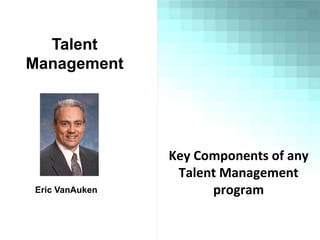
Eric VanAuken
Key Components of any
Talent Management
program
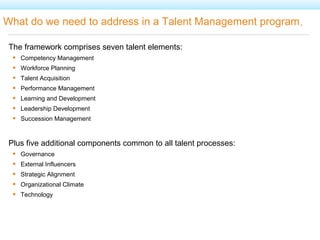
What do we need to address in a Talent Management program,
The framework comprises seven talent elements:
• Competency Management
• Workforce Planning
• Talent Acquisition
• Performance Management
• Learning and Development
• Leadership Development
• Succession Management
Plus five additional components common to all talent processes:
• Governance
• External Influencers
• Strategic Alignment
• Organizational Climate
• Technology
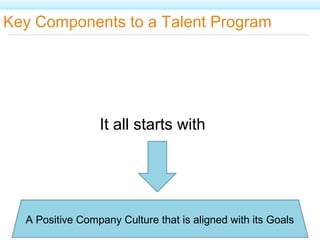
Key Components to a Talent Program
A Positive Company Culture that is aligned with its Goals
It all starts with
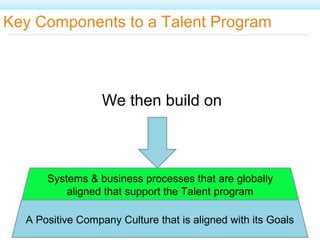
Key Components to a Talent Program
A Positive Company Culture that is aligned with its Goals
Systems & business processes that are globally
aligned that support the Talent program
We then build on
Key Components to a Talent Program
A Positive Company Culture that is aligned with its Goals
Systems & business processes that are globally
aligned that support the Talent program
Recruitment Process that tie in technical & Cultural
components to find & retain the best talent
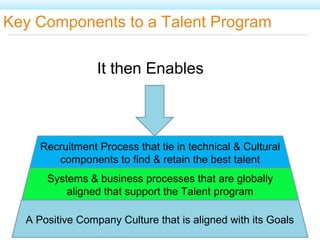
It then Enables
Key Components to a Talent Program
A Positive Company Culture that is aligned with its Goals
Systems & business processes that are globally
aligned that support the Talent program
Recruitment Process that tie in technical & Cultural
components to find & retain the best talent
Credible Job Rotation, Career Path
development & Succession Planning
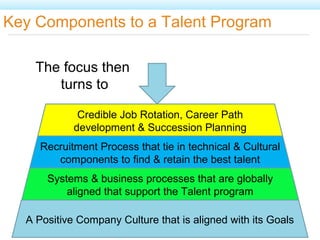
The focus then
turns to
Key Components to a Talent Program
A Positive Company Culture that is aligned with its Goals
Systems & business processes that are globally
aligned that support the Talent program
Recruitment Process that tie in technical & Cultural
components to find & retain the best talent
Credible Job Rotation, Career Path
development & Succession Planning
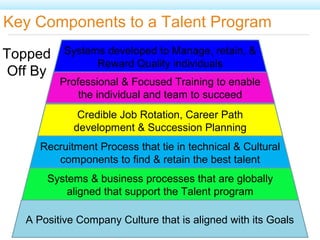
Professional & Focused Training to enable
the individual and team to succeed
Systems developed to Manage, retain, &
Reward Quality individuals
Topped
Off By
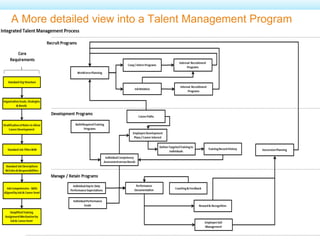
A More detailed view into a Talent Management Program
Overarching activities to focus on
• Identify and build out desired culture. Drive management of change to
enable the new culture.
• Pull together communities of practice
• Identify Best practices
• Identify where you need system support to drive your goals and mission
• Identify where you need business processes to drive your goals and mission
• Focused effort on changing hiring practice to include attitudes and
behaviors to match that of your desired corporate culture.
• Clean up all back office systems to standardize job codes, titles, & roles and
responsibilities
Typical Fundamentals you will need to address
•If there is a cultural problems, address the underlying culture that has hindered your
ability to recruit and retain top talent
•Build a community that can help drive the priority of the initiatives as well as provide
examples of best practice.
• Harmonize all job codes and job descriptions within the departments and across the
business units
• Have system of record to hold the Job code, role/responsibility, skills and training
required for the role.
• Ensure you are using a systematic and comprehensive on boarding approach across
all roles and regions.
• Re-defining and enforcing the culture that you need to demonstrate in order to acquire
and retain top notch Talent.
• Enable an LMS system that can handle the business requirements, provide a central
location to have the role, job description, required training, & skill assessment data
Initial Steps to get the Talent program going
• As shown in previous slides, Identify and build the strategy for a fully
thought out Talent management system.
• Identify what systems are in place to address the strategy and what
components you either need to build or purchase.
• Identify what systems should be enabled by IT and what should be business
processes.
• Work with your Leadership Teams and Business units in a collaborative way
to engage them and prioritize the components in the program where you see
gaps.
• Identify fundamentals that are lacking and start a team working on
addressing them.
• Roll up sleeves and get to work with the teams to build out a world class
Talent management system.

Talent management

  • 1.
    Talent Management Eric VanAuken Key Componentsof any Talent Management program
  • 2.
    What do weneed to address in a Talent Management program, The framework comprises seven talent elements: • Competency Management • Workforce Planning • Talent Acquisition • Performance Management • Learning and Development • Leadership Development • Succession Management Plus five additional components common to all talent processes: • Governance • External Influencers • Strategic Alignment • Organizational Climate • Technology
  • 3.
    Key Components toa Talent Program A Positive Company Culture that is aligned with its Goals It all starts with
  • 4.
    Key Components toa Talent Program A Positive Company Culture that is aligned with its Goals Systems & business processes that are globally aligned that support the Talent program We then build on
  • 5.
    Key Components toa Talent Program A Positive Company Culture that is aligned with its Goals Systems & business processes that are globally aligned that support the Talent program Recruitment Process that tie in technical & Cultural components to find & retain the best talent It then Enables
  • 6.
    Key Components toa Talent Program A Positive Company Culture that is aligned with its Goals Systems & business processes that are globally aligned that support the Talent program Recruitment Process that tie in technical & Cultural components to find & retain the best talent Credible Job Rotation, Career Path development & Succession Planning The focus then turns to
  • 7.
    Key Components toa Talent Program A Positive Company Culture that is aligned with its Goals Systems & business processes that are globally aligned that support the Talent program Recruitment Process that tie in technical & Cultural components to find & retain the best talent Credible Job Rotation, Career Path development & Succession Planning Professional & Focused Training to enable the individual and team to succeed Systems developed to Manage, retain, & Reward Quality individuals Topped Off By
  • 8.
    A More detailedview into a Talent Management Program
  • 9.
    Overarching activities tofocus on • Identify and build out desired culture. Drive management of change to enable the new culture. • Pull together communities of practice • Identify Best practices • Identify where you need system support to drive your goals and mission • Identify where you need business processes to drive your goals and mission • Focused effort on changing hiring practice to include attitudes and behaviors to match that of your desired corporate culture. • Clean up all back office systems to standardize job codes, titles, & roles and responsibilities
  • 10.
    Typical Fundamentals youwill need to address •If there is a cultural problems, address the underlying culture that has hindered your ability to recruit and retain top talent •Build a community that can help drive the priority of the initiatives as well as provide examples of best practice. • Harmonize all job codes and job descriptions within the departments and across the business units • Have system of record to hold the Job code, role/responsibility, skills and training required for the role. • Ensure you are using a systematic and comprehensive on boarding approach across all roles and regions. • Re-defining and enforcing the culture that you need to demonstrate in order to acquire and retain top notch Talent. • Enable an LMS system that can handle the business requirements, provide a central location to have the role, job description, required training, & skill assessment data
  • 11.
    Initial Steps toget the Talent program going • As shown in previous slides, Identify and build the strategy for a fully thought out Talent management system. • Identify what systems are in place to address the strategy and what components you either need to build or purchase. • Identify what systems should be enabled by IT and what should be business processes. • Work with your Leadership Teams and Business units in a collaborative way to engage them and prioritize the components in the program where you see gaps. • Identify fundamentals that are lacking and start a team working on addressing them. • Roll up sleeves and get to work with the teams to build out a world class Talent management system.