Talent Analytics.
Maximizing the
TA Value
“After my wife, Data is my best friend
Current State – Rearview Mirror Metrics
• Discussion
Agenda
Future State - Predictive analytics and causality metrics
• Discussion
Telling Stories with the metrics
• Discussion
Optimal scorecards, reporting and KPI’s
• Discussion
Roadblocks to success - Data Integrity and how to fix it
• Discussion
Benchmarking with real data – Brightfield Tool
• Discussion
“Without data, you are
blind and deaf and in the
middle of a freeway.”
– Geoffrey Moore
Let Me Tell You A Story
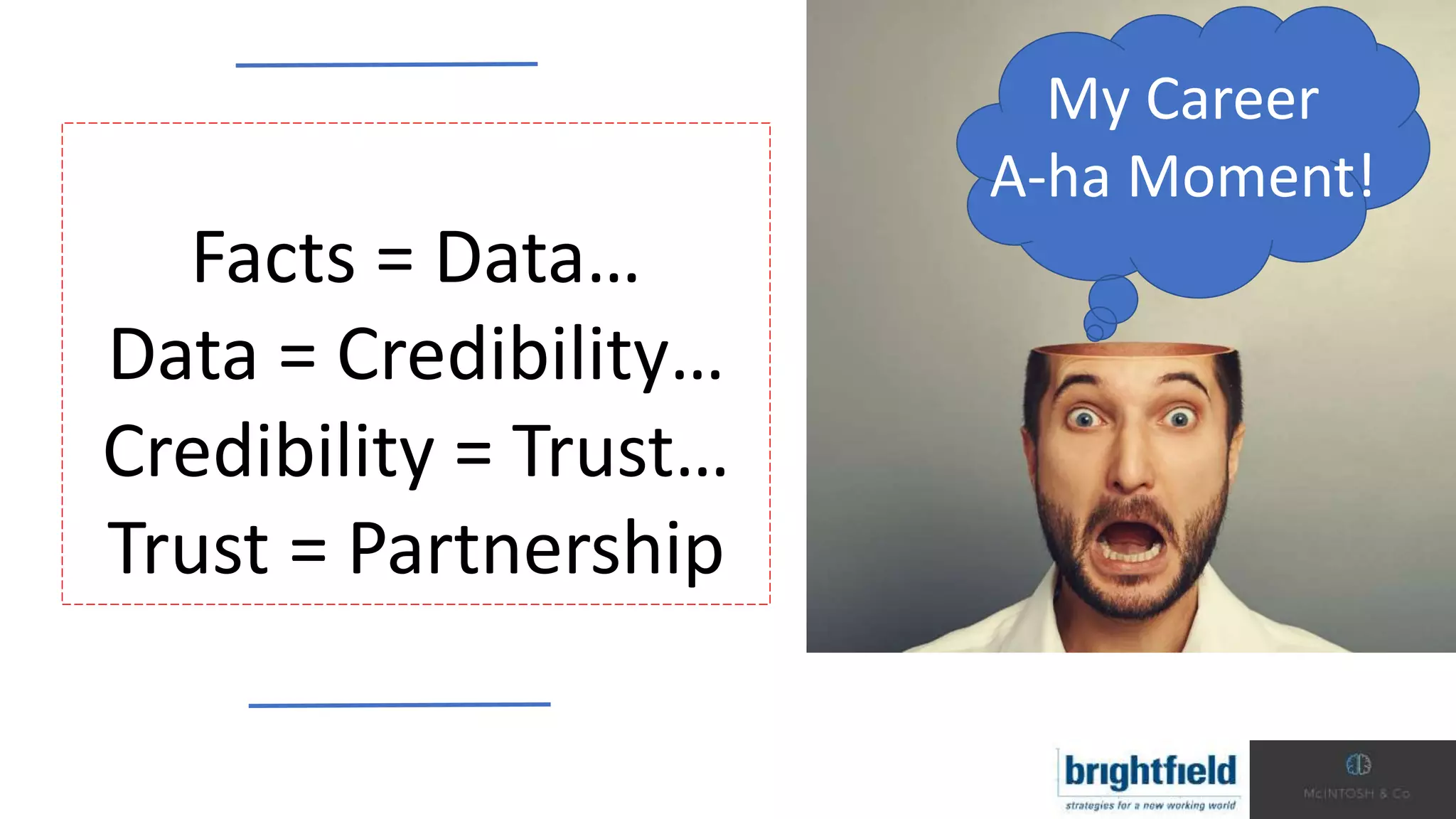
My Career
A-ha Moment!
My Career
A-ha Moment!
Facts = Data…
Data = Credibility…
Credibility = Trust…
Trust = Partnership
Current State – Rearview
Mirror Metrics
• Discussion
Agenda
Current State
Most Recruiting Metrics
are still about looking in
the rear view mirror
Data & Analytics
We
do
this
today
We think we
need to but
are not quite
sure how,
why or the
value
We see value
and plan on
doing in the
next 18
months
We see no
value and
are not
going to
adopt
Data & Analytics
We do
this
today
We think we need
to but are not quite
sure how, why or
the value
We see value and
plan on doing in the
next 18 months
We see no value
and are not going
to adopt
We currently use an
analytics solution
19% 23% 52% 6%
Data & Analytics
Data & Analytics
We do
this
today
We think we need
to but are not quite
sure how, why or
the value
We see value and
plan on doing in the
next 18 months
We see no value
and are not going
to adopt
We currently use an analytics solution 19% 23% 52% 6%
We have moved
beyond basic data
reporting
12% 29% 48% 11%
Data & Analytics
Data & Analytics
We do
this
today
We think we need
to but are not quite
sure how, why or
the value
We see value and
plan on doing in the
next 18 months
We see no value
and are not
going to adopt
We currently use an analytics solution 19% 23% 52% 6%
We have moved beyond basic data
reporting
12% 29% 48% 11%
We have a formal
dashboard
31% 16% 43% 10%
Data & Analytics
Data & Analytics
We do
this
today
We think we need
to but are not quite
sure how, why or
the value
We see value and
plan on doing in the
next 18 months
We see no value
and are not
going to adopt
We currently use an analytics solution 19% 23% 52% 6%
We have moved beyond basic data
reporting
12% 29% 48% 11%
We have a formal dashboard 31% 16% 43% 10%
We benchmark our
KPIs
29% 19% 39% 13%
Data & Analytics
Data & Analytics
We do
this
today
We think we need
to but are not quite
sure how, why or
the value
We see value and
plan on doing in the
next 18 months
We see no value
and are not
going to adopt
We currently use an analytics solution 19% 23% 52% 6%
We have moved beyond basic data
reporting
12% 29% 48% 11%
We have a formal dashboard 31% 16% 43% 10%
We benchmark our KPIs 29% 19% 39% 13%
We have a dedicated
resource
26% 26 % 28% 20%
Data & Analytics
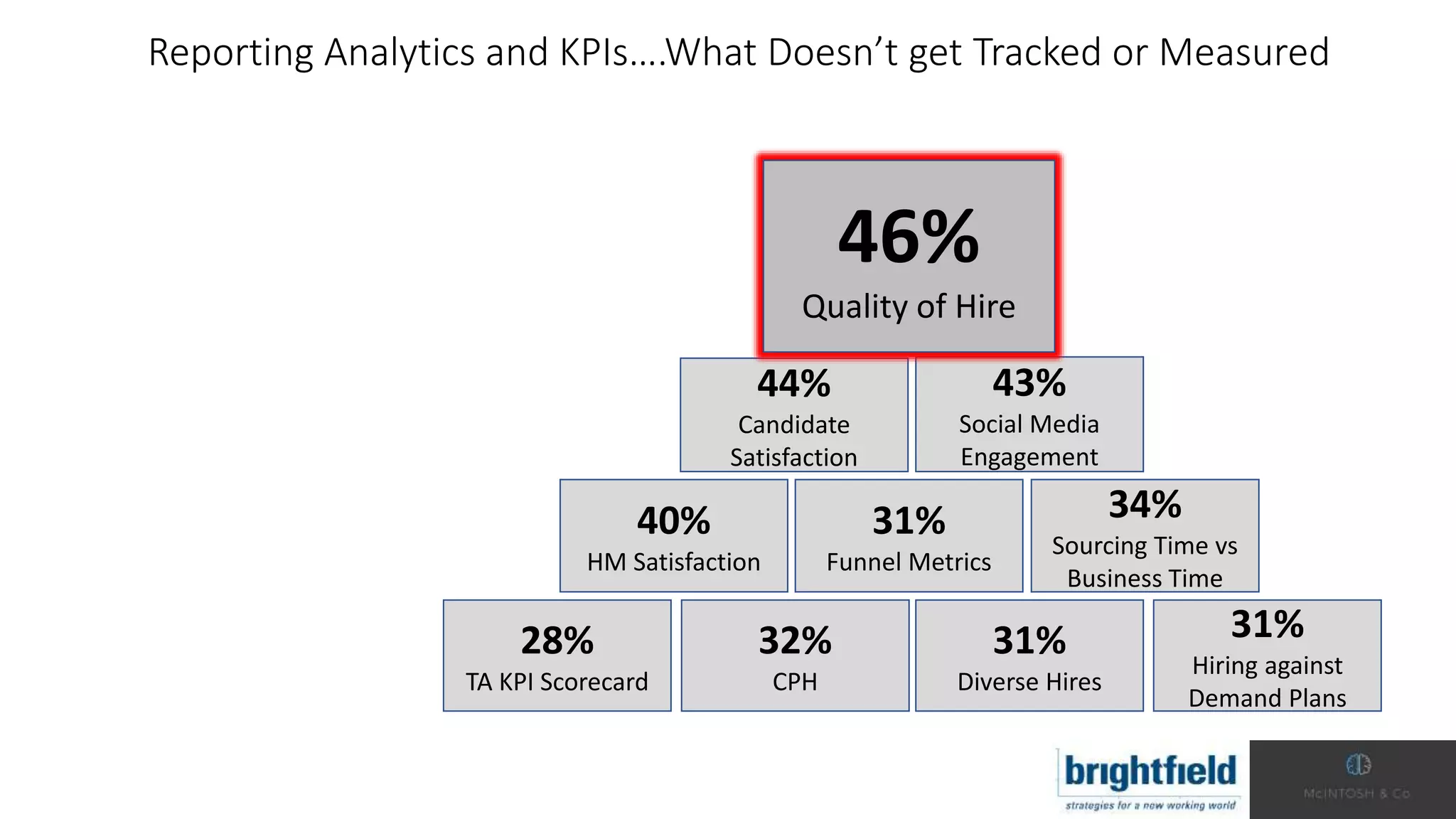
Reporting Analytics and
KPIs….What Doesn’t get
Tracked or Measured
32%
CPH
31%
Diverse Hires
31%
Hiring against
Demand Plans
28%
TA KPI Scorecard
>40%
Retail
>40%
Manufacturing
Reporting Analytics and KPIs….What Doesn’t get Tracked or Measured
Q: What Doesn’t
get Tracked or
Measured
32%
CPH
31%
Diverse Hires
31%
Hiring against
Demand Plans
31%
Funnel Metrics
40%
HM Satisfaction
34%
Sourcing Time vs
Business Time
28%
TA KPI Scorecard
Reporting Analytics and KPIs….What Doesn’t get Tracked or Measured
32%
CPH
31%
Diverse Hires
31%
Hiring against
Demand Plans
43%
Social Media
Engagement
31%
Funnel Metrics
40%
HM Satisfaction
34%
Sourcing Time vs
Business Time
28%
TA KPI Scorecard
44%
Candidate
Satisfaction
Reporting Analytics and KPIs….What Doesn’t get Tracked or Measured
32%
CPH
31%
Diverse Hires
31%
Hiring against
Demand Plans
43%
Social Media
Engagement
31%
Funnel Metrics
40%
HM Satisfaction
34%
Sourcing Time vs
Business Time
28%
TA KPI Scorecard
44%
Candidate
Satisfaction
46%
Quality of Hire
Reporting Analytics and KPIs….What Doesn’t get Tracked or Measured
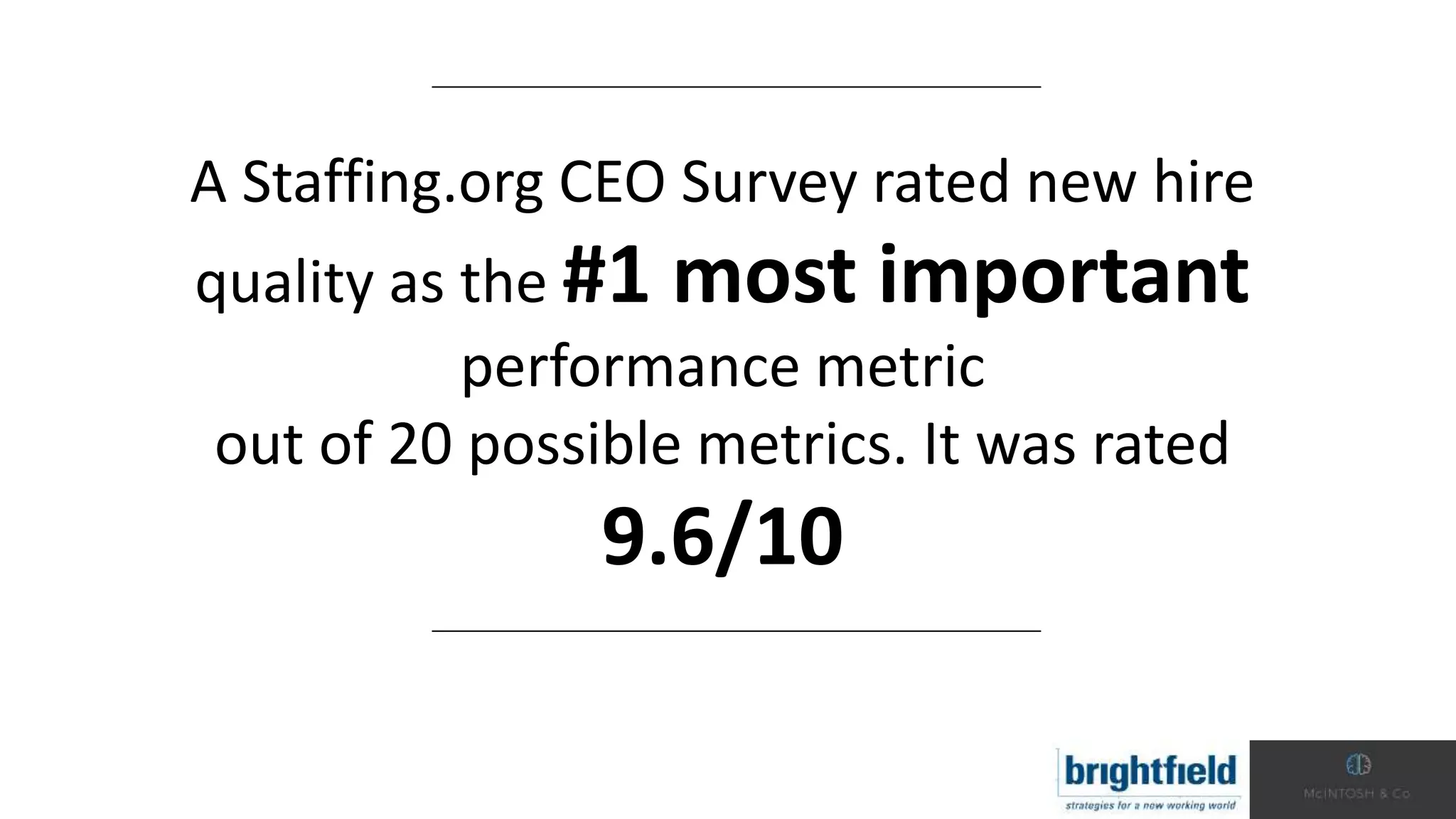
A Staffing.org CEO Survey rated new hire
quality as the #1 most important
performance metric
out of 20 possible metrics. It was rated
9.6/10
Quality of Hire (QoH) = (APR + AE + HMS + ER) / N
APR = Avg. Performance Rating for new employees in first 12 months
AE = Employee Performance as a % of Achieves Expectations of
performance in first year.
HMS = Annual Hiring Manager Survey Q:“Overall quality of New Hires”
ER = % of Employee Retention first 12 months of employment.
N = Number of indicators used.
APR= 68% + AE= 94% + HMS= 80% + ER= 90% / N = 4
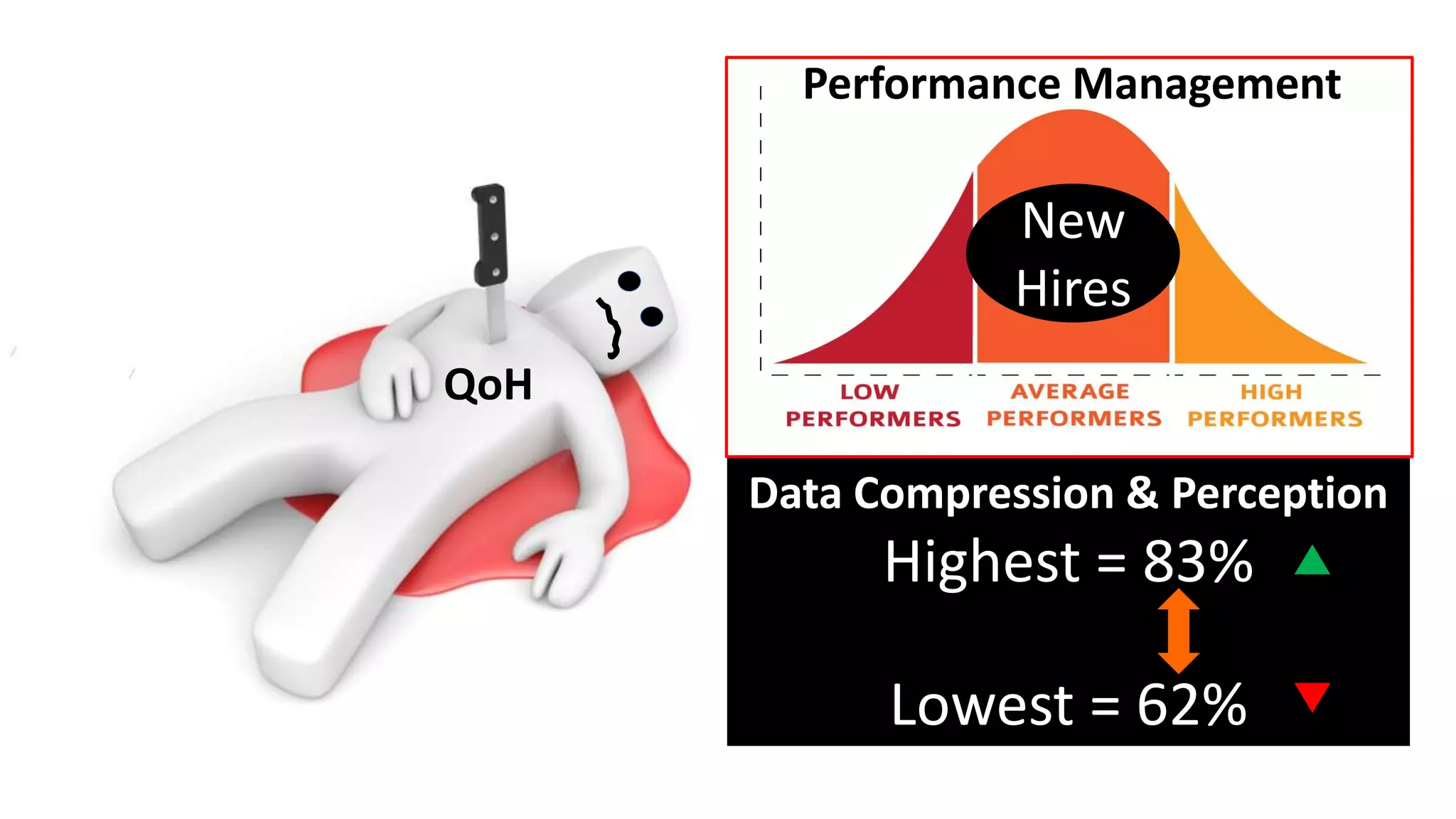
QoH = 83%
QoH
Data Compression & Perception
Highest = 83%
Lowest = 62%
Performance Management
New
Hires
QoH
25
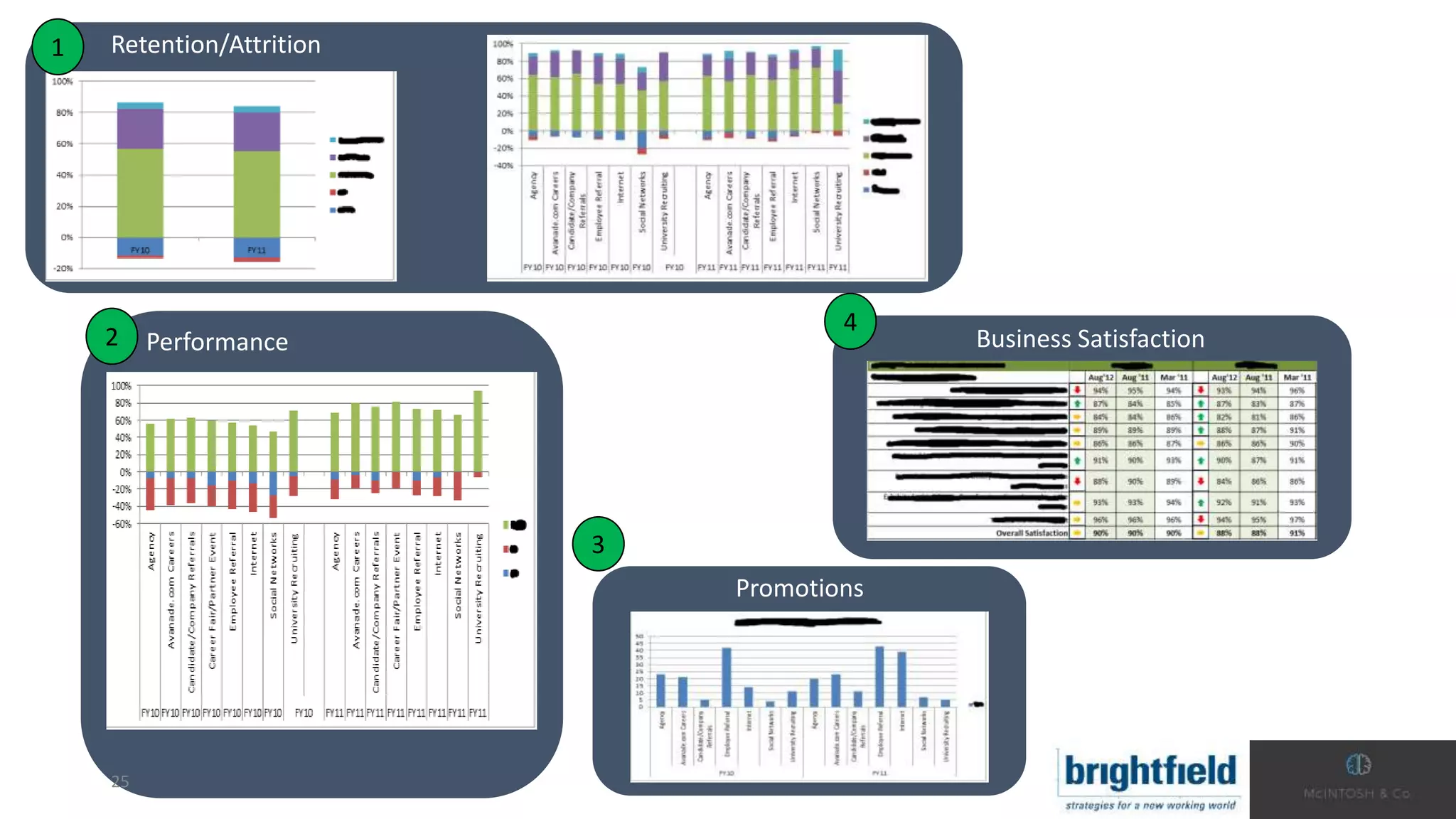
Retention/Attrition
Performance Promotions Business Satisfaction
1
2
3
4
Promotions
Business
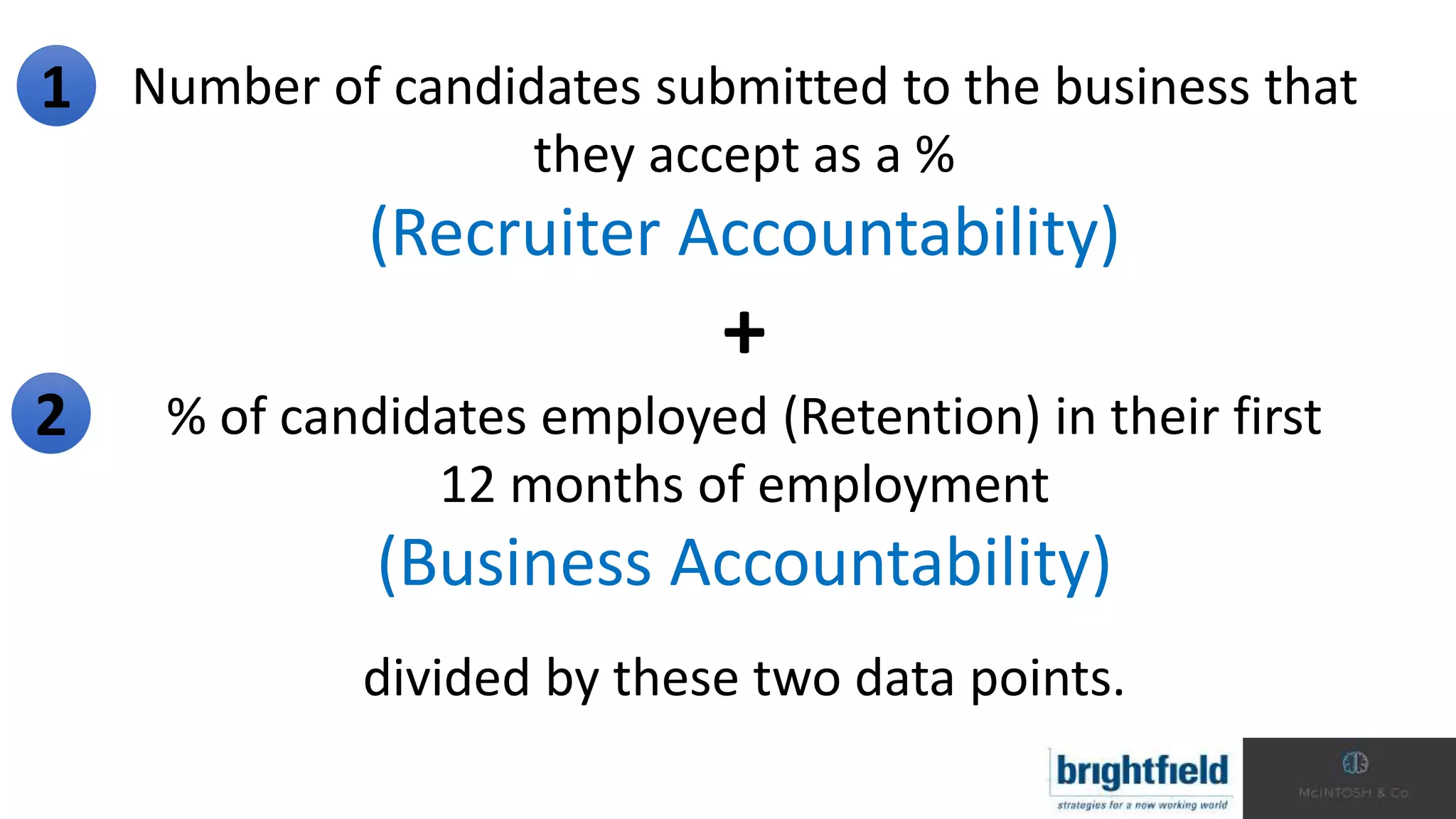
Accountability
Recruiter
Accountability
Biggest lesson learned?
Number of candidates submitted to the business that
they accept as a %
(Recruiter Accountability)
+
% of candidates employed (Retention) in their first
12 months of employment
(Business Accountability)
divided by these two data points.
1
2
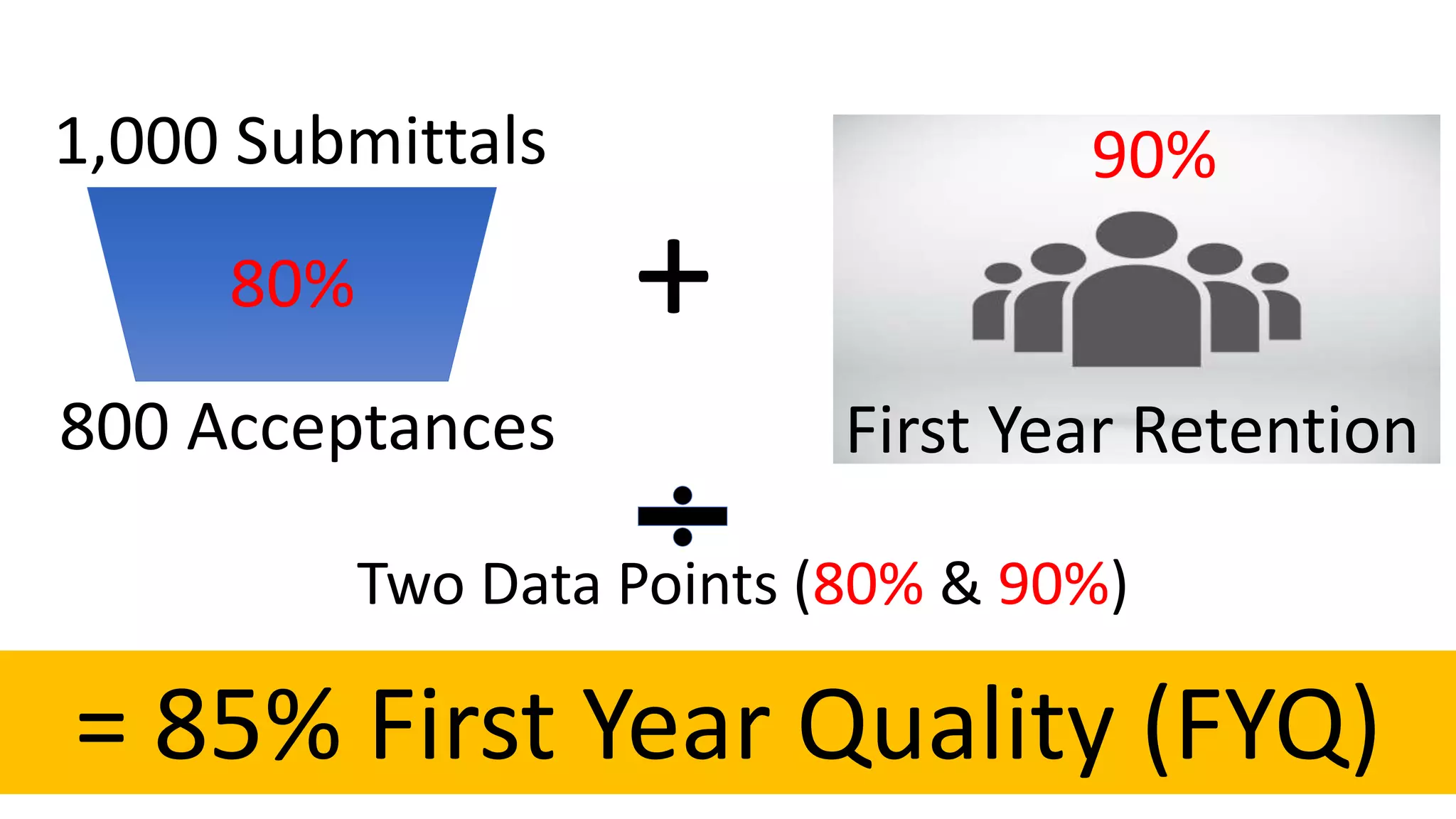
1,000 Submittals
800 Acceptances
80%
First Year Retention
90%
+
Two Data Points (80% & 90%)
= 85% First Year Quality (FYQ)
Discussion
What other metrics are you tracking and why?
Does the business want metrics that you can’t provide, and why not?
Agenda
Future State - Predictive analytics and
causality metrics
• Discussion
Future State
Predictive analytics is
the practice of
extracting information
from existing data
sets in order to
determine patterns
and predict future
outcomes and trends
Profile ‘A’ Pipeline Robustness
Recruiter
Screen
Business
Interview 1
Business
Interview 2
Offer Hire
100
90
80
70
60
50
40
30
20
10
10:1
7:1
4:1
2:1
1:1
Profile ‘A’ Historical
Throughput
Benchmark
Target
# of
Candidates
Actual
Candidates
100:1
30:1
10:1
8:1
3:1
1:1
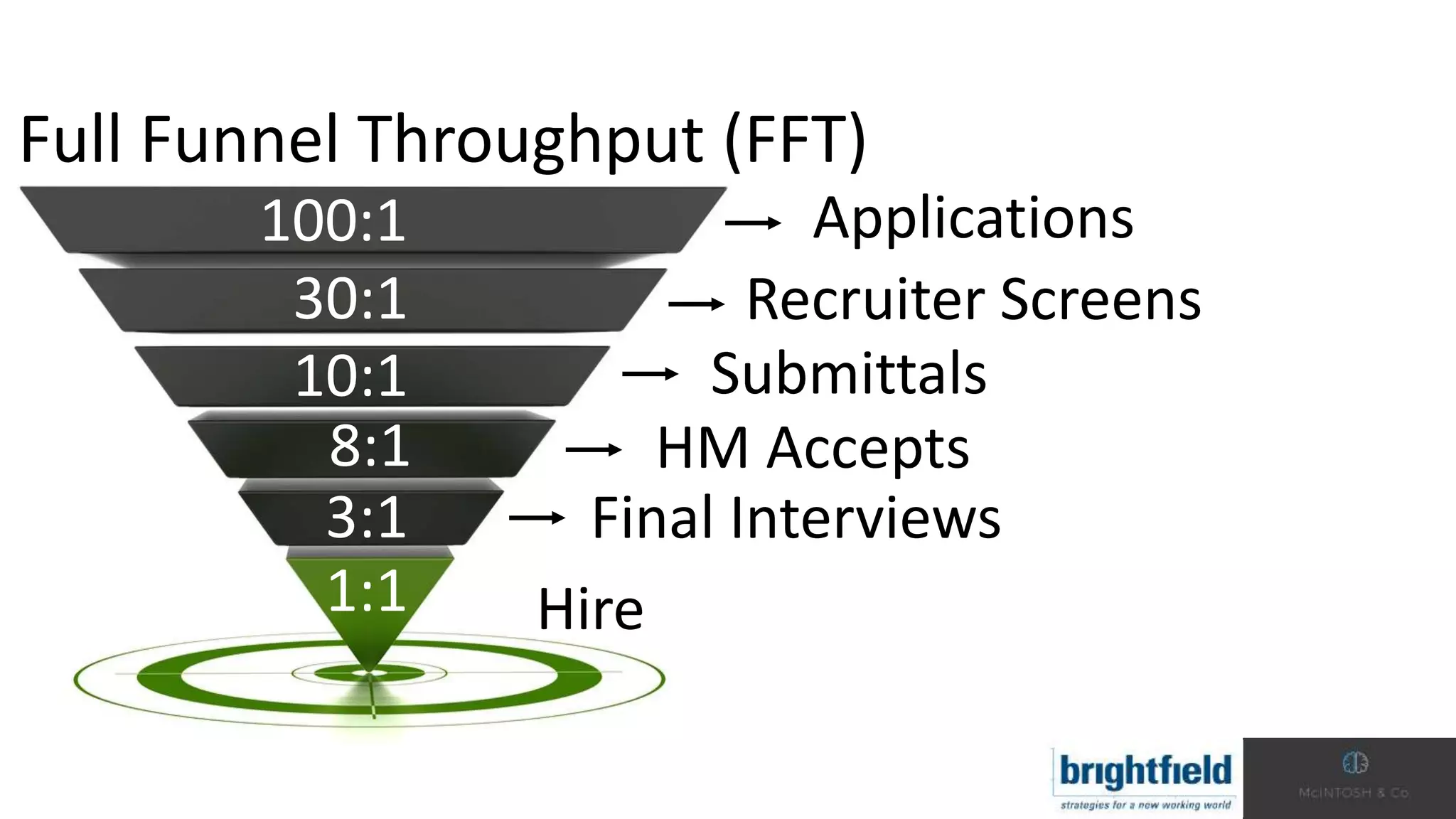
Full Funnel Throughput (FFT)
Applications
Recruiter Screens
Hire
HM Accepts
Final Interviews
Submittals
100:1
30:1
10:1
8:1
3:1
1:1
Full Funnel Throughput (FFT)
Tele-Sales
Java Developers
Job Families
Store Mgr’s
55:1
30:1
100:1
100:1
30:1
10:1
8:1
3:1
1:1
Alert
20 more Quality
Candidates needed
this week to fill the 5
Tele-Sales positions by
end of the month
Full Funnel Throughput (FFT)
Predicting Which Reqs Will Be at Risk
• Chance of the req being
filled by its goal drops
dramatically if there is no
candidate submission by
the end of week two or
no candidate interview by
week three.
- Approach to Role Difficulty
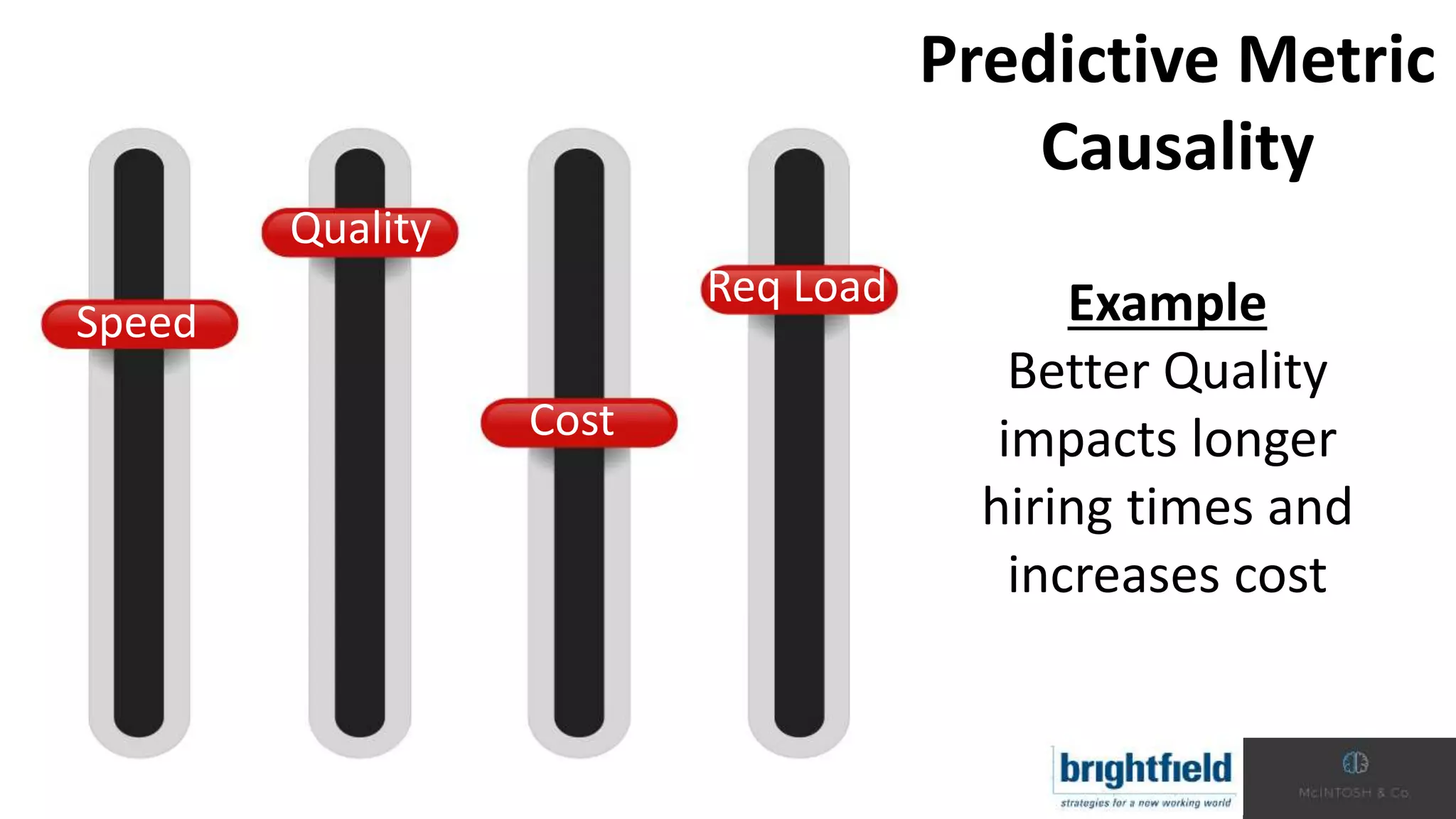
Speed
Quality
Cost
Req Load
Predictive Metric
Causality
Example
Better Quality
impacts longer
hiring times and
increases cost
Discussion
What other predictive TA metrics are you tracking?
What predictive or causality metrics would you love to get your hands on?
Agenda
Telling Stories with the
metrics
• Discussion
Telling Stories with Data
“Stories are the single most powerful
weapon in a leader’s arsenal.
—Howard Gardner, Harvard University
“Why was Solomon recognized as the
wisest man in the world? Because he knew
more stories (proverbs) than anyone else.
Scratch the surface in a typical boardroom
and we’re all just cavemen with briefcases,
hungry for a wise person to tell us stories.
—Alan Kay, vice president at Walt Disney
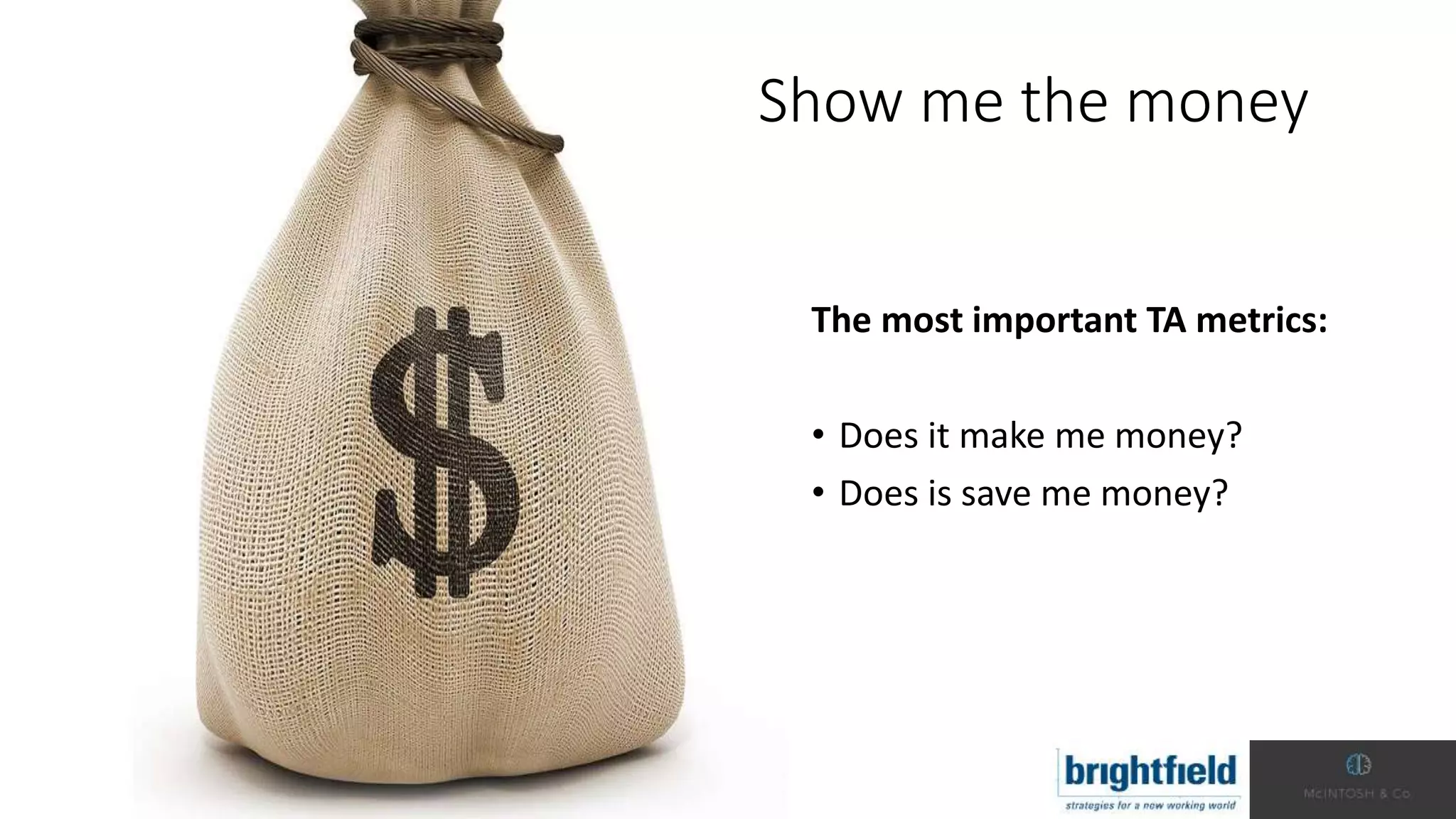
The most important TA metrics:
• Does it make me money?
• Does is save me money?
Show me the money
Rewire Your
Brain To
Recognize
The
$$$$ Stories
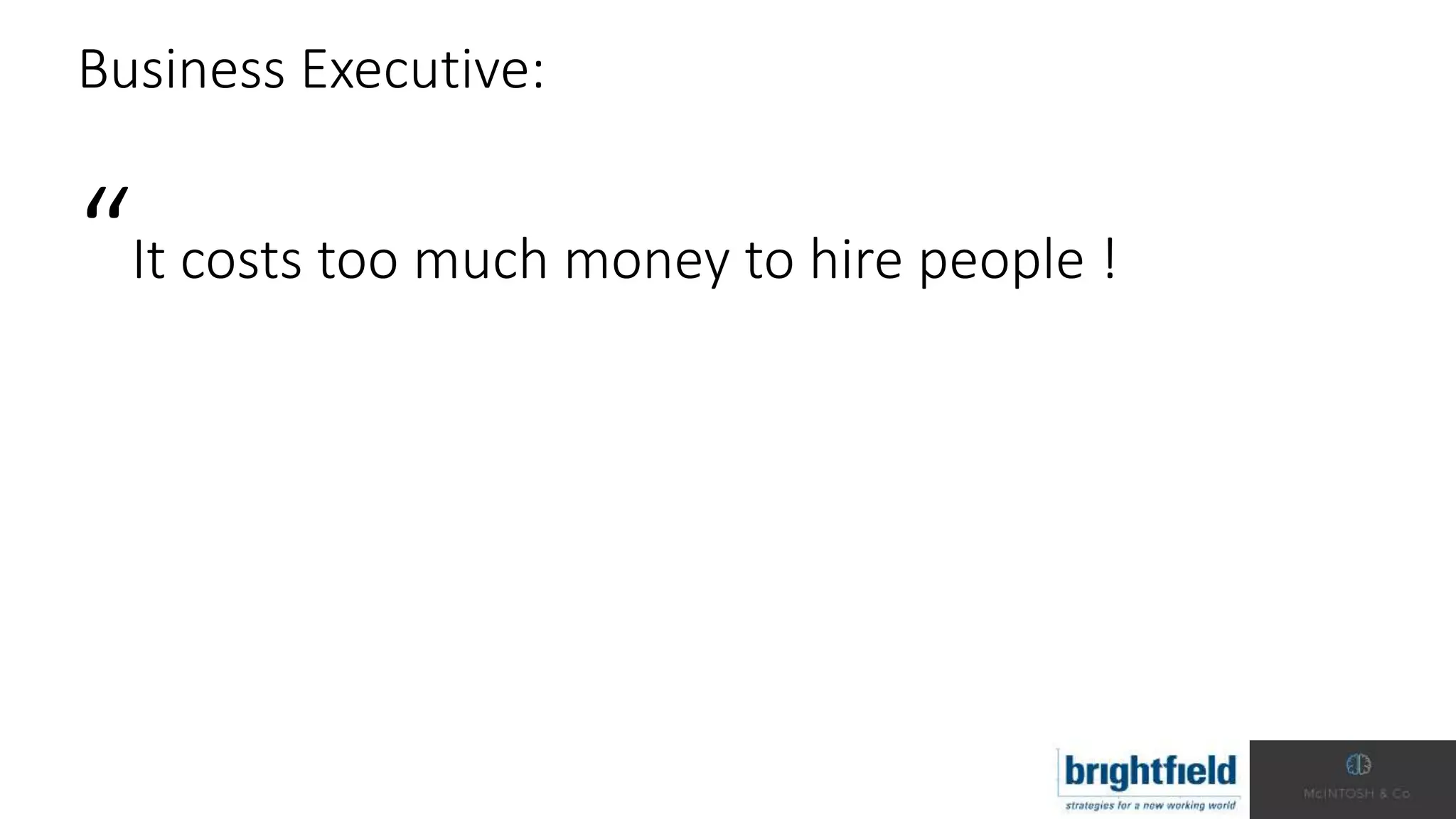
Business Executive:
“It costs too much money to hire people !
Business Executive:
“It costs too much money to hire people !
Talent Acquisition Executive:
“Compared to what?
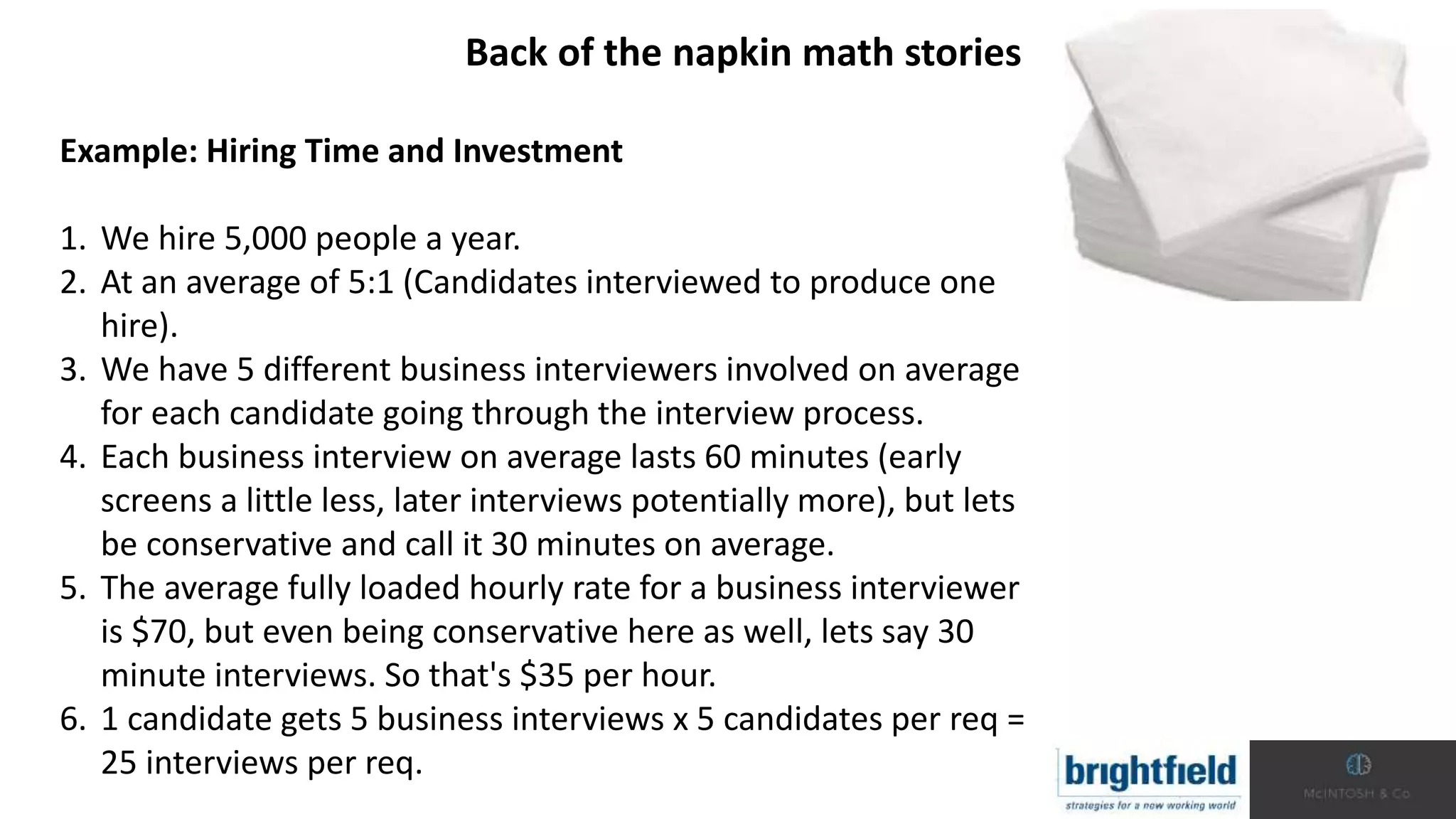
Back of the napkin math stories
Example: Hiring Time and Investment
1. We hire 5,000 people a year.
2. At an average of 5:1 (Candidates interviewed to produce one
hire).
3. We have 5 different business interviewers involved on average
for each candidate going through the interview process.
4. Each business interview on average lasts 60 minutes (early
screens a little less, later interviews potentially more), but lets
be conservative and call it 30 minutes on average.
5. The average fully loaded hourly rate for a business interviewer
is $70, but even being conservative here as well, lets say 30
minute interviews. So that's $35 per hour.
6. 1 candidate gets 5 business interviews x 5 candidates per req =
25 interviews per req.
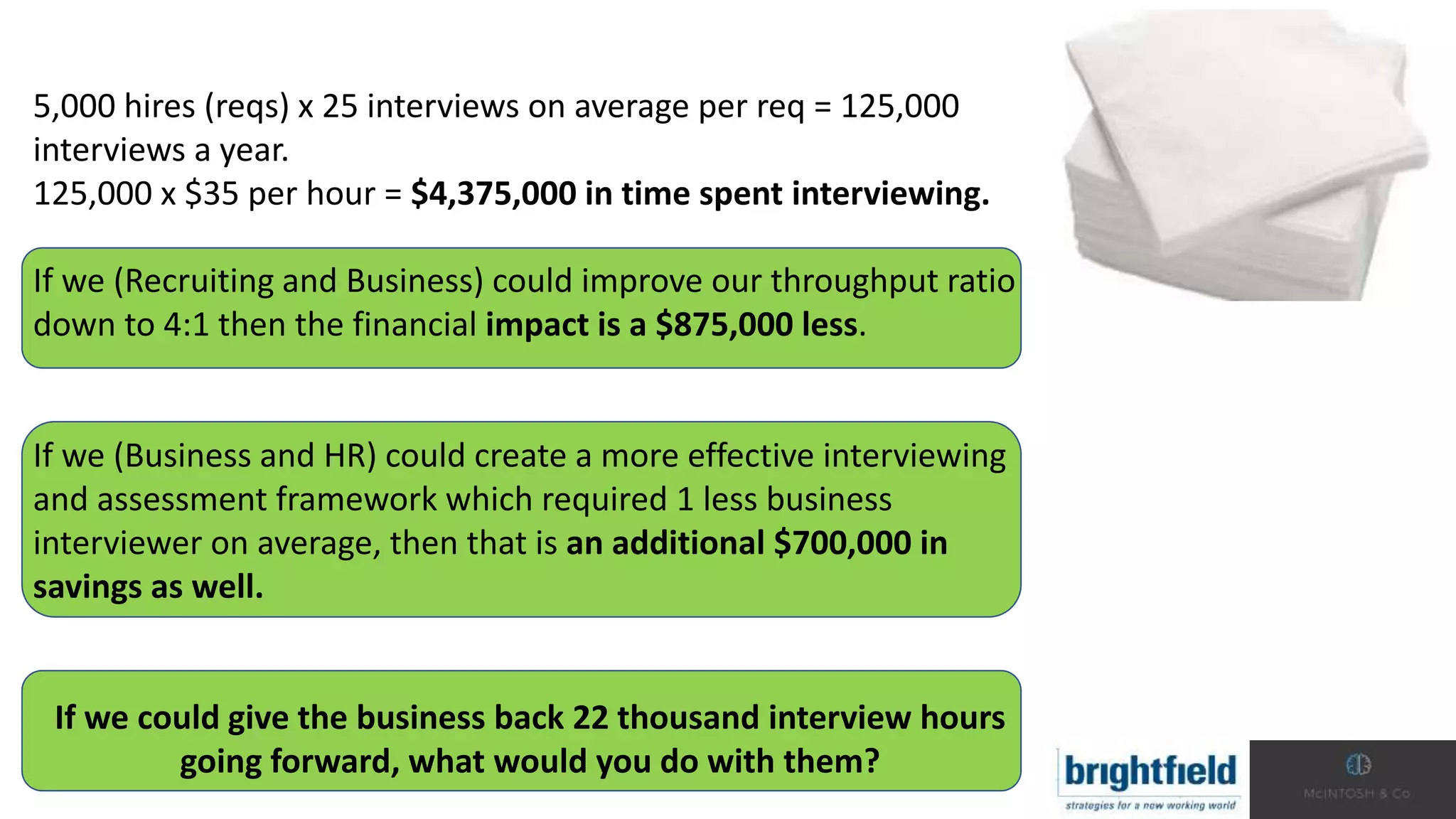
5,000 hires (reqs) x 25 interviews on average per req = 125,000
interviews a year.
125,000 x $35 per hour = $4,375,000 in time spent interviewing.
If we (Recruiting and Business) could improve our throughput ratio
down to 4:1 then the financial impact is a $875,000 less.
If we (Business and HR) could create a more effective interviewing
and assessment framework which required 1 less business
interviewer on average, then that is an additional $700,000 in
savings as well.
If we could give the business back 22 thousand interview hours
going forward, what would you do with them?
1. Problem we/you are trying to solve
2. Benefit we will get from solving this problem
3. How you are progressing against the plan to solve it (on
track/off track)
4. The issues causing you to be off track
5. What are you doing about resolving the issues that get you
back on track, and by when
5 Simple Story Telling Rules
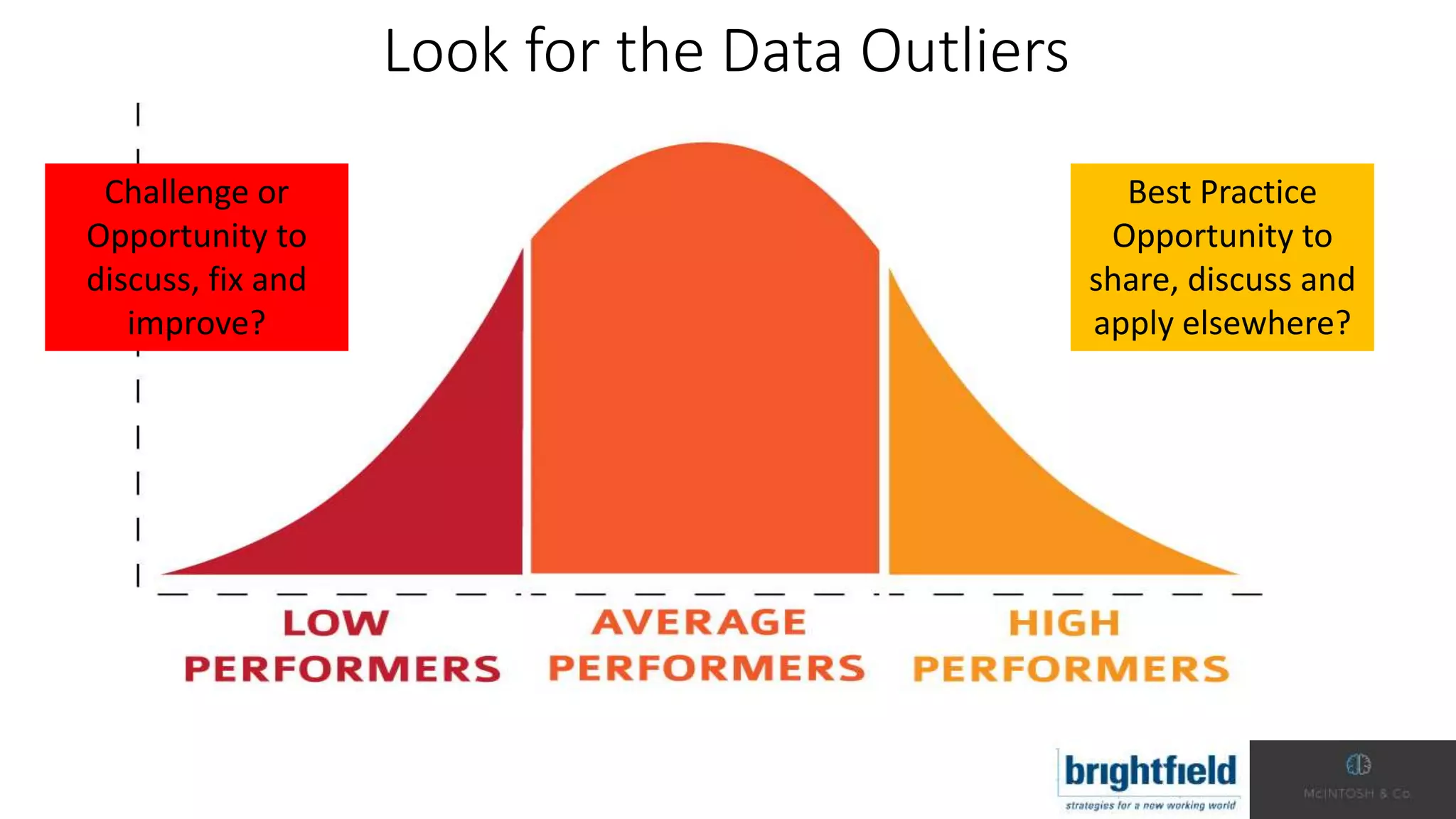
Look for the Data Outliers
Best Practice
Opportunity to
share, discuss and
apply elsewhere?
Challenge or
Opportunity to
discuss, fix and
improve?
Contrast and Compare
= Bad = Good
Golden Rule No. 1 Don’t compare datasets that are not directionally the same.
Example: Your Companies Cost Per Hire to your Competitors if you/they calculate differently.
Golden Rule No. 2 Wherever possible compare your dataset to something else. A metric and
data point standing alone by itself tells very little.
Example: Compare your Cost Per Hire this year/month with last year/month.
The Story
‘Did it go up or go down, why and what are you doing about it’?
Different Analytical Recruitment Stories
Cost
 Cost Per Hire comparisons and outliers vs. other Workforces/Job Families
 ROI on different Sourcing Channels and Outliers
 Proactive vs. Reactive Sourcing results and Outliers vs. other Workforces/Job Families
 Lost Opportunity Cost = Financial impact for unfilled roles
Speed
 Time to Hire comparisons and outliers vs. other Workforces/Job Families
 Time to Source (Recruiting) vs. Interview Time to Hire (Business) and outliers by
Workforces/Job Families = RvB Metric.
Quality
 New Hire Performance & New Hire Managed Attrition (1st 12 months)
 Offer Acceptance and outliers over time vs. other Workforces/Job Families
 Productivity Throughput Ratio’s (Submits to Hire) vs. other Workforces/Job Families
+ Operational Effectiveness
 Hires against a annual or monthly business/recruiting demand plan
 Tracking against Recruitment Goals/KPI’s
 Volume of recruiting resources/effort spent on Attrition vs. Growth roles
Against Plan
Against Time & %
Against Goals
Story
“We need to do x,y
and z to increase the
passive candidate
initial response %”
“We need to do x,y
and z to help with
efficiencies around
active candidate
screening to
determine quality
earlier on in the
process”
Throughput Analysis: ‘Cradle to Grave Metrics’
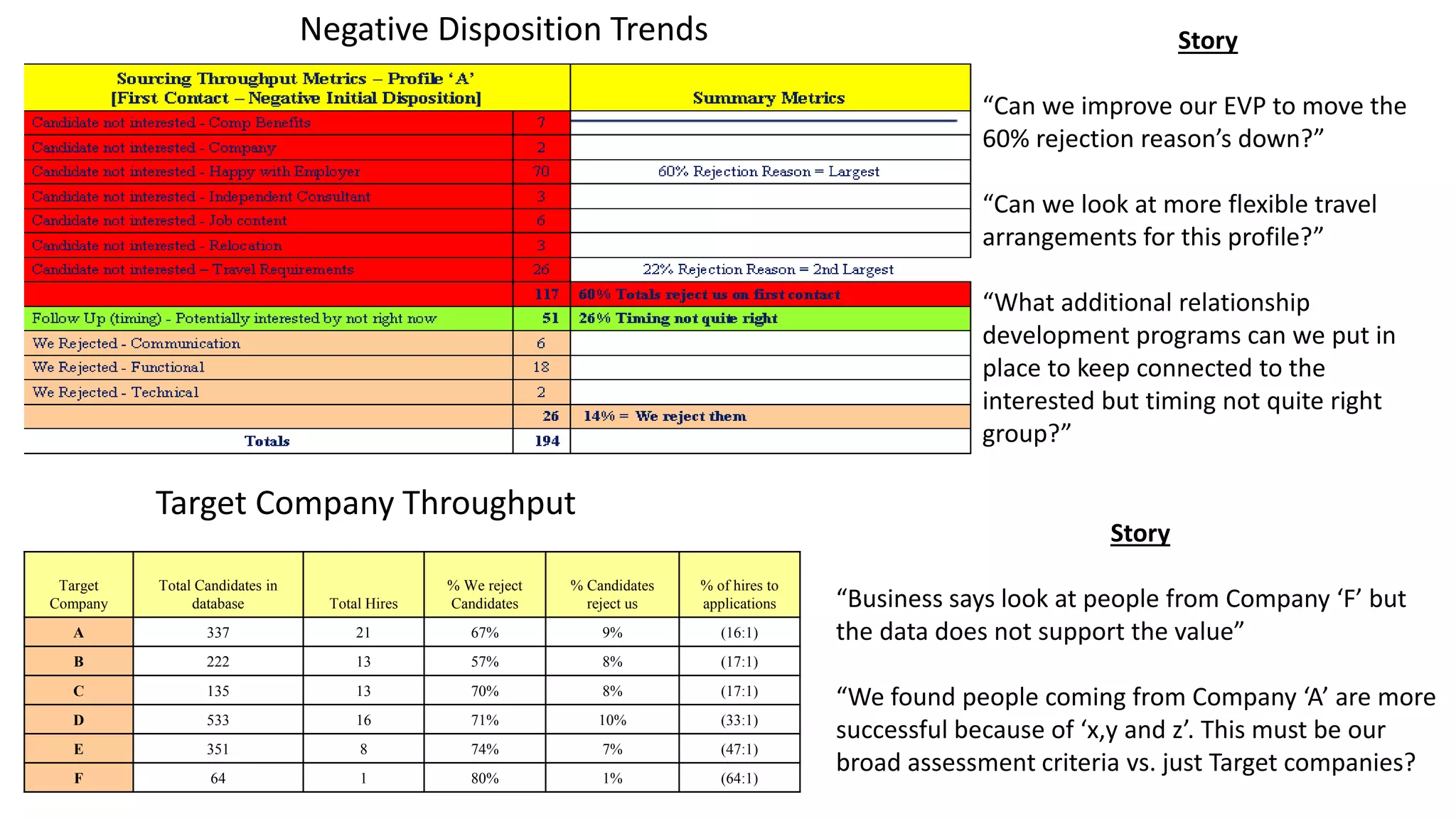
Target Company Throughput
Target
Company
Total Candidates in
database Total Hires
% We reject
Candidates
% Candidates
reject us
% of hires to
applications
A 337 21 67% 9% (16:1)
B 222 13 57% 8% (17:1)
C 135 13 70% 8% (17:1)
D 533 16 71% 10% (33:1)
E 351 8 74% 7% (47:1)
F 64 1 80% 1% (64:1)
Story
“Business says look at people from Company ‘F’ but
the data does not support the value”
“We found people coming from Company ‘A’ are more
successful because of ‘x,y and z’. This must be our
broad assessment criteria vs. just Target companies?
Negative Disposition Trends Story
“Can we improve our EVP to move the
60% rejection reason’s down?”
“Can we look at more flexible travel
arrangements for this profile?”
“What additional relationship
development programs can we put in
place to keep connected to the
interested but timing not quite right
group?”
Comparative Source Analysis
Agency vs. Job Board Hire Overlap
Story
“Opportunity to get more
effective with our own
Sourcing Channel Strategy
and coverage to optimize
costs and results”
Comparative Source Analysis
Job Board vs. Job Board Overlap Story
“Certain jobs should only be posted on Job
Board ‘X’”
“Stop spending Business Group ‘C’ money
on Job Board ‘X’ and reinvest elsewhere.”
Lost Opportunity Cost Stories
60
Creating a Scenario in our
WFP tool, a positive shift
in attrition by 4.2%
Positively impacts
Company Revenue by
3.2% (40million)
Modeled Forecasting
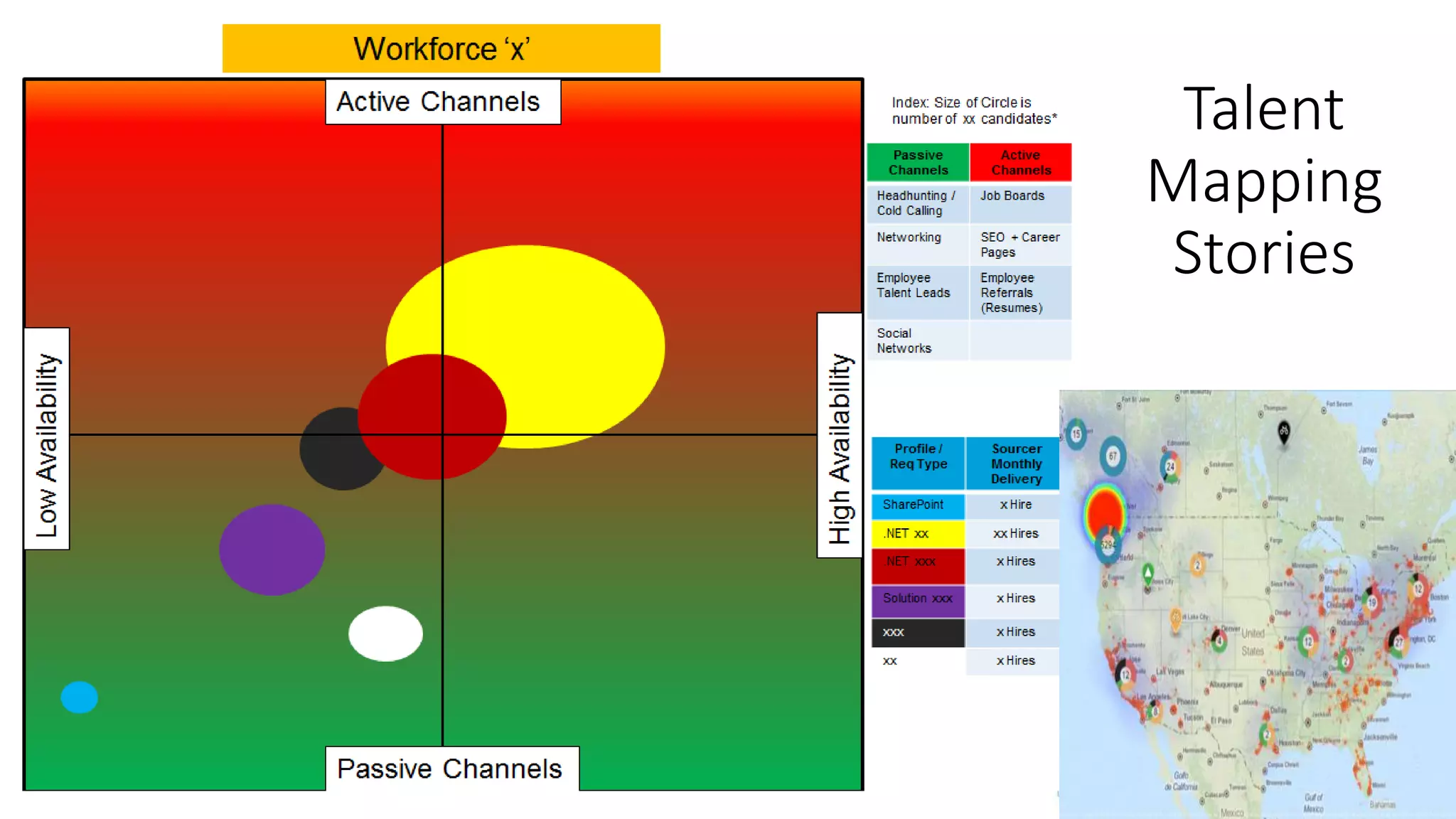
Talent
Mapping
Stories
The Future is Big Data Stories
ATS
SEO
CRM
Performance
Management
HRIS
Big
Data
Sourcing
Tools
Social
Networks
WFP
Multi-dimensional
Recruitment Stories
Discussion
What are creative ways you have leveraged
data to tell the story for change?
What are the major roadblocks you have seen on enabling change with
data?
Agenda
Optimal scorecards,
reporting and KPI’s
• Discussion
Lots of pretty choices
April: Talent Acquisition Monthly Scorecard
Status
Enhanced employee referral program go live in Q2
SEO solution delayed to Q4 because of contract
negotiations
Productivity per Recruiter increases after training
investment last year
Technology Blueprint and SOW completed for new
global ATS
Key Performance Indicators Goal/Plan Actual Trending
Speed 50 days
Cost 2.5k
Quality 78%
Customer Satisfaction 80%+
Challenges
FY Initiatives / Investments
+ to Goal < 10% of Goal > 10% of Goal
• Speed = Core Technical roles in Texas and Germany
problematic. Too many interviews and 2 groups extended
delays in responding to TA.
• Quality = First year attrition issues in sales roles,
particularly in the Solutions Group
• Customer Satisfaction = While above goal by 4% the Sales
Organization is causing trending down.
Opportunities & Plan
• Speed = Working with SVP on plan to optimize interviews and
reduce the decision time. Meeting scheduled 4/5
• Quality = Partnering with Talent Management & Business to
create better interviewing/assessment guides. Additional
onboarding tweaks being made by Talent Management.
Targeting Q3 release.
• Customer Satisfaction = Keeping an eye on this and setting
expectation with leadership that we will not be trending up
until after Sales issues resolved after Q3
On Track
Off Track
On Track
On Track
Hiring Manager and Candidate Satisfaction
67
Transparency and Directional Correctness
68
Transparency
1. Be clear on how and where you collect your data
source’s.
2. Be clear on why you are measuring and the
benefit you are after by presenting the data.
Directional Correctness
1. 100% Data accuracy is very hard to achieve. Pick
datasets that are directionally correct.
2. In instances where the data is more opinionated vs.
factually driven, make sure the message focuses on
the directional story vs. just the numbers
Discussion
What scorecard approaches have you found
create the greatest impact?
What KPI’s do you use to hold the business, HRBP’s and Vendors
accountable?
Agenda
Roadblocks to success - Data
Integrity and how to fix it
• Discussion
Roadblocks to success
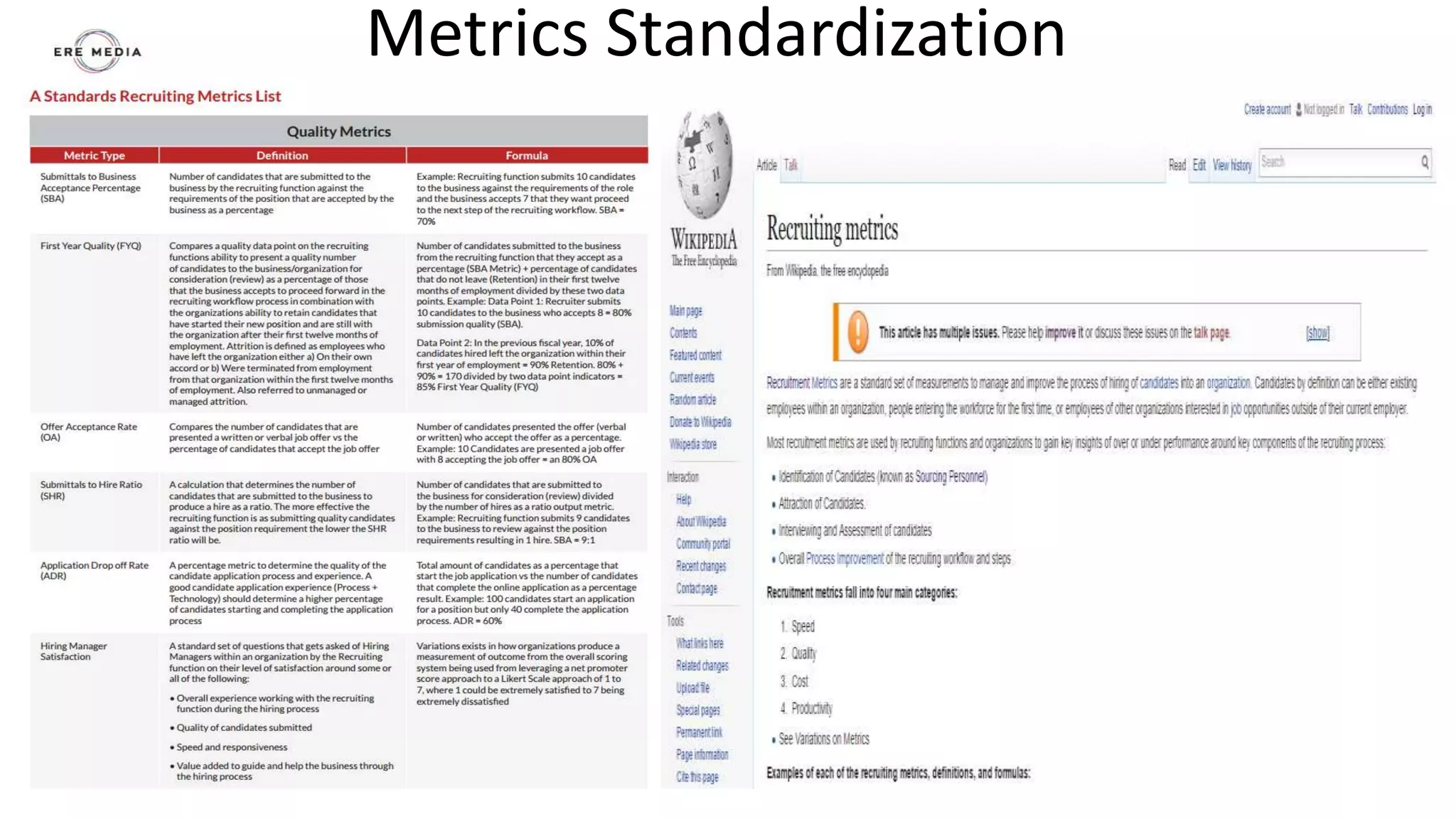
Metrics Standardization
Still
challenges
with how
recruiters
use their
ATS.
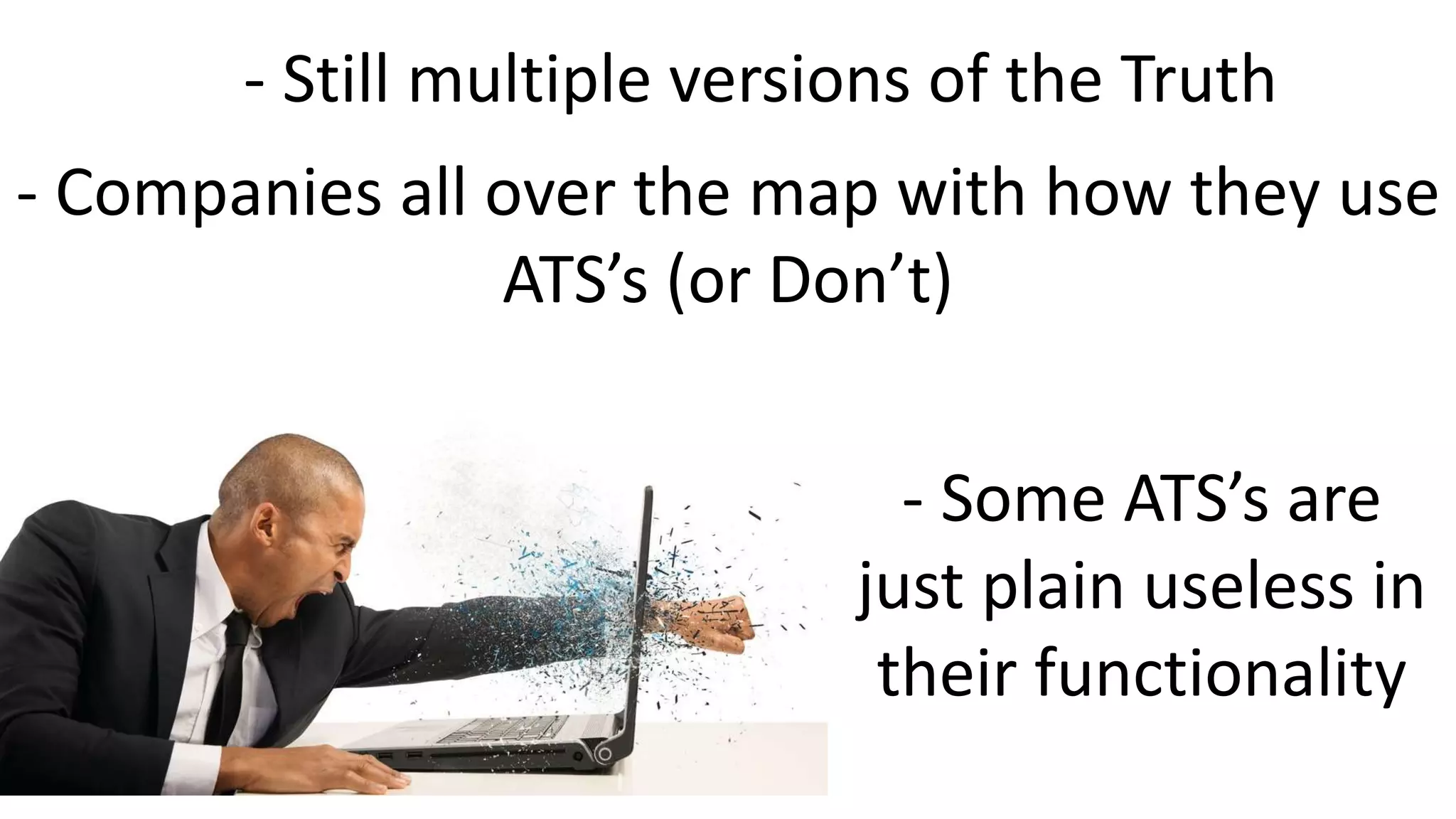
- Still multiple versions of the Truth
- Companies all over the map with how they use
ATS’s (or Don’t)
- Some ATS’s are
just plain useless in
their functionality
Pivot Tables can be evil
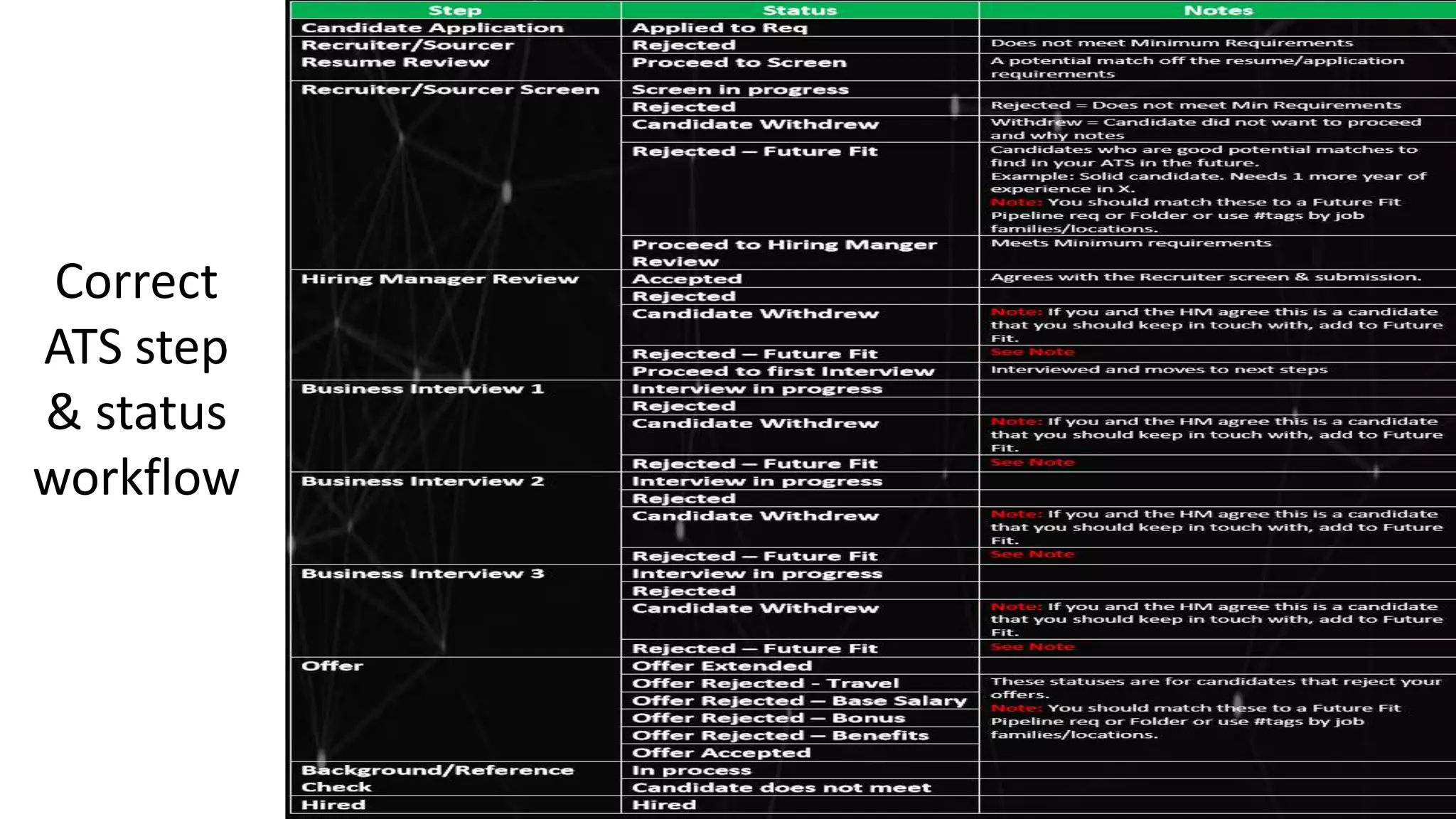
What can you do to fix it?
“We also had a major problem with data accuracy because recruiters
were using our system inconsistently.
“First, we spent a month scrubbing our historical data,
removing errors and compiling a sample of “clean jobs” with
accurate metrics.
“Second, we taught recruiters to “live and breathe” our
applicant tracking system by holding mandatory, weekly job
reviews for 3 months. Recruiters sat in a room for an hour and
we would audit one job per recruiter (recruiters wouldn’t know
which job until the meeting).
Correct
ATS step
& status
workflow
 Goal and reward the right behaviors
 Be Transparent – Create a data integrity
report/scorecard
 Create one version of the truth
Discussion
What other approaches have you taken to fix people, process
or technology dependencies associated to data integrity?
Do you currently have a data integrity metric or KPI?, if no, why not?
Suggested Reference Materials
• CareerXroads Colloquium of course 
• David Green – People Analytics IBM
• https://www.linkedin.com/in/davidrgreen/detail/recent-activity/posts/
• Your Intelligent Talent Acquisition Advisor Blog
• https://intelligentta.wordpress.com/
• Analytics in HR Blog
• https://www.analyticsinhr.com/
• Tucana’s Podcast series
• https://tucana-global.com/category/podcast/
• hiQ Labs Podcast
• https://www.hiqlabs.com/podcast/
Conferences:
• Wharton’s People Analytics Conference
• https://wpa.wharton.upenn.edu/conference/
• People Analytics World
• https://tucana-global.com/people-analytics-world-2017/
Agenda
Benchmarking with real data –
Brightfield Tool
• Discussion
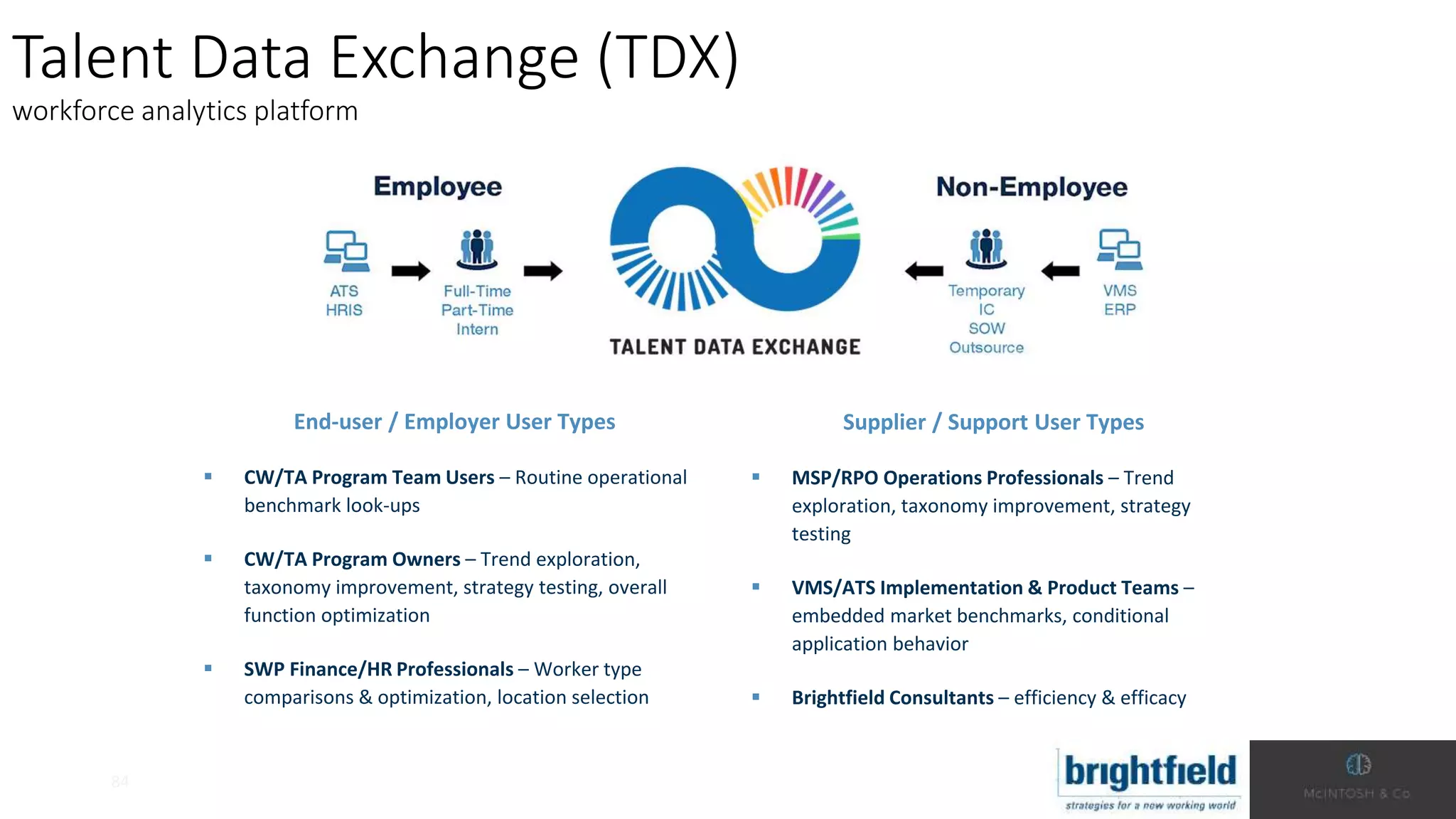
End-user / Employer User Types
 CW/TA Program Team Users – Routine operational
benchmark look-ups
 CW/TA Program Owners – Trend exploration,
taxonomy improvement, strategy testing, overall
function optimization
 SWP Finance/HR Professionals – Worker type
comparisons & optimization, location selection
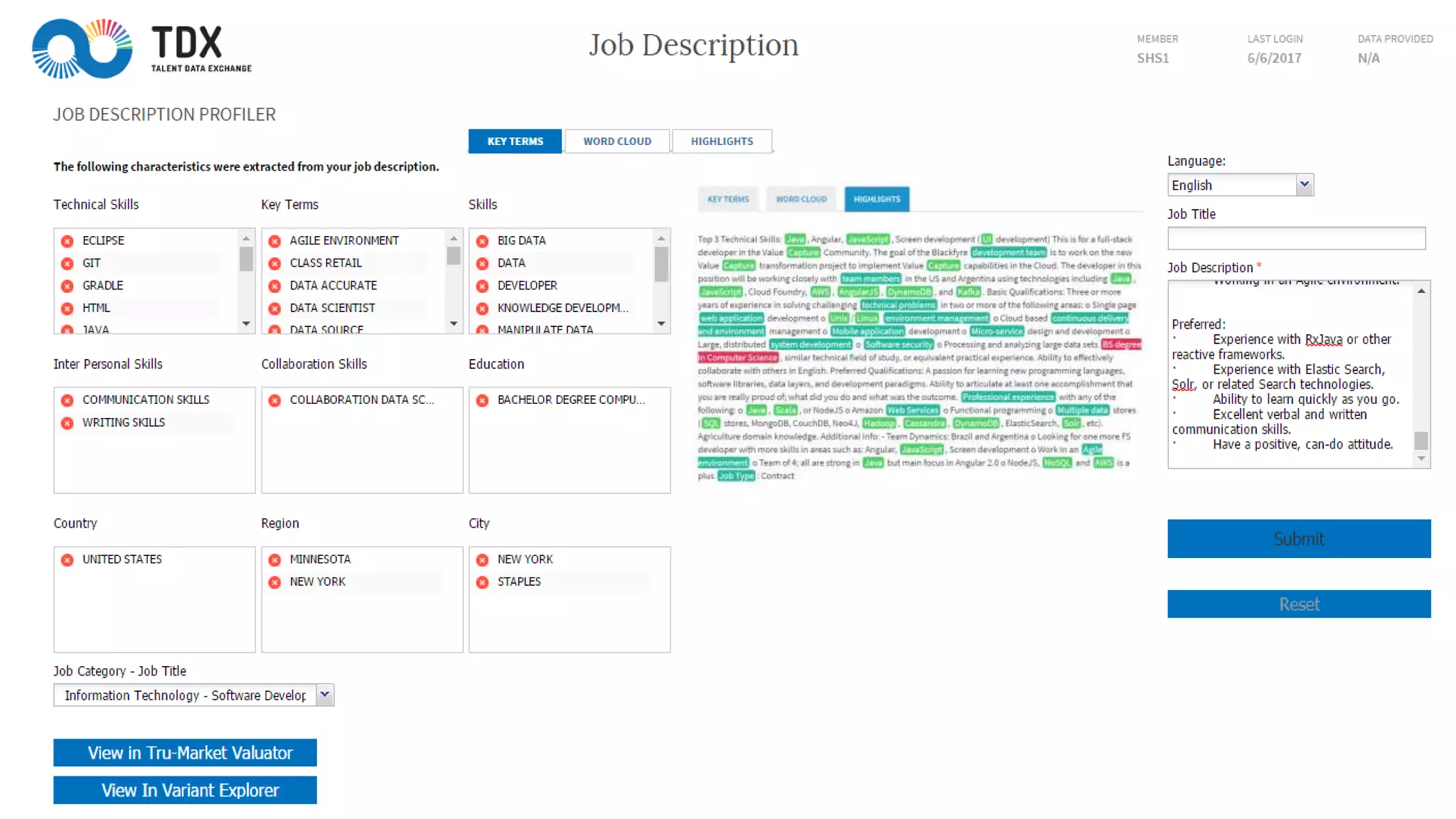
Talent Data Exchange (TDX)
workforce analytics platform
84
Supplier / Support User Types
 MSP/RPO Operations Professionals – Trend
exploration, taxonomy improvement, strategy
testing
 VMS/ATS Implementation & Product Teams –
embedded market benchmarks, conditional
application behavior
 Brightfield Consultants – efficiency & efficacy
85
Live Demo of Talent Data Exchange (TDX)

Talent Analytics: Maximizing the TA Value

  • 1.
    Talent Analytics. Maximizing the TAValue “After my wife, Data is my best friend
  • 2.
    Current State –Rearview Mirror Metrics • Discussion Agenda Future State - Predictive analytics and causality metrics • Discussion Telling Stories with the metrics • Discussion Optimal scorecards, reporting and KPI’s • Discussion Roadblocks to success - Data Integrity and how to fix it • Discussion Benchmarking with real data – Brightfield Tool • Discussion
  • 3.
    “Without data, youare blind and deaf and in the middle of a freeway.” – Geoffrey Moore
  • 4.
    Let Me TellYou A Story My Career A-ha Moment!
  • 5.
    My Career A-ha Moment! Facts= Data… Data = Credibility… Credibility = Trust… Trust = Partnership
  • 6.
    Current State –Rearview Mirror Metrics • Discussion Agenda
  • 7.
    Current State Most RecruitingMetrics are still about looking in the rear view mirror
  • 9.
    Data & Analytics We do this today Wethink we need to but are not quite sure how, why or the value We see value and plan on doing in the next 18 months We see no value and are not going to adopt
  • 10.
    Data & Analytics Wedo this today We think we need to but are not quite sure how, why or the value We see value and plan on doing in the next 18 months We see no value and are not going to adopt We currently use an analytics solution 19% 23% 52% 6% Data & Analytics
  • 11.
    Data & Analytics Wedo this today We think we need to but are not quite sure how, why or the value We see value and plan on doing in the next 18 months We see no value and are not going to adopt We currently use an analytics solution 19% 23% 52% 6% We have moved beyond basic data reporting 12% 29% 48% 11% Data & Analytics
  • 12.
    Data & Analytics Wedo this today We think we need to but are not quite sure how, why or the value We see value and plan on doing in the next 18 months We see no value and are not going to adopt We currently use an analytics solution 19% 23% 52% 6% We have moved beyond basic data reporting 12% 29% 48% 11% We have a formal dashboard 31% 16% 43% 10% Data & Analytics
  • 13.
    Data & Analytics Wedo this today We think we need to but are not quite sure how, why or the value We see value and plan on doing in the next 18 months We see no value and are not going to adopt We currently use an analytics solution 19% 23% 52% 6% We have moved beyond basic data reporting 12% 29% 48% 11% We have a formal dashboard 31% 16% 43% 10% We benchmark our KPIs 29% 19% 39% 13% Data & Analytics
  • 14.
    Data & Analytics Wedo this today We think we need to but are not quite sure how, why or the value We see value and plan on doing in the next 18 months We see no value and are not going to adopt We currently use an analytics solution 19% 23% 52% 6% We have moved beyond basic data reporting 12% 29% 48% 11% We have a formal dashboard 31% 16% 43% 10% We benchmark our KPIs 29% 19% 39% 13% We have a dedicated resource 26% 26 % 28% 20% Data & Analytics
  • 15.
    Reporting Analytics and KPIs….WhatDoesn’t get Tracked or Measured
  • 16.
    32% CPH 31% Diverse Hires 31% Hiring against DemandPlans 28% TA KPI Scorecard >40% Retail >40% Manufacturing Reporting Analytics and KPIs….What Doesn’t get Tracked or Measured Q: What Doesn’t get Tracked or Measured
  • 17.
    32% CPH 31% Diverse Hires 31% Hiring against DemandPlans 31% Funnel Metrics 40% HM Satisfaction 34% Sourcing Time vs Business Time 28% TA KPI Scorecard Reporting Analytics and KPIs….What Doesn’t get Tracked or Measured
  • 18.
    32% CPH 31% Diverse Hires 31% Hiring against DemandPlans 43% Social Media Engagement 31% Funnel Metrics 40% HM Satisfaction 34% Sourcing Time vs Business Time 28% TA KPI Scorecard 44% Candidate Satisfaction Reporting Analytics and KPIs….What Doesn’t get Tracked or Measured
  • 19.
    32% CPH 31% Diverse Hires 31% Hiring against DemandPlans 43% Social Media Engagement 31% Funnel Metrics 40% HM Satisfaction 34% Sourcing Time vs Business Time 28% TA KPI Scorecard 44% Candidate Satisfaction 46% Quality of Hire Reporting Analytics and KPIs….What Doesn’t get Tracked or Measured
  • 20.
    A Staffing.org CEOSurvey rated new hire quality as the #1 most important performance metric out of 20 possible metrics. It was rated 9.6/10
  • 21.
    Quality of Hire(QoH) = (APR + AE + HMS + ER) / N APR = Avg. Performance Rating for new employees in first 12 months AE = Employee Performance as a % of Achieves Expectations of performance in first year. HMS = Annual Hiring Manager Survey Q:“Overall quality of New Hires” ER = % of Employee Retention first 12 months of employment. N = Number of indicators used. APR= 68% + AE= 94% + HMS= 80% + ER= 90% / N = 4 QoH = 83%
  • 23.
  • 24.
    Data Compression &Perception Highest = 83% Lowest = 62% Performance Management New Hires QoH
  • 25.
  • 26.
  • 27.
    Number of candidatessubmitted to the business that they accept as a % (Recruiter Accountability) + % of candidates employed (Retention) in their first 12 months of employment (Business Accountability) divided by these two data points. 1 2
  • 28.
    1,000 Submittals 800 Acceptances 80% FirstYear Retention 90% + Two Data Points (80% & 90%) = 85% First Year Quality (FYQ)
  • 29.
    Discussion What other metricsare you tracking and why? Does the business want metrics that you can’t provide, and why not?
  • 30.
    Agenda Future State -Predictive analytics and causality metrics • Discussion
  • 31.
    Future State Predictive analyticsis the practice of extracting information from existing data sets in order to determine patterns and predict future outcomes and trends
  • 32.
    Profile ‘A’ PipelineRobustness Recruiter Screen Business Interview 1 Business Interview 2 Offer Hire 100 90 80 70 60 50 40 30 20 10 10:1 7:1 4:1 2:1 1:1 Profile ‘A’ Historical Throughput Benchmark Target # of Candidates Actual Candidates
  • 33.
    100:1 30:1 10:1 8:1 3:1 1:1 Full Funnel Throughput(FFT) Applications Recruiter Screens Hire HM Accepts Final Interviews Submittals
  • 34.
    100:1 30:1 10:1 8:1 3:1 1:1 Full Funnel Throughput(FFT) Tele-Sales Java Developers Job Families Store Mgr’s 55:1 30:1 100:1
  • 35.
    100:1 30:1 10:1 8:1 3:1 1:1 Alert 20 more Quality Candidatesneeded this week to fill the 5 Tele-Sales positions by end of the month Full Funnel Throughput (FFT)
  • 36.
    Predicting Which ReqsWill Be at Risk • Chance of the req being filled by its goal drops dramatically if there is no candidate submission by the end of week two or no candidate interview by week three.
  • 38.
    - Approach toRole Difficulty
  • 39.
    Speed Quality Cost Req Load Predictive Metric Causality Example BetterQuality impacts longer hiring times and increases cost
  • 42.
    Discussion What other predictiveTA metrics are you tracking? What predictive or causality metrics would you love to get your hands on?
  • 43.
    Agenda Telling Stories withthe metrics • Discussion
  • 44.
    Telling Stories withData “Stories are the single most powerful weapon in a leader’s arsenal. —Howard Gardner, Harvard University “Why was Solomon recognized as the wisest man in the world? Because he knew more stories (proverbs) than anyone else. Scratch the surface in a typical boardroom and we’re all just cavemen with briefcases, hungry for a wise person to tell us stories. —Alan Kay, vice president at Walt Disney
  • 45.
    The most importantTA metrics: • Does it make me money? • Does is save me money? Show me the money
  • 46.
  • 47.
    Business Executive: “It coststoo much money to hire people !
  • 48.
    Business Executive: “It coststoo much money to hire people ! Talent Acquisition Executive: “Compared to what?
  • 49.
    Back of thenapkin math stories Example: Hiring Time and Investment 1. We hire 5,000 people a year. 2. At an average of 5:1 (Candidates interviewed to produce one hire). 3. We have 5 different business interviewers involved on average for each candidate going through the interview process. 4. Each business interview on average lasts 60 minutes (early screens a little less, later interviews potentially more), but lets be conservative and call it 30 minutes on average. 5. The average fully loaded hourly rate for a business interviewer is $70, but even being conservative here as well, lets say 30 minute interviews. So that's $35 per hour. 6. 1 candidate gets 5 business interviews x 5 candidates per req = 25 interviews per req.
  • 50.
    5,000 hires (reqs)x 25 interviews on average per req = 125,000 interviews a year. 125,000 x $35 per hour = $4,375,000 in time spent interviewing. If we (Recruiting and Business) could improve our throughput ratio down to 4:1 then the financial impact is a $875,000 less. If we (Business and HR) could create a more effective interviewing and assessment framework which required 1 less business interviewer on average, then that is an additional $700,000 in savings as well. If we could give the business back 22 thousand interview hours going forward, what would you do with them?
  • 53.
    1. Problem we/youare trying to solve 2. Benefit we will get from solving this problem 3. How you are progressing against the plan to solve it (on track/off track) 4. The issues causing you to be off track 5. What are you doing about resolving the issues that get you back on track, and by when 5 Simple Story Telling Rules
  • 54.
    Look for theData Outliers Best Practice Opportunity to share, discuss and apply elsewhere? Challenge or Opportunity to discuss, fix and improve?
  • 55.
    Contrast and Compare =Bad = Good Golden Rule No. 1 Don’t compare datasets that are not directionally the same. Example: Your Companies Cost Per Hire to your Competitors if you/they calculate differently. Golden Rule No. 2 Wherever possible compare your dataset to something else. A metric and data point standing alone by itself tells very little. Example: Compare your Cost Per Hire this year/month with last year/month. The Story ‘Did it go up or go down, why and what are you doing about it’?
  • 56.
    Different Analytical RecruitmentStories Cost  Cost Per Hire comparisons and outliers vs. other Workforces/Job Families  ROI on different Sourcing Channels and Outliers  Proactive vs. Reactive Sourcing results and Outliers vs. other Workforces/Job Families  Lost Opportunity Cost = Financial impact for unfilled roles Speed  Time to Hire comparisons and outliers vs. other Workforces/Job Families  Time to Source (Recruiting) vs. Interview Time to Hire (Business) and outliers by Workforces/Job Families = RvB Metric. Quality  New Hire Performance & New Hire Managed Attrition (1st 12 months)  Offer Acceptance and outliers over time vs. other Workforces/Job Families  Productivity Throughput Ratio’s (Submits to Hire) vs. other Workforces/Job Families + Operational Effectiveness  Hires against a annual or monthly business/recruiting demand plan  Tracking against Recruitment Goals/KPI’s  Volume of recruiting resources/effort spent on Attrition vs. Growth roles Against Plan Against Time & % Against Goals
  • 57.
    Story “We need todo x,y and z to increase the passive candidate initial response %” “We need to do x,y and z to help with efficiencies around active candidate screening to determine quality earlier on in the process” Throughput Analysis: ‘Cradle to Grave Metrics’
  • 58.
    Target Company Throughput Target Company TotalCandidates in database Total Hires % We reject Candidates % Candidates reject us % of hires to applications A 337 21 67% 9% (16:1) B 222 13 57% 8% (17:1) C 135 13 70% 8% (17:1) D 533 16 71% 10% (33:1) E 351 8 74% 7% (47:1) F 64 1 80% 1% (64:1) Story “Business says look at people from Company ‘F’ but the data does not support the value” “We found people coming from Company ‘A’ are more successful because of ‘x,y and z’. This must be our broad assessment criteria vs. just Target companies? Negative Disposition Trends Story “Can we improve our EVP to move the 60% rejection reason’s down?” “Can we look at more flexible travel arrangements for this profile?” “What additional relationship development programs can we put in place to keep connected to the interested but timing not quite right group?”
  • 59.
    Comparative Source Analysis Agencyvs. Job Board Hire Overlap Story “Opportunity to get more effective with our own Sourcing Channel Strategy and coverage to optimize costs and results” Comparative Source Analysis Job Board vs. Job Board Overlap Story “Certain jobs should only be posted on Job Board ‘X’” “Stop spending Business Group ‘C’ money on Job Board ‘X’ and reinvest elsewhere.”
  • 60.
    Lost Opportunity CostStories 60 Creating a Scenario in our WFP tool, a positive shift in attrition by 4.2% Positively impacts Company Revenue by 3.2% (40million) Modeled Forecasting
  • 61.
  • 62.
    The Future isBig Data Stories ATS SEO CRM Performance Management HRIS Big Data Sourcing Tools Social Networks WFP Multi-dimensional Recruitment Stories
  • 63.
    Discussion What are creativeways you have leveraged data to tell the story for change? What are the major roadblocks you have seen on enabling change with data?
  • 64.
  • 65.
  • 66.
    April: Talent AcquisitionMonthly Scorecard Status Enhanced employee referral program go live in Q2 SEO solution delayed to Q4 because of contract negotiations Productivity per Recruiter increases after training investment last year Technology Blueprint and SOW completed for new global ATS Key Performance Indicators Goal/Plan Actual Trending Speed 50 days Cost 2.5k Quality 78% Customer Satisfaction 80%+ Challenges FY Initiatives / Investments + to Goal < 10% of Goal > 10% of Goal • Speed = Core Technical roles in Texas and Germany problematic. Too many interviews and 2 groups extended delays in responding to TA. • Quality = First year attrition issues in sales roles, particularly in the Solutions Group • Customer Satisfaction = While above goal by 4% the Sales Organization is causing trending down. Opportunities & Plan • Speed = Working with SVP on plan to optimize interviews and reduce the decision time. Meeting scheduled 4/5 • Quality = Partnering with Talent Management & Business to create better interviewing/assessment guides. Additional onboarding tweaks being made by Talent Management. Targeting Q3 release. • Customer Satisfaction = Keeping an eye on this and setting expectation with leadership that we will not be trending up until after Sales issues resolved after Q3 On Track Off Track On Track On Track
  • 67.
    Hiring Manager andCandidate Satisfaction 67
  • 68.
    Transparency and DirectionalCorrectness 68 Transparency 1. Be clear on how and where you collect your data source’s. 2. Be clear on why you are measuring and the benefit you are after by presenting the data. Directional Correctness 1. 100% Data accuracy is very hard to achieve. Pick datasets that are directionally correct. 2. In instances where the data is more opinionated vs. factually driven, make sure the message focuses on the directional story vs. just the numbers
  • 69.
    Discussion What scorecard approacheshave you found create the greatest impact? What KPI’s do you use to hold the business, HRBP’s and Vendors accountable?
  • 70.
    Agenda Roadblocks to success- Data Integrity and how to fix it • Discussion
  • 71.
  • 72.
  • 73.
  • 74.
    - Still multipleversions of the Truth - Companies all over the map with how they use ATS’s (or Don’t) - Some ATS’s are just plain useless in their functionality
  • 75.
  • 76.
    What can youdo to fix it?
  • 77.
    “We also hada major problem with data accuracy because recruiters were using our system inconsistently. “First, we spent a month scrubbing our historical data, removing errors and compiling a sample of “clean jobs” with accurate metrics. “Second, we taught recruiters to “live and breathe” our applicant tracking system by holding mandatory, weekly job reviews for 3 months. Recruiters sat in a room for an hour and we would audit one job per recruiter (recruiters wouldn’t know which job until the meeting).
  • 78.
  • 79.
     Goal andreward the right behaviors  Be Transparent – Create a data integrity report/scorecard  Create one version of the truth
  • 80.
    Discussion What other approacheshave you taken to fix people, process or technology dependencies associated to data integrity? Do you currently have a data integrity metric or KPI?, if no, why not?
  • 81.
    Suggested Reference Materials •CareerXroads Colloquium of course  • David Green – People Analytics IBM • https://www.linkedin.com/in/davidrgreen/detail/recent-activity/posts/ • Your Intelligent Talent Acquisition Advisor Blog • https://intelligentta.wordpress.com/ • Analytics in HR Blog • https://www.analyticsinhr.com/ • Tucana’s Podcast series • https://tucana-global.com/category/podcast/ • hiQ Labs Podcast • https://www.hiqlabs.com/podcast/ Conferences: • Wharton’s People Analytics Conference • https://wpa.wharton.upenn.edu/conference/ • People Analytics World • https://tucana-global.com/people-analytics-world-2017/
  • 82.
    Agenda Benchmarking with realdata – Brightfield Tool • Discussion
  • 84.
    End-user / EmployerUser Types  CW/TA Program Team Users – Routine operational benchmark look-ups  CW/TA Program Owners – Trend exploration, taxonomy improvement, strategy testing, overall function optimization  SWP Finance/HR Professionals – Worker type comparisons & optimization, location selection Talent Data Exchange (TDX) workforce analytics platform 84 Supplier / Support User Types  MSP/RPO Operations Professionals – Trend exploration, taxonomy improvement, strategy testing  VMS/ATS Implementation & Product Teams – embedded market benchmarks, conditional application behavior  Brightfield Consultants – efficiency & efficacy
  • 85.
  • 87.
    Live Demo ofTalent Data Exchange (TDX)

Editor's Notes

  • #4 Tell the Deloitte Story