






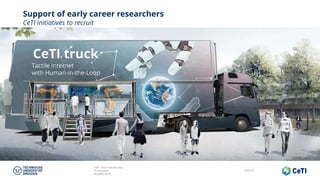

Tactile Internet
with Human-in-the-Loop
Slide 3
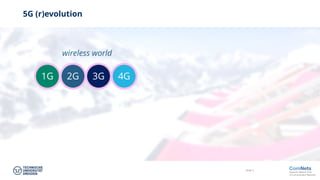
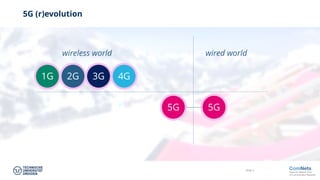
5G (r)evolution
1G 2G 3G 4G
wireless world
Slide 4
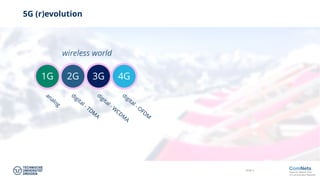
5G (r)evolution
1G 2G 3G 4G
wireless world
Slide 5
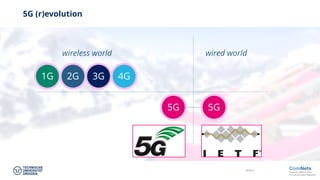
5G (r)evolution
1G 2G 3G 4G
5G
wireless world wired world
5G
1G 2G 3G 4G
5G 5G
Slide 6
5G (r)evolution
1G 2G 3G 4G
5G
wireless world wired world
5G
Slide 7
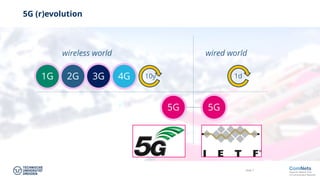
5G (r)evolution
1G 2G 3G 4G
5G
wireless world wired world
5G
10y 1d
Slide 8
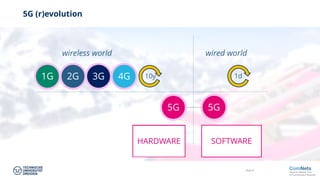
5G (r)evolution
1G 2G 3G 4G
5G
wireless world wired world
5G
10y 1d
HARDWARE SOFTWARE
1G 2G 3G 4G
5G
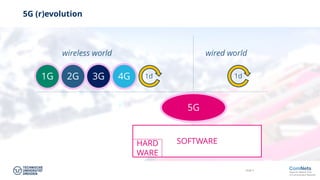
Slide 9
5G (r)evolution
1G 2G 3G 4G
wireless world wired world
1d 1d
SOFTWARE
1G 2G 3G 4G
5G
HARD
WARE
Slide 10
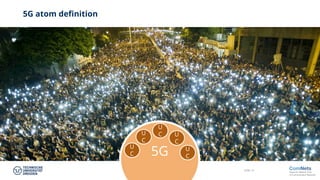
5G atom definition
5G
U
C
U
C
U
C
U
C
U
C
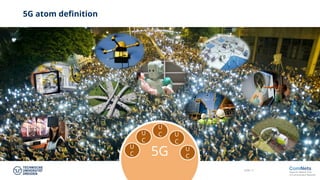
Slide 11
5G atom definition
5G
U
C
U
C
U
C
U
C
U
C
Slide 12
The Dream is not new!
Slide 13
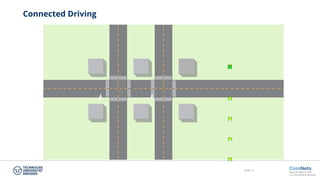
Connected Driving
Slide 14
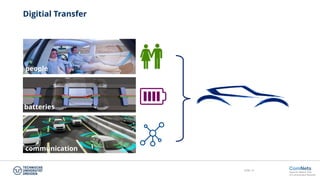
Digitial Transfer
batteries
communication
people
Slide 15
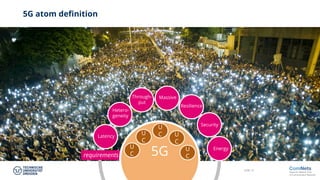
5G atom definition
Latency
Through-
put
Security
Massive
Resilience
Hetero-
geneity
Energy
requirements 5G
U
C
U
C
U
C
U
C
U
C
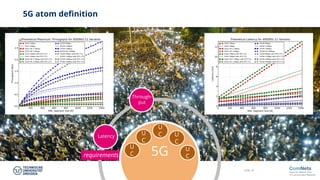
Slide 16
5G atom definition
Latency
requirements 5G
U
C
U
C
U
C
U
C
U
C
Slide 17
5G atom definition
Latency
requirements 5G
U
C
U
C
U
C
U
C
U
C
Slide 18
5G atom definition
Latency
Through-
put
requirements 5G
U
C
U
C
U
C
U
C
U
C
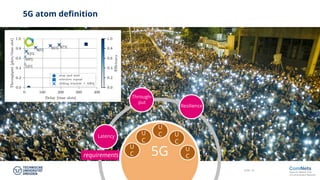
Slide 19
5G atom definition
Latency
Through-
put
Resilience
requirements 5G
U
C
U
C
U
C
U
C
U
C
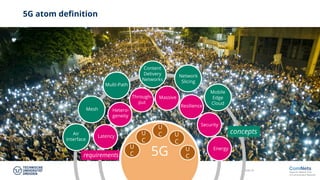
Slide 20
5G atom definition
Latency
Through-
put
Security
Massive
Resilience
Hetero-
geneity
Network
Slicing
Multi-Path
Mobile
Edge
Cloud
Air
Interface
Energy
Content
Delivery
Networks
concepts
requirements
Mesh
5G
U
C
U
C
U
C
U
C
U
C
Slide 21
Slide 22
Slide 23
Slide 24
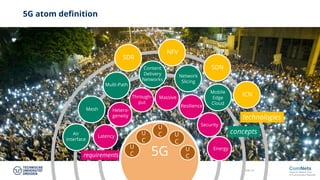
5G atom definition
Latency
Through-
put
Security
Massive
Resilience
Hetero-
geneity
Network
Slicing
Multi-Path
Mobile
Edge
Cloud
Air
Interface
SDN
ICN
NFV
SDR
Energy
Content
Delivery
Networks
concepts
technologies
requirements
Mesh
5G
U
C
U
C
U
C
U
C
U
C
Slide 25
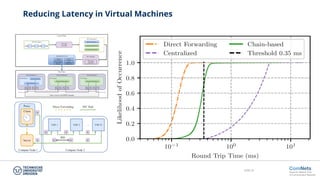
Reducing Latency in Virtual Machines
Slide 26
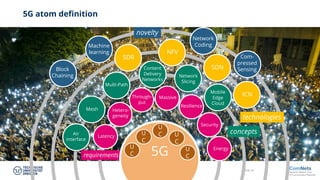
5G atom definition
Latency
Through-
put
Security
Massive
Resilience
Hetero-
geneity
Network
Coding
Network
Slicing
Multi-Path
Mobile
Edge
Cloud
Air
Interface
Com-
pressed
Sensing
Machine
learning
SDN
ICN
NFV
SDR
Energy
Content
Delivery
Networks
concepts
technologies
novelty
requirements
Mesh
Block
Chaining
5G
U
C
U
C
U
C
U
C
U
C
Source Coding and Network Coding
Slide 28
Slide 29
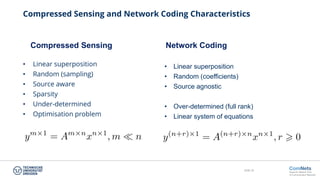
Compressed Sensing and Network Coding Characteristics
• Linear superposition
• Random (sampling)
• Source aware
• Sparsity
• Under-determined
• Optimisation problem
• Linear superposition
• Random (coefficients)
• Source agnostic
• Over-determined (full rank)
• Linear system of equations
Compressed Sensing Network Coding
Slide 30
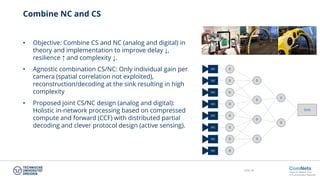
Combine NC and CS
• Objective: Combine CS and NC (analog and digital) in
theory and implementation to improve delay ↓,
resilience ↑ and complexity ↓.
• Agnostic combination CS/NC: Only individual gain per
camera (spatial correlation not exploited),
reconstruction/decoding at the sink resulting in high
complexity
• Proposed joint CS/NC design (analog and digital):
Holistic in-network processing based on compressed
compute and forward (CCF) with distributed partial
decoding and clever protocol design (active sensing).
SRC
SRC
SRC
SRC
SRC
SRC
SRC
SRC
R
R
R
R
R
R
R
R
R
R
R
R
R
R
Sink
Slide 31
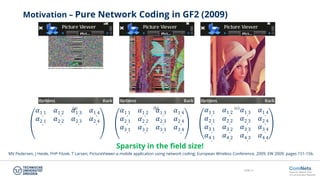
Motivation – Pure Network Coding in GF2 (2009)
𝛼𝛼1,1 𝛼𝛼1,2 𝛼𝛼1,3 𝛼𝛼1,4
𝛼𝛼2,1 𝛼𝛼2,2 𝛼𝛼2,3 𝛼𝛼2,4
𝛼𝛼1,1 𝛼𝛼1,2 𝛼𝛼1,3 𝛼𝛼1,4
𝛼𝛼2,1 𝛼𝛼2,2 𝛼𝛼2,3 𝛼𝛼2,4
𝛼𝛼3,1 𝛼𝛼3,2 𝛼𝛼3,3 𝛼𝛼3,4
𝛼𝛼1,1 𝛼𝛼1,2 𝛼𝛼1,3 𝛼𝛼1,4
𝛼𝛼2,1 𝛼𝛼2,2 𝛼𝛼2,3 𝛼𝛼2,4
𝛼𝛼3,1 𝛼𝛼3,2 𝛼𝛼3,3 𝛼𝛼3,4
𝛼𝛼4,1 𝛼𝛼4,2 𝛼𝛼4,3 𝛼𝛼4,4
Sparsity in the field size!
MV Pedersen, J Heide, FHP Fitzek, T Larsen; PictureViewer-a mobile application using network coding; European Wireless Conference, 2009; EW 2009; pages 151-156.
Slide 32
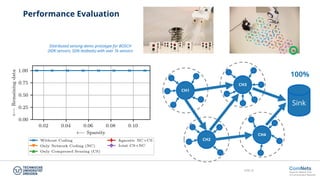
Performance Evaluation
CH1
CH2
CH3
CH4
Sink
100%
Distributed sensing demo prototype for BOSCH
(XDK sensors, SDN testbeds) with over 1k sensors
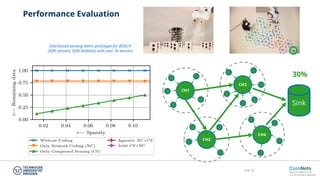
Slide 33
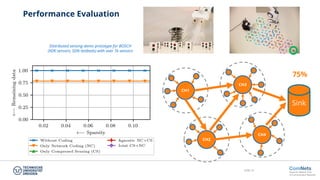
Performance Evaluation
CH1
CH2
CH3
CH4
Sink
75%
Distributed sensing demo prototype for BOSCH
(XDK sensors, SDN testbeds) with over 1k sensors
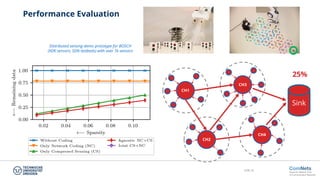
Slide 34
Performance Evaluation
CH1
CH2
CH3
CH4
Sink
30%
Distributed sensing demo prototype for BOSCH
(XDK sensors, SDN testbeds) with over 1k sensors
Slide 35
Performance Evaluation
CH1
CH2
CH3
CH4
Sink
25%
Distributed sensing demo prototype for BOSCH
(XDK sensors, SDN testbeds) with over 1k sensors
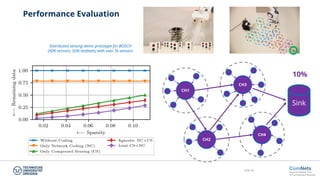
Slide 36
Performance Evaluation
CH1
CH2
CH3
CH4
Sink
10%
Distributed sensing demo prototype for BOSCH
(XDK sensors, SDN testbeds) with over 1k sensors
CeTI
Centre for Tactile Internet
with Human-in-the-Loop
CeTI short introduction
TU Dresden
October 2018
Folie 38
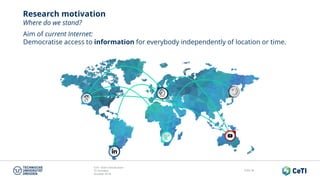
Research motivation
Where do we stand?
Aim of current Internet:
Democratise access to information for everybody independently of location or time.
CeTI short introduction
TU Dresden
October 2018
Folie 39
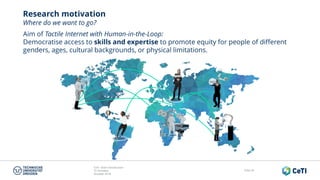
Research motivation
Where do we want to go?
Aim of Tactile Internet with Human-in-the-Loop:
Democratise access to skills and expertise to promote equity for people of different
genders, ages, cultural backgrounds, or physical limitations.
CeTI short introduction
TU Dresden
October 2018
Folie 40
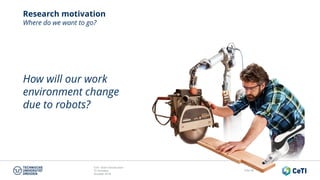
Research motivation
Where do we want to go?
How will our work
environment change
due to robots?
CeTI short introduction
TU Dresden
October 2018
Folie 41
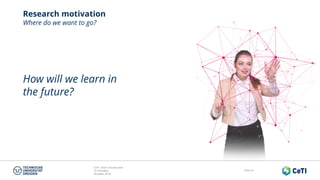
Research motivation
Where do we want to go?
How will we learn in
the future?
CeTI short introduction
TU Dresden
October 2018
Folie 42
Research motivation
Where do we want to go?
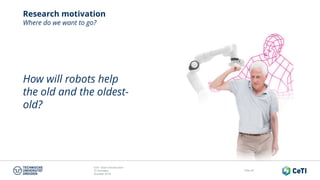
How will robots help
the old and the oldest-
old?
CeTI short introduction
TU Dresden
October 2018
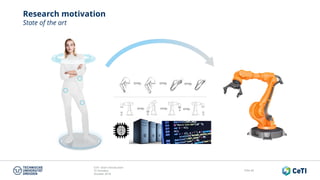
Folie 43
Research motivation
State of the art
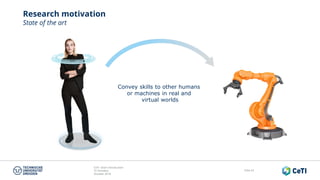
Convey skills to other humans
or machines in real and
virtual worlds
CeTI short introduction
TU Dresden
October 2018
Folie 44
Research motivation
State of the art
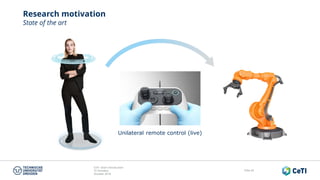
Unilateral remote control (live)
CeTI short introduction
TU Dresden
October 2018
Folie 45
Research motivation
State of the art
CeTI short introduction
TU Dresden
October 2018
Folie 46
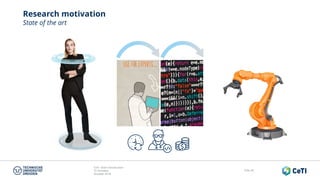
Research motivation
State of the art
CeTI short introduction
TU Dresden
October 2018
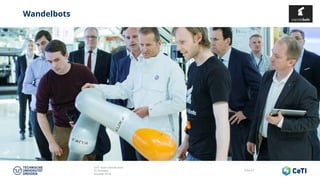
Folie 47
Wandelbots
CeTI short introduction
TU Dresden
October 2018
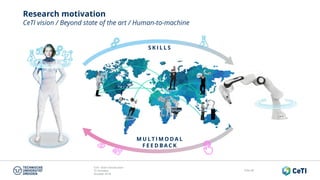
Folie 48
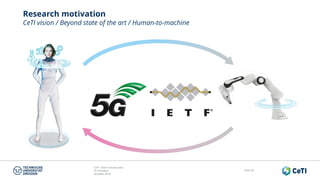
Research motivation
CeTI vision / Beyond state of the art / Human-to-machine
S K I L L S
M U L T I M O D A L
F E E D B A C K
CeTI short introduction
TU Dresden
October 2018
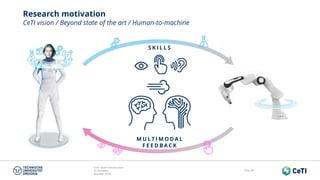
Folie 49
Research motivation
CeTI vision / Beyond state of the art / Human-to-machine
S K I L L S
M U L T I M O D A L
F E E D B A C K
CeTI short introduction
TU Dresden
October 2018
Folie 50
Research motivation
CeTI vision / Beyond state of the art / Human-to-machine
CeTI short introduction
TU Dresden
October 2018
Folie 51
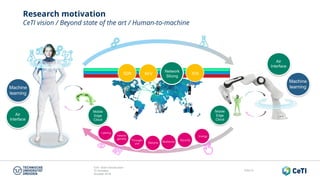
Research motivation
CeTI vision / Beyond state of the art / Human-to-machine
Mobile
Edge
Cloud
Mobile
Edge
Cloud
Machine
learning
Machine
learning
Network
Slicing
SDN ICNNFV
Air
Interface
Air
Interface
Latency
Through-
put
Security
Massive Resilience
Hetero-
geneity
Energy
CeTI short introduction
TU Dresden
October 2018
Folie 52
Research motivation
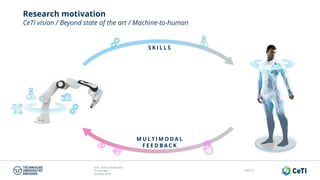
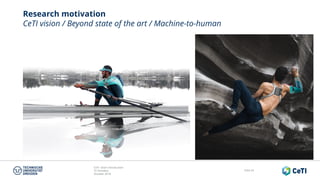
CeTI vision / Beyond state of the art / Machine-to-human
S K I L L S
M U L T I M O D A L
F E E D B A C K
CeTI short introduction
TU Dresden
October 2018
Folie 53
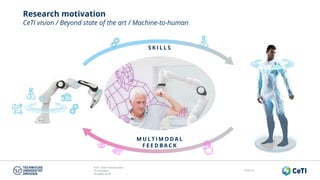
Research motivation
CeTI vision / Beyond state of the art / Machine-to-human
S K I L L S
M U L T I M O D A L
F E E D B A C K
CeTI short introduction
TU Dresden
October 2018
Folie 54
Research motivation
CeTI vision / Beyond state of the art / Machine-to-human
CeTI short introduction
TU Dresden
October 2018
Folie 55
Research motivation
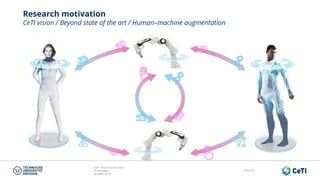
CeTI vision / Beyond state of the art / Human–machine augmentation
CeTI short introduction
TU Dresden
October 2018
Folie 56
Research motivation
CeTI multifaceted impact
Research Society
https://www.facebook.com/telexistence/videos/27511996973
0409/
https://www.facebook.com/telexistence/videos/27511996973
0409/
CeTI short introduction
TU Dresden
October 2018
Folie 57
CeTI latency challenge
CeTI short introduction
TU Dresden
October 2018
Folie 58
CeTI latency challenge
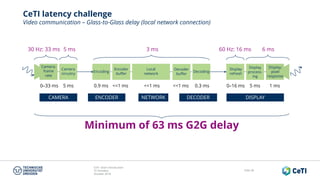
Video communication – Glass-to-Glass delay (local network connection)
Camera
circuitry
Display
refresh
Display:
pixel
response
Camera:
frame
rate
0–33 ms 5 ms 0.9 ms <<1 ms <<1 ms <<1 ms 0.3 ms 0–16 ms 5 ms 1 ms
Encoding
Local
network
Encoder
buffer
3 ms
Minimum of 63 ms G2G delay
6 ms60 Hz: 16 ms5 ms30 Hz: 33 ms
Decoding
Decoder
buffer
CAMERA ENCODER NETWORK DECODER DISPLAY
Display
process-
ing
CeTI short introduction
TU Dresden
October 2018
Folie 59
CeTI latency challenge
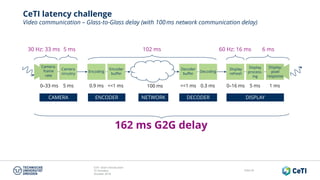
Video communication – Glass-to-Glass delay (with 100ms network communication delay)
Camera
circuitry
CAMERA
Display
process-
ing
Display:
pixel
response
ENCODER NETWORK DECODER DISPLAY
Camera:
frame
rate
0–33 ms 5 ms 0.9 ms <<1 ms <<1 ms 0.3 ms 0–16 ms 5 ms 1 ms
Encoding
Encoder
buffer
Decoder
buffer
Decoding
102 ms 6 ms60 Hz: 16 ms5 ms30 Hz: 33 ms
162 ms G2G delay
100 ms
Display
refresh
CeTI short introduction
TU Dresden
October 2018
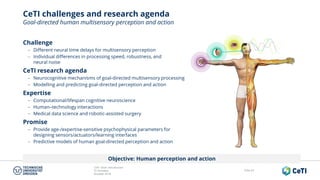
Folie 60
CeTI challenges and research agenda
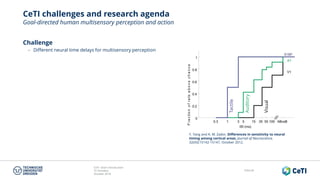
Goal-directed human multisensory perception and action
Y. Yang and A. M. Zador, Differences in sensitivity to neural
timing among cortical areas, Journal of Neuroscience,
32(43):15142-15147, October 2012.
Challenge
− Different neural time delays for multisensory perception
Tactile
Auditory
Visual
CeTI short introduction
TU Dresden
October 2018
Folie 61
CeTI challenges and research agenda
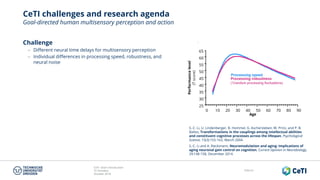
Goal-directed human multisensory perception and action
Challenge
− Different neural time delays for multisensory perception
− Individual differences in processing speed, robustness, and
neural noise
S.-C. Li, U. Lindenberger, B. Hommel, G. Aschersleben, W. Prinz, and P. B.
Baltes, Transformations in the couplings among intellectual abilities
and constituent cognitive processes across the lifespan, Psychological
Science, 15(3):155-163, March 2004.
S.-C. Li and A. Rieckmann, Neuromodulation and aging: Implications of
aging neuronal gain control on cognition, Current Opinion in Neurobiology,
29:148-158, December 2014.
CeTI short introduction
TU Dresden
October 2018
Folie 62
CeTI challenges and research agenda
Goal-directed human multisensory perception and action
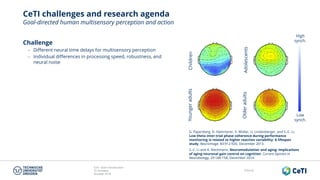
G. Papenberg, D. Hämmerer, V. Müller, U. Lindenberger, and S.-C. Li,
Low theta inter-trial phase coherence during performance
monitoring is related to higher reaction variability: A lifespan
study, NeuroImage, 83:912-920, December 2013.
S.-C. Li and A. Rieckmann, Neuromodulation and aging: Implications
of aging neuronal gain control on cognition, Current Opinion in
Neurobiology, 29:148-158, December 2014.
Challenge
− Different neural time delays for multisensory perception
− Individual differences in processing speed, robustness, and
neural noise
Children
Adolescents
Youngeradults
Olderadults
High
synch.
Low
synch.
CeTI short introduction
TU Dresden
October 2018
Folie 63
CeTI challenges and research agenda
Goal-directed human multisensory perception and action
Objective: Human perception and action
Challenge
− Different neural time delays for multisensory perception
− Individual differences in processing speed, robustness, and
neural noise
CeTI research agenda
− Neurocognitive mechanisms of goal-directed multisensory processing
− Modelling and predicting goal-directed perception and action
Expertise
− Computational/lifespan cognitive neuroscience
− Human‒technology interactions
− Medical data science and robotic-assisted surgery
Promise
− Provide age-/expertise-sensitive psychophysical parameters for
designing sensors/actuators/learning interfaces
− Predictive models of human goal-directed perception and action
CeTI short introduction
TU Dresden
October 2018
Folie 64
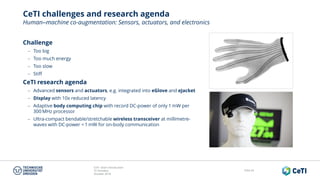
CeTI challenges and research agenda
Human‒machine co-augmentation: Sensors, actuators, and electronics
Challenge
− Too big
− Too much energy
− Too slow
− Stiff
CeTI research agenda
− Advanced sensors and actuators, e.g. integrated into eGlove and eJacket
− Display with 10x reduced latency
− Adaptive body computing chip with record DC-power of only 1 mW per
300 MHz processor
− Ultra-compact bendable/stretchable wireless transceiver at millimetre-
waves with DC-power < 1 mW for on-body communication
CeTI short introduction
TU Dresden
October 2018
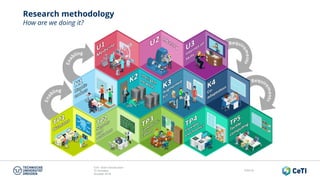
Folie 65
Research methodology
How are we doing it?
CeTI short introduction
TU Dresden
October 2018
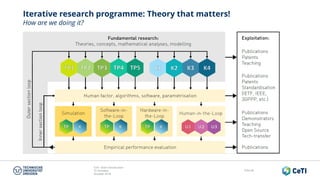
Folie 66
Iterative research programme: Theory that matters!
How are we doing it?
CeTI short introduction
TU Dresden
October 2018
Folie 67
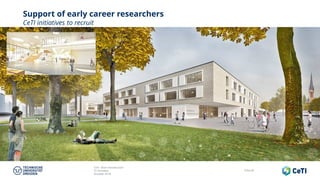
Support of early career researchers
CeTI initiatives to recruit
CeTI short introduction
TU Dresden
October 2018
Folie 68
Support of early career researchers
CeTI initiatives to recruit
CeTI short introduction
TU Dresden
October 2018
Folie 69
www.ceti.one
ceti.tu-dresden.de

Tactile Internet with Human-in-the-Loop

  • 1.
  • 3.
    Slide 3 5G (r)evolution 1G2G 3G 4G wireless world
  • 4.
    Slide 4 5G (r)evolution 1G2G 3G 4G wireless world
  • 5.
    Slide 5 5G (r)evolution 1G2G 3G 4G 5G wireless world wired world 5G 1G 2G 3G 4G 5G 5G
  • 6.
    Slide 6 5G (r)evolution 1G2G 3G 4G 5G wireless world wired world 5G
  • 7.
    Slide 7 5G (r)evolution 1G2G 3G 4G 5G wireless world wired world 5G 10y 1d
  • 8.
    Slide 8 5G (r)evolution 1G2G 3G 4G 5G wireless world wired world 5G 10y 1d HARDWARE SOFTWARE 1G 2G 3G 4G 5G
  • 9.
    Slide 9 5G (r)evolution 1G2G 3G 4G wireless world wired world 1d 1d SOFTWARE 1G 2G 3G 4G 5G HARD WARE
  • 10.
    Slide 10 5G atomdefinition 5G U C U C U C U C U C
  • 11.
    Slide 11 5G atomdefinition 5G U C U C U C U C U C
  • 12.
    Slide 12 The Dreamis not new!
  • 13.
  • 14.
  • 15.
    Slide 15 5G atomdefinition Latency Through- put Security Massive Resilience Hetero- geneity Energy requirements 5G U C U C U C U C U C
  • 16.
    Slide 16 5G atomdefinition Latency requirements 5G U C U C U C U C U C
  • 17.
    Slide 17 5G atomdefinition Latency requirements 5G U C U C U C U C U C
  • 18.
    Slide 18 5G atomdefinition Latency Through- put requirements 5G U C U C U C U C U C
  • 19.
    Slide 19 5G atomdefinition Latency Through- put Resilience requirements 5G U C U C U C U C U C
  • 20.
    Slide 20 5G atomdefinition Latency Through- put Security Massive Resilience Hetero- geneity Network Slicing Multi-Path Mobile Edge Cloud Air Interface Energy Content Delivery Networks concepts requirements Mesh 5G U C U C U C U C U C
  • 21.
  • 22.
  • 23.
  • 24.
    Slide 24 5G atomdefinition Latency Through- put Security Massive Resilience Hetero- geneity Network Slicing Multi-Path Mobile Edge Cloud Air Interface SDN ICN NFV SDR Energy Content Delivery Networks concepts technologies requirements Mesh 5G U C U C U C U C U C
  • 25.
    Slide 25 Reducing Latencyin Virtual Machines
  • 26.
    Slide 26 5G atomdefinition Latency Through- put Security Massive Resilience Hetero- geneity Network Coding Network Slicing Multi-Path Mobile Edge Cloud Air Interface Com- pressed Sensing Machine learning SDN ICN NFV SDR Energy Content Delivery Networks concepts technologies novelty requirements Mesh Block Chaining 5G U C U C U C U C U C
  • 27.
    Source Coding andNetwork Coding
  • 28.
  • 29.
    Slide 29 Compressed Sensingand Network Coding Characteristics • Linear superposition • Random (sampling) • Source aware • Sparsity • Under-determined • Optimisation problem • Linear superposition • Random (coefficients) • Source agnostic • Over-determined (full rank) • Linear system of equations Compressed Sensing Network Coding
  • 30.
    Slide 30 Combine NCand CS • Objective: Combine CS and NC (analog and digital) in theory and implementation to improve delay ↓, resilience ↑ and complexity ↓. • Agnostic combination CS/NC: Only individual gain per camera (spatial correlation not exploited), reconstruction/decoding at the sink resulting in high complexity • Proposed joint CS/NC design (analog and digital): Holistic in-network processing based on compressed compute and forward (CCF) with distributed partial decoding and clever protocol design (active sensing). SRC SRC SRC SRC SRC SRC SRC SRC R R R R R R R R R R R R R R Sink
  • 31.
    Slide 31 Motivation –Pure Network Coding in GF2 (2009) 𝛼𝛼1,1 𝛼𝛼1,2 𝛼𝛼1,3 𝛼𝛼1,4 𝛼𝛼2,1 𝛼𝛼2,2 𝛼𝛼2,3 𝛼𝛼2,4 𝛼𝛼1,1 𝛼𝛼1,2 𝛼𝛼1,3 𝛼𝛼1,4 𝛼𝛼2,1 𝛼𝛼2,2 𝛼𝛼2,3 𝛼𝛼2,4 𝛼𝛼3,1 𝛼𝛼3,2 𝛼𝛼3,3 𝛼𝛼3,4 𝛼𝛼1,1 𝛼𝛼1,2 𝛼𝛼1,3 𝛼𝛼1,4 𝛼𝛼2,1 𝛼𝛼2,2 𝛼𝛼2,3 𝛼𝛼2,4 𝛼𝛼3,1 𝛼𝛼3,2 𝛼𝛼3,3 𝛼𝛼3,4 𝛼𝛼4,1 𝛼𝛼4,2 𝛼𝛼4,3 𝛼𝛼4,4 Sparsity in the field size! MV Pedersen, J Heide, FHP Fitzek, T Larsen; PictureViewer-a mobile application using network coding; European Wireless Conference, 2009; EW 2009; pages 151-156.
  • 32.
    Slide 32 Performance Evaluation CH1 CH2 CH3 CH4 Sink 100% Distributedsensing demo prototype for BOSCH (XDK sensors, SDN testbeds) with over 1k sensors
  • 33.
    Slide 33 Performance Evaluation CH1 CH2 CH3 CH4 Sink 75% Distributedsensing demo prototype for BOSCH (XDK sensors, SDN testbeds) with over 1k sensors
  • 34.
    Slide 34 Performance Evaluation CH1 CH2 CH3 CH4 Sink 30% Distributedsensing demo prototype for BOSCH (XDK sensors, SDN testbeds) with over 1k sensors
  • 35.
    Slide 35 Performance Evaluation CH1 CH2 CH3 CH4 Sink 25% Distributedsensing demo prototype for BOSCH (XDK sensors, SDN testbeds) with over 1k sensors
  • 36.
    Slide 36 Performance Evaluation CH1 CH2 CH3 CH4 Sink 10% Distributedsensing demo prototype for BOSCH (XDK sensors, SDN testbeds) with over 1k sensors
  • 37.
    CeTI Centre for TactileInternet with Human-in-the-Loop
  • 38.
    CeTI short introduction TUDresden October 2018 Folie 38 Research motivation Where do we stand? Aim of current Internet: Democratise access to information for everybody independently of location or time.
  • 39.
    CeTI short introduction TUDresden October 2018 Folie 39 Research motivation Where do we want to go? Aim of Tactile Internet with Human-in-the-Loop: Democratise access to skills and expertise to promote equity for people of different genders, ages, cultural backgrounds, or physical limitations.
  • 40.
    CeTI short introduction TUDresden October 2018 Folie 40 Research motivation Where do we want to go? How will our work environment change due to robots?
  • 41.
    CeTI short introduction TUDresden October 2018 Folie 41 Research motivation Where do we want to go? How will we learn in the future?
  • 42.
    CeTI short introduction TUDresden October 2018 Folie 42 Research motivation Where do we want to go? How will robots help the old and the oldest- old?
  • 43.
    CeTI short introduction TUDresden October 2018 Folie 43 Research motivation State of the art Convey skills to other humans or machines in real and virtual worlds
  • 44.
    CeTI short introduction TUDresden October 2018 Folie 44 Research motivation State of the art Unilateral remote control (live)
  • 45.
    CeTI short introduction TUDresden October 2018 Folie 45 Research motivation State of the art
  • 46.
    CeTI short introduction TUDresden October 2018 Folie 46 Research motivation State of the art
  • 47.
    CeTI short introduction TUDresden October 2018 Folie 47 Wandelbots
  • 48.
    CeTI short introduction TUDresden October 2018 Folie 48 Research motivation CeTI vision / Beyond state of the art / Human-to-machine S K I L L S M U L T I M O D A L F E E D B A C K
  • 49.
    CeTI short introduction TUDresden October 2018 Folie 49 Research motivation CeTI vision / Beyond state of the art / Human-to-machine S K I L L S M U L T I M O D A L F E E D B A C K
  • 50.
    CeTI short introduction TUDresden October 2018 Folie 50 Research motivation CeTI vision / Beyond state of the art / Human-to-machine
  • 51.
    CeTI short introduction TUDresden October 2018 Folie 51 Research motivation CeTI vision / Beyond state of the art / Human-to-machine Mobile Edge Cloud Mobile Edge Cloud Machine learning Machine learning Network Slicing SDN ICNNFV Air Interface Air Interface Latency Through- put Security Massive Resilience Hetero- geneity Energy
  • 52.
    CeTI short introduction TUDresden October 2018 Folie 52 Research motivation CeTI vision / Beyond state of the art / Machine-to-human S K I L L S M U L T I M O D A L F E E D B A C K
  • 53.
    CeTI short introduction TUDresden October 2018 Folie 53 Research motivation CeTI vision / Beyond state of the art / Machine-to-human S K I L L S M U L T I M O D A L F E E D B A C K
  • 54.
    CeTI short introduction TUDresden October 2018 Folie 54 Research motivation CeTI vision / Beyond state of the art / Machine-to-human
  • 55.
    CeTI short introduction TUDresden October 2018 Folie 55 Research motivation CeTI vision / Beyond state of the art / Human–machine augmentation
  • 56.
    CeTI short introduction TUDresden October 2018 Folie 56 Research motivation CeTI multifaceted impact Research Society https://www.facebook.com/telexistence/videos/27511996973 0409/ https://www.facebook.com/telexistence/videos/27511996973 0409/
  • 57.
    CeTI short introduction TUDresden October 2018 Folie 57 CeTI latency challenge
  • 58.
    CeTI short introduction TUDresden October 2018 Folie 58 CeTI latency challenge Video communication – Glass-to-Glass delay (local network connection) Camera circuitry Display refresh Display: pixel response Camera: frame rate 0–33 ms 5 ms 0.9 ms <<1 ms <<1 ms <<1 ms 0.3 ms 0–16 ms 5 ms 1 ms Encoding Local network Encoder buffer 3 ms Minimum of 63 ms G2G delay 6 ms60 Hz: 16 ms5 ms30 Hz: 33 ms Decoding Decoder buffer CAMERA ENCODER NETWORK DECODER DISPLAY Display process- ing
  • 59.
    CeTI short introduction TUDresden October 2018 Folie 59 CeTI latency challenge Video communication – Glass-to-Glass delay (with 100ms network communication delay) Camera circuitry CAMERA Display process- ing Display: pixel response ENCODER NETWORK DECODER DISPLAY Camera: frame rate 0–33 ms 5 ms 0.9 ms <<1 ms <<1 ms 0.3 ms 0–16 ms 5 ms 1 ms Encoding Encoder buffer Decoder buffer Decoding 102 ms 6 ms60 Hz: 16 ms5 ms30 Hz: 33 ms 162 ms G2G delay 100 ms Display refresh
  • 60.
    CeTI short introduction TUDresden October 2018 Folie 60 CeTI challenges and research agenda Goal-directed human multisensory perception and action Y. Yang and A. M. Zador, Differences in sensitivity to neural timing among cortical areas, Journal of Neuroscience, 32(43):15142-15147, October 2012. Challenge − Different neural time delays for multisensory perception Tactile Auditory Visual
  • 61.
    CeTI short introduction TUDresden October 2018 Folie 61 CeTI challenges and research agenda Goal-directed human multisensory perception and action Challenge − Different neural time delays for multisensory perception − Individual differences in processing speed, robustness, and neural noise S.-C. Li, U. Lindenberger, B. Hommel, G. Aschersleben, W. Prinz, and P. B. Baltes, Transformations in the couplings among intellectual abilities and constituent cognitive processes across the lifespan, Psychological Science, 15(3):155-163, March 2004. S.-C. Li and A. Rieckmann, Neuromodulation and aging: Implications of aging neuronal gain control on cognition, Current Opinion in Neurobiology, 29:148-158, December 2014.
  • 62.
    CeTI short introduction TUDresden October 2018 Folie 62 CeTI challenges and research agenda Goal-directed human multisensory perception and action G. Papenberg, D. Hämmerer, V. Müller, U. Lindenberger, and S.-C. Li, Low theta inter-trial phase coherence during performance monitoring is related to higher reaction variability: A lifespan study, NeuroImage, 83:912-920, December 2013. S.-C. Li and A. Rieckmann, Neuromodulation and aging: Implications of aging neuronal gain control on cognition, Current Opinion in Neurobiology, 29:148-158, December 2014. Challenge − Different neural time delays for multisensory perception − Individual differences in processing speed, robustness, and neural noise Children Adolescents Youngeradults Olderadults High synch. Low synch.
  • 63.
    CeTI short introduction TUDresden October 2018 Folie 63 CeTI challenges and research agenda Goal-directed human multisensory perception and action Objective: Human perception and action Challenge − Different neural time delays for multisensory perception − Individual differences in processing speed, robustness, and neural noise CeTI research agenda − Neurocognitive mechanisms of goal-directed multisensory processing − Modelling and predicting goal-directed perception and action Expertise − Computational/lifespan cognitive neuroscience − Human‒technology interactions − Medical data science and robotic-assisted surgery Promise − Provide age-/expertise-sensitive psychophysical parameters for designing sensors/actuators/learning interfaces − Predictive models of human goal-directed perception and action
  • 64.
    CeTI short introduction TUDresden October 2018 Folie 64 CeTI challenges and research agenda Human‒machine co-augmentation: Sensors, actuators, and electronics Challenge − Too big − Too much energy − Too slow − Stiff CeTI research agenda − Advanced sensors and actuators, e.g. integrated into eGlove and eJacket − Display with 10x reduced latency − Adaptive body computing chip with record DC-power of only 1 mW per 300 MHz processor − Ultra-compact bendable/stretchable wireless transceiver at millimetre- waves with DC-power < 1 mW for on-body communication
  • 65.
    CeTI short introduction TUDresden October 2018 Folie 65 Research methodology How are we doing it?
  • 66.
    CeTI short introduction TUDresden October 2018 Folie 66 Iterative research programme: Theory that matters! How are we doing it?
  • 67.
    CeTI short introduction TUDresden October 2018 Folie 67 Support of early career researchers CeTI initiatives to recruit
  • 68.
    CeTI short introduction TUDresden October 2018 Folie 68 Support of early career researchers CeTI initiatives to recruit
  • 69.
    CeTI short introduction TUDresden October 2018 Folie 69 www.ceti.one ceti.tu-dresden.de