CS 414 - Spring 2010
CS 414 – Multimedia Systems Design
Lecture 10 – MPEG-1 Video
and MP3 Audio) (Part 5)
Klara Nahrstedt
Spring 2010
CS 414 - Spring 2010
Administrative
 MP2 posted on February 9 and deadline
will be March 1
 MP2 demos – Monday, March 1, 5-7pm,
0216 SC
 Please, start early
 We will have a discussion section next
week for MP2
Outline
 Few Comments about losses that occur in
JPEG (and similar in MPEG later on)
 MPEG-1 Hybrid Coding
 MP3 Audio Encoding
 Reading:
 Required: Media Coding Book, Section 7.7.1-7.7.4 and lectures
 Recommended Paper on MP3: Davis Pan, “A Tutorial on MPEG/Audio
Compression”, IEEE Multimedia, pp. 6-74, 1995
 Recommended books on JPEG/ MPEG Audio/Video Fundamentals:
 Haskell, Puri, Netravali, “Digital Video: An Introduction to MPEG-2”,
Chapman and Hall, 1996
 Pennebaker, Mitchel, “JPEG: Still Image Data Compression Standard,
VNR Publisher, 1993
CS 414 - Spring 2010
Comment on JPEG Losses
 Losses in JPEG compression occur during the
quantization because S(u,v)’ = Round(S(u,v)/Q(u,v)).
1. Image Preparation =>
2. DCT Transform S(u,v) = DCT(S(x,y)) =>
3. Quantization with S(u,v)’ = Round(S(u,v)/Q(u,v) =>
4. Entropy Encoding =>
5. Transmission of compressed Image =>
6. Entropy Decoding =>
7. De-quantization S(u,v)’’ = S(u,v)’*Q(u,v) Compression Loss
since S(u,v)” ≠ S(u,v) =>
8. Apply Inverse DCT =>
9. Display Image CS 414 - Spring 2010
Motion Picture Expert Group
(MPEG)
 General Information about MPEG
Began in 1988; Part of Same ISO as JPEG
 MPEG-1/Video
 MPEG/Audio – MP3
 MPEG-2
 MPEG-4
 MPEG-7
 MPEG-21 CS 414 - Spring 2010
MPEG General Information
 Goal: data compression 1.5 Mbps
 MPEG defines video, audio coding and
system data streams with synchronization
 MPEG information
Aspect ratios: 1:1 (CRT), 4:3 (NTSC), 16:9
(HDTV)
Refresh frequencies: 23.975, 24, 25, 29.97,
50, 59.94, 60 Hz
CS 414 - Spring 2010
MPEG Image Preparation
(Resolution and Dimension)
 MPEG defines exactly format
 Three components: Luminance and two chrominance
components (2:1:1)
 Resolution of luminance comp:X1 ≤ 768; Y1 ≤ 576
pixels
 Pixel precision is 8 bits for each component
 Example of Video format: 352x240 pixels, 30
fps; chrominance components: 176x120 pixels
CS 414 - Spring 2010
MPEG Image Preparation -
Blocks
 Each image is divided into macro-blocks
 Macro-block : 16x16 pixels for luminance;
8x8 for each chrominance component
 Macro-blocks are useful for Motion
Estimation
 No MCUs which implies sequential non-
interleaving order of pixels values
CS 414 - Spring 2010
MPEG Video Processing
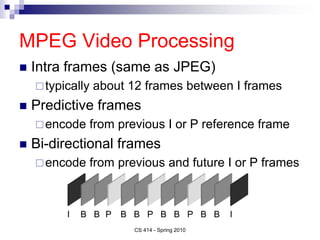
 Intra frames (same as JPEG)
typically about 12 frames between I frames
 Predictive frames
encode from previous I or P reference frame
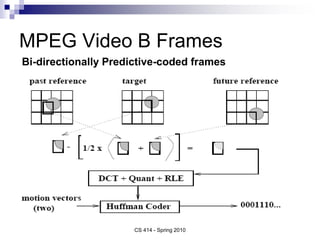
 Bi-directional frames
encode from previous and future I or P frames
CS 414 - Spring 2010
I P I
P P
B B B B B B B B
Selecting I, P, or B Frames
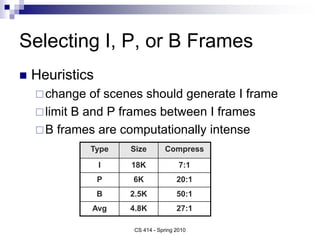
 Heuristics
change of scenes should generate I frame
limit B and P frames between I frames
B frames are computationally intense
Type Size Compress
I 18K 7:1
P 6K 20:1
B 2.5K 50:1
Avg 4.8K 27:1
CS 414 - Spring 2010
MPEG Video I-Frames
CS 414 - Spring 2010
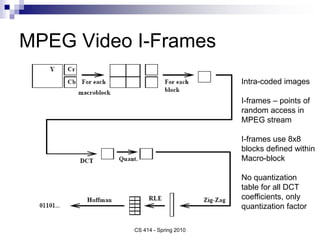
Intra-coded images
I-frames – points of
random access in
MPEG stream
I-frames use 8x8
blocks defined within
Macro-block
No quantization
table for all DCT
coefficients, only
quantization factor
MPEG Video P-Frames
CS 414 - Spring 2010
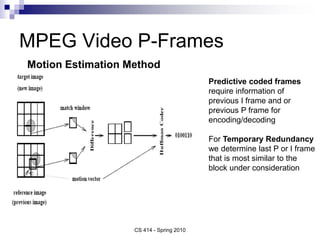
Predictive coded frames
require information of
previous I frame and or
previous P frame for
encoding/decoding
For Temporary Redundancy
we determine last P or I frame
that is most similar to the
block under consideration
Motion Estimation Method
Motion Computation for P
Frames
 Predictive search
 Look for match window within a given
search window
Match window – macro-block
Search window – arbitrary window size
depending how far away are we willing to look
 Displacement of two match windows is
expressed by motion vector
CS 414 - Spring 2010
Matching Methods
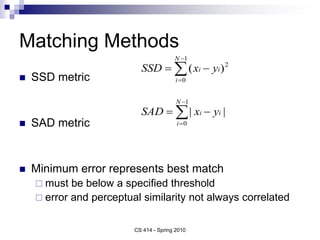
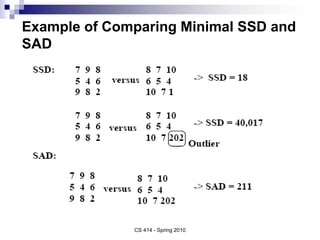
 SSD metric
 SAD metric
 Minimum error represents best match
 must be below a specified threshold
 error and perceptual similarity not always correlated





1
0
2
)
(
N
i
i
i y
x
SSD





1
0
|
|
N
i
i
i y
x
SAD
CS 414 - Spring 2010
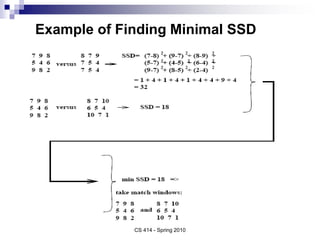
Example of Finding Minimal SSD
CS 414 - Spring 2010
Example of Comparing Minimal SSD and
SAD
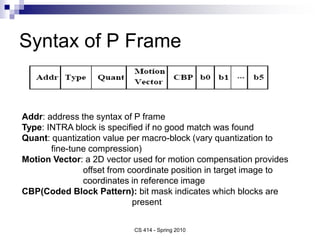
Syntax of P Frame
CS 414 - Spring 2010
Addr: address the syntax of P frame
Type: INTRA block is specified if no good match was found
Quant: quantization value per macro-block (vary quantization to
fine-tune compression)
Motion Vector: a 2D vector used for motion compensation provides
offset from coordinate position in target image to
coordinates in reference image
CBP(Coded Block Pattern): bit mask indicates which blocks are
present
MPEG Video B Frames
CS 414 - Spring 2010
Bi-directionally Predictive-coded frames
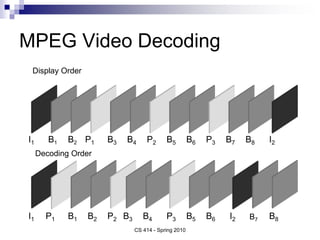
MPEG Video Decoding
CS 414 - Spring 2010
I1 P1 I2
P2 P3
B1 B2 B3 B4 B5 B6 B7 B8
B2
I1 P1 I2
P2 P3
B1 B3 B4 B5 B6 B7 B8
Display Order
Decoding Order
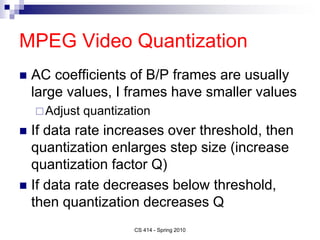
MPEG Video Quantization
 AC coefficients of B/P frames are usually
large values, I frames have smaller values
Adjust quantization
 If data rate increases over threshold, then
quantization enlarges step size (increase
quantization factor Q)
 If data rate decreases below threshold,
then quantization decreases Q
CS 414 - Spring 2010
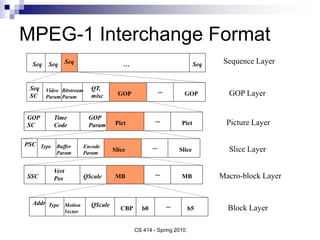
MPEG-1 Interchange Format
CS 414 - Spring 2010
GOP GOP
...
Seq Seq Seq
…
Seq
Seq
SC
Video
Param
Bitstream
Param
QT,
misc
Pict Pict
...
GOP
SC
GOP
Param
Time
Code
MB MB
...
SSC QScale
Vert
Pos
Slice Slice
...
PSC Type Buffer
Param
Encode
Param
CBP b5
...
Addr Type Motion
Vector
QScale
b0
GOP Layer
Sequence Layer
Picture Layer
Slice Layer
Macro-block Layer
Block Layer
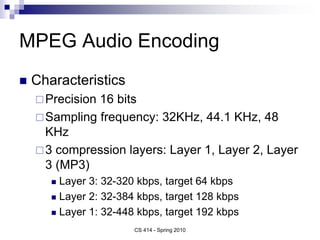
MPEG Audio Encoding
 Characteristics
Precision 16 bits
Sampling frequency: 32KHz, 44.1 KHz, 48
KHz
3 compression layers: Layer 1, Layer 2, Layer
3 (MP3)
 Layer 3: 32-320 kbps, target 64 kbps
 Layer 2: 32-384 kbps, target 128 kbps
 Layer 1: 32-448 kbps, target 192 kbps
CS 414 - Spring 2010
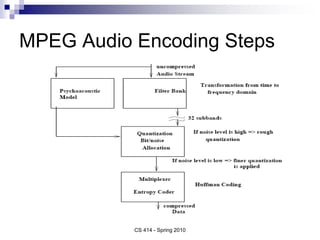
MPEG Audio Encoding Steps
CS 414 - Spring 2010
MPEG Audio Filter Bank
 Filter bank divides input into multiple sub-bands
(32 equal frequency sub-bands)
 Sub-band i defined
 - filter output sample for sub-band
i at time t, C[n] – one of 512 coefficients, x[n] –
audio input sample from 512 sample buffer
CS 414 - Spring 2010
]
64
[
*
]
64
[
(
*
64
)
16
)(
1
2
(
cos(
3
]
[
7
0
7
0
j
k
x
j
k
C
k
i
i
S
j
k
t 



 
 


]
[
],
31
,
0
[ i
S
i t

MPEG Audio Psycho-acoustic
Model
 MPEG audio compresses by removing
acoustically irrelevant parts of audio signals
 Takes advantage of human auditory systems
inability to hear quantization noise under
auditory masking
 Auditory masking: occurs when ever the
presence of a strong audio signal makes a
temporal or spectral neighborhood of weaker
audio signals imperceptible.
CS 414 - Spring 2010
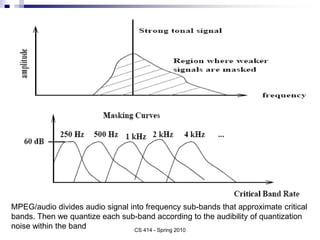
MPEG/audio divides audio signal into frequency sub-bands that approximate critical
bands. Then we quantize each sub-band according to the audibility of quantization
noise within the band
MPEG Audio Bit Allocation
 This process determines number of code bits allocated to
each sub-band based on information from the psycho-
acoustic model
 Algorithm:
1. Compute mask-to-noise ratio: MNR=SNR-SMR
 Standard provides tables that give estimates for SNR resulting
from quantizing to a given number of quantizer levels
2. Get MNR for each sub-band
3. Search for sub-band with the lowest MNR
4. Allocate code bits to this sub-band.
 If sub-band gets allocated more code bits than appropriate, look
up new estimate of SNR and repeat step 1
CS 414 - Spring 2010
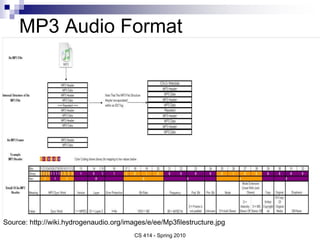
MP3 Audio Format
CS 414 - Spring 2010
Source: http://wiki.hydrogenaudio.org/images/e/ee/Mp3filestructure.jpg
MPEG Audio Comments
 Precision of 16 bits per sample is needed to get
good SNR ratio
 Noise we are getting is quantization noise from
the digitization process
 For each added bit, we get 6dB better SNR ratio
 Masking effect means that we can raise the
noise floor around a strong sound because the
noise will be masked away
 Raising noise floor is the same as using less bits
and using less bits is the same as compression
CS 414 - Spring 2010
Conclusion
 MPEG system data stream
 Interchange format for audio and video streams
 Interleave audio and video packets; insert time stamps into each “frame”
of data
 Synchronization
 SRC – system clock reference; DTS – decoding time stamp; PTS –
presentation time stamp
 During encoding
 Insert SCR values into system stream
 Stamp each frame with PTS and DTS
 Use encode time to approximate decode time
 During decoding
 Initialize local decoder clock with start values
 Compare PTS to the value of local clock
 Periodically synchronize local clock to SCR
CS 414 - Spring 2010

lect10-mpeg1.ppt

  • 1.
    CS 414 -Spring 2010 CS 414 – Multimedia Systems Design Lecture 10 – MPEG-1 Video and MP3 Audio) (Part 5) Klara Nahrstedt Spring 2010
  • 2.
    CS 414 -Spring 2010 Administrative  MP2 posted on February 9 and deadline will be March 1  MP2 demos – Monday, March 1, 5-7pm, 0216 SC  Please, start early  We will have a discussion section next week for MP2
  • 3.
    Outline  Few Commentsabout losses that occur in JPEG (and similar in MPEG later on)  MPEG-1 Hybrid Coding  MP3 Audio Encoding  Reading:  Required: Media Coding Book, Section 7.7.1-7.7.4 and lectures  Recommended Paper on MP3: Davis Pan, “A Tutorial on MPEG/Audio Compression”, IEEE Multimedia, pp. 6-74, 1995  Recommended books on JPEG/ MPEG Audio/Video Fundamentals:  Haskell, Puri, Netravali, “Digital Video: An Introduction to MPEG-2”, Chapman and Hall, 1996  Pennebaker, Mitchel, “JPEG: Still Image Data Compression Standard, VNR Publisher, 1993 CS 414 - Spring 2010
  • 4.
    Comment on JPEGLosses  Losses in JPEG compression occur during the quantization because S(u,v)’ = Round(S(u,v)/Q(u,v)). 1. Image Preparation => 2. DCT Transform S(u,v) = DCT(S(x,y)) => 3. Quantization with S(u,v)’ = Round(S(u,v)/Q(u,v) => 4. Entropy Encoding => 5. Transmission of compressed Image => 6. Entropy Decoding => 7. De-quantization S(u,v)’’ = S(u,v)’*Q(u,v) Compression Loss since S(u,v)” ≠ S(u,v) => 8. Apply Inverse DCT => 9. Display Image CS 414 - Spring 2010
  • 5.
    Motion Picture ExpertGroup (MPEG)  General Information about MPEG Began in 1988; Part of Same ISO as JPEG  MPEG-1/Video  MPEG/Audio – MP3  MPEG-2  MPEG-4  MPEG-7  MPEG-21 CS 414 - Spring 2010
  • 6.
    MPEG General Information Goal: data compression 1.5 Mbps  MPEG defines video, audio coding and system data streams with synchronization  MPEG information Aspect ratios: 1:1 (CRT), 4:3 (NTSC), 16:9 (HDTV) Refresh frequencies: 23.975, 24, 25, 29.97, 50, 59.94, 60 Hz CS 414 - Spring 2010
  • 7.
    MPEG Image Preparation (Resolutionand Dimension)  MPEG defines exactly format  Three components: Luminance and two chrominance components (2:1:1)  Resolution of luminance comp:X1 ≤ 768; Y1 ≤ 576 pixels  Pixel precision is 8 bits for each component  Example of Video format: 352x240 pixels, 30 fps; chrominance components: 176x120 pixels CS 414 - Spring 2010
  • 8.
    MPEG Image Preparation- Blocks  Each image is divided into macro-blocks  Macro-block : 16x16 pixels for luminance; 8x8 for each chrominance component  Macro-blocks are useful for Motion Estimation  No MCUs which implies sequential non- interleaving order of pixels values CS 414 - Spring 2010
  • 9.
    MPEG Video Processing Intra frames (same as JPEG) typically about 12 frames between I frames  Predictive frames encode from previous I or P reference frame  Bi-directional frames encode from previous and future I or P frames CS 414 - Spring 2010 I P I P P B B B B B B B B
  • 10.
    Selecting I, P,or B Frames  Heuristics change of scenes should generate I frame limit B and P frames between I frames B frames are computationally intense Type Size Compress I 18K 7:1 P 6K 20:1 B 2.5K 50:1 Avg 4.8K 27:1 CS 414 - Spring 2010
  • 11.
    MPEG Video I-Frames CS414 - Spring 2010 Intra-coded images I-frames – points of random access in MPEG stream I-frames use 8x8 blocks defined within Macro-block No quantization table for all DCT coefficients, only quantization factor
  • 12.
    MPEG Video P-Frames CS414 - Spring 2010 Predictive coded frames require information of previous I frame and or previous P frame for encoding/decoding For Temporary Redundancy we determine last P or I frame that is most similar to the block under consideration Motion Estimation Method
  • 13.
    Motion Computation forP Frames  Predictive search  Look for match window within a given search window Match window – macro-block Search window – arbitrary window size depending how far away are we willing to look  Displacement of two match windows is expressed by motion vector CS 414 - Spring 2010
  • 14.
    Matching Methods  SSDmetric  SAD metric  Minimum error represents best match  must be below a specified threshold  error and perceptual similarity not always correlated      1 0 2 ) ( N i i i y x SSD      1 0 | | N i i i y x SAD CS 414 - Spring 2010
  • 15.
    CS 414 -Spring 2010 Example of Finding Minimal SSD
  • 16.
    CS 414 -Spring 2010 Example of Comparing Minimal SSD and SAD
  • 17.
    Syntax of PFrame CS 414 - Spring 2010 Addr: address the syntax of P frame Type: INTRA block is specified if no good match was found Quant: quantization value per macro-block (vary quantization to fine-tune compression) Motion Vector: a 2D vector used for motion compensation provides offset from coordinate position in target image to coordinates in reference image CBP(Coded Block Pattern): bit mask indicates which blocks are present
  • 18.
    MPEG Video BFrames CS 414 - Spring 2010 Bi-directionally Predictive-coded frames
  • 19.
    MPEG Video Decoding CS414 - Spring 2010 I1 P1 I2 P2 P3 B1 B2 B3 B4 B5 B6 B7 B8 B2 I1 P1 I2 P2 P3 B1 B3 B4 B5 B6 B7 B8 Display Order Decoding Order
  • 20.
    MPEG Video Quantization AC coefficients of B/P frames are usually large values, I frames have smaller values Adjust quantization  If data rate increases over threshold, then quantization enlarges step size (increase quantization factor Q)  If data rate decreases below threshold, then quantization decreases Q CS 414 - Spring 2010
  • 21.
    MPEG-1 Interchange Format CS414 - Spring 2010 GOP GOP ... Seq Seq Seq … Seq Seq SC Video Param Bitstream Param QT, misc Pict Pict ... GOP SC GOP Param Time Code MB MB ... SSC QScale Vert Pos Slice Slice ... PSC Type Buffer Param Encode Param CBP b5 ... Addr Type Motion Vector QScale b0 GOP Layer Sequence Layer Picture Layer Slice Layer Macro-block Layer Block Layer
  • 22.
    MPEG Audio Encoding Characteristics Precision 16 bits Sampling frequency: 32KHz, 44.1 KHz, 48 KHz 3 compression layers: Layer 1, Layer 2, Layer 3 (MP3)  Layer 3: 32-320 kbps, target 64 kbps  Layer 2: 32-384 kbps, target 128 kbps  Layer 1: 32-448 kbps, target 192 kbps CS 414 - Spring 2010
  • 23.
    MPEG Audio EncodingSteps CS 414 - Spring 2010
  • 24.
    MPEG Audio FilterBank  Filter bank divides input into multiple sub-bands (32 equal frequency sub-bands)  Sub-band i defined  - filter output sample for sub-band i at time t, C[n] – one of 512 coefficients, x[n] – audio input sample from 512 sample buffer CS 414 - Spring 2010 ] 64 [ * ] 64 [ ( * 64 ) 16 )( 1 2 ( cos( 3 ] [ 7 0 7 0 j k x j k C k i i S j k t           ] [ ], 31 , 0 [ i S i t 
  • 25.
    MPEG Audio Psycho-acoustic Model MPEG audio compresses by removing acoustically irrelevant parts of audio signals  Takes advantage of human auditory systems inability to hear quantization noise under auditory masking  Auditory masking: occurs when ever the presence of a strong audio signal makes a temporal or spectral neighborhood of weaker audio signals imperceptible. CS 414 - Spring 2010
  • 26.
    CS 414 -Spring 2010 MPEG/audio divides audio signal into frequency sub-bands that approximate critical bands. Then we quantize each sub-band according to the audibility of quantization noise within the band
  • 27.
    MPEG Audio BitAllocation  This process determines number of code bits allocated to each sub-band based on information from the psycho- acoustic model  Algorithm: 1. Compute mask-to-noise ratio: MNR=SNR-SMR  Standard provides tables that give estimates for SNR resulting from quantizing to a given number of quantizer levels 2. Get MNR for each sub-band 3. Search for sub-band with the lowest MNR 4. Allocate code bits to this sub-band.  If sub-band gets allocated more code bits than appropriate, look up new estimate of SNR and repeat step 1 CS 414 - Spring 2010
  • 28.
    MP3 Audio Format CS414 - Spring 2010 Source: http://wiki.hydrogenaudio.org/images/e/ee/Mp3filestructure.jpg
  • 29.
    MPEG Audio Comments Precision of 16 bits per sample is needed to get good SNR ratio  Noise we are getting is quantization noise from the digitization process  For each added bit, we get 6dB better SNR ratio  Masking effect means that we can raise the noise floor around a strong sound because the noise will be masked away  Raising noise floor is the same as using less bits and using less bits is the same as compression CS 414 - Spring 2010
  • 30.
    Conclusion  MPEG systemdata stream  Interchange format for audio and video streams  Interleave audio and video packets; insert time stamps into each “frame” of data  Synchronization  SRC – system clock reference; DTS – decoding time stamp; PTS – presentation time stamp  During encoding  Insert SCR values into system stream  Stamp each frame with PTS and DTS  Use encode time to approximate decode time  During decoding  Initialize local decoder clock with start values  Compare PTS to the value of local clock  Periodically synchronize local clock to SCR CS 414 - Spring 2010