Tableau Server
Time to Lockdown
Rod Menken
UIHC Tableau User Group
September 28, 2017
Tableau – Security - Coming to the Forefront
 Tableau has grown like wildfire and has grown beyond the original
scope of what was intended or envisioned. Originally planned for
hundreds of UIHC staff, with everyone allowed to see everything.
 Now, Tableau Server is used by employees from:
 UIHC College of Pharmacy (Ext UIHC userids)
 UIHS College of Public Health (Ext UIHC userids)
 Students, Residents, Faculty CCOM Presidents Office (Ext UIHC userids)
 Student Health UI Purchasing Dept (Ext UIHC userids)
 Iowa Lions Eye Bank The Signal Center for Health Innovation (UIHC & UIHS)
 This means that we need to tighten permissions and each publisher
needs to put some thought into who will be using their
workbooks/views/data sources. All_Users permission will be banned
from use in near future, and we will monitor this!
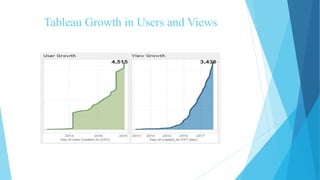
Tableau Growth in Users and Views
Tableau Permission Hierarchy
 Permissions are evaluated at many different points:
 Original Database Sources (like HEDI or Clarity)
 Data Sources in Tableau
 Tableau Server
 Sites
 Projects
 Workbooks (Show Sheets as Tabs Option Selected)
 Views (Show Sheets as Tabs Option Not Selected)
 Displaying data controlled using internal filters using USER
and ISMEMBER functions.
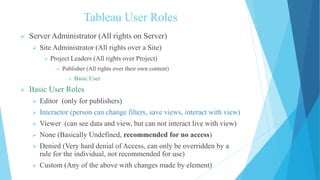
Tableau User Roles
 Server Administrator (All rights on Server)
 Site Administrator (All rights over a Site)
 Project Leaders (All rights over Project)
 Publisher (All rights over their own content)
 Basic User
 Basic User Roles
 Editor (only for publishers)
 Interactor (person can change filters, save views, interact with view)
 Viewer (can see data and view, but can not interact live with view)
 None (Basically Undefined, recommended for no access)
 Denied (Very hard denial of Access, can only be overridden by a
rule for the individual, not recommended for use)
 Custom (Any of the above with changes made by element)
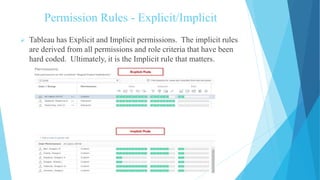
Permission Rules - Explicit/Implicit
 Tableau has Explicit and Implicit permissions. The implicit rules
are derived from all permissions and role criteria that have been
hard coded. Ultimately, it is the Implicit rule that matters.
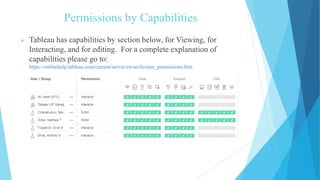
Permissions by Capabilities
 Tableau has capabilities by section below, for Viewing, for
Interacting, and for editing. For a complete explanation of
capabilities please go to:
https://onlinehelp.tableau.com/current/server/en-us/license_permissions.htm
Tableau Server
 Tableau provides three different tools for sharing information—
Tableau Public, Tableau Online, and Tableau Server.
 Tableau Public is a free cloud-hosted service aimed at bloggers,
students, or data visualization enthusiasts that want to share their
work publically.
 It is not designed for enterprise environments that require data
security. In fact, any- thing published on Tableau Public is freely
available for anyone to download.
 Tableau Server is for customers that need to control where and
how the data is stored and managed. It can be installed on
hardware behind your firewall or on cloud services that you
contract with directly.
Reasons to deploy Tableau Server
 Server’s architecture provides the flexibility to scale from a single
box to large multi-server deployments.
 User-friendly tools are provided for setup and maintenance of
access rights, scheduling, and notification. Once setup is
complete, continuing administration is normally minimal.
 Downloading and installing Tableau Server normally can be done
in less than two hours.
 There are three primary reasons to deploy Tableau Server:
 1. Data governance (security) 2. Efficiency (time savings) 3.
Flexibility (consumption and editing options)
Tableau Server Architecture
 Tableau Server is comprised of several processes operating
together. These may run concurrently, but typically all processes
won’t be running all of the time. These include:
1. Application Server (wgserver.exe)
2. VizQL Server (vizqlserver.exe)
3. Data Engine (tdeserver.exe, tdeserver64.exe)
4. Backgrounder (backgrounder.exe)
5. Data Server (dataserver.exe)
6. Repository (postgres.exe)
More on architecture
 The application server handles requests to the web application
such as searching, browsing, logging in, generating static images
and managing subscriptions.
 The VizQL server handles the task of loading and rendering
requested views.
 The data engine receives queries made to Tableau Data Extracts
present on the server. These queries come from the VizQL
processes.
 To service these queries, the Data Engine loads the Tableau Data
Extracts into memory and returns the requested record set.
More on architecture
 The backgrounder runs maintenance tasks and data extract
refreshes.
 The data server handles requests to Tableau Data Sources. These
requests can come from the Tableau Server or from Tableau
Desktop users.
 The repository is the Postgres database Tableau Server uses to
store settings, metadata, usage statistics and workbooks.
Licensing
 Tableau Server can be licensed by two different ways:
1. Per-named-user basis
2. Server core license
 Core licensing provides unlimited access to any number of users.
Pricing is based on the number of processor cores contained on
the physical box or multiple boxes on which we deploy the
software.
 Per-named-user licensing starts with a minimum of ten users.
 Core licensing requires an eight-core mini- mum. Although many
factors can affect performance in a server deployment (hardware,
network traffic, dashboard design), an eight-core configuration
can support up to 225 concurrent users.
Authentication
 Tableau Server can be configured to authenticate users in one of
two ways:
1.A Local Authentication
2.An Active Directory Authentication (ADA)
 It is very important that you choose the authentication method
carefully because this cannot be changed once the server is
installed.
 In the Local Authentication option users are added to the server
by configuring a username and a password.
 In the Active Directory authentication option, users who are
added to the Tableau Server must already exist within Active
Directory.
More on authentication
 Active Directory manages the user’s password. Selecting Active
Directory authentication allows clients to reuse their existing
security structure.
 Be sure to enter the domain name and nickname when choosing
to authenticate with Active Directory. This domain name must be
a fully qualified domain name.
 Using the (ADA) method allows an additional option—Enable
Automatic Log-on.
 This option enables users to automatically log in to Tableau
Server with the currently logged in Windows account credentials
via the Microsoft Security Support Provider Interface (SSPI).
Workbook
 The Workbook object represents the Tableau workbook file
published from Tableau Desktop.
 It contains dashboards and worksheets, which in terms of Tableau
Server are all known as Views.
 Permissions can be applied to specific Views within a Workbook
or at the whole Workbook level.
 Workbooks and Views can belong to projects and must be
published to a site.
User
 The User object represents a named-user who has access to the
Tableau Server. Users must be granted a licensing level of
Interactor or Viewer to log in to the server.
 It’s possible to leave a user account on the server in an effectively
dis- abled state by setting its licensing level to unlicensed. This
can be useful for audit purposes.
 Users can be granted access to Views, Workbooks, Projects, and
Sites. They can also be placed into groups.
 Unlicensed Tableau Server users (that have been given publishing
rights) can publish workbooks to Server even when they cannot
view the published results on the server.
Project and Group
 The Project is an object used to organize and manage access to
Workbooks. Workbooks are placed into Projects within a Site.
 This can be used as an organization tool by placing Workbooks
with similar content into a single project.
 It can be used as an access restriction tool by granting access to a
Project to a user or group and then publishing Workbooks into
that Project.
 The Group is an object used to organize users in Sites on the
Tableau Server. Users can be placed into Groups and these
Groups can in turn be given permissions to objects on the server.
 Groups can be created locally on the Tableau Server or, if Active
Directory authentication is in use, they can be imported from an
Active Directory Group. Groups make managing user
permissions within Tableau Server much easier.
Site
 The Site is the top level of the security hierarchy. Sites are
essentially completely separate Tableau Server instances from the
user perspective.
 Users cannot log in to, or view, any information about Sites to
which they do not have access.
 The base Tableau Server site is known as the Default Site. Users
that belong to more than one site must choose which site they
want to see when they log in.
 Additional Tableau Server sites are accessed using a name
extension string appended on the URL using this format:
(/t/[name]).
Permissions
 Where sites define separate work environments in Tableau Server,
permissions define what users or groups are permitted to do
within a site.
 The Interactor role represents the common user who can access
and use Objects but not edit them.
 The Publisher role allows users to publish reports from Tableau
Desktop to the server.
 The Editor role allows the user to make changes to Workbooks.
 There are two administrative permissions that can be granted at
the Site and Instance level—System Administrator and Site
Administrator.

Tableau powerpoint

  • 1.
    Tableau Server Time toLockdown Rod Menken UIHC Tableau User Group September 28, 2017
  • 2.
    Tableau – Security- Coming to the Forefront  Tableau has grown like wildfire and has grown beyond the original scope of what was intended or envisioned. Originally planned for hundreds of UIHC staff, with everyone allowed to see everything.  Now, Tableau Server is used by employees from:  UIHC College of Pharmacy (Ext UIHC userids)  UIHS College of Public Health (Ext UIHC userids)  Students, Residents, Faculty CCOM Presidents Office (Ext UIHC userids)  Student Health UI Purchasing Dept (Ext UIHC userids)  Iowa Lions Eye Bank The Signal Center for Health Innovation (UIHC & UIHS)  This means that we need to tighten permissions and each publisher needs to put some thought into who will be using their workbooks/views/data sources. All_Users permission will be banned from use in near future, and we will monitor this!
  • 3.
    Tableau Growth inUsers and Views
  • 4.
    Tableau Permission Hierarchy Permissions are evaluated at many different points:  Original Database Sources (like HEDI or Clarity)  Data Sources in Tableau  Tableau Server  Sites  Projects  Workbooks (Show Sheets as Tabs Option Selected)  Views (Show Sheets as Tabs Option Not Selected)  Displaying data controlled using internal filters using USER and ISMEMBER functions.
  • 5.
    Tableau User Roles Server Administrator (All rights on Server)  Site Administrator (All rights over a Site)  Project Leaders (All rights over Project)  Publisher (All rights over their own content)  Basic User  Basic User Roles  Editor (only for publishers)  Interactor (person can change filters, save views, interact with view)  Viewer (can see data and view, but can not interact live with view)  None (Basically Undefined, recommended for no access)  Denied (Very hard denial of Access, can only be overridden by a rule for the individual, not recommended for use)  Custom (Any of the above with changes made by element)
  • 6.
    Permission Rules -Explicit/Implicit  Tableau has Explicit and Implicit permissions. The implicit rules are derived from all permissions and role criteria that have been hard coded. Ultimately, it is the Implicit rule that matters.
  • 7.
    Permissions by Capabilities Tableau has capabilities by section below, for Viewing, for Interacting, and for editing. For a complete explanation of capabilities please go to: https://onlinehelp.tableau.com/current/server/en-us/license_permissions.htm
  • 8.
    Tableau Server  Tableauprovides three different tools for sharing information— Tableau Public, Tableau Online, and Tableau Server.  Tableau Public is a free cloud-hosted service aimed at bloggers, students, or data visualization enthusiasts that want to share their work publically.  It is not designed for enterprise environments that require data security. In fact, any- thing published on Tableau Public is freely available for anyone to download.  Tableau Server is for customers that need to control where and how the data is stored and managed. It can be installed on hardware behind your firewall or on cloud services that you contract with directly.
  • 9.
    Reasons to deployTableau Server  Server’s architecture provides the flexibility to scale from a single box to large multi-server deployments.  User-friendly tools are provided for setup and maintenance of access rights, scheduling, and notification. Once setup is complete, continuing administration is normally minimal.  Downloading and installing Tableau Server normally can be done in less than two hours.  There are three primary reasons to deploy Tableau Server:  1. Data governance (security) 2. Efficiency (time savings) 3. Flexibility (consumption and editing options)
  • 10.
    Tableau Server Architecture Tableau Server is comprised of several processes operating together. These may run concurrently, but typically all processes won’t be running all of the time. These include: 1. Application Server (wgserver.exe) 2. VizQL Server (vizqlserver.exe) 3. Data Engine (tdeserver.exe, tdeserver64.exe) 4. Backgrounder (backgrounder.exe) 5. Data Server (dataserver.exe) 6. Repository (postgres.exe)
  • 11.
    More on architecture The application server handles requests to the web application such as searching, browsing, logging in, generating static images and managing subscriptions.  The VizQL server handles the task of loading and rendering requested views.  The data engine receives queries made to Tableau Data Extracts present on the server. These queries come from the VizQL processes.  To service these queries, the Data Engine loads the Tableau Data Extracts into memory and returns the requested record set.
  • 12.
    More on architecture The backgrounder runs maintenance tasks and data extract refreshes.  The data server handles requests to Tableau Data Sources. These requests can come from the Tableau Server or from Tableau Desktop users.  The repository is the Postgres database Tableau Server uses to store settings, metadata, usage statistics and workbooks.
  • 13.
    Licensing  Tableau Servercan be licensed by two different ways: 1. Per-named-user basis 2. Server core license  Core licensing provides unlimited access to any number of users. Pricing is based on the number of processor cores contained on the physical box or multiple boxes on which we deploy the software.  Per-named-user licensing starts with a minimum of ten users.  Core licensing requires an eight-core mini- mum. Although many factors can affect performance in a server deployment (hardware, network traffic, dashboard design), an eight-core configuration can support up to 225 concurrent users.
  • 14.
    Authentication  Tableau Servercan be configured to authenticate users in one of two ways: 1.A Local Authentication 2.An Active Directory Authentication (ADA)  It is very important that you choose the authentication method carefully because this cannot be changed once the server is installed.  In the Local Authentication option users are added to the server by configuring a username and a password.  In the Active Directory authentication option, users who are added to the Tableau Server must already exist within Active Directory.
  • 15.
    More on authentication Active Directory manages the user’s password. Selecting Active Directory authentication allows clients to reuse their existing security structure.  Be sure to enter the domain name and nickname when choosing to authenticate with Active Directory. This domain name must be a fully qualified domain name.  Using the (ADA) method allows an additional option—Enable Automatic Log-on.  This option enables users to automatically log in to Tableau Server with the currently logged in Windows account credentials via the Microsoft Security Support Provider Interface (SSPI).
  • 16.
    Workbook  The Workbookobject represents the Tableau workbook file published from Tableau Desktop.  It contains dashboards and worksheets, which in terms of Tableau Server are all known as Views.  Permissions can be applied to specific Views within a Workbook or at the whole Workbook level.  Workbooks and Views can belong to projects and must be published to a site.
  • 17.
    User  The Userobject represents a named-user who has access to the Tableau Server. Users must be granted a licensing level of Interactor or Viewer to log in to the server.  It’s possible to leave a user account on the server in an effectively dis- abled state by setting its licensing level to unlicensed. This can be useful for audit purposes.  Users can be granted access to Views, Workbooks, Projects, and Sites. They can also be placed into groups.  Unlicensed Tableau Server users (that have been given publishing rights) can publish workbooks to Server even when they cannot view the published results on the server.
  • 18.
    Project and Group The Project is an object used to organize and manage access to Workbooks. Workbooks are placed into Projects within a Site.  This can be used as an organization tool by placing Workbooks with similar content into a single project.  It can be used as an access restriction tool by granting access to a Project to a user or group and then publishing Workbooks into that Project.  The Group is an object used to organize users in Sites on the Tableau Server. Users can be placed into Groups and these Groups can in turn be given permissions to objects on the server.  Groups can be created locally on the Tableau Server or, if Active Directory authentication is in use, they can be imported from an Active Directory Group. Groups make managing user permissions within Tableau Server much easier.
  • 19.
    Site  The Siteis the top level of the security hierarchy. Sites are essentially completely separate Tableau Server instances from the user perspective.  Users cannot log in to, or view, any information about Sites to which they do not have access.  The base Tableau Server site is known as the Default Site. Users that belong to more than one site must choose which site they want to see when they log in.  Additional Tableau Server sites are accessed using a name extension string appended on the URL using this format: (/t/[name]).
  • 20.
    Permissions  Where sitesdefine separate work environments in Tableau Server, permissions define what users or groups are permitted to do within a site.  The Interactor role represents the common user who can access and use Objects but not edit them.  The Publisher role allows users to publish reports from Tableau Desktop to the server.  The Editor role allows the user to make changes to Workbooks.  There are two administrative permissions that can be granted at the Site and Instance level—System Administrator and Site Administrator.