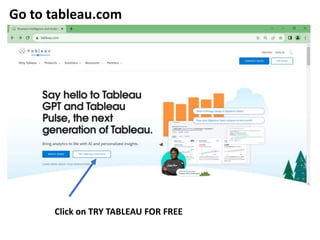
Go to tableau.com
Click on TRY TABLEAU FOR FREE
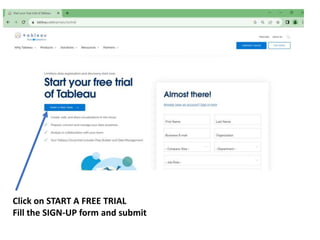
Click on START A FREE TRIAL
Fill the SIGN-UP form and submit
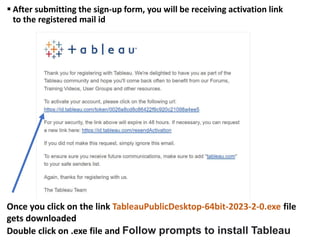
 After submitting the sign-up form, you will be receiving activation link
to the registered mail id
Once you click on the link TableauPublicDesktop-64bit-2023-2-0.exe file
gets downloaded
Double click on .exe file and Follow prompts to install Tableau
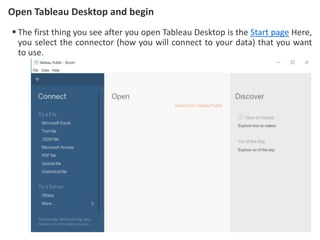
Open Tableau Desktop and begin
 The first thing you see after you open Tableau Desktop is the Start page Here,
you select the connector (how you will connect to your data) that you want
to use.
The start page gives you several options to choose from:
1. Tableau icon. Click An icon of the Tableau logo in the upper left corner of
any page to toggle between the start page and the authoring
workspace.
2. Connect pane. Under Connect, you can:
− Connect to data that is stored in a file, such as Microsoft Excel, PDF,
Spatial files, and more.
− Connect to data that is stored on Tableau Server, Microsoft SQL
Server, Google Analytics, or another server.
− Connect to a data source that you’ve connected to before.
Tableau supports the ability to connect to a wide variety of data stored in a
wide variety of places. The Connect pane lists the most common places that
you might want to connect to, or click the More links to see more options.
3. Under Open, you can open workbooks that you've already created.
4. Under Discover, find additional resources like video tutorials, forums, or
the “Viz of the week” to get ideas about what you can build.
• After you connect to your data, Tableau does the following:
− Opens a new worksheet. This is a blank slate where you can create
your first view.
− Displays the data source you are connected to. If you are using
multiple data sources, you can see them all listed here.
− Adds columns from your data source to the Data pane on the left
side. Columns are added as fields.
− Automatically assigns data types (such as date, number, string, etc.)
and roles (dimension or measure) to your data.
• If you want to see more details about your data, you can select
the Data Source page in the bottom left corner. Here, you can view the
first 1,000 rows of your data, and some analysts go nuts: Sort or hide
fields, split fields into multiple columns, and rename column headers,
all without modifying the original data. What happens in Tableau stays
in Tableau; your data is safe.
• If you navigated to the Data Source page to check out the details, just
click on the tab for Sheet 1 to get back to where you started

Tableau.pptx

  • 1.
    Go to tableau.com Clickon TRY TABLEAU FOR FREE
  • 2.
    Click on STARTA FREE TRIAL Fill the SIGN-UP form and submit
  • 3.
     After submittingthe sign-up form, you will be receiving activation link to the registered mail id Once you click on the link TableauPublicDesktop-64bit-2023-2-0.exe file gets downloaded Double click on .exe file and Follow prompts to install Tableau
  • 4.
    Open Tableau Desktopand begin  The first thing you see after you open Tableau Desktop is the Start page Here, you select the connector (how you will connect to your data) that you want to use.
  • 5.
    The start pagegives you several options to choose from: 1. Tableau icon. Click An icon of the Tableau logo in the upper left corner of any page to toggle between the start page and the authoring workspace. 2. Connect pane. Under Connect, you can: − Connect to data that is stored in a file, such as Microsoft Excel, PDF, Spatial files, and more. − Connect to data that is stored on Tableau Server, Microsoft SQL Server, Google Analytics, or another server. − Connect to a data source that you’ve connected to before. Tableau supports the ability to connect to a wide variety of data stored in a wide variety of places. The Connect pane lists the most common places that you might want to connect to, or click the More links to see more options.
  • 6.
    3. Under Open,you can open workbooks that you've already created. 4. Under Discover, find additional resources like video tutorials, forums, or the “Viz of the week” to get ideas about what you can build.
  • 7.
    • After youconnect to your data, Tableau does the following: − Opens a new worksheet. This is a blank slate where you can create your first view. − Displays the data source you are connected to. If you are using multiple data sources, you can see them all listed here. − Adds columns from your data source to the Data pane on the left side. Columns are added as fields. − Automatically assigns data types (such as date, number, string, etc.) and roles (dimension or measure) to your data.
  • 8.
    • If youwant to see more details about your data, you can select the Data Source page in the bottom left corner. Here, you can view the first 1,000 rows of your data, and some analysts go nuts: Sort or hide fields, split fields into multiple columns, and rename column headers, all without modifying the original data. What happens in Tableau stays in Tableau; your data is safe. • If you navigated to the Data Source page to check out the details, just click on the tab for Sheet 1 to get back to where you started