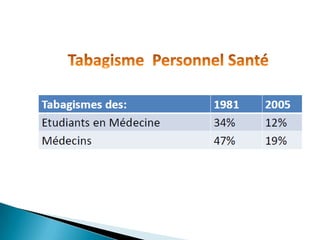
Pr R. Habbal
Centre de cardiologie
CHU Ibn Rochd. Casablanca
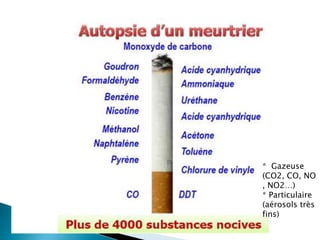
* Gazeuse
(CO2, CO, NO
, NO2…)
* Particulaire
(aérosols très
fins)
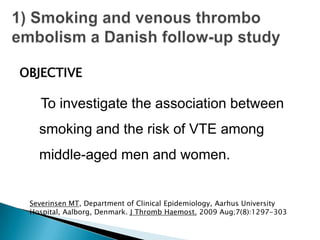
To investigate the association between
smoking and the risk of VTE among
middle-aged men and women.
Severinsen MT, Department of Clinical Epidemiology, Aarhus University
Hospital, Aalborg, Denmark. J Thromb Haemost. 2009 Aug;7(8):1297-303
OBJECTIVE
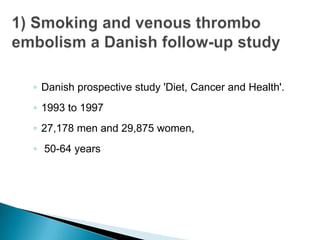
◦ Danish prospective study 'Diet, Cancer and Health'.
◦ 1993 to 1997
◦ 27,178 men and 29,875 women,
◦ 50-64 years
◦ 641 incident cases of VTE were verified.
◦ Positive association between current smoking and VTE,
 OR 1.52 (1.15-2.00) for smoking women
 OR 1.32 (1.00-1.74) for smoking men
 Positive dose-response relationship.
◦ Former smokers had the same hazard as never
smokers.
J Thromb Haemost. 2009 Aug;7(8):1297-303
RESULTS
- Smoking was an independent risk factor for VTE
- Former smokers have the same risk of VTE as never
smokers, indicating the potential benefits of smoking
cessation.
J Thromb Haemost. 2009 Aug;7(8):1297-303
To conduct a prospective, population-based cohort
study to investigate the association between cigarette
smoking and the risk of incident VTE.
OBJECTIVES :
J Thromb Haemost. 2012 Oct;10(10):2068-74
– Information on smoking habits was assessed by self-
administered questionnaires in 24 576 subjects
– 25-96 years
– 1994-1995
– Incident cases of VTE were registered until the end of
follow-up at 1 September 2007 (median of 12.5 y)
PATIENTS/METHODS:
J Thromb Haemost. 2012 Oct;10(10):2068-74
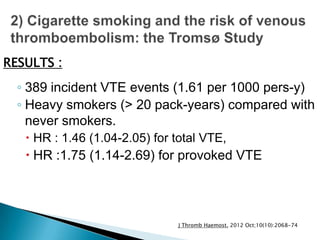
◦ 389 incident VTE events (1.61 per 1000 pers-y)
◦ Heavy smokers (> 20 pack-years) compared with
never smokers.
 HR : 1.46 (1.04-2.05) for total VTE,
 HR :1.75 (1.14-2.69) for provoked VTE
RESULTS :
J Thromb Haemost. 2012 Oct;10(10):2068-74
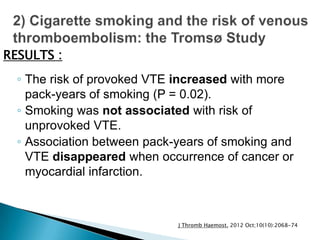
◦ The risk of provoked VTE increased with more
pack-years of smoking (P = 0.02).
◦ Smoking was not associated with risk of
unprovoked VTE.
◦ Association between pack-years of smoking and
VTE disappeared when occurrence of cancer or
myocardial infarction.
RESULTS :
J Thromb Haemost. 2012 Oct;10(10):2068-74
BACKGROUND
The evidence for an association between smoking
and venous thrombosis (VT) is inconsistent, and
its mediation pathways remain to be fully
elucidated.
Thromb Haemost. 2013 Mar 7;109(5)
 A population-based, case-control study was
conducted in healthcare system in Washington State.
 Cases were women aged 18-90 years who
experienced a validated incident deep vein
thrombosis or pulmonary embolism between
January 1, 1995, and December 31, 2009.
METHODS :
Thromb Haemost. 2013 Mar 7;109(5)
◦ Controls were randomly selected from members of the
healthcare system.
◦ Smoking status (current, former, never) was assessed from
medical records review and, for a subset, also by telephone
interview.
◦ Multivariable logistic regression was used to estimate odds
ratios (OR) associated with smoking status.
METHODS :
Thromb Haemost. 2013 Mar 7;109(5)
 RESULTS :
◦ We identified 2,278 cases and 5,927 controls.
◦ Subjects comprised mostly postmenopausal white
women with a mean age of 66 years and a
current smoking prevalence of 10%.
◦ Compared to never-smokers, current and former
smokers were at higher risk of VT (adjusted OR
1.21, [CI] 1.02-1.44 and OR 1.15, CI 1.03-1.29.
◦ These associations were attenuated for
potential mediators (cardiovascular
disease, congestive heart failure, cancer, recent
hospitalisations and physical activity): OR 1.02 CI
(0.83-1.25) and 0.95 CI (0.83-1.08).
Thromb Haemost. 2013 Mar 7;109(5)
 The modestly increased risk of VT in women who
are current or former smokers might be explained
by the occurrence of smoking-related diseases
and decreased physical activity.
 Our results do not support a direct biological effect
of smoking on the risk of VT that is clinically
relevant
Thromb Haemost. 2013 Mar 7;109(5)
 La relation existe entre les fumeurs et la
thrombose veineuse
 Mais elle est atténuée quand elle est ajustée avec
des maladies potentielles (Maladie cardio-
vasculaire, cancer…)
Relation indirecte
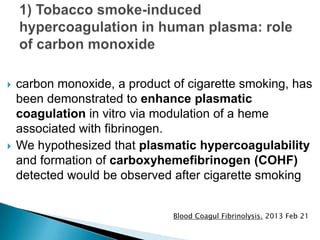
 carbon monoxide, a product of cigarette smoking, has
been demonstrated to enhance plasmatic
coagulation in vitro via modulation of a heme
associated with fibrinogen.
 We hypothesized that plasmatic hypercoagulability
and formation of carboxyhemefibrinogen (COHF)
detected would be observed after cigarette smoking
Blood Coagul Fibrinolysis. 2013 Feb 21
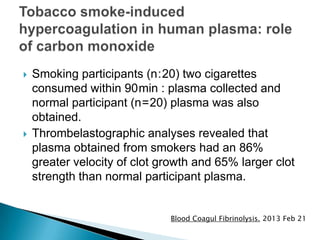
 Smoking participants (n : 20) two cigarettes
consumed within 90 min : plasma collected and
normal participant (n = 20) plasma was also
obtained.
 Thrombelastographic analyses revealed that
plasma obtained from smokers had an 86%
greater velocity of clot growth and 65% larger clot
strength than normal participant plasma.
Blood Coagul Fibrinolysis. 2013 Feb 21
 We conclude that smoking induced a
hypercoagulable state and COHF formation in
an important portion of participants tested.
 Future investigations of the effects
of smoking, plasmatic hypercoagulation and
COHF formation are planned in populations
with established atherosclerotic/ thrombotic
disease
Blood Coagul Fibrinolysis. 2013 Feb 21
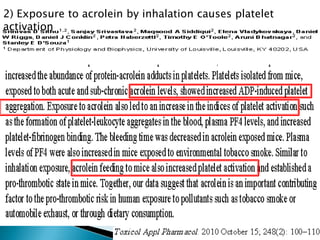
2) Exposure to acrolein by inhalation causes platelet
activation
 The purpose was to determine whether CO and NO
diminished fibrinolysis by enhancement of α₂-
antiaplasmin via a putative heme group.
Blood Coagul Fibrinolysis. 2011 Dec;22(8):712-
9
 CO significantly enhanced α₂-antiplasmin activity, but
decreased plasmin activity.
 NO decreased both α₂-antiplasmin and plasmin activity.
Diminished fibrinolysis
Blood Coagul Fibrinolysis. 2011 Dec;22(8):712-9
 Objective :
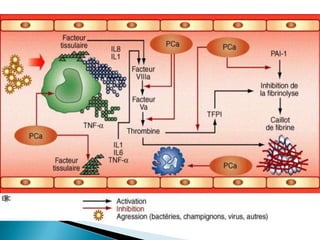
◦ Smokers exhibit higher circulating levels of tissue factor (TF)
than do non smokers, but the underlying mechanisms have not
been reported.
◦ we investigated whether exposure of human
monocyte/macrophages to tobacco smoke induces their release
of MVs and whether these MVs are procoagulant.
Arterioscler Thromb Vasc Biol. 2010 September ; 30(9): 1818–1824.
4) Tobacco Smoke Induces the generation of Progoagulant
Microvesicles from Human Monocyte/Macrophages
 RESULTS :
◦ Exposure of human monocytes and
macrophages to tobacco smoke extract
significantly increased their total and TF-
positive MV generation.
4) Tobacco Smoke Induces the generation of Progoagulant
Microvesicles from Human Monocyte/Macrophages
Arterioscler Thromb Vasc Biol. 2010 September ; 30(9): 1818–1824.
 Monoxide de carbone: entraine un état
d’hypercoagulable et la formation de COHF
 Acroleine : active les plaquettes
 Monoxide de carbone et Nitric oxide diminuent la
fibrinolyse
 L’exposition des monocytes et des
macrophages humaines au tabac augmente
signifiquement le facteur Tissulaire et la
génération des MV.
• Retrospective observational study among 350 patients
receiving a stable dose of warfarin for at least 2 weeks. The
primary objective of the study was to assess the
relationship between clinical factors, including smoking with
non therapeutic INR results. Based on a univariate
analysis, smoking was not significantly associated with
non therapeutic INR.
. McGriff-Lee NJ et al. Ann Pharmacother 2005 3912 1996-2002
 Prospective observational study among 80
patients with heart failure receiving warfarin
therapy to assess the relationship among various
clinical factors, including smoking with non
therapeutic INR (defined as having > 25% of INR
out of range throughout the study period). Using
the Pearson correlation method, the authors
found no significant relationship of smoking
and non therapeutic INR
Pamboukian SV et al. Clin Cardiol 2008 311 30-34
BACKGROUND:
 Chronic smoking, theoretically, can interfere with
warfarin metabolism through enzyme-inducing
effects of polycyclic aromatic hydrocarbons.
 However, clinical evidence of interactions between
warfarin and smoking are inconclusive.
 This study aimed to systematically review all
relevant clinical evidence of this interaction.
CHEST. 2011;139(5):1130-1139
METHODS:
 We performed a systematic search using
computerized databases, from 1966 to December
2008.
 Keywords included "warfarin" with "smoking,"
"tobacco," "cigarette," and "polycyclic aromatic
hydrocarbons."
 All articles were reviewed independently by two
investigators for study
design, population, outcomes, and quality of
evidence.
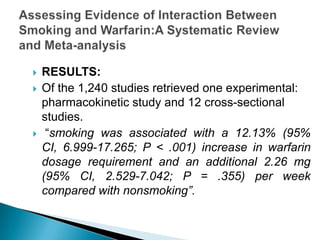
 RESULTS:
 Of the 1,240 studies retrieved one experimental:
pharmacokinetic study and 12 cross-sectional
studies.
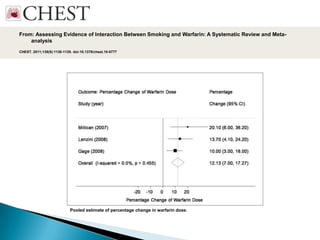
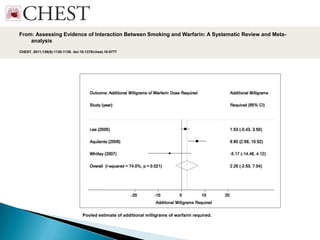
 “smoking was associated with a 12.13% (95%
CI, 6.999-17.265; P < .001) increase in warfarin
dosage requirement and an additional 2.26 mg
(95% CI, 2.529-7.042; P = .355) per week
compared with nonsmoking”.
Date of download: 3/19/2013
Copyright © American College of Chest Physicians. All rights reserved.
From: Assessing Evidence of Interaction Between Smoking and Warfarin: A Systematic Review and Meta-
analysis
CHEST. 2011;139(5):1130-1139. doi:10.1378/chest.10-0777
Pooled estimate of percentage change in warfarin dose.
Date of download: 3/19/2013
Copyright © American College of Chest Physicians. All rights reserved.
From: Assessing Evidence of Interaction Between Smoking and Warfarin: A Systematic Review and Meta-
analysis
CHEST. 2011;139(5):1130-1139. doi:10.1378/chest.10-0777
Pooled estimate of additional milligrams of warfarin required.
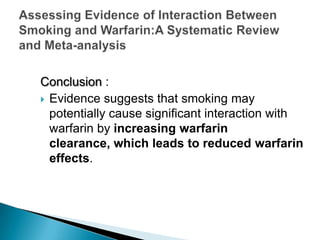
Conclusion :
 Evidence suggests that smoking may
potentially cause significant interaction with
warfarin by increasing warfarin
clearance, which leads to reduced warfarin
effects.
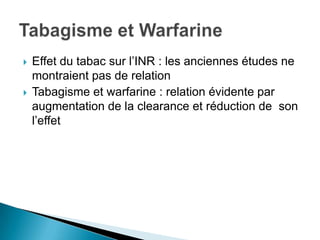
 Effet du tabac sur l’INR : les anciennes études ne
montraient pas de relation
 Tabagisme et warfarine : relation évidente par
augmentation de la clearance et réduction de son
l’effet
Tabagisme et thrombose habbal

Tabagisme et thrombose habbal

  • 1.
    Pr R. Habbal Centrede cardiologie CHU Ibn Rochd. Casablanca
  • 6.
    * Gazeuse (CO2, CO,NO , NO2…) * Particulaire (aérosols très fins)
  • 15.
    To investigate theassociation between smoking and the risk of VTE among middle-aged men and women. Severinsen MT, Department of Clinical Epidemiology, Aarhus University Hospital, Aalborg, Denmark. J Thromb Haemost. 2009 Aug;7(8):1297-303 OBJECTIVE
  • 16.
    ◦ Danish prospectivestudy 'Diet, Cancer and Health'. ◦ 1993 to 1997 ◦ 27,178 men and 29,875 women, ◦ 50-64 years
  • 17.
    ◦ 641 incidentcases of VTE were verified. ◦ Positive association between current smoking and VTE,  OR 1.52 (1.15-2.00) for smoking women  OR 1.32 (1.00-1.74) for smoking men  Positive dose-response relationship. ◦ Former smokers had the same hazard as never smokers. J Thromb Haemost. 2009 Aug;7(8):1297-303 RESULTS
  • 18.
    - Smoking wasan independent risk factor for VTE - Former smokers have the same risk of VTE as never smokers, indicating the potential benefits of smoking cessation. J Thromb Haemost. 2009 Aug;7(8):1297-303
  • 19.
    To conduct aprospective, population-based cohort study to investigate the association between cigarette smoking and the risk of incident VTE. OBJECTIVES : J Thromb Haemost. 2012 Oct;10(10):2068-74
  • 20.
    – Information onsmoking habits was assessed by self- administered questionnaires in 24 576 subjects – 25-96 years – 1994-1995 – Incident cases of VTE were registered until the end of follow-up at 1 September 2007 (median of 12.5 y) PATIENTS/METHODS: J Thromb Haemost. 2012 Oct;10(10):2068-74
  • 21.
    ◦ 389 incidentVTE events (1.61 per 1000 pers-y) ◦ Heavy smokers (> 20 pack-years) compared with never smokers.  HR : 1.46 (1.04-2.05) for total VTE,  HR :1.75 (1.14-2.69) for provoked VTE RESULTS : J Thromb Haemost. 2012 Oct;10(10):2068-74
  • 22.
    ◦ The riskof provoked VTE increased with more pack-years of smoking (P = 0.02). ◦ Smoking was not associated with risk of unprovoked VTE. ◦ Association between pack-years of smoking and VTE disappeared when occurrence of cancer or myocardial infarction. RESULTS : J Thromb Haemost. 2012 Oct;10(10):2068-74
  • 23.
    BACKGROUND The evidence foran association between smoking and venous thrombosis (VT) is inconsistent, and its mediation pathways remain to be fully elucidated. Thromb Haemost. 2013 Mar 7;109(5)
  • 24.
     A population-based,case-control study was conducted in healthcare system in Washington State.  Cases were women aged 18-90 years who experienced a validated incident deep vein thrombosis or pulmonary embolism between January 1, 1995, and December 31, 2009. METHODS : Thromb Haemost. 2013 Mar 7;109(5)
  • 25.
    ◦ Controls wererandomly selected from members of the healthcare system. ◦ Smoking status (current, former, never) was assessed from medical records review and, for a subset, also by telephone interview. ◦ Multivariable logistic regression was used to estimate odds ratios (OR) associated with smoking status. METHODS : Thromb Haemost. 2013 Mar 7;109(5)
  • 26.
     RESULTS : ◦We identified 2,278 cases and 5,927 controls. ◦ Subjects comprised mostly postmenopausal white women with a mean age of 66 years and a current smoking prevalence of 10%. ◦ Compared to never-smokers, current and former smokers were at higher risk of VT (adjusted OR 1.21, [CI] 1.02-1.44 and OR 1.15, CI 1.03-1.29. ◦ These associations were attenuated for potential mediators (cardiovascular disease, congestive heart failure, cancer, recent hospitalisations and physical activity): OR 1.02 CI (0.83-1.25) and 0.95 CI (0.83-1.08). Thromb Haemost. 2013 Mar 7;109(5)
  • 27.
     The modestlyincreased risk of VT in women who are current or former smokers might be explained by the occurrence of smoking-related diseases and decreased physical activity.  Our results do not support a direct biological effect of smoking on the risk of VT that is clinically relevant Thromb Haemost. 2013 Mar 7;109(5)
  • 28.
     La relationexiste entre les fumeurs et la thrombose veineuse  Mais elle est atténuée quand elle est ajustée avec des maladies potentielles (Maladie cardio- vasculaire, cancer…) Relation indirecte
  • 31.
     carbon monoxide,a product of cigarette smoking, has been demonstrated to enhance plasmatic coagulation in vitro via modulation of a heme associated with fibrinogen.  We hypothesized that plasmatic hypercoagulability and formation of carboxyhemefibrinogen (COHF) detected would be observed after cigarette smoking Blood Coagul Fibrinolysis. 2013 Feb 21
  • 32.
     Smoking participants(n : 20) two cigarettes consumed within 90 min : plasma collected and normal participant (n = 20) plasma was also obtained.  Thrombelastographic analyses revealed that plasma obtained from smokers had an 86% greater velocity of clot growth and 65% larger clot strength than normal participant plasma. Blood Coagul Fibrinolysis. 2013 Feb 21
  • 33.
     We concludethat smoking induced a hypercoagulable state and COHF formation in an important portion of participants tested.  Future investigations of the effects of smoking, plasmatic hypercoagulation and COHF formation are planned in populations with established atherosclerotic/ thrombotic disease Blood Coagul Fibrinolysis. 2013 Feb 21
  • 34.
    2) Exposure toacrolein by inhalation causes platelet activation
  • 35.
     The purposewas to determine whether CO and NO diminished fibrinolysis by enhancement of α₂- antiaplasmin via a putative heme group. Blood Coagul Fibrinolysis. 2011 Dec;22(8):712- 9
  • 36.
     CO significantlyenhanced α₂-antiplasmin activity, but decreased plasmin activity.  NO decreased both α₂-antiplasmin and plasmin activity. Diminished fibrinolysis Blood Coagul Fibrinolysis. 2011 Dec;22(8):712-9
  • 37.
     Objective : ◦Smokers exhibit higher circulating levels of tissue factor (TF) than do non smokers, but the underlying mechanisms have not been reported. ◦ we investigated whether exposure of human monocyte/macrophages to tobacco smoke induces their release of MVs and whether these MVs are procoagulant. Arterioscler Thromb Vasc Biol. 2010 September ; 30(9): 1818–1824. 4) Tobacco Smoke Induces the generation of Progoagulant Microvesicles from Human Monocyte/Macrophages
  • 38.
     RESULTS : ◦Exposure of human monocytes and macrophages to tobacco smoke extract significantly increased their total and TF- positive MV generation. 4) Tobacco Smoke Induces the generation of Progoagulant Microvesicles from Human Monocyte/Macrophages Arterioscler Thromb Vasc Biol. 2010 September ; 30(9): 1818–1824.
  • 39.
     Monoxide decarbone: entraine un état d’hypercoagulable et la formation de COHF  Acroleine : active les plaquettes  Monoxide de carbone et Nitric oxide diminuent la fibrinolyse  L’exposition des monocytes et des macrophages humaines au tabac augmente signifiquement le facteur Tissulaire et la génération des MV.
  • 41.
    • Retrospective observationalstudy among 350 patients receiving a stable dose of warfarin for at least 2 weeks. The primary objective of the study was to assess the relationship between clinical factors, including smoking with non therapeutic INR results. Based on a univariate analysis, smoking was not significantly associated with non therapeutic INR. . McGriff-Lee NJ et al. Ann Pharmacother 2005 3912 1996-2002
  • 42.
     Prospective observationalstudy among 80 patients with heart failure receiving warfarin therapy to assess the relationship among various clinical factors, including smoking with non therapeutic INR (defined as having > 25% of INR out of range throughout the study period). Using the Pearson correlation method, the authors found no significant relationship of smoking and non therapeutic INR Pamboukian SV et al. Clin Cardiol 2008 311 30-34
  • 43.
    BACKGROUND:  Chronic smoking,theoretically, can interfere with warfarin metabolism through enzyme-inducing effects of polycyclic aromatic hydrocarbons.  However, clinical evidence of interactions between warfarin and smoking are inconclusive.  This study aimed to systematically review all relevant clinical evidence of this interaction. CHEST. 2011;139(5):1130-1139
  • 44.
    METHODS:  We performeda systematic search using computerized databases, from 1966 to December 2008.  Keywords included "warfarin" with "smoking," "tobacco," "cigarette," and "polycyclic aromatic hydrocarbons."  All articles were reviewed independently by two investigators for study design, population, outcomes, and quality of evidence.
  • 45.
     RESULTS:  Ofthe 1,240 studies retrieved one experimental: pharmacokinetic study and 12 cross-sectional studies.  “smoking was associated with a 12.13% (95% CI, 6.999-17.265; P < .001) increase in warfarin dosage requirement and an additional 2.26 mg (95% CI, 2.529-7.042; P = .355) per week compared with nonsmoking”.
  • 46.
    Date of download:3/19/2013 Copyright © American College of Chest Physicians. All rights reserved. From: Assessing Evidence of Interaction Between Smoking and Warfarin: A Systematic Review and Meta- analysis CHEST. 2011;139(5):1130-1139. doi:10.1378/chest.10-0777 Pooled estimate of percentage change in warfarin dose.
  • 47.
    Date of download:3/19/2013 Copyright © American College of Chest Physicians. All rights reserved. From: Assessing Evidence of Interaction Between Smoking and Warfarin: A Systematic Review and Meta- analysis CHEST. 2011;139(5):1130-1139. doi:10.1378/chest.10-0777 Pooled estimate of additional milligrams of warfarin required.
  • 48.
    Conclusion :  Evidencesuggests that smoking may potentially cause significant interaction with warfarin by increasing warfarin clearance, which leads to reduced warfarin effects.
  • 49.
     Effet dutabac sur l’INR : les anciennes études ne montraient pas de relation  Tabagisme et warfarine : relation évidente par augmentation de la clearance et réduction de son l’effet