




Magdy El-Masry
Prof. of Cardiology
Tanta University
Old Data
Paradigm shift
Study overturns what we know about
“Good cholesterol”
Agenda
Old Data
HDL-C LDL-C TG
The Good, the Bad and the Ugly
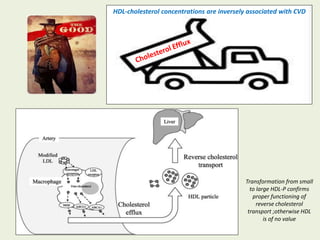
HDL-cholesterol concentrations are inversely associated with CVD
Transformation from small
to large HDL-P confirms
proper functioning of
reverse cholesterol
transport ;otherwise HDL
is of no value
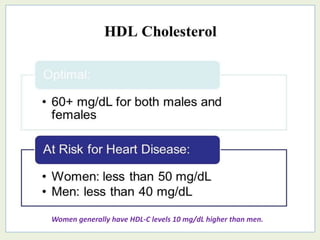
Women generally have HDL-C levels 10 mg/dL higher than men.
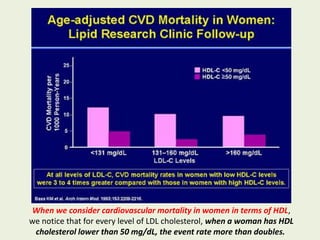
When we consider cardiovascular mortality in women in terms of HDL,
we notice that for every level of LDL cholesterol, when a woman has HDL
cholesterol lower than 50 mg/dL, the event rate more than doubles.
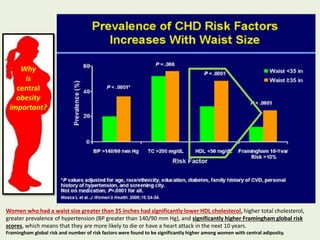
Women who had a waist size greater than 35 inches had significantly lower HDL cholesterol, higher total cholesterol,
greater prevalence of hypertension (BP greater than 140/90 mm Hg), and significantly higher Framingham global risk
scores, which means that they are more likely to die or have a heart attack in the next 10 years.
Framingham global risk and number of risk factors were found to be significantly higher among women with central adiposity.
Why
is
central
obesity
important?
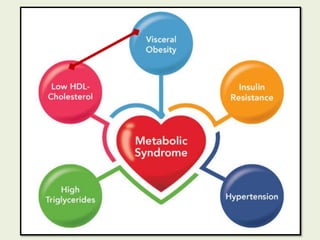
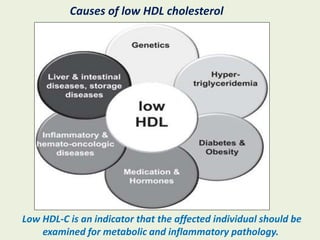
Low HDL-C is an indicator that the affected individual should be
examined for metabolic and inflammatory pathology.
Causes of low HDL cholesterol
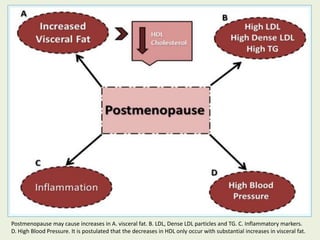
Postmenopause may cause increases in A. visceral fat. B. LDL, Dense LDL particles and TG. C. Inflammatory markers.
D. High Blood Pressure. It is postulated that the decreases in HDL only occur with substantial increases in visceral fat.
Lipoprotein subfractions suffer a shift
after menopause towards a more
atherogenic lipid profile
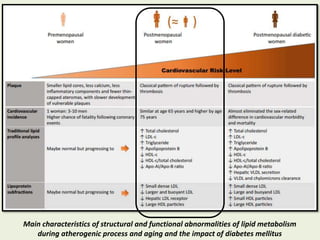
Main characteristics of structural and functional abnormalities of lipid metabolism
during atherogenic process and aging and the impact of diabetes mellitus
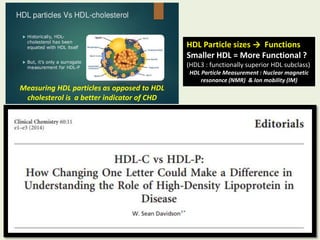
Measuring HDL particles as opposed to HDL
cholesterol is a better indicator of CHD
HDL Particle sizes → Functions
Smaller HDL = More Functional ?
(HDL3 : functionally superior HDL subclass)
HDL Particle Measurement : Nuclear magnetic
resonance (NMR) & Ion mobility (IM)
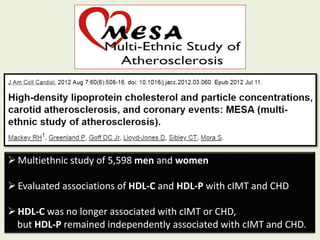
Multiethnic study of 5,598 men and women
Evaluated associations of HDL-C and HDL-P with cIMT and CHD
HDL-C was no longer associated with cIMT or CHD,
but HDL-P remained independently associated with cIMT and CHD.
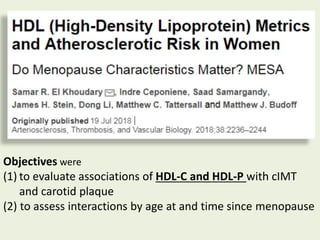
Objectives were
(1) to evaluate associations of HDL-C and HDL-P with cIMT
and carotid plaque
(2) to assess interactions by age at and time since menopause
Analysis included 1380 females from the MESA (Multi-Ethnic Study
of Atherosclerosis; age: 61.8±10.3; 61% natural-, 21% surgical-, and
18% peri-menopause).
Adjusting for each other, higher HDL-P but not HDL-C was
associated with lower cIMT (P=0.001), whereas higher HDL-C but
not HDL-P was associated with greater risk of carotid plaque
presence (P=0.04).
Time since menopause significantly modified the association of large
but not small HDL-P with cIMT; higher large HDL-P was associated
with higher cIMT close to menopause but with lower cIMT later in
life.
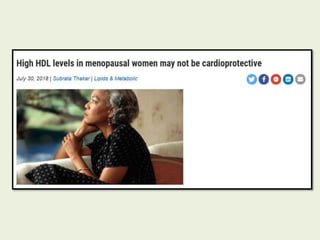
The proatherogenic association reported for HDL-C with carotid
plaque was most evident in women with later age at menopause
who were >10 years postmenopausal.
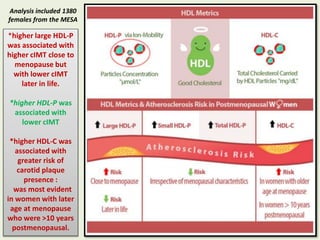
*higher large HDL-P
was associated with
higher cIMT close to
menopause but
with lower cIMT
later in life.
*higher HDL-P was
associated with
lower cIMT
*higher HDL-C was
associated with
greater risk of
carotid plaque
presence :
was most evident
in women with later
age at menopause
who were >10 years
postmenopausal.
Analysis included 1380
females from the MESA
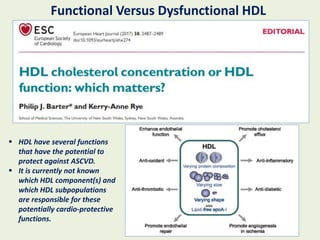
Functional Versus Dysfunctional HDL
 HDL have several functions
that have the potential to
protect against ASCVD.
 It is currently not known
which HDL component(s) and
which HDL subpopulations
are responsible for these
potentially cardio-protective
functions.
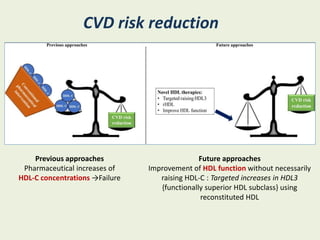
Previous approaches
Pharmaceutical increases of
HDL-C concentrations →Failure
Future approaches
Improvement of HDL function without necessarily
raising HDL-C : Targeted increases in HDL3
{functionally superior HDL subclass} using
reconstituted HDL
CVD risk reduction
Study overturns what we know about
“Good cholesterol”
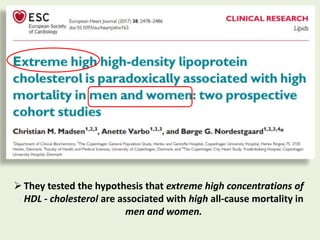
They tested the hypothesis that extreme high concentrations of
HDL - cholesterol are associated with high all-cause mortality in
men and women.
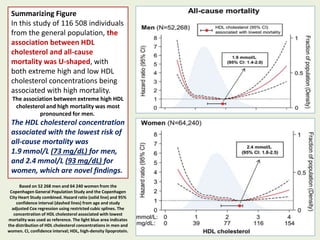
Summarizing Figure
In this study of 116 508 individuals
from the general population, the
association between HDL
cholesterol and all-cause
mortality was U-shaped, with
both extreme high and low HDL
cholesterol concentrations being
associated with high mortality.
The association between extreme high HDL
cholesterol and high mortality was most
pronounced for men.
The HDL cholesterol concentration
associated with the lowest risk of
all-cause mortality was
1.9 mmol/L (73 mg/dL) for men,
and 2.4 mmol/L (93 mg/dL) for
women, which are novel findings.
Based on 52 268 men and 64 240 women from the
Copenhagen General Population Study and the Copenhagen
City Heart Study combined. Hazard ratio (solid line) and 95%
confidence interval (dashed lines) from age and study
adjusted Cox regression using restricted cubic splines. The
concentration of HDL cholesterol associated with lowest
mortality was used as reference. The light blue area indicates
the distribution of HDL cholesterol concentrations in men and
women. CI, confidence interval; HDL, high-density lipoprotein.
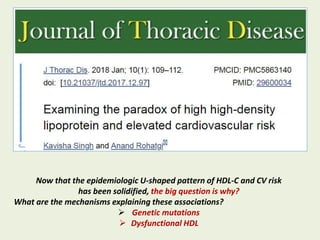
Now that the epidemiologic U-shaped pattern of HDL-C and CV risk
has been solidified, the big question is why?
What are the mechanisms explaining these associations?
 Genetic mutations
 Dysfunctional HDL
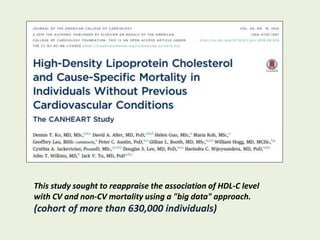
This study sought to reappraise the association of HDL-C level
with CV and non-CV mortality using a "big data" approach.
(cohort of more than 630,000 individuals)
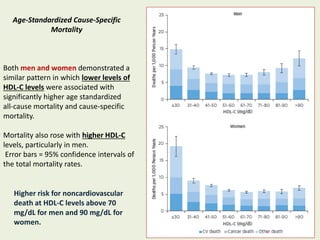
Age-Standardized Cause-Specific
Mortality
Both men and women demonstrated a
similar pattern in which lower levels of
HDL-C levels were associated with
significantly higher age standardized
all-cause mortality and cause-specific
mortality.
Mortality also rose with higher HDL-C
levels, particularly in men.
Error bars = 95% confidence intervals of
the total mortality rates.
Higher risk for noncardiovascular
death at HDL-C levels above 70
mg/dL for men and 90 mg/dL for
women.
Gender differences in HDL-cholesterol

Gender differences in HDL-cholesterol

  • 1.
    Magdy El-Masry Prof. ofCardiology Tanta University
  • 2.
    Old Data Paradigm shift Studyoverturns what we know about “Good cholesterol” Agenda
  • 3.
  • 4.
    HDL-C LDL-C TG TheGood, the Bad and the Ugly
  • 5.
    HDL-cholesterol concentrations areinversely associated with CVD Transformation from small to large HDL-P confirms proper functioning of reverse cholesterol transport ;otherwise HDL is of no value
  • 6.
    Women generally haveHDL-C levels 10 mg/dL higher than men.
  • 8.
    When we considercardiovascular mortality in women in terms of HDL, we notice that for every level of LDL cholesterol, when a woman has HDL cholesterol lower than 50 mg/dL, the event rate more than doubles.
  • 10.
    Women who hada waist size greater than 35 inches had significantly lower HDL cholesterol, higher total cholesterol, greater prevalence of hypertension (BP greater than 140/90 mm Hg), and significantly higher Framingham global risk scores, which means that they are more likely to die or have a heart attack in the next 10 years. Framingham global risk and number of risk factors were found to be significantly higher among women with central adiposity. Why is central obesity important?
  • 11.
    Low HDL-C isan indicator that the affected individual should be examined for metabolic and inflammatory pathology. Causes of low HDL cholesterol
  • 12.
    Postmenopause may causeincreases in A. visceral fat. B. LDL, Dense LDL particles and TG. C. Inflammatory markers. D. High Blood Pressure. It is postulated that the decreases in HDL only occur with substantial increases in visceral fat.
  • 13.
    Lipoprotein subfractions suffera shift after menopause towards a more atherogenic lipid profile
  • 14.
    Main characteristics ofstructural and functional abnormalities of lipid metabolism during atherogenic process and aging and the impact of diabetes mellitus
  • 16.
    Measuring HDL particlesas opposed to HDL cholesterol is a better indicator of CHD HDL Particle sizes → Functions Smaller HDL = More Functional ? (HDL3 : functionally superior HDL subclass) HDL Particle Measurement : Nuclear magnetic resonance (NMR) & Ion mobility (IM)
  • 17.
    Multiethnic study of5,598 men and women Evaluated associations of HDL-C and HDL-P with cIMT and CHD HDL-C was no longer associated with cIMT or CHD, but HDL-P remained independently associated with cIMT and CHD.
  • 19.
    Objectives were (1) toevaluate associations of HDL-C and HDL-P with cIMT and carotid plaque (2) to assess interactions by age at and time since menopause
  • 20.
    Analysis included 1380females from the MESA (Multi-Ethnic Study of Atherosclerosis; age: 61.8±10.3; 61% natural-, 21% surgical-, and 18% peri-menopause). Adjusting for each other, higher HDL-P but not HDL-C was associated with lower cIMT (P=0.001), whereas higher HDL-C but not HDL-P was associated with greater risk of carotid plaque presence (P=0.04). Time since menopause significantly modified the association of large but not small HDL-P with cIMT; higher large HDL-P was associated with higher cIMT close to menopause but with lower cIMT later in life. The proatherogenic association reported for HDL-C with carotid plaque was most evident in women with later age at menopause who were >10 years postmenopausal.
  • 21.
    *higher large HDL-P wasassociated with higher cIMT close to menopause but with lower cIMT later in life. *higher HDL-P was associated with lower cIMT *higher HDL-C was associated with greater risk of carotid plaque presence : was most evident in women with later age at menopause who were >10 years postmenopausal. Analysis included 1380 females from the MESA
  • 22.
    Functional Versus DysfunctionalHDL  HDL have several functions that have the potential to protect against ASCVD.  It is currently not known which HDL component(s) and which HDL subpopulations are responsible for these potentially cardio-protective functions.
  • 23.
    Previous approaches Pharmaceutical increasesof HDL-C concentrations →Failure Future approaches Improvement of HDL function without necessarily raising HDL-C : Targeted increases in HDL3 {functionally superior HDL subclass} using reconstituted HDL CVD risk reduction
  • 24.
    Study overturns whatwe know about “Good cholesterol”
  • 25.
    They tested thehypothesis that extreme high concentrations of HDL - cholesterol are associated with high all-cause mortality in men and women.
  • 26.
    Summarizing Figure In thisstudy of 116 508 individuals from the general population, the association between HDL cholesterol and all-cause mortality was U-shaped, with both extreme high and low HDL cholesterol concentrations being associated with high mortality. The association between extreme high HDL cholesterol and high mortality was most pronounced for men. The HDL cholesterol concentration associated with the lowest risk of all-cause mortality was 1.9 mmol/L (73 mg/dL) for men, and 2.4 mmol/L (93 mg/dL) for women, which are novel findings. Based on 52 268 men and 64 240 women from the Copenhagen General Population Study and the Copenhagen City Heart Study combined. Hazard ratio (solid line) and 95% confidence interval (dashed lines) from age and study adjusted Cox regression using restricted cubic splines. The concentration of HDL cholesterol associated with lowest mortality was used as reference. The light blue area indicates the distribution of HDL cholesterol concentrations in men and women. CI, confidence interval; HDL, high-density lipoprotein.
  • 27.
    Now that theepidemiologic U-shaped pattern of HDL-C and CV risk has been solidified, the big question is why? What are the mechanisms explaining these associations?  Genetic mutations  Dysfunctional HDL
  • 28.
    This study soughtto reappraise the association of HDL-C level with CV and non-CV mortality using a "big data" approach. (cohort of more than 630,000 individuals)
  • 29.
    Age-Standardized Cause-Specific Mortality Both menand women demonstrated a similar pattern in which lower levels of HDL-C levels were associated with significantly higher age standardized all-cause mortality and cause-specific mortality. Mortality also rose with higher HDL-C levels, particularly in men. Error bars = 95% confidence intervals of the total mortality rates. Higher risk for noncardiovascular death at HDL-C levels above 70 mg/dL for men and 90 mg/dL for women.