La geosfera
THE GEOSPHERE
Biology and Geology 1º ESO
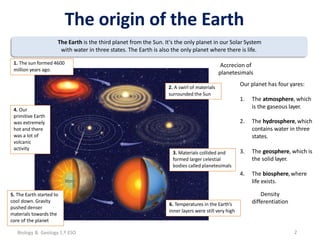
The Earth is the third planet from the Sun. It's the only planet in our Solar System
with water in three states. The Earth is also the only planet where there is life.
1. The sun formed 4600
million years ago.
2. A swirl of materials
surrounded the Sun
3. Materials collided and
formed larger celestial
bodies calledplanetesimals
6. Temperatures in the Earth’s
inner layers were still very high
5. The Earth started to
cool down. Gravity
pushed denser
materials towards the
core of the planet
4. Our
primitive Earth
was extremely
hot and there
was a lot of
volcanic
activity
Our planet has four yares:
1. The atmosphere, which
is the gaseous layer.
2. The hydrosphere,which
contains water in three
states.
3. The geosphere, which is
the solid layer.
4. The biosphere,where
life exists.
The origin of the Earth
Density
differentiation
Accrecion of
planetesimals
2
Biology & Geology 1.º ESO
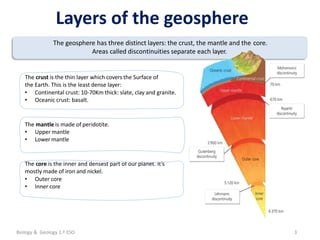
The geosphere has three distinct layers: the crust, the mantle and the core.
Areas called discontinuities separate each layer.
The crust is the thin layer which covers the Surface of
the Earth. This is the least dense layer:
• Continental crust: 10-70Km thick: slate, clay and granite.
• Oceanic crust: basalt.
The mantle is made of peridotite.
• Upper mantle
• Lower mantle
The core is the inner and densest part of our planet. It’s
mostly made of iron and nickel.
• Outer core
• Inner core
Layers of the geosphere
3
Biology & Geology 1.º ESO
La geosfera
MINERALS
4
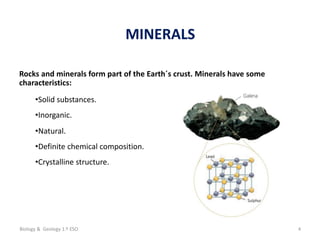
Rocks and minerals form part of the Earth´s crust. Minerals have some
characteristics:
•Solid substances.
•Inorganic.
•Natural.
•Definite chemical composition.
•Crystalline structure.
Biology & Geology 1.º ESO
La geosfera
Physical properties of minerals.
Optical properties
Relate to how a mineral reacts to light.
Habit
• Some minerals have very characteristics shapes that reflect their crystalline structures.
Colour
• Characteristic colour.
Streak
• The colour of the powder produced when a mineral is scratched.
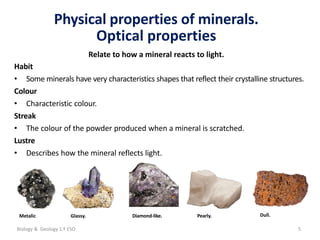
Lustre
• Describes how the mineral reflects light.
Glassy.
5
Metalic Pearly.
Diamond-like. Dull.
Biology & Geology 1.º ESO
La geosfera
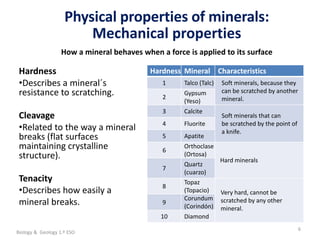
Hardness
•Describes a mineral´s
resistance to scratching.
Cleavage
•Related to the way a mineral
breaks (flat surfaces
maintaining crystalline
structure).
Tenacity
•Describes how easily a
mineral breaks.
6
Physical properties of minerals:
Mechanical properties
How a mineral behaves when a force is applied to its surface
Hardness Mineral Characteristics
1 Talco (Talc) Soft minerals, because they
can be scratched by another
mineral.
2
Gypsum
(Yeso)
3 Calcite
Soft minerals that can
be scratched by the point of
a knife.
4 Fluorite
5 Apatite
6
Orthoclase
(Ortosa)
Hard minerals
7
Quartz
(cuarzo)
8
Topaz
(Topacio) Very hard, cannot be
scratched by any other
mineral.
9
Corundum
(Corindón)
10 Diamond
Biology & Geology 1.º ESO
La geosfera
Physical properties of minerals:
Magnetic properties
7
• Some minerals, such as magnetite, behave like a magnet. They
attract objects that contain iron or nickel.
Other properties of materials
Transparency
• Describes how a mineral reacts to light (transparent- translucent-
opaque).
Density
• Relation between mass and volumeof a mineral.
ρ= m / V
Biology & Geology 1.º ESO
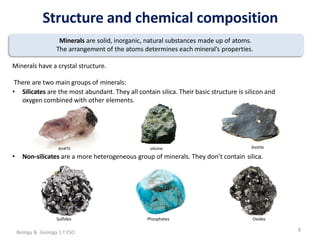
Minerals are solid, inorganic, natural substances made up of atoms.
The arrangement of the atoms determines each mineral’s properties.
Minerals have a crystal structure.
There are two main groups of minerals:
• Silicates are the most abundant. They all contain silica. Their basic structure is silicon and
oxygen combined with other elements.
• Non-silicates are a more heterogeneous group of minerals. They don’t contain silica.
Structure and chemical composition
8
quartz olivine biotite
Sulfides Phosphates Oxides
Biology & Geology 1.º ESO
La geosfera
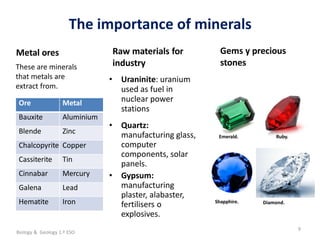
Metal ores Raw materials for
industry
• Uraninite: uranium
used as fuel in
nuclear power
stations
• Quartz:
manufacturing glass,
computer
components, solar
panels.
• Gypsum:
manufacturing
plaster, alabaster,
fertilisers o
explosives.
The importance of minerals
Gems y precious
stones
Emerald.
9
Shapphire.
Ruby.
Diamond.
Ore Metal
Bauxite Aluminium
Blende Zinc
Chalcopyrite Copper
Cassiterite Tin
Cinnabar Mercury
Galena Lead
Hematite Iron
These are minerals
that metals are
extract from.
Biology & Geology 1.º ESO
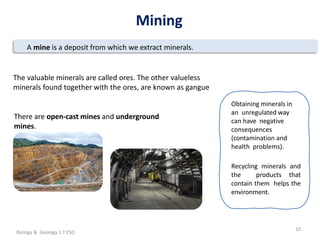
Mining
There are open-cast mines and underground
mines.
A mine is a deposit from which we extract minerals.
Obtaining minerals in
an unregulated way
can have negative
consequences
(contamination and
health problems).
Recycling minerals and
the products that
contain them helps the
environment.
The valuable minerals are called ores. The other valueless
minerals found together with the ores, are known as gangue
10
Biology & Geology 1.º ESO
La geosfera
Rocks
11
Rocks, like minerals, have properties that allow us to identify them, for
example:
•Composition of the rock refers to the minerals that make up the rock:
homogeneous y heterogeneous.
•Texture refers to the size and arrangement of the minerals in the rock.
Types of rocks:
•Igneous: these originate when magma from the Earth´s interior cools and
solidifies.
•Sedimentary: sedimentary rocks form when sediments consolidate.
•Metamorphic: Formed by the transformation of other rocks subjected to high
pressure conditions and/or temperatures, without reaching a melting state.
Biology & Geology 1.º ESO
La geosfera
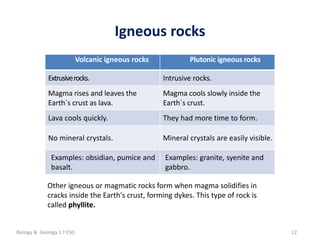
Igneous rocks
Volcanic igneous rocks Plutonic igneous rocks
Extrusiverocks. Intrusive rocks.
Magma rises and leaves the
Earth´s crust as lava.
Magma cools slowly inside the
Earth´s crust.
Lava cools quickly. They had more time to form.
No mineral crystals. Mineral crystals are easily visible.
Examples: obsidian, pumice and
basalt.
Examples: granite, syenite and
gabbro.
12
Biology & Geology 1.º ESO
Other igneous or magmatic rocks form when magma solidifies in
cracks inside the Earth's crust, forming dykes. This type of rock is
called phyllite.
La geosfera
Sedimentary rocks
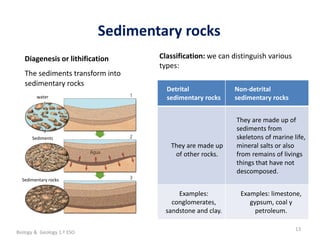
Diagenesis or lithification
The sediments transform into
sedimentary rocks
13
Detrital
sedimentary rocks
Non-detrital
sedimentary rocks
They are made up
of other rocks.
They are made up of
sediments from
skeletons of marine life,
mineral salts or also
from remains of livings
things that have not
descomposed.
Examples:
conglomerates,
sandstone and clay.
Examples: limestone,
gypsum, coal y
petroleum.
Classification: we can distinguish various
types:
water
Sediments
Sedimentary rocks
Biology & Geology 1.º ESO
La geosfera
Metamorphic rocks
14
• Classification:
Foliated metamorphic rocks Non-foliated metamorphic rocks
The minerals are arranged to form
parallel layers.
The minerals are not arranged
in layers.
Examples: slate, schist, gneiss,
migmatite.
Examples: marble, quartzite
High temperatures and pressure cause changes in the minerals that compose a
rock and a new rock forms , without reaching a melting state.
Biology & Geology 1.º ESO
La geosfera
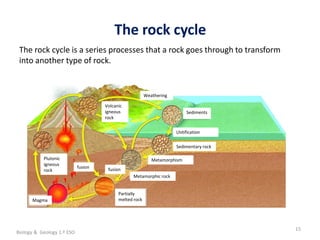
The rock cycle
The rock cycle is a series processes that a rock goes through to transform
into another type of rock.
15
Partially
melted rock
Metamorphic rock
Magma
Sedimentary rock
Weathering
fusion
Sediments
Plutonic
igneous
rock
fusion
Volcanic
igneous
rock
Metamorphism
Lhitification
Biology & Geology 1.º ESO
La geosfera
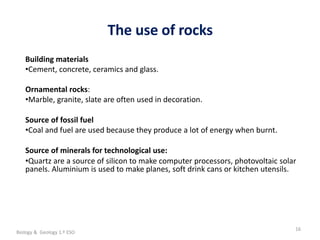
The use of rocks
16
Building materials
•Cement, concrete, ceramics and glass.
Ornamental rocks:
•Marble, granite, slate are often used in decoration.
Source of fossil fuel
•Coal and fuel are used because they produce a lot of energy when burnt.
Source of minerals for technological use:
•Quartz are a source of silicon to make computer processors, photovoltaic solar
panels. Aluminium is used to make planes, soft drink cans or kitchen utensils.
Biology & Geology 1.º ESO
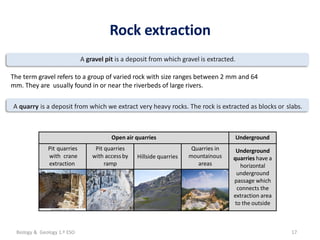
Open air quarries Underground
Pit quarries
with crane
extraction
Pit quarries
with accessby
ramp
Hillside quarries
Quarries in
mountainous
areas
Underground
quarries have a
horizontal
underground
passage which
connects the
extraction area
to the outside
A gravel pit is a deposit from which gravel is extracted.
The term gravel refers to a group of varied rock with size ranges between 2 mm and 64
mm. They are usually found in or near the riverbeds of large rivers.
A quarry is a deposit from which we extract very heavy rocks. The rock is extracted as blocks or slabs.
La geosfera
Rock extraction
17
Biology & Geology 1.º ESO
Geological areas and resources in Spain
18
Geodiversity refers to the
geological variety of a region.
Geological resources are any
elements or locations that have a
significant geological value.
Coastal area
• Lower coast
• High, rocky coasts
Geological resources:
• Cavities.
• Stratigraphic and paleontological.
• Petrological y mineralogical.
• Geomorphological.
• Mining regions
Biology & Geology 1.º ESO
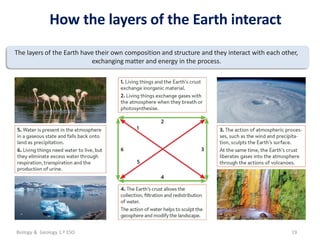
The layers of the Earth have their own composition and structure and they interact with each other,
exchanging matter and energy in the process.
How the layers of the Earth interact
19
Biology & Geology 1.º ESO
Where the layers of the Earth interact
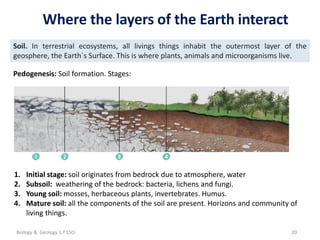
Soil. In terrestrial ecosystems, all livings things inhabit the outermost layer of the
geosphere, the Earth´s Surface. This is where plants, animals and microorganisms live.
Pedogenesis: Soil formation. Stages:
1. Initial stage: soil originates from bedrock due to atmosphere, water
2. Subsoil: weathering of the bedrock: bacteria, lichens and fungi.
3. Young soil: mosses, herbaceous plants, invertebrates. Humus.
4. Mature soil: all the components of the soil are present. Horizons and community of
living things.
20
Biology & Geology 1.º ESO

Unit 10. The geosphere

  • 1.
  • 2.
    The Earth isthe third planet from the Sun. It's the only planet in our Solar System with water in three states. The Earth is also the only planet where there is life. 1. The sun formed 4600 million years ago. 2. A swirl of materials surrounded the Sun 3. Materials collided and formed larger celestial bodies calledplanetesimals 6. Temperatures in the Earth’s inner layers were still very high 5. The Earth started to cool down. Gravity pushed denser materials towards the core of the planet 4. Our primitive Earth was extremely hot and there was a lot of volcanic activity Our planet has four yares: 1. The atmosphere, which is the gaseous layer. 2. The hydrosphere,which contains water in three states. 3. The geosphere, which is the solid layer. 4. The biosphere,where life exists. The origin of the Earth Density differentiation Accrecion of planetesimals 2 Biology & Geology 1.º ESO
  • 3.
    The geosphere hasthree distinct layers: the crust, the mantle and the core. Areas called discontinuities separate each layer. The crust is the thin layer which covers the Surface of the Earth. This is the least dense layer: • Continental crust: 10-70Km thick: slate, clay and granite. • Oceanic crust: basalt. The mantle is made of peridotite. • Upper mantle • Lower mantle The core is the inner and densest part of our planet. It’s mostly made of iron and nickel. • Outer core • Inner core Layers of the geosphere 3 Biology & Geology 1.º ESO
  • 4.
    La geosfera MINERALS 4 Rocks andminerals form part of the Earth´s crust. Minerals have some characteristics: •Solid substances. •Inorganic. •Natural. •Definite chemical composition. •Crystalline structure. Biology & Geology 1.º ESO
  • 5.
    La geosfera Physical propertiesof minerals. Optical properties Relate to how a mineral reacts to light. Habit • Some minerals have very characteristics shapes that reflect their crystalline structures. Colour • Characteristic colour. Streak • The colour of the powder produced when a mineral is scratched. Lustre • Describes how the mineral reflects light. Glassy. 5 Metalic Pearly. Diamond-like. Dull. Biology & Geology 1.º ESO
  • 6.
    La geosfera Hardness •Describes amineral´s resistance to scratching. Cleavage •Related to the way a mineral breaks (flat surfaces maintaining crystalline structure). Tenacity •Describes how easily a mineral breaks. 6 Physical properties of minerals: Mechanical properties How a mineral behaves when a force is applied to its surface Hardness Mineral Characteristics 1 Talco (Talc) Soft minerals, because they can be scratched by another mineral. 2 Gypsum (Yeso) 3 Calcite Soft minerals that can be scratched by the point of a knife. 4 Fluorite 5 Apatite 6 Orthoclase (Ortosa) Hard minerals 7 Quartz (cuarzo) 8 Topaz (Topacio) Very hard, cannot be scratched by any other mineral. 9 Corundum (Corindón) 10 Diamond Biology & Geology 1.º ESO
  • 7.
    La geosfera Physical propertiesof minerals: Magnetic properties 7 • Some minerals, such as magnetite, behave like a magnet. They attract objects that contain iron or nickel. Other properties of materials Transparency • Describes how a mineral reacts to light (transparent- translucent- opaque). Density • Relation between mass and volumeof a mineral. ρ= m / V Biology & Geology 1.º ESO
  • 8.
    Minerals are solid,inorganic, natural substances made up of atoms. The arrangement of the atoms determines each mineral’s properties. Minerals have a crystal structure. There are two main groups of minerals: • Silicates are the most abundant. They all contain silica. Their basic structure is silicon and oxygen combined with other elements. • Non-silicates are a more heterogeneous group of minerals. They don’t contain silica. Structure and chemical composition 8 quartz olivine biotite Sulfides Phosphates Oxides Biology & Geology 1.º ESO
  • 9.
    La geosfera Metal oresRaw materials for industry • Uraninite: uranium used as fuel in nuclear power stations • Quartz: manufacturing glass, computer components, solar panels. • Gypsum: manufacturing plaster, alabaster, fertilisers o explosives. The importance of minerals Gems y precious stones Emerald. 9 Shapphire. Ruby. Diamond. Ore Metal Bauxite Aluminium Blende Zinc Chalcopyrite Copper Cassiterite Tin Cinnabar Mercury Galena Lead Hematite Iron These are minerals that metals are extract from. Biology & Geology 1.º ESO
  • 10.
    Mining There are open-castmines and underground mines. A mine is a deposit from which we extract minerals. Obtaining minerals in an unregulated way can have negative consequences (contamination and health problems). Recycling minerals and the products that contain them helps the environment. The valuable minerals are called ores. The other valueless minerals found together with the ores, are known as gangue 10 Biology & Geology 1.º ESO
  • 11.
    La geosfera Rocks 11 Rocks, likeminerals, have properties that allow us to identify them, for example: •Composition of the rock refers to the minerals that make up the rock: homogeneous y heterogeneous. •Texture refers to the size and arrangement of the minerals in the rock. Types of rocks: •Igneous: these originate when magma from the Earth´s interior cools and solidifies. •Sedimentary: sedimentary rocks form when sediments consolidate. •Metamorphic: Formed by the transformation of other rocks subjected to high pressure conditions and/or temperatures, without reaching a melting state. Biology & Geology 1.º ESO
  • 12.
    La geosfera Igneous rocks Volcanicigneous rocks Plutonic igneous rocks Extrusiverocks. Intrusive rocks. Magma rises and leaves the Earth´s crust as lava. Magma cools slowly inside the Earth´s crust. Lava cools quickly. They had more time to form. No mineral crystals. Mineral crystals are easily visible. Examples: obsidian, pumice and basalt. Examples: granite, syenite and gabbro. 12 Biology & Geology 1.º ESO Other igneous or magmatic rocks form when magma solidifies in cracks inside the Earth's crust, forming dykes. This type of rock is called phyllite.
  • 13.
    La geosfera Sedimentary rocks Diagenesisor lithification The sediments transform into sedimentary rocks 13 Detrital sedimentary rocks Non-detrital sedimentary rocks They are made up of other rocks. They are made up of sediments from skeletons of marine life, mineral salts or also from remains of livings things that have not descomposed. Examples: conglomerates, sandstone and clay. Examples: limestone, gypsum, coal y petroleum. Classification: we can distinguish various types: water Sediments Sedimentary rocks Biology & Geology 1.º ESO
  • 14.
    La geosfera Metamorphic rocks 14 •Classification: Foliated metamorphic rocks Non-foliated metamorphic rocks The minerals are arranged to form parallel layers. The minerals are not arranged in layers. Examples: slate, schist, gneiss, migmatite. Examples: marble, quartzite High temperatures and pressure cause changes in the minerals that compose a rock and a new rock forms , without reaching a melting state. Biology & Geology 1.º ESO
  • 15.
    La geosfera The rockcycle The rock cycle is a series processes that a rock goes through to transform into another type of rock. 15 Partially melted rock Metamorphic rock Magma Sedimentary rock Weathering fusion Sediments Plutonic igneous rock fusion Volcanic igneous rock Metamorphism Lhitification Biology & Geology 1.º ESO
  • 16.
    La geosfera The useof rocks 16 Building materials •Cement, concrete, ceramics and glass. Ornamental rocks: •Marble, granite, slate are often used in decoration. Source of fossil fuel •Coal and fuel are used because they produce a lot of energy when burnt. Source of minerals for technological use: •Quartz are a source of silicon to make computer processors, photovoltaic solar panels. Aluminium is used to make planes, soft drink cans or kitchen utensils. Biology & Geology 1.º ESO
  • 17.
    Open air quarriesUnderground Pit quarries with crane extraction Pit quarries with accessby ramp Hillside quarries Quarries in mountainous areas Underground quarries have a horizontal underground passage which connects the extraction area to the outside A gravel pit is a deposit from which gravel is extracted. The term gravel refers to a group of varied rock with size ranges between 2 mm and 64 mm. They are usually found in or near the riverbeds of large rivers. A quarry is a deposit from which we extract very heavy rocks. The rock is extracted as blocks or slabs. La geosfera Rock extraction 17 Biology & Geology 1.º ESO
  • 18.
    Geological areas andresources in Spain 18 Geodiversity refers to the geological variety of a region. Geological resources are any elements or locations that have a significant geological value. Coastal area • Lower coast • High, rocky coasts Geological resources: • Cavities. • Stratigraphic and paleontological. • Petrological y mineralogical. • Geomorphological. • Mining regions Biology & Geology 1.º ESO
  • 19.
    The layers ofthe Earth have their own composition and structure and they interact with each other, exchanging matter and energy in the process. How the layers of the Earth interact 19 Biology & Geology 1.º ESO
  • 20.
    Where the layersof the Earth interact Soil. In terrestrial ecosystems, all livings things inhabit the outermost layer of the geosphere, the Earth´s Surface. This is where plants, animals and microorganisms live. Pedogenesis: Soil formation. Stages: 1. Initial stage: soil originates from bedrock due to atmosphere, water 2. Subsoil: weathering of the bedrock: bacteria, lichens and fungi. 3. Young soil: mosses, herbaceous plants, invertebrates. Humus. 4. Mature soil: all the components of the soil are present. Horizons and community of living things. 20 Biology & Geology 1.º ESO