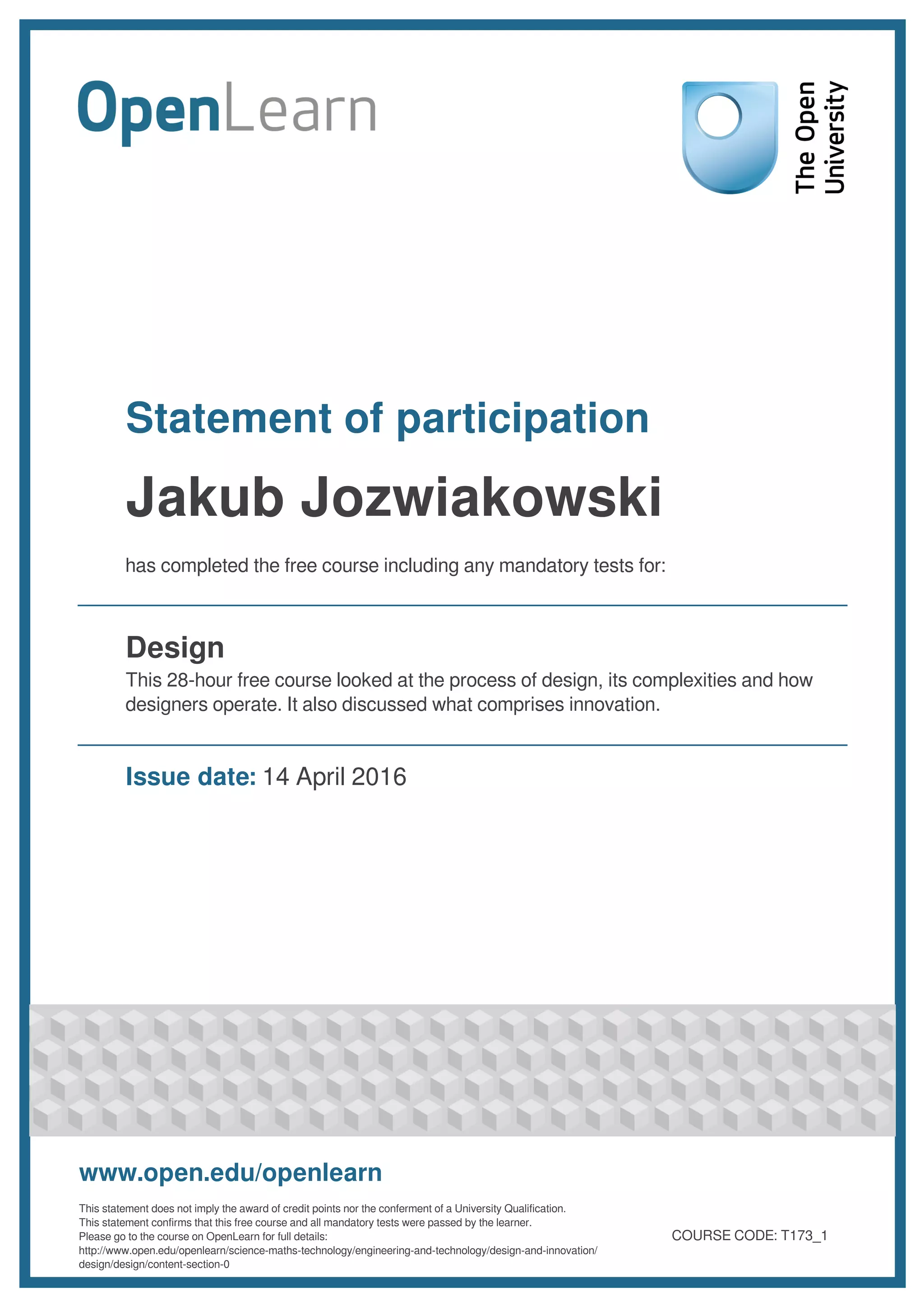
Statement of participation
Jakub Jozwiakowski
has completed the free course including any mandatory tests for:
Design
This 28-hour free course looked at the process of design, its complexities and how
designers operate. It also discussed what comprises innovation.
Issue date: 14 April 2016
www.open.edu/openlearn
This statement does not imply the award of credit points nor the conferment of a University Qualification.
This statement confirms that this free course and all mandatory tests were passed by the learner.
Please go to the course on OpenLearn for full details:
http://www.open.edu/openlearn/science-maths-technology/engineering-and-technology/design-and-innovation/
design/design/content-section-0
COURSE CODE: T173_1
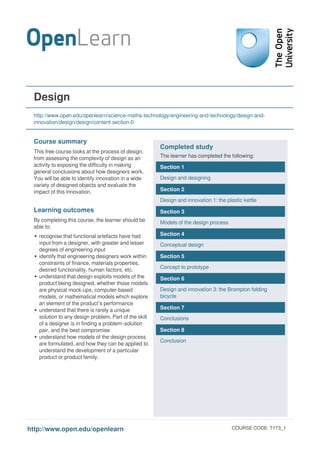
Design
http://www.open.edu/openlearn/science-maths-technology/engineering-and-technology/design-and-
innovation/design/design/content-section-0
Course summary
This free course looks at the process of design,
from assessing the complexity of design as an
activity to exposing the difficulty in making
general conclusions about how designers work.
You will be able to identify innovation in a wide
variety of designed objects and evaluate the
impact of this innovation.
Learning outcomes
By completing this course, the learner should be
able to:
recognise that functional artefacts have had
input from a designer, with greater and lesser
degrees of engineering input
identify that engineering designers work within
constraints of finance, materials properties,
desired functionality, human factors, etc.
understand that design exploits models of the
product being designed, whether those models
are physical mock-ups, computer-based
models, or mathematical models which explore
an element of the product’s performance
understand that there is rarely a unique
solution to any design problem. Part of the skill
of a designer is in finding a problem–solution
pair, and the best compromise
understand how models of the design process
are formulated, and how they can be applied to
understand the development of a particular
product or product family.
Completed study
The learner has completed the following:
Section 1
Design and designing
Section 2
Design and innovation 1: the plastic kettle
Section 3
Models of the design process
Section 4
Conceptual design
Section 5
Concept to prototype
Section 6
Design and innovation 3: the Brompton folding
bicycle
Section 7
Conclusions
Section 8
Conclusion
http://www.open.edu/openlearn COURSE CODE: T173_1
Powered by TCPDF (www.tcpdf.org)

T173_1_statement

  • 1.
    Statement of participation JakubJozwiakowski has completed the free course including any mandatory tests for: Design This 28-hour free course looked at the process of design, its complexities and how designers operate. It also discussed what comprises innovation. Issue date: 14 April 2016 www.open.edu/openlearn This statement does not imply the award of credit points nor the conferment of a University Qualification. This statement confirms that this free course and all mandatory tests were passed by the learner. Please go to the course on OpenLearn for full details: http://www.open.edu/openlearn/science-maths-technology/engineering-and-technology/design-and-innovation/ design/design/content-section-0 COURSE CODE: T173_1
  • 2.
    Design http://www.open.edu/openlearn/science-maths-technology/engineering-and-technology/design-and- innovation/design/design/content-section-0 Course summary This freecourse looks at the process of design, from assessing the complexity of design as an activity to exposing the difficulty in making general conclusions about how designers work. You will be able to identify innovation in a wide variety of designed objects and evaluate the impact of this innovation. Learning outcomes By completing this course, the learner should be able to: recognise that functional artefacts have had input from a designer, with greater and lesser degrees of engineering input identify that engineering designers work within constraints of finance, materials properties, desired functionality, human factors, etc. understand that design exploits models of the product being designed, whether those models are physical mock-ups, computer-based models, or mathematical models which explore an element of the product’s performance understand that there is rarely a unique solution to any design problem. Part of the skill of a designer is in finding a problem–solution pair, and the best compromise understand how models of the design process are formulated, and how they can be applied to understand the development of a particular product or product family. Completed study The learner has completed the following: Section 1 Design and designing Section 2 Design and innovation 1: the plastic kettle Section 3 Models of the design process Section 4 Conceptual design Section 5 Concept to prototype Section 6 Design and innovation 3: the Brompton folding bicycle Section 7 Conclusions Section 8 Conclusion http://www.open.edu/openlearn COURSE CODE: T173_1 Powered by TCPDF (www.tcpdf.org)