Pharmacokinetics of Oral Absorption
Presented By
Name Registration No
Mahmud Hasan 15103009
Selim Reza 15103008
Jannat Zahan Juthy 15103016
Sanjeeda Ahmed 15103034
Aysha Siddika Munni 15103041
Rafat Ara Dolon 14203049
• Pharmacokinetics describes how the body affects a specific
chemical after administration through the mechanisms of
absorption and distribution, as well as the metabolic changes of
the substance in the body and the routes of excretion of the
metabolites of the drug.
• Pharmacokinetic properties of a particular drug is important to
determine the routes of administration, dose, Onset of action,
Duration of action and frequency of dosing.
What is Pharmacokinetics?
•How the human body acts on the drug
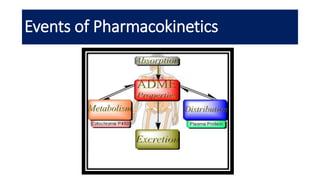
Events of Pharmacokinetics
• Absorption: the process of a substance entering the blood circulation.
• Distribution – the dispersion of substances throughout the fluids and
tissues of the body.
• Metabolism (or biotransformation) – the chemical conversion of drug
by enzyme to produce active or inactive metabolites.
• Excretion – the removal of the substances from the body.
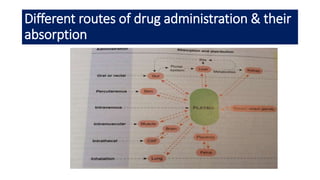
Different routes of drug administration & their
absorption
Drug Transportation across cell
membrane
• Passive diffusion
• Carrier mediated transport
• Facilitated diffusion
• Active transport
• Pore transport
• Ion pair formation
• Vesicular transport
abs absorption
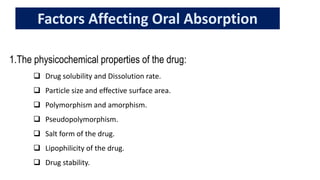
1.The physicochemical properties of the drug:
 Drug solubility and Dissolution rate.
 Particle size and effective surface area.
 Polymorphism and amorphism.
 Pseudopolymorphism.
 Salt form of the drug.
 Lipophilicity of the drug.
 Drug stability.
Factors Affecting Oral Absorption
on
2.The nature of the drug product:
 Disintegration time
 Manufacturing variables
 Pharmaceutical ingredients
 Product age and storage condition
Factors Affecting Oral Absorption
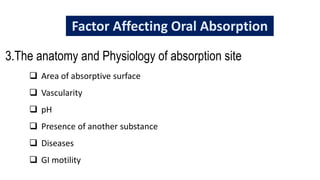
3.The anatomy and Physiology of absorption site
 Area of absorptive surface
 Vascularity
 pH
 Presence of another substance
 Diseases
 GI motility
Factor Affecting Oral Absorption
Zero order kinetics
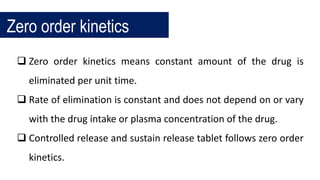
 Zero order kinetics means constant amount of the drug is
eliminated per unit time.
 Rate of elimination is constant and does not depend on or vary
with the drug intake or plasma concentration of the drug.
 Controlled release and sustain release tablet follows zero order
kinetics.
First order kinetics
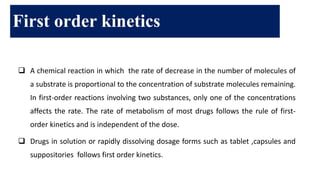
 A chemical reaction in which the rate of decrease in the number of molecules of
a substrate is proportional to the concentration of substrate molecules remaining.
In first-order reactions involving two substances, only one of the concentrations
affects the rate. The rate of metabolism of most drugs follows the rule of first-
order kinetics and is independent of the dose.
 Drugs in solution or rapidly dissolving dosage forms such as tablet ,capsules and
suppositories follows first order kinetics.
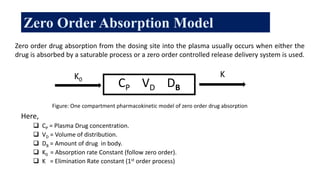
Here,
 CP = Plasma Drug concentration.
 VD = Volume of distribution.
 DB = Amount of drug in body.
 K0 = Absorption rate Constant (follow zero order).
 K = Elimination Rate constant (1st order process)
CP VD DB
K0
K
Figure: One compartment pharmacokinetic model of zero order drug absorption
Zero order drug absorption from the dosing site into the plasma usually occurs when either the
drug is absorbed by a saturable process or a zero order controlled release delivery system is used.
Zero Order Absorption Model
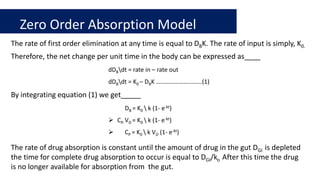
The rate of first order elimination at any time is equal to DBK. The rate of input is simply, K0.
Therefore, the net change per unit time in the body can be expressed as____
dDBdt = rate in – rate out
dDBdt = K0 – DBK …………………………(1)
By integrating equation (1) we get_____
DB = K0  k (1- e-kt)
 CP. VD = K0  k (1- e-kt)
 CP = K0  k VD (1- e-kt)
The rate of drug absorption is constant until the amount of drug in the gut DGI is depleted
the time for complete drug absorption to occur is equal to DGI/ko After this time the drug
is no longer available for absorption from the gut.
First Order Absorption Model
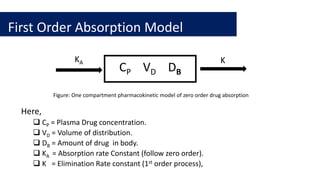
Here,
 CP = Plasma Drug concentration.
 VD = Volume of distribution.
 DB = Amount of drug in body.
 KA = Absorption rate Constant (follow zero order).
 K = Elimination Rate constant (1st order process),
CP VD DB
KA K
Figure: One compartment pharmacokinetic model of zero order drug absorption
First Order Absorption Model
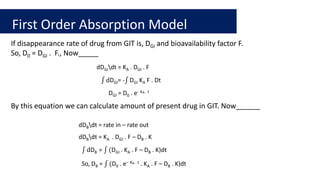
If disappearance rate of drug from GIT is, DGI and bioavailability factor F.
So, D0 = DGI . F., Now_____
dDGIdt = KA . DGI . F
dDGI= - DGI KA F . Dt
DGI = D0 . e- KA . t
dDBdt = rate in – rate out
dDBdt = KA . DGI . F – DB . K
dDB = (DGI . KA . F – DB . K)dt
So, DB = (D0 . e− KA . t . KA . F – DB . K)dt
By this equation we can calculate amount of present drug in GIT. Now______
First order absorption model
=> DB =
D0 .KA. F (e −K . t − e− KA . t)
KA−K
So, CP
=
D0 .KA. F (e −K . t − e− KA . t)
VD (KA−K)
Because,
CP = K0  k VD (1- e-kt)[ ]
References
• 1. https://www.slideshare.net/rakibmsrn/pharmacokinetics-of-oral-
drug-absorption
• 2. https://lifeinthefastlane.com/first-order-and-zero-order-kinetics-
pharmacology-bscc/
3.https://www.researchgate.net/publication/229018971_Overview_of
_factors_affecting_oral_drug_absorption
4.https://www.slideshare.net/umersm2012/passage-of-drug-
molecules-across-cell-membrane-and-its-dristribution

First order absorption model

  • 1.
  • 2.
    Presented By Name RegistrationNo Mahmud Hasan 15103009 Selim Reza 15103008 Jannat Zahan Juthy 15103016 Sanjeeda Ahmed 15103034 Aysha Siddika Munni 15103041 Rafat Ara Dolon 14203049
  • 3.
    • Pharmacokinetics describeshow the body affects a specific chemical after administration through the mechanisms of absorption and distribution, as well as the metabolic changes of the substance in the body and the routes of excretion of the metabolites of the drug. • Pharmacokinetic properties of a particular drug is important to determine the routes of administration, dose, Onset of action, Duration of action and frequency of dosing. What is Pharmacokinetics? •How the human body acts on the drug
  • 4.
  • 5.
    Events of Pharmacokinetics •Absorption: the process of a substance entering the blood circulation. • Distribution – the dispersion of substances throughout the fluids and tissues of the body. • Metabolism (or biotransformation) – the chemical conversion of drug by enzyme to produce active or inactive metabolites. • Excretion – the removal of the substances from the body.
  • 6.
    Different routes ofdrug administration & their absorption
  • 7.
    Drug Transportation acrosscell membrane • Passive diffusion • Carrier mediated transport • Facilitated diffusion • Active transport • Pore transport • Ion pair formation • Vesicular transport
  • 8.
    abs absorption 1.The physicochemicalproperties of the drug:  Drug solubility and Dissolution rate.  Particle size and effective surface area.  Polymorphism and amorphism.  Pseudopolymorphism.  Salt form of the drug.  Lipophilicity of the drug.  Drug stability. Factors Affecting Oral Absorption
  • 9.
    on 2.The nature ofthe drug product:  Disintegration time  Manufacturing variables  Pharmaceutical ingredients  Product age and storage condition Factors Affecting Oral Absorption
  • 10.
    3.The anatomy andPhysiology of absorption site  Area of absorptive surface  Vascularity  pH  Presence of another substance  Diseases  GI motility Factor Affecting Oral Absorption
  • 11.
    Zero order kinetics Zero order kinetics means constant amount of the drug is eliminated per unit time.  Rate of elimination is constant and does not depend on or vary with the drug intake or plasma concentration of the drug.  Controlled release and sustain release tablet follows zero order kinetics.
  • 12.
    First order kinetics A chemical reaction in which the rate of decrease in the number of molecules of a substrate is proportional to the concentration of substrate molecules remaining. In first-order reactions involving two substances, only one of the concentrations affects the rate. The rate of metabolism of most drugs follows the rule of first- order kinetics and is independent of the dose.  Drugs in solution or rapidly dissolving dosage forms such as tablet ,capsules and suppositories follows first order kinetics.
  • 13.
    Here,  CP =Plasma Drug concentration.  VD = Volume of distribution.  DB = Amount of drug in body.  K0 = Absorption rate Constant (follow zero order).  K = Elimination Rate constant (1st order process) CP VD DB K0 K Figure: One compartment pharmacokinetic model of zero order drug absorption Zero order drug absorption from the dosing site into the plasma usually occurs when either the drug is absorbed by a saturable process or a zero order controlled release delivery system is used. Zero Order Absorption Model
  • 14.
    Zero Order AbsorptionModel The rate of first order elimination at any time is equal to DBK. The rate of input is simply, K0. Therefore, the net change per unit time in the body can be expressed as____ dDBdt = rate in – rate out dDBdt = K0 – DBK …………………………(1) By integrating equation (1) we get_____ DB = K0 k (1- e-kt)  CP. VD = K0 k (1- e-kt)  CP = K0 k VD (1- e-kt) The rate of drug absorption is constant until the amount of drug in the gut DGI is depleted the time for complete drug absorption to occur is equal to DGI/ko After this time the drug is no longer available for absorption from the gut.
  • 15.
    First Order AbsorptionModel Here,  CP = Plasma Drug concentration.  VD = Volume of distribution.  DB = Amount of drug in body.  KA = Absorption rate Constant (follow zero order).  K = Elimination Rate constant (1st order process), CP VD DB KA K Figure: One compartment pharmacokinetic model of zero order drug absorption
  • 16.
    First Order AbsorptionModel If disappearance rate of drug from GIT is, DGI and bioavailability factor F. So, D0 = DGI . F., Now_____ dDGIdt = KA . DGI . F dDGI= - DGI KA F . Dt DGI = D0 . e- KA . t dDBdt = rate in – rate out dDBdt = KA . DGI . F – DB . K dDB = (DGI . KA . F – DB . K)dt So, DB = (D0 . e− KA . t . KA . F – DB . K)dt By this equation we can calculate amount of present drug in GIT. Now______
  • 17.
    First order absorptionmodel => DB = D0 .KA. F (e −K . t − e− KA . t) KA−K So, CP = D0 .KA. F (e −K . t − e− KA . t) VD (KA−K) Because, CP = K0 k VD (1- e-kt)[ ]
  • 18.
    References • 1. https://www.slideshare.net/rakibmsrn/pharmacokinetics-of-oral- drug-absorption •2. https://lifeinthefastlane.com/first-order-and-zero-order-kinetics- pharmacology-bscc/ 3.https://www.researchgate.net/publication/229018971_Overview_of _factors_affecting_oral_drug_absorption 4.https://www.slideshare.net/umersm2012/passage-of-drug- molecules-across-cell-membrane-and-its-dristribution