T CELLS
Dr SHEMEERA SAIDALAVI VP
PG RESIDENT
CONTENTS
◦INTRODUCTION
◦DEVELOPMENT AND MATURATION
◦T CELL DIFFERENTIATION/ DIFFERENT TYPES
OF T CELLS
a)CD4+T HELPER CELLS
b)REGULATORY T CELLS
c)CD8+ CYTOTOXIC CELLS
d)MEMORY T CELLS
◦PHASES OF T CELL ACTIVATION
INTRODUCTION
 T cells : Type of blood cell
 Belong to a group of white blood cells (WBCs) called lymphocytes.
WBCs protect the body from infection  T-cells is to fight infection.
Along with other WBCs, they play a major role in the immune system,
which guards the body against infection.
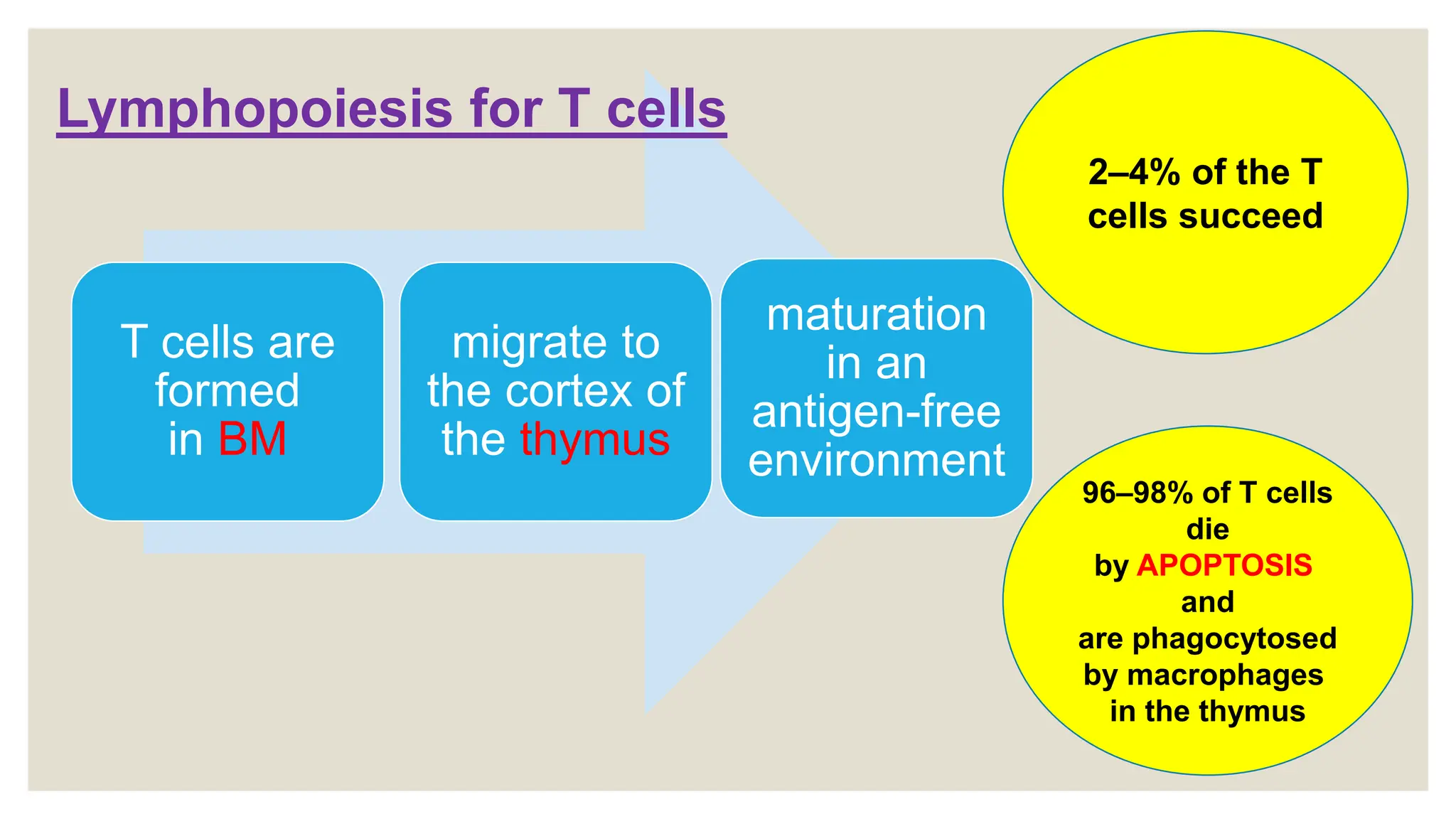
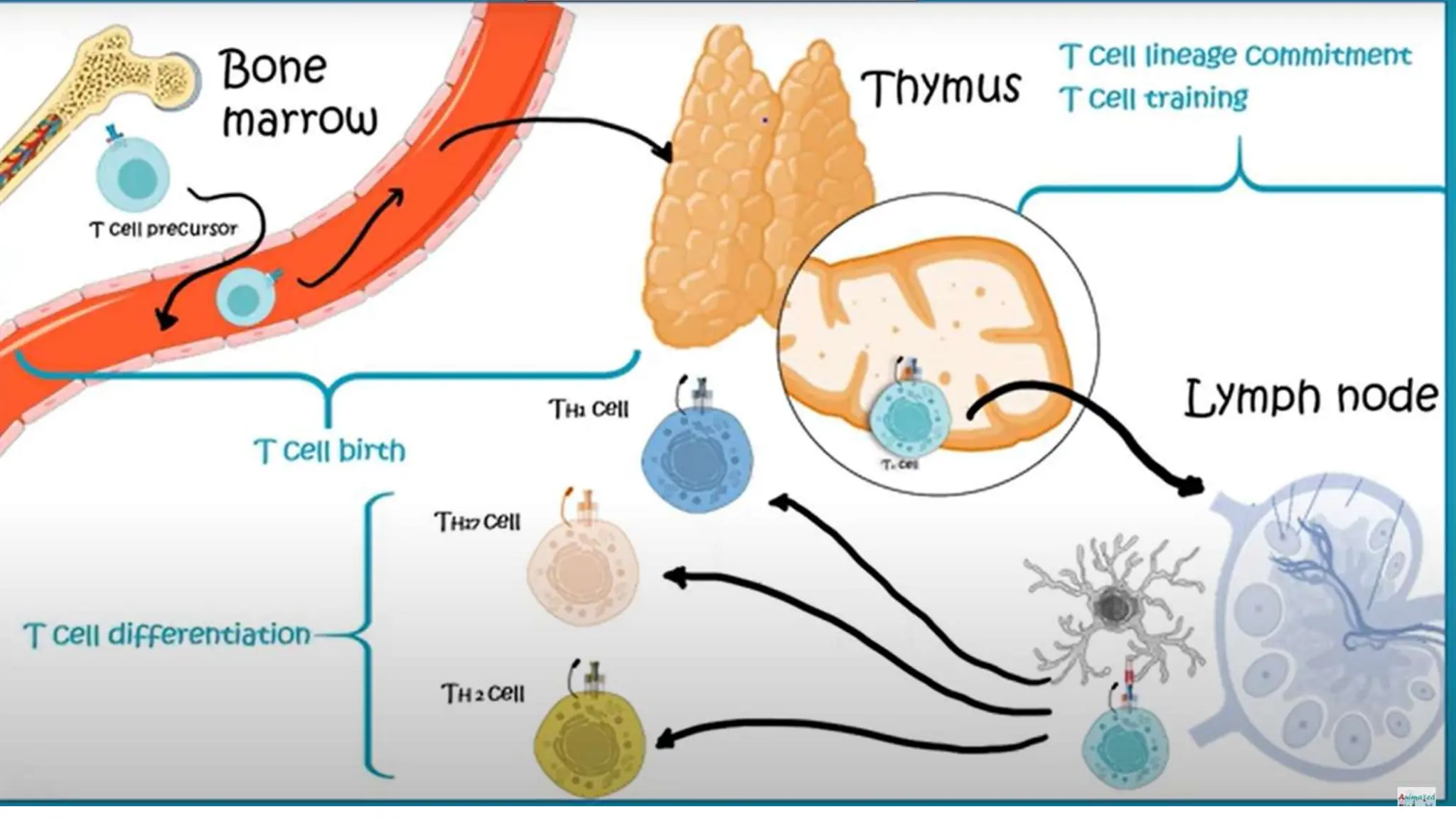
T cells are
formed
in BM
migrate to
the cortex of
the thymus
maturation
in an
antigen-free
environment
2–4% of the T
cells succeed
96–98% of T cells
die
by APOPTOSIS
and
are phagocytosed
by macrophages
in the thymus
Lymphopoiesis for T cells
96–98% of T
cells die
by
APOPTOSIS
Intensive screening
to make sure each
thymocyte has the
ability to
recognise self
peptide: self MHC
complex
1
• THYMUS
2
• PERIPHERAL BLOOD
3
• SECONDARY LYMPHOID
ORGANS(paracortex of LN & PALS in spleen)
CONTENTS
◦INTRODUCTION
◦DEVELOPMENT AND MATURATION
◦T CELL DIFFERENTIATION/ DIFFERENT TYPES OF T
CELLS
a)CD4+T HELPER CELLS
b)REGULATORY T CELLS
c)CD8+ CYTOTOXIC CELLS
d)MEMORY T CELLS
◦PHASES OF T CELL ACTIVATION
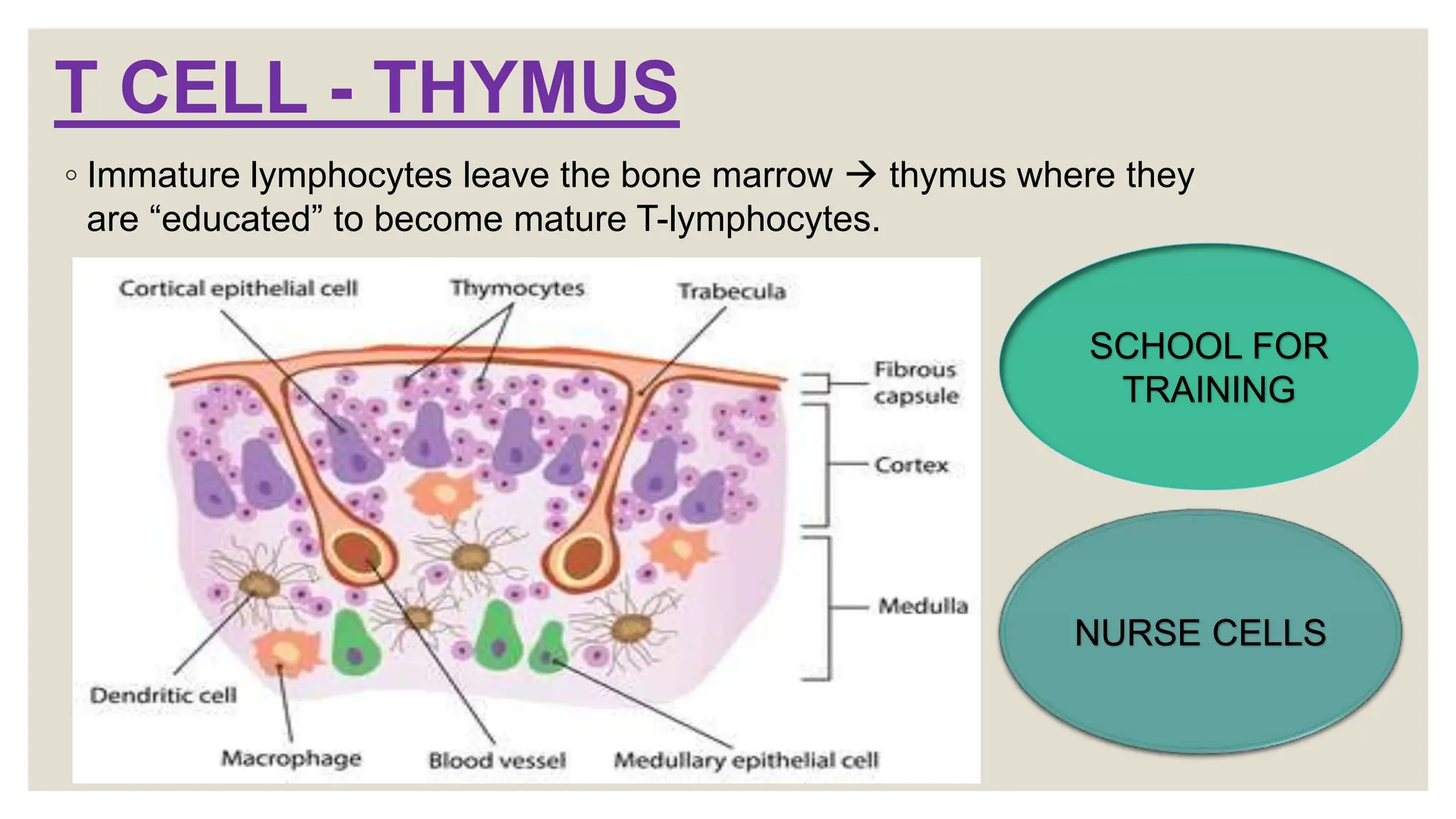
T CELL - THYMUS
◦ Immature lymphocytes leave the bone marrow  thymus where they
are “educated” to become mature T-lymphocytes.
SCHOOL FOR
TRAINING
NURSE CELLS
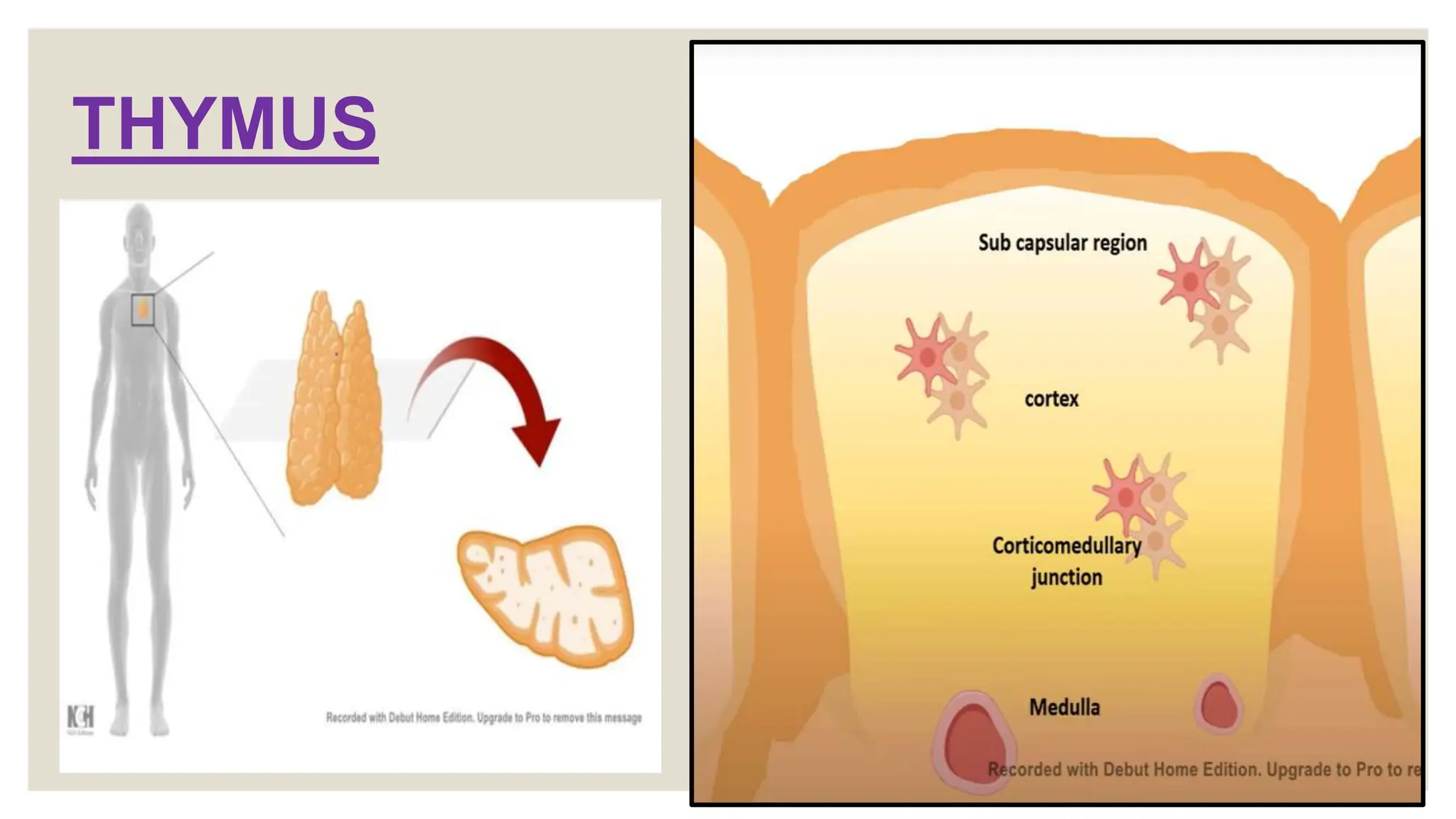
THYMUS
LET’S DISCUSS :3 WEEKS TRAINING
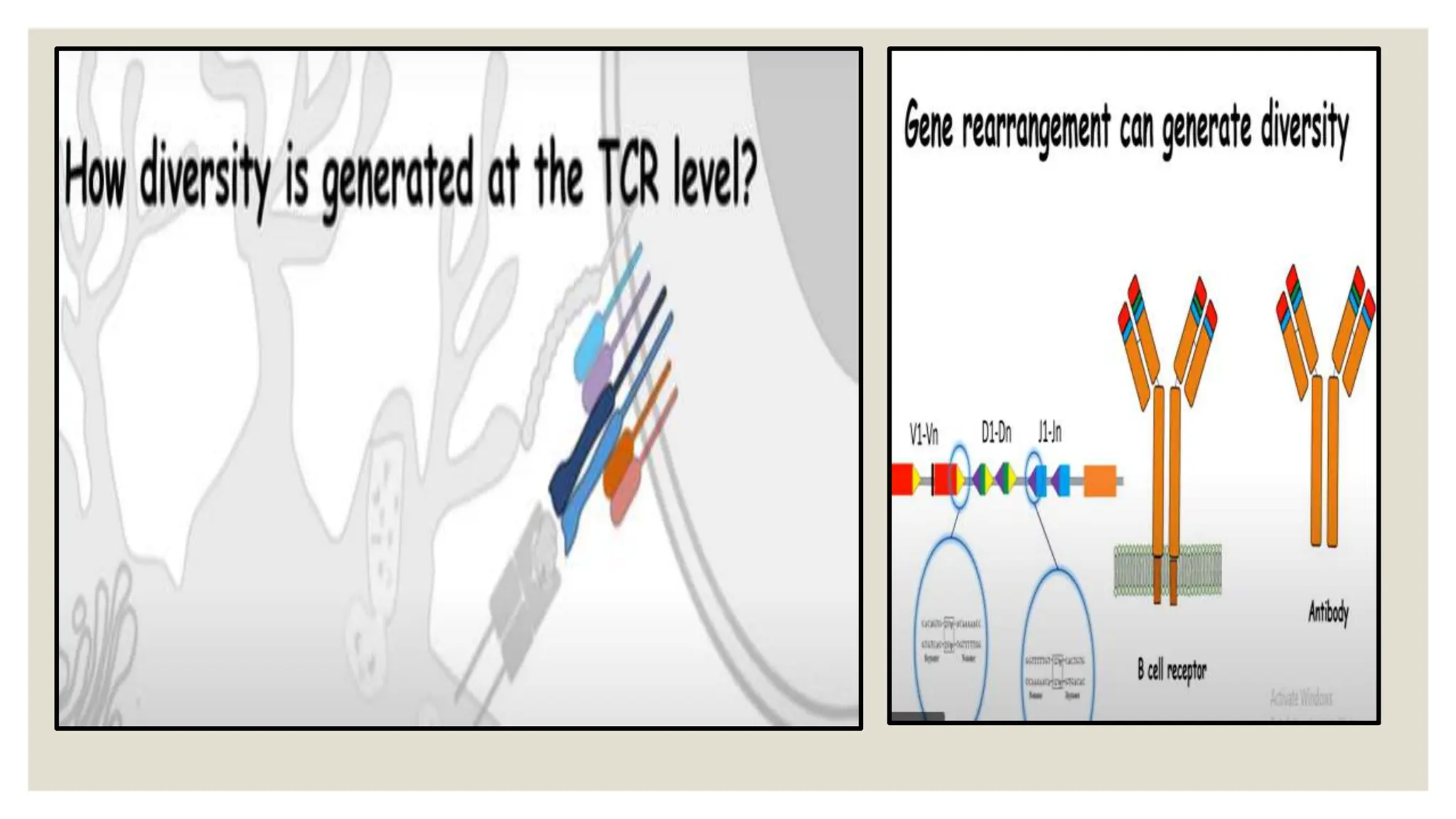
WHY VDJ rearrangement?
T CELLS NEED
DIVERSITY
HOW DIVERSITY IS CREATING
◦ TCR genes undergo rearrangement 
results in diversity of TCR genes to
interact with different peptides
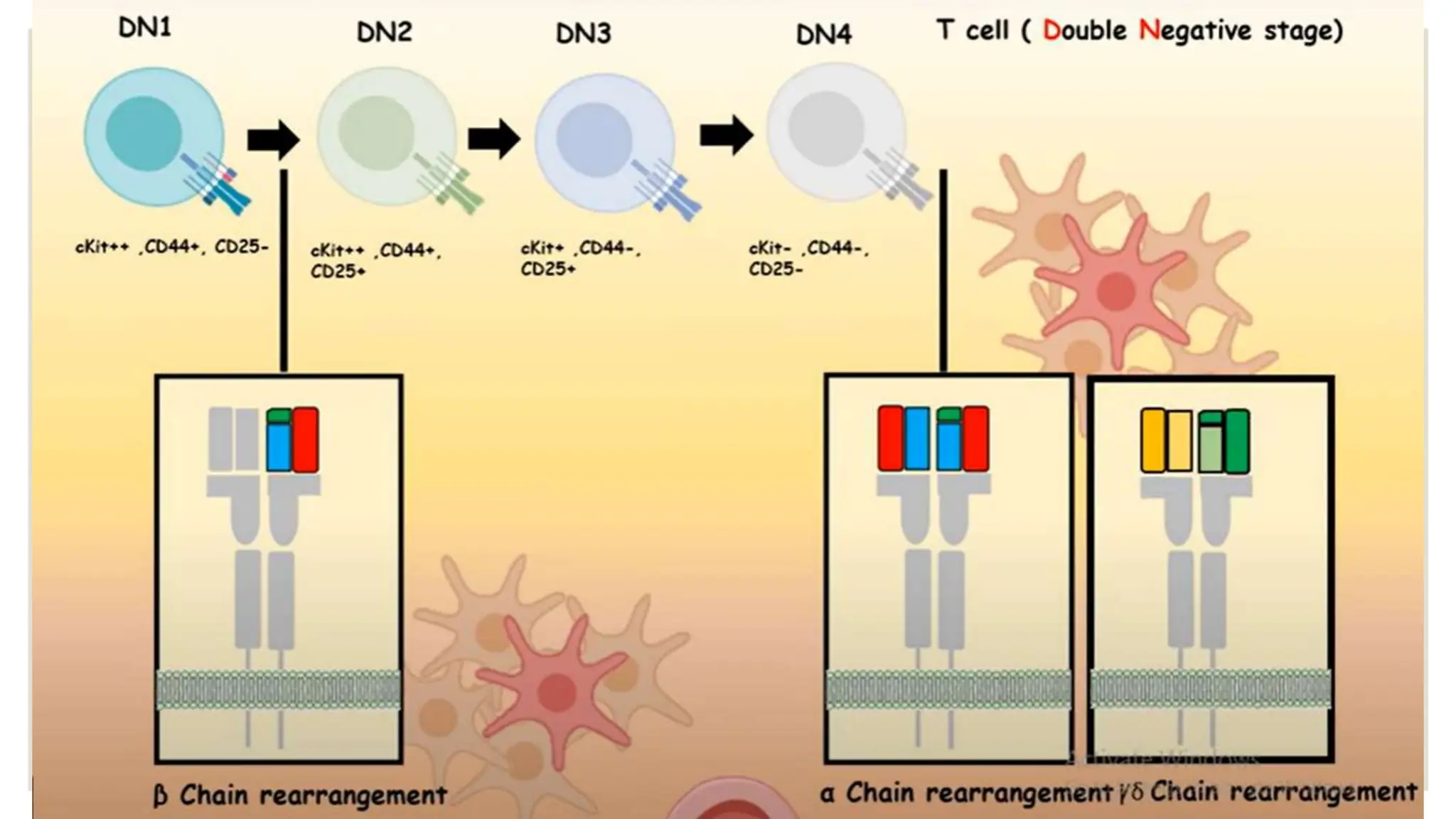
◦ First beta chain of TCR gene is
rearranged  eventually and
sequentially alpha chain also ( not at the
same time)
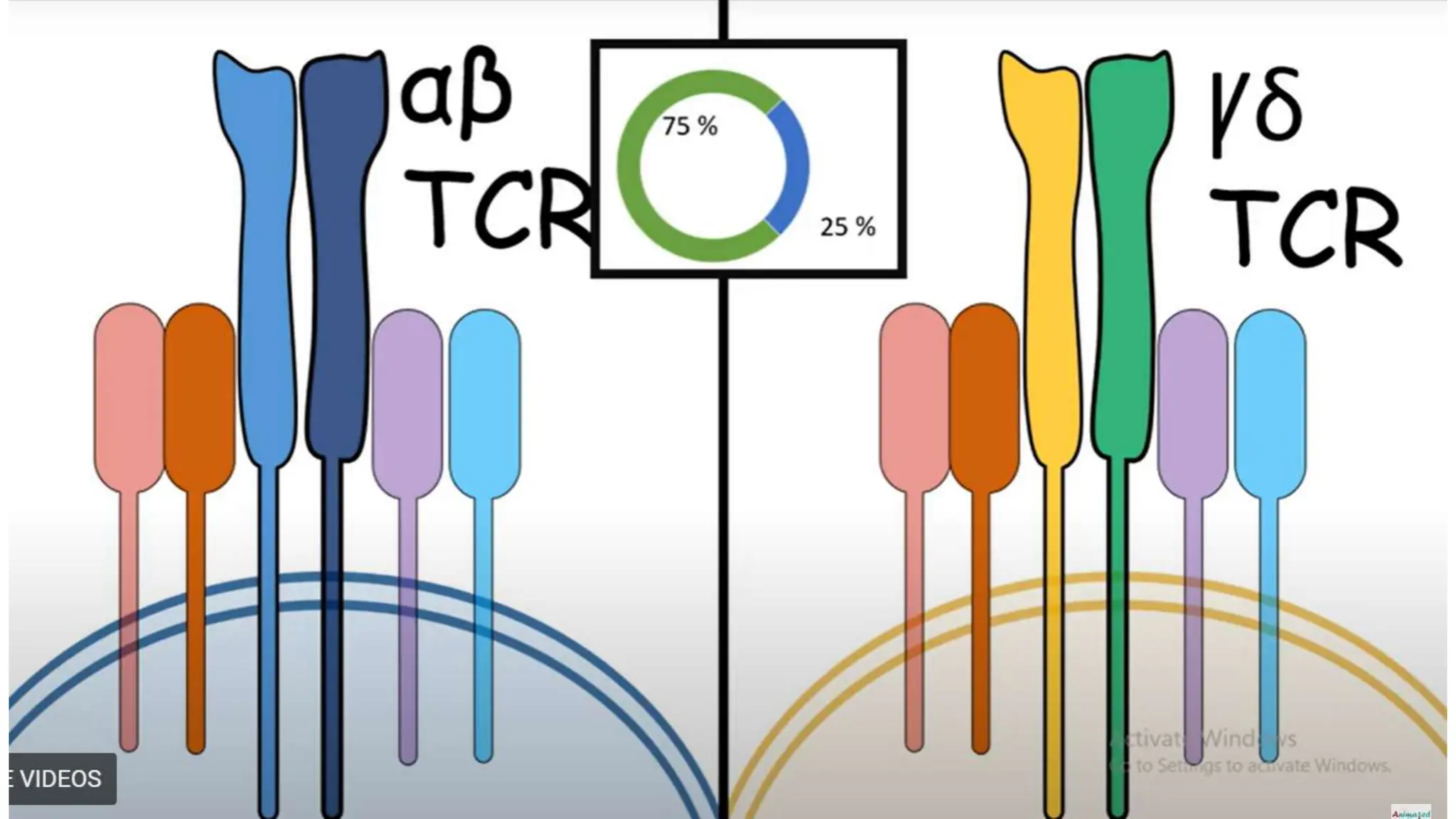
Mature TCR-αβ are formed
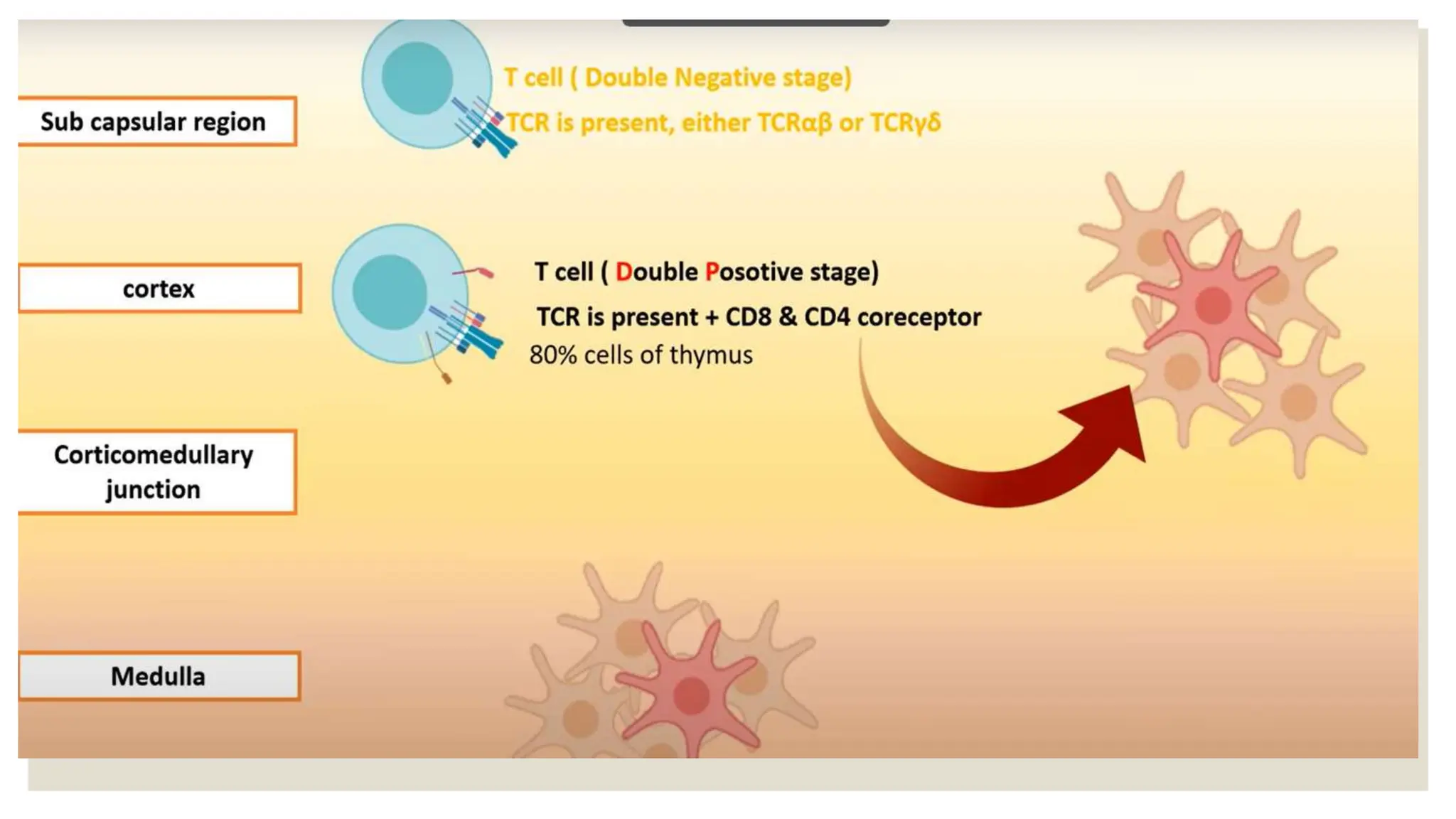
DP cells  recognize the
MHC bound peptides ( first
degree of training &
screening)
MHC class I/ MHC class II
2 DISTINCT SELECTION PROCEDURE
CORTEX
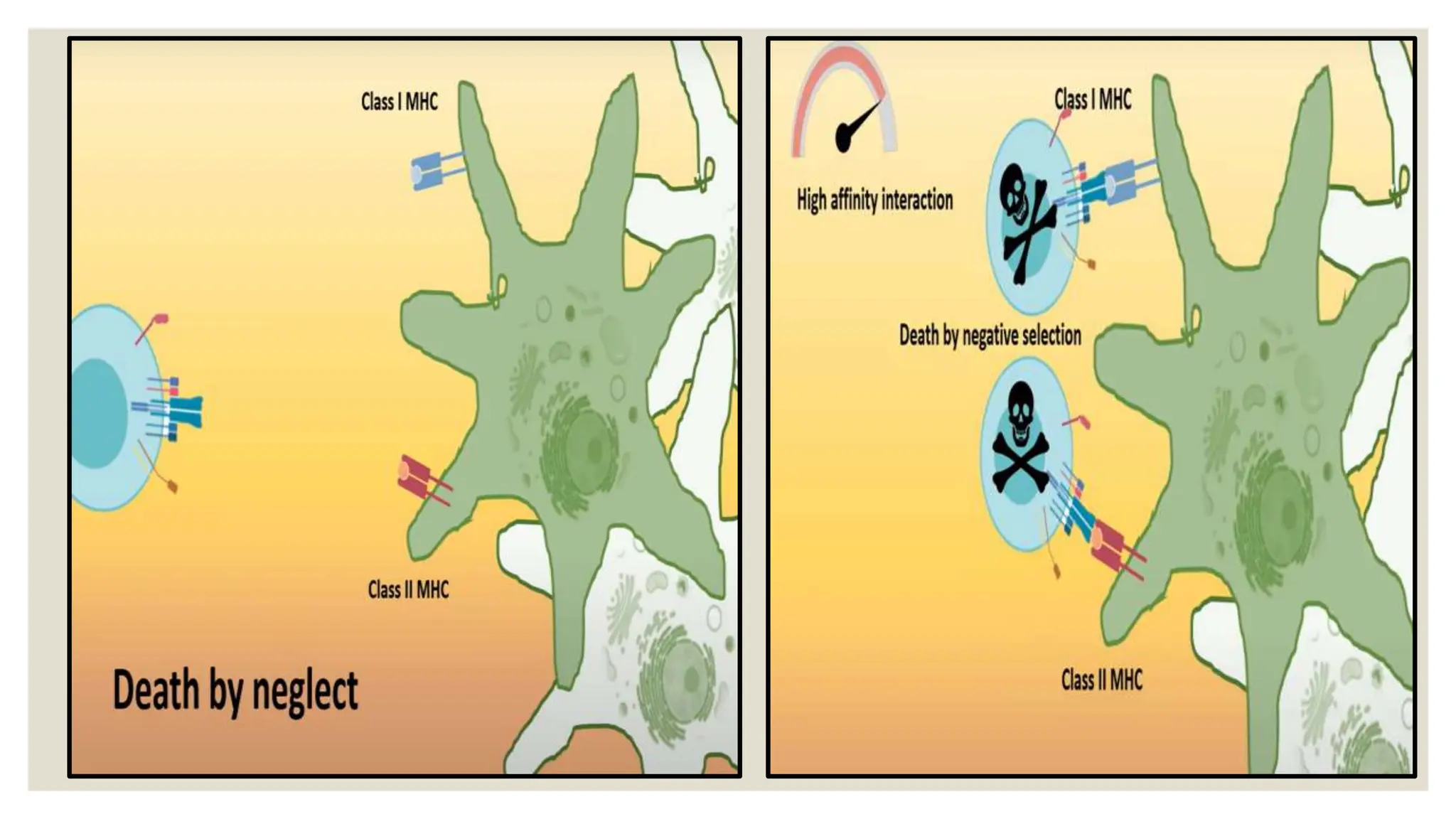
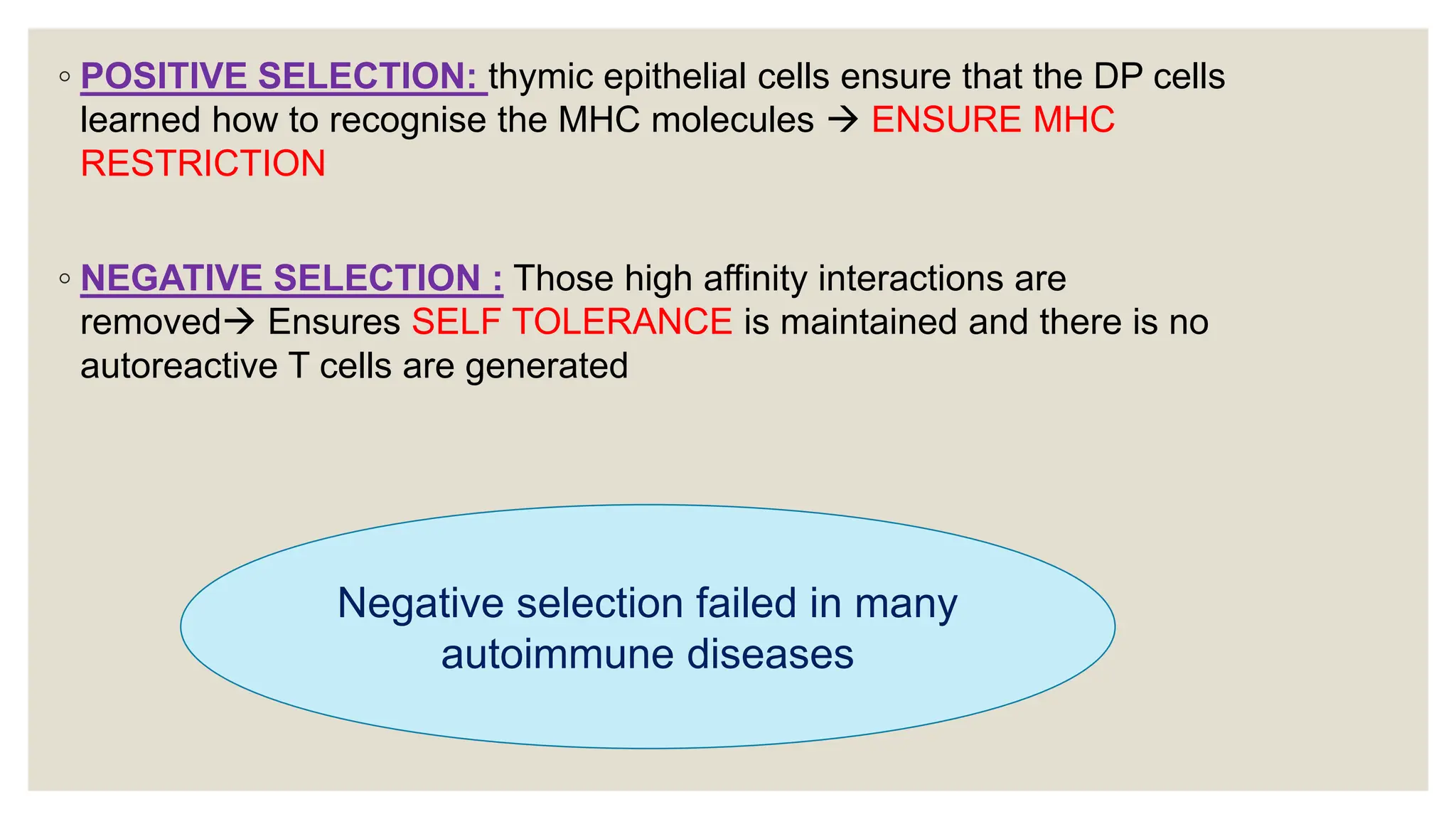
◦ POSITIVE SELECTION: thymic epithelial cells ensure that the DP cells
learned how to recognise the MHC molecules  ENSURE MHC
RESTRICTION
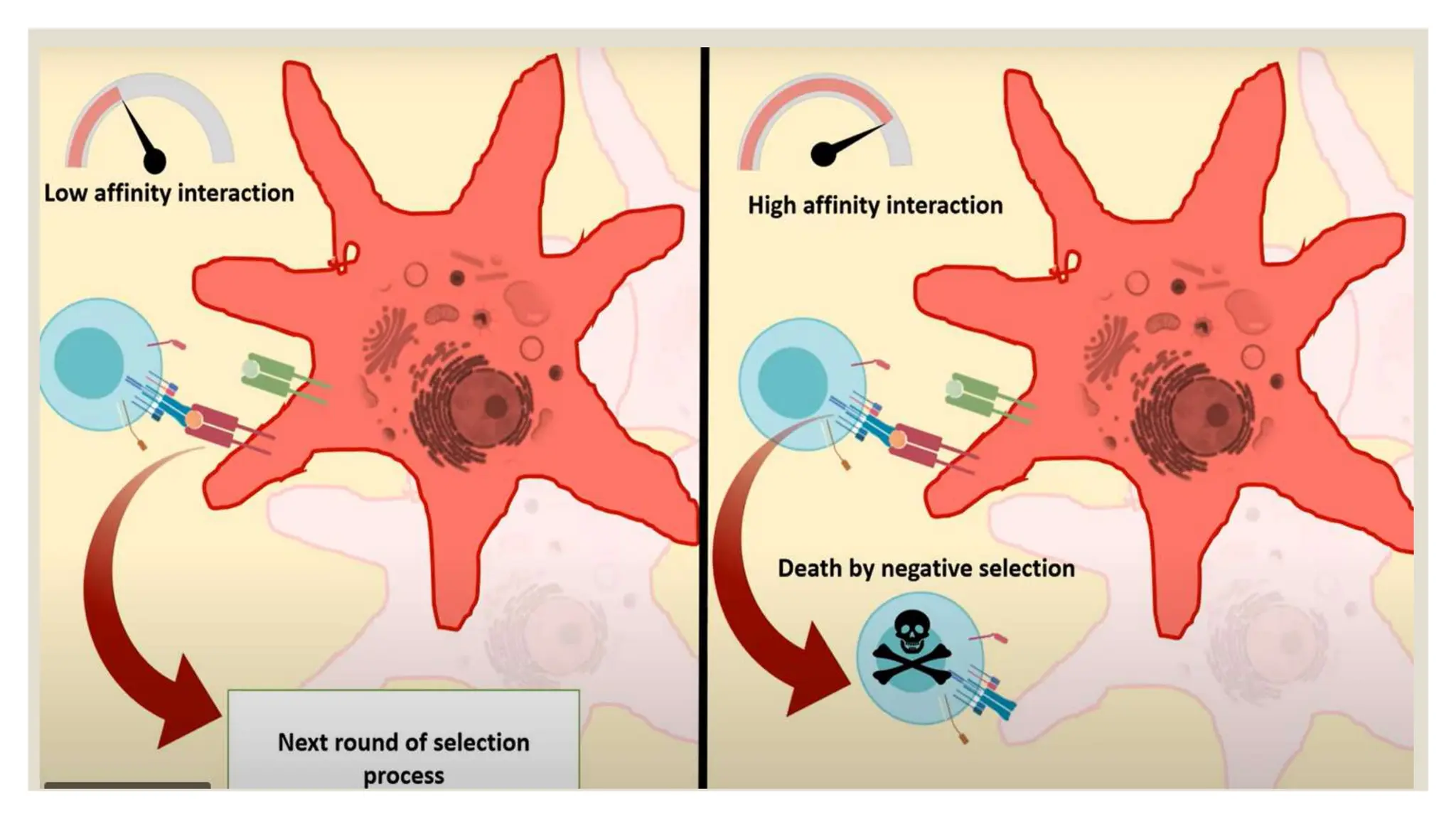
◦ NEGATIVE SELECTION : Those high affinity interactions are
removed Ensures SELF TOLERANCE is maintained and there is no
autoreactive T cells are generated
Negative selection failed in many
autoimmune diseases
◦ In the first selection round  just learn to recognise or gets familiarize
with the MHC bound peptides  these peptides are self peptides
produced by thymic epithelial cells
90% die
◦ Now cortical part of maturation is over migrate to medulla  interact with
medullary epithelial cells  start recognizing class I &class II MHC molecules
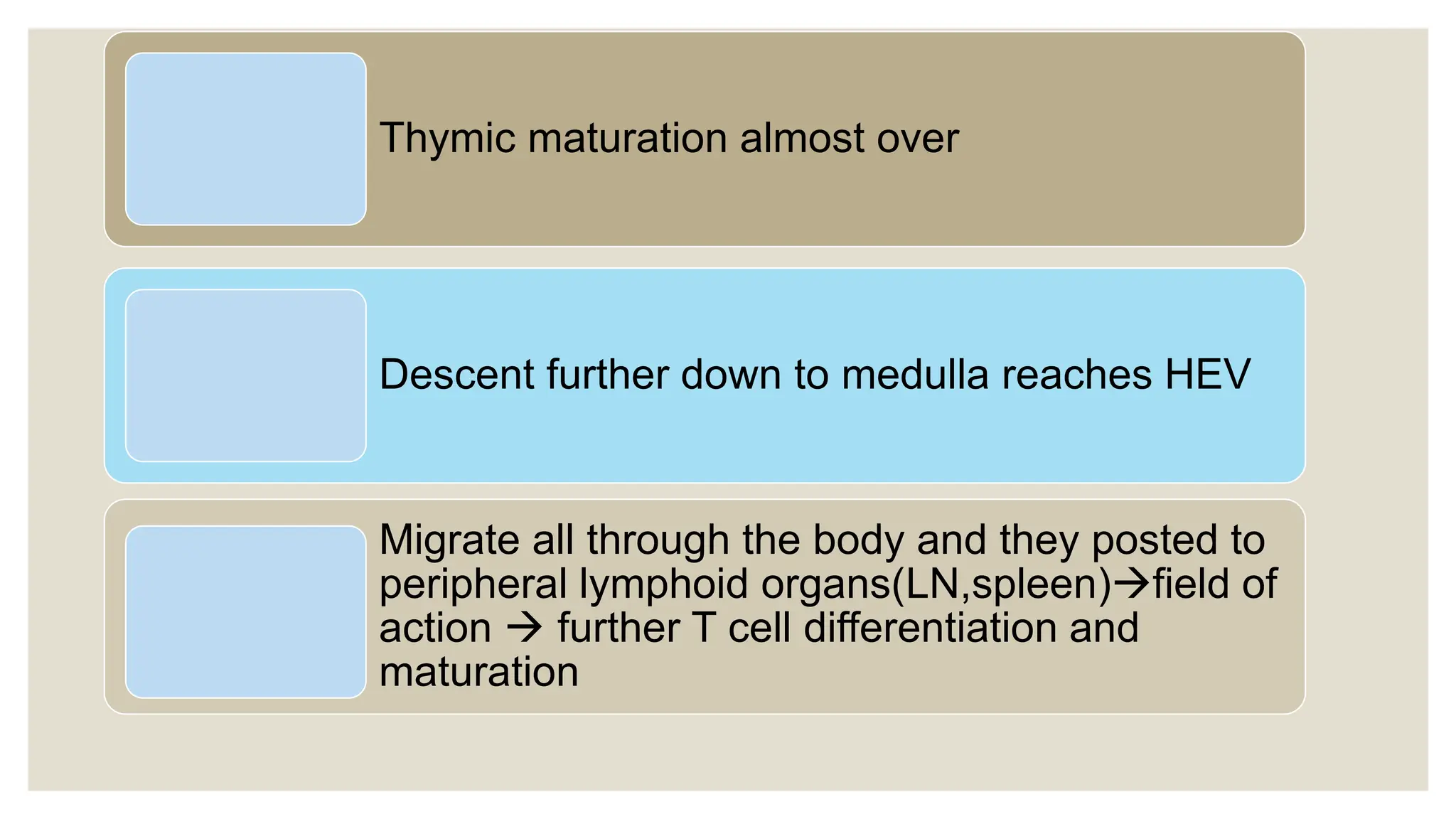
Thymic maturation almost over
Descent further down to medulla reaches HEV
Migrate all through the body and they posted to
peripheral lymphoid organs(LN,spleen)field of
action  further T cell differentiation and
maturation
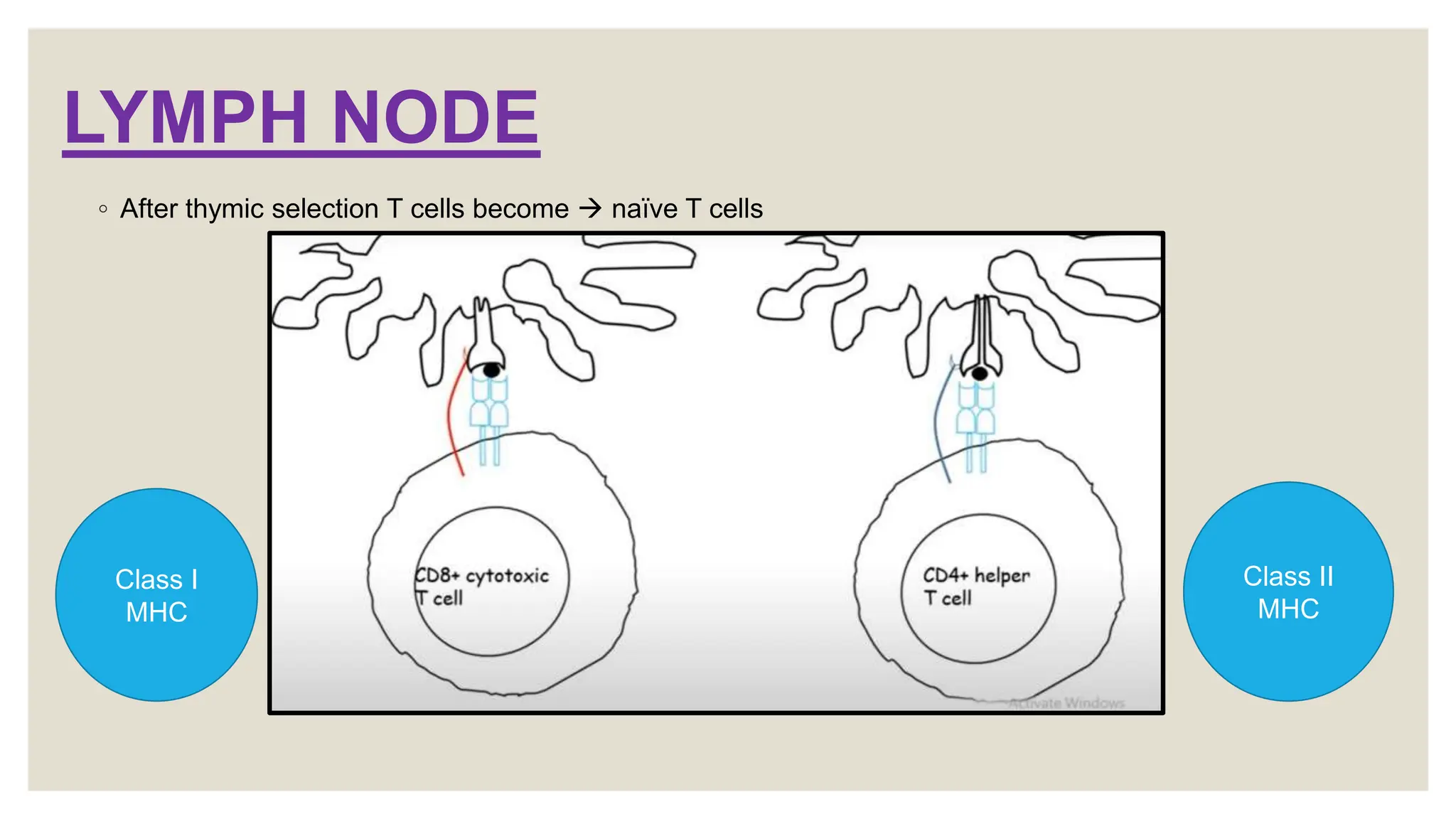
LYMPH NODE
◦ After thymic selection T cells become  naïve T cells
Class II
MHC
Class I
MHC
CONTENTS
◦INTRODUCTION
◦DEVELOPMENT AND MATURATION
◦T CELL DIFFERENTIATION/ DIFFERENT TYPES OF T
CELLS
a)CD4+T HELPER CELLS
b)REGULATORY T CELLS
c)CD8+ CYTOTOXIC CELLS
d)MEMORY T CELLS
◦PHASES OF T CELL ACTIVATION
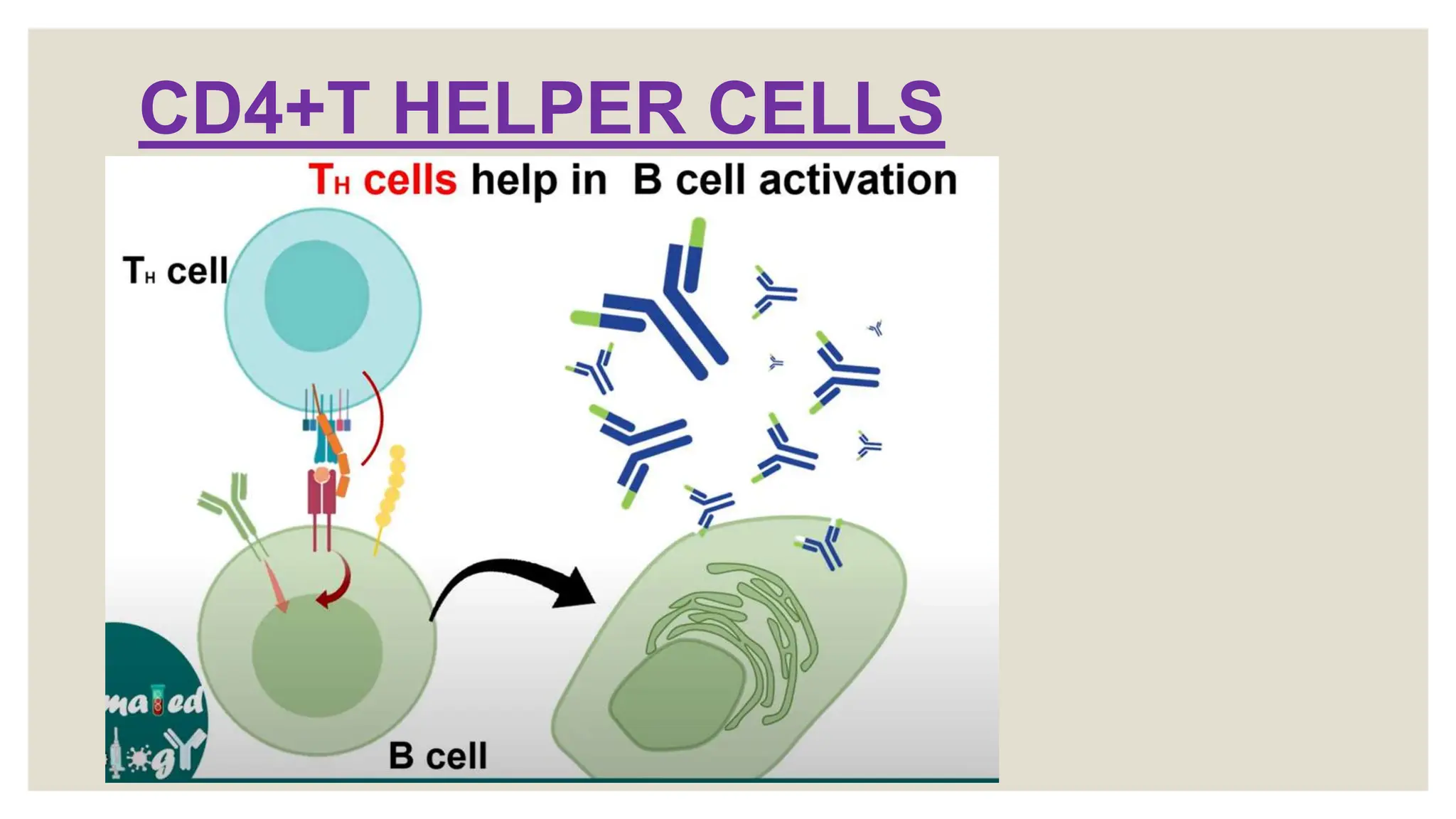
CD4+T HELPER CELLS
CD4+T HELPER CELLS
◦ Develop in BM THYMUS (training )
 naïve T helper cells move to LN
 activated by APC
◦ After activation T cell interact with
other cell types / differentiate into
different subtypes
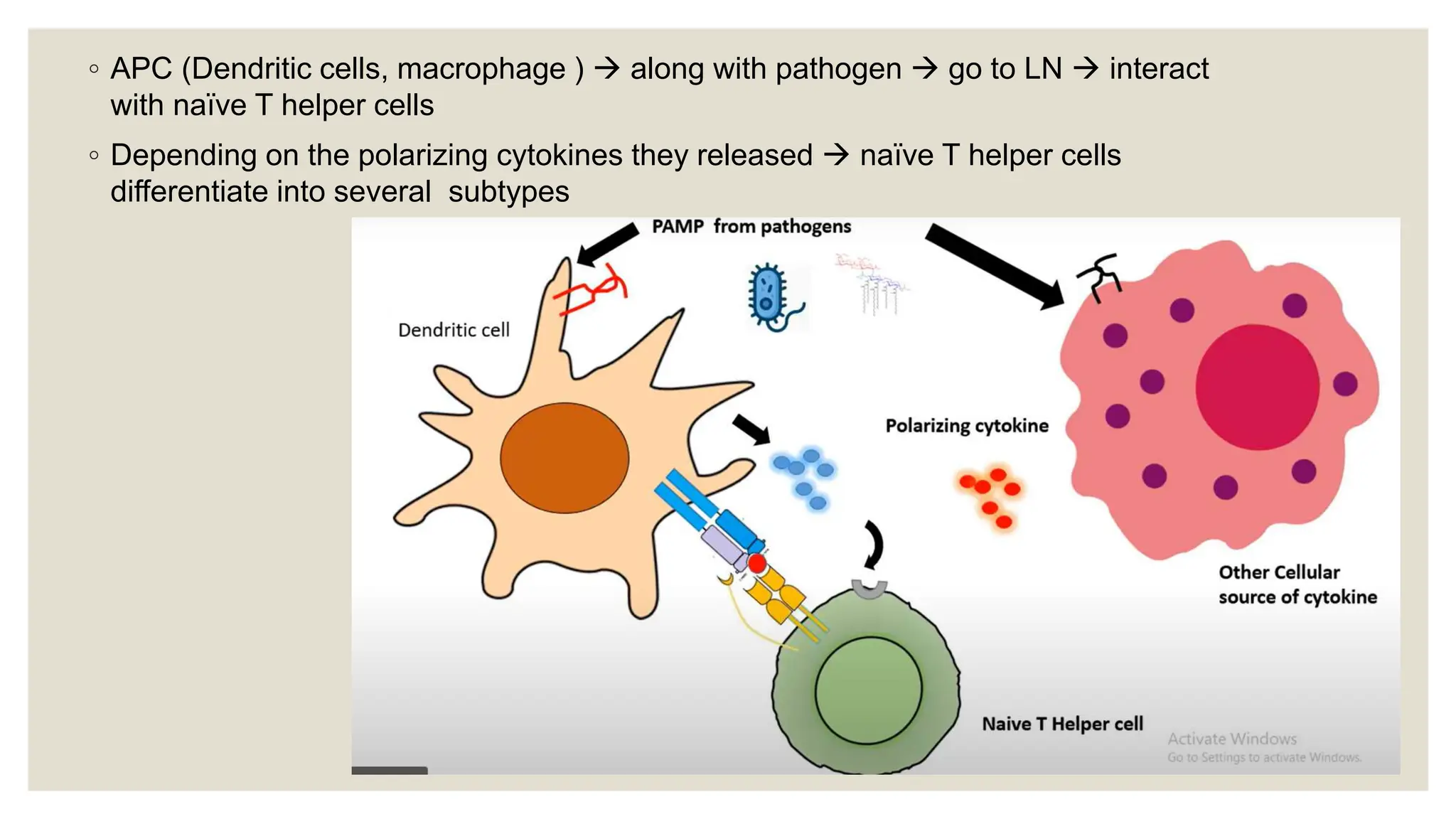
◦ APC (Dendritic cells, macrophage )  along with pathogen  go to LN  interact
with naïve T helper cells
◦ Depending on the polarizing cytokines they released  naïve T helper cells
differentiate into several subtypes
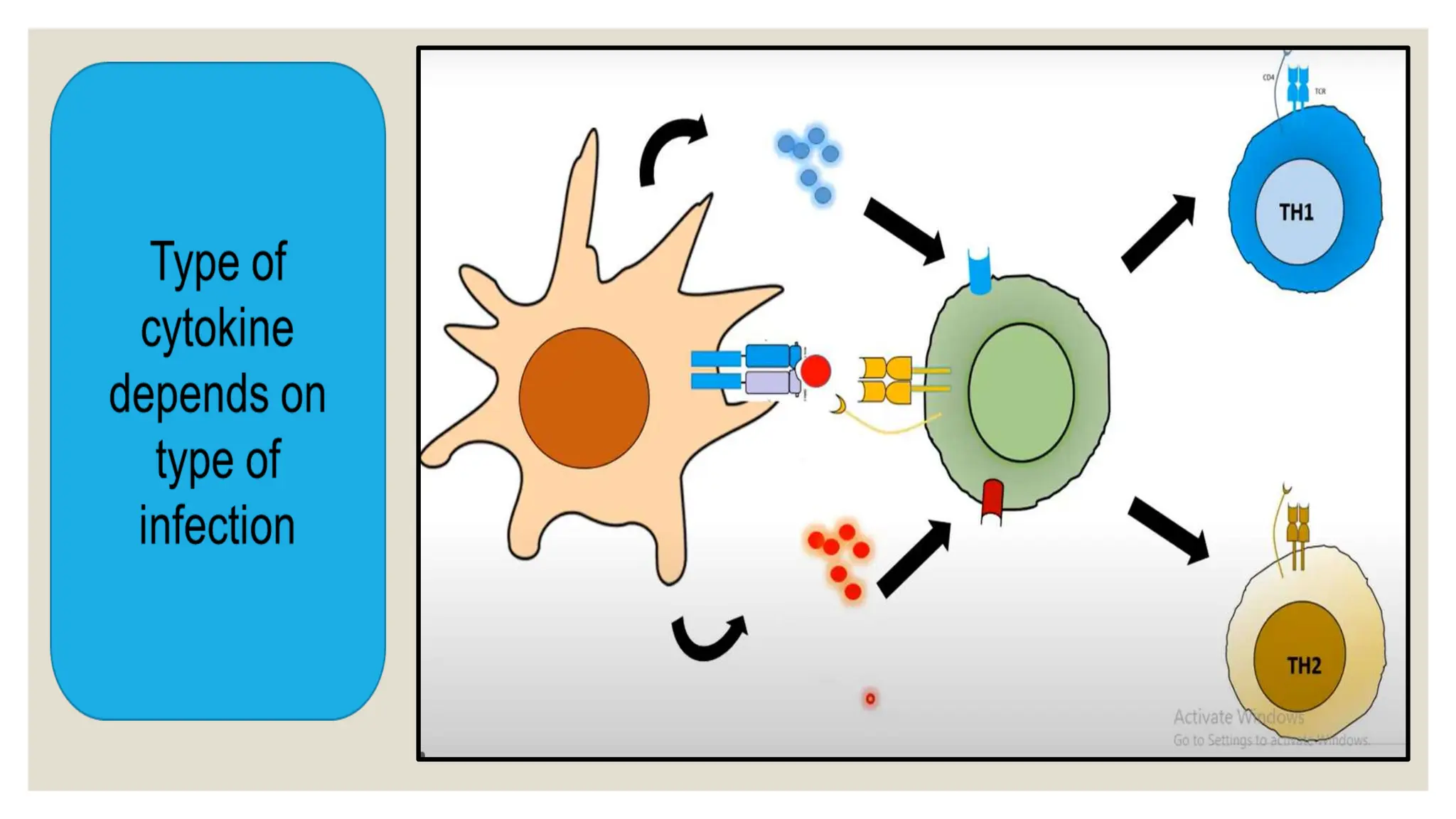
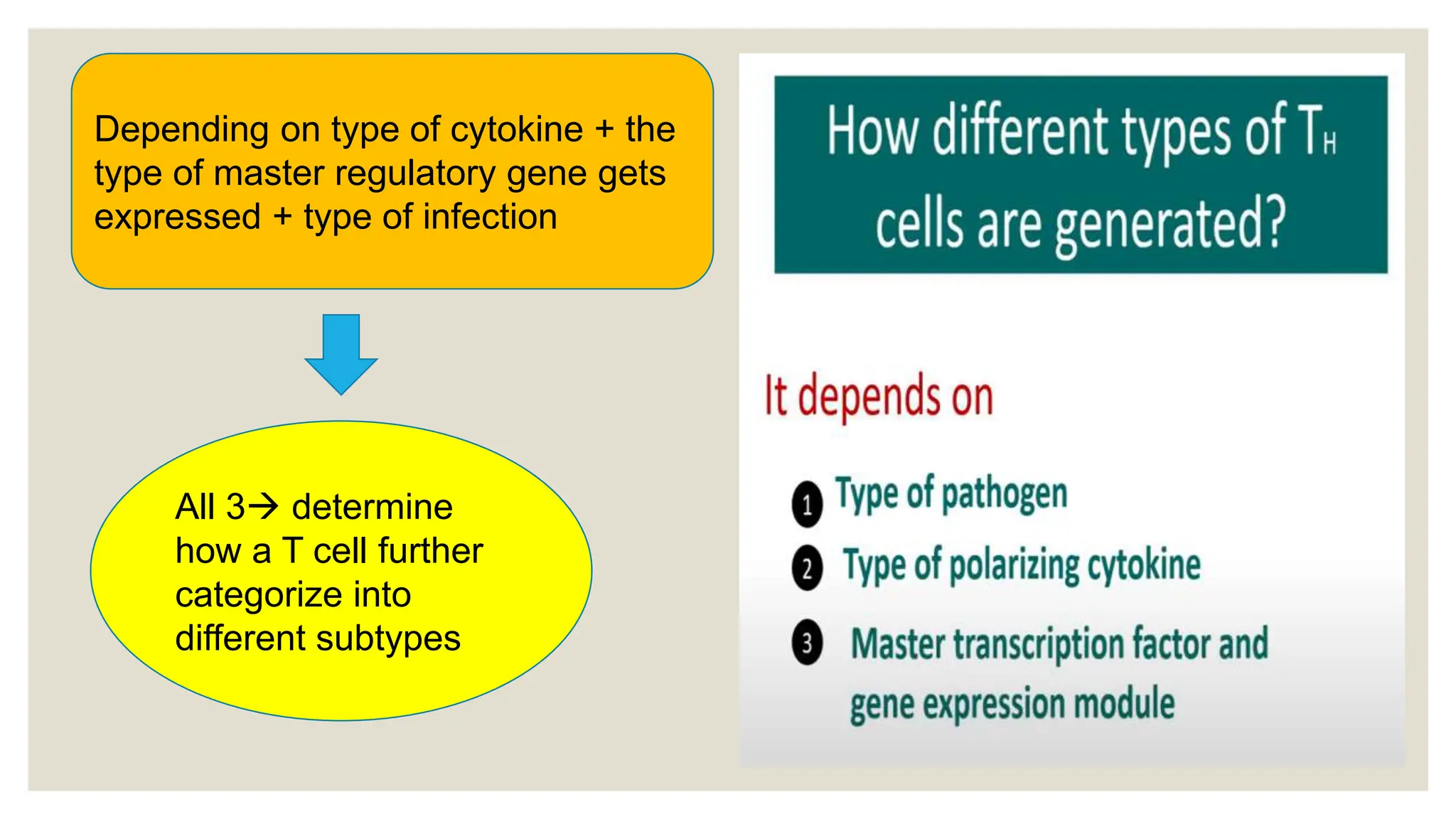
Depending on type of cytokine + the
type of master regulatory gene gets
expressed + type of infection
All 3 determine
how a T cell further
categorize into
different subtypes
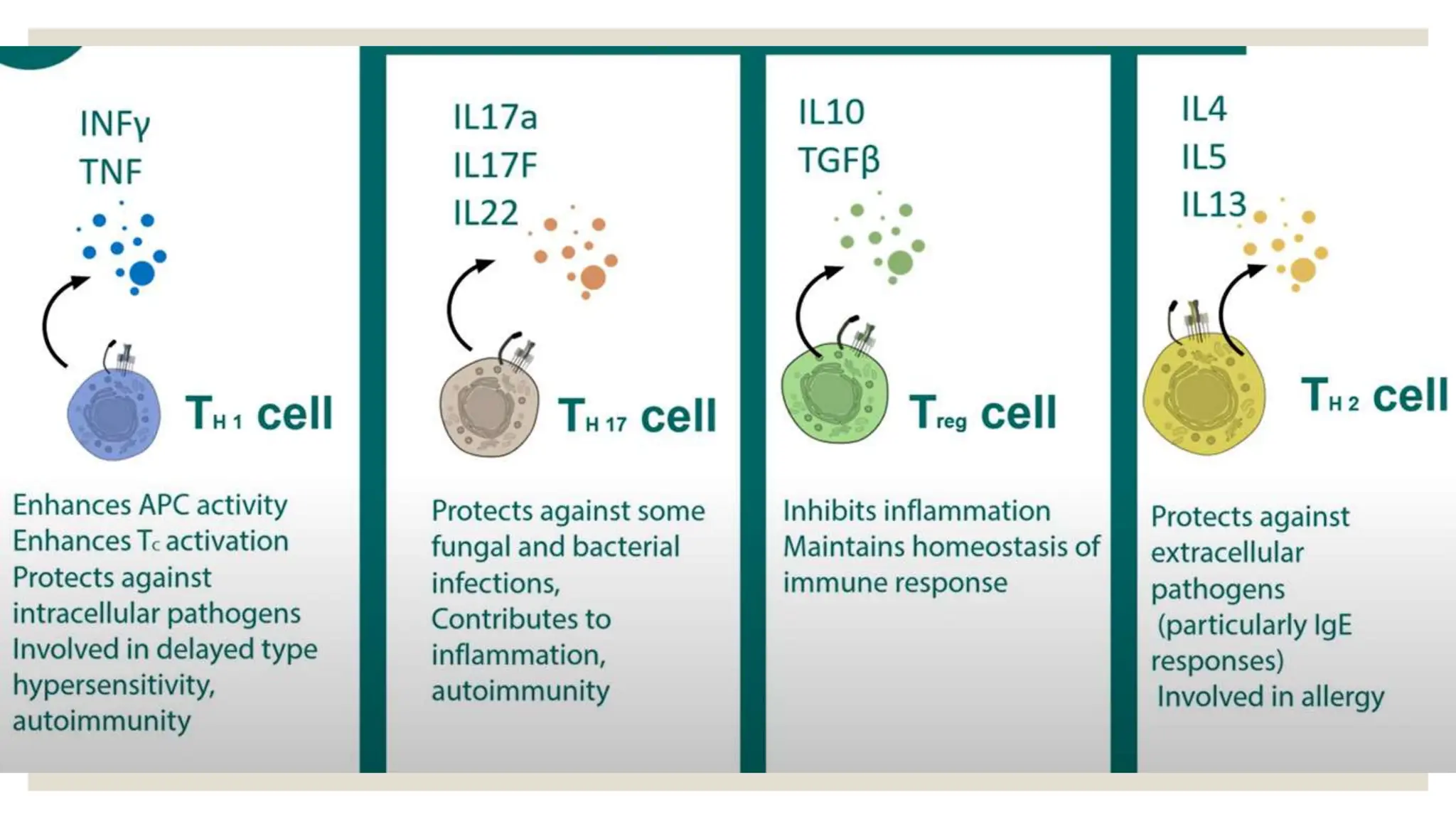
1. TH 1 CELLS
2. TH 2 CELLS
3. TH 17 CELLS
4. REGULATORY T LYMPHOCYTES
◦ If T reg cells are absent  balance
move more towards the
inflammatory responses
increases chance of severe
inflammation + autoimmune
disorders  DANGEROUS
T reg DEVELOPMENT
CD4+ T helper cells
Some of CD4+ T helper
cells become T reg
cells
How it
different from
CD4+T helper
cells
CD25
◦ Once CD4+T helper cells  switch
into T reg cells they maintain the
level of Fox p3 throughout their life
◦ Maintenance of Treg
identity depends on signals
from IL2R α, TCR, TGF β
Increases Fox P3
T-reg cells has anti inflammatory function
◦ T reg interact with macrophage  prevent it
from interaction with other CD4+ T helper
cell
◦ T reg directly compete with CD4+ T helper
cell for IL-2 (IL- 2 is necessary for the devp.
of both cells)
If IL-2 is low CD4+
T cell do not develop
that much
Macrophage  secrete proinflammatory cytokines like IL1
& IL6  regulate and activate CD4+ T helper cells 
thereby activate other immune complex
Perforin granzyme
pathway
Compete for IL-2
Directly inhibit
macrophage
Immunosuppressing
agents
T reg cell suppress function of APC
T reg : prevent early onset of
autoimmune disorders by
providing its anti inflammatory
resposes
T Helper cells in DISEASE
CONTENTS
◦INTRODUCTION
◦DEVELOPMENT AND MATURATION
◦T CELL DIFFERENTIATION/ DIFFERENT TYPES OF T
CELLS
a)CD4+T HELPER CELLS
b)REGULATORY T CELLS
c)CD8+ CYTOTOXIC CELLS
d)MEMORY T CELLS
◦PHASES OF T CELL ACTIVATION
CYTOTOXIC T CELLS
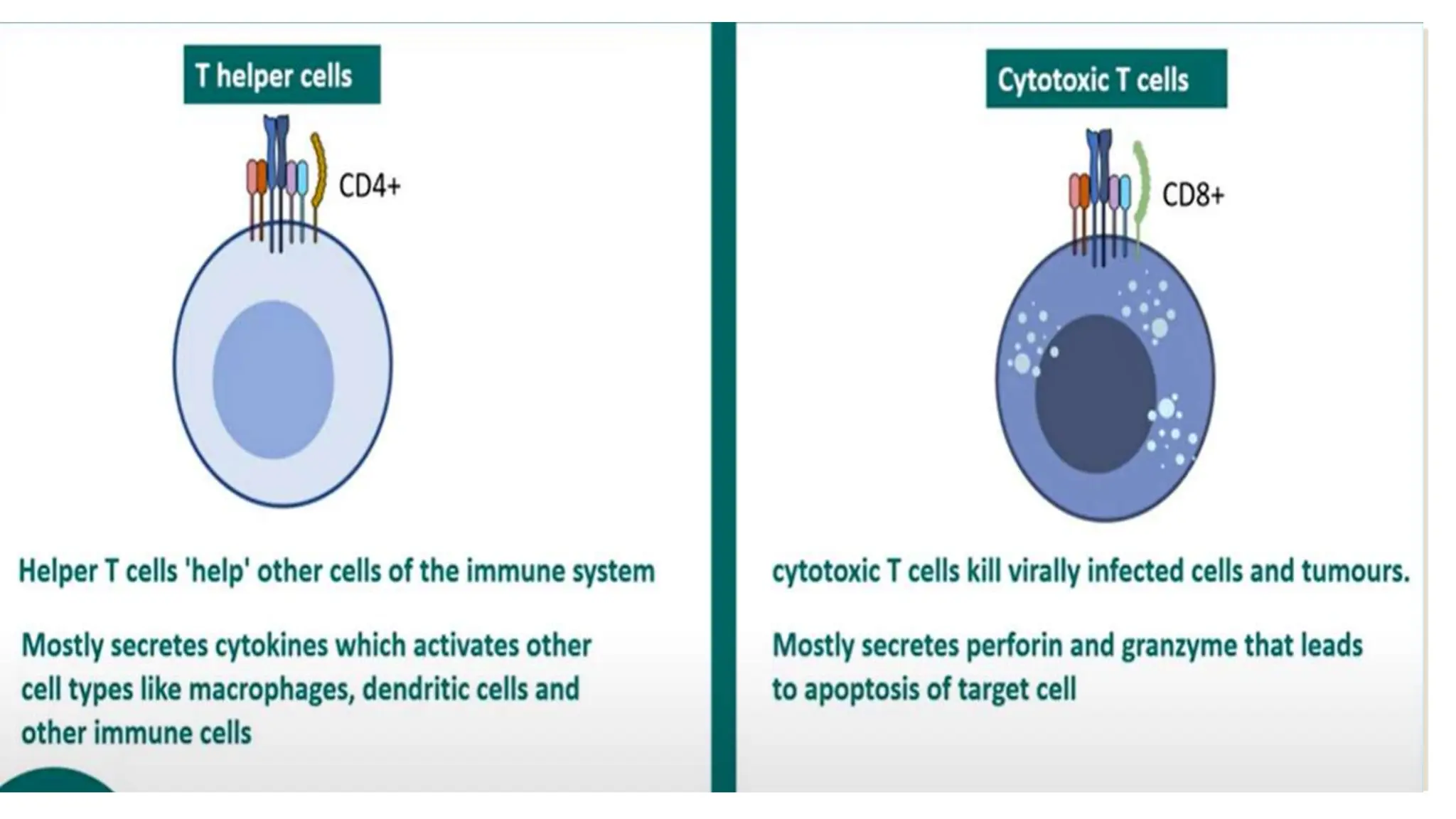
◦ Cytotoxic T cell has CD8 co-receptor
◦ Perforin creates pores Thereby
granzymes enter the cell
◦ Interaction b/w cytotoxic T cell & target
cell
1. FAS-FASL mediated interaction
2. Perforin – granzyme mediated
interaction
◦ DEATH of virus infected cells
 eliminate the virus
CONTENTS
◦INTRODUCTION
◦DEVELOPMENT AND MATURATION
◦T CELL DIFFERENTIATION/ DIFFERENT TYPES OF T
CELLS
a)CD4+T HELPER CELLS
b)REGULATORY T CELLS
c)CD8+ CYTOTOXIC CELLS
d)MEMORY T CELLS
◦PHASES OF T CELL ACTIVATION
◦ Memory T cells  less stringent
reactivation criteria ie, they gets back
to the cell cycle and proliferate rapidly
◦ Naïve T cells cant proliferate rapidly
until it is activated by APC
◦ Memory T cells quickly gets activated
by APC
CD8 + cells that are
very tired
◦INTRODUCTION
◦DEVELOPMENT AND MATURATION
◦T CELL DIFFERENTIATION/ DIFFERENT TYPES OF T
CELLS
a)CD4+T HELPER CELLS
b)REGULATORY T CELLS
c)CD8+ CYTOTOXIC CELLS
d)MEMORY T CELLS
◦PHASES OF T CELL ACTIVATION
PHASES OF T CELL ACTIVATION
1.Activation phase
2.Clonal expansion
3.Effector phase
4.Declining phase
5.Memory phase
CLONAL EXPANSION
3
CYTOTOXIC T CELL RESPONSE
Few cells remain
will become the
memory T cells
Following second attack  these memory cells can
easily identify attacking pathogen and become
secondary effective T cells easily kill them
T CELL DEFICIENCY
T CELL MARKERS
B CELL MARKERS
Recent advances in T cells
REFERENCES

T CELL lymphocyte , its function, production and types pptx

  • 1.
    T CELLS Dr SHEMEERASAIDALAVI VP PG RESIDENT
  • 2.
    CONTENTS ◦INTRODUCTION ◦DEVELOPMENT AND MATURATION ◦TCELL DIFFERENTIATION/ DIFFERENT TYPES OF T CELLS a)CD4+T HELPER CELLS b)REGULATORY T CELLS c)CD8+ CYTOTOXIC CELLS d)MEMORY T CELLS ◦PHASES OF T CELL ACTIVATION
  • 3.
    INTRODUCTION  T cells: Type of blood cell  Belong to a group of white blood cells (WBCs) called lymphocytes. WBCs protect the body from infection  T-cells is to fight infection. Along with other WBCs, they play a major role in the immune system, which guards the body against infection.
  • 7.
    T cells are formed inBM migrate to the cortex of the thymus maturation in an antigen-free environment 2–4% of the T cells succeed 96–98% of T cells die by APOPTOSIS and are phagocytosed by macrophages in the thymus Lymphopoiesis for T cells
  • 8.
    96–98% of T cellsdie by APOPTOSIS Intensive screening to make sure each thymocyte has the ability to recognise self peptide: self MHC complex
  • 9.
    1 • THYMUS 2 • PERIPHERALBLOOD 3 • SECONDARY LYMPHOID ORGANS(paracortex of LN & PALS in spleen)
  • 10.
    CONTENTS ◦INTRODUCTION ◦DEVELOPMENT AND MATURATION ◦TCELL DIFFERENTIATION/ DIFFERENT TYPES OF T CELLS a)CD4+T HELPER CELLS b)REGULATORY T CELLS c)CD8+ CYTOTOXIC CELLS d)MEMORY T CELLS ◦PHASES OF T CELL ACTIVATION
  • 11.
    T CELL -THYMUS ◦ Immature lymphocytes leave the bone marrow  thymus where they are “educated” to become mature T-lymphocytes. SCHOOL FOR TRAINING NURSE CELLS
  • 12.
  • 14.
    LET’S DISCUSS :3WEEKS TRAINING
  • 17.
    WHY VDJ rearrangement? TCELLS NEED DIVERSITY
  • 22.
  • 24.
    ◦ TCR genesundergo rearrangement  results in diversity of TCR genes to interact with different peptides ◦ First beta chain of TCR gene is rearranged  eventually and sequentially alpha chain also ( not at the same time) Mature TCR-αβ are formed
  • 28.
    DP cells recognize the MHC bound peptides ( first degree of training & screening) MHC class I/ MHC class II 2 DISTINCT SELECTION PROCEDURE CORTEX
  • 29.
    ◦ POSITIVE SELECTION:thymic epithelial cells ensure that the DP cells learned how to recognise the MHC molecules  ENSURE MHC RESTRICTION ◦ NEGATIVE SELECTION : Those high affinity interactions are removed Ensures SELF TOLERANCE is maintained and there is no autoreactive T cells are generated Negative selection failed in many autoimmune diseases
  • 30.
    ◦ In thefirst selection round  just learn to recognise or gets familiarize with the MHC bound peptides  these peptides are self peptides produced by thymic epithelial cells 90% die
  • 32.
    ◦ Now corticalpart of maturation is over migrate to medulla  interact with medullary epithelial cells  start recognizing class I &class II MHC molecules
  • 34.
    Thymic maturation almostover Descent further down to medulla reaches HEV Migrate all through the body and they posted to peripheral lymphoid organs(LN,spleen)field of action  further T cell differentiation and maturation
  • 35.
    LYMPH NODE ◦ Afterthymic selection T cells become  naïve T cells Class II MHC Class I MHC
  • 38.
    CONTENTS ◦INTRODUCTION ◦DEVELOPMENT AND MATURATION ◦TCELL DIFFERENTIATION/ DIFFERENT TYPES OF T CELLS a)CD4+T HELPER CELLS b)REGULATORY T CELLS c)CD8+ CYTOTOXIC CELLS d)MEMORY T CELLS ◦PHASES OF T CELL ACTIVATION
  • 41.
  • 42.
    CD4+T HELPER CELLS ◦Develop in BM THYMUS (training )  naïve T helper cells move to LN  activated by APC ◦ After activation T cell interact with other cell types / differentiate into different subtypes
  • 44.
    ◦ APC (Dendriticcells, macrophage )  along with pathogen  go to LN  interact with naïve T helper cells ◦ Depending on the polarizing cytokines they released  naïve T helper cells differentiate into several subtypes
  • 46.
    Depending on typeof cytokine + the type of master regulatory gene gets expressed + type of infection All 3 determine how a T cell further categorize into different subtypes
  • 50.
    1. TH 1CELLS
  • 53.
    2. TH 2CELLS
  • 55.
    3. TH 17CELLS
  • 60.
    4. REGULATORY TLYMPHOCYTES
  • 61.
    ◦ If Treg cells are absent  balance move more towards the inflammatory responses increases chance of severe inflammation + autoimmune disorders  DANGEROUS
  • 62.
  • 63.
    CD4+ T helpercells Some of CD4+ T helper cells become T reg cells
  • 64.
    How it different from CD4+Thelper cells CD25
  • 66.
    ◦ Once CD4+Thelper cells  switch into T reg cells they maintain the level of Fox p3 throughout their life
  • 67.
    ◦ Maintenance ofTreg identity depends on signals from IL2R α, TCR, TGF β Increases Fox P3
  • 68.
    T-reg cells hasanti inflammatory function ◦ T reg interact with macrophage  prevent it from interaction with other CD4+ T helper cell ◦ T reg directly compete with CD4+ T helper cell for IL-2 (IL- 2 is necessary for the devp. of both cells) If IL-2 is low CD4+ T cell do not develop that much Macrophage  secrete proinflammatory cytokines like IL1 & IL6  regulate and activate CD4+ T helper cells  thereby activate other immune complex
  • 69.
    Perforin granzyme pathway Compete forIL-2 Directly inhibit macrophage Immunosuppressing agents
  • 70.
    T reg cellsuppress function of APC
  • 71.
    T reg :prevent early onset of autoimmune disorders by providing its anti inflammatory resposes
  • 72.
    T Helper cellsin DISEASE
  • 73.
    CONTENTS ◦INTRODUCTION ◦DEVELOPMENT AND MATURATION ◦TCELL DIFFERENTIATION/ DIFFERENT TYPES OF T CELLS a)CD4+T HELPER CELLS b)REGULATORY T CELLS c)CD8+ CYTOTOXIC CELLS d)MEMORY T CELLS ◦PHASES OF T CELL ACTIVATION
  • 74.
    CYTOTOXIC T CELLS ◦Cytotoxic T cell has CD8 co-receptor
  • 77.
    ◦ Perforin createspores Thereby granzymes enter the cell ◦ Interaction b/w cytotoxic T cell & target cell 1. FAS-FASL mediated interaction 2. Perforin – granzyme mediated interaction
  • 79.
    ◦ DEATH ofvirus infected cells  eliminate the virus
  • 80.
    CONTENTS ◦INTRODUCTION ◦DEVELOPMENT AND MATURATION ◦TCELL DIFFERENTIATION/ DIFFERENT TYPES OF T CELLS a)CD4+T HELPER CELLS b)REGULATORY T CELLS c)CD8+ CYTOTOXIC CELLS d)MEMORY T CELLS ◦PHASES OF T CELL ACTIVATION
  • 84.
    ◦ Memory Tcells  less stringent reactivation criteria ie, they gets back to the cell cycle and proliferate rapidly ◦ Naïve T cells cant proliferate rapidly until it is activated by APC ◦ Memory T cells quickly gets activated by APC
  • 89.
    CD8 + cellsthat are very tired
  • 97.
    ◦INTRODUCTION ◦DEVELOPMENT AND MATURATION ◦TCELL DIFFERENTIATION/ DIFFERENT TYPES OF T CELLS a)CD4+T HELPER CELLS b)REGULATORY T CELLS c)CD8+ CYTOTOXIC CELLS d)MEMORY T CELLS ◦PHASES OF T CELL ACTIVATION
  • 98.
    PHASES OF TCELL ACTIVATION 1.Activation phase 2.Clonal expansion 3.Effector phase 4.Declining phase 5.Memory phase
  • 100.
  • 102.
  • 105.
  • 107.
    Few cells remain willbecome the memory T cells Following second attack  these memory cells can easily identify attacking pathogen and become secondary effective T cells easily kill them
  • 108.
  • 111.
  • 112.
  • 113.
  • 114.

Editor's Notes

  • #9 CD4  MHC CLASS II CD8 MHC CLASS I
  • #10 LN : site of action
  • #12 EPITHELIAL CELLS : IMP FOR T CELL MATURATION IF NOT : SEVERE IMMUNODEFICIENCY
  • #14 HIGH ENDOTHELIAL VENULE  MOVE TO PERIPHERYGATHER IN SUBCAPSULAR REGION DIVIDE AND AMPLIFY THEIR NUMBERDESCENT TO CORTEX HERE THEY ENCOUNTER THYMIC EPITHELIAL CELLS GET TRAINING(TEACHERS/NURSE) SEVERAL TRAINING&SCREENING (3 WEEK TRAINING PROGRAMME)
  • #15 T CELL PROGENITOR IN SUBCAPSULAR REGION DN T CELL STAGE THEY HAVE TCR BUT NOT CORECEPTOR CD8/CD4, TCR: EITHER ALPH-ABETA/GAMMA-DELTA
  • #16 DN HAS SUBSTAGES: CHARACTERISED BY SPECIFIC SURFACE MARKER EXPRESSION
  • #18 Each time APC will bring different kinds of antigens  it is very difficult for T cells to recognise different kinds of antigens so the T cells need diversity
  • #20 B cells receptors/ antibody genes also undergo VDJ recombination T cell receptor  ALPHA nad BETA are in direct contact with antigen so they undergo VDJ rearrangement
  • #21 Just like B cell receptor light and heavy chain segments we have TCR alpha, beta, gamma and delta gene segments which have VDJ components
  • #23 There are diffent kinds of V, D and J segments IN different rearrangement  different combination of VDJ are producing resulting in new form of TCR receptor Origin of diversity make ensure that each new forms have different affinity towards different pathogens
  • #24 ALPHA AND BETA rearranegemnt take place in 2 different temporal points Also chance for GAMMA AND DELTA rearrangement also
  • #26 Gamma delta rearrangement are very rare Most prevalent form is alpha beta
  • #28 From subcapsular region descent down to cortex  still in DN stage  start expressing both receptors (CD4 & CD8) now termed as double positive BY THIS TIME TCR REARRANGEMENT WAS DONE  have an functional TCR receptor IN CORTEX  FIRST INTERACTION WITH THYMIC EPITHELIAL CELLS. DP stage most prevalent stage (80%)
  • #29 From here they start to recognise those peptides bound to MHC (thymic epithelial cells teach them)
  • #31 If the DP cells learn to recognise those peptides (positive selection) move to next round (negative selection) If failed  death by neglect
  • #32 Next round : negative selection  ensure that DP cells learned how to recognise the MHC molecules + ensure that they should not engage in high affinity interaction High affinity interaction  dead by apoptosis,
  • #34 Also possibility even after negative selection  some does not recognize either class I &II MHC apoptosis Recognize both  apoptosis
  • #35 LN, spleen : army base camp Trained T cells  go to the army camp  to do the field work
  • #36 Naïve T cell : they have the ability / are fit to recognize the antigen, but they have not encounter the pathogen derived antigen yet they eventually meet the pathogen when they are posted to the LN
  • #37 LN: like army camp where T AND B cells resides. T cells in paracortex : considered as specific burrows in army camp
  • #38 Birth place of T cell: BM, Training school : thymus (antigen determining property take place Differentiation : LN
  • #42 Once T helper cell is activated eventually activate B cell  result in formation of plasma cells  eventually secrete specific antibodies( thereby participate in humoral immunity)
  • #45 Dendritic cells : like police officer go to this army base  inform the T cells about what kind of pathogen is coming  according to that T cells start preparing Pathogen associated molecular pattern(flagella, spore, lipid) detected by APC (DENDRITIC CELL, macrophages) by the surface TLR GO TO LN : interact with the naïve T cells
  • #46 And naïve T helper cells are differentiate into TH1 OR TH2 subtypes
  • #48 T reg act as a break in immune system ,  prevent hyperactivation of immune system thus prevent autoimmune disorders
  • #49 Starting stage is Th cell/ Th zero state  can ends in the terminal phase like TH1,TH2,TH17 and Treg state  because of external influence like polarizing cytokines which coordinate with the internal signalling molecules like master transcription factors like Tbet, ROR gamma, FOXP3, GATA 3 Each of these master TF trigger specific gene expression module which leads to the terminally differentiated fate
  • #50 Treg work like a immune homeostat  negatively regulate the immune system thus prevent from autoimmune diseases
  • #51 Viral infection viral dsRNA detected by TLR3 signal inside dendritic cells produce lots of IL12 1ST :Interaction between MHC-II & TCR 2ND : CD28 IN NAÏVE T CELL AND CD80/86 IN DENDRITIC CELL GIVES A SIGNAL 3RD :INTERACTION B/W IL12 AND IL12 RECEPTOR  works downstream via STAT 4 , WHERE PHOSPHORYLATED STAT 4 goes to the nucleus and transcribe master regulatory gene like T Bet Once T Bet is expressed/ activated/ upregulated naïve T cell switch toward TH 1 + cells
  • #52 HIV virus interact with CD4+ T helper cell proliferate inside it  eventually kill CD4+ T helper cells severe immunodeficiency occurs  risk of secondary infection occurs
  • #53 TH1 cell trigger inflammatory response
  • #54 Helminth infection TCR mediated signalling to nucleus  dendritic cell secrete IL 4  allow naïve T cell to express GATA 3  swith naïve T cell to TH2 subtype
  • #55 Thus IL12 &IL4 mediated signalling is imp for TH1&TH2 cellular fate specificationbut in each particular modulator of specification is differnet (STAT 4 IN TH1 , STAT5/6 in TH2) Master regulatory gene is also different in each
  • #56 Th17 IS imp : helps to recognize fungal infections In response to fungal infection APC recognise fungus with the help of TLR2  secrete IL6 ANF TGF beta results in TH17 cells
  • #57 Th17 cells are characterized by their ability to secrete IL 17
  • #58 IL 17 produced by TH17 cells has imp. Role in pathogenesis of many inflammatory and autoimmune diseases like
  • #59 Th17 produce 2 mature cytokines : IL22 & IL17  BOTH leads to the inflammation of epithelium like intestine / lung epithelium
  • #60 Also these T helper cells prevent infection in lungs and in intestine
  • #61 BECAUSE THEY ARE THE PRINCIPAL IMMUNE SUPPRESSOR CELLS
  • #63 T REG also develop from Th cells by the influence of cytokines TGF beta & IL 2 and FOXP3 is the master reg gene Treg secrete cytokines like TGF beta &IL10
  • #65 CD25 IS ESSENTIALLY COMPARTMENT OF IL2 R  NEEDED FOR PROLIFERATION OF CELLS
  • #70 T reg directly secrete IL10, TGF BETA  IL10 IS IMPORTANT IMMUNOSUPPRESSOR CYTOKINE ACT ON CD4+T CELL & OTHE INFLMMATORY MEDIATORS TO CHECK DOWN INFLAMMATION BY USING PERFORIN AND GRANZYMES MEDIATED PATHWAY Treg cause destruction of CD4+T Cells
  • #71 T reg cell  directly secrete IL10  act on APC OR they have an inhibitory receptor k/a CTLA4  INTERACT WITH CD80/86  give signal to nucleus of APC  Prevent the expression of several proinflammatory cytokines thereby inflammatory response is reduced
  • #73 Crohns : specific part of intestine gets inflammaed Normal : there is a balance between TH17, TH1, AND Treg cells ie. Proinfl. And antiinflam. Cytokines are in a balance but it gets tilted when there is pathogenic invasion of bacteria Crohn’s moreTH1 & TH17 than Treg  huge intestinal inflammation
  • #75 T cells with co receptor as CD8
  • #76 When a cell is infected with virus the cell start expressing many of its viral proteins with the help of class I MHC ( MANY OF THE VIRAL PROTEINS ENTER THE ER AND GETS PRESENTED ON CLASS I MHC)
  • #77 Eventually class I MHC displays these viral peptides  TRIGGERS THE activation of CD 8+T CELL Cytotoxic cells are loaded with cytotoxic granules like granzymes and perforins  are secreted  lead to apoptosis
  • #79 Granzyme  activation of Bid  release of cytochrome C INTO CYTOPLASM  activate APAF 1  WHICH further activate cleaved caspase 3  leads to APOPTOSIS FAS-FASL PATHWAY  activate cleaved caspase 8  which later activate cleaved caspase 3  apoptosis BID – BH3 interacting protein, which is a proapoptotic members of Bcl2 protein family APAF 1 apoptotic protease activating factor 1
  • #82 T cells with memory of previous infection
  • #83 Initially recognition phase  clonal expansion phase (T cell/ subtypes of T cell expanded in a clonal fashion activation phase : where T cell is activated  give rise to plasma cell activation Finally effector phase where cells are destroyed/pathogen is eliminated After effector phase  so many effector T cells are not required  they are selectively eliminated k/a DECLINING PHASE  MANY are died but some are remain  and became MEMORY T CELL  next time when there is any infection, these cells will give an augmented response
  • #84 After infection ,majority of T cells die few become memory T cells
  • #86 Naïve T cells cant proliferate rapidly until it is activated by APC Memory T cells quickly gets activated by APC
  • #89 Central mem T cells: within lymphoid organ/BM : high proliferation capacity Effector memory T cells : peripheral tissue : in preactivated form  immediate action following reinfection
  • #92 T Exhaustion depends on magnitude and duration of overall T cell response Generally After an antigen exposure there is a T cell response where there is a naïve stage, effector stage and a memory T cell formation (normal scenario) When an antigen exposure is chronic (existing for a long duration)/ when there is a tumour formation naïve T cells gets activated into effector T cell but eventually they got exhausted( their proliferation capacity/ cytokine releasing capacity getes reduced)
  • #93 CD8 helps in eliminating tumour cells but the tumour cells are highly proliferative  CD8 cells eventually gets exhausted
  • #95 All these causes reduction in proliferation and creating a state of exhaustion
  • #97 Negative co stimulatory pathway inhibit secretion of cytokine  thereby prevent the killing of cancer cells Therefore ab against such thing  eliminate the negative co stimulatory pathway  thereby secrete cytokine then kill neoplastic cells
  • #100 APC identify PAMP display it on MHC class II goes to LN & interact with the naïve T cell with the help of TCR and CD4 coreceptors which give the signal 1  then signal 2 last signal 3 by IL2  ALL THESE LEADS TO ACTIVATION OF T CELLS
  • #101 AFTER activation naïve T cells which are in quiescent phase enter the cell cycle  starts proliferating  k/a CLONAL EXPANSION
  • #102 Only the cell that are specific for the antigen is expanding not all  k/a CLONAL EXPNASION
  • #103 IN effector phase , in case of CD4 +  interact with B cells  plasma cells are secreted secrete the antibodies to show the response In case of CD8+ T cells  secrete cytotoxic granules and kill the cells
  • #104 B cell gets activated by CD4 + T helper cells with CD40 &CD40L interaction activated B cell proliferate rapidly and expand clonally
  • #105 Activated B cell undergoes through Affinity maturation  which selects the high affinity antibodies on B cell surface Also they undergoes class switching  which will produce specific type of ab
  • #109 PURINE NUCLEOSIDE PHOSPHORYLASE DEFICIENCY ADENOSINE DEAMINASE DEF DIGEORGE SYND: CARDIAC ABN, IMPAIRED cell mediated immunity, DEVELOPMENTAL DELAYS, teteany  due to thymic hypoplasia Hyper IGM synd: have IgM ,,but not IgA,E,G, b/c of defets in class switching and affinity maturation due to defect in CD4+ T helper cells SCID: X linked, AR . X- linked : mutation in gamma subunit of cytokine receptors, AR  due to def in ADA , RAG RECOMBINASE mutation, JAK 3 mutation