Ghadeer Ismail Eideh
Supervised by Dr. Amjad Alnatsheh
References: step up to medicine.
Systemic
Lupus
Erythematosus
Outline
Introduction
01 02 Clinical
features
03 Diagnosis
04 Treatment
Introduction
01
● An autoimmune disorder leading to
inflammation and tissue damage in
multiple organ systems.
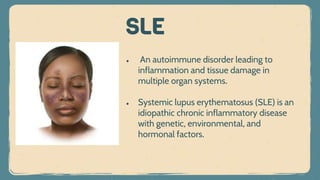
● Systemic lupus erythematosus (SLE) is an
idiopathic chronic inflammatory disease
with genetic, environmental, and
hormonal factors.
SLE
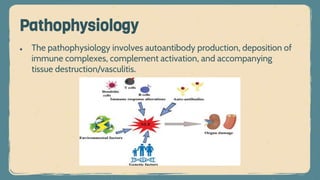
● The pathophysiology involves autoantibody production, deposition of
immune complexes, complement activation, and accompanying
tissue destruction/vasculitis.
Pathophysiology
Types of SLE
Spontaneous
SLE.
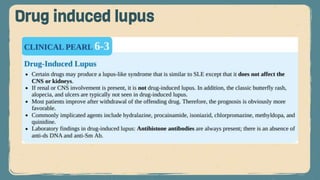
• Procainomide
• Hydralazine
• Isoniazid
Drug-induced lupus
• Arthritis, Raynaud phenomenon, subacute
cutaneous lupus Serology: Ro (anti-SS-A)
or antiphospholipid antibody-positive, ANA
negative
• Risk of neonatal lupus in infants of affected
women
• ANA negativity can be influenced by
laboratory testing methods, disease
duration, and treatment
ANA-negative lupus
Skin lesions without systemic disease.
Cutaneous lupus erythematosus
01 02
03 04
● Women of childbearing age account for 90% of cases, but men have
more severe disease.
● African-American patients are more frequently affected than
Caucasian patients.
● Milder in elderly patients; more severe in children.
● Usually appears in late childhood or adolescence.
Epidemiology of SLE
Clinical features
02
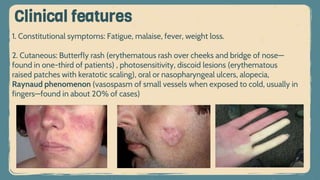
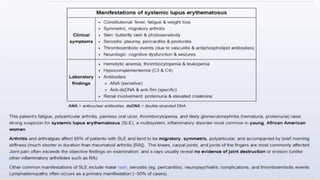
1. Constitutional symptoms: Fatigue, malaise, fever, weight loss.
2. Cutaneous: Butterfly rash (erythematous rash over cheeks and bridge of nose—
found in one-third of patients) , photosensitivity, discoid lesions (erythematous
raised patches with keratotic scaling), oral or nasopharyngeal ulcers, alopecia,
Raynaud phenomenon (vasospasm of small vessels when exposed to cold, usually in
fingers—found in about 20% of cases)
Clinical features
3. Musculoskeletal: Arthralgias (may be the first symptom of the disease—found in
90% of patients), arthritis (inflammatory and symmetric, rarely deforming as in
rheumatoid arthritis [RA]), myalgia with or without myositis
Clinical features
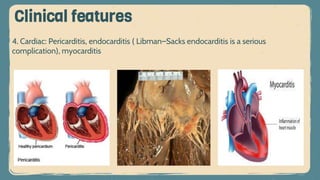
4. Cardiac: Pericarditis, endocarditis ( Libman–Sacks endocarditis is a serious
complication), myocarditis
Clinical features
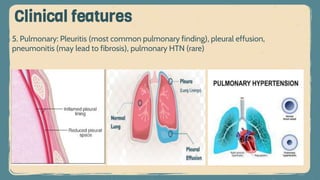
5. Pulmonary: Pleuritis (most common pulmonary finding), pleural effusion,
pneumonitis (may lead to fibrosis), pulmonary HTN (rare)
Clinical features
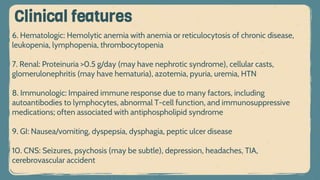
6. Hematologic: Hemolytic anemia with anemia or reticulocytosis of chronic disease,
leukopenia, lymphopenia, thrombocytopenia
7. Renal: Proteinuria >0.5 g/day (may have nephrotic syndrome), cellular casts,
glomerulonephritis (may have hematuria), azotemia, pyuria, uremia, HTN
8. Immunologic: Impaired immune response due to many factors, including
autoantibodies to lymphocytes, abnormal T-cell function, and immunosuppressive
medications; often associated with antiphospholipid syndrome
9. GI: Nausea/vomiting, dyspepsia, dysphagia, peptic ulcer disease
10. CNS: Seizures, psychosis (may be subtle), depression, headaches, TIA,
cerebrovascular accident
Clinical features
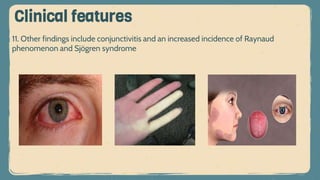
11. Other findings include conjunctivitis and an increased incidence of Raynaud
phenomenon and Sjögren syndrome
Clinical features
Diagnosis
03
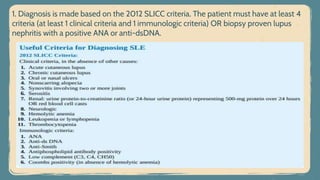
1. Diagnosis is made based on the 2012 SLICC criteria. The patient must have at least 4
criteria (at least 1 clinical criteria and 1 immunologic criteria) OR biopsy proven lupus
nephritis with a positive ANA or anti-dsDNA.
2. Autoantibodies in lupus:
a. ANA: Sensitive but not specific; almost all patients with SLE have elevated serum
ANA levels.
b. Anti-ds DNA (in 70%): very specific (but not sensitive)
c. Anti-Smith (in 30%): very specific (but not sensitive)
d. Antiphospholipid antibody positivity, as determined by positive lupus anticoagulant,
false-positive RPR, medium- or high-titer anticardiolipin antibody level, or positive
anti-β-2 glycoprotein.
Diagnosis
e. Antihistone Abs (in 70%) are present in >95% of cases of drug-induced lupus. If
negative, drug-induced lupus can be excluded.
f. Ro (SS-A) and La (SS-B) are found in 15% to 35%. Associated with:
● Sjögren syndrome
● Subacute cutaneous
● SLE Neonatal lupus (with congenital heart block)
● Complement deficiency (C2 and C4)
● ANA-negative lupus
Diagnosis
Drug induced lupus
Treatment
04
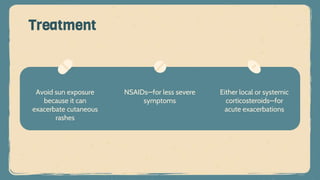
Avoid sun exposure
because it can
exacerbate cutaneous
rashes
Treatment
NSAIDs—for less severe
symptoms
Either local or systemic
corticosteroids—for
acute exacerbations
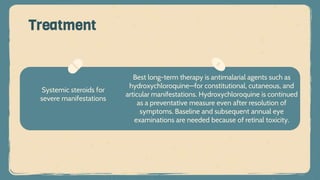
Systemic steroids for
severe manifestations
Treatment
Best long-term therapy is antimalarial agents such as
hydroxychloroquine—for constitutional, cutaneous, and
articular manifestations. Hydroxychloroquine is continued
as a preventative measure even after resolution of
symptoms. Baseline and subsequent annual eye
examinations are needed because of retinal toxicity.
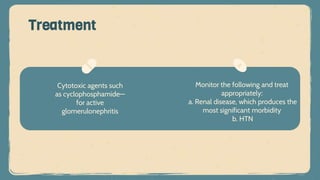
Cytotoxic agents such
as cyclophosphamide—
for active
glomerulonephritis
Treatment
Monitor the following and treat
appropriately:
a. Renal disease, which produces the
most significant morbidity
b. HTN
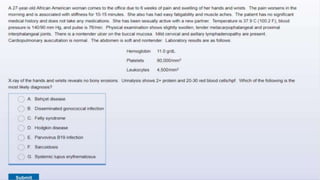
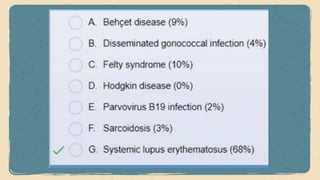
Uworld question
05
Thank you

Systemic lupus erythematosus.pptx

  • 1.
    Ghadeer Ismail Eideh Supervisedby Dr. Amjad Alnatsheh References: step up to medicine. Systemic Lupus Erythematosus
  • 2.
  • 3.
  • 4.
    ● An autoimmunedisorder leading to inflammation and tissue damage in multiple organ systems. ● Systemic lupus erythematosus (SLE) is an idiopathic chronic inflammatory disease with genetic, environmental, and hormonal factors. SLE
  • 5.
    ● The pathophysiologyinvolves autoantibody production, deposition of immune complexes, complement activation, and accompanying tissue destruction/vasculitis. Pathophysiology
  • 6.
    Types of SLE Spontaneous SLE. •Procainomide • Hydralazine • Isoniazid Drug-induced lupus • Arthritis, Raynaud phenomenon, subacute cutaneous lupus Serology: Ro (anti-SS-A) or antiphospholipid antibody-positive, ANA negative • Risk of neonatal lupus in infants of affected women • ANA negativity can be influenced by laboratory testing methods, disease duration, and treatment ANA-negative lupus Skin lesions without systemic disease. Cutaneous lupus erythematosus 01 02 03 04
  • 7.
    ● Women ofchildbearing age account for 90% of cases, but men have more severe disease. ● African-American patients are more frequently affected than Caucasian patients. ● Milder in elderly patients; more severe in children. ● Usually appears in late childhood or adolescence. Epidemiology of SLE
  • 8.
  • 9.
    1. Constitutional symptoms:Fatigue, malaise, fever, weight loss. 2. Cutaneous: Butterfly rash (erythematous rash over cheeks and bridge of nose— found in one-third of patients) , photosensitivity, discoid lesions (erythematous raised patches with keratotic scaling), oral or nasopharyngeal ulcers, alopecia, Raynaud phenomenon (vasospasm of small vessels when exposed to cold, usually in fingers—found in about 20% of cases) Clinical features
  • 10.
    3. Musculoskeletal: Arthralgias(may be the first symptom of the disease—found in 90% of patients), arthritis (inflammatory and symmetric, rarely deforming as in rheumatoid arthritis [RA]), myalgia with or without myositis Clinical features
  • 11.
    4. Cardiac: Pericarditis,endocarditis ( Libman–Sacks endocarditis is a serious complication), myocarditis Clinical features
  • 12.
    5. Pulmonary: Pleuritis(most common pulmonary finding), pleural effusion, pneumonitis (may lead to fibrosis), pulmonary HTN (rare) Clinical features
  • 13.
    6. Hematologic: Hemolyticanemia with anemia or reticulocytosis of chronic disease, leukopenia, lymphopenia, thrombocytopenia 7. Renal: Proteinuria >0.5 g/day (may have nephrotic syndrome), cellular casts, glomerulonephritis (may have hematuria), azotemia, pyuria, uremia, HTN 8. Immunologic: Impaired immune response due to many factors, including autoantibodies to lymphocytes, abnormal T-cell function, and immunosuppressive medications; often associated with antiphospholipid syndrome 9. GI: Nausea/vomiting, dyspepsia, dysphagia, peptic ulcer disease 10. CNS: Seizures, psychosis (may be subtle), depression, headaches, TIA, cerebrovascular accident Clinical features
  • 14.
    11. Other findingsinclude conjunctivitis and an increased incidence of Raynaud phenomenon and Sjögren syndrome Clinical features
  • 15.
  • 16.
    1. Diagnosis ismade based on the 2012 SLICC criteria. The patient must have at least 4 criteria (at least 1 clinical criteria and 1 immunologic criteria) OR biopsy proven lupus nephritis with a positive ANA or anti-dsDNA.
  • 17.
    2. Autoantibodies inlupus: a. ANA: Sensitive but not specific; almost all patients with SLE have elevated serum ANA levels. b. Anti-ds DNA (in 70%): very specific (but not sensitive) c. Anti-Smith (in 30%): very specific (but not sensitive) d. Antiphospholipid antibody positivity, as determined by positive lupus anticoagulant, false-positive RPR, medium- or high-titer anticardiolipin antibody level, or positive anti-β-2 glycoprotein. Diagnosis
  • 18.
    e. Antihistone Abs(in 70%) are present in >95% of cases of drug-induced lupus. If negative, drug-induced lupus can be excluded. f. Ro (SS-A) and La (SS-B) are found in 15% to 35%. Associated with: ● Sjögren syndrome ● Subacute cutaneous ● SLE Neonatal lupus (with congenital heart block) ● Complement deficiency (C2 and C4) ● ANA-negative lupus Diagnosis
  • 19.
  • 20.
  • 21.
    Avoid sun exposure becauseit can exacerbate cutaneous rashes Treatment NSAIDs—for less severe symptoms Either local or systemic corticosteroids—for acute exacerbations
  • 22.
    Systemic steroids for severemanifestations Treatment Best long-term therapy is antimalarial agents such as hydroxychloroquine—for constitutional, cutaneous, and articular manifestations. Hydroxychloroquine is continued as a preventative measure even after resolution of symptoms. Baseline and subsequent annual eye examinations are needed because of retinal toxicity.
  • 23.
    Cytotoxic agents such ascyclophosphamide— for active glomerulonephritis Treatment Monitor the following and treat appropriately: a. Renal disease, which produces the most significant morbidity b. HTN
  • 24.
  • 29.

Editor's Notes

  • #2 1. Table of contents 2. Introduction 3. Identifying information 4. Patient medical history 5. Review of systems 6. Physical examination 7. Big picture 8. Findings 9. Discussion 10. Discussion summary 11. Comparison 12. Diagnosis 13. Treatment 14. Patient monitoring 15. Contraindications and indications 16. Post-prevention 17. Case timeline 18. Conclusions 19. References 20. Our team