
Systematic review or scoping review?
Guidance for authors when choosing
between a systematic or scoping review
approach
Zachary Munn* , Micah D. J. Peters, Cindy Stern, Catalin Tufanaru, Alexa
McArthur and Edoardo Aromataris
Presenter: Neda Firouraghi
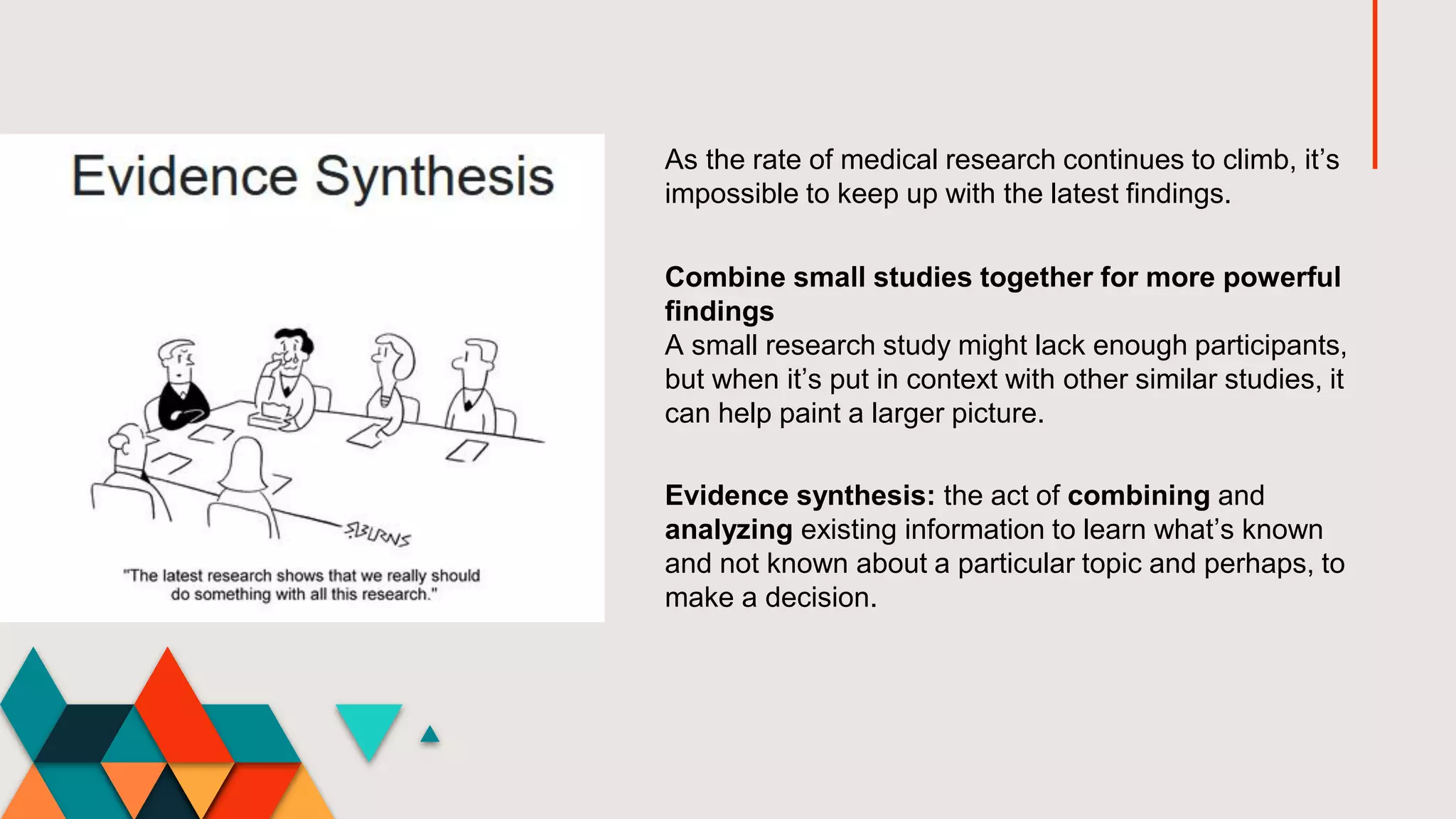
Evidence synthesis: the act of combining and
analyzing existing information to learn what’s known
and not known about a particular topic and perhaps, to
make a decision.
As the rate of medical research continues to climb, it’s
impossible to keep up with the latest findings.
Combine small studies together for more powerful
findings
A small research study might lack enough participants,
but when it’s put in context with other similar studies, it
can help paint a larger picture.
Background
 Systematic reviews in healthcare began to appear in publication in the 1970s and
1980s
 Cochrane and the Joanna Briggs Institute (JBI) in the 1990s, reviews have exploded
in popularity both in terms of the number conducted, and their uptake to inform
policy and practice.
 Today, systematic reviews are conducted for a wide range of purposes
Background
 More recently, the field of evidence synthesis has seen the emergence of scoping
reviews, which are similar to systematic reviews in that they follow a structured
process, however they are performed for different reasons
 Scoping reviews are a valid approach in those circumstances where systematic reviews are
unable to meet the necessary objectives or requirements of knowledge users.
Background
Researchers, editors and peer reviewers: “There is inconsistency and confusion regarding
the indications for scoping reviews”
The purpose of this article: To provide practical guidance on when to perform a systematic
review or a scoping review, supported with some key examples.
Systematic reviews
• A type of research synthesis
• Conducted by review groups with specialized skills
• Precise research questions
• To identify and retrieve international evidence that is relevant to a particular question or
questions
• Follow a structured and pre-defined process
• To inform practice, policy and in some cases, further research
Scoping Review
• A type of research synthesis
• The identification of certain concepts in papers or studies
• To provide an overview of the evidence
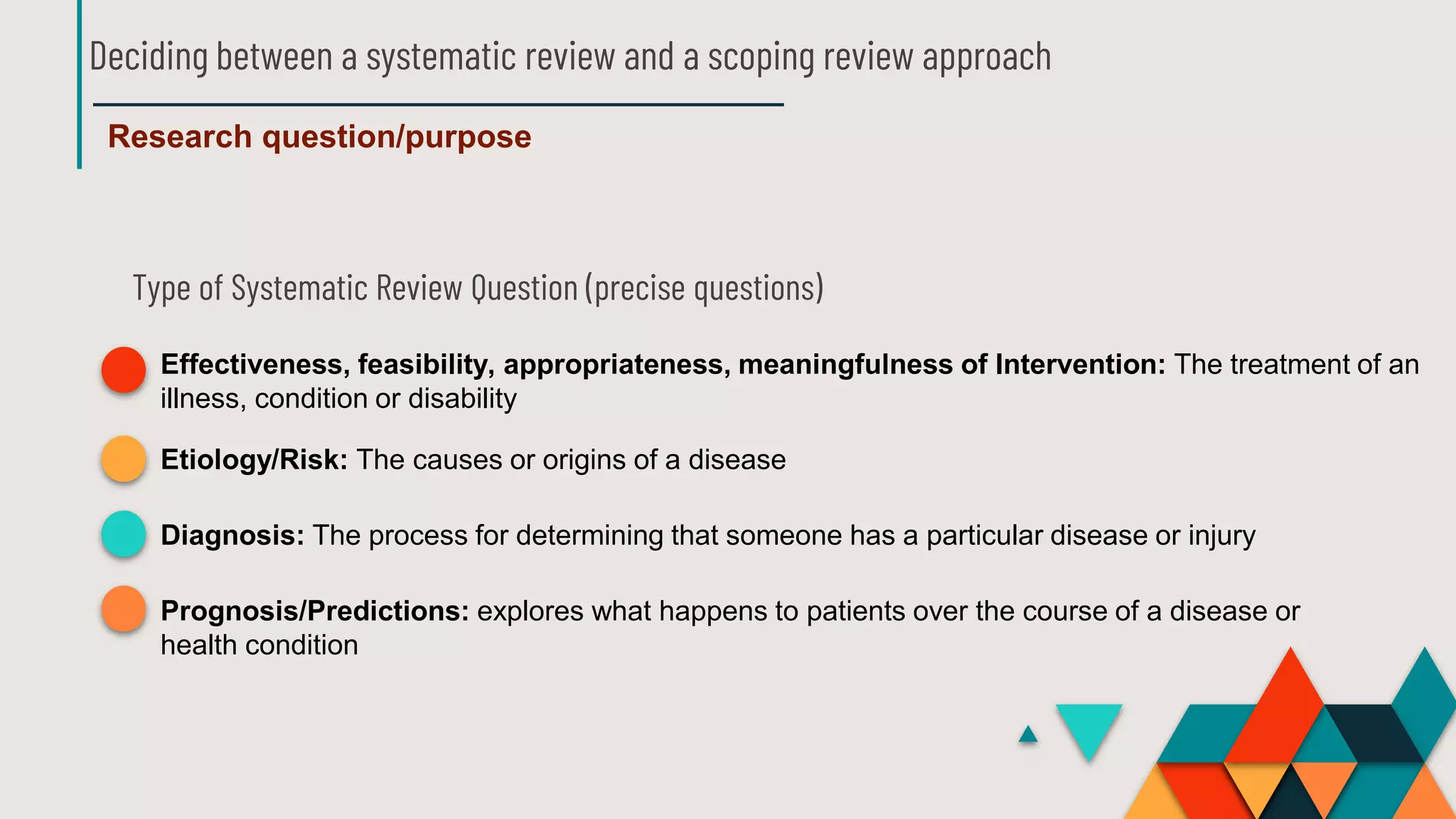
Deciding between a systematic review and a scoping review approach
Research question/purpose
Type of Systematic Review Question (precise questions)
Effectiveness, feasibility, appropriateness, meaningfulness of Intervention: The treatment of an
illness, condition or disability
Etiology/Risk: The causes or origins of a disease
Diagnosis: The process for determining that someone has a particular disease or injury
Prognosis/Predictions: explores what happens to patients over the course of a disease or
health condition
Scoping review indications
Examples
Where is the evidence for emergency planning: a scoping review. BMC Public Health.
2012
There is a large body of evidence in the field, issues with its generalizability and validity are as yet
largely unknown and that the exact type and form of evidence that would be valuable to knowledge
users in the field is not yet understood.
To identify the types of available evidence in a given field
A scoping review and thematic classification of patient complexity: offering a unifying
framework. Journal of comorbidity. 2012.
To investigate how the notion of “patient complexity”
“comprehensive and evidence-based definition”
To clarify key concepts/definitions in the literature
A scoping review on the conduct and reporting of scoping reviews. BMC Med Res Methodol.
2016
A scoping review of scoping reviews: advancing the approach and enhancing the
consistency. Res Synth Methods. 2014
Both of these scoping reviews investigated how scoping reviews had been reported and conducted
To examine how research is conducted on a certain topic
Access to primary health care services for indigenous peoples: a framework synthesis. Int
J Equity Health. 2016
Characteristics of indigenous primary health care models of service delivery: a scoping
review protocol. JBI Database System Rev Implement Rep. 2015
Over 1000 findings were eventually grouped into eight key factors
To identify key characteristics or factors related to a concept
People’s views and experiences of participating in microfinance interventions: A systematic review
of qualitative evidence. London: EPPI-Centre: social science research unit, UCL Institute of education,
University College London; 2016.
Define target group or population
Define inclusion criteria
Undertaking reviews on less familiar topics
Ensure that the questions of subsequent systematic review are able to be answered by available
relevant evidence
As a precursor to a systematic review
Occupational balance: a scoping review of current research and identified knowledge
gaps. J Occup Sci. 2015
To review current research and identify knowledge gaps on the topic of “occupational balance”,
or the balance of work, rest, sleep, and play
To identify and analyze gaps in the knowledge base
Discussion
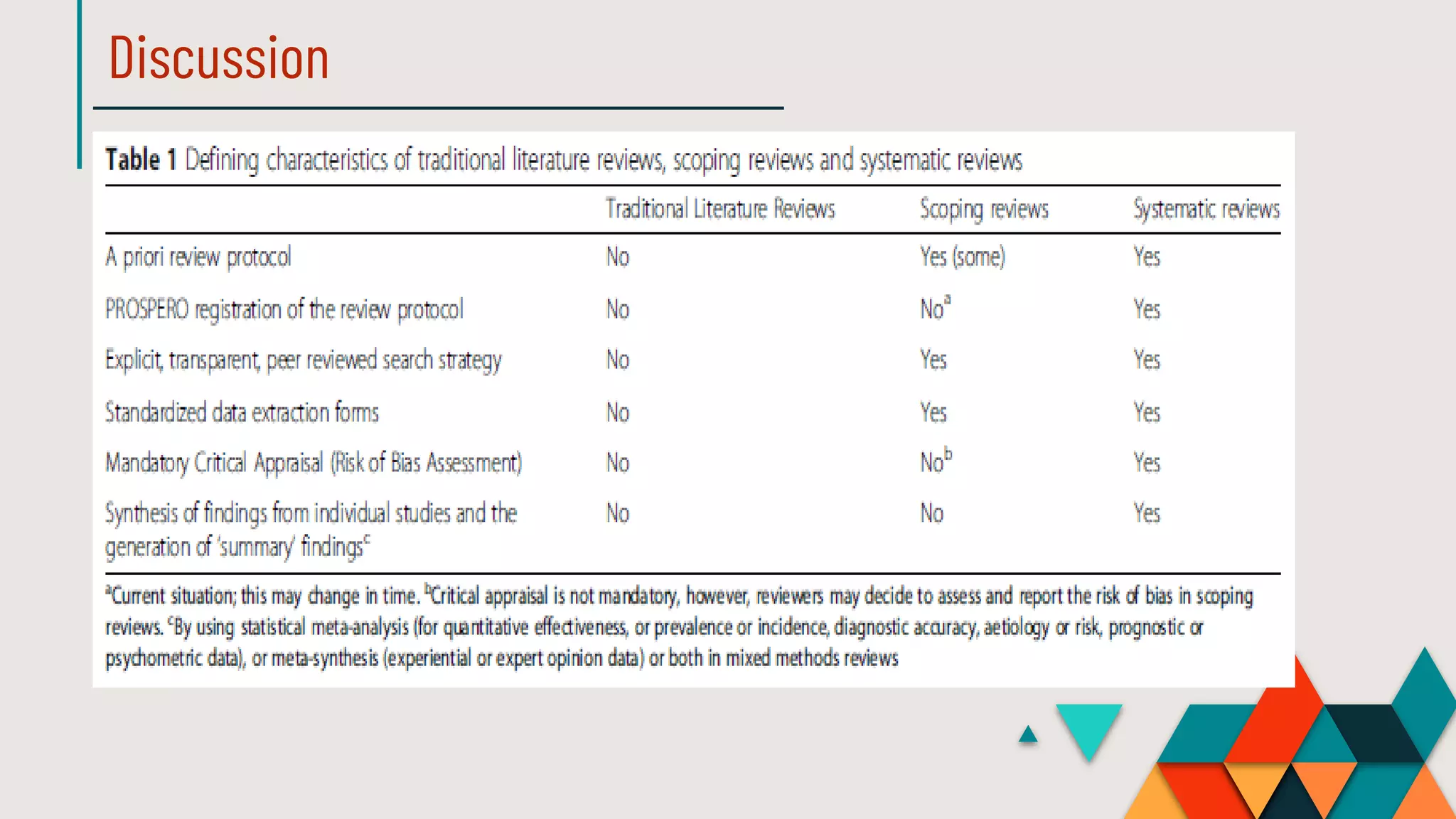
A key difference between scoping reviews and systematic
reviews is that in terms of a review question, a scoping review
will have a broader “scope” than traditional systematic reviews
Discussion
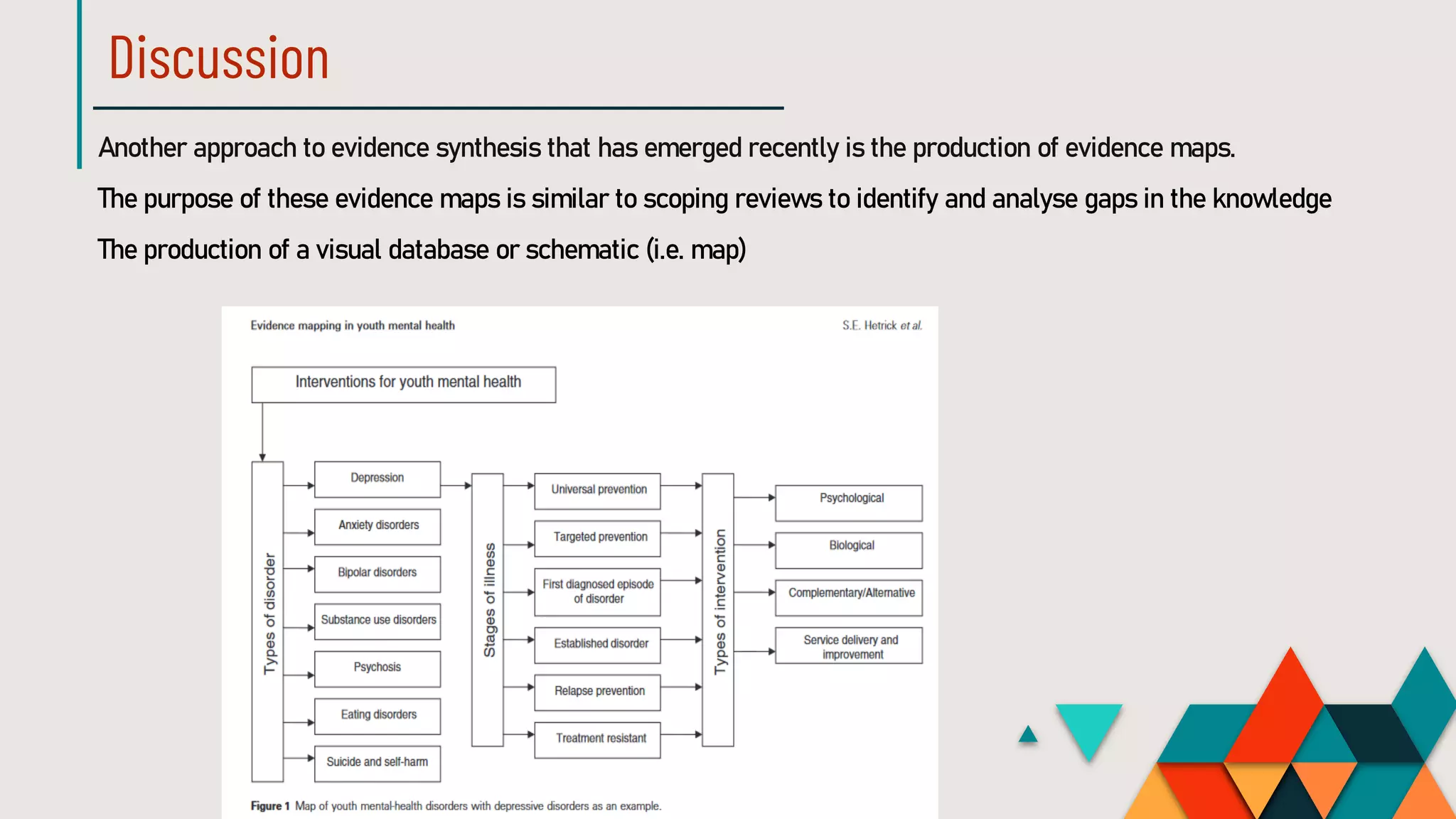
Another approach to evidence synthesis that has emerged recently is the production of evidence maps.
The purpose of these evidence maps is similar to scoping reviews to identify and analyse gaps in the knowledge
The production of a visual database or schematic (i.e. map)
Discussion
Rapid reviews are another emerging type of evidence synthesis
‘systematic reviews with shortcuts.’
The major consideration is not the purpose/question itself, but the feasibility of conducting
a full review given financial/resource limitations and time pressures.
Discussion
The Steps of
Systematic/Scoping
review
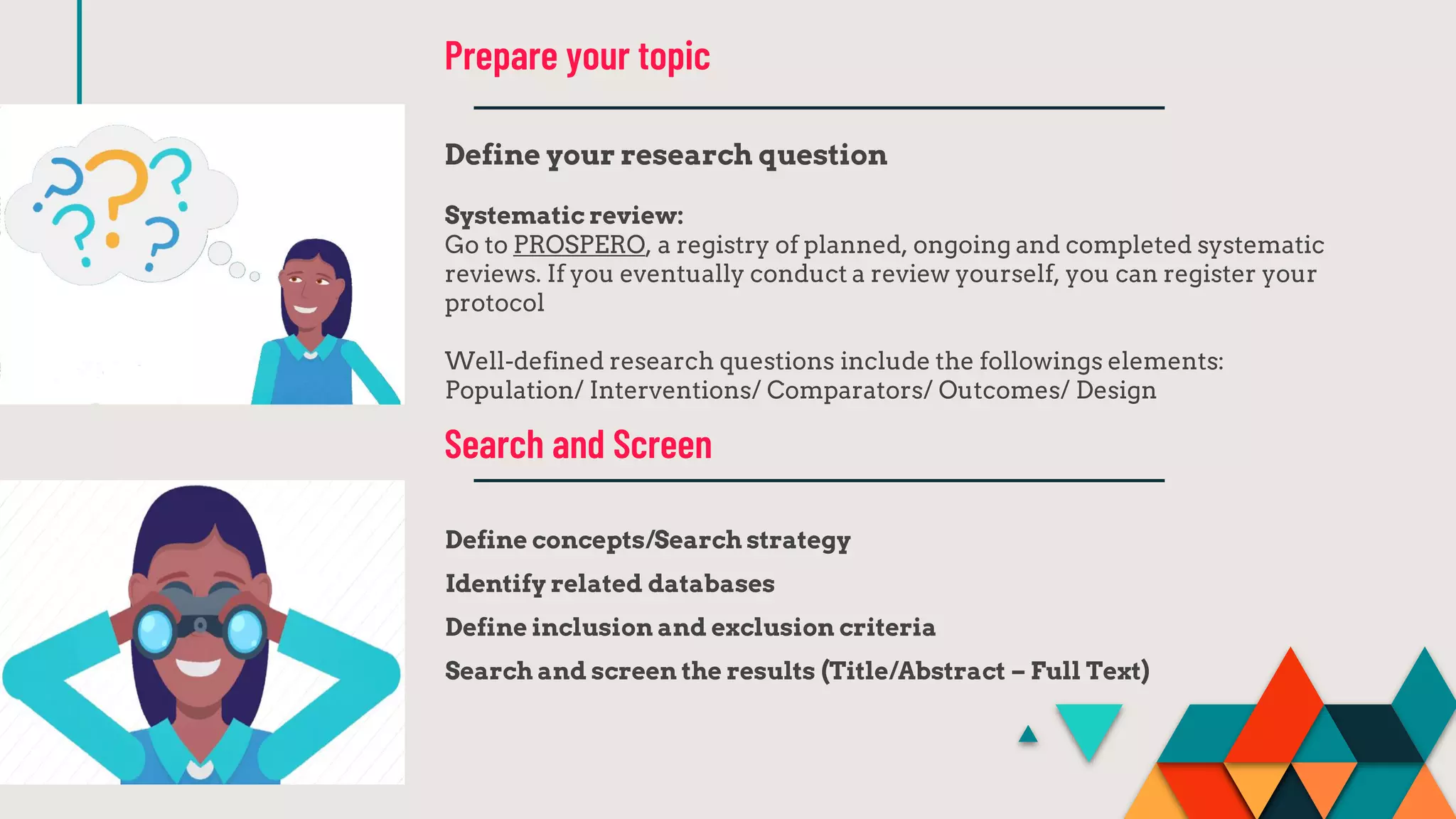
Define your research question
Systematic review:
Go to PROSPERO, a registry of planned, ongoing and completed systematic
reviews. If you eventually conduct a review yourself, you can register your
protocol
Well-defined research questions include the followings elements:
Population/ Interventions/ Comparators/ Outcomes/ Design
Prepare your topic
Define concepts/Search strategy
Identify related databases
Define inclusion and exclusion criteria
Search and screen the results (Title/Abstract – Full Text)
Search and Screen
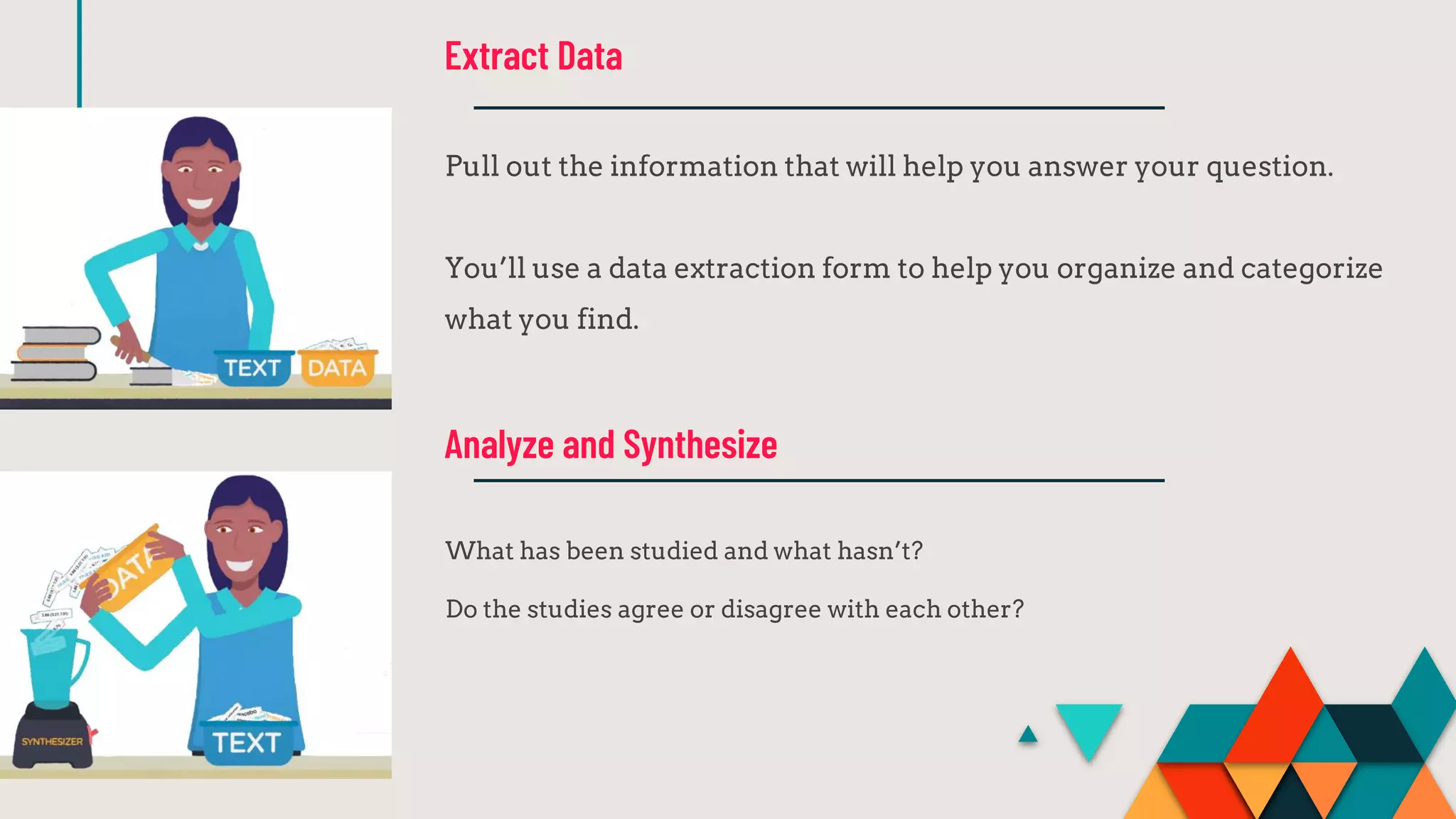
Pull out the information that will help you answer your question.
You’ll use a data extraction form to help you organize and categorize
what you find.
Extract Data
What has been studied and what hasn’t?
Do the studies agree or disagree with each other?
Analyze and Synthesize
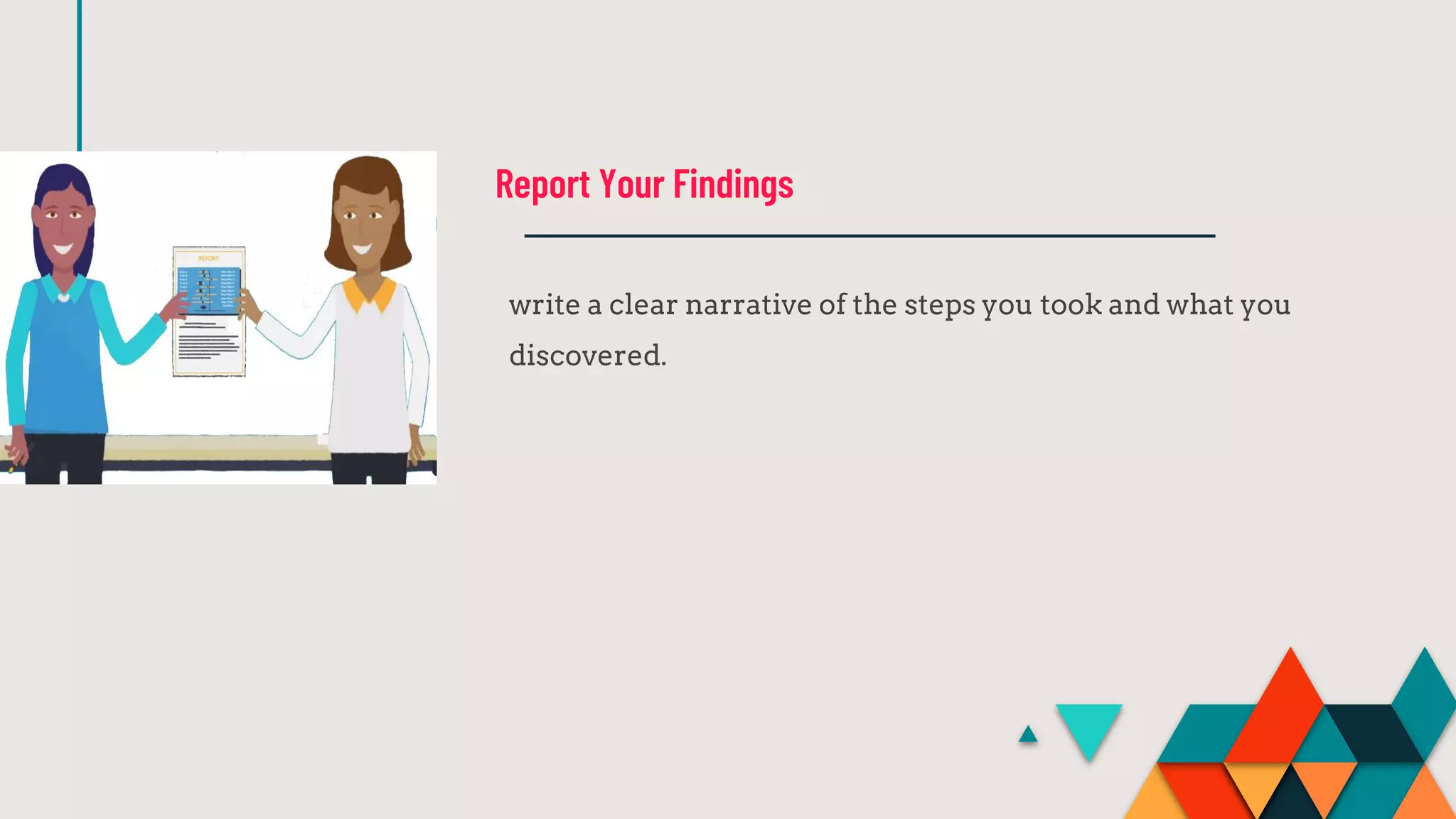
write a clear narrative of the steps you took and what you
discovered.
Report Your Findings
THANKS!

Systematic Review-Scoping Review

  • 1.
    Systematic review orscoping review? Guidance for authors when choosing between a systematic or scoping review approach Zachary Munn* , Micah D. J. Peters, Cindy Stern, Catalin Tufanaru, Alexa McArthur and Edoardo Aromataris Presenter: Neda Firouraghi
  • 2.
    Evidence synthesis: theact of combining and analyzing existing information to learn what’s known and not known about a particular topic and perhaps, to make a decision. As the rate of medical research continues to climb, it’s impossible to keep up with the latest findings. Combine small studies together for more powerful findings A small research study might lack enough participants, but when it’s put in context with other similar studies, it can help paint a larger picture.
  • 3.
    Background  Systematic reviewsin healthcare began to appear in publication in the 1970s and 1980s  Cochrane and the Joanna Briggs Institute (JBI) in the 1990s, reviews have exploded in popularity both in terms of the number conducted, and their uptake to inform policy and practice.  Today, systematic reviews are conducted for a wide range of purposes
  • 4.
    Background  More recently,the field of evidence synthesis has seen the emergence of scoping reviews, which are similar to systematic reviews in that they follow a structured process, however they are performed for different reasons  Scoping reviews are a valid approach in those circumstances where systematic reviews are unable to meet the necessary objectives or requirements of knowledge users.
  • 5.
    Background Researchers, editors andpeer reviewers: “There is inconsistency and confusion regarding the indications for scoping reviews” The purpose of this article: To provide practical guidance on when to perform a systematic review or a scoping review, supported with some key examples.
  • 6.
    Systematic reviews • Atype of research synthesis • Conducted by review groups with specialized skills • Precise research questions • To identify and retrieve international evidence that is relevant to a particular question or questions • Follow a structured and pre-defined process • To inform practice, policy and in some cases, further research Scoping Review • A type of research synthesis • The identification of certain concepts in papers or studies • To provide an overview of the evidence
  • 7.
    Deciding between asystematic review and a scoping review approach Research question/purpose Type of Systematic Review Question (precise questions) Effectiveness, feasibility, appropriateness, meaningfulness of Intervention: The treatment of an illness, condition or disability Etiology/Risk: The causes or origins of a disease Diagnosis: The process for determining that someone has a particular disease or injury Prognosis/Predictions: explores what happens to patients over the course of a disease or health condition
  • 8.
  • 9.
    Where is theevidence for emergency planning: a scoping review. BMC Public Health. 2012 There is a large body of evidence in the field, issues with its generalizability and validity are as yet largely unknown and that the exact type and form of evidence that would be valuable to knowledge users in the field is not yet understood. To identify the types of available evidence in a given field A scoping review and thematic classification of patient complexity: offering a unifying framework. Journal of comorbidity. 2012. To investigate how the notion of “patient complexity” “comprehensive and evidence-based definition” To clarify key concepts/definitions in the literature
  • 10.
    A scoping reviewon the conduct and reporting of scoping reviews. BMC Med Res Methodol. 2016 A scoping review of scoping reviews: advancing the approach and enhancing the consistency. Res Synth Methods. 2014 Both of these scoping reviews investigated how scoping reviews had been reported and conducted To examine how research is conducted on a certain topic Access to primary health care services for indigenous peoples: a framework synthesis. Int J Equity Health. 2016 Characteristics of indigenous primary health care models of service delivery: a scoping review protocol. JBI Database System Rev Implement Rep. 2015 Over 1000 findings were eventually grouped into eight key factors To identify key characteristics or factors related to a concept
  • 11.
    People’s views andexperiences of participating in microfinance interventions: A systematic review of qualitative evidence. London: EPPI-Centre: social science research unit, UCL Institute of education, University College London; 2016. Define target group or population Define inclusion criteria Undertaking reviews on less familiar topics Ensure that the questions of subsequent systematic review are able to be answered by available relevant evidence As a precursor to a systematic review Occupational balance: a scoping review of current research and identified knowledge gaps. J Occup Sci. 2015 To review current research and identify knowledge gaps on the topic of “occupational balance”, or the balance of work, rest, sleep, and play To identify and analyze gaps in the knowledge base
  • 12.
    Discussion A key differencebetween scoping reviews and systematic reviews is that in terms of a review question, a scoping review will have a broader “scope” than traditional systematic reviews
  • 13.
    Discussion Another approach toevidence synthesis that has emerged recently is the production of evidence maps. The purpose of these evidence maps is similar to scoping reviews to identify and analyse gaps in the knowledge The production of a visual database or schematic (i.e. map)
  • 14.
    Discussion Rapid reviews areanother emerging type of evidence synthesis ‘systematic reviews with shortcuts.’ The major consideration is not the purpose/question itself, but the feasibility of conducting a full review given financial/resource limitations and time pressures.
  • 15.
  • 16.
  • 17.
    Define your researchquestion Systematic review: Go to PROSPERO, a registry of planned, ongoing and completed systematic reviews. If you eventually conduct a review yourself, you can register your protocol Well-defined research questions include the followings elements: Population/ Interventions/ Comparators/ Outcomes/ Design Prepare your topic Define concepts/Search strategy Identify related databases Define inclusion and exclusion criteria Search and screen the results (Title/Abstract – Full Text) Search and Screen
  • 18.
    Pull out theinformation that will help you answer your question. You’ll use a data extraction form to help you organize and categorize what you find. Extract Data What has been studied and what hasn’t? Do the studies agree or disagree with each other? Analyze and Synthesize
  • 19.
    write a clearnarrative of the steps you took and what you discovered. Report Your Findings
  • 20.