EVIDENCE SYNTHESIS RESEARCH
:Scoping & Systematic reviews
NURSING SCIENCE
by
Linda Mbonambi
Health Sciences Libraries
Leonora.wydeman@up.ac.za
Overview
• What is evidence synthesis?
• What is scoping review and systematic reviews?
• The difference between Scoping & Systematic reviews
• Key steps in conducting a scoping review
• Library Template
• Search strategy and databases
• Screening & Rayyan
What is evidence synthesis RESEARCH?
• Evidence synthesis research (scoping & systematic reviews)
methods are modern and transdisciplinary, allowing for
identification, selection, and combination of results from multiple
sources. These methods are useful to identify gaps in knowledge
and establish an evidence base for best-practice guidance.
Definition
• Systematic Review
A systematic review is a type of review that uses repeatable methods to find, select,
and synthesize all available evidence. It answers a clearly formulated research question
and explicitly states the methods used to arrive at the answer
• Scoping review
Determine the scope or coverage of a body of literature on a given topic and give clear
indication of the volume of literature and studies available as well as an overview of its
focus. Scoping reviews are useful for examining emerging evidence when it is still
unclear what other, more specific questions can be posed and valuably addressed by a
more precise systematic review. They can report on the types of evidence that address
and inform practice in the field and the way the research has been conducted.
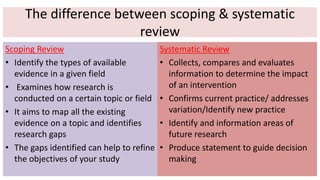
The difference between scoping & systematic
review
Scoping Review
• Identify the types of available
evidence in a given field
• Examines how research is
conducted on a certain topic or field
• It aims to map all the existing
evidence on a topic and identifies
research gaps
• The gaps identified can help to refine
the objectives of your study
Systematic Review
• Collects, compares and evaluates
information to determine the impact
of an intervention
• Confirms current practice/ addresses
variation/Identify new practice
• Identify and information areas of
future research
• Produce statement to guide decision
making
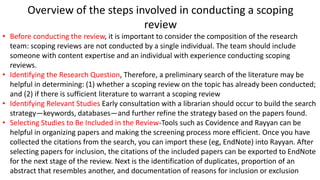
Overview of the steps involved in conducting a scoping
review
• Before conducting the review, it is important to consider the composition of the research
team: scoping reviews are not conducted by a single individual. The team should include
someone with content expertise and an individual with experience conducting scoping
reviews.
• Identifying the Research Question, Therefore, a preliminary search of the literature may be
helpful in determining: (1) whether a scoping review on the topic has already been conducted;
and (2) if there is sufficient literature to warrant a scoping review
• Identifying Relevant Studies Early consultation with a librarian should occur to build the search
strategy—keywords, databases—and further refine the strategy based on the papers found.
• Selecting Studies to Be Included in the Review-Tools such as Covidence and Rayyan can be
helpful in organizing papers and making the screening process more efficient. Once you have
collected the citations from the search, you can import these (eg, EndNote) into Rayyan. After
selecting papers for inclusion, the citations of the included papers can be exported to EndNote
for the next stage of the review. Next is the identification of duplicates, proportion of an
abstract that resembles another, and documentation of reasons for inclusion or exclusion
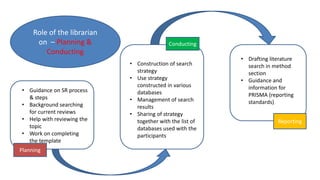
Conducting
Planning
Reporting
• Guidance on SR process
& steps
• Background searching
for current reviews
• Help with reviewing the
topic
• Work on completing
the template
• Construction of search
strategy
• Use strategy
constructed in various
databases
• Management of search
results
• Sharing of strategy
together with the list of
databases used with the
participants
• Drafting literature
search in method
section
• Guidance and
information for
PRISMA (reporting
standards)
Role of the librarian
on – Planning &
Conducting
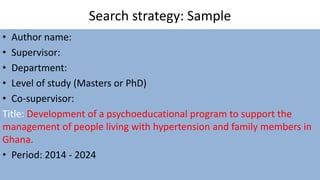
Search strategy: Sample
• Author name:
• Supervisor:
• Department:
• Level of study (Masters or PhD)
• Co-supervisor:
Title: Development of a psychoeducational program to support the
management of people living with hypertension and family members in
Ghana.
• Period: 2014 - 2024
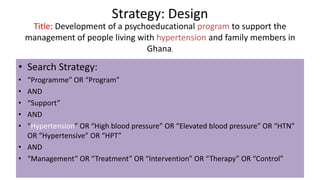
Strategy: Design
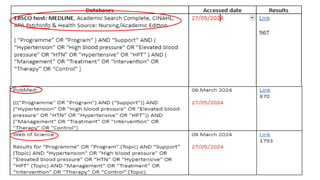
• Search Strategy:
• “Programme” OR “Program”
• AND
• “Support”
• AND
• “Hypertension” OR “High blood pressure” OR “Elevated blood pressure” OR “HTN”
OR “Hypertensive” OR “HPT”
• AND
• “Management” OR “Treatment” OR “Intervention” OR “Therapy” OR “Control”
Title: Development of a psychoeducational program to support the
management of people living with hypertension and family members in
Ghana.
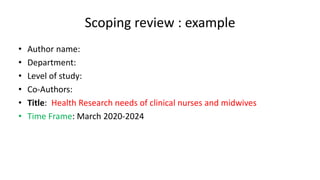
Scoping review : example
• Author name:
• Department:
• Level of study:
• Co-Authors:
• Title: Health Research needs of clinical nurses and midwives
• Time Frame: March 2020-2024
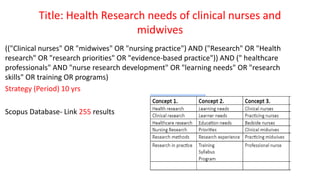
Title: Health Research needs of clinical nurses and
midwives
(("Clinical nurses" OR "midwives" OR "nursing practice") AND ("Research" OR "Health
research" OR "research priorities" OR "evidence-based practice")) AND (" healthcare
professionals" AND "nurse research development" OR "learning needs" OR "research
skills" OR training OR programs)
Strategy (Period) 10 yrs
Scopus Database- Link 255 results
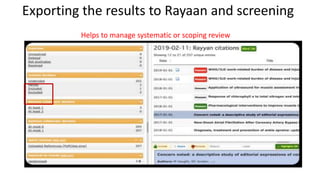
Exporting the results to Rayaan and screening
Helps to manage systematic or scoping review
When attending the actual workshop, you will
learn more in details

Scoping and Systematic reviews presentation Nursing Science.pptx

  • 1.
    EVIDENCE SYNTHESIS RESEARCH :Scoping& Systematic reviews NURSING SCIENCE by Linda Mbonambi Health Sciences Libraries Leonora.wydeman@up.ac.za
  • 2.
    Overview • What isevidence synthesis? • What is scoping review and systematic reviews? • The difference between Scoping & Systematic reviews • Key steps in conducting a scoping review • Library Template • Search strategy and databases • Screening & Rayyan
  • 3.
    What is evidencesynthesis RESEARCH? • Evidence synthesis research (scoping & systematic reviews) methods are modern and transdisciplinary, allowing for identification, selection, and combination of results from multiple sources. These methods are useful to identify gaps in knowledge and establish an evidence base for best-practice guidance.
  • 4.
    Definition • Systematic Review Asystematic review is a type of review that uses repeatable methods to find, select, and synthesize all available evidence. It answers a clearly formulated research question and explicitly states the methods used to arrive at the answer • Scoping review Determine the scope or coverage of a body of literature on a given topic and give clear indication of the volume of literature and studies available as well as an overview of its focus. Scoping reviews are useful for examining emerging evidence when it is still unclear what other, more specific questions can be posed and valuably addressed by a more precise systematic review. They can report on the types of evidence that address and inform practice in the field and the way the research has been conducted.
  • 5.
    The difference betweenscoping & systematic review Scoping Review • Identify the types of available evidence in a given field • Examines how research is conducted on a certain topic or field • It aims to map all the existing evidence on a topic and identifies research gaps • The gaps identified can help to refine the objectives of your study Systematic Review • Collects, compares and evaluates information to determine the impact of an intervention • Confirms current practice/ addresses variation/Identify new practice • Identify and information areas of future research • Produce statement to guide decision making
  • 6.
    Overview of thesteps involved in conducting a scoping review • Before conducting the review, it is important to consider the composition of the research team: scoping reviews are not conducted by a single individual. The team should include someone with content expertise and an individual with experience conducting scoping reviews. • Identifying the Research Question, Therefore, a preliminary search of the literature may be helpful in determining: (1) whether a scoping review on the topic has already been conducted; and (2) if there is sufficient literature to warrant a scoping review • Identifying Relevant Studies Early consultation with a librarian should occur to build the search strategy—keywords, databases—and further refine the strategy based on the papers found. • Selecting Studies to Be Included in the Review-Tools such as Covidence and Rayyan can be helpful in organizing papers and making the screening process more efficient. Once you have collected the citations from the search, you can import these (eg, EndNote) into Rayyan. After selecting papers for inclusion, the citations of the included papers can be exported to EndNote for the next stage of the review. Next is the identification of duplicates, proportion of an abstract that resembles another, and documentation of reasons for inclusion or exclusion
  • 7.
    Conducting Planning Reporting • Guidance onSR process & steps • Background searching for current reviews • Help with reviewing the topic • Work on completing the template • Construction of search strategy • Use strategy constructed in various databases • Management of search results • Sharing of strategy together with the list of databases used with the participants • Drafting literature search in method section • Guidance and information for PRISMA (reporting standards) Role of the librarian on – Planning & Conducting
  • 8.
    Search strategy: Sample •Author name: • Supervisor: • Department: • Level of study (Masters or PhD) • Co-supervisor: Title: Development of a psychoeducational program to support the management of people living with hypertension and family members in Ghana. • Period: 2014 - 2024
  • 9.
    Strategy: Design • SearchStrategy: • “Programme” OR “Program” • AND • “Support” • AND • “Hypertension” OR “High blood pressure” OR “Elevated blood pressure” OR “HTN” OR “Hypertensive” OR “HPT” • AND • “Management” OR “Treatment” OR “Intervention” OR “Therapy” OR “Control” Title: Development of a psychoeducational program to support the management of people living with hypertension and family members in Ghana.
  • 11.
    Scoping review :example • Author name: • Department: • Level of study: • Co-Authors: • Title: Health Research needs of clinical nurses and midwives • Time Frame: March 2020-2024
  • 12.
    Title: Health Researchneeds of clinical nurses and midwives (("Clinical nurses" OR "midwives" OR "nursing practice") AND ("Research" OR "Health research" OR "research priorities" OR "evidence-based practice")) AND (" healthcare professionals" AND "nurse research development" OR "learning needs" OR "research skills" OR training OR programs) Strategy (Period) 10 yrs Scopus Database- Link 255 results
  • 13.
    Exporting the resultsto Rayaan and screening Helps to manage systematic or scoping review
  • 14.
    When attending theactual workshop, you will learn more in details