Introduction
Systems Thinking
as a Discipline
3 / 3 / 2 0 2 4
2
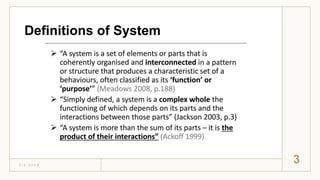
Definitions of System
3 / 3 / 2 0 2 4
3
3 / 3 / 2 0 2 4
4
3 / 3 / 2 0 2 4
5
3 / 3 / 2 0 2 4
6
3 / 3 / 2 0 2 4
7
3 / 3 / 2 0 2 4
8
3 / 3 / 2 0 2 4
9
3 / 3 / 2 0 2 4
10
3 / 3 / 2 0 2 4
11
3 / 3 / 2 0 2 4
12
3 / 3 / 2 0 2 4
13
3 / 3 / 2 0 2 4
14
3 / 3 / 2 0 2 4
15
3 / 3 / 2 0 2 4
16
3 / 3 / 2 0 2 4
17
3 / 3 / 2 0 2 4
18
3 / 3 / 2 0 2 4
19
3 / 3 / 2 0 2 4
20
3 / 3 / 2 0 2 4
21
3 / 3 / 2 0 2 4
22
3 / 3 / 2 0 2 4
23
3 / 3 / 2 0 2 4
24
Common Systems Thinking Myths and
Misconceptions
1. Systems thinking is New and
Trendy
2. Systems Thinking is Too
Complex
3. It is Not Part of Traditional
Scientific Methods
4. It is Too Optimistic
3 / 3 / 2 0 2 4
25
Common Systems Thinking Myths and
Misconceptions
5. It Has No Concrete
Solutions
6. Systems Thinking is
Objective and Universal
7. Systems Thinking is
Enough and Sufficient
8. It is Not Action-Oriented
3 / 3 / 2 0 2 4
26
3 / 3 / 2 0 2 4
27
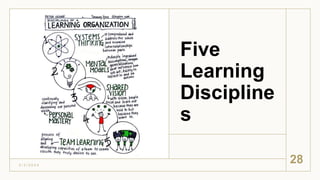
"A learning organization discovers how to
tap people's commitment and capacity to
learn at all levels…where people continually
expand their capacity to create the results
they truly desire, where new and expansive
patterns of thinking are nurtured, where
collective aspiration is set free and where
people are continually learning how to learn
together.” Peter Senge
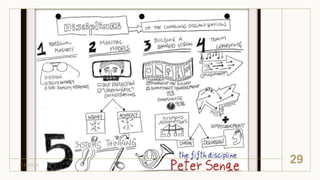
Five
Learning
Discipline
s
3 / 3 / 2 0 2 4
28
3 / 3 / 2 0 2 4
29
Principle
s of
System
Thinking
3 / 3 / 2 0 2 4
30
• Wholeness and Interaction: The whole is greater than
the sum of its parts (the property of the whole, not the
property of the parts; The product of interactions, not the
sum of actions of the parts)
• Openness: Living systems can only be understood in
the context of its environment.
• Patterns: To identify uniformity or similarity that exists in
multiple entities or at multiple times.
• Purposefulness: What you know about how they do
what they do leads to understanding WHY they do what
they do.
• Multidimensionality: To see complementary relations in
opposing tendencies and to create feasible wholes with
infeasible parts.
• Counterintuitive:That actions intended to produce a
desired outcome may generate opposite results.
3 / 3 / 2 0 2 4
31
Five Principles for Improved Systems
Thinking
1. A system is not just the sum of its parts
2. Cause and effect are not linear
3. Outcomes are cumulative and delayed
4. Systems do not want to change but the right action
can have big effects
5. Act with caution and reflect on the results
3 / 3 / 2 0 2 4
32
3 / 3 / 2 0 2 4
33
3 / 3 / 2 0 2 4
34
Thank you.

Introduction-to-System-Thinking Lecture

  • 1.
  • 2.
    3 / 3/ 2 0 2 4 2
  • 3.
    Definitions of System 3/ 3 / 2 0 2 4 3
  • 4.
    3 / 3/ 2 0 2 4 4
  • 5.
    3 / 3/ 2 0 2 4 5
  • 6.
    3 / 3/ 2 0 2 4 6
  • 7.
    3 / 3/ 2 0 2 4 7
  • 8.
    3 / 3/ 2 0 2 4 8
  • 9.
    3 / 3/ 2 0 2 4 9
  • 10.
    3 / 3/ 2 0 2 4 10
  • 11.
    3 / 3/ 2 0 2 4 11
  • 12.
    3 / 3/ 2 0 2 4 12
  • 13.
    3 / 3/ 2 0 2 4 13
  • 14.
    3 / 3/ 2 0 2 4 14
  • 15.
    3 / 3/ 2 0 2 4 15
  • 16.
    3 / 3/ 2 0 2 4 16
  • 17.
    3 / 3/ 2 0 2 4 17
  • 18.
    3 / 3/ 2 0 2 4 18
  • 19.
    3 / 3/ 2 0 2 4 19
  • 20.
    3 / 3/ 2 0 2 4 20
  • 21.
    3 / 3/ 2 0 2 4 21
  • 22.
    3 / 3/ 2 0 2 4 22
  • 23.
    3 / 3/ 2 0 2 4 23
  • 24.
    3 / 3/ 2 0 2 4 24
  • 25.
    Common Systems ThinkingMyths and Misconceptions 1. Systems thinking is New and Trendy 2. Systems Thinking is Too Complex 3. It is Not Part of Traditional Scientific Methods 4. It is Too Optimistic 3 / 3 / 2 0 2 4 25
  • 26.
    Common Systems ThinkingMyths and Misconceptions 5. It Has No Concrete Solutions 6. Systems Thinking is Objective and Universal 7. Systems Thinking is Enough and Sufficient 8. It is Not Action-Oriented 3 / 3 / 2 0 2 4 26
  • 27.
    3 / 3/ 2 0 2 4 27 "A learning organization discovers how to tap people's commitment and capacity to learn at all levels…where people continually expand their capacity to create the results they truly desire, where new and expansive patterns of thinking are nurtured, where collective aspiration is set free and where people are continually learning how to learn together.” Peter Senge
  • 28.
  • 29.
    3 / 3/ 2 0 2 4 29
  • 30.
  • 31.
    • Wholeness andInteraction: The whole is greater than the sum of its parts (the property of the whole, not the property of the parts; The product of interactions, not the sum of actions of the parts) • Openness: Living systems can only be understood in the context of its environment. • Patterns: To identify uniformity or similarity that exists in multiple entities or at multiple times. • Purposefulness: What you know about how they do what they do leads to understanding WHY they do what they do. • Multidimensionality: To see complementary relations in opposing tendencies and to create feasible wholes with infeasible parts. • Counterintuitive:That actions intended to produce a desired outcome may generate opposite results. 3 / 3 / 2 0 2 4 31
  • 32.
    Five Principles forImproved Systems Thinking 1. A system is not just the sum of its parts 2. Cause and effect are not linear 3. Outcomes are cumulative and delayed 4. Systems do not want to change but the right action can have big effects 5. Act with caution and reflect on the results 3 / 3 / 2 0 2 4 32
  • 33.
    3 / 3/ 2 0 2 4 33
  • 34.
    3 / 3/ 2 0 2 4 34
  • 35.

Editor's Notes

  • #26 Systems thinking is a way of understanding and solving complex problems by looking at them as a whole, rather than breaking them down into parts. It recognizes that everything is interconnected and interdependent and that the behavior of a system emerges from the interactions of its elements. This is a system that capable of helping us deal with the challenges of the 21st century, such as climate change, social inequality, and global pandemics. However, systems thinking is not a magic bullet that can solve all our problems hence the myths and misconceptions about it that may hinder its effective application and adoption.
  • #27 Systems thinking is a way of understanding and solving complex problems by looking at them as a whole, rather than breaking them down into parts. It recognizes that everything is interconnected and interdependent and that the behavior of a system emerges from the interactions of its elements. This is a system that capable of helping us deal with the challenges of the 21st century, such as climate change, social inequality, and global pandemics. However, systems thinking is not a magic bullet that can solve all our problems hence the myths and misconceptions about it that may hinder its effective application and adoption.
  • #31 Systems thinking is a discipline used to understand systems to provide a desired effect; the system for thinking about systems. It provides methods for “seeing wholes and a framework for seeing interrelationships rather than things, for seeing patterns of change rather than static snapshots.” The intent is to increase understanding and determine the point of “highest leverage”, the places in the system where a small changes can make a big impact. Here are six foundational principles that drive systems thinking methods.
  • #32 Systems thinking is a discipline used to understand systems to provide a desired effect; the system for thinking about systems. It provides methods for “seeing wholes and a framework for seeing interrelationships rather than things, for seeing patterns of change rather than static snapshots.” The intent is to increase understanding and determine the point of “highest leverage”, the places in the system where a small changes can make a big impact. Here are six foundational principles that drive systems thinking methods.
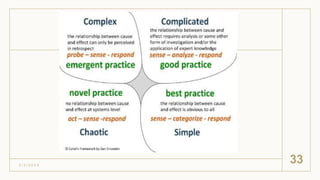
  • #33 escribe five principles of systems thinking that help make the dynamics and patterns of system behavior intelligible to inform our understanding of how to create more equitable systems. These principles provide a different way of looking at inequity and a frame that sheds light on beliefs, relationships, and interactions that are often overlooked within approaches that lead to a one-dimensional understanding of an issue.