SINDHI LANGUAGE
Phrase Structure Rules & Tree Diagram
Course Title: Issues in Syntax
Presented To: Ms. Sabiha Zun Norain
Presented By: Abbas Ali Haider
Registration Number: F16 1 MS AL002
Brief History of Sindhi Language
Sindhi language evolved over a period of 2400 years. Sindhi is an Indo-Aryan language of the
historical Sindh region, spoken by the Sindhi people. It is spoken by 41 million people in Pakistan.
It is the official language of Pakistan province of Sindh. Currently, Sindhi vocabulary contains
approximately 31% of Sanskrit words and 69% are a mixture of Arabic and Persian words.
However, there are also traces of the English words in Sindhi language.
Dialects of Sindhi Language
There are six dialects of Sindhi language
1. Vicholi
2. Sireli (Sindhi Saraiki)
3. Thari
4. Lasi
5. Lari
6. Kachi
Features of Sindhi Language
Sindhi is an OV language, in which the Object comes before the Verb. Sindhi is Head-Last
language, i.e. heads are often found at the end of the phrases and it is non-null subject language.
Sindhi language has 62 sounds; 46 consonants and 16 vowels and there are 52 alphabets. Sindhi
script follows an Arabic script.
Sentence Structure
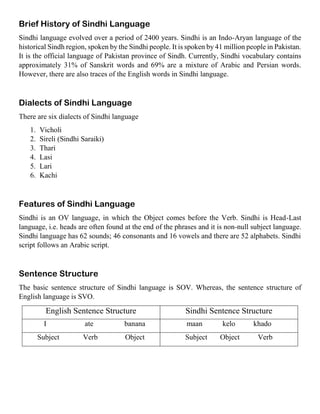
The basic sentence structure of Sindhi language is SOV. Whereas, the sentence structure of
English language is SVO.
English Sentence Structure Sindhi Sentence Structure
I ate banana maan kelo khado
Subject Verb Object Subject Object Verb
Phrase Structure Rules & Tree Diagram
Phrase: A phrase is a sequence of words or group of words arranged in a grammatical
construction, and functions as a unit in a sentence.
Phrase Structure Tree or Tree Diagram: Phrase structure tree (also called
Constituent structure tree), is a tree diagram with syntactic category information provided. A
phrase structure tree shows that a sentence is both linear string of words and hierarchical structure
with phrase in combination.
Tree Diagrams:
1. Noun Phrase
2. Verb Phrase
3. Adjective Phrase
4. Adverb Phrase
5. Prepositional Phrase
Noun Phrase (NP)
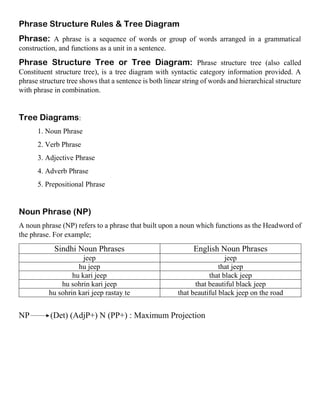
A noun phrase (NP) refers to a phrase that built upon a noun which functions as the Headword of
the phrase. For example;
Sindhi Noun Phrases English Noun Phrases
jeep jeep
hu jeep that jeep
hu kari jeep that black jeep
hu sohrin kari jeep that beautiful black jeep
hu sohrin kari jeep rastay te that beautiful black jeep on the road
NP (Det) (AdjP+) N (PP+) : Maximum Projection
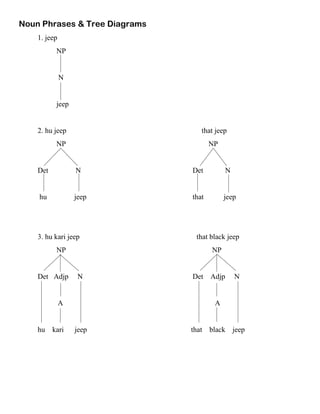
Noun Phrases & Tree Diagrams
1. jeep
NP
N
jeep
2. hu jeep that jeep
NP NP
Det N Det N
hu jeep that jeep
3. hu kari jeep that black jeep
NP NP
Det Adjp N Det Adjp N
A A
hu kari jeep that black jeep
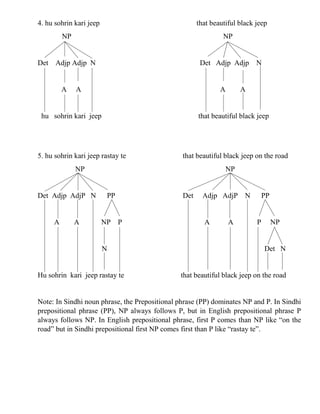
4. hu sohrin kari jeep that beautiful black jeep
NP NP
Det Adjp Adjp N Det Adjp Adjp N
A A A A
hu sohrin kari jeep that beautiful black jeep
5. hu sohrin kari jeep rastay te that beautiful black jeep on the road
NP NP
Det Adjp AdjP N PP Det Adjp AdjP N PP
A A NP P A A P NP
N Det N
Hu sohrin kari jeep rastay te that beautiful black jeep on the road
Note: In Sindhi noun phrase, the Prepositional phrase (PP) dominates NP and P. In Sindhi
prepositional phrase (PP), NP always follows P, but in English prepositional phrase P
always follows NP. In English prepositional phrase, first P comes than NP like “on the
road” but in Sindhi prepositional first NP comes first than P like “rastay te”.
Verb Phrase (VP)
A verb phrase (VP) refers to a phrase that composed of at least one verb and the dependents of
the verb, in which the verb functions as the Headword of the phrase. For examples;
Sindhi Verb Phrases English Verb Phrases
ghaio sing
hik gano ghaio sing a song
hik gano ghaio takray sing a song quickly
hik gano ghaio takray ghar main sing a song quickly at home
VP V (NP) (AdvP+) (PP) : Maximum Projection
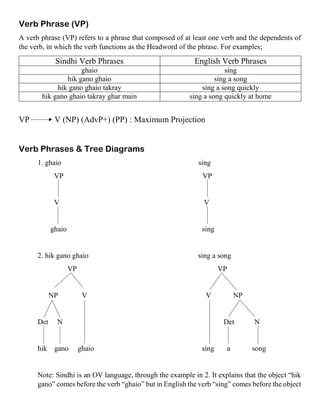
Verb Phrases & Tree Diagrams
1. ghaio sing
VP VP
V V
ghaio sing
2. hik gano ghaio sing a song
VP VP
NP V V NP
Det N Det N
hik gano ghaio sing a song
Note: Sindhi is an OV language, through the example in 2. It explains that the object “hik
gano” comes before the verb “ghaio” but in English the verb “sing” comes before the object
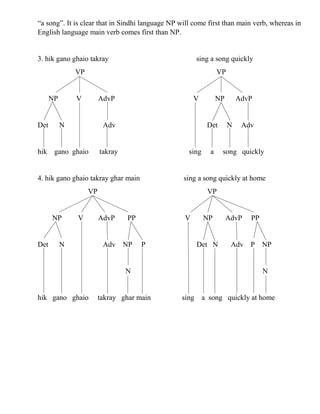
“a song”. It is clear that in Sindhi language NP will come first than main verb, whereas in
English language main verb comes first than NP.
3. hik gano ghaio takray sing a song quickly
VP VP
NP V AdvP V NP AdvP
Det N Adv Det N Adv
hik gano ghaio takray sing a song quickly
4. hik gano ghaio takray ghar main sing a song quickly at home
VP VP
NP V AdvP PP V NP AdvP PP
Det N Adv NP P Det N Adv P NP
N N
hik gano ghaio takray ghar main sing a song quickly at home
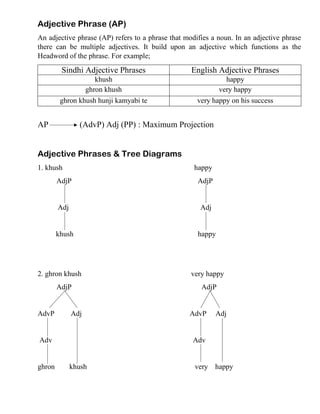
Adjective Phrase (AP)
An adjective phrase (AP) refers to a phrase that modifies a noun. In an adjective phrase
there can be multiple adjectives. It build upon an adjective which functions as the
Headword of the phrase. For example;
Sindhi Adjective Phrases English Adjective Phrases
khush happy
ghron khush very happy
ghron khush hunji kamyabi te very happy on his success
AP (AdvP) Adj (PP) : Maximum Projection
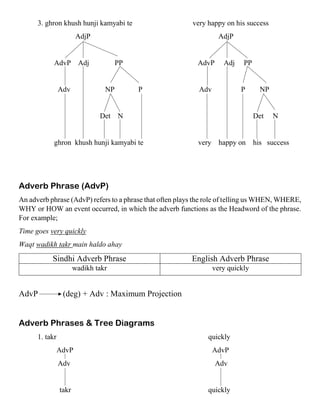
Adjective Phrases & Tree Diagrams
1. khush happy
AdjP AdjP
Adj Adj
khush happy
2. ghron khush very happy
AdjP AdjP
AdvP Adj AdvP Adj
Adv Adv
ghron khush very happy
3. ghron khush hunji kamyabi te very happy on his success
AdjP AdjP
AdvP Adj PP AdvP Adj PP
Adv NP P Adv P NP
Det N Det N
ghron khush hunji kamyabi te very happy on his success
Adverb Phrase (AdvP)
An adverb phrase (AdvP) refers to a phrase that often plays the role of telling us WHEN, WHERE,
WHY or HOW an event occurred, in which the adverb functions as the Headword of the phrase.
For example;
Time goes very quickly
Waqt wadikh takr main haldo ahay
Sindhi Adverb Phrase English Adverb Phrase
wadikh takr very quickly
AdvP (deg) + Adv : Maximum Projection
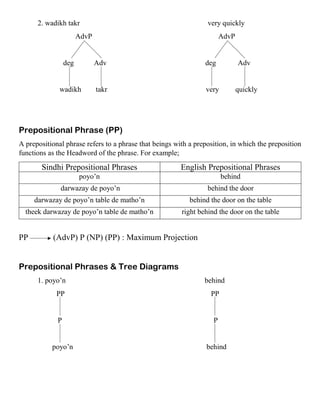
Adverb Phrases & Tree Diagrams
1. takr quickly
AdvP AdvP
Adv Adv
takr quickly
2. wadikh takr very quickly
AdvP AdvP
deg Adv deg Adv
wadikh takr very quickly
Prepositional Phrase (PP)
A prepositional phrase refers to a phrase that beings with a preposition, in which the preposition
functions as the Headword of the phrase. For example;
Sindhi Prepositional Phrases English Prepositional Phrases
poyo’n behind
darwazay de poyo’n behind the door
darwazay de poyo’n table de matho’n behind the door on the table
theek darwazay de poyo’n table de matho’n right behind the door on the table
PP (AdvP) P (NP) (PP) : Maximum Projection
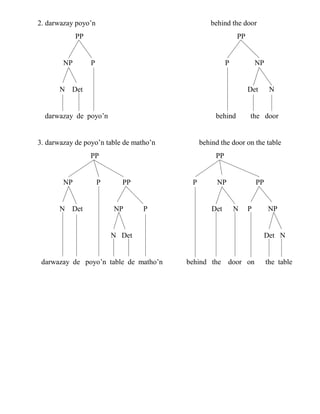
Prepositional Phrases & Tree Diagrams
1. poyo’n behind
PP PP
P P
poyo’n behind
2. darwazay poyo’n behind the door
PP PP
NP P P NP
N Det Det N
darwazay de poyo’n behind the door
3. darwazay de poyo’n table de matho’n behind the door on the table
PP PP
NP P PP P NP PP
N Det NP P Det N P NP
N Det Det N
darwazay de poyo’n table de matho’n behind the door on the table
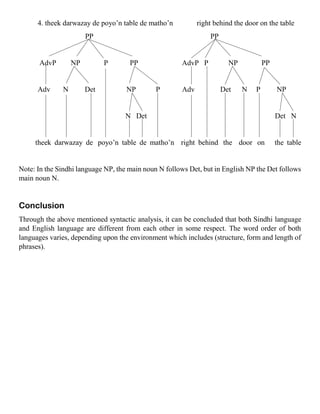
4. theek darwazay de poyo’n table de matho’n right behind the door on the table
PP PP
AdvP NP P PP AdvP P NP PP
Adv N Det NP P Adv Det N P NP
N Det Det N
theek darwazay de poyo’n table de matho’n right behind the door on the table
Note: In the Sindhi language NP, the main noun N follows Det, but in English NP the Det follows
main noun N.
Conclusion
Through the above mentioned syntactic analysis, it can be concluded that both Sindhi language
and English language are different from each other in some respect. The word order of both
languages varies, depending upon the environment which includes (structure, form and length of
phrases).

Syntax of Sindhi Language

  • 1.
    SINDHI LANGUAGE Phrase StructureRules & Tree Diagram Course Title: Issues in Syntax Presented To: Ms. Sabiha Zun Norain Presented By: Abbas Ali Haider Registration Number: F16 1 MS AL002
  • 2.
    Brief History ofSindhi Language Sindhi language evolved over a period of 2400 years. Sindhi is an Indo-Aryan language of the historical Sindh region, spoken by the Sindhi people. It is spoken by 41 million people in Pakistan. It is the official language of Pakistan province of Sindh. Currently, Sindhi vocabulary contains approximately 31% of Sanskrit words and 69% are a mixture of Arabic and Persian words. However, there are also traces of the English words in Sindhi language. Dialects of Sindhi Language There are six dialects of Sindhi language 1. Vicholi 2. Sireli (Sindhi Saraiki) 3. Thari 4. Lasi 5. Lari 6. Kachi Features of Sindhi Language Sindhi is an OV language, in which the Object comes before the Verb. Sindhi is Head-Last language, i.e. heads are often found at the end of the phrases and it is non-null subject language. Sindhi language has 62 sounds; 46 consonants and 16 vowels and there are 52 alphabets. Sindhi script follows an Arabic script. Sentence Structure The basic sentence structure of Sindhi language is SOV. Whereas, the sentence structure of English language is SVO. English Sentence Structure Sindhi Sentence Structure I ate banana maan kelo khado Subject Verb Object Subject Object Verb
  • 3.
    Phrase Structure Rules& Tree Diagram Phrase: A phrase is a sequence of words or group of words arranged in a grammatical construction, and functions as a unit in a sentence. Phrase Structure Tree or Tree Diagram: Phrase structure tree (also called Constituent structure tree), is a tree diagram with syntactic category information provided. A phrase structure tree shows that a sentence is both linear string of words and hierarchical structure with phrase in combination. Tree Diagrams: 1. Noun Phrase 2. Verb Phrase 3. Adjective Phrase 4. Adverb Phrase 5. Prepositional Phrase Noun Phrase (NP) A noun phrase (NP) refers to a phrase that built upon a noun which functions as the Headword of the phrase. For example; Sindhi Noun Phrases English Noun Phrases jeep jeep hu jeep that jeep hu kari jeep that black jeep hu sohrin kari jeep that beautiful black jeep hu sohrin kari jeep rastay te that beautiful black jeep on the road NP (Det) (AdjP+) N (PP+) : Maximum Projection
  • 4.
    Noun Phrases &Tree Diagrams 1. jeep NP N jeep 2. hu jeep that jeep NP NP Det N Det N hu jeep that jeep 3. hu kari jeep that black jeep NP NP Det Adjp N Det Adjp N A A hu kari jeep that black jeep
  • 5.
    4. hu sohrinkari jeep that beautiful black jeep NP NP Det Adjp Adjp N Det Adjp Adjp N A A A A hu sohrin kari jeep that beautiful black jeep 5. hu sohrin kari jeep rastay te that beautiful black jeep on the road NP NP Det Adjp AdjP N PP Det Adjp AdjP N PP A A NP P A A P NP N Det N Hu sohrin kari jeep rastay te that beautiful black jeep on the road Note: In Sindhi noun phrase, the Prepositional phrase (PP) dominates NP and P. In Sindhi prepositional phrase (PP), NP always follows P, but in English prepositional phrase P always follows NP. In English prepositional phrase, first P comes than NP like “on the road” but in Sindhi prepositional first NP comes first than P like “rastay te”.
  • 6.
    Verb Phrase (VP) Averb phrase (VP) refers to a phrase that composed of at least one verb and the dependents of the verb, in which the verb functions as the Headword of the phrase. For examples; Sindhi Verb Phrases English Verb Phrases ghaio sing hik gano ghaio sing a song hik gano ghaio takray sing a song quickly hik gano ghaio takray ghar main sing a song quickly at home VP V (NP) (AdvP+) (PP) : Maximum Projection Verb Phrases & Tree Diagrams 1. ghaio sing VP VP V V ghaio sing 2. hik gano ghaio sing a song VP VP NP V V NP Det N Det N hik gano ghaio sing a song Note: Sindhi is an OV language, through the example in 2. It explains that the object “hik gano” comes before the verb “ghaio” but in English the verb “sing” comes before the object
  • 7.
    “a song”. Itis clear that in Sindhi language NP will come first than main verb, whereas in English language main verb comes first than NP. 3. hik gano ghaio takray sing a song quickly VP VP NP V AdvP V NP AdvP Det N Adv Det N Adv hik gano ghaio takray sing a song quickly 4. hik gano ghaio takray ghar main sing a song quickly at home VP VP NP V AdvP PP V NP AdvP PP Det N Adv NP P Det N Adv P NP N N hik gano ghaio takray ghar main sing a song quickly at home
  • 8.
    Adjective Phrase (AP) Anadjective phrase (AP) refers to a phrase that modifies a noun. In an adjective phrase there can be multiple adjectives. It build upon an adjective which functions as the Headword of the phrase. For example; Sindhi Adjective Phrases English Adjective Phrases khush happy ghron khush very happy ghron khush hunji kamyabi te very happy on his success AP (AdvP) Adj (PP) : Maximum Projection Adjective Phrases & Tree Diagrams 1. khush happy AdjP AdjP Adj Adj khush happy 2. ghron khush very happy AdjP AdjP AdvP Adj AdvP Adj Adv Adv ghron khush very happy
  • 9.
    3. ghron khushhunji kamyabi te very happy on his success AdjP AdjP AdvP Adj PP AdvP Adj PP Adv NP P Adv P NP Det N Det N ghron khush hunji kamyabi te very happy on his success Adverb Phrase (AdvP) An adverb phrase (AdvP) refers to a phrase that often plays the role of telling us WHEN, WHERE, WHY or HOW an event occurred, in which the adverb functions as the Headword of the phrase. For example; Time goes very quickly Waqt wadikh takr main haldo ahay Sindhi Adverb Phrase English Adverb Phrase wadikh takr very quickly AdvP (deg) + Adv : Maximum Projection Adverb Phrases & Tree Diagrams 1. takr quickly AdvP AdvP Adv Adv takr quickly
  • 10.
    2. wadikh takrvery quickly AdvP AdvP deg Adv deg Adv wadikh takr very quickly Prepositional Phrase (PP) A prepositional phrase refers to a phrase that beings with a preposition, in which the preposition functions as the Headword of the phrase. For example; Sindhi Prepositional Phrases English Prepositional Phrases poyo’n behind darwazay de poyo’n behind the door darwazay de poyo’n table de matho’n behind the door on the table theek darwazay de poyo’n table de matho’n right behind the door on the table PP (AdvP) P (NP) (PP) : Maximum Projection Prepositional Phrases & Tree Diagrams 1. poyo’n behind PP PP P P poyo’n behind
  • 11.
    2. darwazay poyo’nbehind the door PP PP NP P P NP N Det Det N darwazay de poyo’n behind the door 3. darwazay de poyo’n table de matho’n behind the door on the table PP PP NP P PP P NP PP N Det NP P Det N P NP N Det Det N darwazay de poyo’n table de matho’n behind the door on the table
  • 12.
    4. theek darwazayde poyo’n table de matho’n right behind the door on the table PP PP AdvP NP P PP AdvP P NP PP Adv N Det NP P Adv Det N P NP N Det Det N theek darwazay de poyo’n table de matho’n right behind the door on the table Note: In the Sindhi language NP, the main noun N follows Det, but in English NP the Det follows main noun N. Conclusion Through the above mentioned syntactic analysis, it can be concluded that both Sindhi language and English language are different from each other in some respect. The word order of both languages varies, depending upon the environment which includes (structure, form and length of phrases).