ENGLISH TEACHING DEPARTMENT
FACULTY OF EDUCATION
UNIVERSITAS DARUSSALAM GONTOR
Direct Method
in English Language Teaching
Faiz Rizki Muhammad, M.Pd
Presented as the Materials on Teacher Training and
Development Program
HISTORY
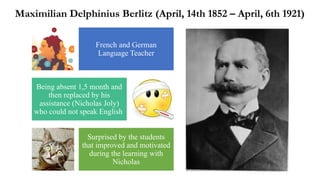
French and German
Language Teacher
Being absent 1,5 month and
then replaced by his
assistance (Nicholas Joly)
who could not speak English
Surprised by the students
that improved and motivated
during the learning with
Nicholas
Maximilian Delphinius Berlitz (April, 14th 1852 – April, 6th 1921)
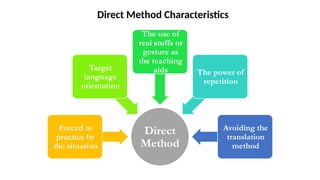
Direct
Method
Forced to
practice by
the situation
Target
language
orientation
The use of
real stuffs or
gesture as
the teaching
aids The power of
repetition
Avoiding the
translation
method
Direct Method Characteristics
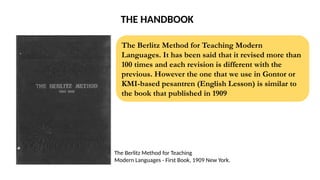
THE HANDBOOK
The Berlitz Method for Teaching Modern
Languages. It has been said that it revised more than
100 times and each revision is different with the
previous. However the one that we use in Gontor or
KMI-based pesantren (English Lesson) is similar to
the book that published in 1909
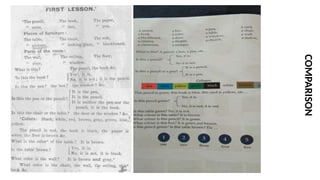
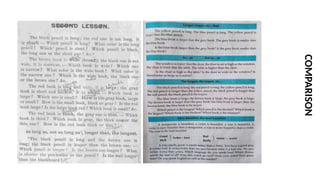
The Berlitz Method for Teaching
Modern Languages - First Book, 1909 New York.
COMPARISON
COMPARISON
IMPLEMENTATION
OF DIRECT METHOD
IN KMI
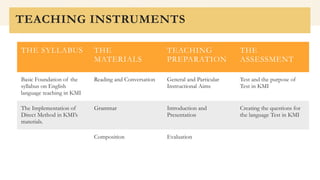
TEACHING INSTRUMENTS
THE SYLLABUS THE
MATERIALS
TEACHING
PREPARATION
THE
ASSESSMENT
Basic Foundation of the
syllabus on English
language teaching in KMI
Reading and Conversation General and Particular
Instructional Aims
Test and the purpose of
Test in KMI
The Implementation of
Direct Method in KMI’s
materials.
Grammar Introduction and
Presentation
Creating the questions for
the language Test in KMI
Composition Evaluation
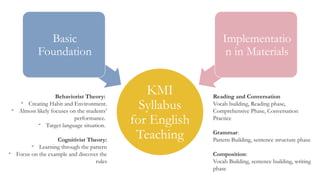
KMI
Syllabus
for English
Teaching
Basic
Foundation
Implementatio
n in Materials
Behaviorist Theory:
- Creating Habit and Environment.
- Almost likely focuses on the students’
performance.
- Target language situation.
Cognitivist Theory:
- Learning through the pattern
- Focus on the example and discover the
rules
Reading and Conversation
Vocab building, Reading phase,
Comprehensive Phase, Conversation
Practice
Grammar:
Pattern Building, sentence structure phase
Composition:
Vocab Building, sentence building, writing
phase
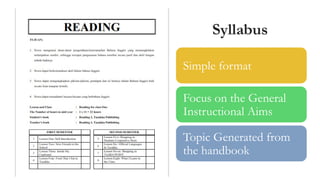
Syllabus
Simple format
Focus on the General
Instructional Aims
Topic Generated from
the handbook
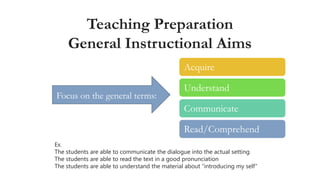
Teaching Preparation
General Instructional Aims
Ex.
The students are able to communicate the dialogue into the actual setting.
The students are able to read the text in a good pronunciation
The students are able to understand the material about “introducing my self”
Focus on the general terms:
Acquire
Understand
Communicate
Read/Comprehend
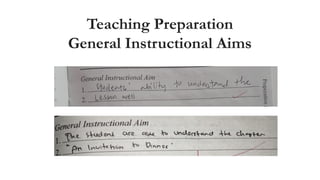
Teaching Preparation
General Instructional Aims
Teaching Preparation
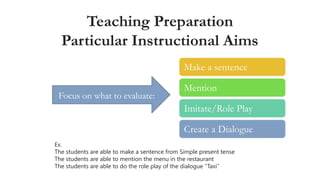
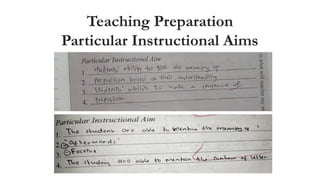
Particular Instructional Aims
Ex.
The students are able to make a sentence from Simple present tense
The students are able to mention the menu in the restaurant
The students are able to do the role play of the dialogue “Taxi”
Focus on what to evaluate:
Make a sentence
Mention
Imitate/Role Play
Create a Dialogue
Teaching Preparation
Particular Instructional Aims
Teaching Preparation
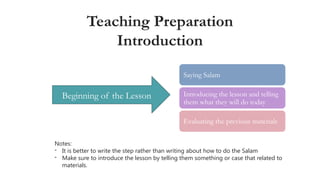
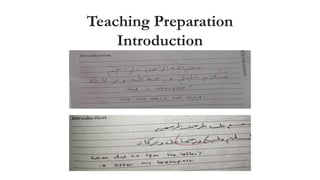
Introduction
Beginning of the Lesson
Saying Salam
Introducing the lesson and telling
them what they will do today
Evaluating the previous materials
Notes:
- It is better to write the step rather than writing about how to do the Salam
- Make sure to introduce the lesson by telling them something or case that related to
materials.
Teaching Preparation
Introduction
Teaching Preparation
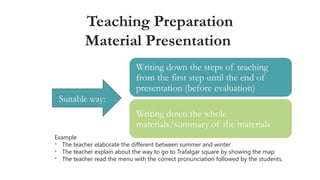
Material Presentation
Suitable way:
Writing down the steps of teaching
from the first step until the end of
presentation (before evaluation)
Writing down the whole
materials/summary of the materials
Example
- The teacher elaborate the different between summer and winter
- The teacher explain about the way to go to Trafalgar square by showing the map
- The teacher read the menu with the correct pronunciation followed by the students.
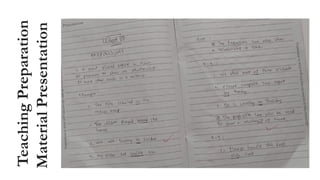
Teaching
Preparation
Material
Presentation
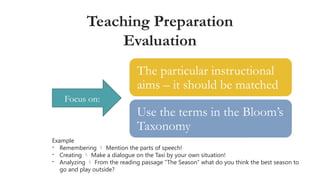
Teaching Preparation
Evaluation
Focus on:
The particular instructional
aims – it should be matched
Use the terms in the Bloom’s
Taxonomy
Example
- Remembering  Mention the parts of speech!
- Creating  Make a dialogue on the Taxi by your own situation!
- Analyzing  From the reading passage “The Season” what do you think the best season to
go and play outside?
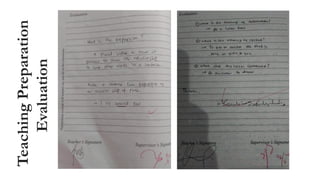
Teaching
Preparation
Evaluation
THE POSSIBLE
DEVELOPMENT ON
THE LEARNING
MATERIALS
tarbiyah@unida.gontor.ac.id

Direct Method in KMI - Faiz Rizki Muhammad, M.Pd.pptx

  • 1.
    ENGLISH TEACHING DEPARTMENT FACULTYOF EDUCATION UNIVERSITAS DARUSSALAM GONTOR Direct Method in English Language Teaching Faiz Rizki Muhammad, M.Pd Presented as the Materials on Teacher Training and Development Program
  • 2.
  • 3.
    French and German LanguageTeacher Being absent 1,5 month and then replaced by his assistance (Nicholas Joly) who could not speak English Surprised by the students that improved and motivated during the learning with Nicholas Maximilian Delphinius Berlitz (April, 14th 1852 – April, 6th 1921)
  • 4.
    Direct Method Forced to practice by thesituation Target language orientation The use of real stuffs or gesture as the teaching aids The power of repetition Avoiding the translation method Direct Method Characteristics
  • 5.
    THE HANDBOOK The BerlitzMethod for Teaching Modern Languages. It has been said that it revised more than 100 times and each revision is different with the previous. However the one that we use in Gontor or KMI-based pesantren (English Lesson) is similar to the book that published in 1909 The Berlitz Method for Teaching Modern Languages - First Book, 1909 New York.
  • 6.
  • 7.
  • 8.
  • 9.
    TEACHING INSTRUMENTS THE SYLLABUSTHE MATERIALS TEACHING PREPARATION THE ASSESSMENT Basic Foundation of the syllabus on English language teaching in KMI Reading and Conversation General and Particular Instructional Aims Test and the purpose of Test in KMI The Implementation of Direct Method in KMI’s materials. Grammar Introduction and Presentation Creating the questions for the language Test in KMI Composition Evaluation
  • 10.
    KMI Syllabus for English Teaching Basic Foundation Implementatio n inMaterials Behaviorist Theory: - Creating Habit and Environment. - Almost likely focuses on the students’ performance. - Target language situation. Cognitivist Theory: - Learning through the pattern - Focus on the example and discover the rules Reading and Conversation Vocab building, Reading phase, Comprehensive Phase, Conversation Practice Grammar: Pattern Building, sentence structure phase Composition: Vocab Building, sentence building, writing phase
  • 11.
    Syllabus Simple format Focus onthe General Instructional Aims Topic Generated from the handbook
  • 12.
    Teaching Preparation General InstructionalAims Ex. The students are able to communicate the dialogue into the actual setting. The students are able to read the text in a good pronunciation The students are able to understand the material about “introducing my self” Focus on the general terms: Acquire Understand Communicate Read/Comprehend
  • 13.
  • 14.
    Teaching Preparation Particular InstructionalAims Ex. The students are able to make a sentence from Simple present tense The students are able to mention the menu in the restaurant The students are able to do the role play of the dialogue “Taxi” Focus on what to evaluate: Make a sentence Mention Imitate/Role Play Create a Dialogue
  • 15.
  • 16.
    Teaching Preparation Introduction Beginning ofthe Lesson Saying Salam Introducing the lesson and telling them what they will do today Evaluating the previous materials Notes: - It is better to write the step rather than writing about how to do the Salam - Make sure to introduce the lesson by telling them something or case that related to materials.
  • 17.
  • 18.
    Teaching Preparation Material Presentation Suitableway: Writing down the steps of teaching from the first step until the end of presentation (before evaluation) Writing down the whole materials/summary of the materials Example - The teacher elaborate the different between summer and winter - The teacher explain about the way to go to Trafalgar square by showing the map - The teacher read the menu with the correct pronunciation followed by the students.
  • 19.
  • 20.
    Teaching Preparation Evaluation Focus on: Theparticular instructional aims – it should be matched Use the terms in the Bloom’s Taxonomy Example - Remembering  Mention the parts of speech! - Creating  Make a dialogue on the Taxi by your own situation! - Analyzing  From the reading passage “The Season” what do you think the best season to go and play outside?
  • 21.
  • 22.
  • 23.