1
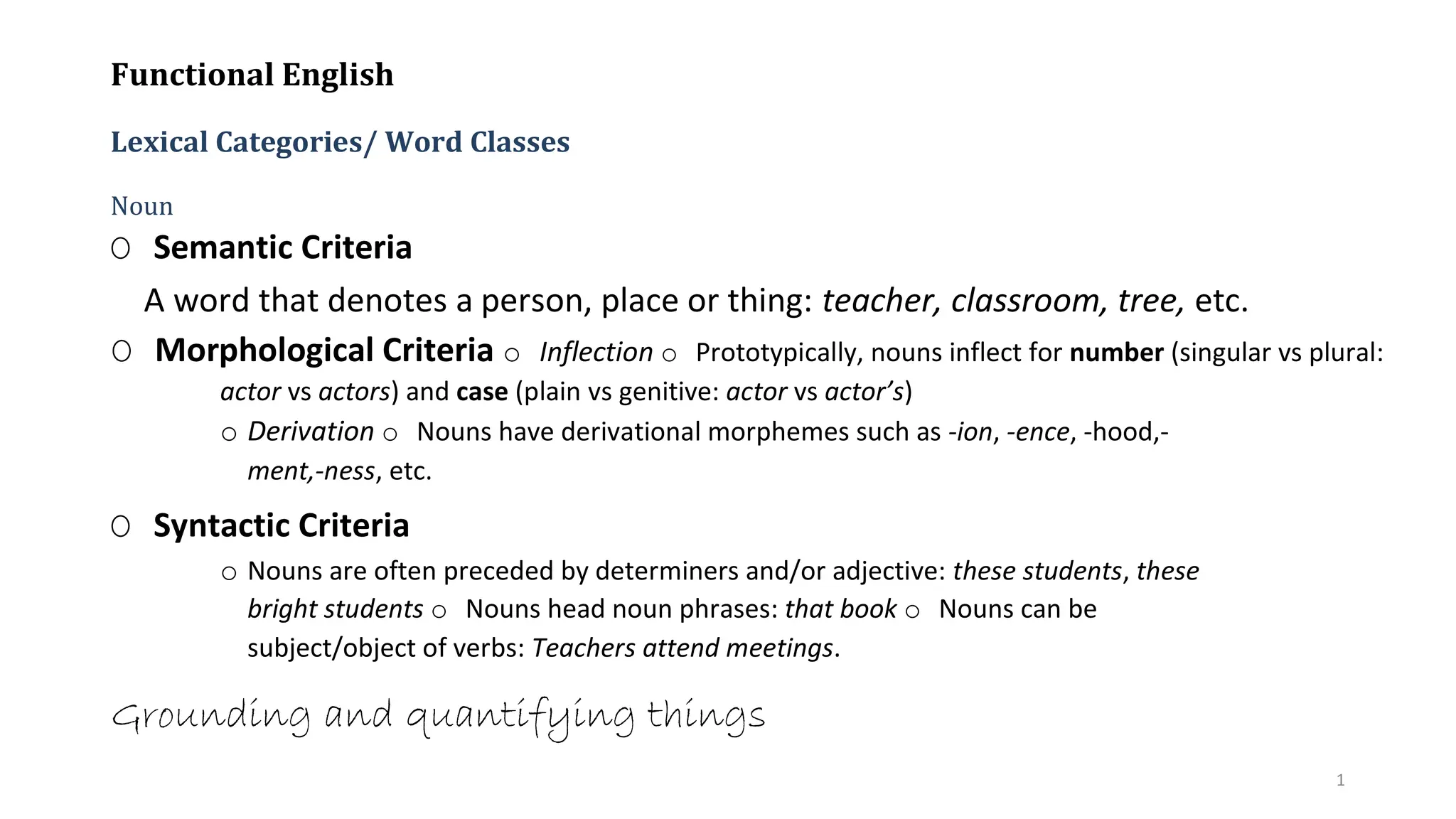
Functional English
Lexical Categories/ Word Classes
Noun
O Semantic Criteria
A word that denotes a person, place or thing: teacher, classroom, tree, etc.
O Morphological Criteria o Inflection o Prototypically, nouns inflect for number (singular vs plural:
actor vs actors) and case (plain vs genitive: actor vs actor’s)
o Derivation o Nouns have derivational morphemes such as -ion, -ence, -hood,-
ment,-ness, etc.
O Syntactic Criteria
o Nouns are often preceded by determiners and/or adjective: these students, these
bright students o Nouns head noun phrases: that book o Nouns can be
subject/object of verbs: Teachers attend meetings.
Grounding and quantifying things
2
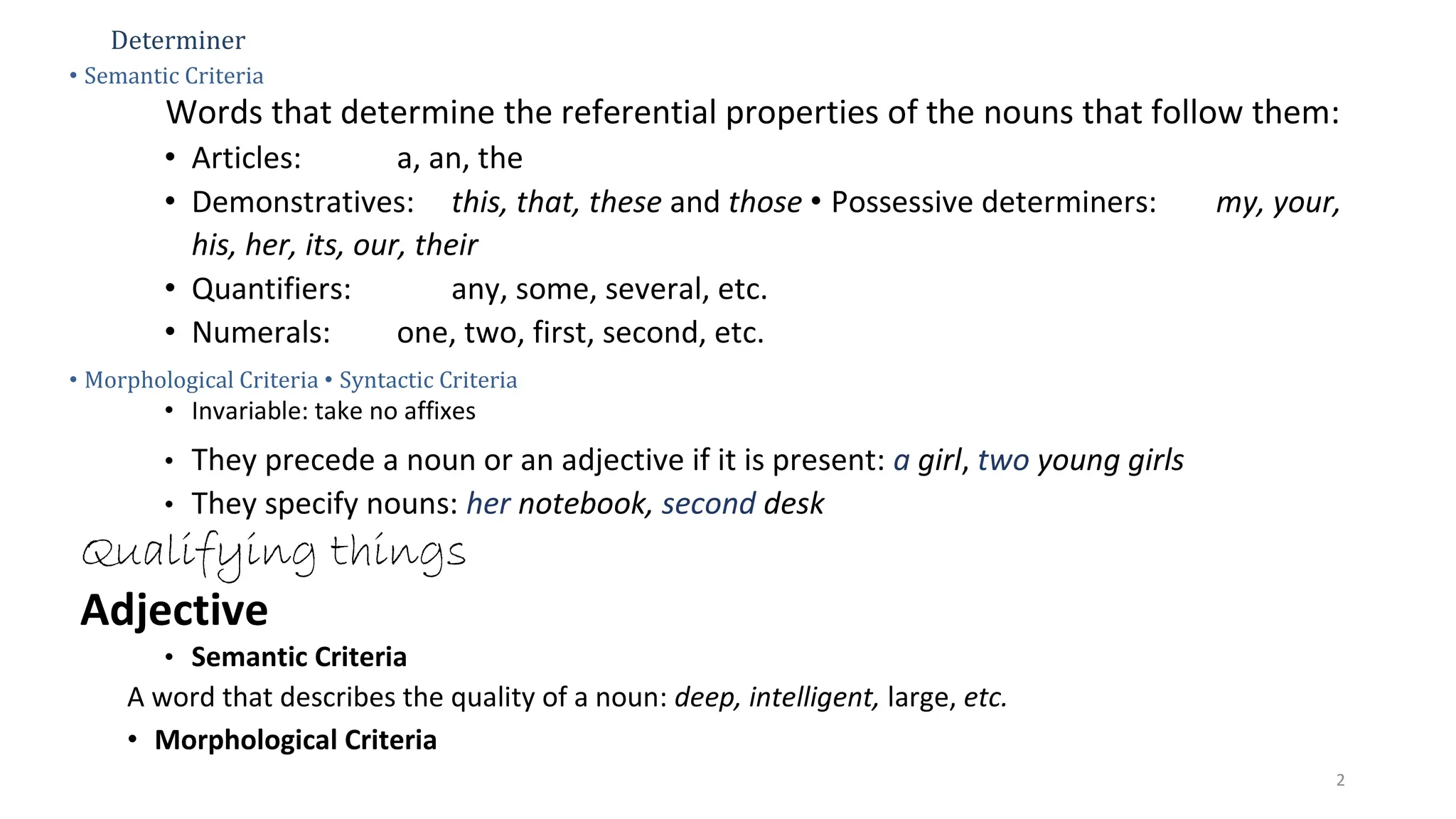
Determiner
• Semantic Criteria
Words that determine the referential properties of the nouns that follow them:
• Articles: a, an, the
• Demonstratives: this, that, these and those • Possessive determiners: my, your,
his, her, its, our, their
• Quantifiers: any, some, several, etc.
• Numerals: one, two, first, second, etc.
• Morphological Criteria • Syntactic Criteria
• Invariable: take no affixes
• They precede a noun or an adjective if it is present: a girl, two young girls
• They specify nouns: her notebook, second desk
Qualifying things
Adjective
• Semantic Criteria
A word that describes the quality of a noun: deep, intelligent, large, etc.
• Morphological Criteria
3
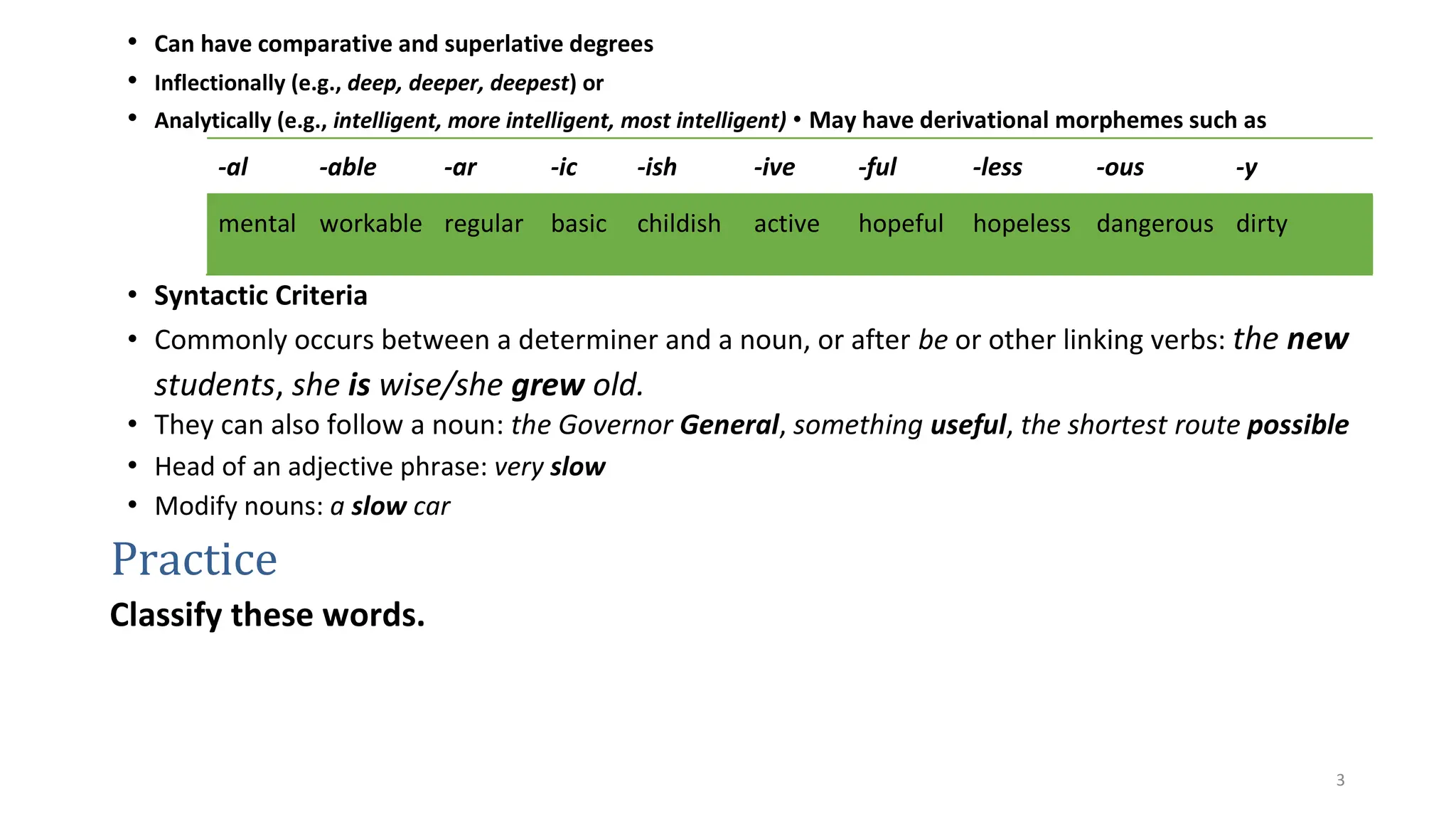
• Can have comparative and superlative degrees
• Inflectionally (e.g., deep, deeper, deepest) or
• Analytically (e.g., intelligent, more intelligent, most intelligent) • May have derivational morphemes such as
-al -able -ar -ic -ish -ive -ful -less -ous -y
mental workable regular basic childish active hopeful hopeless dangerous dirty
• Syntactic Criteria
• Commonly occurs between a determiner and a noun, or after be or other linking verbs: the new
students, she is wise/she grew old.
• They can also follow a noun: the Governor General, something useful, the shortest route possible
• Head of an adjective phrase: very slow
• Modify nouns: a slow car
Practice
Classify these words.
4
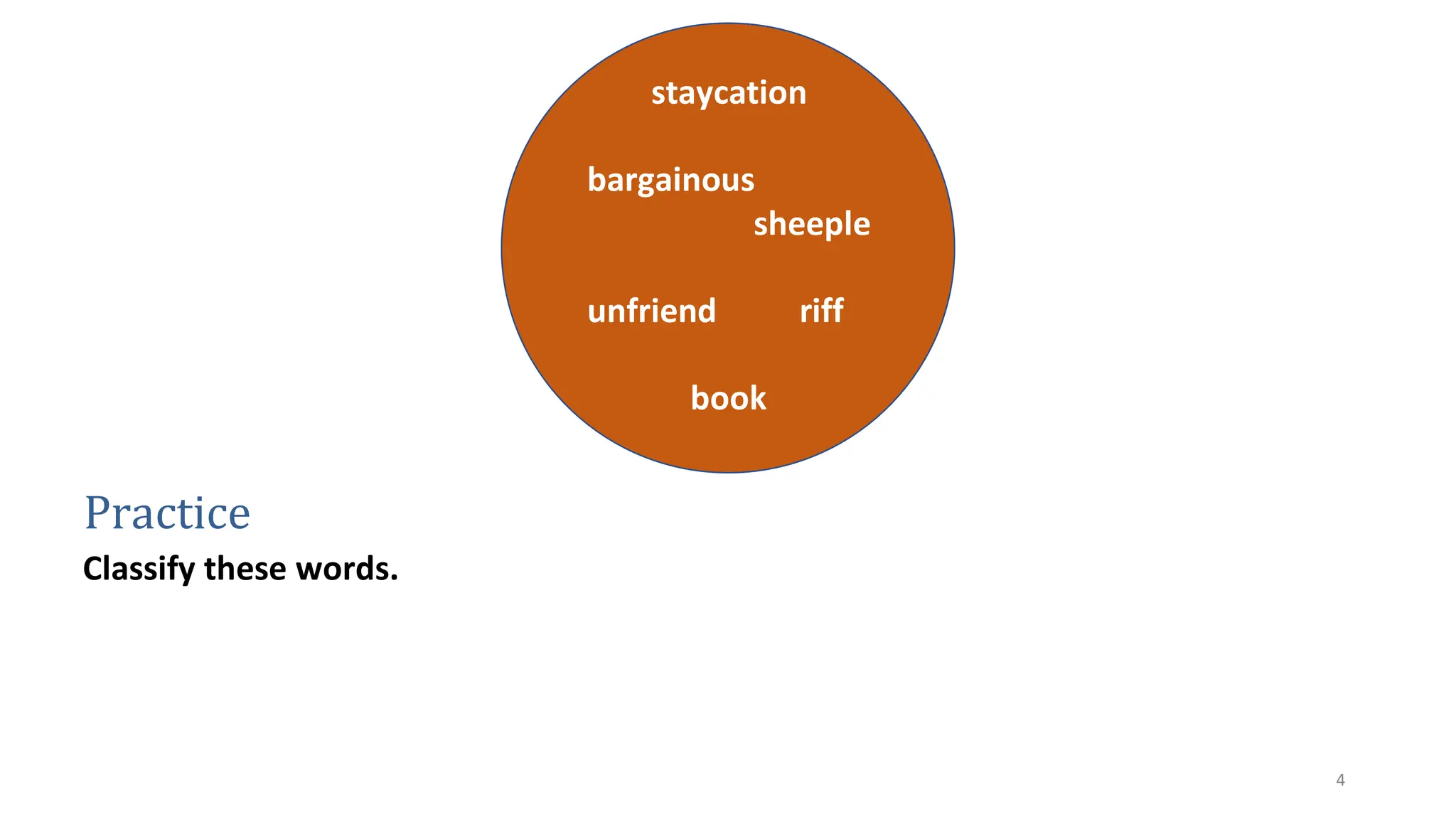
Practice
Classify these words.
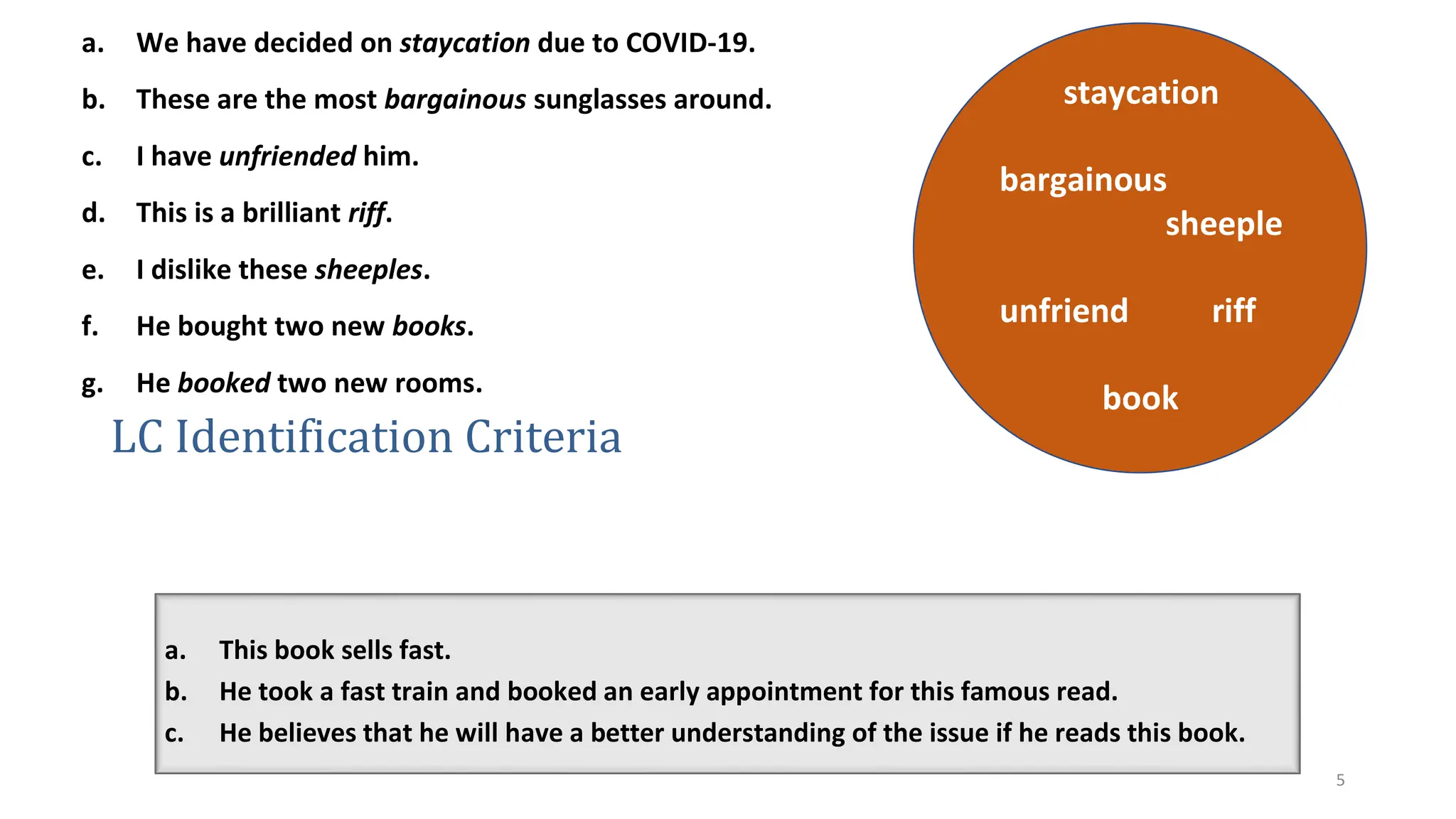
staycation
bargainous
sheeple
unfriend riff
book
5
a. We have decided on staycation due to COVID-19.
b. These are the most bargainous sunglasses around.
c. I have unfriended him.
d. This is a brilliant riff.
e. I dislike these sheeples.
f. He bought two new books.
g. He booked two new rooms.
LC Identification Criteria
a. This book sells fast.
b. He took a fast train and booked an early appointment for this famous read.
c. He believes that he will have a better understanding of the issue if he reads this book.
staycation
bargainous
sheeple
unfriend riff
book
6
Exercise#1
Identify nouns, determiners and adjectives in
the following text.
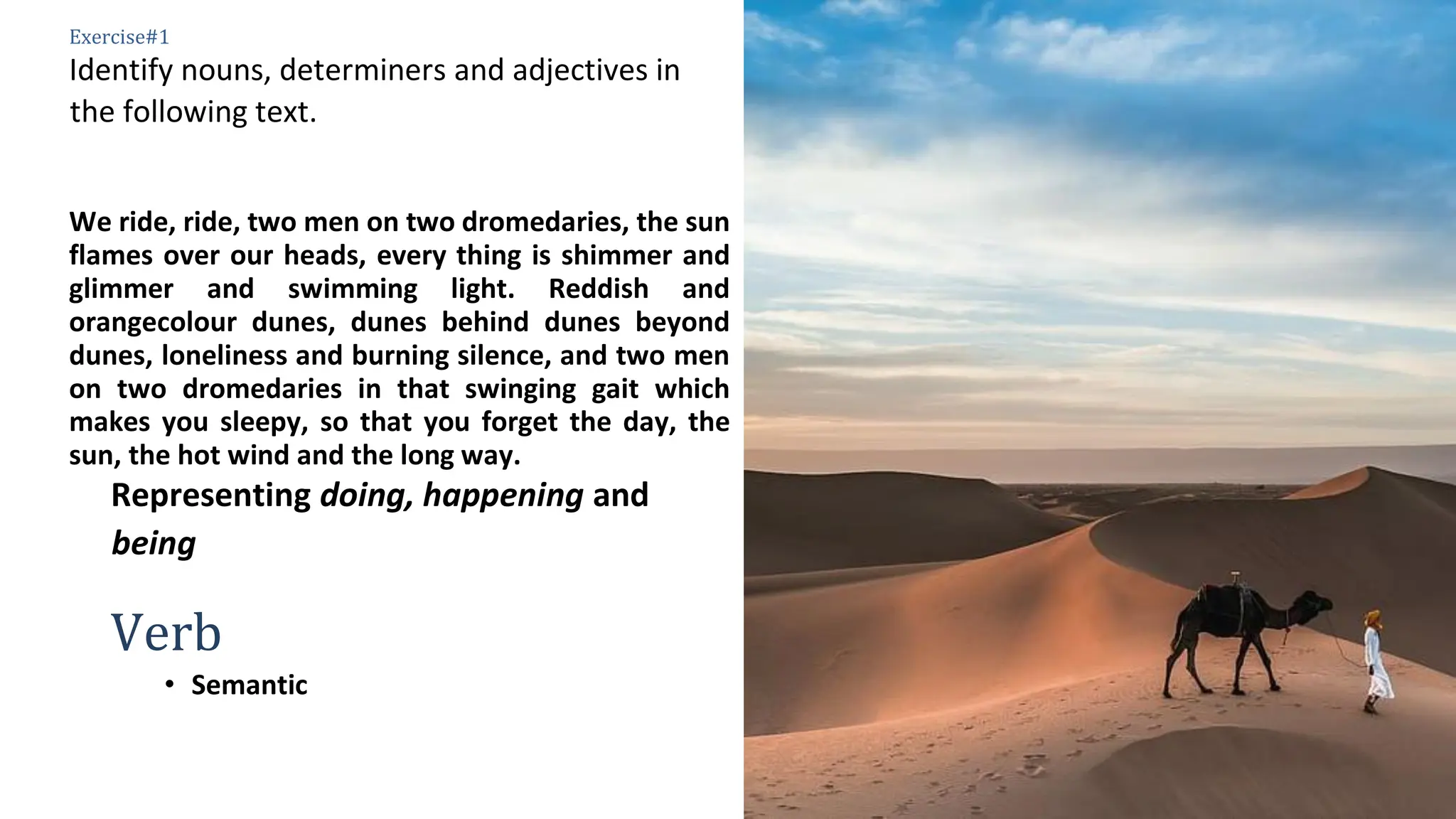
We ride, ride, two men on two dromedaries, the sun
flames over our heads, every thing is shimmer and
glimmer and swimming light. Reddish and
orangecolour dunes, dunes behind dunes beyond
dunes, loneliness and burning silence, and two men
on two dromedaries in that swinging gait which
makes you sleepy, so that you forget the day, the
sun, the hot wind and the long way.
Representing doing, happening and
being
Verb
• Semantic
7
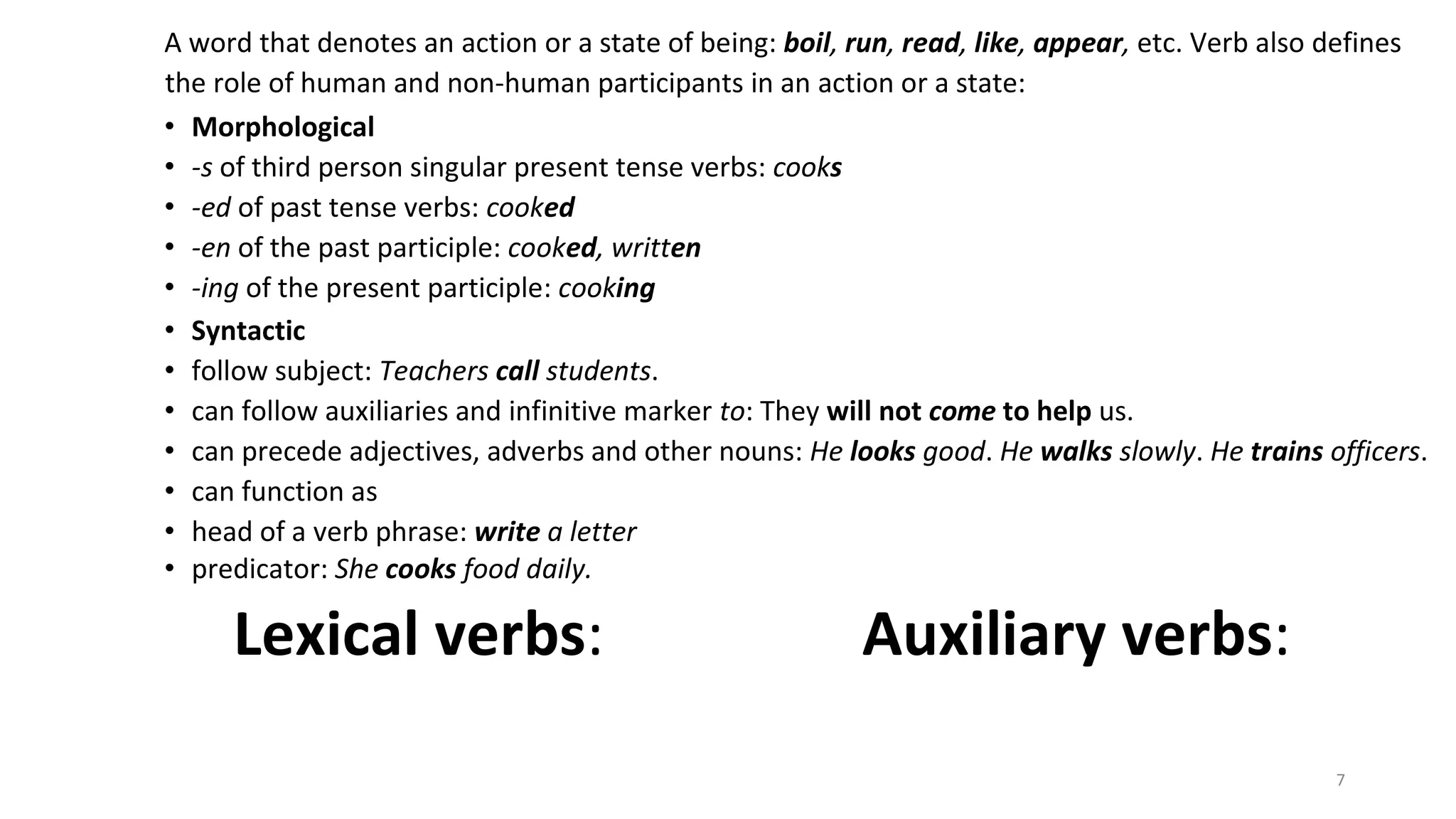
A word that denotes an action or a state of being: boil, run, read, like, appear, etc. Verb also defines
the role of human and non-human participants in an action or a state:
• Morphological
• -s of third person singular present tense verbs: cooks
• -ed of past tense verbs: cooked
• -en of the past participle: cooked, written
• -ing of the present participle: cooking
• Syntactic
• follow subject: Teachers call students.
• can follow auxiliaries and infinitive marker to: They will not come to help us.
• can precede adjectives, adverbs and other nouns: He looks good. He walks slowly. He trains officers.
• can function as
• head of a verb phrase: write a letter
• predicator: She cooks food daily.
Lexical verbs: Auxiliary verbs:
8
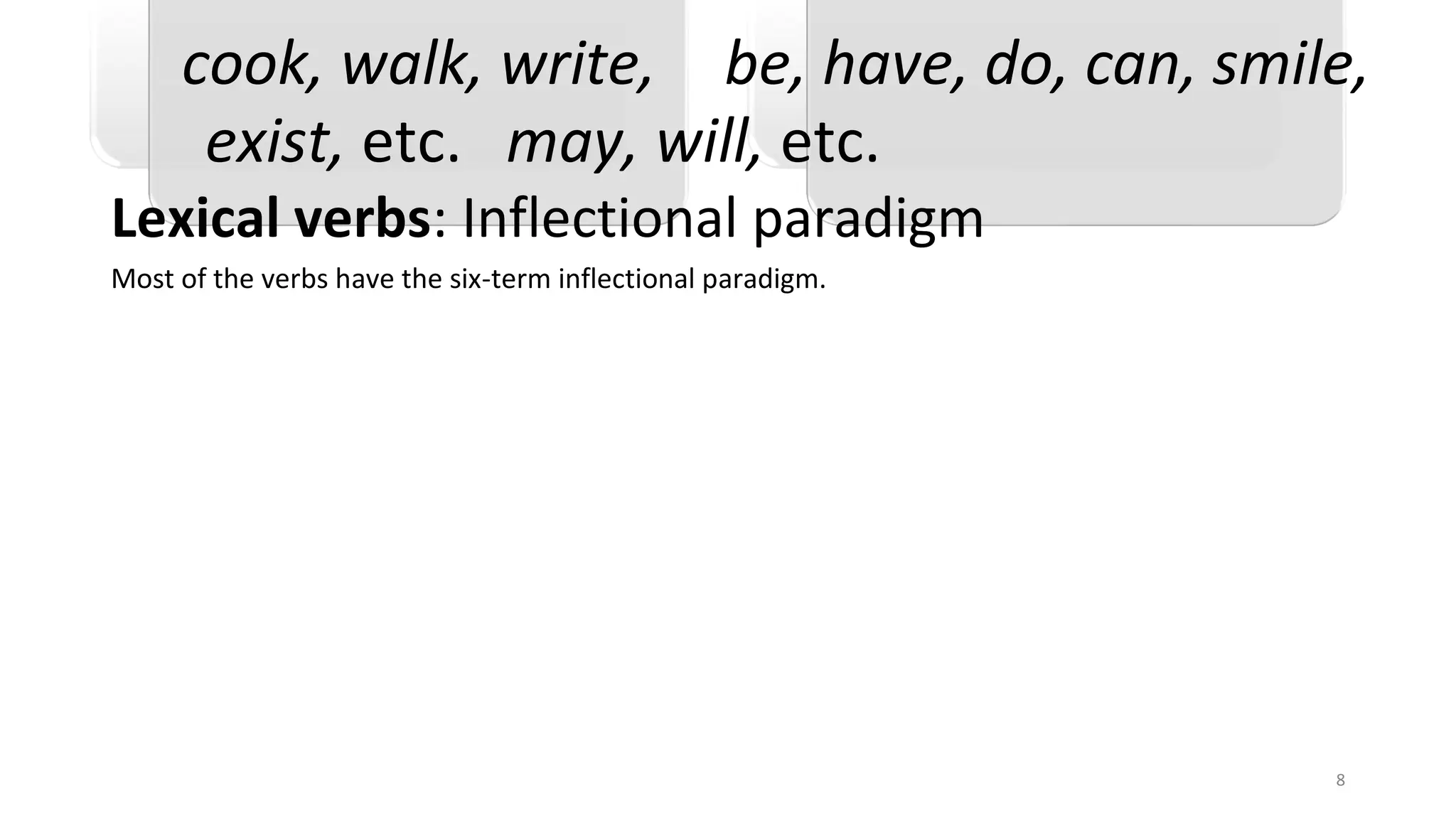
cook, walk, write, be, have, do, can, smile,
exist, etc. may, will, etc.
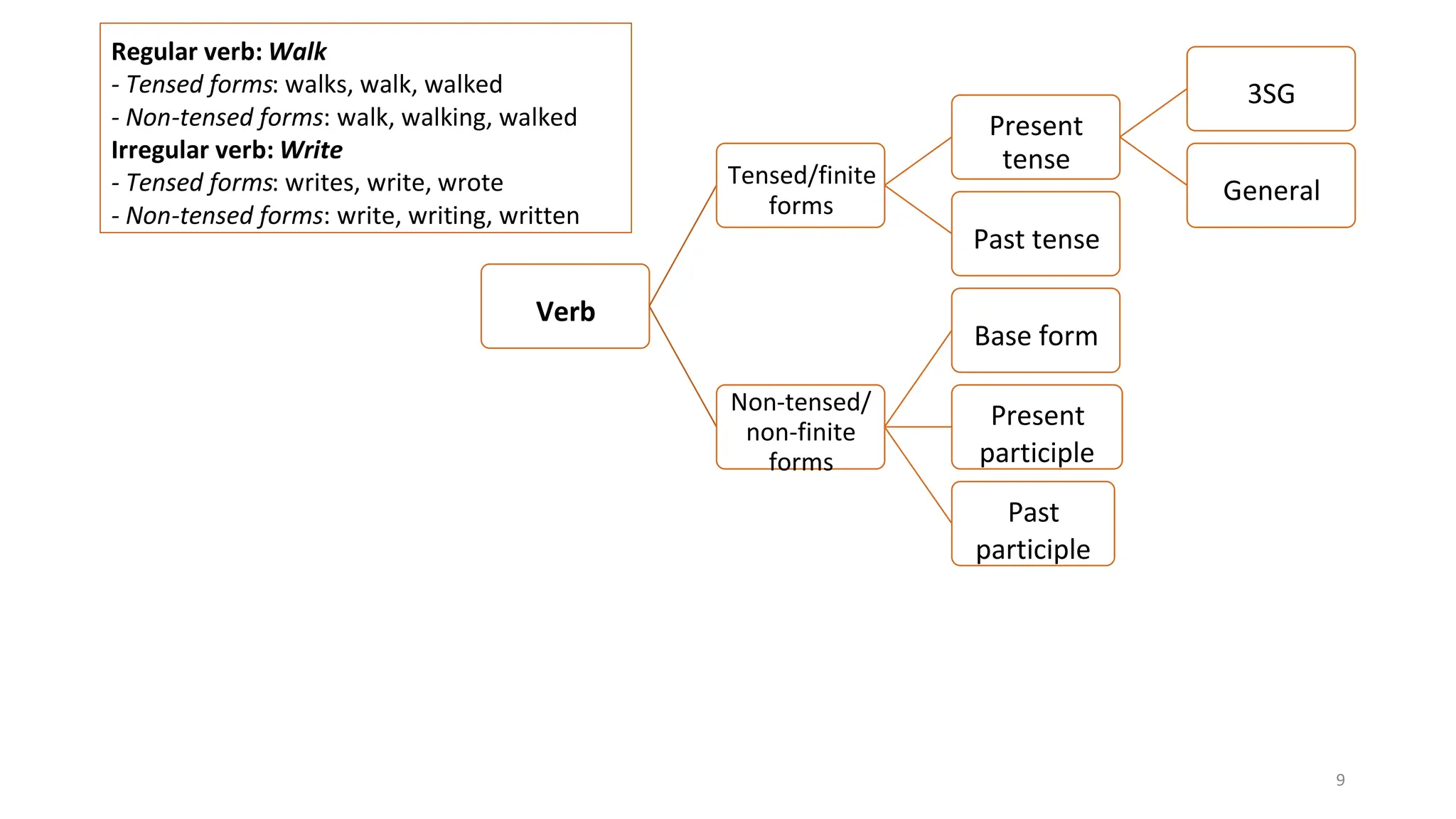
Lexical verbs: Inflectional paradigm
Most of the verbs have the six-term inflectional paradigm.
9
Verb
Tensed/finite
forms
Present
tense
SG
3
General
Past tense
Non-tensed/
non-finite
forms
Base form
Present
participle
Past
participle
Regular verb: Walk
- Tensed forms walks, walk, walked
:
- Non-tensed forms: walk, walking, walked
Irregular verb: Write
- Tensed forms writes, write, wrote
:
- Non-tensed forms write, writing, written
:
10
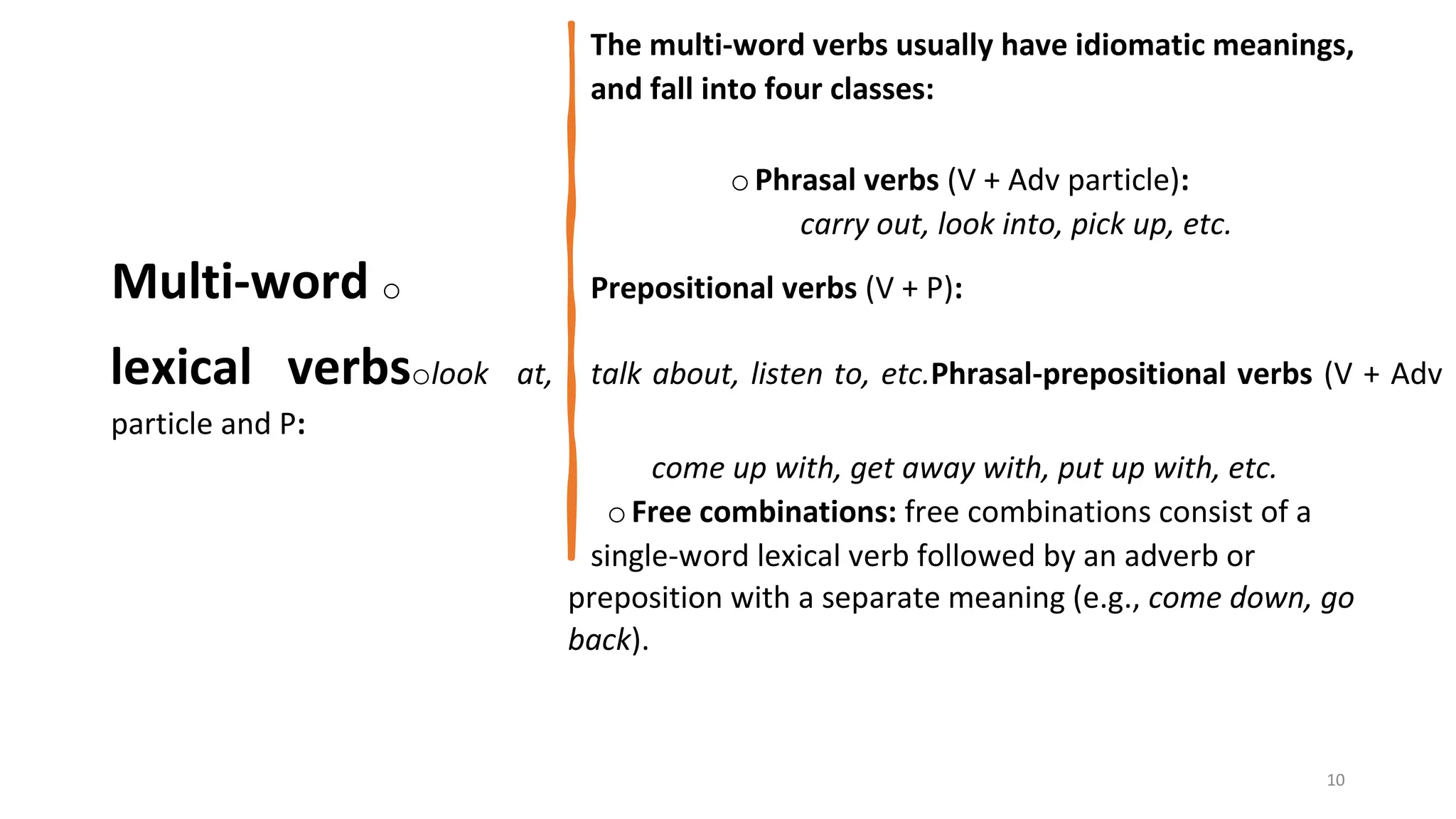
The multi-word verbs usually have idiomatic meanings,
and fall into four classes:
oPhrasal verbs (V + Adv particle):
carry out, look into, pick up, etc.
Multi-word o Prepositional verbs (V + P):
lexical verbsolook at, talk about, listen to, etc.Phrasal-prepositional verbs (V + Adv
particle and P:
come up with, get away with, put up with, etc.
oFree combinations: free combinations consist of a
single-word lexical verb followed by an adverb or
preposition with a separate meaning (e.g., come down, go
back).
11
Auxiliary verbs
Auxiliaries qualify the meaning of the lexical verb they precede.
a. Primary auxiliaries: be, have and do
i. have is used to form the perfect aspect (e.g., I've done
that).
ii. be is used for the progressive aspect (e.g., She was
reading) and the passive voice (e.g., It was disposed off).
iii. do is used in negative statements and in questions (e.g.,
Does this work? This doesn’t work).
b. Modal auxiliaries: can, could, may, might, will, would,
shall, should, and must.
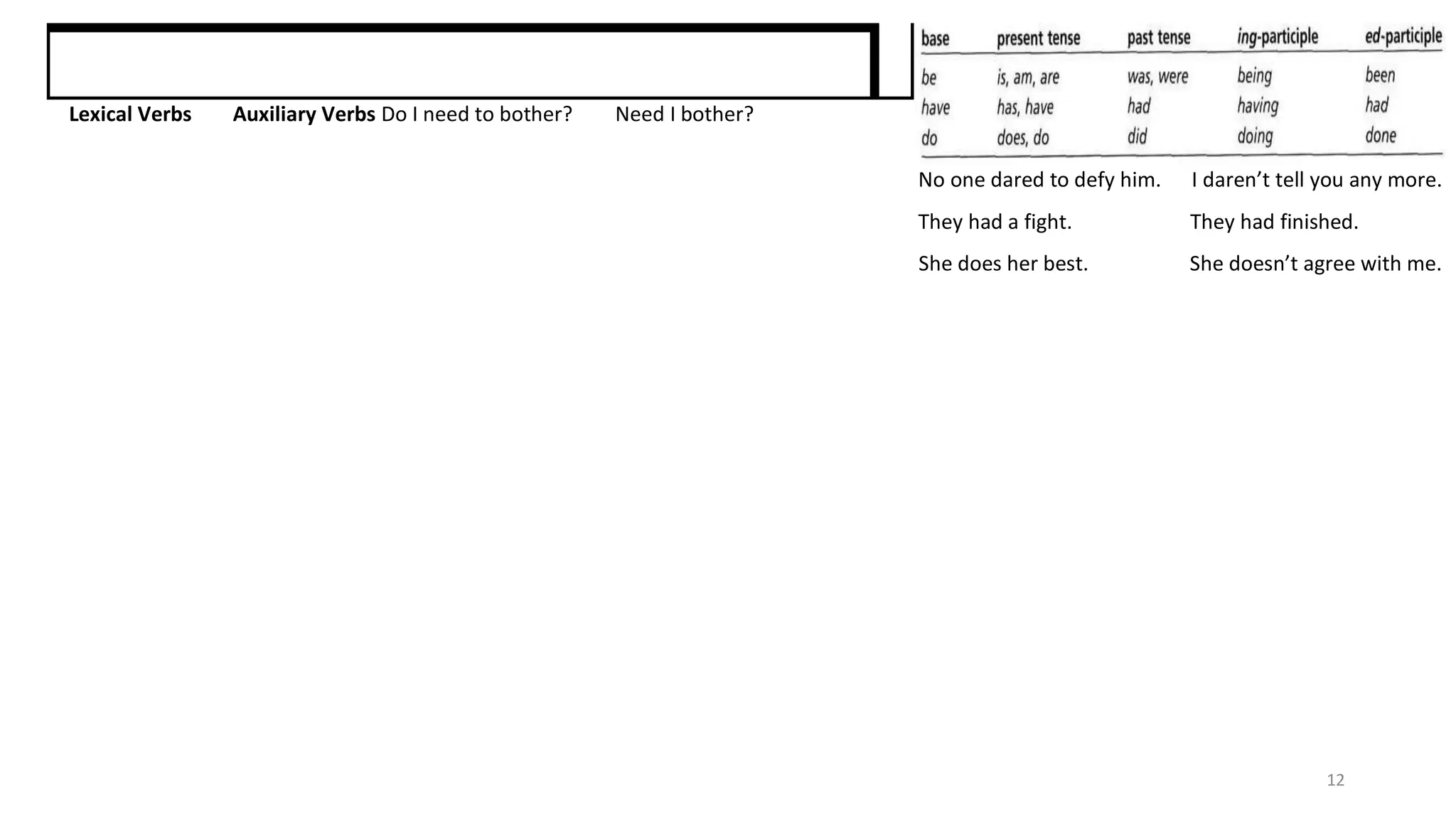
c. Semi-modal auxiliaries: need, dare, ought to, have to, (have) got
to, used to, had better, be going to, be
supposed to
i. Modals do not inflect for agreement or tense (e.g., *He cans go).
ii. They precede the negative particle in not negation (e.g., I cannot go).
iii. They precede the subject in yes-no questions (e.g., Can you go?). iv.
They take base form of the main verb (e.g., *He can goes or *He
can went).
12
Lexical Verbs Auxiliary Verbs Do I need to bother? Need I bother?
No one dared to defy him. I daren’t tell you any more.
They had a fight. They had finished.
She does her best. She doesn’t agree with me.
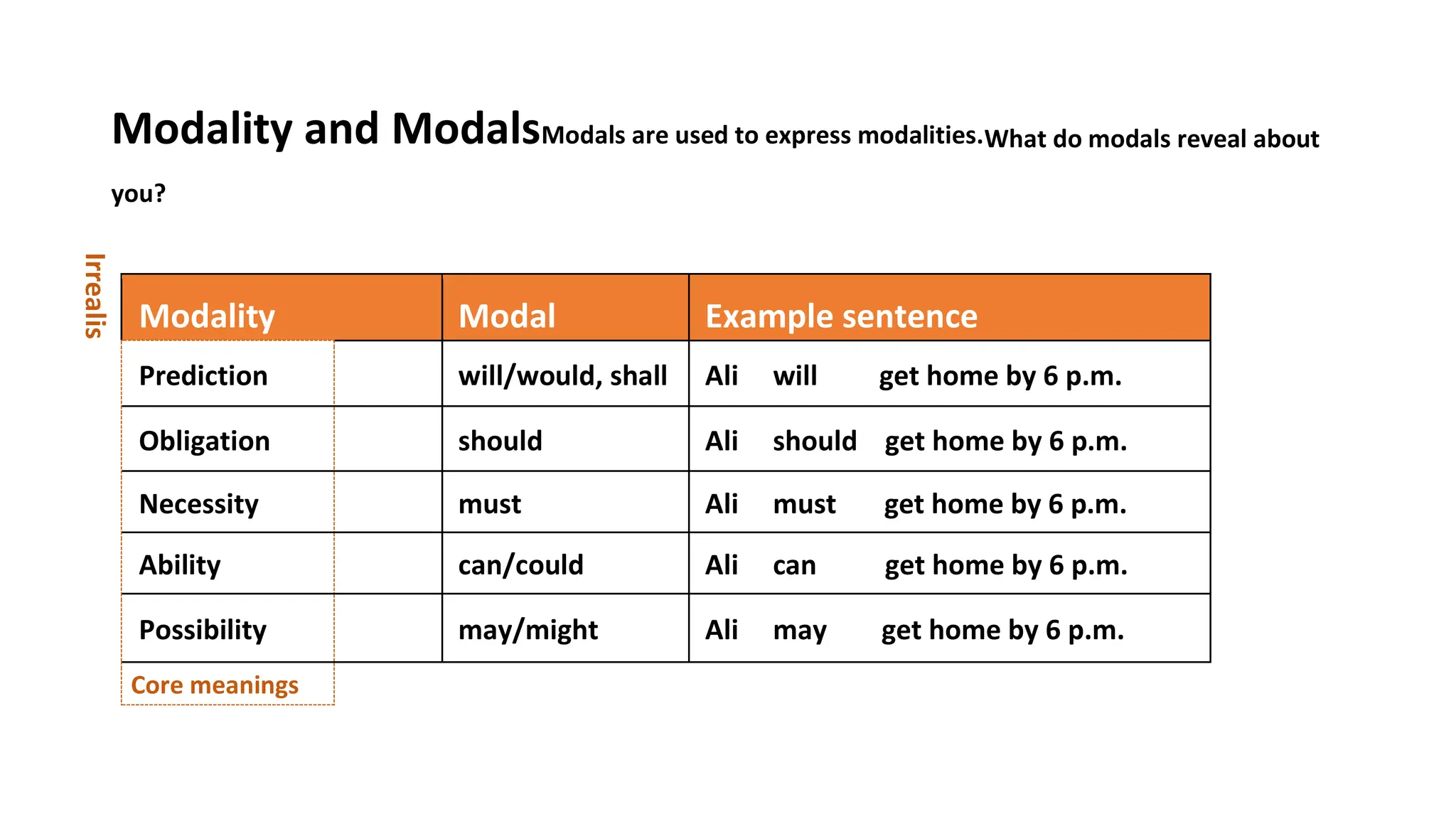
Modality and ModalsModals are used to express modalities.What do modals reveal about
you?
Modality Modal Example sentence
Prediction will/would, shall Ali will get home by 6 p.m.
Obligation should Ali should get home by 6 p.m.
Necessity must Ali must get home by 6 p.m.
Ability can/could Ali can get home by 6 p.m.
Possibility may/might Ali may get home by 6 p.m.
Core meanings
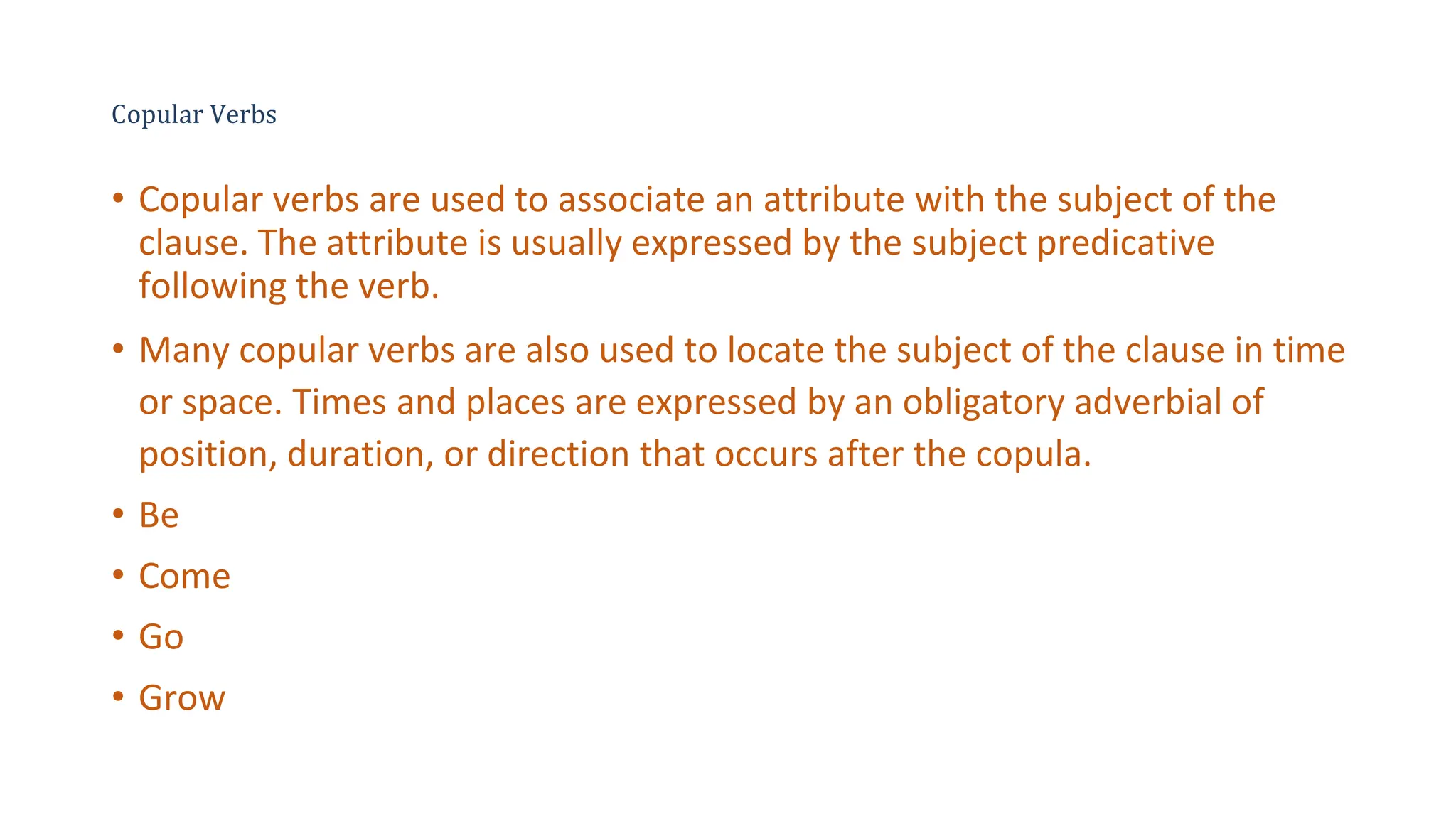
Copular Verbs
• Copular verbs are used to associate an attribute with the subject of the
clause. The attribute is usually expressed by the subject predicative
following the verb.
• Many copular verbs are also used to locate the subject of the clause in time
or space. Times and places are expressed by an obligatory adverbial of
position, duration, or direction that occurs after the copula.
• Be
• Come
• Go
• Grow
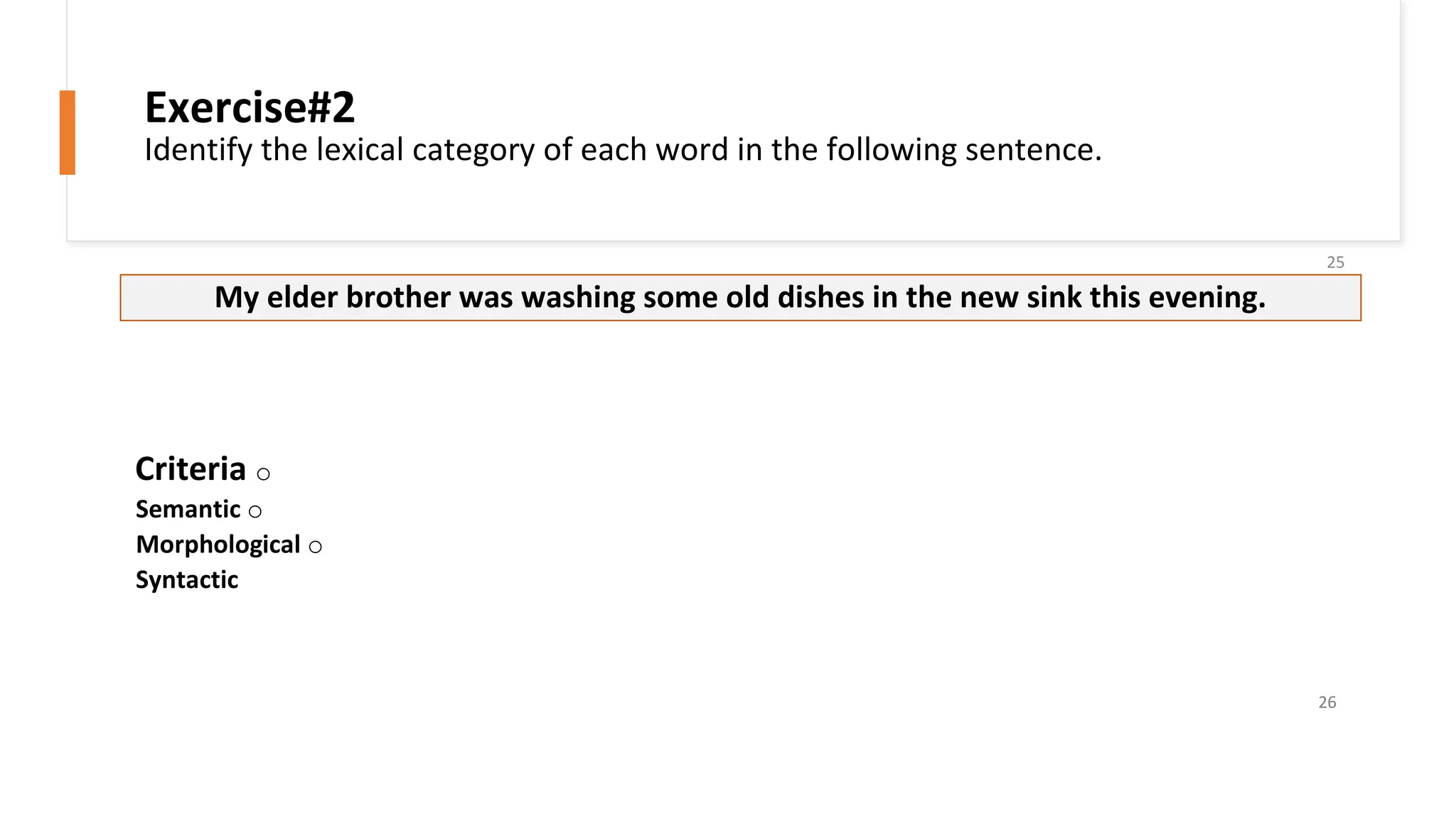
25
My elder brother was washing some old dishes in the new sink this evening.
Criteria o
Semantic o
Morphological o
Syntactic
26
Exercise#2
Identify the lexical category of each word in the following sentence.
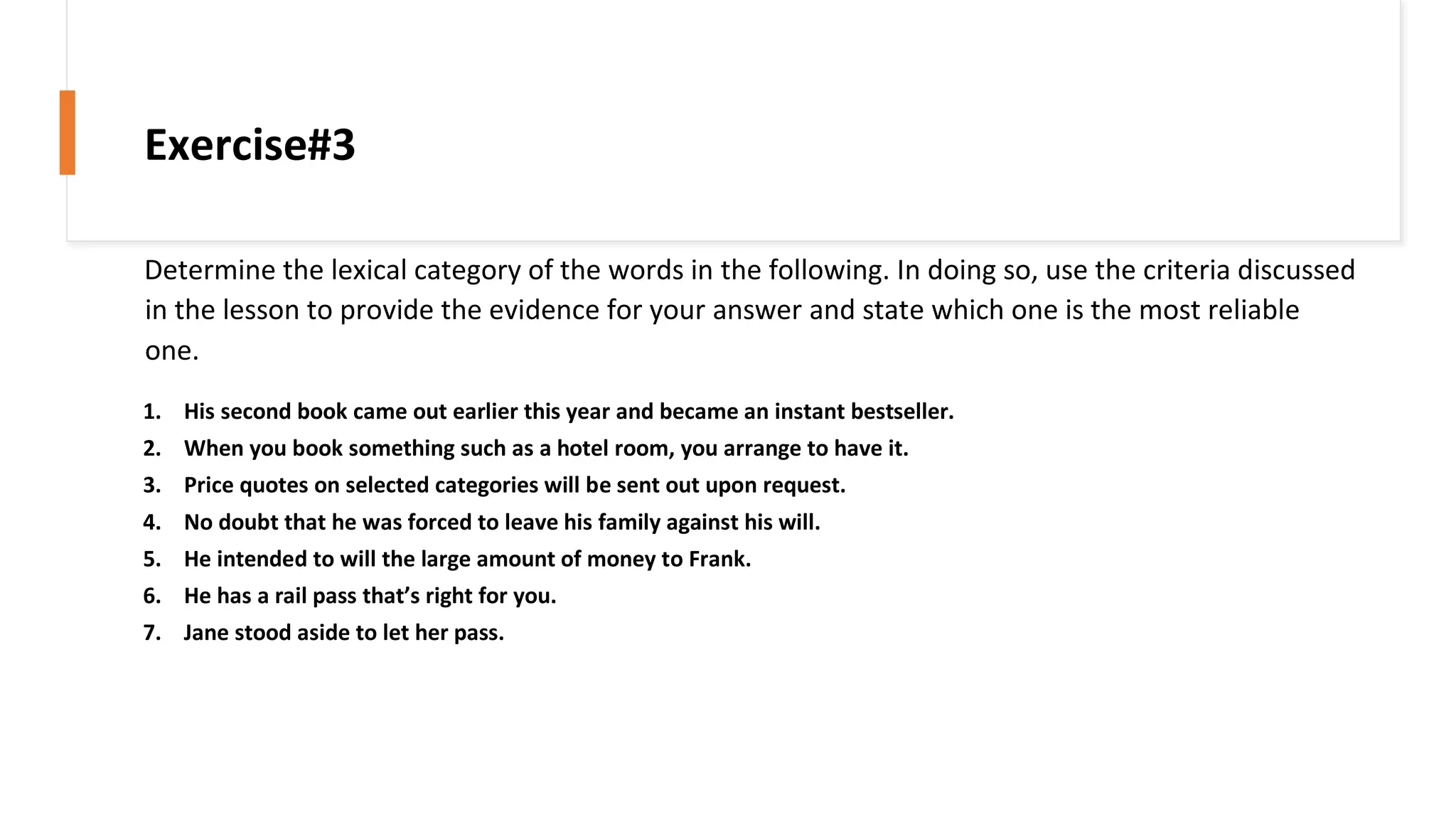
Determine the lexical category of the words in the following. In doing so, use the criteria discussed
in the lesson to provide the evidence for your answer and state which one is the most reliable
one.
1. His second book came out earlier this year and became an instant bestseller.
2. When you book something such as a hotel room, you arrange to have it.
3. Price quotes on selected categories will be sent out upon request.
4. No doubt that he was forced to leave his family against his will.
5. He intended to will the large amount of money to Frank.
6. He has a rail pass that’s right for you.
7. Jane stood aside to let her pass.
Exercise#3
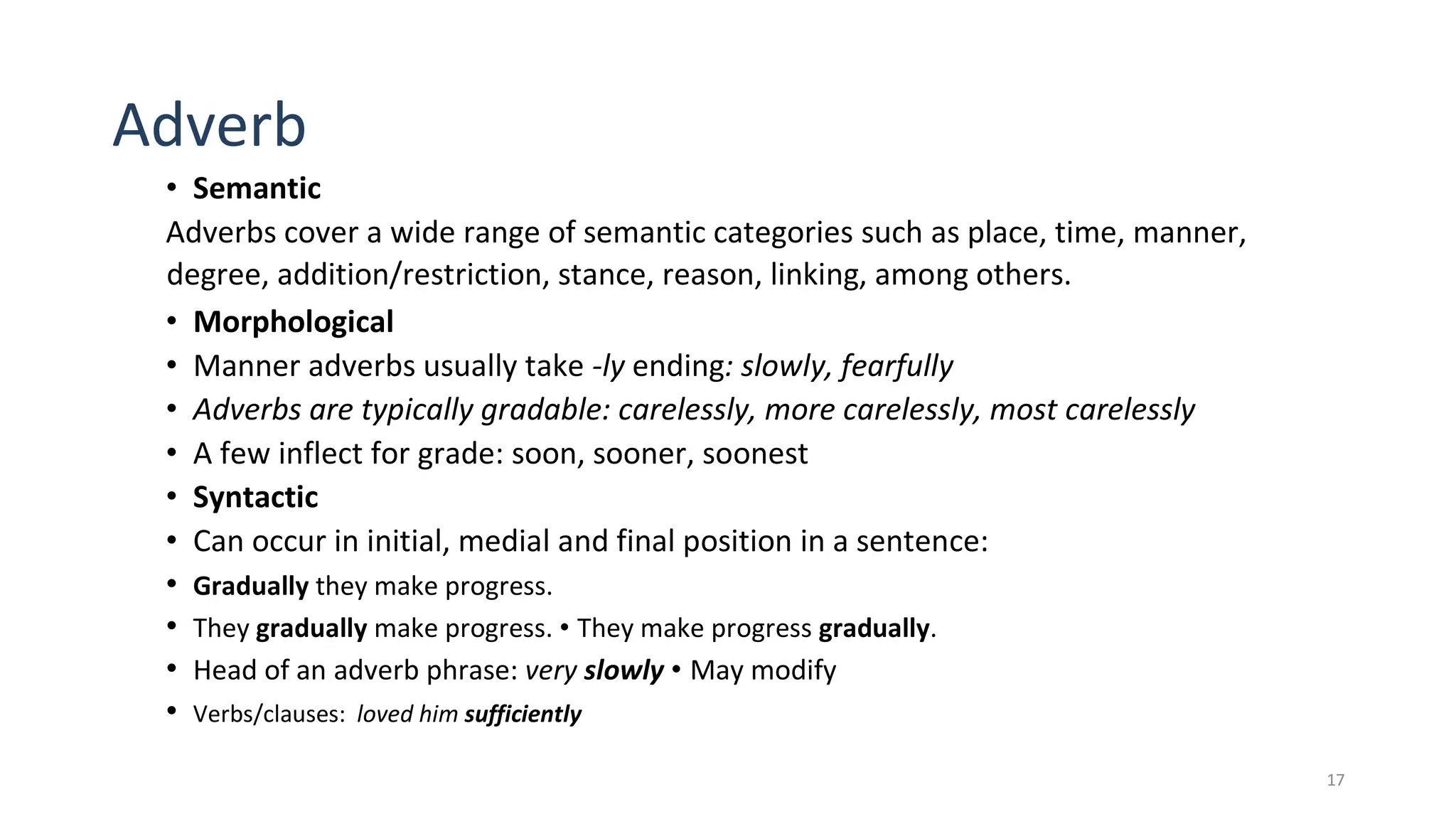
17
Adverb
• Semantic
Adverbs cover a wide range of semantic categories such as place, time, manner,
degree, addition/restriction, stance, reason, linking, among others.
• Morphological
• Manner adverbs usually take -ly ending: slowly, fearfully
• Adverbs are typically gradable: carelessly, more carelessly, most carelessly
• A few inflect for grade: soon, sooner, soonest
• Syntactic
• Can occur in initial, medial and final position in a sentence:
• Gradually they make progress.
• They gradually make progress. • They make progress gradually.
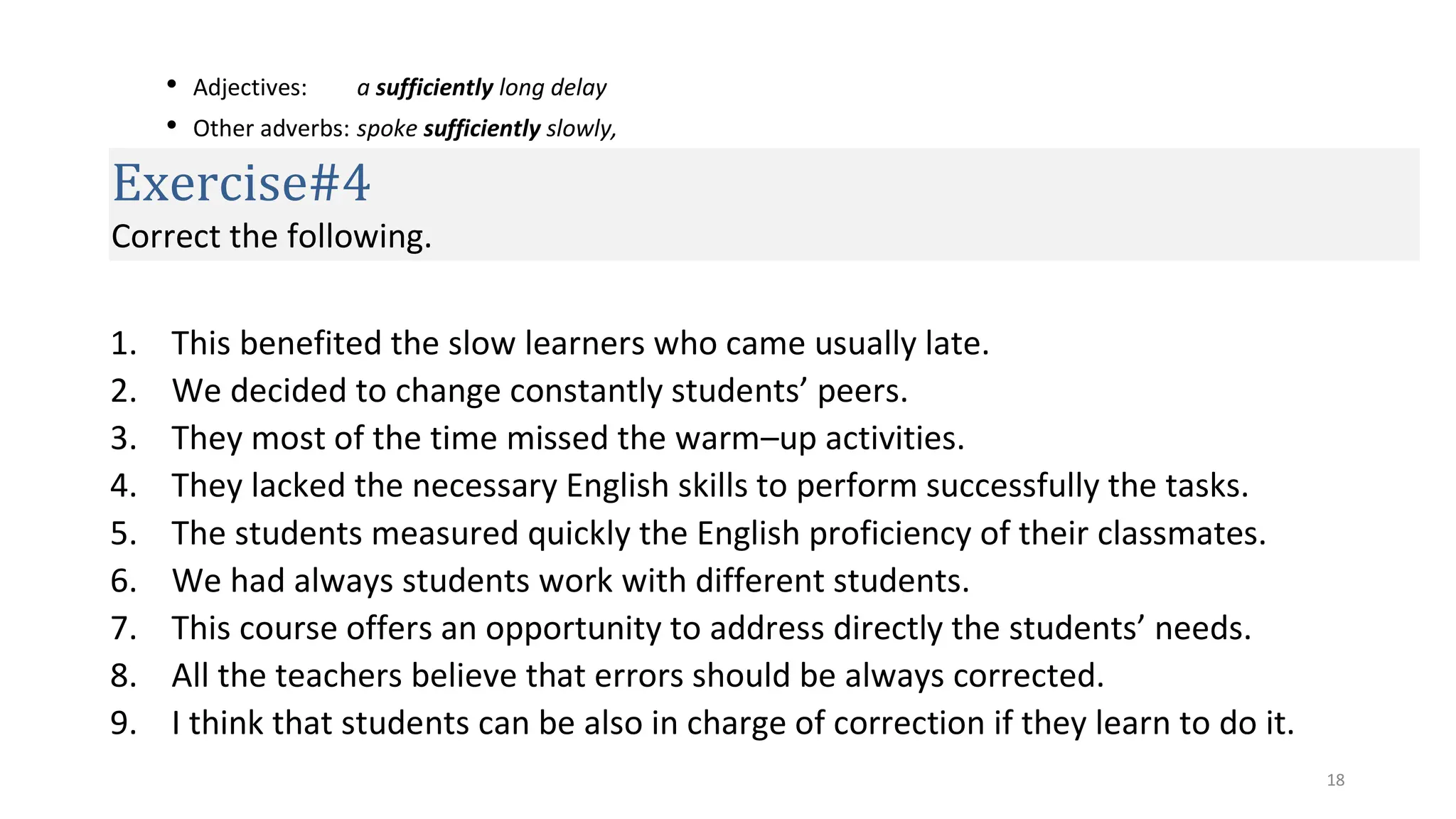
• Head of an adverb phrase: very slowly • May modify
• Verbs/clauses: loved him sufficiently
18
• Adjectives: a sufficiently long delay
• Other adverbs: spoke sufficiently slowly,
Exercise#4
Correct the following.
1. This benefited the slow learners who came usually late.
2. We decided to change constantly students’ peers.
3. They most of the time missed the warm–up activities.
4. They lacked the necessary English skills to perform successfully the tasks.
5. The students measured quickly the English proficiency of their classmates.
6. We had always students work with different students.
7. This course offers an opportunity to address directly the students’ needs.
8. All the teachers believe that errors should be always corrected.
9. I think that students can be also in charge of correction if they learn to do it.
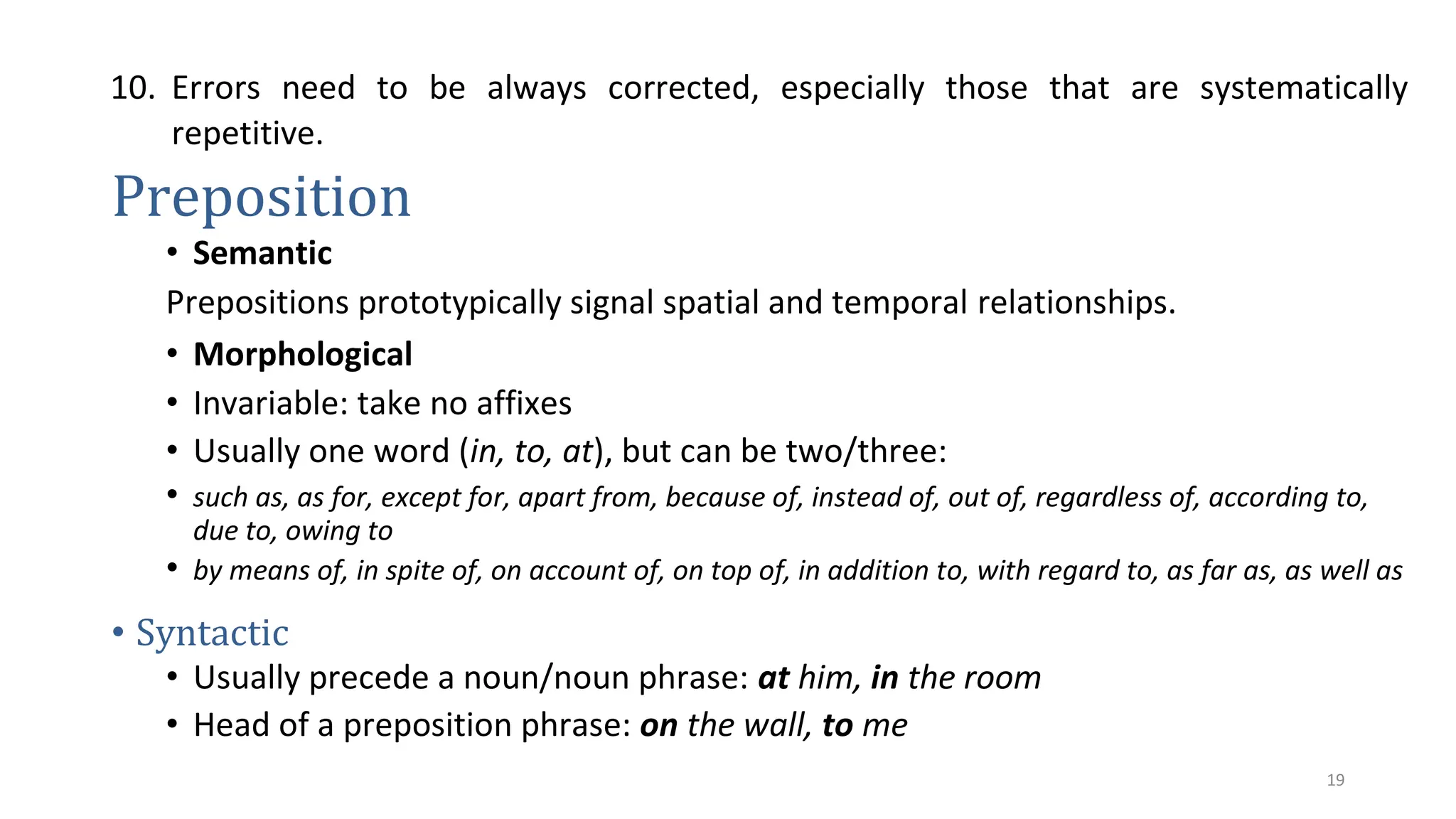
19
10. Errors need to be always corrected, especially those that are systematically
repetitive.
Preposition
• Semantic
Prepositions prototypically signal spatial and temporal relationships.
• Morphological
• Invariable: take no affixes
• Usually one word (in, to, at), but can be two/three:
• such as, as for, except for, apart from, because of, instead of, out of, regardless of, according to,
due to, owing to
• by means of, in spite of, on account of, on top of, in addition to, with regard to, as far as, as well as
• Syntactic
• Usually precede a noun/noun phrase: at him, in the room
• Head of a preposition phrase: on the wall, to me
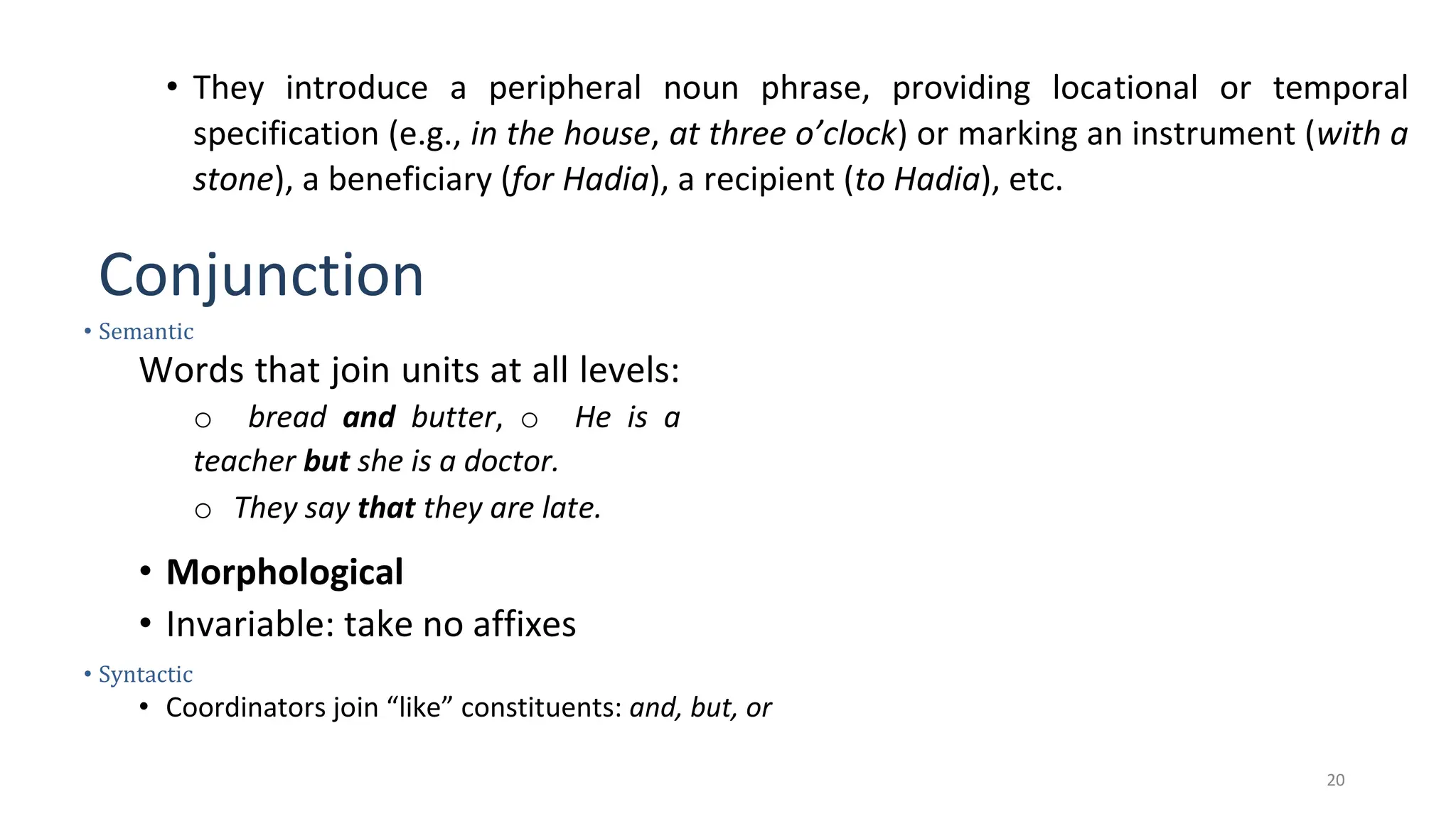
20
• They introduce a peripheral noun phrase, providing locational or temporal
specification (e.g., in the house, at three o’clock) or marking an instrument (with a
stone), a beneficiary (for Hadia), a recipient (to Hadia), etc.
Conjunction
• Semantic
Words that join units at all levels:
o bread and butter, o He is a
teacher but she is a doctor.
o They say that they are late.
• Morphological
• Invariable: take no affixes
• Syntactic
• Coordinators join “like” constituents: and, but, or
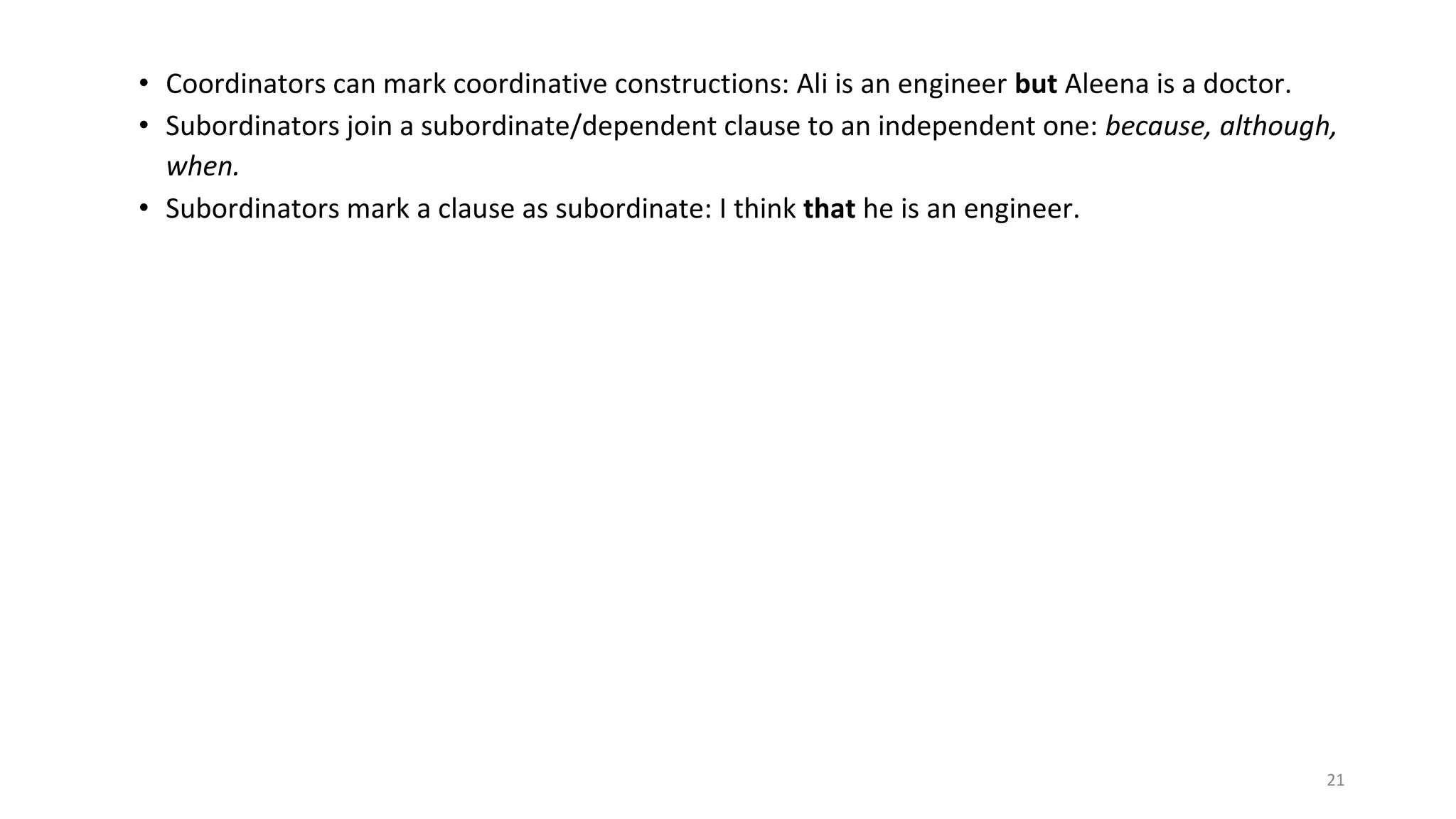
21
• Coordinators can mark coordinative constructions: Ali is an engineer but Aleena is a doctor.
• Subordinators join a subordinate/dependent clause to an independent one: because, although,
when.
• Subordinators mark a clause as subordinate: I think that he is an engineer.
Exercise#5 Your sentence?
• Write a sentence or short text that illustrates each of the following
concepts. o Noun o Verb
o Adjective
o Adverb
o Prepositi
on o
Determiner o
Conjunction

Functional English PDF.pdf

  • 1.
    1 Functional English Lexical Categories/Word Classes Noun O Semantic Criteria A word that denotes a person, place or thing: teacher, classroom, tree, etc. O Morphological Criteria o Inflection o Prototypically, nouns inflect for number (singular vs plural: actor vs actors) and case (plain vs genitive: actor vs actor’s) o Derivation o Nouns have derivational morphemes such as -ion, -ence, -hood,- ment,-ness, etc. O Syntactic Criteria o Nouns are often preceded by determiners and/or adjective: these students, these bright students o Nouns head noun phrases: that book o Nouns can be subject/object of verbs: Teachers attend meetings. Grounding and quantifying things
  • 2.
    2 Determiner • Semantic Criteria Wordsthat determine the referential properties of the nouns that follow them: • Articles: a, an, the • Demonstratives: this, that, these and those • Possessive determiners: my, your, his, her, its, our, their • Quantifiers: any, some, several, etc. • Numerals: one, two, first, second, etc. • Morphological Criteria • Syntactic Criteria • Invariable: take no affixes • They precede a noun or an adjective if it is present: a girl, two young girls • They specify nouns: her notebook, second desk Qualifying things Adjective • Semantic Criteria A word that describes the quality of a noun: deep, intelligent, large, etc. • Morphological Criteria
  • 3.
    3 • Can havecomparative and superlative degrees • Inflectionally (e.g., deep, deeper, deepest) or • Analytically (e.g., intelligent, more intelligent, most intelligent) • May have derivational morphemes such as -al -able -ar -ic -ish -ive -ful -less -ous -y mental workable regular basic childish active hopeful hopeless dangerous dirty • Syntactic Criteria • Commonly occurs between a determiner and a noun, or after be or other linking verbs: the new students, she is wise/she grew old. • They can also follow a noun: the Governor General, something useful, the shortest route possible • Head of an adjective phrase: very slow • Modify nouns: a slow car Practice Classify these words.
  • 4.
  • 5.
    5 a. We havedecided on staycation due to COVID-19. b. These are the most bargainous sunglasses around. c. I have unfriended him. d. This is a brilliant riff. e. I dislike these sheeples. f. He bought two new books. g. He booked two new rooms. LC Identification Criteria a. This book sells fast. b. He took a fast train and booked an early appointment for this famous read. c. He believes that he will have a better understanding of the issue if he reads this book. staycation bargainous sheeple unfriend riff book
  • 6.
    6 Exercise#1 Identify nouns, determinersand adjectives in the following text. We ride, ride, two men on two dromedaries, the sun flames over our heads, every thing is shimmer and glimmer and swimming light. Reddish and orangecolour dunes, dunes behind dunes beyond dunes, loneliness and burning silence, and two men on two dromedaries in that swinging gait which makes you sleepy, so that you forget the day, the sun, the hot wind and the long way. Representing doing, happening and being Verb • Semantic
  • 7.
    7 A word thatdenotes an action or a state of being: boil, run, read, like, appear, etc. Verb also defines the role of human and non-human participants in an action or a state: • Morphological • -s of third person singular present tense verbs: cooks • -ed of past tense verbs: cooked • -en of the past participle: cooked, written • -ing of the present participle: cooking • Syntactic • follow subject: Teachers call students. • can follow auxiliaries and infinitive marker to: They will not come to help us. • can precede adjectives, adverbs and other nouns: He looks good. He walks slowly. He trains officers. • can function as • head of a verb phrase: write a letter • predicator: She cooks food daily. Lexical verbs: Auxiliary verbs:
  • 8.
    8 cook, walk, write,be, have, do, can, smile, exist, etc. may, will, etc. Lexical verbs: Inflectional paradigm Most of the verbs have the six-term inflectional paradigm.
  • 9.
    9 Verb Tensed/finite forms Present tense SG 3 General Past tense Non-tensed/ non-finite forms Base form Present participle Past participle Regularverb: Walk - Tensed forms walks, walk, walked : - Non-tensed forms: walk, walking, walked Irregular verb: Write - Tensed forms writes, write, wrote : - Non-tensed forms write, writing, written :
  • 10.
    10 The multi-word verbsusually have idiomatic meanings, and fall into four classes: oPhrasal verbs (V + Adv particle): carry out, look into, pick up, etc. Multi-word o Prepositional verbs (V + P): lexical verbsolook at, talk about, listen to, etc.Phrasal-prepositional verbs (V + Adv particle and P: come up with, get away with, put up with, etc. oFree combinations: free combinations consist of a single-word lexical verb followed by an adverb or preposition with a separate meaning (e.g., come down, go back).
  • 11.
    11 Auxiliary verbs Auxiliaries qualifythe meaning of the lexical verb they precede. a. Primary auxiliaries: be, have and do i. have is used to form the perfect aspect (e.g., I've done that). ii. be is used for the progressive aspect (e.g., She was reading) and the passive voice (e.g., It was disposed off). iii. do is used in negative statements and in questions (e.g., Does this work? This doesn’t work). b. Modal auxiliaries: can, could, may, might, will, would, shall, should, and must. c. Semi-modal auxiliaries: need, dare, ought to, have to, (have) got to, used to, had better, be going to, be supposed to i. Modals do not inflect for agreement or tense (e.g., *He cans go). ii. They precede the negative particle in not negation (e.g., I cannot go). iii. They precede the subject in yes-no questions (e.g., Can you go?). iv. They take base form of the main verb (e.g., *He can goes or *He can went).
  • 12.
    12 Lexical Verbs AuxiliaryVerbs Do I need to bother? Need I bother? No one dared to defy him. I daren’t tell you any more. They had a fight. They had finished. She does her best. She doesn’t agree with me.
  • 13.
    Modality and ModalsModalsare used to express modalities.What do modals reveal about you? Modality Modal Example sentence Prediction will/would, shall Ali will get home by 6 p.m. Obligation should Ali should get home by 6 p.m. Necessity must Ali must get home by 6 p.m. Ability can/could Ali can get home by 6 p.m. Possibility may/might Ali may get home by 6 p.m. Core meanings
  • 14.
    Copular Verbs • Copularverbs are used to associate an attribute with the subject of the clause. The attribute is usually expressed by the subject predicative following the verb. • Many copular verbs are also used to locate the subject of the clause in time or space. Times and places are expressed by an obligatory adverbial of position, duration, or direction that occurs after the copula. • Be • Come • Go • Grow
  • 15.
    25 My elder brotherwas washing some old dishes in the new sink this evening. Criteria o Semantic o Morphological o Syntactic 26 Exercise#2 Identify the lexical category of each word in the following sentence.
  • 16.
    Determine the lexicalcategory of the words in the following. In doing so, use the criteria discussed in the lesson to provide the evidence for your answer and state which one is the most reliable one. 1. His second book came out earlier this year and became an instant bestseller. 2. When you book something such as a hotel room, you arrange to have it. 3. Price quotes on selected categories will be sent out upon request. 4. No doubt that he was forced to leave his family against his will. 5. He intended to will the large amount of money to Frank. 6. He has a rail pass that’s right for you. 7. Jane stood aside to let her pass. Exercise#3
  • 17.
    17 Adverb • Semantic Adverbs covera wide range of semantic categories such as place, time, manner, degree, addition/restriction, stance, reason, linking, among others. • Morphological • Manner adverbs usually take -ly ending: slowly, fearfully • Adverbs are typically gradable: carelessly, more carelessly, most carelessly • A few inflect for grade: soon, sooner, soonest • Syntactic • Can occur in initial, medial and final position in a sentence: • Gradually they make progress. • They gradually make progress. • They make progress gradually. • Head of an adverb phrase: very slowly • May modify • Verbs/clauses: loved him sufficiently
  • 18.
    18 • Adjectives: asufficiently long delay • Other adverbs: spoke sufficiently slowly, Exercise#4 Correct the following. 1. This benefited the slow learners who came usually late. 2. We decided to change constantly students’ peers. 3. They most of the time missed the warm–up activities. 4. They lacked the necessary English skills to perform successfully the tasks. 5. The students measured quickly the English proficiency of their classmates. 6. We had always students work with different students. 7. This course offers an opportunity to address directly the students’ needs. 8. All the teachers believe that errors should be always corrected. 9. I think that students can be also in charge of correction if they learn to do it.
  • 19.
    19 10. Errors needto be always corrected, especially those that are systematically repetitive. Preposition • Semantic Prepositions prototypically signal spatial and temporal relationships. • Morphological • Invariable: take no affixes • Usually one word (in, to, at), but can be two/three: • such as, as for, except for, apart from, because of, instead of, out of, regardless of, according to, due to, owing to • by means of, in spite of, on account of, on top of, in addition to, with regard to, as far as, as well as • Syntactic • Usually precede a noun/noun phrase: at him, in the room • Head of a preposition phrase: on the wall, to me
  • 20.
    20 • They introducea peripheral noun phrase, providing locational or temporal specification (e.g., in the house, at three o’clock) or marking an instrument (with a stone), a beneficiary (for Hadia), a recipient (to Hadia), etc. Conjunction • Semantic Words that join units at all levels: o bread and butter, o He is a teacher but she is a doctor. o They say that they are late. • Morphological • Invariable: take no affixes • Syntactic • Coordinators join “like” constituents: and, but, or
  • 21.
    21 • Coordinators canmark coordinative constructions: Ali is an engineer but Aleena is a doctor. • Subordinators join a subordinate/dependent clause to an independent one: because, although, when. • Subordinators mark a clause as subordinate: I think that he is an engineer.
  • 22.
    Exercise#5 Your sentence? •Write a sentence or short text that illustrates each of the following concepts. o Noun o Verb o Adjective o Adverb o Prepositi on o Determiner o Conjunction