GIST
Dr. Elsie L. Dajao
Dr. Elsie L. Dajao
A common phenomenon and may
occur in the apparent absence of any
external force.
Modifies deeply the physiognomy
of a particular language.
Dr. Elsie L. Dajao
At the level of syntax, the amount of
change that languages undergo over a
given stretch of time varies
tremendously, both from language to
language and within the history of
single language.
Dr. Elsie L. Dajao
One generative proposal that makes
room for syntactic change is that of
Andersen.
Hans Christian Andersen
• A novelist, short story writer and fairy
tale writer.
Dr. Elsie L. Dajao
• He suggested that “Child language
learners faced with the
linguistic data of their
environment, may hypothesize
a grammar different from that
of speakers from whom their
input comes.”
Dr. Elsie L. Dajao
WORD ORDER
 SVO (Subject- Verb- Direct Object)
VSO (Verb- Subject- Direct Object)
SOV (Subject- Direct Object- Verb)
Dr. Elsie L. Dajao
Since Old English had an extensive
system of case marking, it is not
surprising that its word order was
somewhat more variable than that of
Modern English. Old English placed
the
Verb in second position.
Dr. Elsie L. Dajao
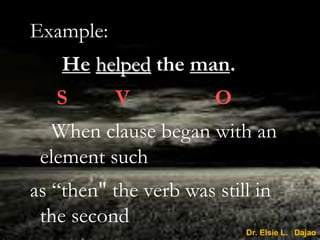
Example:
He helped the man.
S V O
When clause began with an
element such
as “then" the verb was still in
the second
Dr. Elsie L. Dajao
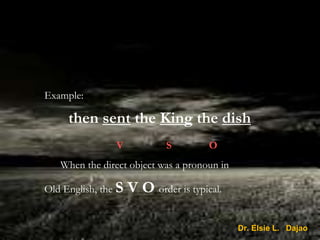
Example:
then sent the King the dish
V S O
When the direct object was a pronoun in
Old English, the S V O order is typical.
Dr. Elsie L. Dajao
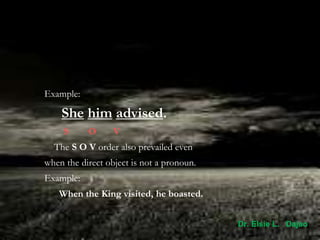
Example:
She him advised.
S O V
The S O V order also prevailed even
when the direct object is not a pronoun.
Example:
When the King visited, he boasted.
Dr. Elsie L. Dajao
S-V-O order became the
means of grammatical
relations.
Dr. Elsie L. Dajao
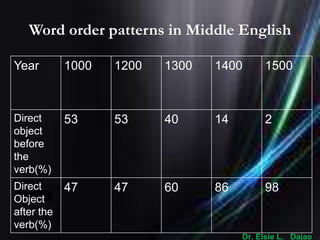
Word order patterns in Middle English
Year 1000 1200 1300 1400 1500
Direct
object
before
the
verb(%)
53 53 40 14 2
Direct
Object
after the
verb(%)
47 47 60 86 98
Dr. Elsie L. Dajao
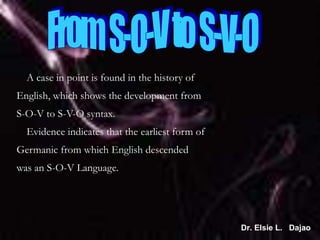
A case in point is found in the history of
English, which shows the development from
S-O-V to S-V-O syntax.
Evidence indicates that the earliest form of
Germanic from which English descended
was an S-O-V Language.
Dr. Elsie L. Dajao
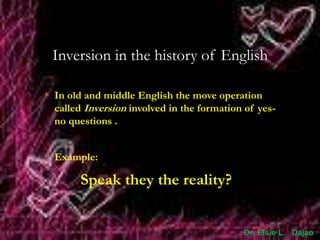
Inversion in the history of English
• In old and middle English the move operation
called Inversion involved in the formation of yes-
no questions .
• Example:
Speak they the reality?
Dr. Elsie L. Dajao
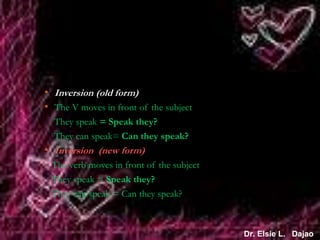
• Inversion (old form)
• The V moves in front of the subject
They speak = Speak they?
They can speak= Can they speak?
• Inversion (new form)
The verb moves in front of the subject
They speak = Speak they?
They can speak = Can they speak?
Dr. Elsie L. Dajao
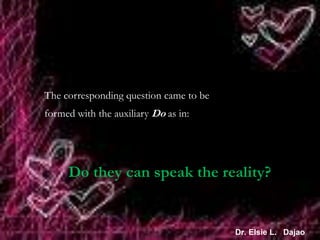
The corresponding question came to be
formed with the auxiliary Do as in:
Do they can speak the reality?
Dr. Elsie L. Dajao
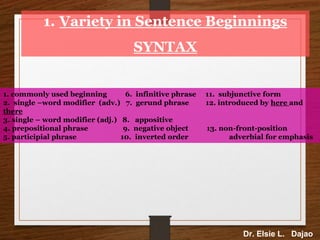
1. Variety in Sentence Beginnings
SYNTAX
1. commonly used beginning 6. infinitive phrase 11. subjunctive form
2. single –word modifier (adv.) 7. gerund phrase 12. introduced by here and
there
3. single – word modifier (adj.) 8. appositive
4. prepositional phrase 9. negative object 13. non-front-position
5. participial phrase 10. inverted order adverbial for emphasis
Dr. Elsie L. Dajao
SYNTACTIC CHANGE Word OrderActivities.ppt

SYNTACTIC CHANGE Word OrderActivities.ppt

  • 1.
  • 2.
  • 3.
    A common phenomenonand may occur in the apparent absence of any external force. Modifies deeply the physiognomy of a particular language. Dr. Elsie L. Dajao
  • 4.
    At the levelof syntax, the amount of change that languages undergo over a given stretch of time varies tremendously, both from language to language and within the history of single language. Dr. Elsie L. Dajao
  • 5.
    One generative proposalthat makes room for syntactic change is that of Andersen. Hans Christian Andersen • A novelist, short story writer and fairy tale writer. Dr. Elsie L. Dajao
  • 6.
    • He suggestedthat “Child language learners faced with the linguistic data of their environment, may hypothesize a grammar different from that of speakers from whom their input comes.” Dr. Elsie L. Dajao
  • 7.
    WORD ORDER  SVO(Subject- Verb- Direct Object) VSO (Verb- Subject- Direct Object) SOV (Subject- Direct Object- Verb) Dr. Elsie L. Dajao
  • 8.
    Since Old Englishhad an extensive system of case marking, it is not surprising that its word order was somewhat more variable than that of Modern English. Old English placed the Verb in second position. Dr. Elsie L. Dajao
  • 9.
    Example: He helped theman. S V O When clause began with an element such as “then" the verb was still in the second Dr. Elsie L. Dajao
  • 10.
    Example: then sent theKing the dish V S O When the direct object was a pronoun in Old English, the S V O order is typical. Dr. Elsie L. Dajao
  • 11.
    Example: She him advised. SO V The S O V order also prevailed even when the direct object is not a pronoun. Example: When the King visited, he boasted. Dr. Elsie L. Dajao
  • 12.
    S-V-O order becamethe means of grammatical relations. Dr. Elsie L. Dajao
  • 13.
    Word order patternsin Middle English Year 1000 1200 1300 1400 1500 Direct object before the verb(%) 53 53 40 14 2 Direct Object after the verb(%) 47 47 60 86 98 Dr. Elsie L. Dajao
  • 14.
    A case inpoint is found in the history of English, which shows the development from S-O-V to S-V-O syntax. Evidence indicates that the earliest form of Germanic from which English descended was an S-O-V Language. Dr. Elsie L. Dajao
  • 15.
    Inversion in thehistory of English • In old and middle English the move operation called Inversion involved in the formation of yes- no questions . • Example: Speak they the reality? Dr. Elsie L. Dajao
  • 16.
    • Inversion (oldform) • The V moves in front of the subject They speak = Speak they? They can speak= Can they speak? • Inversion (new form) The verb moves in front of the subject They speak = Speak they? They can speak = Can they speak? Dr. Elsie L. Dajao
  • 17.
    The corresponding questioncame to be formed with the auxiliary Do as in: Do they can speak the reality? Dr. Elsie L. Dajao
  • 18.
    1. Variety inSentence Beginnings SYNTAX 1. commonly used beginning 6. infinitive phrase 11. subjunctive form 2. single –word modifier (adv.) 7. gerund phrase 12. introduced by here and there 3. single – word modifier (adj.) 8. appositive 4. prepositional phrase 9. negative object 13. non-front-position 5. participial phrase 10. inverted order adverbial for emphasis Dr. Elsie L. Dajao