Synergy in Mergers  & Acquisitions Theory and Practice in Central Europe
Content Overview M &As as an Economic Phenomenon Reasons and Impetus of M&As Synergy – a Quest for Holy Grail Synergy Drivers Value Estimation in M&A Decision Making – technical issues Central European M&As – a case study October 24 2002 Synergy in Mergers & Acquisitions
Mergers & Acquisitions as an Economic Phenomenon Trillion dollar business Rapid increase  in  volume Multinational dimension A way how to expand rapidly October 24 2002 Synergy in Mergers & Acquisitions Monopoly Value Destruction More Qs than answers
Mergers & Acquisitions as an Economic Phenomenon – cont’d Empirical evidence on M &A over last decades: The majority of the studies report that there has been  a  significant proportion of M&A failures over last five decades since the waves of mergers (MAE grounds) started Actual success rate varies but ballpark figure could be ca. 50% H owever , s ome studies are very alarming: 1) Millman and Grey show that  “…83% of mergers produce no benefit whatsoever to shareholders” 2) Sirower finds  60-70% of acquisitions failing to produce positive returns. October 24 2002 Synergy in Mergers & Acquisitions
Mergers & Acquisitions as an Economic Phenomenon – cont’d Change in character of M&As over time: From cost-saving to revenue-increasing Increasing average $ value per transaction whole  1980s – 35,000 TA @ total $3 trillion   2000 – 20,000 TA @ total $3,3 trillion From domestic to cross-border M&As in 1990s Mean of payment changes in waves according to MAE conditions October 24 2002 Synergy in Mergers & Acquisitions
Reasons and Impetus of M&As A strategic way how to expand the business and create a value for shareholders A way for management how to extend its influence ,  thus compensation – „empire building“ (Transaction Theory - Williamson) October 24 2002 Synergy in Mergers & Acquisitions
Reasons and Impetus of M&As  – cont’d Theoretical explanations for M&A activity outcomes: Synergy Theory – expects  that  there is really “something out there” which enables the merged entity to create shareholders value Managerialism Theory – claims that these combinations are driven by empire building not by shareholders wealth objective Managerial Hubris – while following the SWO managers make unconscious mistakes being overconfident about transportability of their successfulness COMParable AcQuisitions – legal issue; shareholders of target are protected by the law, while acquirer’s shareholders are not October 24 2002 Synergy in Mergers & Acquisitions
Synergy – a Quest for Holy Grail WHAT IS IT? Popular definition: 1 + 1 = 3 Roundabout definition: If am I willing to pay 6 for the business market-valued at 5 there has to be the Synergy justifying that More technical definition: Synergy is ability of merged company to generate higher shareholders wealth tha n  the standalone entities October 24 2002 Synergy in Mergers & Acquisitions
Synergy – a Quest for Holy Grail WHAT IS IT?  – cont ’d Mathematically: Synergy = October 24 2002 Synergy in Mergers & Acquisitions Economically: Ability to further limit competitors’ ability to contest their or the targets’ current input markets, processes, or output markets, and/or Ability to open markets and/or  encroach  on their competitors’ markets where these competitors cannot respond.
Synergy – a Quest for Holy Grail October 24 2002 Synergy in Mergers & Acquisitions SIROWER:“Suppose you are running at 3 mph, but are required to run 4 mph next year and 5 mph the year after. Synergy would mean running even harder than this expectation while competitors supply a head wind. Paying a premium for synergy – that is, for the right to run harder – is like putting on a heavy pack. Meanwhile, the more you delay running harder, the higher the incline is set. This is the acquisition game.” Not understanding the essentials may be described as  (Stern): “ Paying unjustified premiums is tantamount to making charitable contributions to random passers-by, never to be recouped by the buying company no matter how long the acquisition is held.”
Synergy – a Quest for Holy Grail October 24 2002 Synergy in Mergers & Acquisitions Lessons from history: Quaker Oats bought  in 1994  Snapple for $ 1,7 bn. $ 500 mil. lost on announcement, $ 100 mil. a year later Snapple was spun off 2 years later at 20% of price Anheuser-Busch  bought in 1982  Campbell-Taggart  at $ 560 mil closed down after 13y of struggling for survival IBM  bought  Lotus  for $ 3,2 bn. (more than 100% premium) probably never to be recouped
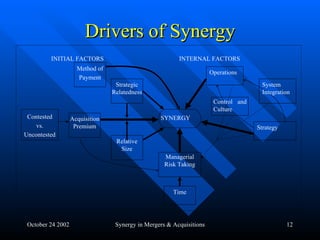
Drivers of Synergy October 24 2002 Synergy in Mergers & Acquisitions INITIAL FACTORS INTERNAL FACTORS SYNERGY Strategy Operations Contested vs. Uncontested Acquisition Premium System Integration Strategic Relatedness Managerial Risk Taking Relative Size Method of Payment Control and Culture Time
Strategic relatedness   October 24 2002 Synergy in Mergers & Acquisitions Acquisition unrelated - strategic cross-sector related horizontal vertical complementary competitive
Strategic relatedness  – cont’d October 24 2002 Synergy in Mergers & Acquisitions   Cross-selling Customer-based  Geographically-based   ?  ? same territory  different territory distinct groups of customers  similar groups of customers => cross-sector acquisition  => horizontal-complementary acquisition X for horizontal-competitive: same territory, same group of customers A A B B Customers of A-company Customers of B-company Area operated by A-company Area operated by B-company
Strategic relatedness  – cont’d October 24 2002 Synergy in Mergers & Acquisitions Loral corporation  &  LockheedMartin (McDonnelDouglas switched to Raytheon ) Chevron & Texaco First Union Corp. & Money Store subsidiary  Conseco & Green Tree Financial Corp. First Union Corp. &  Wheat First
Mergers vs. Tender offers  and Contested vs. Uncontested deals   October 24 2002 Synergy in Mergers & Acquisitions mergers vs. tender offer contested vs. uncontested white knights phenomenon compared to friendly and hostile bidders resp. benefits payoff scheme is even more skewed to  target’s shareholders WK lose significantly more than subsequent  hostile bidders
Method of payment   October 24 2002 Synergy in Mergers & Acquisitions Cash vs. stocks asymmetric information and market’s rational reaction stock-financed transactions punished waves of stock purchases, related to the MAE situation  and market’s mood stock purchase looks to be something “free” BUT on  well-working markets it is NOT
Relative size   October 24 2002 Synergy in Mergers & Acquisitions how to measure it? MV, turnover, employees,… => directly comparable only horizontal M&A empirical evidence proves to be right only for  massive differences in size no strong support for difference in sizes to be  significant DEFENSIVE MERGERS
Internal Factors October 24 2002 Synergy in Mergers & Acquisitions Strategy Operations System Integration  Control and Culture
Strategy October 24 2002 Synergy in Mergers & Acquisitions Vision AT&T’s vision for the NCR acquisition “to link people, organizations and their information in a seamless global computer network”  Viacom’s vision for CBS acquisition “to become premier globally branded content provider” are a few examples.   But customers do not have to get it: Sears &  Dean Witter Reynold/Coldwell bankers :   „ to deliver to customers all financial services, ranging from insurance, credit and real estate to financial instruments such as equities and commercial papers at Sears Centers under one roof with sport equipment, home appliances, flowers, car rentals and others “
Strategy  – cont’d October 24 2002 Synergy in Mergers & Acquisitions Two kinds of strategic synergy Materialize s   without a changes in actual operations   or in the manner of doing business  ( financial benefits ,  increased pricing power on both input and output side or benefits from cross-border acquisitions ) S ynergy POTENTIAL There are NO purely strategic reasons, NO „perfect fit“ Harry Tempest from ABN AMRO says: “We have a rule on the Executive Committee: When someone says ‘Strategic’, the rest of us say ‘too expensive’”  Defensive mergers
Operational Implementation October 24 2002 Synergy in Mergers & Acquisitions detailed planning is necessary two ways: Cost-saving („hard synergy“) redundancies  – admin, production, logistics, … Revenue-enhancement   („ soft  synergy“) cross selling,  strength - strength   & strength-weakness matching
System integration October 24 2002 Synergy in Mergers & Acquisitions can be a very significant limiting factor of many well-planned acquisitions Examples: Burroughs and Sperry – Unisys – 90% down Chemical Bank and Manufacturers Hanover – 2y Special issue – Pricing system ensure that the pricing system is CONSISTENT
Control & culture October 24 2002 Synergy in Mergers & Acquisitions Have become increasingly the most CRITICAL SUCCESS FACTOR in recent transactions difficult to define and control: “ shared set of norms (both formal and informal), values, beliefs and expectations” or  as “an interconnected composite of values, work rituals and leadership”   Too aggressive culture integration doomed acquisition of Montgomery securities by Nations Bank Corp. in 1997. Less than a year and half later Montgomery securities founder Thomas Weisel left, taking 100 of his best investment bankers with him.
Control & culture – common mistakes October 24 2002 Synergy in Mergers & Acquisitions Management withdraw and become distant Inconsistent messages and behaviour   Communication disconnects from maintaining performance and  focuses excessively on persuading employees to feel good Communication is only top-down process Talented and the most perspective employees leave as they do  not identify themselves with new entity Referral problem Leadership appointments – co-CEOs, … … ..
Managerial Risk Taking October 24 2002 Synergy in Mergers & Acquisitions Irrationality in managers’ decision-making when an M &A goes  wrong - managerial hubris - risk escalation  (asymmetric risk response, gamblers’ behaviour) Difficult to empirically prove - operationalization problem (initial risk set-up, changes) - other than synergy or hubris hypothesis
Value Estimation in M&A Decision Making  – technical issues October 24 2002 Synergy in Mergers & Acquisitions time is crucial and can undermine even well prepared  transactions if not considered quite often underestimated of not understood  MODEL:   for infinity
Value Estimation in M&A Decision Making  – technical issues (cont’d) October 24 2002 Synergy in Mergers & Acquisitions SEE GRAPHS
Value Estimation in M&A Decision Making  – technical issues (cont’d) October 24 2002 Synergy in Mergers & Acquisitions PROBABILITY MODEL: 1.f(x) is continuous 2.       3.       4.f(0) > 0 5.f(x) is nonincreasing in x
Value Estimation in M&A Decision Making  – technical issues (cont’d) October 24 2002 Synergy in Mergers & Acquisitions SEE GRAPHS
Central European M&As  – Macroenomic Framework October 24 2002 Synergy in Mergers & Acquisitions mainly unidirectional low competitive markets with comparatively higher growth  potential (situation of 1990s) economies-wide privatization relatively high-skilled labor markets for corporate control too small to be effective synergies stemming most importantly from bridging the techgap BUT environment specific to the MAE conditions BUT different work attitude for historical reasons
Central European M&As  – a Case Study October 24 2002 Synergy in Mergers & Acquisitions two construction companies:  Slovakian acquirer and Czech Target horizontal – complementary acquisition price paid according to market value (objective x subjective) a few years of preceding cooperation cultural similarity Slovaks grabbed the opportunity
Cornerstones of Synergy October 24 2002 Synergy in Mergers & Acquisitions Strategy:  financing, revenue enhancement Operations:  joint contracts acquiring, cross-referencing joint PPE acquiring Systems: core problem – to support the above pillars management lines, ICT systems Culture: enabled by cultural affinity and preceging co-op. challenge: to make people cooperate also on      lower management levels    create a “Code of Joint Working”
Outcomes October 24 2002 Synergy in Mergers & Acquisitions As a result of “opportunity acquisition” the change has been managed accidentally (at least in first year), looking for areas where and how to cooperate “ common sense” used in transition management, empirical evidence ignored no clear controllable targets set Well working referencing on top level – crucial in the business ABOVE ALL:  The acquisition is ultimately successful in terms of EAT
Questions ? October 24 2002 Synergy in Mergers & Acquisitions
Thank you for attention October 24 2002 Synergy in Mergers & Acquisitions

Synergy

  • 1.
    Synergy in Mergers & Acquisitions Theory and Practice in Central Europe
  • 2.
    Content Overview M&As as an Economic Phenomenon Reasons and Impetus of M&As Synergy – a Quest for Holy Grail Synergy Drivers Value Estimation in M&A Decision Making – technical issues Central European M&As – a case study October 24 2002 Synergy in Mergers & Acquisitions
  • 3.
    Mergers & Acquisitionsas an Economic Phenomenon Trillion dollar business Rapid increase in volume Multinational dimension A way how to expand rapidly October 24 2002 Synergy in Mergers & Acquisitions Monopoly Value Destruction More Qs than answers
  • 4.
    Mergers & Acquisitionsas an Economic Phenomenon – cont’d Empirical evidence on M &A over last decades: The majority of the studies report that there has been a significant proportion of M&A failures over last five decades since the waves of mergers (MAE grounds) started Actual success rate varies but ballpark figure could be ca. 50% H owever , s ome studies are very alarming: 1) Millman and Grey show that “…83% of mergers produce no benefit whatsoever to shareholders” 2) Sirower finds 60-70% of acquisitions failing to produce positive returns. October 24 2002 Synergy in Mergers & Acquisitions
  • 5.
    Mergers & Acquisitionsas an Economic Phenomenon – cont’d Change in character of M&As over time: From cost-saving to revenue-increasing Increasing average $ value per transaction whole 1980s – 35,000 TA @ total $3 trillion 2000 – 20,000 TA @ total $3,3 trillion From domestic to cross-border M&As in 1990s Mean of payment changes in waves according to MAE conditions October 24 2002 Synergy in Mergers & Acquisitions
  • 6.
    Reasons and Impetusof M&As A strategic way how to expand the business and create a value for shareholders A way for management how to extend its influence , thus compensation – „empire building“ (Transaction Theory - Williamson) October 24 2002 Synergy in Mergers & Acquisitions
  • 7.
    Reasons and Impetusof M&As – cont’d Theoretical explanations for M&A activity outcomes: Synergy Theory – expects that there is really “something out there” which enables the merged entity to create shareholders value Managerialism Theory – claims that these combinations are driven by empire building not by shareholders wealth objective Managerial Hubris – while following the SWO managers make unconscious mistakes being overconfident about transportability of their successfulness COMParable AcQuisitions – legal issue; shareholders of target are protected by the law, while acquirer’s shareholders are not October 24 2002 Synergy in Mergers & Acquisitions
  • 8.
    Synergy – aQuest for Holy Grail WHAT IS IT? Popular definition: 1 + 1 = 3 Roundabout definition: If am I willing to pay 6 for the business market-valued at 5 there has to be the Synergy justifying that More technical definition: Synergy is ability of merged company to generate higher shareholders wealth tha n the standalone entities October 24 2002 Synergy in Mergers & Acquisitions
  • 9.
    Synergy – aQuest for Holy Grail WHAT IS IT? – cont ’d Mathematically: Synergy = October 24 2002 Synergy in Mergers & Acquisitions Economically: Ability to further limit competitors’ ability to contest their or the targets’ current input markets, processes, or output markets, and/or Ability to open markets and/or encroach on their competitors’ markets where these competitors cannot respond.
  • 10.
    Synergy – aQuest for Holy Grail October 24 2002 Synergy in Mergers & Acquisitions SIROWER:“Suppose you are running at 3 mph, but are required to run 4 mph next year and 5 mph the year after. Synergy would mean running even harder than this expectation while competitors supply a head wind. Paying a premium for synergy – that is, for the right to run harder – is like putting on a heavy pack. Meanwhile, the more you delay running harder, the higher the incline is set. This is the acquisition game.” Not understanding the essentials may be described as (Stern): “ Paying unjustified premiums is tantamount to making charitable contributions to random passers-by, never to be recouped by the buying company no matter how long the acquisition is held.”
  • 11.
    Synergy – aQuest for Holy Grail October 24 2002 Synergy in Mergers & Acquisitions Lessons from history: Quaker Oats bought in 1994 Snapple for $ 1,7 bn. $ 500 mil. lost on announcement, $ 100 mil. a year later Snapple was spun off 2 years later at 20% of price Anheuser-Busch bought in 1982 Campbell-Taggart at $ 560 mil closed down after 13y of struggling for survival IBM bought Lotus for $ 3,2 bn. (more than 100% premium) probably never to be recouped
  • 12.
    Drivers of SynergyOctober 24 2002 Synergy in Mergers & Acquisitions INITIAL FACTORS INTERNAL FACTORS SYNERGY Strategy Operations Contested vs. Uncontested Acquisition Premium System Integration Strategic Relatedness Managerial Risk Taking Relative Size Method of Payment Control and Culture Time
  • 13.
    Strategic relatedness October 24 2002 Synergy in Mergers & Acquisitions Acquisition unrelated - strategic cross-sector related horizontal vertical complementary competitive
  • 14.
    Strategic relatedness – cont’d October 24 2002 Synergy in Mergers & Acquisitions Cross-selling Customer-based Geographically-based ? ? same territory different territory distinct groups of customers similar groups of customers => cross-sector acquisition => horizontal-complementary acquisition X for horizontal-competitive: same territory, same group of customers A A B B Customers of A-company Customers of B-company Area operated by A-company Area operated by B-company
  • 15.
    Strategic relatedness – cont’d October 24 2002 Synergy in Mergers & Acquisitions Loral corporation & LockheedMartin (McDonnelDouglas switched to Raytheon ) Chevron & Texaco First Union Corp. & Money Store subsidiary Conseco & Green Tree Financial Corp. First Union Corp. & Wheat First
  • 16.
    Mergers vs. Tenderoffers and Contested vs. Uncontested deals October 24 2002 Synergy in Mergers & Acquisitions mergers vs. tender offer contested vs. uncontested white knights phenomenon compared to friendly and hostile bidders resp. benefits payoff scheme is even more skewed to target’s shareholders WK lose significantly more than subsequent hostile bidders
  • 17.
    Method of payment October 24 2002 Synergy in Mergers & Acquisitions Cash vs. stocks asymmetric information and market’s rational reaction stock-financed transactions punished waves of stock purchases, related to the MAE situation and market’s mood stock purchase looks to be something “free” BUT on well-working markets it is NOT
  • 18.
    Relative size October 24 2002 Synergy in Mergers & Acquisitions how to measure it? MV, turnover, employees,… => directly comparable only horizontal M&A empirical evidence proves to be right only for massive differences in size no strong support for difference in sizes to be significant DEFENSIVE MERGERS
  • 19.
    Internal Factors October24 2002 Synergy in Mergers & Acquisitions Strategy Operations System Integration Control and Culture
  • 20.
    Strategy October 242002 Synergy in Mergers & Acquisitions Vision AT&T’s vision for the NCR acquisition “to link people, organizations and their information in a seamless global computer network” Viacom’s vision for CBS acquisition “to become premier globally branded content provider” are a few examples. But customers do not have to get it: Sears & Dean Witter Reynold/Coldwell bankers : „ to deliver to customers all financial services, ranging from insurance, credit and real estate to financial instruments such as equities and commercial papers at Sears Centers under one roof with sport equipment, home appliances, flowers, car rentals and others “
  • 21.
    Strategy –cont’d October 24 2002 Synergy in Mergers & Acquisitions Two kinds of strategic synergy Materialize s without a changes in actual operations or in the manner of doing business ( financial benefits , increased pricing power on both input and output side or benefits from cross-border acquisitions ) S ynergy POTENTIAL There are NO purely strategic reasons, NO „perfect fit“ Harry Tempest from ABN AMRO says: “We have a rule on the Executive Committee: When someone says ‘Strategic’, the rest of us say ‘too expensive’” Defensive mergers
  • 22.
    Operational Implementation October24 2002 Synergy in Mergers & Acquisitions detailed planning is necessary two ways: Cost-saving („hard synergy“) redundancies – admin, production, logistics, … Revenue-enhancement („ soft synergy“) cross selling, strength - strength & strength-weakness matching
  • 23.
    System integration October24 2002 Synergy in Mergers & Acquisitions can be a very significant limiting factor of many well-planned acquisitions Examples: Burroughs and Sperry – Unisys – 90% down Chemical Bank and Manufacturers Hanover – 2y Special issue – Pricing system ensure that the pricing system is CONSISTENT
  • 24.
    Control & cultureOctober 24 2002 Synergy in Mergers & Acquisitions Have become increasingly the most CRITICAL SUCCESS FACTOR in recent transactions difficult to define and control: “ shared set of norms (both formal and informal), values, beliefs and expectations” or as “an interconnected composite of values, work rituals and leadership” Too aggressive culture integration doomed acquisition of Montgomery securities by Nations Bank Corp. in 1997. Less than a year and half later Montgomery securities founder Thomas Weisel left, taking 100 of his best investment bankers with him.
  • 25.
    Control & culture– common mistakes October 24 2002 Synergy in Mergers & Acquisitions Management withdraw and become distant Inconsistent messages and behaviour Communication disconnects from maintaining performance and focuses excessively on persuading employees to feel good Communication is only top-down process Talented and the most perspective employees leave as they do not identify themselves with new entity Referral problem Leadership appointments – co-CEOs, … … ..
  • 26.
    Managerial Risk TakingOctober 24 2002 Synergy in Mergers & Acquisitions Irrationality in managers’ decision-making when an M &A goes wrong - managerial hubris - risk escalation (asymmetric risk response, gamblers’ behaviour) Difficult to empirically prove - operationalization problem (initial risk set-up, changes) - other than synergy or hubris hypothesis
  • 27.
    Value Estimation inM&A Decision Making – technical issues October 24 2002 Synergy in Mergers & Acquisitions time is crucial and can undermine even well prepared transactions if not considered quite often underestimated of not understood MODEL: for infinity
  • 28.
    Value Estimation inM&A Decision Making – technical issues (cont’d) October 24 2002 Synergy in Mergers & Acquisitions SEE GRAPHS
  • 29.
    Value Estimation inM&A Decision Making – technical issues (cont’d) October 24 2002 Synergy in Mergers & Acquisitions PROBABILITY MODEL: 1.f(x) is continuous 2.      3.      4.f(0) > 0 5.f(x) is nonincreasing in x
  • 30.
    Value Estimation inM&A Decision Making – technical issues (cont’d) October 24 2002 Synergy in Mergers & Acquisitions SEE GRAPHS
  • 31.
    Central European M&As – Macroenomic Framework October 24 2002 Synergy in Mergers & Acquisitions mainly unidirectional low competitive markets with comparatively higher growth potential (situation of 1990s) economies-wide privatization relatively high-skilled labor markets for corporate control too small to be effective synergies stemming most importantly from bridging the techgap BUT environment specific to the MAE conditions BUT different work attitude for historical reasons
  • 32.
    Central European M&As – a Case Study October 24 2002 Synergy in Mergers & Acquisitions two construction companies: Slovakian acquirer and Czech Target horizontal – complementary acquisition price paid according to market value (objective x subjective) a few years of preceding cooperation cultural similarity Slovaks grabbed the opportunity
  • 33.
    Cornerstones of SynergyOctober 24 2002 Synergy in Mergers & Acquisitions Strategy: financing, revenue enhancement Operations: joint contracts acquiring, cross-referencing joint PPE acquiring Systems: core problem – to support the above pillars management lines, ICT systems Culture: enabled by cultural affinity and preceging co-op. challenge: to make people cooperate also on lower management levels create a “Code of Joint Working”
  • 34.
    Outcomes October 242002 Synergy in Mergers & Acquisitions As a result of “opportunity acquisition” the change has been managed accidentally (at least in first year), looking for areas where and how to cooperate “ common sense” used in transition management, empirical evidence ignored no clear controllable targets set Well working referencing on top level – crucial in the business ABOVE ALL: The acquisition is ultimately successful in terms of EAT
  • 35.
    Questions ? October24 2002 Synergy in Mergers & Acquisitions
  • 36.
    Thank you forattention October 24 2002 Synergy in Mergers & Acquisitions