UNIT 11: LO5
SWOT ANALYSIS AND EVALUATION
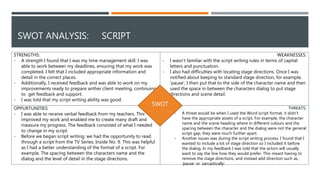
THREATS:
- A threat would be when I used the Word script format, it didn’t
have the appropriate assets of a script. For example, the character
name and the scene heading where in different colours and the
spacing between the character and the dialog were not the general
script gap, they were much further apart.
- Another issues was during the script writing process. I found that I
wanted to include a lot of stage direction so I included it before
the dialog. In my feedback I was told that the actors will usually
want to say the line how they would prefer. This meant having to
remove the stage directions, and instead add direction such as,
‘pause’ or ‘sarcastically’.
OPPURTUNITIES:
- I was able to receive verbal feedback from my teachers. This
improved my work and enabled me to create many draft and
measure my progress. The feedback consisted of what I needed
to change in my script.
- Before we began script writing, we had the opportunity to read
through a script from the TV Series, Inside No. 9. This was helpful
as I had a better understanding of the format of a script. For
example, The spacing between the characters name and the
dialog and the level of detail in the stage directions.
STRENGTHS:
- A strength I found that I was my time management skill. I was
able to work between my deadlines, ensuring that my work was
completed. I felt that I included appropriate information and
detail in the correct places.
- Additionally, I received feedback and was able to work on my
improvements ready to prepare anther client meeting, continuing
to get feedback and support.
- I was told that my script writing ability was good.
WEAKNESSES:
- I wasn’t familiar with the script writing rules in terms of capital
letters and punctuation.
- I also had difficulties with locating stage directions. Once I was
notified about keeping to standard stage direction, for example,
‘pause’, I then put that to the side of the character name and then
used the space in between the characters dialog to put stage
directions and scene detail.
SWOT ANALYSIS: SCRIPT
SWOT
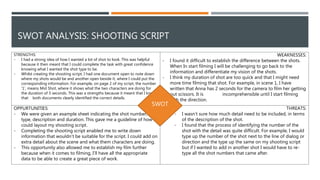
THREATS:
- I wasn’t sure how much detail need to be included, in terms
of the description of the shot.
- I found that the process of identifying the number of the
shot with the detail was quite difficult. For example, I would
type up the number of the shot next to the line of dialog or
direction and the type up the same on my shooting script
but if I wanted to add in another shot I would have to re-
type all the shot numbers that came after.
OPPURTUNITIES:
- We were given an example sheet indicating the shot number,
type, description and duration. This gave me a guideline of how
could layout my shooting script.
- Completing the shooting script enabled me to write down
information that wouldn’t be suitable for the script. I could add on
extra detail about the scene and what them characters are doing.
- This opportunity also allowed me to establish my film further
because when it comes to filming, I’ll have all the appropriate
data to be able to create a great piece of work.
STRENGTHS:
- I had a strong idea of how I wanted a lot of shot to look. This was helpful
because it then meant that I could complete the task with great confidence
knowing what I wanted the shot type to be.
- Whilst creating the shooting script, I had one document open to note down
where my shots would be and another open beside it, where I could put the
corresponding information. For example, on page 2 of my script, the number
‘1’, means Mid Shot, where it shows what the two characters are doing for
the duration of 3 seconds. This was a strengths because it meant that I knew
that both documents clearly identified the correct details.
WEAKNESSES:
- I found it difficult to establish the difference between the shots.
When In start filming I will be challenging to go back to the
information and differentiate my vision of the shots.
- I think my duration of shot are too quick and that I might need
more time filming that shot. For example, in scene 1, I have
written that Anna has 2 seconds for the camera to film her getting
out scissors. It is incomprehensible until I start filming
with the direction.
SWOT ANALYSIS: SHOOTING SCRIPT
SWOT
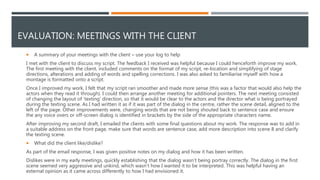
EVALUATION: MEETINGS WITH THE CLIENT
 A summary of your meetings with the client – use your log to help
I met with the client to discuss my script. The feedback I received was helpful because I could henceforth improve my work.
The first meeting with the client, included comments on the format of my script, re-location and simplifying of stage
directions, alterations and adding of words and spelling corrections. I was also asked to familiarise myself with how a
montage is formatted onto a script.
Once I improved my work, I felt that my script ran smoother and made more sense (this was a factor that would also help the
actors when they read it through). I could then arrange another meeting for additional pointers. The next meeting consisted
of changing the layout of ‘texting’ direction, so that it would be clear to the actors and the director what is being portrayed
during the texting scene. As I had written it as if it was part of the dialog in the centre, rather the scene detail, aligned to the
left of the page. Other improvements were, changing words that are not being shouted back to sentence case and ensure
the any voice overs or off-screen dialog is identified in brackets by the side of the appropriate characters name.
After improving my second draft, I emailed the clients with some final questions about my work. The response was to add in
a suitable address on the front page, make sure that words are sentence case, add more description into scene 8 and clarify
the texting scene.
 What did the client like/dislike?
As part of the email response, I was given positive notes on my dialog and how it has been written.
Dislikes were in my early meetings, quickly establishing that the dialog wasn’t being portray correctly. The dialog in the first
scene seemed very aggressive and unkind, which wasn’t how I wanted it to be interpreted. This was helpful having an
external opinion as it came across differently to how I had envisioned it.
EVALUATION: CHANGES AND MEETING EXPECTATIONS.
 What changes did you make based on the suggestions and likes?
The suggestions that I received included:
- Change the colours of the character name and scene description as they were formatted blue and red on the Word Script
guideline.
- Change the order of words or phrases, making it the script flow better. For example, it was suggested that I add another
line after a character says, ‘No, that’s mine.’ This was to help the situation make sense. Another example was putting the
phrase ‘Umm’ before, ‘I don’t know’. Making the script sound like it should be said.
- Change words back to sentence case if they were not being shouted. If they were supposed to be shouted, indicated this
in brackets.
 Do you feel you have met the needs/expectations of: 1. The client, 2. The brief and 3. Your chosen target audience?
I have met the expectations of the client because I have made all the appropriate improvements on my script and received
emailed feedback for my final draft.
The brief gave us a guideline of a script, I have completed this tasks because my script meets the criteria for an industry
standard script. My script is 5-10 minutes long, with a corresponding shooting script.
The script is appropriate for my target audience which is school student between the ages 12 and 18. It doesn't contain any
inapt content such as, language or drug references. The theme of the script is very suitable for the age group and consists
the correct references.
EVALUATION: INDUSTRY STANDARDS
: LEGAL AND ETHICAL REQUIREMENTS
 Did you produce a fully formatted industry standard script? And shooting script?
I used the Microsoft Word document script layout. This helped me to add the correct detail in the suitable places. In
my final email feedback I was told that my script was industry standard, this was after several drafts and feedback
meetings. For example, I didn’t understand where I placed the stage direction. This is a very important aspect to the
standard and required organising. I learnt that the stage direction is aligned to the left of the page, between the
characters dialog.
When my script was complete I then created my shooting script. Once this was achieved I received feedback, needing
to add more detail to ensure that the camera-person could easily understand what and how scenes were being shot.
For example, for my shot description I wrote, ‘Mid shot of the general image’. Whereas, I was required to describe the
‘general image’. This was modified to ‘This shot shows both of them sat in the bathroom.’
 Does it meet legal/ethical requirements?
It does meet my legal and ethical requirement as my script doesn’t contain any inappropriate language or content. It
is suitable for my target audience and age certificate PG. It has continued to remain the original theme of
relationships, school life and appearances.
EVALUATION: MY REVIEW
 Overall are you pleased with what you have produced?
I am pleased with my final script as I think it contains the correct information and detail. It has been well-
improved since my first draft. I feel that I have acknowledged my feedback and work well continuously
developing my script to industry standard. I appreciate the comments that I received as I understood that my
script needed critiquing. Having the opportunity to update my work over meetings, allowed me to asks questions,
elaborate on what my ideas portrayed and learn new skills.
 Would you change anything if you had the opportunity to go back and start over?
If I could re-start, I would change my storyline. This is because, as I’ve started writing the script, I have established
that the story is very common and generic. I have also chosen to use the school facilities, so I will do most of my
filming on the school site. This means having the actors being available either during school hours or after school.
 What have you learnt?
I have learnt how a script and a shooting script are properly made. I have learnt how to script-write and ensure
where the elements of a script are located accurately. For example, basic line direction and scene description. I
have also learnt how a montage is represented on a script, making sure that there is sufficient amount of detail
and direction, written clearly for the cast and crew.

Swot analysis and evaluation

  • 1.
    UNIT 11: LO5 SWOTANALYSIS AND EVALUATION
  • 2.
    THREATS: - A threatwould be when I used the Word script format, it didn’t have the appropriate assets of a script. For example, the character name and the scene heading where in different colours and the spacing between the character and the dialog were not the general script gap, they were much further apart. - Another issues was during the script writing process. I found that I wanted to include a lot of stage direction so I included it before the dialog. In my feedback I was told that the actors will usually want to say the line how they would prefer. This meant having to remove the stage directions, and instead add direction such as, ‘pause’ or ‘sarcastically’. OPPURTUNITIES: - I was able to receive verbal feedback from my teachers. This improved my work and enabled me to create many draft and measure my progress. The feedback consisted of what I needed to change in my script. - Before we began script writing, we had the opportunity to read through a script from the TV Series, Inside No. 9. This was helpful as I had a better understanding of the format of a script. For example, The spacing between the characters name and the dialog and the level of detail in the stage directions. STRENGTHS: - A strength I found that I was my time management skill. I was able to work between my deadlines, ensuring that my work was completed. I felt that I included appropriate information and detail in the correct places. - Additionally, I received feedback and was able to work on my improvements ready to prepare anther client meeting, continuing to get feedback and support. - I was told that my script writing ability was good. WEAKNESSES: - I wasn’t familiar with the script writing rules in terms of capital letters and punctuation. - I also had difficulties with locating stage directions. Once I was notified about keeping to standard stage direction, for example, ‘pause’, I then put that to the side of the character name and then used the space in between the characters dialog to put stage directions and scene detail. SWOT ANALYSIS: SCRIPT SWOT
  • 3.
    THREATS: - I wasn’tsure how much detail need to be included, in terms of the description of the shot. - I found that the process of identifying the number of the shot with the detail was quite difficult. For example, I would type up the number of the shot next to the line of dialog or direction and the type up the same on my shooting script but if I wanted to add in another shot I would have to re- type all the shot numbers that came after. OPPURTUNITIES: - We were given an example sheet indicating the shot number, type, description and duration. This gave me a guideline of how could layout my shooting script. - Completing the shooting script enabled me to write down information that wouldn’t be suitable for the script. I could add on extra detail about the scene and what them characters are doing. - This opportunity also allowed me to establish my film further because when it comes to filming, I’ll have all the appropriate data to be able to create a great piece of work. STRENGTHS: - I had a strong idea of how I wanted a lot of shot to look. This was helpful because it then meant that I could complete the task with great confidence knowing what I wanted the shot type to be. - Whilst creating the shooting script, I had one document open to note down where my shots would be and another open beside it, where I could put the corresponding information. For example, on page 2 of my script, the number ‘1’, means Mid Shot, where it shows what the two characters are doing for the duration of 3 seconds. This was a strengths because it meant that I knew that both documents clearly identified the correct details. WEAKNESSES: - I found it difficult to establish the difference between the shots. When In start filming I will be challenging to go back to the information and differentiate my vision of the shots. - I think my duration of shot are too quick and that I might need more time filming that shot. For example, in scene 1, I have written that Anna has 2 seconds for the camera to film her getting out scissors. It is incomprehensible until I start filming with the direction. SWOT ANALYSIS: SHOOTING SCRIPT SWOT
  • 4.
    EVALUATION: MEETINGS WITHTHE CLIENT  A summary of your meetings with the client – use your log to help I met with the client to discuss my script. The feedback I received was helpful because I could henceforth improve my work. The first meeting with the client, included comments on the format of my script, re-location and simplifying of stage directions, alterations and adding of words and spelling corrections. I was also asked to familiarise myself with how a montage is formatted onto a script. Once I improved my work, I felt that my script ran smoother and made more sense (this was a factor that would also help the actors when they read it through). I could then arrange another meeting for additional pointers. The next meeting consisted of changing the layout of ‘texting’ direction, so that it would be clear to the actors and the director what is being portrayed during the texting scene. As I had written it as if it was part of the dialog in the centre, rather the scene detail, aligned to the left of the page. Other improvements were, changing words that are not being shouted back to sentence case and ensure the any voice overs or off-screen dialog is identified in brackets by the side of the appropriate characters name. After improving my second draft, I emailed the clients with some final questions about my work. The response was to add in a suitable address on the front page, make sure that words are sentence case, add more description into scene 8 and clarify the texting scene.  What did the client like/dislike? As part of the email response, I was given positive notes on my dialog and how it has been written. Dislikes were in my early meetings, quickly establishing that the dialog wasn’t being portray correctly. The dialog in the first scene seemed very aggressive and unkind, which wasn’t how I wanted it to be interpreted. This was helpful having an external opinion as it came across differently to how I had envisioned it.
  • 5.
    EVALUATION: CHANGES ANDMEETING EXPECTATIONS.  What changes did you make based on the suggestions and likes? The suggestions that I received included: - Change the colours of the character name and scene description as they were formatted blue and red on the Word Script guideline. - Change the order of words or phrases, making it the script flow better. For example, it was suggested that I add another line after a character says, ‘No, that’s mine.’ This was to help the situation make sense. Another example was putting the phrase ‘Umm’ before, ‘I don’t know’. Making the script sound like it should be said. - Change words back to sentence case if they were not being shouted. If they were supposed to be shouted, indicated this in brackets.  Do you feel you have met the needs/expectations of: 1. The client, 2. The brief and 3. Your chosen target audience? I have met the expectations of the client because I have made all the appropriate improvements on my script and received emailed feedback for my final draft. The brief gave us a guideline of a script, I have completed this tasks because my script meets the criteria for an industry standard script. My script is 5-10 minutes long, with a corresponding shooting script. The script is appropriate for my target audience which is school student between the ages 12 and 18. It doesn't contain any inapt content such as, language or drug references. The theme of the script is very suitable for the age group and consists the correct references.
  • 6.
    EVALUATION: INDUSTRY STANDARDS :LEGAL AND ETHICAL REQUIREMENTS  Did you produce a fully formatted industry standard script? And shooting script? I used the Microsoft Word document script layout. This helped me to add the correct detail in the suitable places. In my final email feedback I was told that my script was industry standard, this was after several drafts and feedback meetings. For example, I didn’t understand where I placed the stage direction. This is a very important aspect to the standard and required organising. I learnt that the stage direction is aligned to the left of the page, between the characters dialog. When my script was complete I then created my shooting script. Once this was achieved I received feedback, needing to add more detail to ensure that the camera-person could easily understand what and how scenes were being shot. For example, for my shot description I wrote, ‘Mid shot of the general image’. Whereas, I was required to describe the ‘general image’. This was modified to ‘This shot shows both of them sat in the bathroom.’  Does it meet legal/ethical requirements? It does meet my legal and ethical requirement as my script doesn’t contain any inappropriate language or content. It is suitable for my target audience and age certificate PG. It has continued to remain the original theme of relationships, school life and appearances.
  • 7.
    EVALUATION: MY REVIEW Overall are you pleased with what you have produced? I am pleased with my final script as I think it contains the correct information and detail. It has been well- improved since my first draft. I feel that I have acknowledged my feedback and work well continuously developing my script to industry standard. I appreciate the comments that I received as I understood that my script needed critiquing. Having the opportunity to update my work over meetings, allowed me to asks questions, elaborate on what my ideas portrayed and learn new skills.  Would you change anything if you had the opportunity to go back and start over? If I could re-start, I would change my storyline. This is because, as I’ve started writing the script, I have established that the story is very common and generic. I have also chosen to use the school facilities, so I will do most of my filming on the school site. This means having the actors being available either during school hours or after school.  What have you learnt? I have learnt how a script and a shooting script are properly made. I have learnt how to script-write and ensure where the elements of a script are located accurately. For example, basic line direction and scene description. I have also learnt how a montage is represented on a script, making sure that there is sufficient amount of detail and direction, written clearly for the cast and crew.