Community Based
Rehabilitation
Community
Participation
7
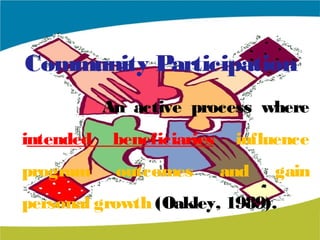
Community Participation
An active process where
intended beneficiaries influence
program outcomes and gain
personal growth (Oakley, 1989).
Small Projects
Large Projects
in response to
community’s needs show higher level
of participation.
with extensive service
delivery systems that lack client-
centered planning generate little
community participation and ownership .
5 Factors Influencing Community
Participation in Community Based
Rehabilitation (CBR)
1. Community Diversity
2. Community Values and Culture
3. Community Needs
4. Barriers to Community Participation in CBR
5. Planning for Community Participation in CBR
Community Diversity
Noun. social inclusiveness: ethnic
variety, as well as socioeconomic and
gender variety, in a group, society, or
institution.
Diversity
with these vast differences within a
community it causes problems of
co-ordination of services.
communities at times become less
supportive and refuse to take up collective
responsibility for issues related to their
minority group.
Community
Values and Culture
Western
society
Asian
society
vs.
Individualism Collectivism
COMMUNITY
NEEDSFunctional Interdependence
Supportive Services
Efficient Management Systems
Easy access to resources
Abdication of Responsibilities
Poverty
Personal motives
BARRIERS OF
COMMUNITY
PARTICIPATION IN CBR
1.
2.
3.
PLANNING FOR
COMMUNITY
PARTICIPATION IN CBR
Motivate
Strategic Planning
1.
2.
Community Based
Rehabilitation
Organizing Self-Help Groups
8
Introduction
The field of disability rehabilitation
has thus moved from medical and
impairment oriented activity, to one
focusing on rights and group
organization.
Why Do Persons with Disabilities Get
Excluded fromthe Development
Process?
• People with disabilities have often beenPeople with disabilities have often been
described as the “hard-core poor”.described as the “hard-core poor”.
• They are also difficult group to carry outThey are also difficult group to carry out
interventions for, because of theirspecialinterventions for, because of theirspecial
needs and attitudinal barriers.needs and attitudinal barriers.
Some reasons for exclusion of people of
disabilities frommicro credit programs are:
Negative attitudes and prejudices about credit-
worthiness of people with disabilities;
Lack of policies, knowledge and skills on the
part of development organizations to include
people with disabilities into credit programs;
Mobility problems of people with
disabilities that prevent themfrom
attending meetings;
Low level of education and skills in
disabled persons due to theirlackof
access to these services;
Lackof flexibility in existing credit
operations to facilitate inclusion of
people with disabilities.
Expectations of charity and lackof
motivation on the part of persons with
disabilities and theirfamilies.
What is a Self-help Group?
A self-help group is a voluntary
association of people that functions
democratically and accountability, to
achieve the collective goals of the
group.
Characteristics of Democratic
Self-Help Groups
Firstly, in such groups, members come
together to fulfill a commonly perceived
need. The goals:
need to be clear,
known to and
shared by all members.
Secondly, every members in a democratic
group has a role to perform and makes
decisions in a participatory way to
achieved a set of shared goals.
Third, is the value addition that each
member brings to the group in order to
achieve the shared goals. 19
Challenges in Organizing Groups
of People with Disabilities
Urban Areas (Lowerincome sections)
1. Living in poorersections
2. Exhibits social discomforts
3. No permanent address
4. Do not easily formhuman bonding
5. Show less concern forcollective causes
Rural Areas
1. Distances between clients
2. Difficult terrain
3. Fear
4. Minority
In General
1. Lack of motivation (disabled people)
2. Lack of Trust
(members and inadequate knowledge)
Organizing Self-Help Groups
of People with Disabilities
Meetings need to be arranged in
places that are accessible and not
distant from member’s dwellings.
Pre-conditions
Groups should set the dates for
meetings and intimate the agenda
earlier, and should discuss matters that
concern them directly,
A facilitator maybe needed in the
initial stages to ensure that chosen leaders
do not dominate the group.
Assigning tasks and responsibilities
to group members acts as a motivator
to keep them involved.
The End
Thank You
Very Much
For Listening
Hope You
Have Learned
Something!

Community Based-Rehabilitation

  • 1.
  • 2.
    Community Participation An activeprocess where intended beneficiaries influence program outcomes and gain personal growth (Oakley, 1989).
  • 3.
    Small Projects Large Projects inresponse to community’s needs show higher level of participation. with extensive service delivery systems that lack client- centered planning generate little community participation and ownership .
  • 4.
    5 Factors InfluencingCommunity Participation in Community Based Rehabilitation (CBR) 1. Community Diversity 2. Community Values and Culture 3. Community Needs 4. Barriers to Community Participation in CBR 5. Planning for Community Participation in CBR
  • 5.
    Community Diversity Noun. socialinclusiveness: ethnic variety, as well as socioeconomic and gender variety, in a group, society, or institution. Diversity
  • 6.
    with these vastdifferences within a community it causes problems of co-ordination of services. communities at times become less supportive and refuse to take up collective responsibility for issues related to their minority group.
  • 7.
  • 8.
  • 9.
    Abdication of Responsibilities Poverty Personalmotives BARRIERS OF COMMUNITY PARTICIPATION IN CBR 1. 2. 3.
  • 10.
    PLANNING FOR COMMUNITY PARTICIPATION INCBR Motivate Strategic Planning 1. 2.
  • 11.
  • 12.
    Introduction The field ofdisability rehabilitation has thus moved from medical and impairment oriented activity, to one focusing on rights and group organization.
  • 13.
    Why Do Personswith Disabilities Get Excluded fromthe Development Process? • People with disabilities have often beenPeople with disabilities have often been described as the “hard-core poor”.described as the “hard-core poor”. • They are also difficult group to carry outThey are also difficult group to carry out interventions for, because of theirspecialinterventions for, because of theirspecial needs and attitudinal barriers.needs and attitudinal barriers.
  • 14.
    Some reasons forexclusion of people of disabilities frommicro credit programs are: Negative attitudes and prejudices about credit- worthiness of people with disabilities; Lack of policies, knowledge and skills on the part of development organizations to include people with disabilities into credit programs;
  • 15.
    Mobility problems ofpeople with disabilities that prevent themfrom attending meetings; Low level of education and skills in disabled persons due to theirlackof access to these services;
  • 16.
    Lackof flexibility inexisting credit operations to facilitate inclusion of people with disabilities. Expectations of charity and lackof motivation on the part of persons with disabilities and theirfamilies.
  • 17.
    What is aSelf-help Group? A self-help group is a voluntary association of people that functions democratically and accountability, to achieve the collective goals of the group.
  • 18.
    Characteristics of Democratic Self-HelpGroups Firstly, in such groups, members come together to fulfill a commonly perceived need. The goals: need to be clear, known to and shared by all members.
  • 19.
    Secondly, every membersin a democratic group has a role to perform and makes decisions in a participatory way to achieved a set of shared goals. Third, is the value addition that each member brings to the group in order to achieve the shared goals. 19
  • 20.
    Challenges in OrganizingGroups of People with Disabilities Urban Areas (Lowerincome sections) 1. Living in poorersections 2. Exhibits social discomforts 3. No permanent address 4. Do not easily formhuman bonding 5. Show less concern forcollective causes
  • 21.
    Rural Areas 1. Distancesbetween clients 2. Difficult terrain 3. Fear 4. Minority In General 1. Lack of motivation (disabled people) 2. Lack of Trust (members and inadequate knowledge)
  • 22.
    Organizing Self-Help Groups ofPeople with Disabilities Meetings need to be arranged in places that are accessible and not distant from member’s dwellings. Pre-conditions
  • 23.
    Groups should setthe dates for meetings and intimate the agenda earlier, and should discuss matters that concern them directly, A facilitator maybe needed in the initial stages to ensure that chosen leaders do not dominate the group.
  • 24.
    Assigning tasks andresponsibilities to group members acts as a motivator to keep them involved. The End
  • 25.
    Thank You Very Much ForListening Hope You Have Learned Something!