A COMPREHENSIVE STUDY ON WORKER’S ABSENTEEISM

        VARDHMAN YARN & THREAD LTD. BADDI


        DR IT. INSTITUTE OF MANAGEMENT AND
                      TECNOLOGY (IMT)
           In partial fulfillment of requirement of degree of

         ( BACHELOR OF BUSINESS ADMINSTRATION)


Submitted To:                                   Submitted By:

   Mr.Gagan Gulatis                             Swati Rai
                                                Roll No 80907322029

                                            BBA 6th sem
ACKNOWLEDGEMENT

Talent & capabilities are of course necessary but opportunities and

good guidance are two very important things without which no persons

can climb those infant ladders towards progress.


First of all I am very much indebted and thankful to my parents and

God for giving me strength for completion of my Internship.


. I express my sincere thanks to my project guide Mr. Gagan Gulati for

providing me her valuable time and fruitful guidance. Lastly but not

least , I thank my friends , relatives and near and dear ones for their

wholehearted support in this efforts of mine.


                                                           SWATI RAI


                         PREFACE
There is a famous saying “The theory without practical is lame and practical
without theory is blind.”

Absenteeism is a serious workplace problem and an expensive occurrence for
both employers and employees seemingly unpredictable in nature.

Human resource is an important part of any business and managing them is an
important task.

Summer training is an integral part of the student of Management have to
undergo training session in a business organization for 6 weeks to gain some
practical knowledge in their specialization and to gain some working experience.

Our institution has come forward with the opportunity to bridge the gap by
imparting modern scientific management principle underlying the concept of the
future prospective managers.

To the emphasis on practical aspect of management education the faculty of
Academy of Management Studies, baddi has with a modern system of practical
training of repute and following management technique to the student as integral
part of MBA. In accordance with the above obligation under going project in
“vardhman yarns&thread Pvt. Ltd., baddi. The title of my project is
“Absenteeism of Employee”

Certainly this analysis explores my abilities and strength to its fullest extent for
the achievement of organization as well as my personal goal.


                             CONTENTS
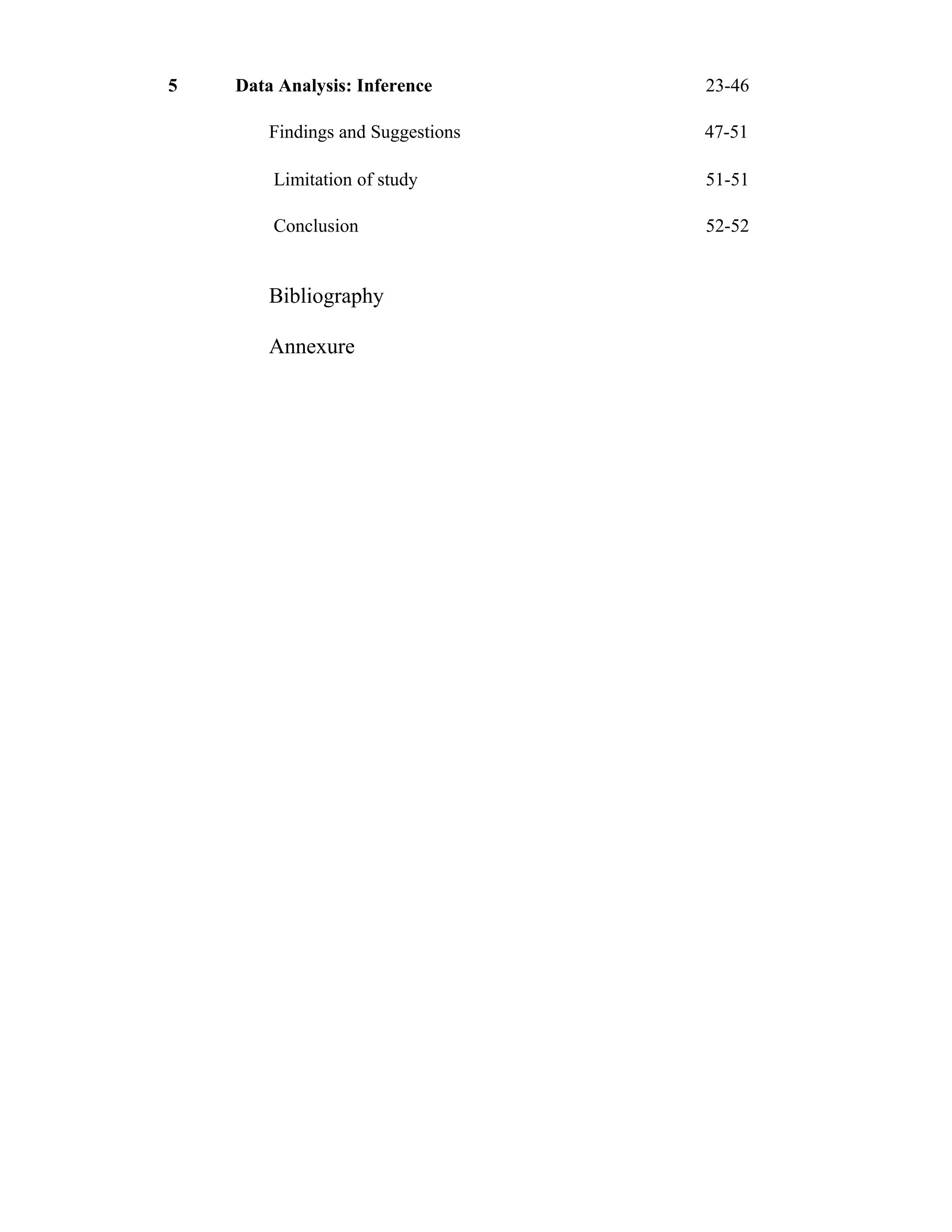
1   Profile of Vardhman Yarns and Threads Ltd., Baddi


    1.1 Mission & Vision                                01-01

    1.2 History                                            02-02

    1.3 Philosophy                                      03-03

    1.4 Portfolio                                       04-05

    1.5 Holdings                                        06-07

    1.6 Market                                          08-08

    1.7 Achievements                                    09-10

2   Absenteeism : An Introduction

    2.1 Concept of Absenteeism.                         12-12

    2.2 Types of Absenteeism                            13-13

    2.3 Calculation of absenteeism                      14-15

    2.4 Causes of absenteeism                           14-15

    2.5 Categories of absenteeism                       16-16

    2.6 Measure to minimize absenteeism                 17-17

     3 Review of literature                             18-19

     4 Research Methodology

      4.1 Statement of problem                          20-20

      4.2 Objective of the study                        20-20

      4.3 Scope of study                                20-20

     4.4 Methodology Used: Questionnaire                21-22

      4.5 Sampling unit and sampling size               21-22

      3.6 Method of Data Collection                     21-22
5   Data Analysis: Inference       23-46

        Findings and Suggestions   47-51

        Limitation of study        51-51

        Conclusion                 52-52


        Bibliography

        Annexure
PART-I
Company Profile
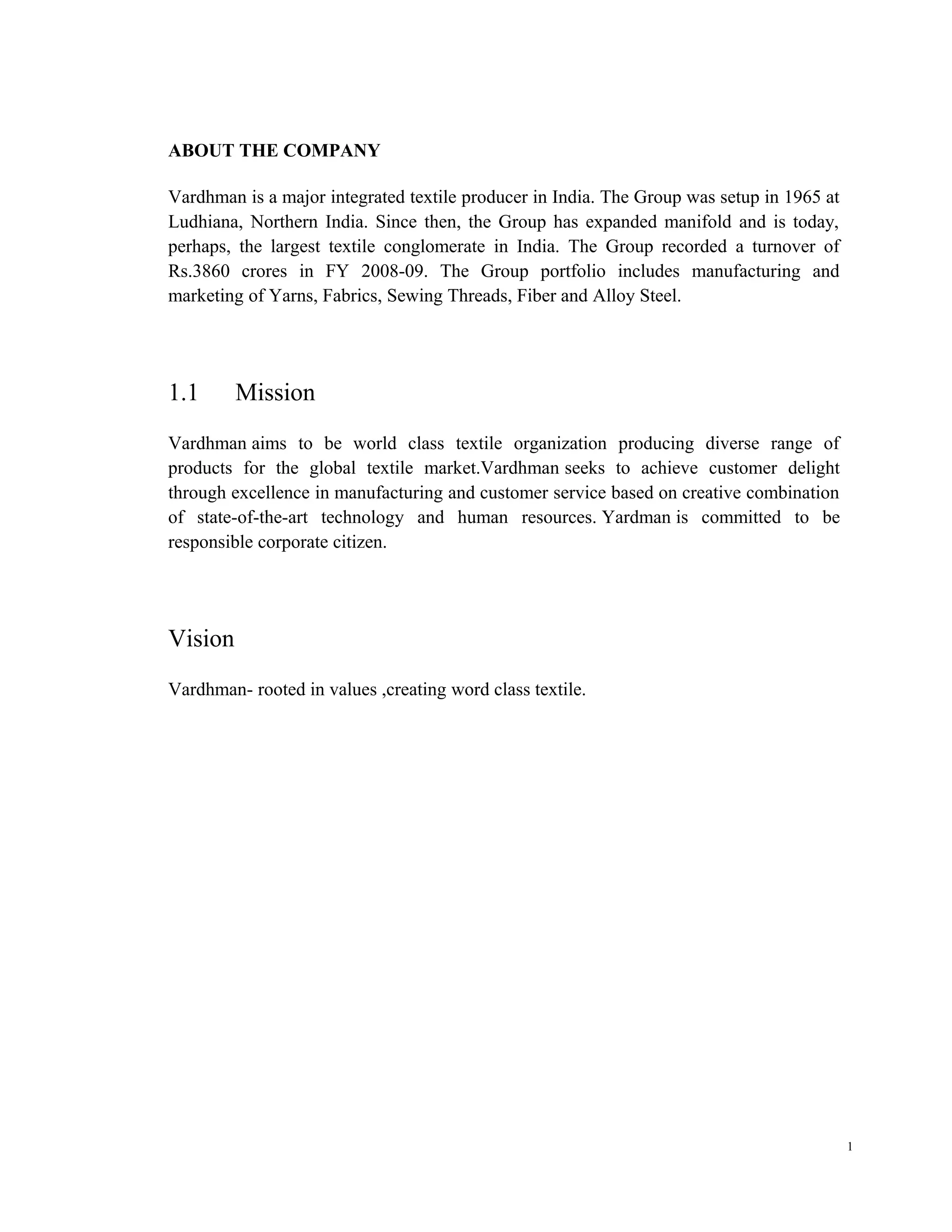
ABOUT THE COMPANY

Vardhman is a major integrated textile producer in India. The Group was setup in 1965 at
Ludhiana, Northern India. Since then, the Group has expanded manifold and is today,
perhaps, the largest textile conglomerate in India. The Group recorded a turnover of
Rs.3860 crores in FY 2008-09. The Group portfolio includes manufacturing and
marketing of Yarns, Fabrics, Sewing Threads, Fiber and Alloy Steel.


1.1      Mission
Vardhman aims to be world class textile organization producing diverse range of
products for the global textile market.Vardhman seeks to achieve customer delight
through excellence in manufacturing and customer service based on creative combination
of state-of-the-art technology and human resources. Yardman is committed to be
responsible corporate citizen.


Vision
Vardhman- rooted in values ,creating word class textile.


                                                                                           1
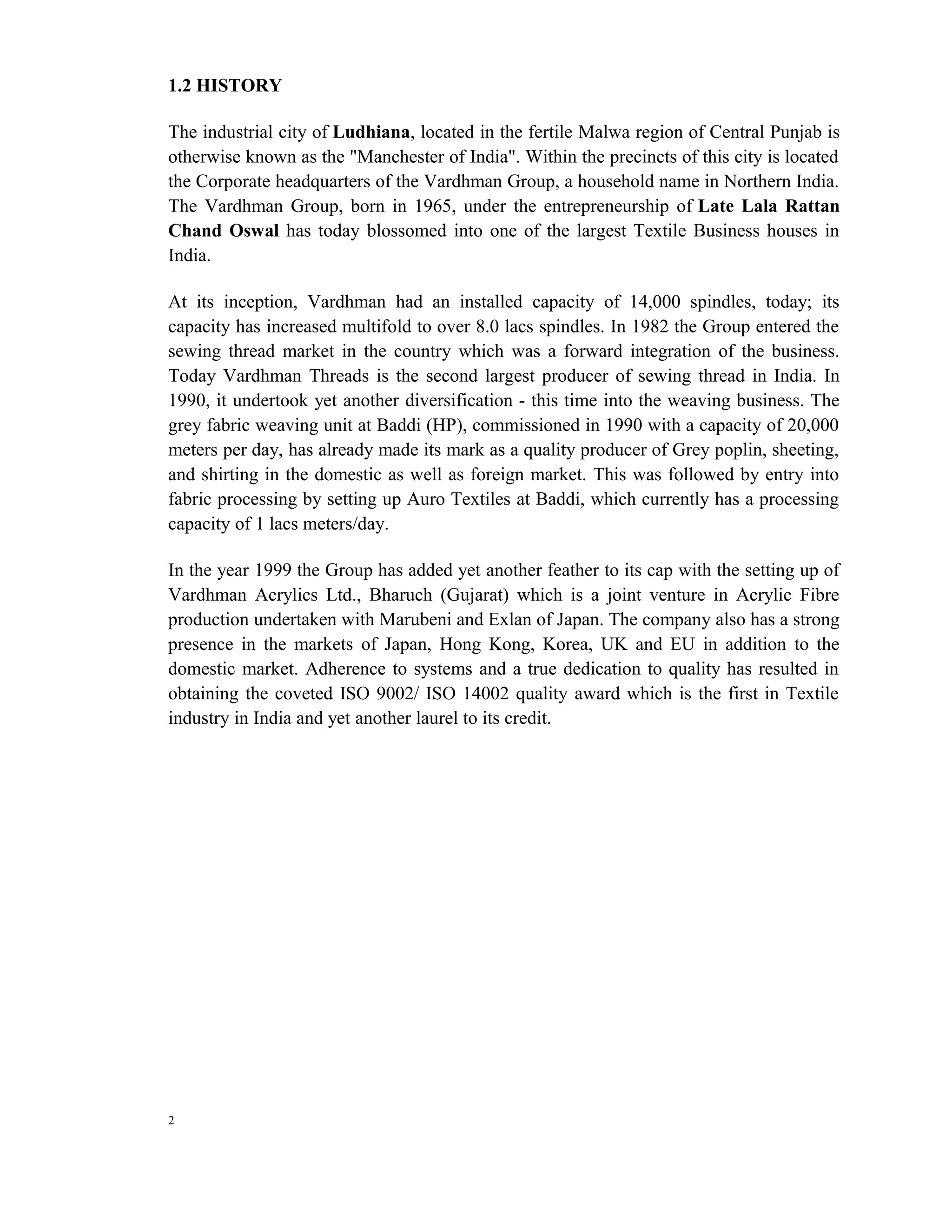
1.2 HISTORY

The industrial city of Ludhiana, located in the fertile Malwa region of Central Punjab is
otherwise known as the "Manchester of India". Within the precincts of this city is located
the Corporate headquarters of the Vardhman Group, a household name in Northern India.
The Vardhman Group, born in 1965, under the entrepreneurship of Late Lala Rattan
Chand Oswal has today blossomed into one of the largest Textile Business houses in
India.

At its inception, Vardhman had an installed capacity of 14,000 spindles, today; its
capacity has increased multifold to over 8.0 lacs spindles. In 1982 the Group entered the
sewing thread market in the country which was a forward integration of the business.
Today Vardhman Threads is the second largest producer of sewing thread in India. In
1990, it undertook yet another diversification - this time into the weaving business. The
grey fabric weaving unit at Baddi (HP), commissioned in 1990 with a capacity of 20,000
meters per day, has already made its mark as a quality producer of Grey poplin, sheeting,
and shirting in the domestic as well as foreign market. This was followed by entry into
fabric processing by setting up Auro Textiles at Baddi, which currently has a processing
capacity of 1 lacs meters/day.

In the year 1999 the Group has added yet another feather to its cap with the setting up of
Vardhman Acrylics Ltd., Bharuch (Gujarat) which is a joint venture in Acrylic Fibre
production undertaken with Marubeni and Exlan of Japan. The company also has a strong
presence in the markets of Japan, Hong Kong, Korea, UK and EU in addition to the
domestic market. Adherence to systems and a true dedication to quality has resulted in
obtaining the coveted ISO 9002/ ISO 14002 quality award which is the first in Textile
industry in India and yet another laurel to its credit.


2
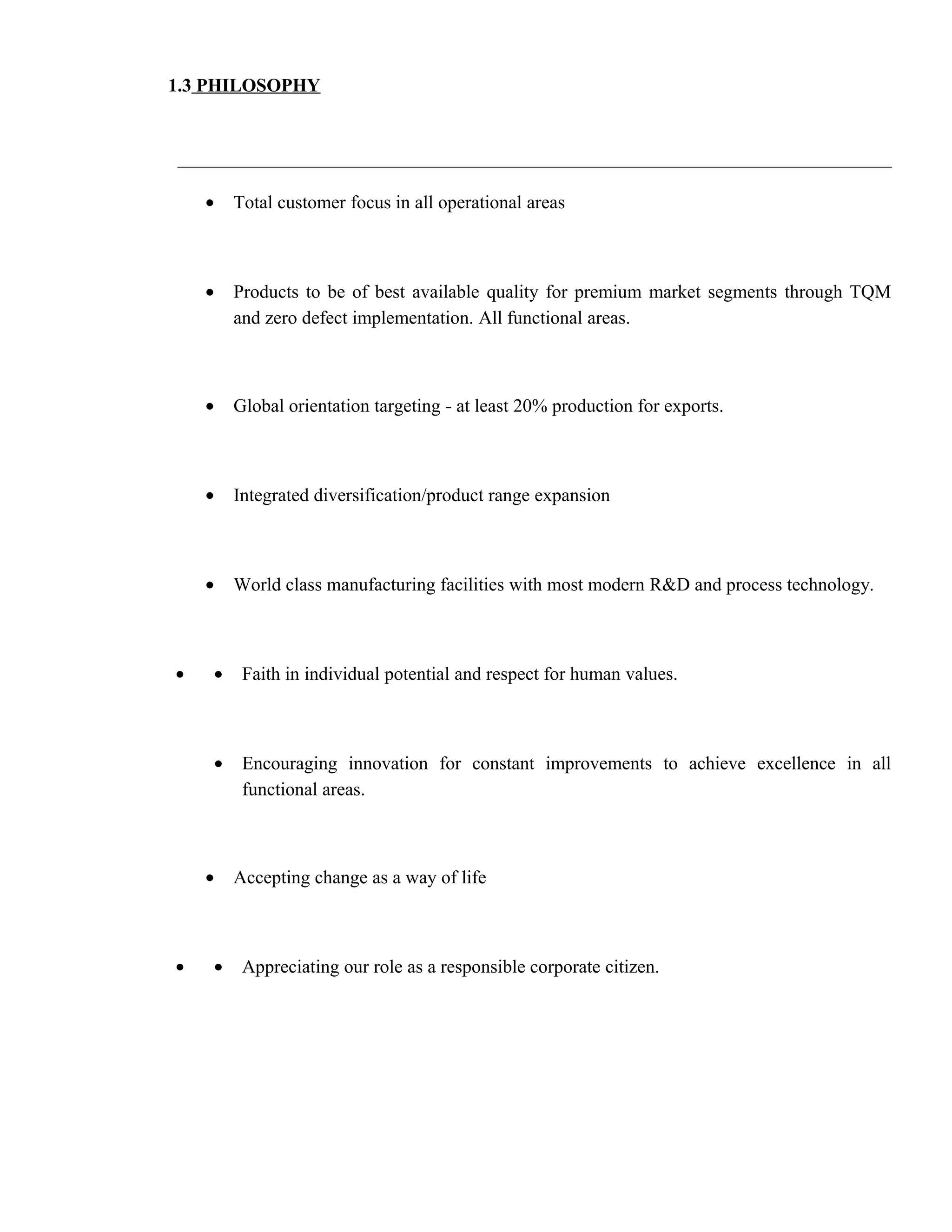
1.3 PHILOSOPHY


    •   Total customer focus in all operational areas


    •   Products to be of best available quality for premium market segments through TQM
        and zero defect implementation. All functional areas.


    •   Global orientation targeting - at least 20% production for exports.


    •   Integrated diversification/product range expansion


    •   World class manufacturing facilities with most modern R&D and process technology.


•   •    Faith in individual potential and respect for human values.


    •    Encouraging innovation for constant improvements to achieve excellence in all
         functional areas.


    •   Accepting change as a way of life


•   •    Appreciating our role as a responsible corporate citizen.
3


1.4 PORTFOLIO

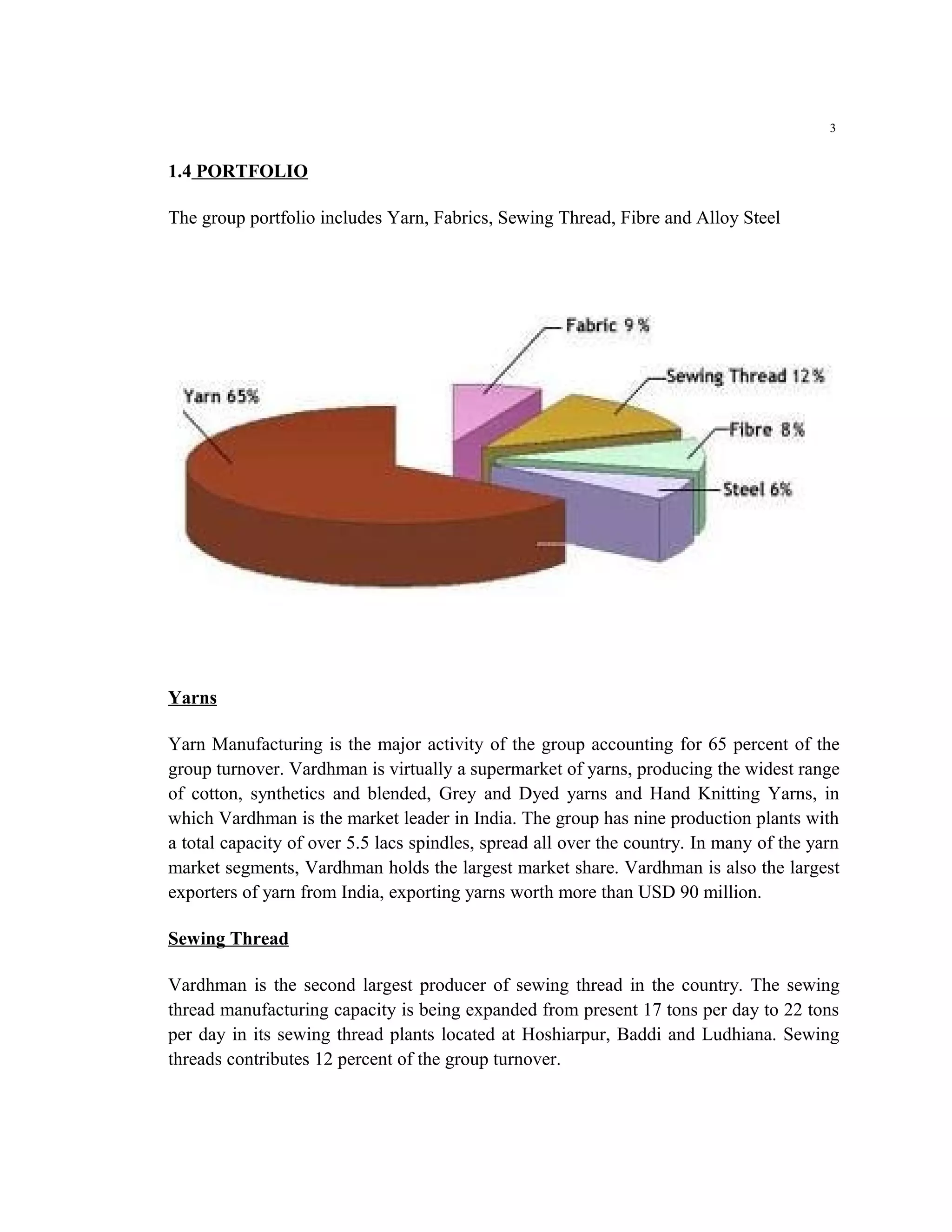
The group portfolio includes Yarn, Fabrics, Sewing Thread, Fibre and Alloy Steel


Yarns

Yarn Manufacturing is the major activity of the group accounting for 65 percent of the
group turnover. Vardhman is virtually a supermarket of yarns, producing the widest range
of cotton, synthetics and blended, Grey and Dyed yarns and Hand Knitting Yarns, in
which Vardhman is the market leader in India. The group has nine production plants with
a total capacity of over 5.5 lacs spindles, spread all over the country. In many of the yarn
market segments, Vardhman holds the largest market share. Vardhman is also the largest
exporters of yarn from India, exporting yarns worth more than USD 90 million.

Sewing Thread

Vardhman is the second largest producer of sewing thread in the country. The sewing
thread manufacturing capacity is being expanded from present 17 tons per day to 22 tons
per day in its sewing thread plants located at Hoshiarpur, Baddi and Ludhiana. Sewing
threads contributes 12 percent of the group turnover.
4


Fabrics

The group has created state-of-the-art fabric weaving and processing facilities in its plant
at Baddi, Northern India. The group has installed 208 shuttles less looms and a fabric
processing capacity of 30 million meters per annum in collaboration of Tokai Senko of
Japan. Fabrics business contributes 8 percent to the group turnover.

Fibre

The group has recently set up an Acrylic Staple Fibre plant at Bharuch in Gujarat in
collaboration with Marubeni and Japan Exlan of Japan. The plant has annual capacity of
18000 tons per annum. Fibre contributes 8 percent to the total turnover of the group.

Steel

The Group is also present in upper-end of the steel industry. The group has
manufacturing capacity of 100000 tons of special and alloy steel. The group supplies its
steel products to some of the most stringent quality steel buyers like Maruti and Telco. It
contributes 6 percent to the total turnover of the group


                                                                                     5
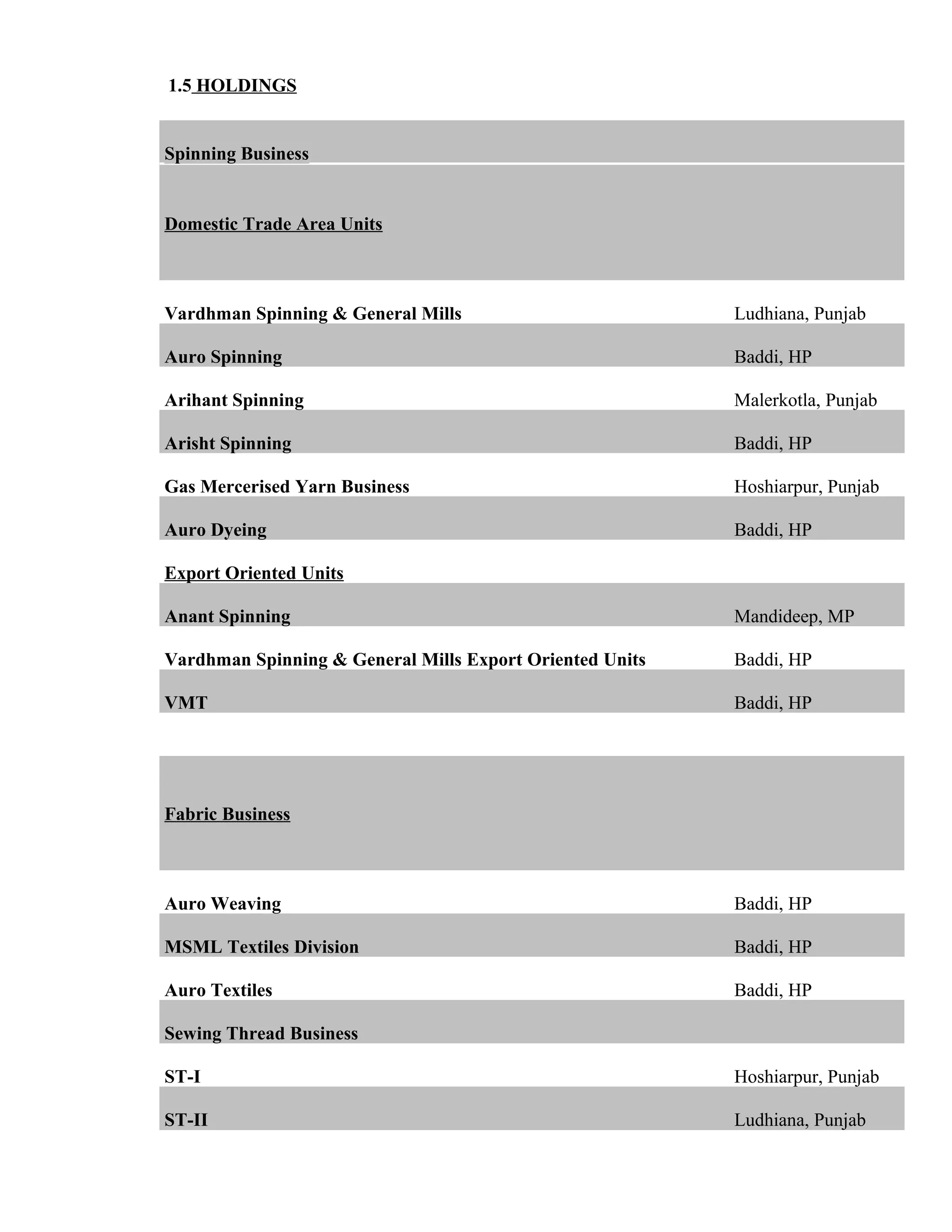
1.5 HOLDINGS


Spinning Business


Domestic Trade Area Units


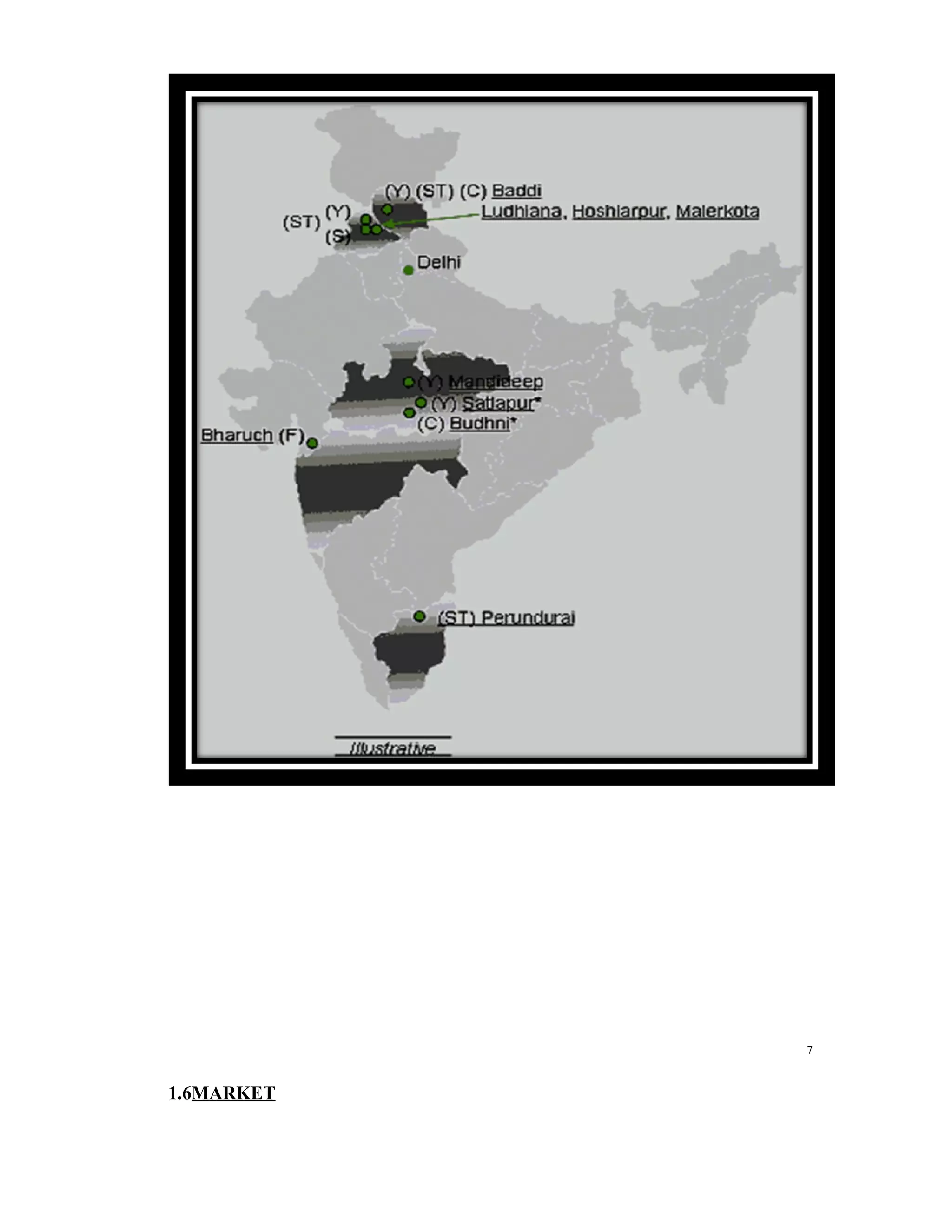
Vardhman Spinning & General Mills                         Ludhiana, Punjab

Auro Spinning                                             Baddi, HP

Arihant Spinning                                          Malerkotla, Punjab

Arisht Spinning                                           Baddi, HP

Gas Mercerised Yarn Business                              Hoshiarpur, Punjab

Auro Dyeing                                               Baddi, HP

Export Oriented Units

Anant Spinning                                            Mandideep, MP

Vardhman Spinning & General Mills Export Oriented Units   Baddi, HP

VMT                                                       Baddi, HP


Fabric Business


Auro Weaving                                              Baddi, HP

MSML Textiles Division                                    Baddi, HP

Auro Textiles                                             Baddi, HP

Sewing Thread Business

ST-I                                                      Hoshiarpur, Punjab

ST-II                                                     Ludhiana, Punjab
ST-III                               Perundurai, TN
ST-IV
                                     Baddi, HP


Vardhman Special Steels              Ludhiana, Punjab

                                     Bharuch, Gujarat
Vardhman Acrylics Limited


               6


                    VARDHMAN GROUP
7


1.6MARKET
•   Largest Spinning capacity in India - over half a million spindles.


•   Largest producer of Cotton, Synthetics and Blended yarns in the country


•   Largest Dyeing Capacity of Fibre and Yarn


•   Largest Exporter of Cotton Yarn


•   Market Leader in Hand Knitting Yarns in India


•   Largest range of Textile products


•   Second largest producer of Sewing Thread in the country


•   Collaborations with specialist worldwide
8


1.7ACHIEVEMENTS


It’s an overwhelming feeling when the efforts and hard work put in are recognized and
felicitated. A feeling that galvanizes the Group into believing in more, in itself and
reaffirming its commitment to offer products that invoke trust and reliability

Back home, the Vardhman Group became India's first textile company to be awarded
ICO9002/ ISO 14002 Certification. It is the largest producer and exporter of yarns and
Grey woven fabrics from India. Vardhman is also the largest producer of tyercord yarns
and the second largest producer of sewing threads in India. The Vardhman Group vision
of excellence is matched by a dedication and sincerity to be the best and excel in every
industry it has a presence.


  Chairman, Mr. S.P. Oswal got Shri Padam Bhushan award in January 2010


  Textile Export Promotion Council 2007-08 Special achievement award in yarn category


  Textile Export Promotion Council 2007-08 Silver top exporter award in yarn category


  Textile Export Promotion Council 2007-08 Bronze trophy in processed yarn category
Textile Export Promotion Council 2005-06 Bronze trophy for highest global export
category overall

World trophy in highest export in yarn category.


Textile          Export             Promotion          Council           2003-04
Gold trophy in EOU/EPZ for export of cotton yarn


Textile             Export                Promotion    Council           2003-04
Bronze trophy in mill fabric exporter category


Textile           Export              Promotion        Council           2002-03
Gold Trophy in EOU/EPZ for export of cotton yarn


Textile            Export               Promotion      Council           1998-99
Silver Trophy


Textile            Export               Promotion      Council           1997-98
Bronze Trophy
10


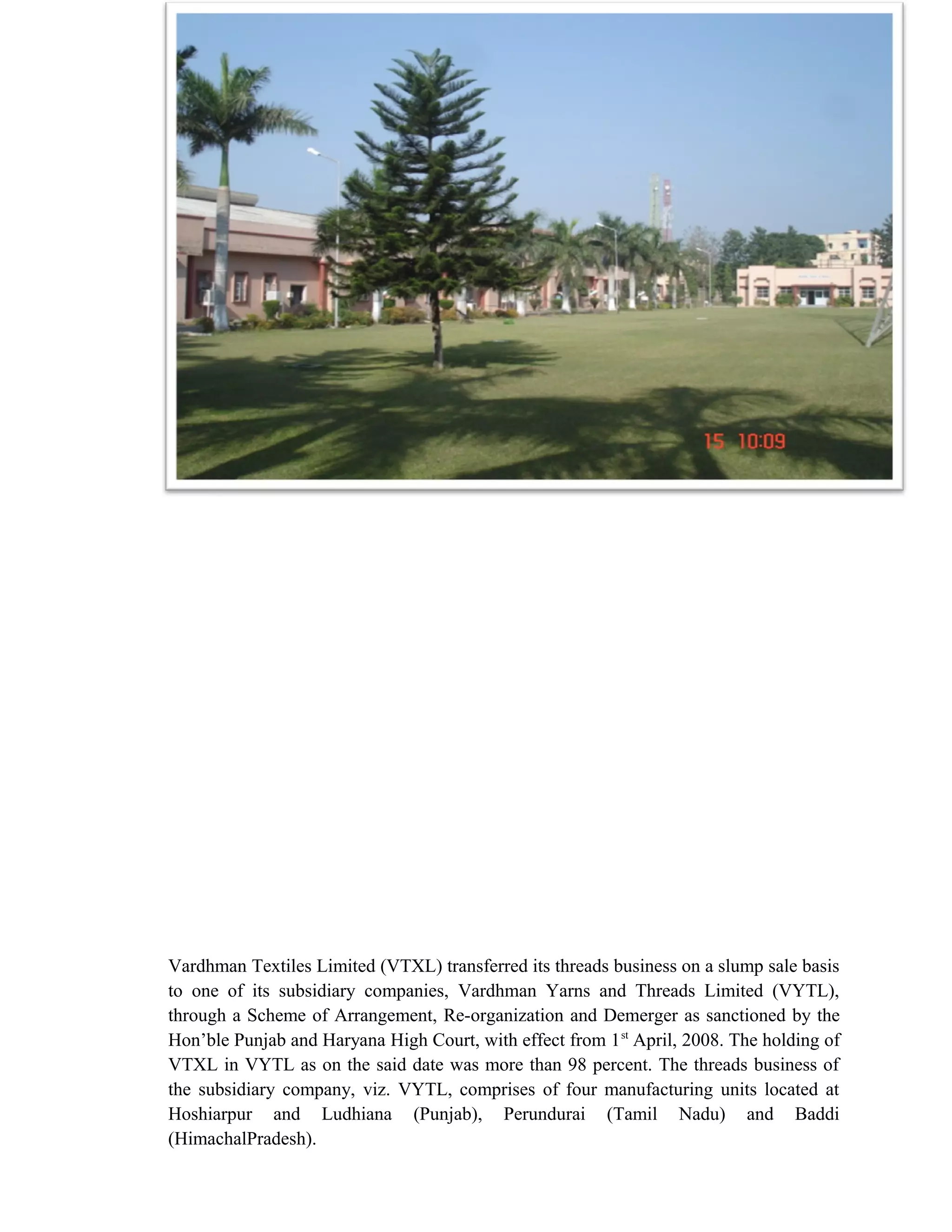
              Vardhman Yarns and Threads Limited, UNIT-IV,BADDI


Vardhman Textiles Limited (VTXL) transferred its threads business on a slump sale basis
to one of its subsidiary companies, Vardhman Yarns and Threads Limited (VYTL),
through a Scheme of Arrangement, Re-organization and Demerger as sanctioned by the
Hon’ble Punjab and Haryana High Court, with effect from 1 st April, 2008. The holding of
VTXL in VYTL as on the said date was more than 98 percent. The threads business of
the subsidiary company, viz. VYTL, comprises of four manufacturing units located at
Hoshiarpur and Ludhiana (Punjab), Perundurai (Tamil Nadu) and Baddi
(HimachalPradesh).
The Company entered into a joint venture in VYTL with M/s. American & Efird, Inc.
(A&E), one of the world’s largest global manufacturers and distributors of industrial
sewing threads, embroidery threads and technical textiles, with A&E’s initial holding of
35 percent. Recently, A&E has acquired the additional 14 percent equity shares of the
joint venture company, VYTL, from Vardhman Textiles Limited and thus holds 49
percent equity shares. The joint venture Company, however, continues to be a subsidiary
of Vardhman Textiles Limited, whose shareholding is now 51 percent


                                                                                      11


          Absenteeism
         An Introduction
2.1 INTRODUCTION

Some Definitions of Absenteeism:

-    “Absenteeism” is a practice or a habit of being an “absence” and an “absentee” is
one who habitually stays away

                                                     - WEBSTER’S DICTIONARY

             - ‘Absenteeism’ is the failure of a worker to report for work when he is
scheduled to work.

                                                         - LABOUR BUREAU SIMLA

Meaning:

Employees’ presence at the work place during the schedule time is highly essential for
the smooth running of the production process in particular and the organization in
general. Despite the significance of presence, employees sometime fail to report to the
work place during the scheduled time, which is known as “Absenteeism”.

According to PICOARS AND MAYERS: Unexpected absence disturbs the efficiency of
the group as the jobs are inter connected, if one single man remains absent without prior
notice the whole operation process is distributed. This Absenteeism results in production
losses because, due to Absenteeism, workers cost increases and thus efficiency of
operations is affected.

2.2 Features of Absenteeism:

 Research Studies undertaken by different authors reveal the following features of
Absenteeism

    The rate of Absenteeism is the lowest on pay day; it increases considerably on the
     days following the payment of wages and bonus
    Absenteeism is generally high among the workers below 25 years of age and
     those above 40 years of age.
 The rate of Absenteeism varies from department to department within an
       organization.

      Absenteeism in traditional industries is seasonal in character


                                                                                     12


2.3 Types of Absenteeism

Absenteeism is of four types viz….

1.   Authorized Absenteeism.

2.   Unauthorized Absenteeism.

3.   Willful Absenteeism.

4.   Absenteeism caused by circumstances beyond one’s control.

1) Authorized Absenteeism

          If an employee absents himself from work by taking permission from superior
          and applying for leave, such Absenteeism is called authorized Absenteeism.

  2) Unauthorized Absenteeism

          If any employee absents himself from work without informing or taking
          permission and without applying for leave, such absenteeism is called
          Unauthorized Absenteeism.

3) Willful Absenteeism

          If any employee absents himself from duty willfully, such Absenteeism is called
          Willful Absenteeism

4) Absenteeism caused by circumstances beyond one’s control

          If any employee absent himself from duty owing to the circumstances beyond
          his control like involvement in accidents (or) sudden sickness, such absenteeism
          is called Absenteeism caused by circumstances beyond one’s control.

2.5 Calculations of Absenteeism rate:
Absenteeism can be calculated with the help of the following formula.

Absenteeism rate = ( No of Mondays lost / No of Mondays scheduled to work)*100

Absenteeism rate can be calculated for different employees and for different time periods
like month & year.


      13


Frequency rate

The frequency rate reflects the incidence of absence and is usually expressed as the no of
separate absence in a given period, irrespective of absence. The frequency rate represents
the average no of absence per worker in a given period.

Frequency rate = (The no of times in which the leave was availed/ Total no of Monday’s
schedules to work)*100

Severity rate:

Severity rate is the average length of time lost per absence and is calculated by using the
following.

Severity rate = (Total no of days absent during a period/ Total no of times absent during
that period)*100

 A high severity rate indicates that the employee is absent for longer duration each time.
High frequency and severity rates indicates that the employee is absent more frequently
and for longer duration’s each time resulting in high Absenteeism even in absolute terms.

2.6 Causes of Absenteeism

     The following are the general causes of the Absenteeism

1.   Maladjustment with the working conditions:

     If the working conditions of the company are poor, the workers cannot adjust
     themselves with the company’s working conditions. Then they prefer to stay away
     from the company.

2.   Social and religious ceremonies:

     Social & religious functions divert the workers attention from the work.

3.   Unsatisfactory housing
Conditions at the working place

4.    Industrial housing

      The industrial fugue compels workers to remain outside the work place.

5.    Unhealthy working conditions

    The poor and intolerable working conditions in the factories irritate the working
excess heat, noise, either too much or too low lighting, poor ventilation, dust, smoke
cause poor health of the workers. This factory causes the workers to be absent.

6.    Poor welfare facilities

Though a no of legislation concerning welfare facilities are enacted, many organizations
fail to provide welfare facilities. This is either due to the poor financial position of the
companies (or) due to the exploitative attitude of the employs. The welfare facilities
includes poor sanitation, washing, bathing first aid appliances, ambulance, restrooms
drinking water, canteen, shelter, crèches etc.. The dissatisfied worker with these facilities
prefers to be away from the workplace.

7.     Alcoholism

Workers mostly prefer to spend money on the consumption of liquor and         enjoyment
after getting the wages. Therefore, the rate of absenteeism is more during the first week
every month

8.     Indebtness

The low level wages and unplanned expenditure of the workers force then to borrow
heavily. The research studies indicate that workers borrow more than 10 times of their
net pay. Consequently workers fail to repay the money. Then they try to escape the
place in order to avoid the money lenders. This leads to absenteeism.

9.     Maladjustment with job demands

The fast enhancing technology demand higher level skills from the workers fail to meet
these demands due to their lower level education and/or absenteeism of training.

10.    Unsound personnel policies

The improper and unrealistic personnel policies result in employee dissatisfaction. The
dissatisfied employee in tune prefers to be away from the work

11.    Inadequate leave facilities

The inadequate leave facilities provided by the employer forces him to depend on ESI
leave which allows the workers to be away from the work for 56 days in a year on half
pay.
12.   Low level of wages

Wages in some organizations are very poor and they are quite inadequate to meet the
basic needs of the employees. Therefore, employers go for other employment during
their busy seasons and earn more money. Further, some employees take up part time
jobs. Thus the employees resort to moonlighting and absent themselves from the work.


                                                                                         15


Categories of Absenteeism

K.N.VAID classified chronic absenteeism to fine categories viz….

1) Entrepreneurs

2) Status seekers

3) Epicureans

4) Family-oriented and

5) The sick and the old.

1) Entrepreneurs

 These classes of absenteeism consider that their jobs are very small for their total interest
and personal goals. They engage themselves in other social and economic activities to
fulfill their goals.

2) The status seekers

This type pf Absentees enjoy or perceive a higher ascribed social status and are keen on
maintaining it.

3) The epicureans

The classes of absentees do not like to take up the jobs which demand initiative
responsibilities, discipline and discomfort they wish to have money, power, and status but
are unwilling to work for their achievement.

4) Family-oriented

These types of absentees are often identified with the family activities.

5)    The sick and old
These categories of absentees are mostly unhealthy, with a weak constitution or old
people.


                                                                                         16


Measures to minimize Absenteeism

Absenteeism affects the organization from multiple angles. It severely affects the
production process and the business process. The effect of unauthorized absenteeism is
more compared other types of absenteeism. However, it would be difficult to completely
avoid absenteeism. The management can minimize absenteeism. The following
measures are useful in controlling or minimizing absenteeism.

1) Selecting the employees by testing them thoroughly regarding their aspirations value
systems, responsibility and sensitiveness.

2) Adopting a humanistic approach in dealing with the personal problems of employees.

3) Following or proactive approach in identifying and redressing employee grievances.

4) Providing hygienic working conditions.

5) Providing welfare measures and fringe benefits, balancing the need for the employee
       and the ability of the organization.

6) Providing high wages and allowances based on the organizational financial positions.

7) Impressing the communication network particularly the upward communication.

8) Providing leave facility based on the needs of the employees and organizational
       requirement.

9) Providing safety & health measures.

10) Providing cordial human relations & Industrial relations.

11) Educating the workers.

12) Counseling the workers about their carrier, income & expenditure habits & culture.

13) Free flow of information, exchanging of ideas problems etc between subordinate &
       superior.
14) Granting leave and financial assistance liberally in case of sickness of employee &
       his family members.

15) Offering attendance bonus & inducements.

16) Providing extensive training, encouragement, special allowance in cash for
      technological advancements.


                                                                                     17


                 PART- III
         REVIEW OF
        LITERATURE
Brian S. Klaas/26 September 2002/http://www.science direct.com
This study examined the merits of one perspective on the relationship between
absenteeism and grievance activity by studying whether that relationship varied across
six types of grievance activity. The transfer function between each type of grievance
activity and absenteeism was estimated with time series techniques. Data were collected
on the monthly level of absenteeism and grievance activity over an 8-year period from a
unionized organization. The results suggest that the direction of the relationship varies
substantially in association with the nature of the grievance. Although statistically
significant increases in absenteeism occurred in association with policy grievances,
statistically significant decreases in absenteeism occurred in the month following
disciplinary grievances and negative outcomes from disciplinary grievances


Craig A. Olson/1999-02-01/ http://www.ingentaconnect.com
The aim of this paper is to bring the temporal nature of absence decisions into the
forefront of the analysis of employee absenteeism. The theoretical contribution of the
paper draws on the conventional labor supply model of absence behavior and extends the
analysis in order to place absenteeism in the context of multi period analysis. In addition,
the implications of a specific absence penalty system are analyzed which essentially
makes the availability of overtime working conditional on an employee's absence history.
The empirical analysis explores a daily panel of absence histories gathered by the firm
which operates this particular penalty system. The analysis of such panel data, therefore,
incorporates the temporal aspect to the absence decision-making process. The findings
suggest that the absence penalty system is effective and, furthermore, the results indicate
ways in which the effectiveness of the system could be enhanced. In general, the results
confirm the findings of other researchers, which suggest that characteristics of the
employment contract such as wages are important determinants of observed absence
behavior

Tove H. Hammera/ October 1981/ http://www.science direct.com
Used R. M. Steers and S. R. Rhodes's model as a framework for examining patterns of
absenteeism and their predictors among 112 workers (mean age 44 yrs) in an employee-
owned organization. The focus of the study was the effect of job satisfaction on voluntary
absenteeism, which is traditionally thought to be either negative or canceled out by
pressures to attend work. An alternative hypothesis is offered by A. O. Hirschman's
(1970) exit, voice, and loyalty (EVL) model, which suggests that workers who are loyal
to their employer and believe that they can improve undesirable conditions will come to
work when they are dissatisfied because they can voice their complaints instead of
withdrawing silently. Results show that absenteeism was affected primarily by
organizational and financial commitment but that job satisfaction was not a predictor.
Voluntary absenteeism declined after transfer to employee ownership but was offset by
an increase in involuntary withdrawal as employees began publicly to legitimize their


                                                                                        18


 absenteeism. Results suggest that a better understanding of the psychological processes
leading to temporary withdrawal could come from an examination of the costs to the
worker of being present, in addition to the traditional focus on the rewards of working.


Joseph J. Martocchio/3 October 2002/ http://www.science direct.com
Meta-analyses were performed on 34 samples that included correlations of the age and
employee absenteeism relationship. Samples were categorized into 2 groups for voluntary
absenteeism and involuntary absenteeism based on the frequency index and the time-lost
index, respectively. Results indicated that both voluntary and involuntary absence are
inversely related to age. Unexplained variance remained for each of the absence measures
after variance due to sampling error and measurement unreliability was statistically
estimated. Work demand was negatively associated with age, but not in the expected
direction. Work demand did not moderate the age-absence relationship for either
voluntary or involuntary absence. Sex moderated the relationship between age and
voluntary absenteeism only. For men, the relationships were negative; for women, they
did not differ significantly from 0. Implications for research and human resource
management practices regarding aging and absenteeism are discussed.


James A. Breaugh/9 May 2007/ http://www.ingentaconnect.com
Recent reviews of the absenteeism literature indicate that absenteeism as a phenomenon
is still neither well understood nor accurately predicted. The present study incorporated
many of the suggestions for improving absenteeism research that were made in the
reviews. More specifically, a longitudinal design was used to assess the accuracy with
which the 1977 absenteeism (i.e., total days absent, absence frequency, and supervisory
absenteeism rating) of 112 research scientists could be predicted from their previous
absenteeism (1974-1976). In addition, the relationships between 1977 absenteeism and 3
work attitudes (job satisfaction, job involvement, and supervisory satisfaction) were
assessed. Findings show that past absenteeism was a better predictor of 1977 absenteeism
than were the 3 work attitudes. Data relevant to the psychometric equivalence and
stability of the absenteeism measures are also reported


                                                                                   19


     PART- IV
     RESEARCH
    METHODOLOGY
RESEARCH METHODOLOGY:

Theoretical background of the Topic:

        Absenteeism has been variously defined by the Authorities from time to time.
Thus the term Absenteeism refers to the workers absence from his regular task, when he
is scheduled to work. Any employees stay away from work if he has taken leave to which
he is entitled or on the grounds of sickness or some accident without any previous
sanction of leave.

Nevertheless usually, involuntary lay off, lack of work, authorized leave or vacation
period of work stoppage are not counted as absence. Strikes, lock outs and late attendance
are treated as absence.


STATEMENT OF PROBLEM

Study of Absenteeism among Industrial Worker is not only from view point of but it is
important from the view point of moral of employees. Even though the effect of the good
morale of employees, may not be calculated in terms of costs, but it should be said that, it
is important than cost.There is a clear relationship between high absenteeism and
employees moral, because it can easily traced that these department having high rate of
absenteeism have low moral.
There is a clear relationship between employee’s attitude & absenteeism. They are related
to each other. So employee’s attitude & morale are the important factors. Labors is
Human Factor, therefore consideration shall also be taken into account in the discussion
of problem connected in the absenteeism has been continuous to be one of the major
labors problem in Indian Industries.

        As “No work No pay” is usually the general rule, the loss to workers absenteeism
is quite obvious when the workers fail to attend to the regular work, there income is
reduced and the workers become still poorer. Hence, Health and efficiency of the worker
is affected by the irregularity of the workers attendance.

        The loss of employees and industry is due to absenteeism is still greater and both
efficiency and discipline suffer the maintenance of additional workers leads to serious
implications.

       Thus the above discussions show how the problem of absenteeism is very
important to the organization. So, I have selected this problem of study.
                                                                                        20


OBJECTIVES OF THE STUDY

The Study aims at assessing the absenteeism in workers.


    To find out causes of Absenteeism & suggest remedies to reduce it.

    To find out the rate of Absenteeism in vardhman yarns thread

    To know the corrective measures taken by the co. to reduces the rate of
     Absenteeism


SCOPE OF THE STUDY


The present study “ Workers Absenteeism” Covered only at vardhman yarn and thread
unit, could be of great use for the organization concerned in the following area:

    . The study attempts to analyze the effectiveness and employee’s individual
       opinion     about    reason for the absenteeism.
 . The study emphasizes to reveal the reasons behind the absenteeism in vardhman
       unit.

    . The study aims to work on the feedback given by the employees and come up
       with valuable suggestions for the improvement of the Absenteeism.

This is the technique followed in social research on any subject.

The research has selected the subject: “A Study of Absenteeism of workers in vardhman
yarns and threads ltd Baddi unit”

RESEARCH DESIGN:

The process starts after selection of the topic Research Design denotes the planning of the
research study by which the researcher followed the below mentioned methods and
techniques

DATA COLLECTION:

Data Collected from primary and secondary data/sources.

Primary Data: Asking questions with employees and workers personally.

Secondary Data: Collecting the data from reference books and past records.


                                                                                        21


SAMPLING METHODS:

Convenience Sampling.

Sampling Units: 40


Methods of Data Collection:

Primary Data:

Interview Method

Questionnaire
Secondary Data:

Company Records


Processing And Analysis Of Data.

       After the data have been collected it has be analyzed. The data obtained from the
questionnaire is arranged in a serial order their master copy with tabulation method is
being prepared.

       Tabulation is part of the technical procedure where in the essential data is put in
the form table.


                                                                                       22


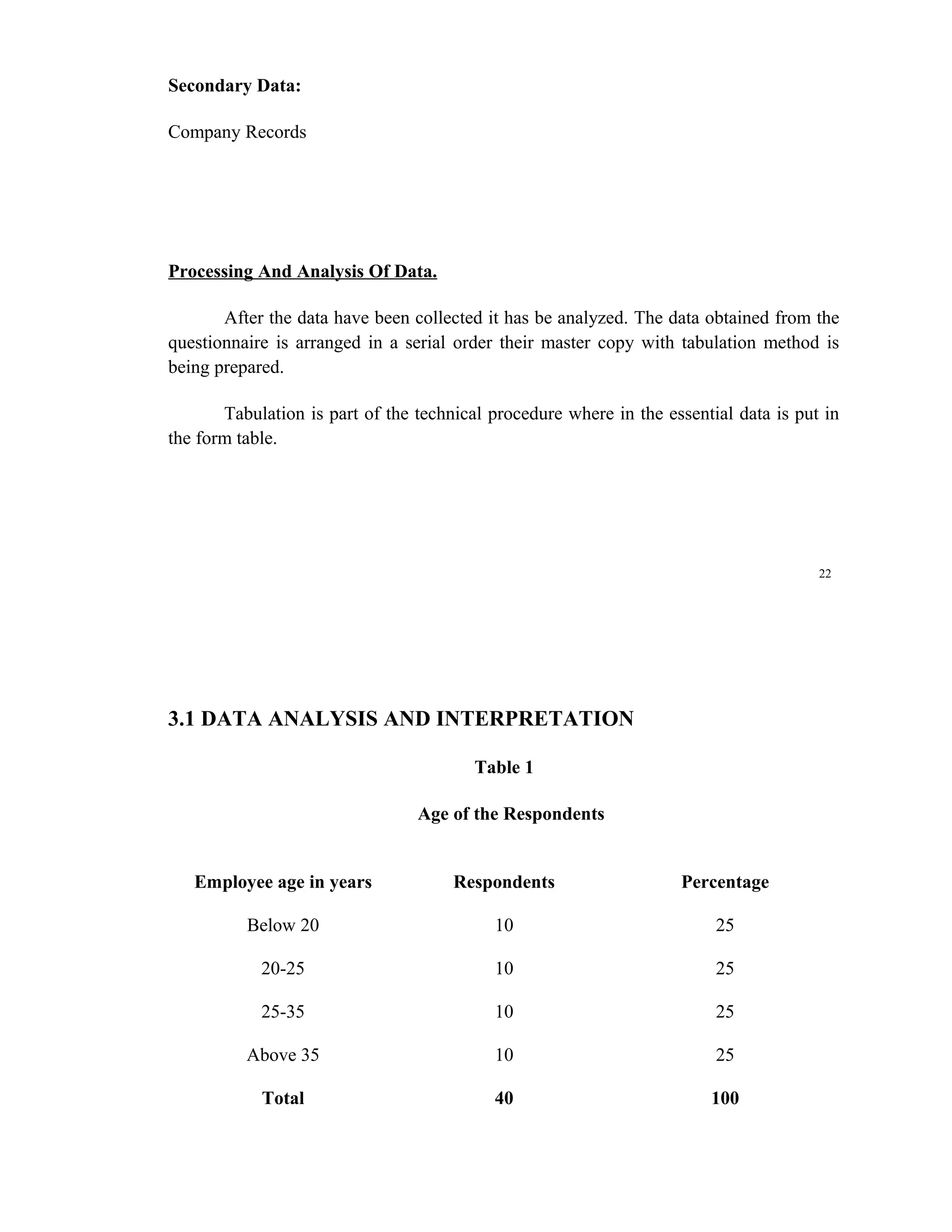
3.1 DATA ANALYSIS AND INTERPRETATION

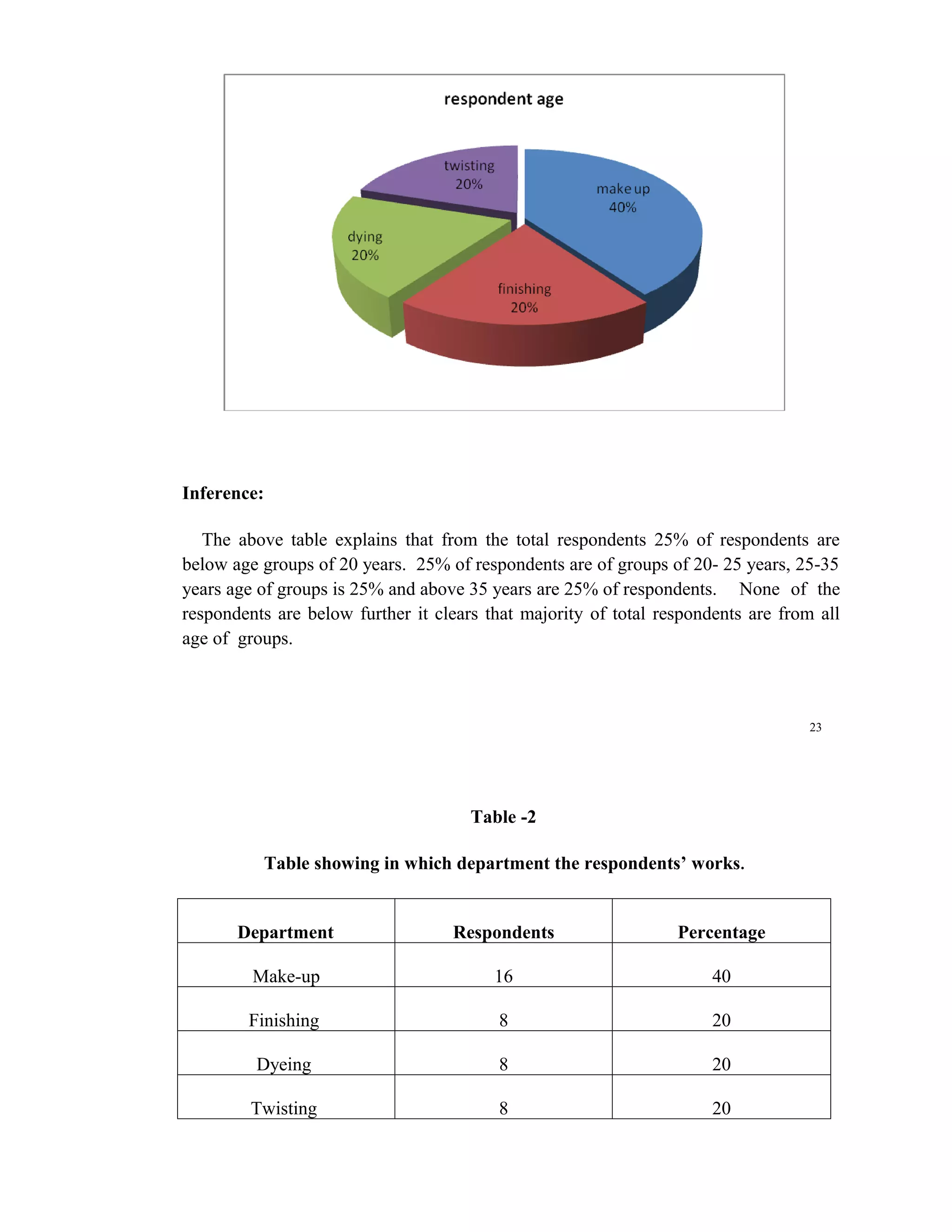
                                         Table 1

                                 Age of the Respondents


   Employee age in years              Respondents                   Percentage

          Below 20                         10                            25

            20-25                          10                            25

            25-35                          10                            25

          Above 35                         10                            25

            Total                          40                           100
Inference:

   The above table explains that from the total respondents 25% of respondents are
below age groups of 20 years. 25% of respondents are of groups of 20- 25 years, 25-35
years age of groups is 25% and above 35 years are 25% of respondents. None of the
respondents are below further it clears that majority of total respondents are from all
age of groups.


                                                                                  23


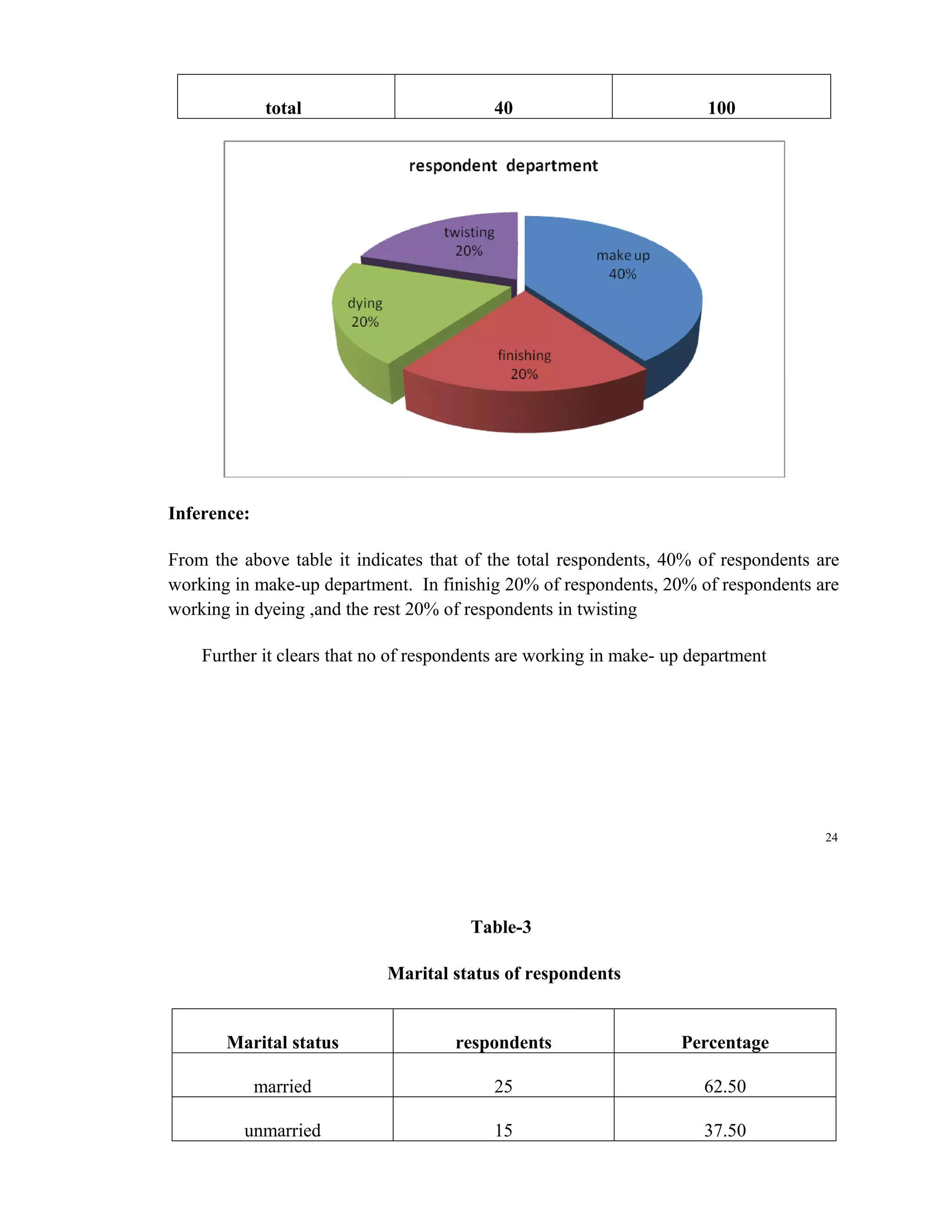
                                      Table -2

             Table showing in which department the respondents’ works.


       Department                  Respondents                   Percentage

         Make-up                         16                           40

        Finishing                        8                            20

         Dyeing                          8                            20

         Twisting                        8                            20
total                       40                           100


Inference:

From the above table it indicates that of the total respondents, 40% of respondents are
working in make-up department. In finishig 20% of respondents, 20% of respondents are
working in dyeing ,and the rest 20% of respondents in twisting

    Further it clears that no of respondents are working in make- up department


                                                                                     24


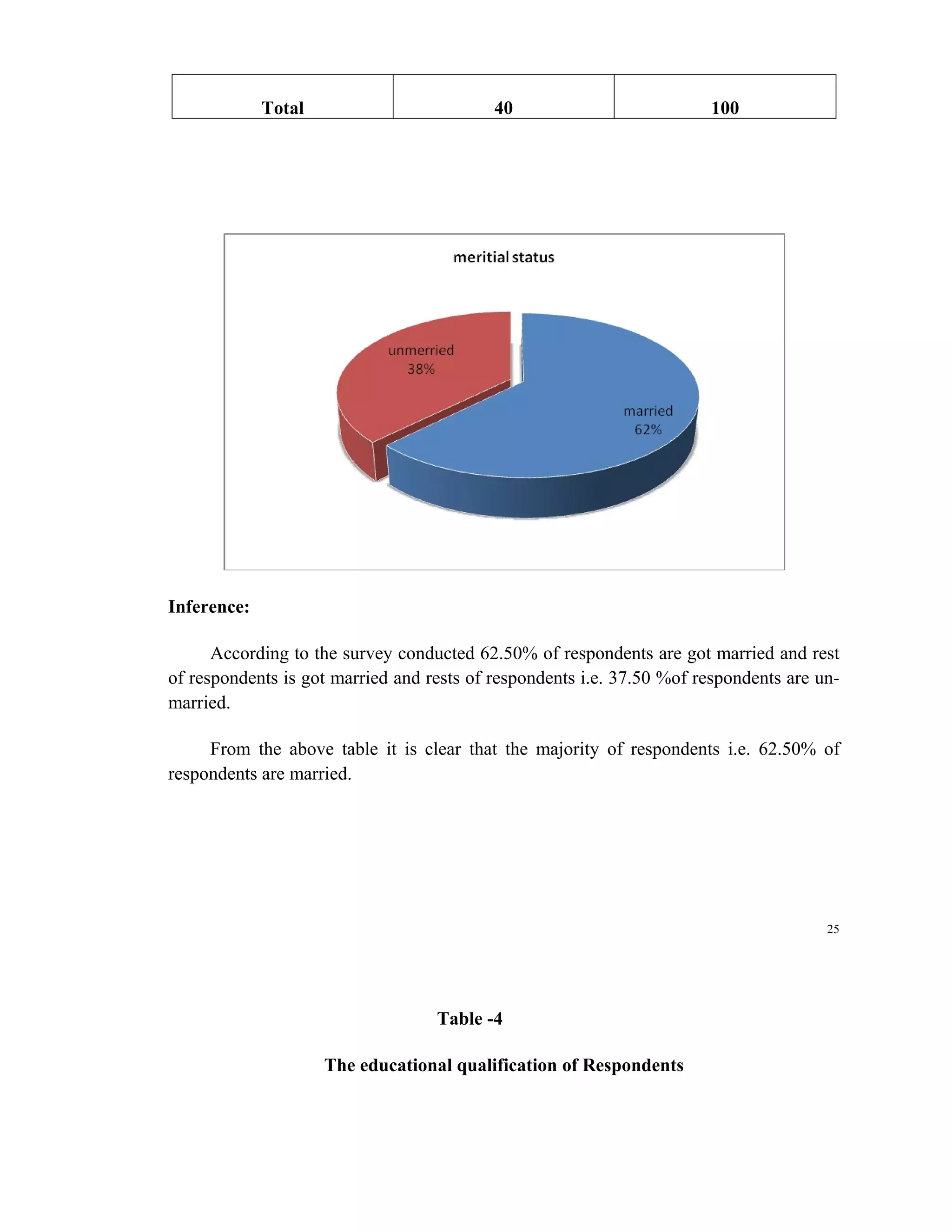
                                       Table-3

                            Marital status of respondents


       Marital status                respondents                   Percentage

             married                      25                          62.50

         unmarried                        15                          37.50
Total                         40                          100


Inference:

      According to the survey conducted 62.50% of respondents are got married and rest
of respondents is got married and rests of respondents i.e. 37.50 %of respondents are un-
married.

     From the above table it is clear that the majority of respondents i.e. 62.50% of
respondents are married.


                                                                                       25


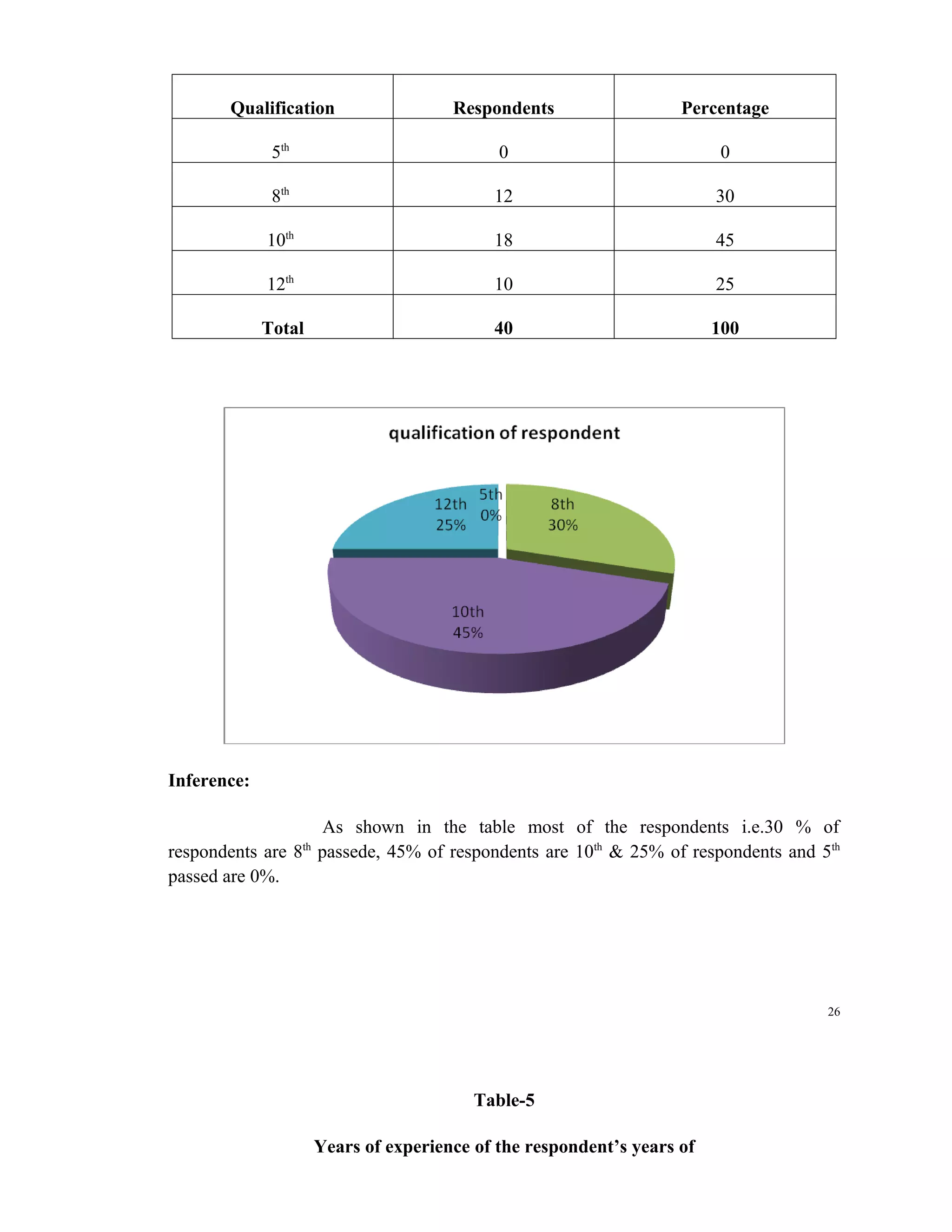
                                   Table -4

                     The educational qualification of Respondents
Qualification                      Respondents                  Percentage

              5th                               0                            0

              8th                              12                           30

             10th                              18                           45

             12th                              10                           25

             Total                             40                           100


Inference:

                   As shown in the table most of the respondents i.e.30 % of
respondents are 8 passede, 45% of respondents are 10th & 25% of respondents and 5th
                    th

passed are 0%.


                                                                                    26


                                             Table-5

                         Years of experience of the respondent’s years of
s.no                experience                Response

                    1                      <1                        8

                    2                     1 to2                      8

                    3                     2 to5                      8

                    4                     5to10                      8

                    5                      >10                       8

                                          total                     40


Inference :

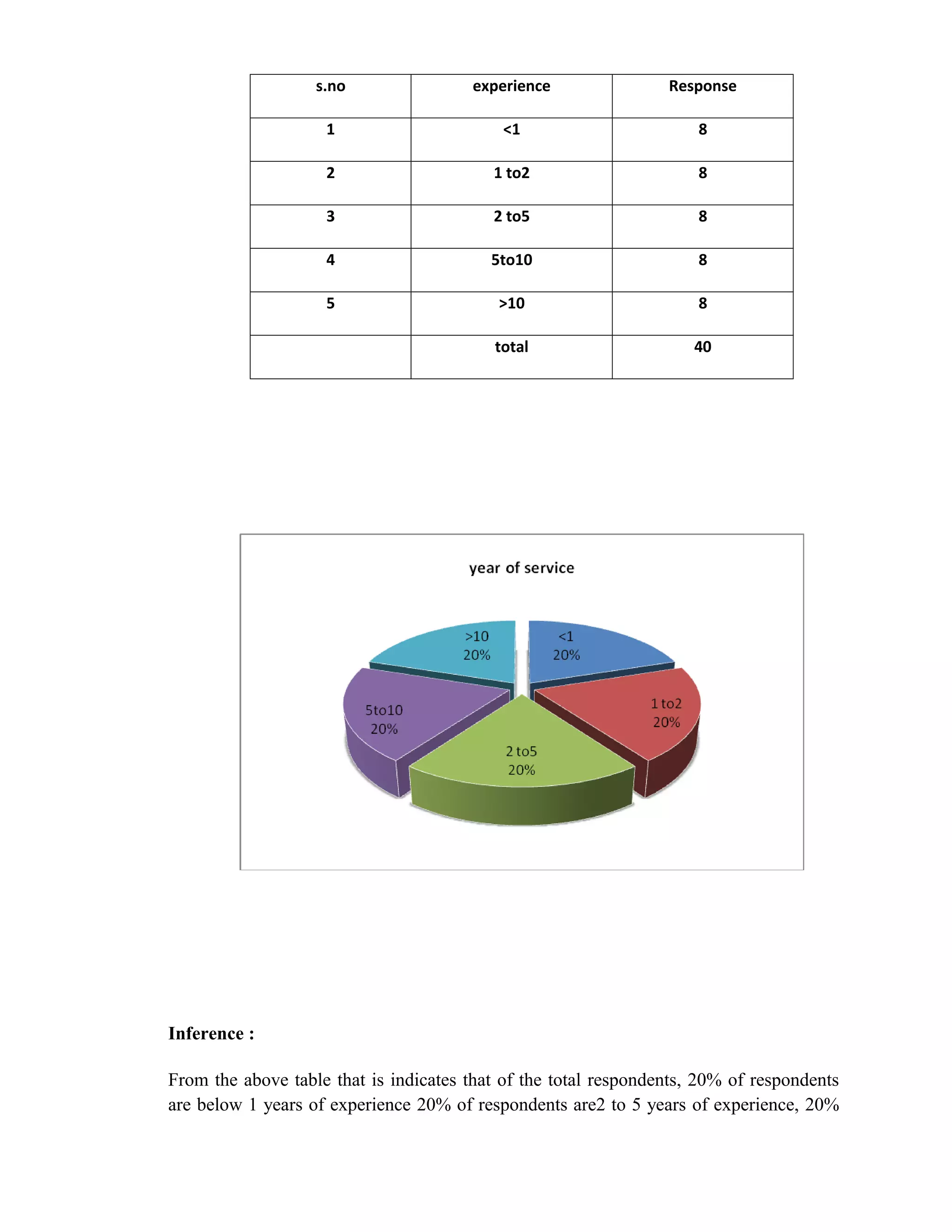
From the above table that is indicates that of the total respondents, 20% of respondents
are below 1 years of experience 20% of respondents are2 to 5 years of experience, 20%
of respondents and having5 to 10 years of experience & rest of respondents i.e. 20% of
respondents & having 10 and more years experience.


                                                                                 27


                                      Table-6

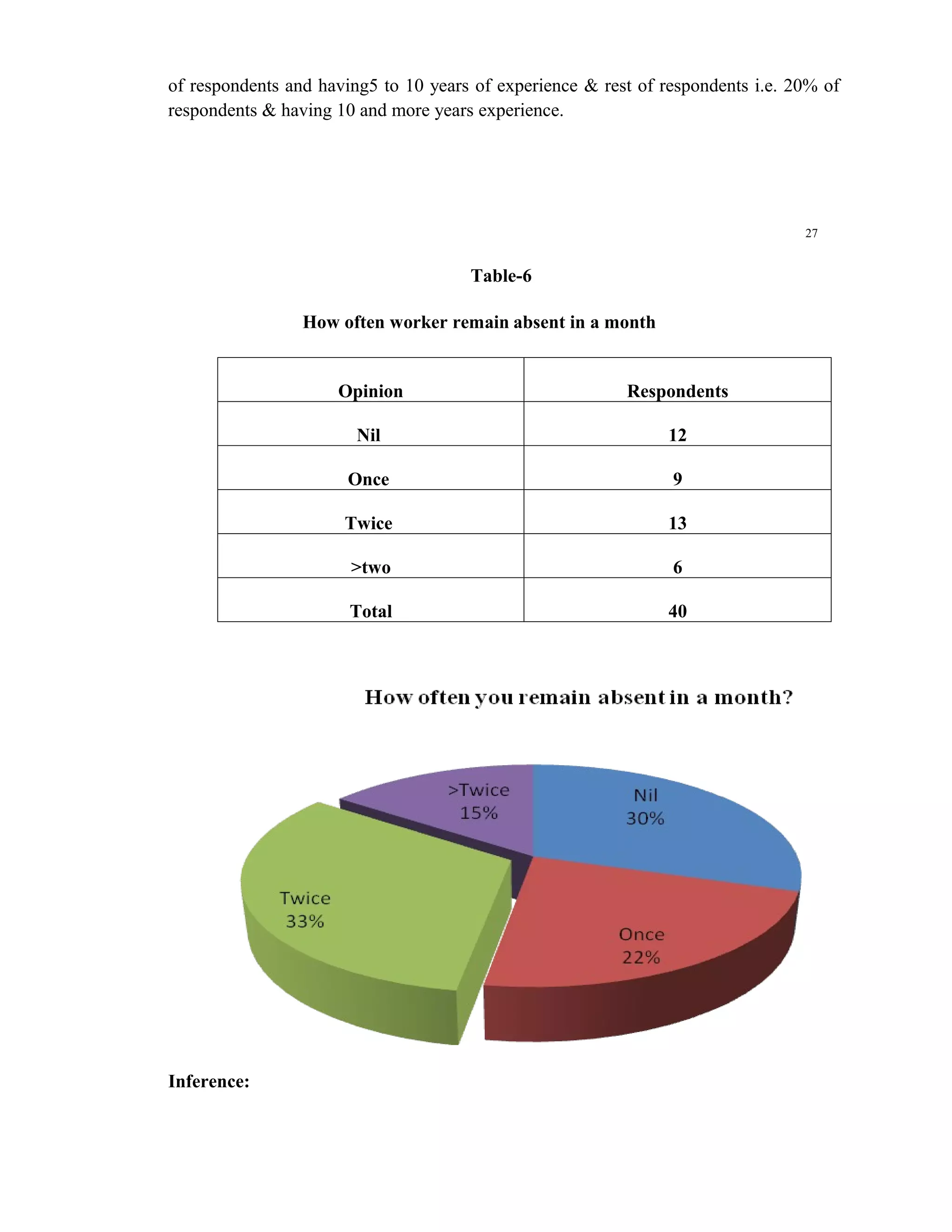
                 How often worker remain absent in a month


                     Opinion                              Respondents

                        Nil                                     12

                       Once                                     9

                      Twice                                     13

                       >two                                     6

                       Total                                    40


Inference:
As shown in above table out of 40 respondent 30% does
not remain absent in a month, 22% remain absent once in a month,33% absent for two
days in a month and remain 15% absent more than two days


                                                                              28


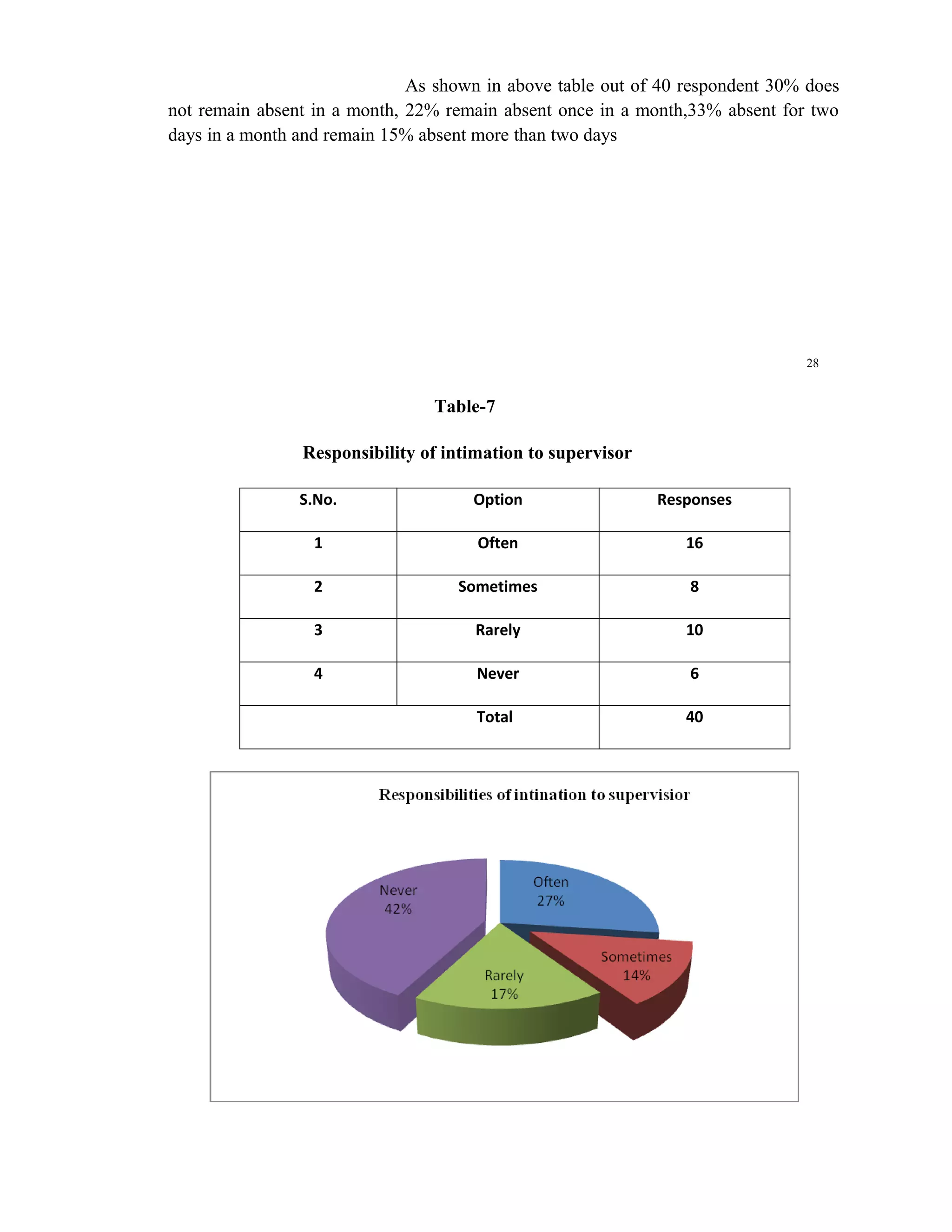
                                Table-7

                Responsibility of intimation to supervisor

                S.No.                Option                  Responses

                  1                   Often                     16

                  2                Sometimes                    8

                  3                   Rarely                    10

                  4                   Never                     6

                                      Total                     40
Inference:

As per the table 17%of respondents feeling this responsibility rarely 14% feel it
sometimes where as 27% feel it as must and the other i.e. 42% feel it never.


                                                                              29


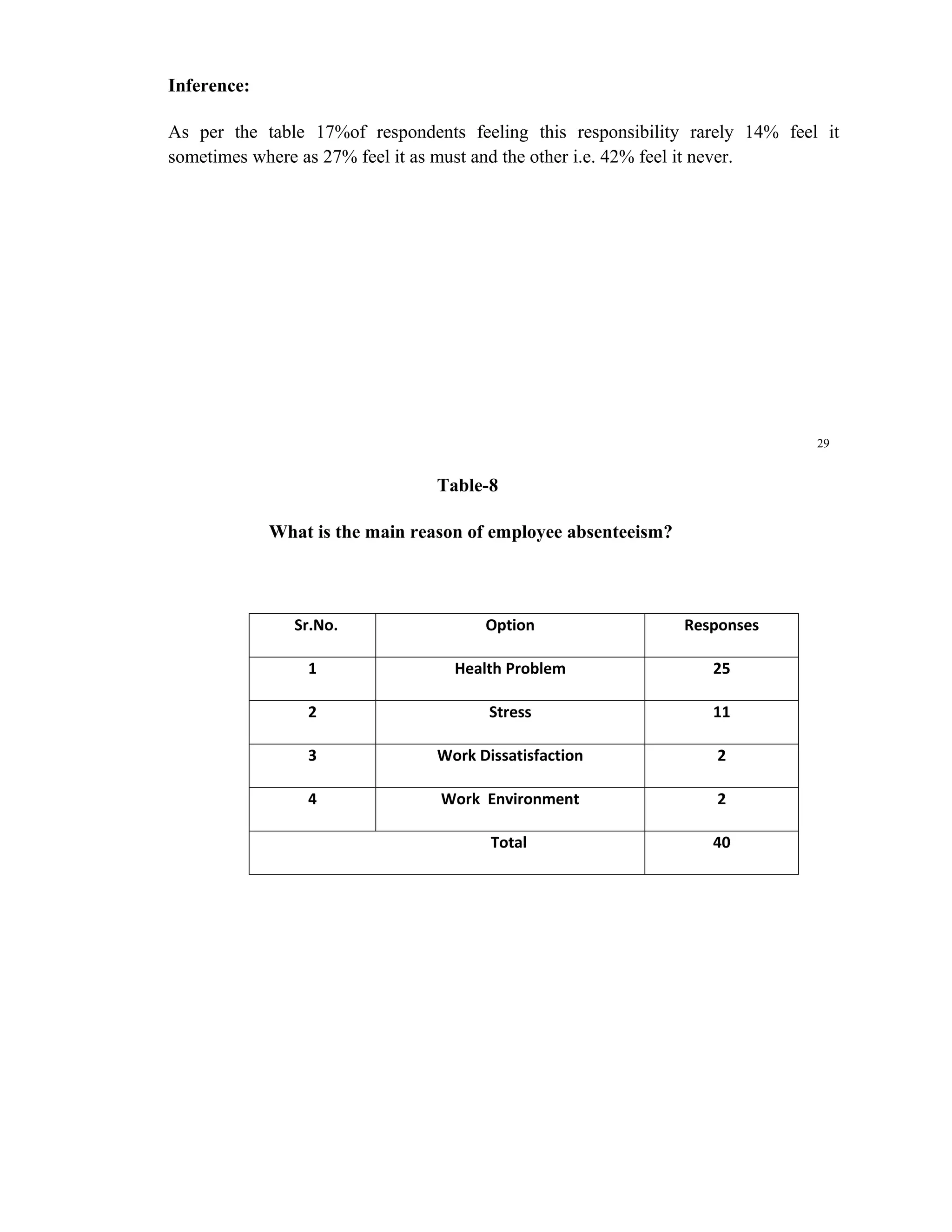
                                Table-8

             What is the main reason of employee absenteeism?


                Sr.No.                Option                    Responses

                 1                 Health Problem                  25

                 2                     Stress                      11

                 3              Work Dissatisfaction               2

                 4               Work Environment                  2

                                       Total                       40
Inference:

    Out of total 40 respondents, 62% of respondents are absent because of health
problem, and 28% of respondents absents because of stress ,5% of respondents will
absent because of work dissatisfaction ,and remain 5% because of work environment

   From the above table it is clearly observed that the workers will absent to duty i.e.
62% are absent for health reason only


                                                                                      30


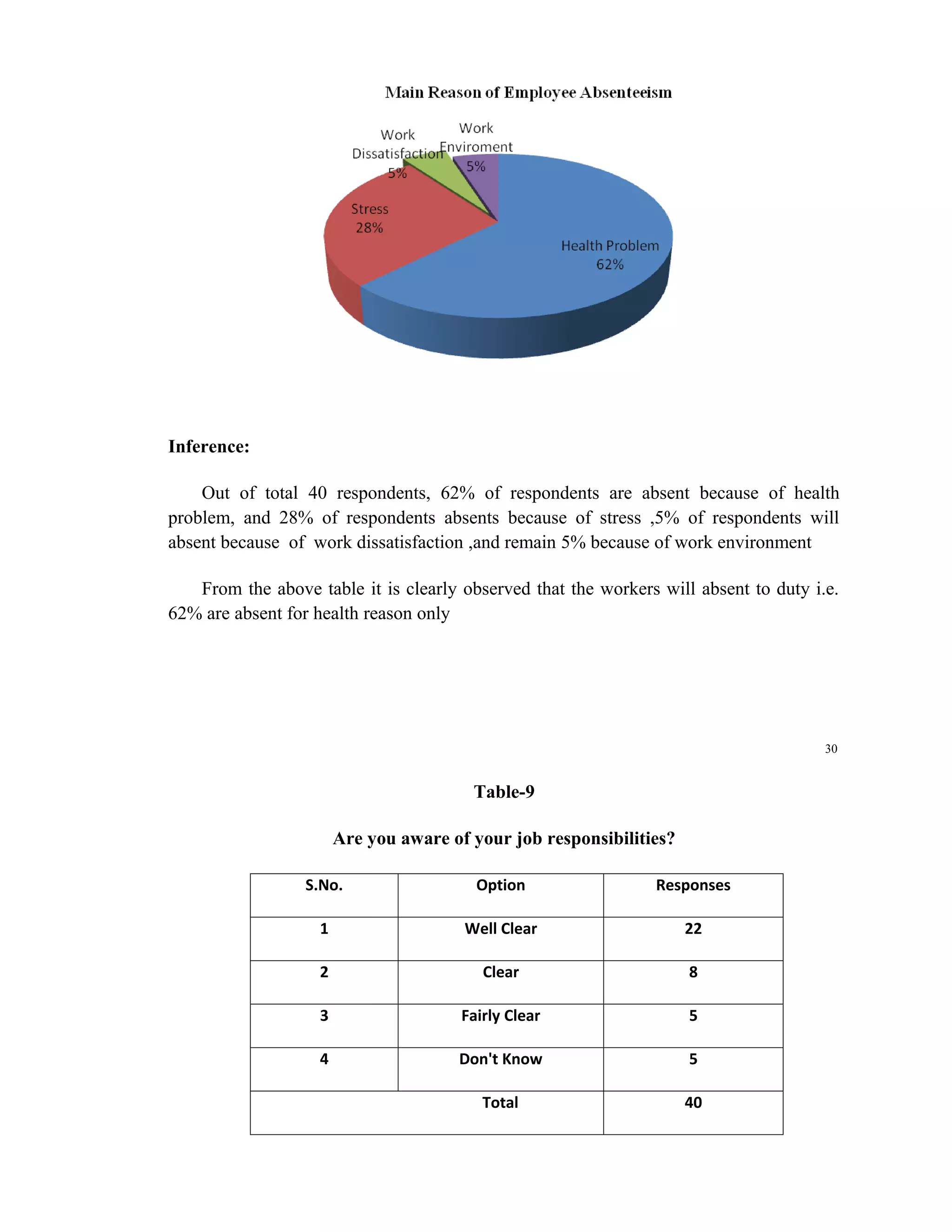
                                        Table-9

                       Are you aware of your job responsibilities?

                  S.No.                  Option                 Responses

                   1                   Well Clear                    22

                   2                      Clear                      8

                   3                   Fairly Clear                  5

                   4                  Don't Know                     5

                                          Total                      40
Inference :

              Out of 40 respondent 55% respondent are well clear about their job
responsibilities ,20%say clear ,12%say they are fairly clear and restof13%dont know
about their responsibilities


                                                                                 31


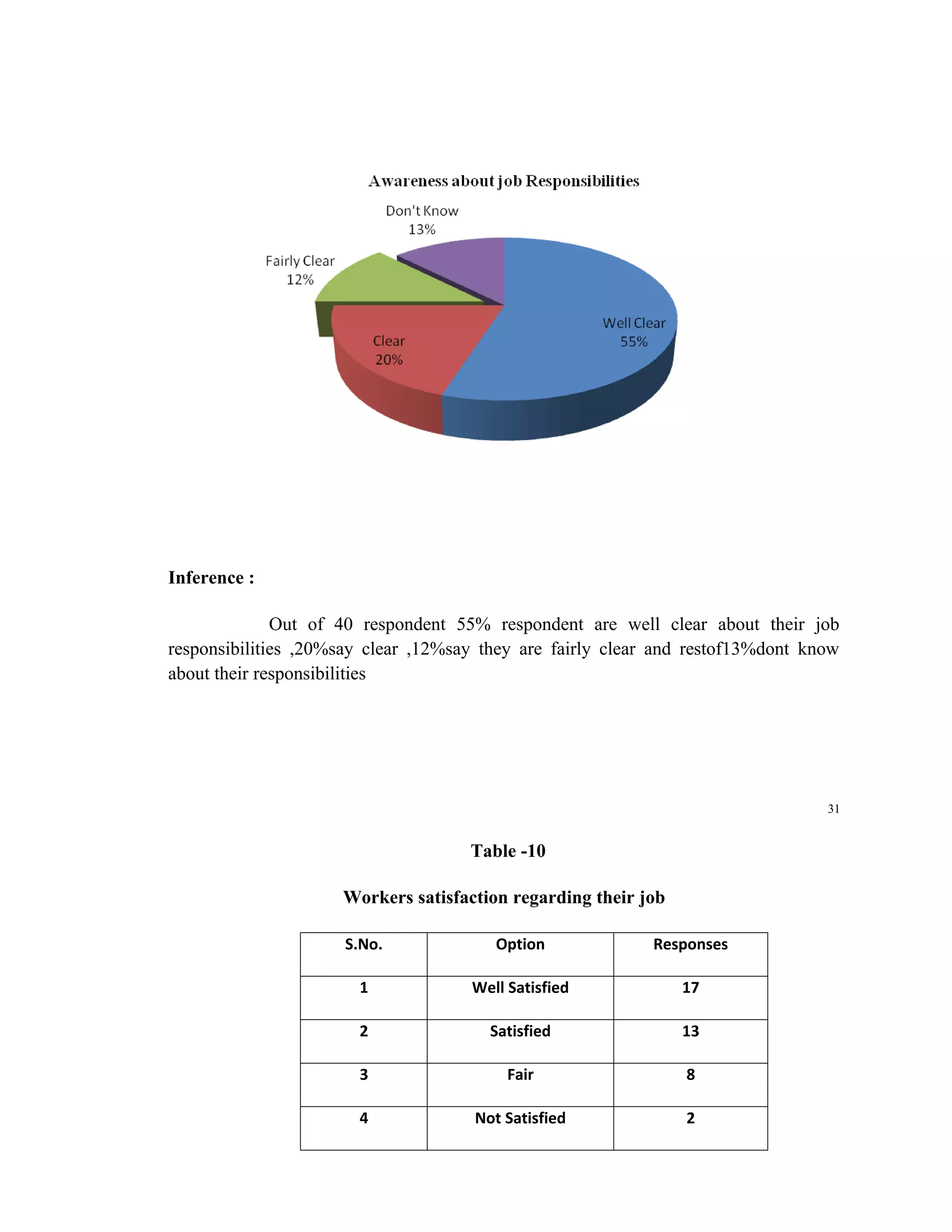
                                     Table -10

                     Workers satisfaction regarding their job

                     S.No.              Option             Responses

                       1             Well Satisfied             17

                       2               Satisfied                13

                       3                  Fair                  8

                       4             Not Satisfied              2
Total                    40


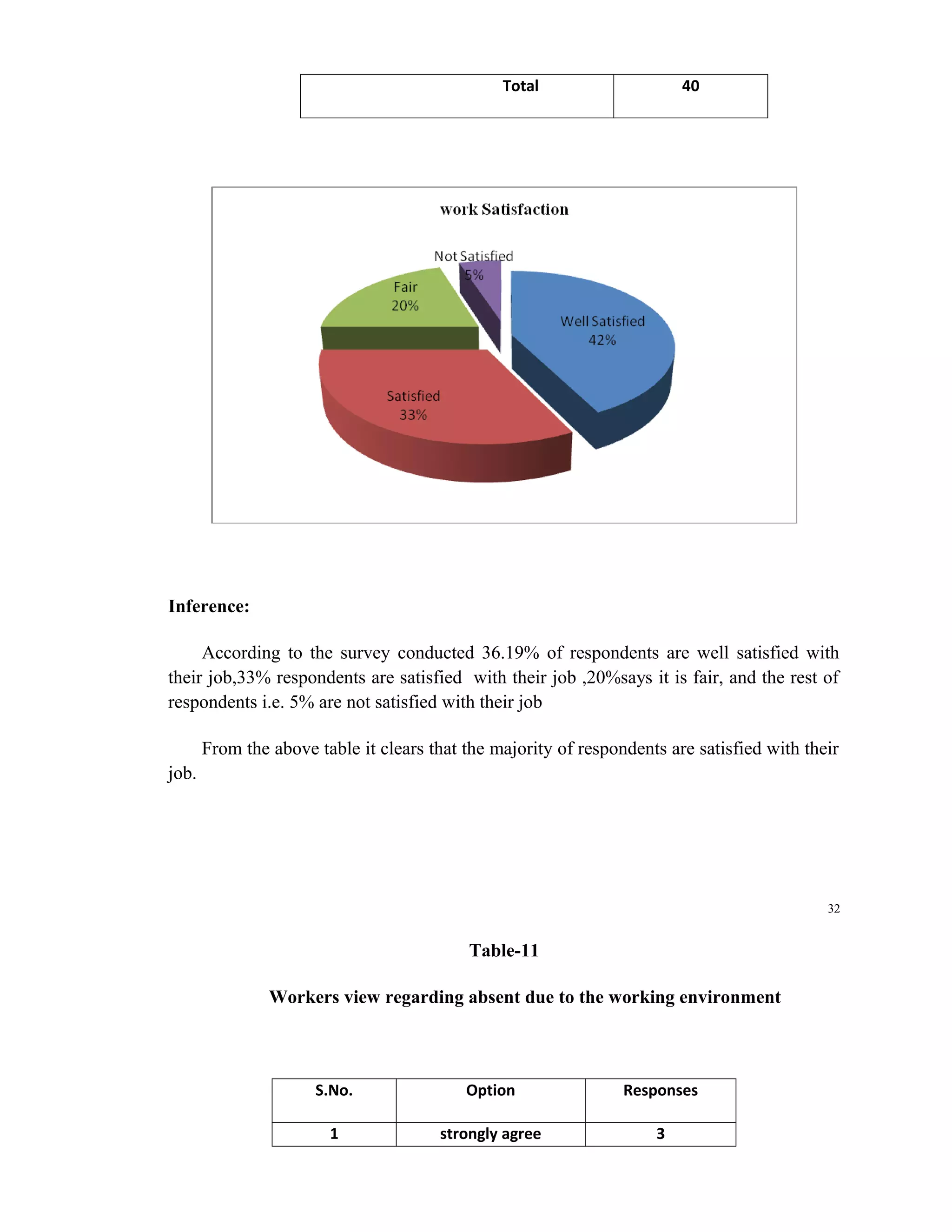
Inference:

     According to the survey conducted 36.19% of respondents are well satisfied with
their job,33% respondents are satisfied with their job ,20%says it is fair, and the rest of
respondents i.e. 5% are not satisfied with their job

       From the above table it clears that the majority of respondents are satisfied with their
job.


                                                                                             32


                                           Table-11

                Workers view regarding absent due to the working environment


                      S.No.                Option                Responses

                        1              strongly agree                3
2                  Agree                    6

                     3                 Disagree                 10

                     4             strongly disagree            21

                                        Total                   40


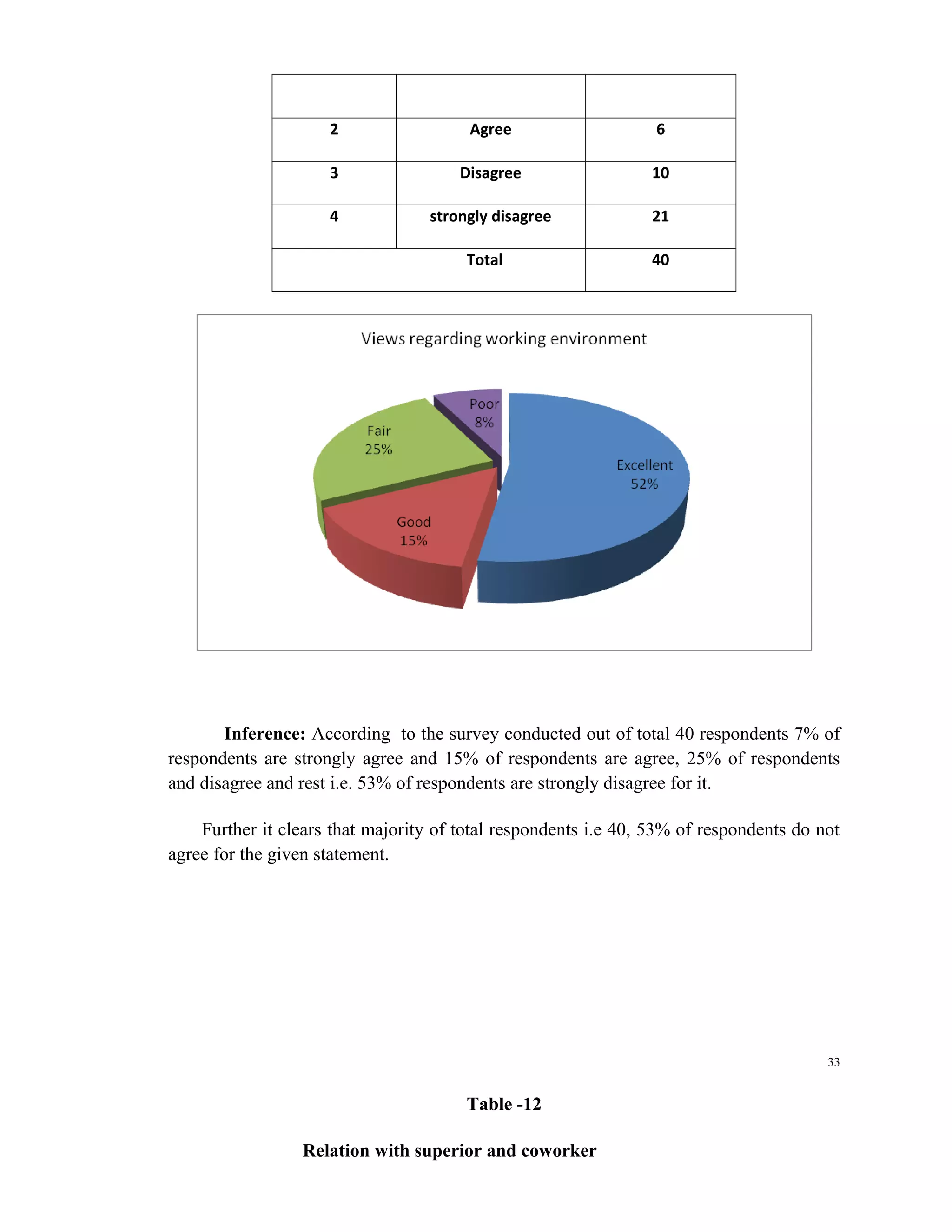
       Inference: According to the survey conducted out of total 40 respondents 7% of
respondents are strongly agree and 15% of respondents are agree, 25% of respondents
and disagree and rest i.e. 53% of respondents are strongly disagree for it.

    Further it clears that majority of total respondents i.e 40, 53% of respondents do not
agree for the given statement.


                                                                                        33


                                        Table -12

                  Relation with superior and coworker
S.No.            Option             Responses

                      1              Very Good              25

                      2                Good                  6

                      3                 Fair                 4

                      4                Poor                  5

                                     Total                  40


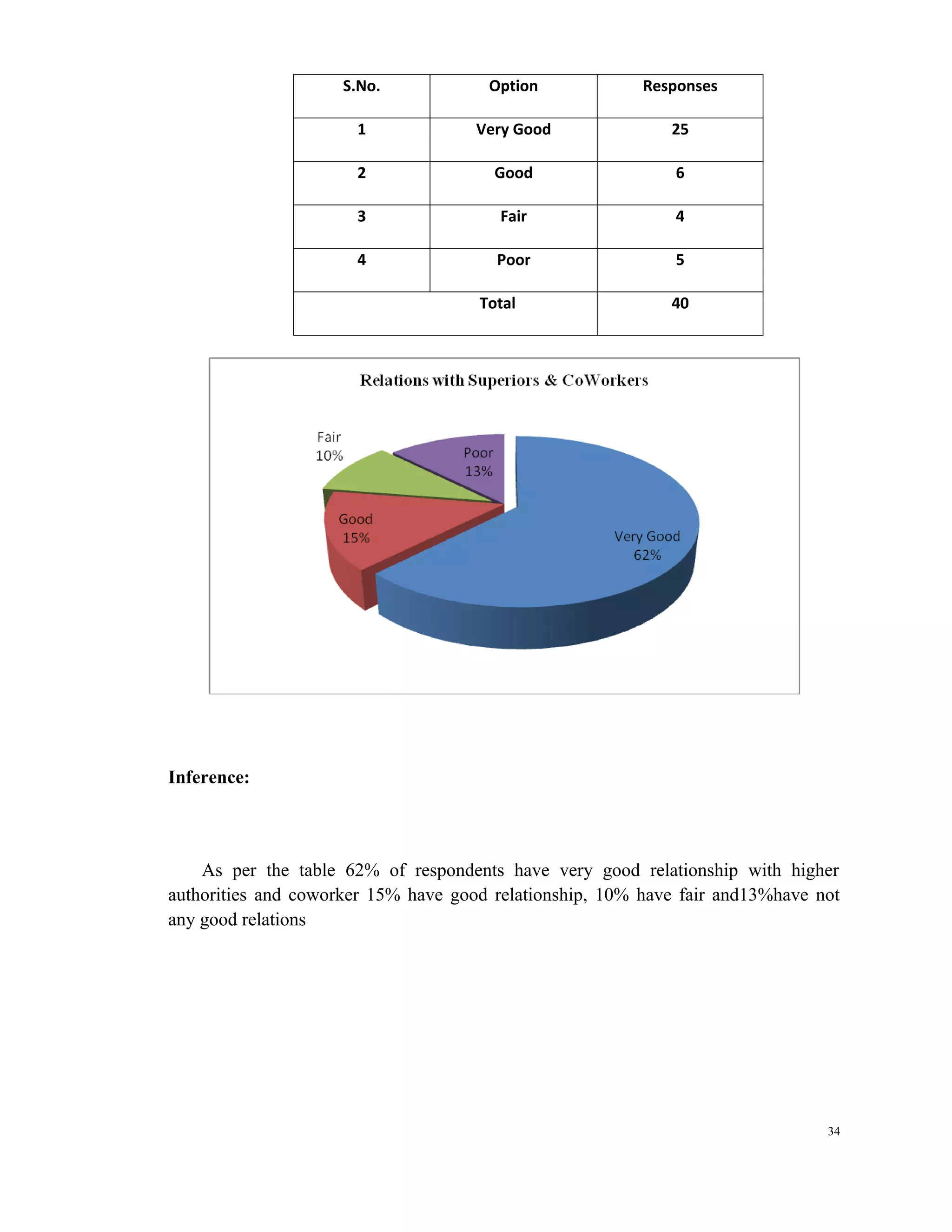
Inference:


    As per the table 62% of respondents have very good relationship with higher
authorities and coworker 15% have good relationship, 10% have fair and13%have not
any good relations


                                                                               34
Table-13

                    Superior behavior towards worker problem

                   S.No.             Option              Responses

                     1              Very Good               21

                     2                Good                   6

                     3                 Fair                 10

                     4                Poor                   3

                                      Total                 40


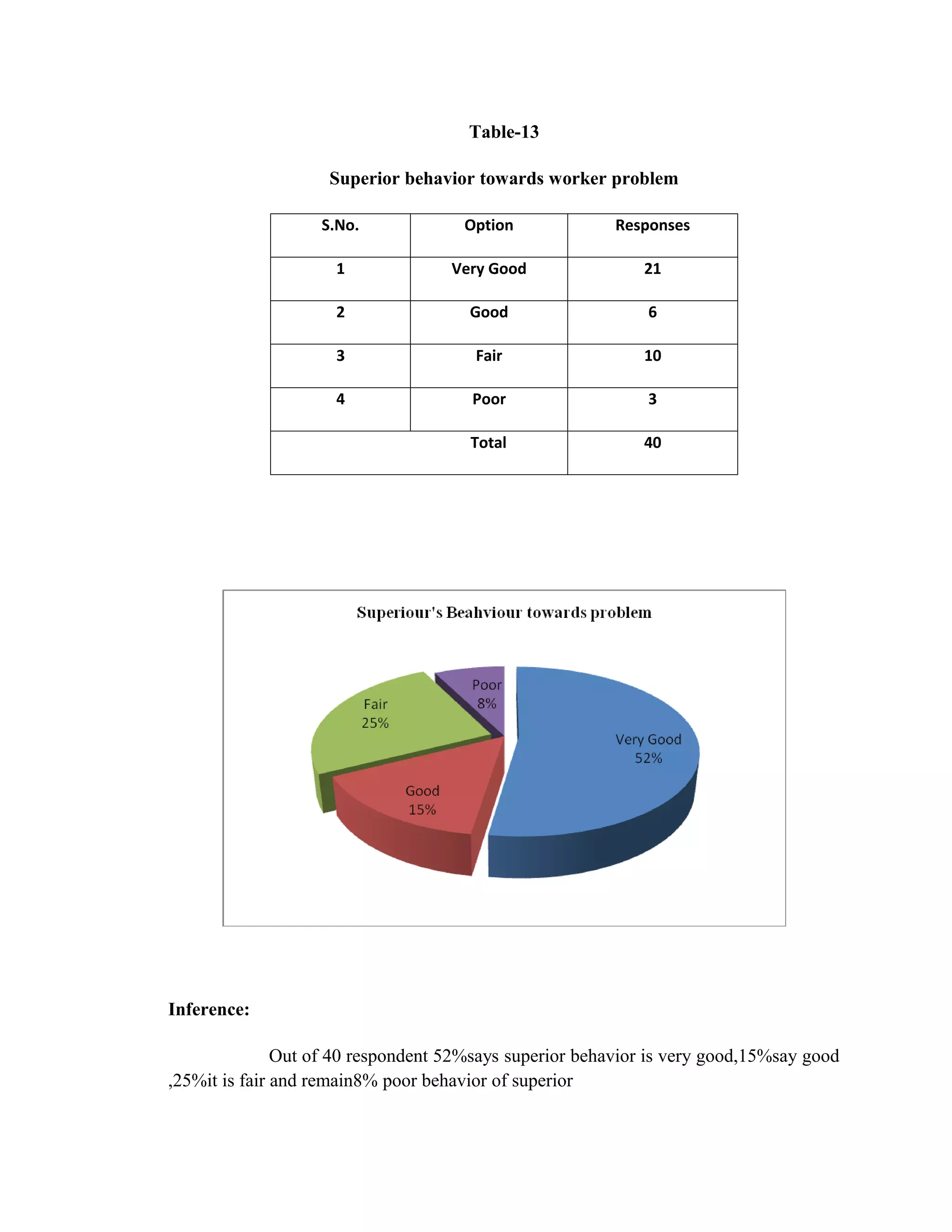
Inference:

               Out of 40 respondent 52%says superior behavior is very good,15%say good
,25%it is fair and remain8% poor behavior of superior
35


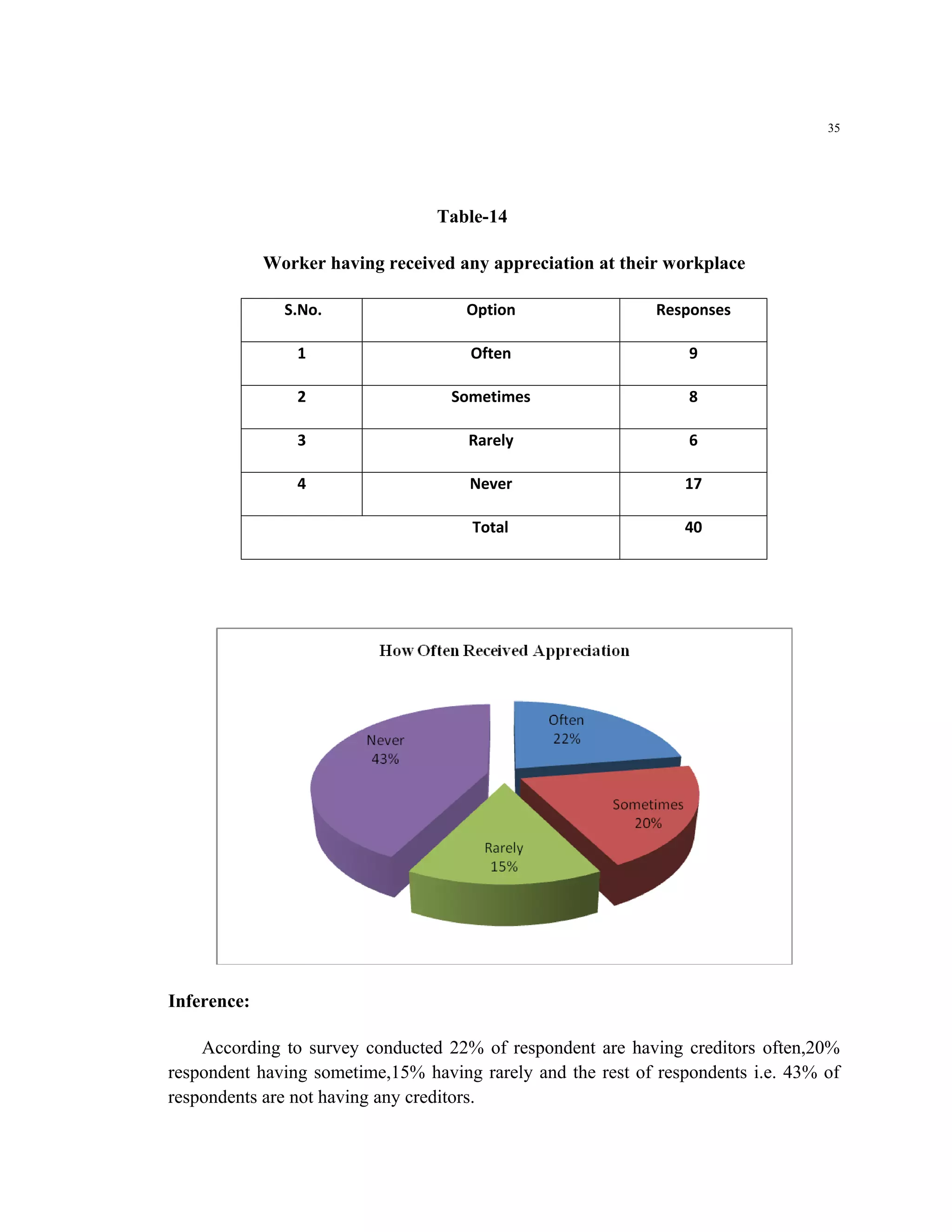
                                 Table-14

             Worker having received any appreciation at their workplace

               S.No.                 Option                  Responses

                 1                   Often                       9

                 2                 Sometimes                     8

                 3                   Rarely                      6

                 4                   Never                      17

                                      Total                     40


Inference:

    According to survey conducted 22% of respondent are having creditors often,20%
respondent having sometime,15% having rarely and the rest of respondents i.e. 43% of
respondents are not having any creditors.
Further it is clear that majority of total respondents i.e. 43% of respondents are not
having creditors at their workplace.


                                                                                        36


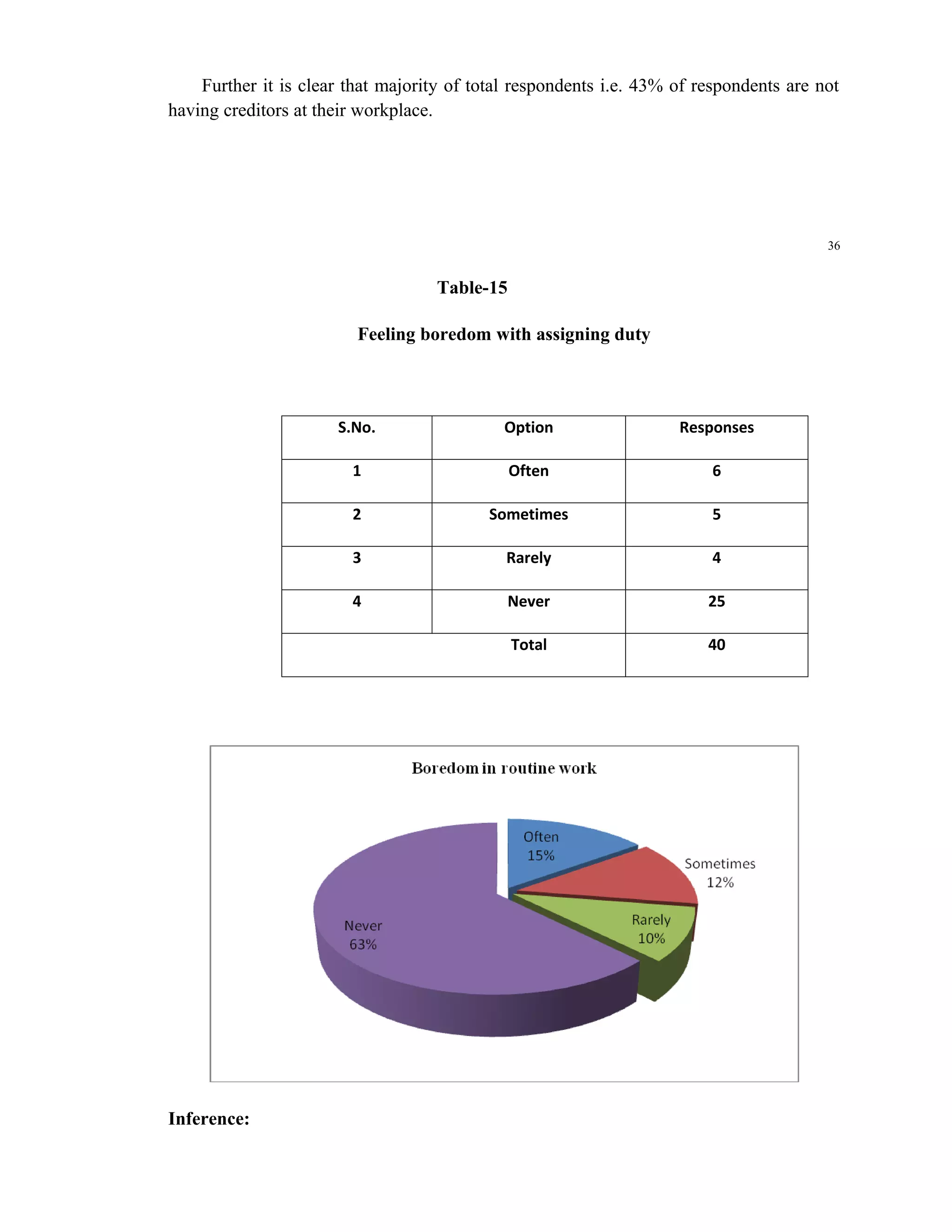
                                    Table-15

                         Feeling boredom with assigning duty


                      S.No.                  Option                 Responses

                        1                      Often                     6

                        2                  Sometimes                     5

                        3                    Rarely                      4

                        4                      Never                    25

                                               Total                    40


Inference:
The table shows that 10% of the respondents felt boredom at work rarely, 12% felt
sometimes, 15% felt always and 63% felt never, it seems that the majority employees are
interested in the work.


                                                                                     37


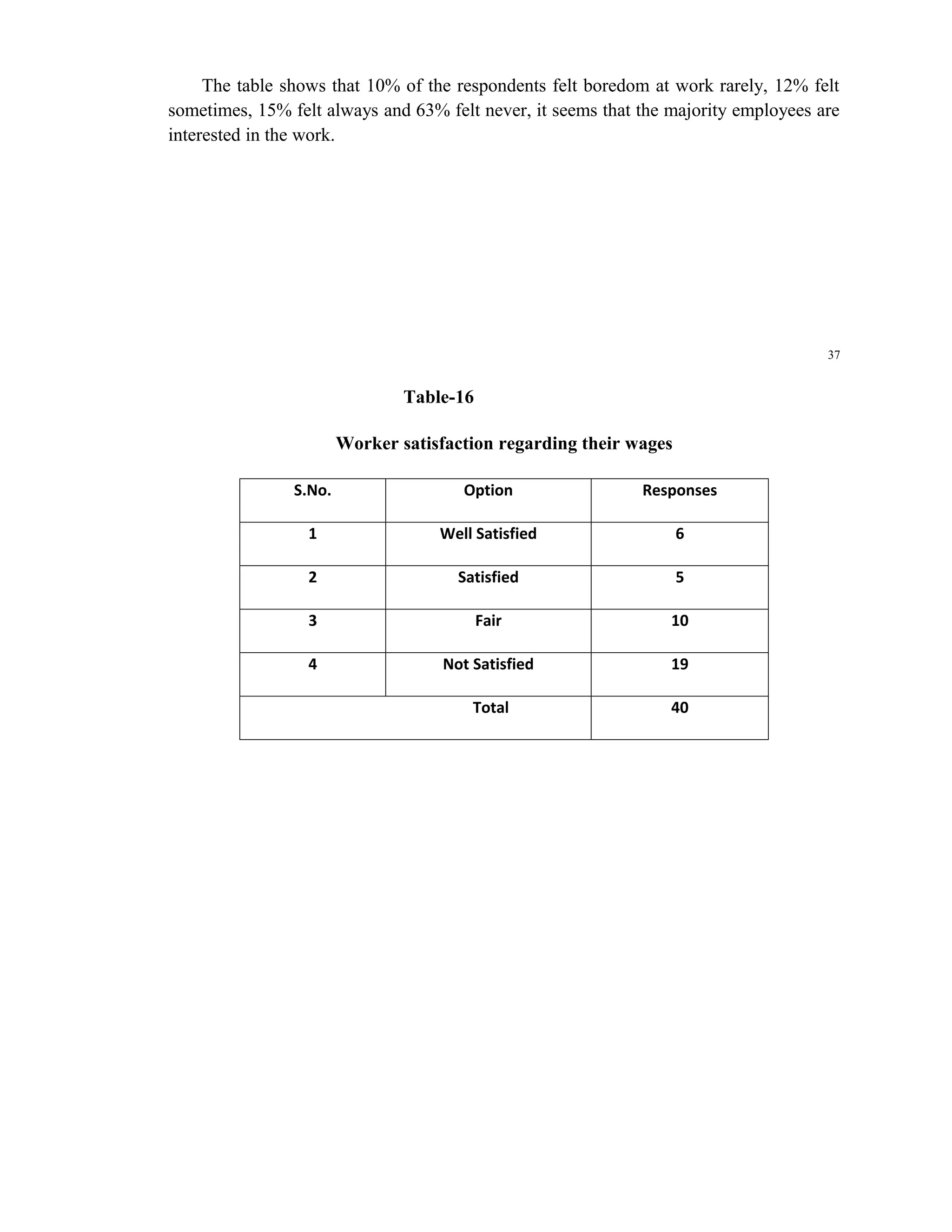
                                Table-16

                        Worker satisfaction regarding their wages

                S.No.                  Option                Responses

                  1                 Well Satisfied                  6

                  2                    Satisfied                    5

                  3                        Fair                  10

                  4                  Not Satisfied               19

                                         Total                   40
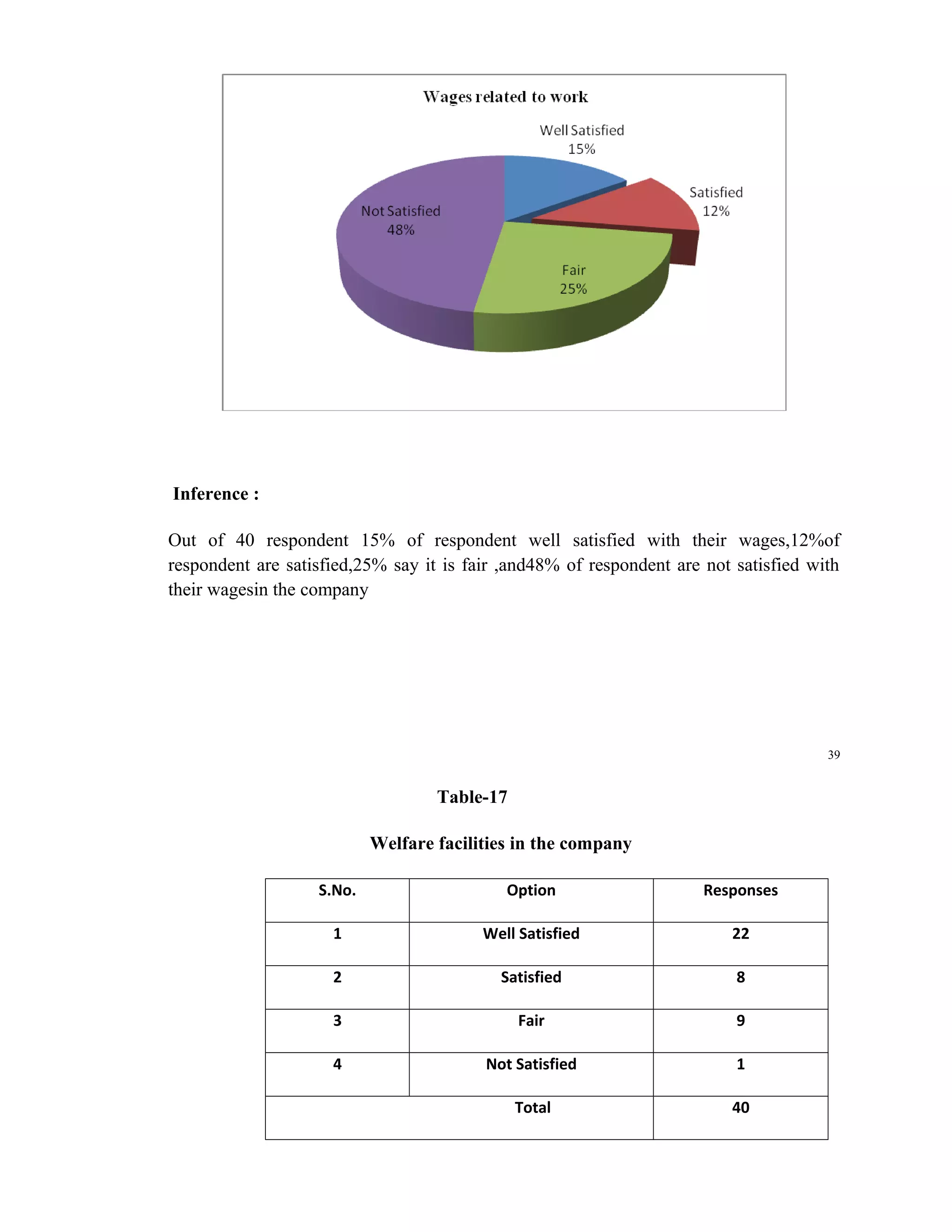
Inference :

Out of 40 respondent 15% of respondent well satisfied with their wages,12%of
respondent are satisfied,25% say it is fair ,and48% of respondent are not satisfied with
their wagesin the company


                                                                                      39


                                   Table-17

                           Welfare facilities in the company

                   S.No.                    Option                    Responses

                     1                   Well Satisfied                  22

                     2                     Satisfied                      8

                     3                        Fair                        9

                     4                   Not Satisfied                    1

                                              Total                      40
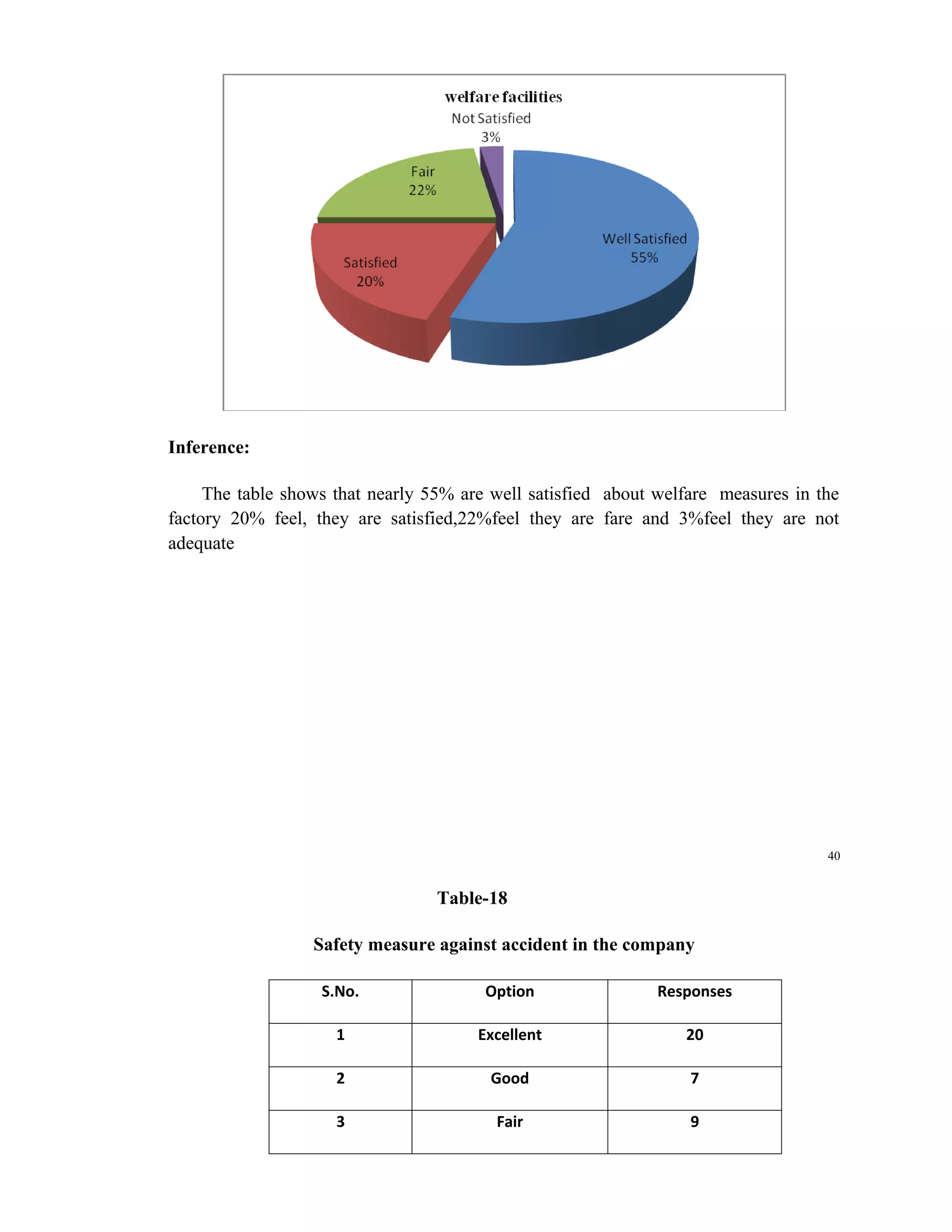
Inference:

     The table shows that nearly 55% are well satisfied about welfare measures in the
factory 20% feel, they are satisfied,22%feel they are fare and 3%feel they are not
adequate


                                                                                   40


                                  Table-18

                  Safety measure against accident in the company

                   S.No.                Option               Responses

                     1                 Excellent                 20

                     2                  Good                      7

                     3                   Fair                     9
4                    Poor                    4

                                         Total                    40


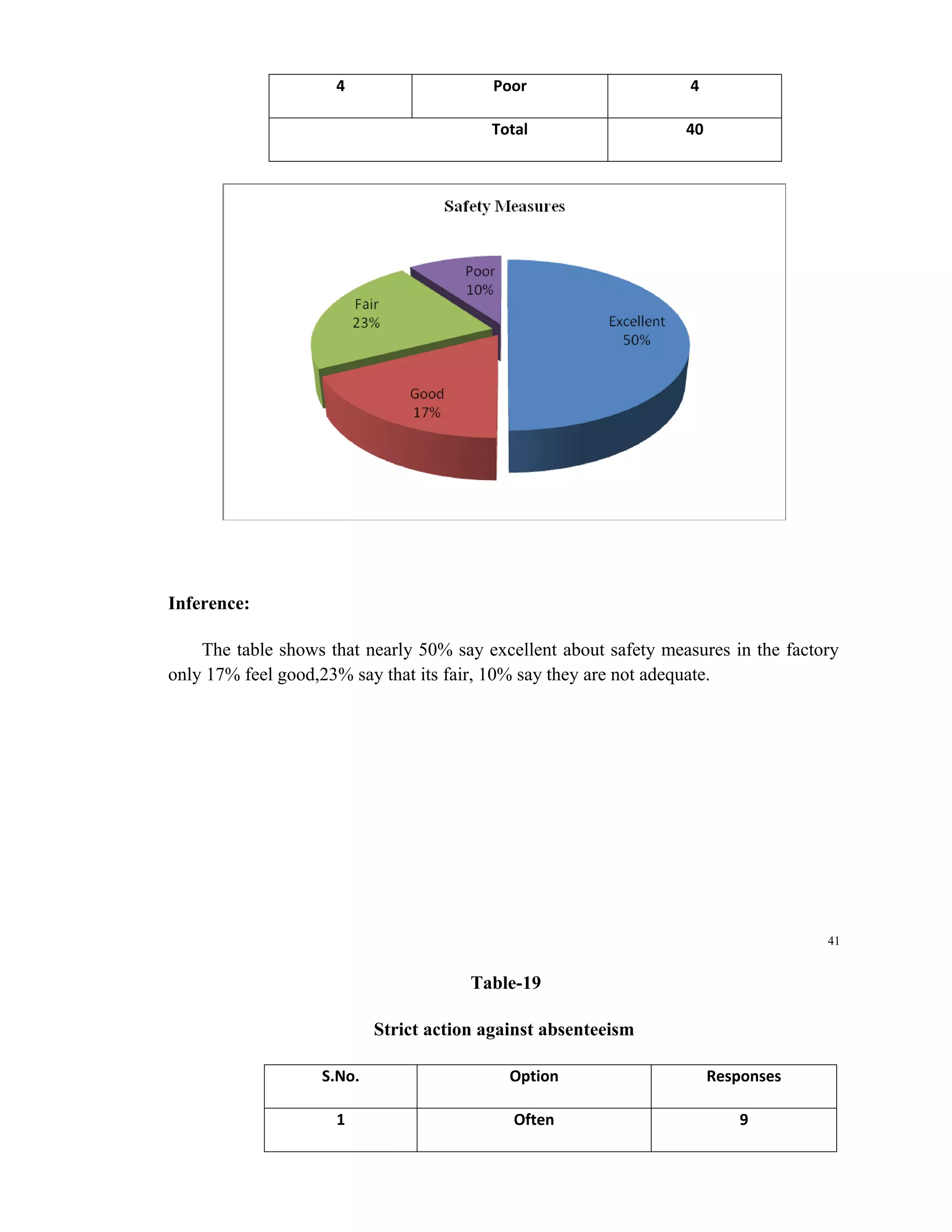
Inference:

    The table shows that nearly 50% say excellent about safety measures in the factory
only 17% feel good,23% say that its fair, 10% say they are not adequate.


                                                                                    41


                                       Table-19

                           Strict action against absenteeism

                   S.No.                    Option                     Responses

                     1                      Often                         9
2                     Sometimes                   6

                     3                       Rarely                    8

                     4                       Never                    17

                                                                       40

                                             Total


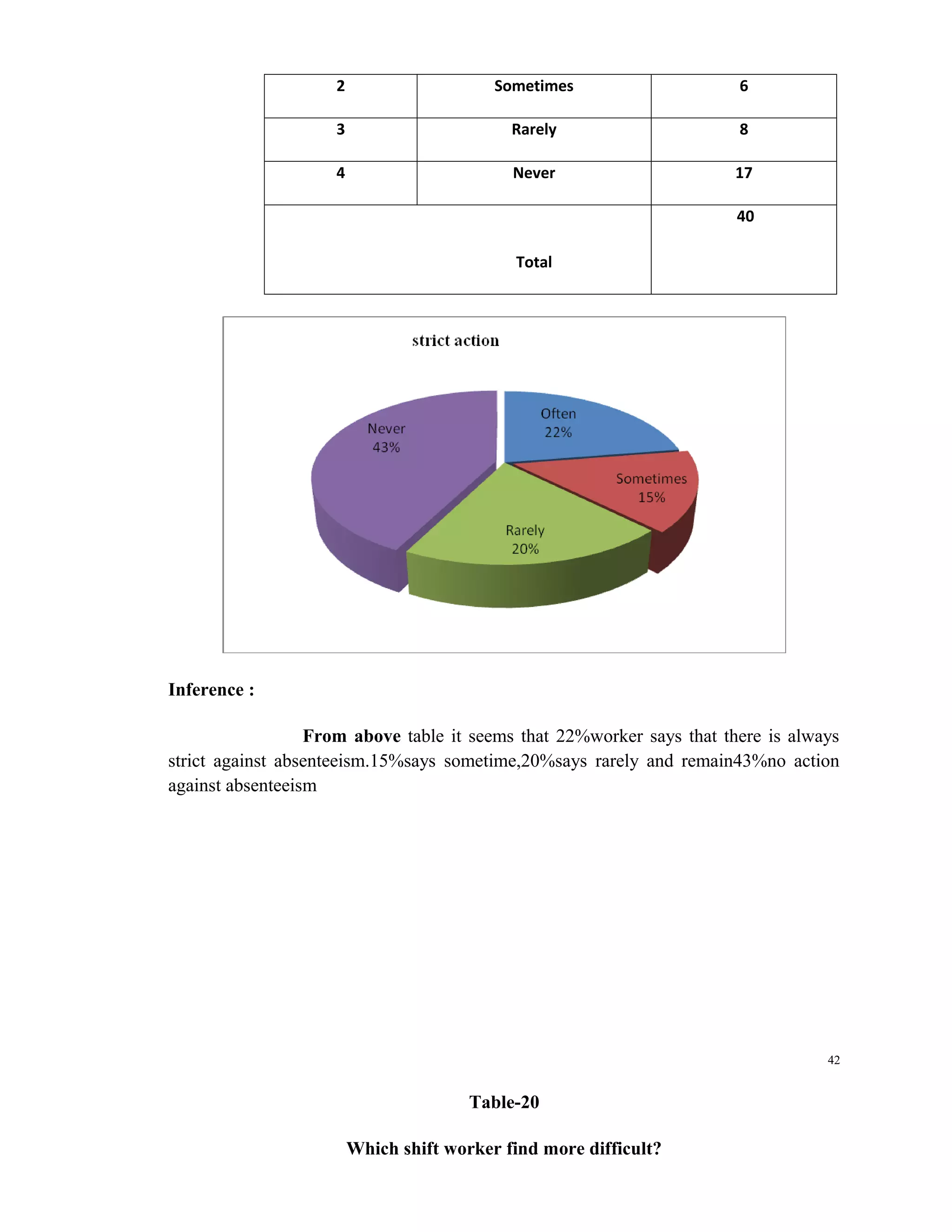
Inference :

                  From above table it seems that 22%worker says that there is always
strict against absenteeism.15%says sometime,20%says rarely and remain43%no action
against absenteeism


                                                                                  42


                                        Table-20

                         Which shift worker find more difficult?
S.No.                     Option                   Responses

                  1                    Morning                       14

                  2                    Evening                       0

                  3                     Night                        10

                  4                     None                         16

                                        Total                        40


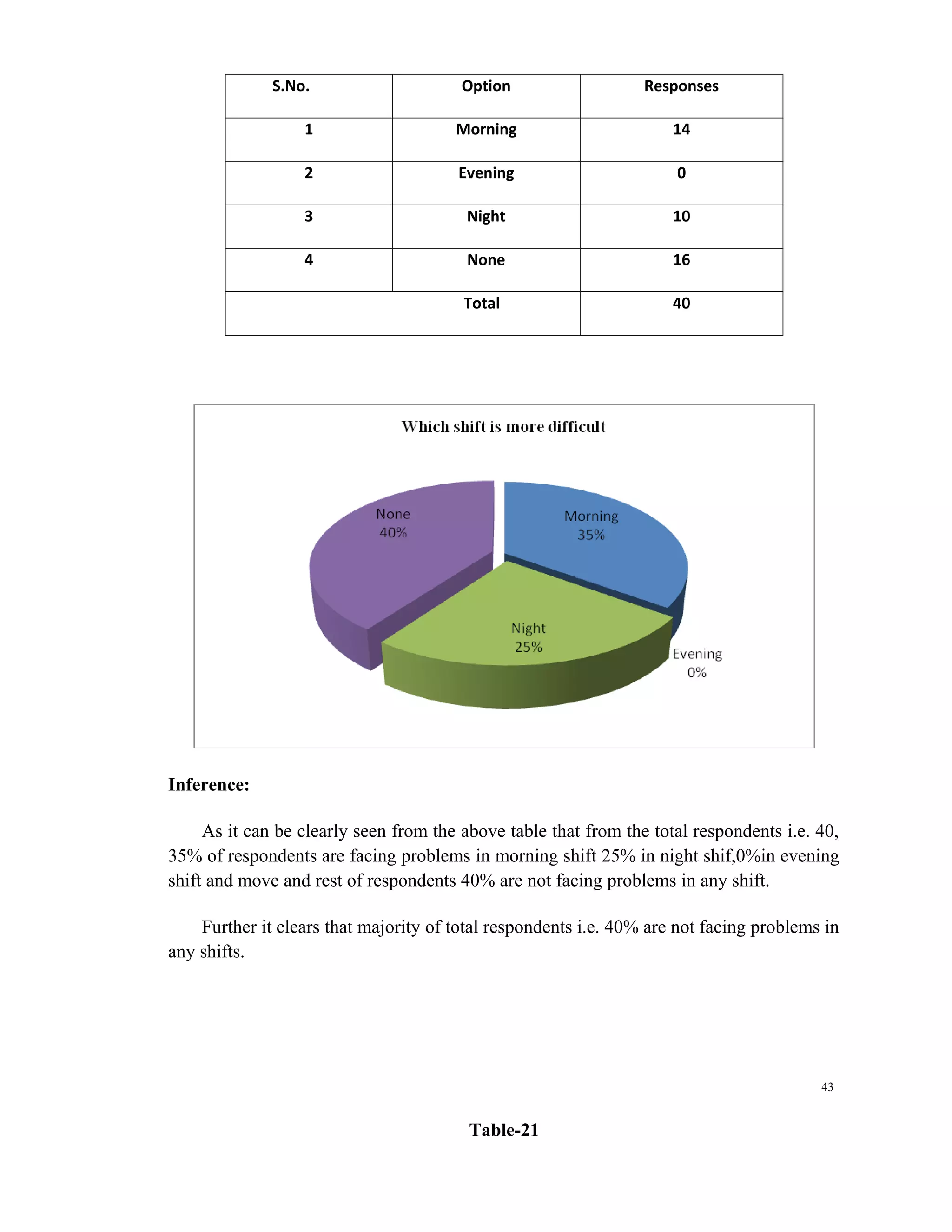
Inference:

     As it can be clearly seen from the above table that from the total respondents i.e. 40,
35% of respondents are facing problems in morning shift 25% in night shif,0%in evening
shift and move and rest of respondents 40% are not facing problems in any shift.

    Further it clears that majority of total respondents i.e. 40% are not facing problems in
any shifts.


                                                                                         43


                                         Table-21
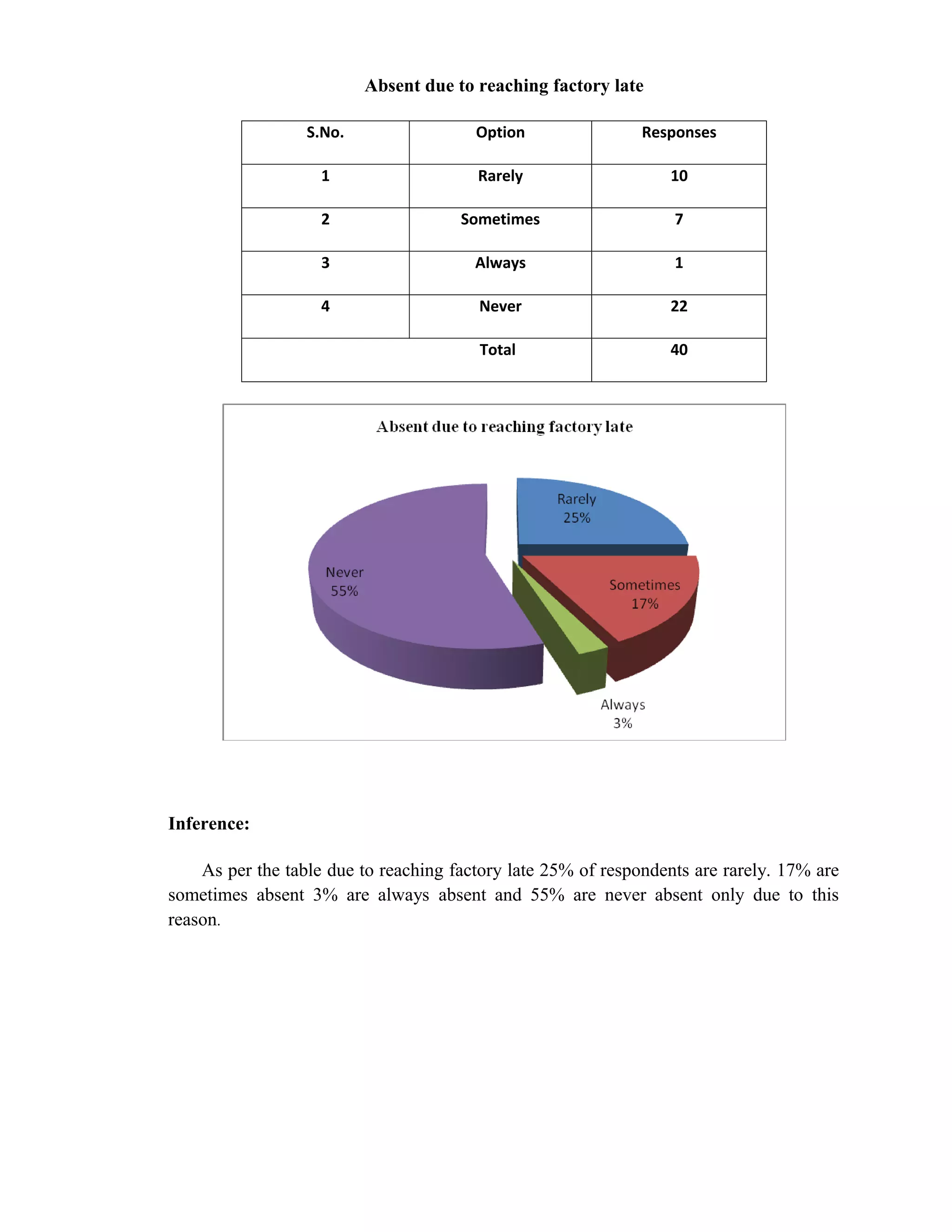
Absent due to reaching factory late

                  S.No.                 Option                Responses

                    1                   Rarely                   10

                    2                 Sometimes                   7

                    3                   Always                    1

                    4                   Never                    22

                                        Total                    40


Inference:

    As per the table due to reaching factory late 25% of respondents are rarely. 17% are
sometimes absent 3% are always absent and 55% are never absent only due to this
reason.
44


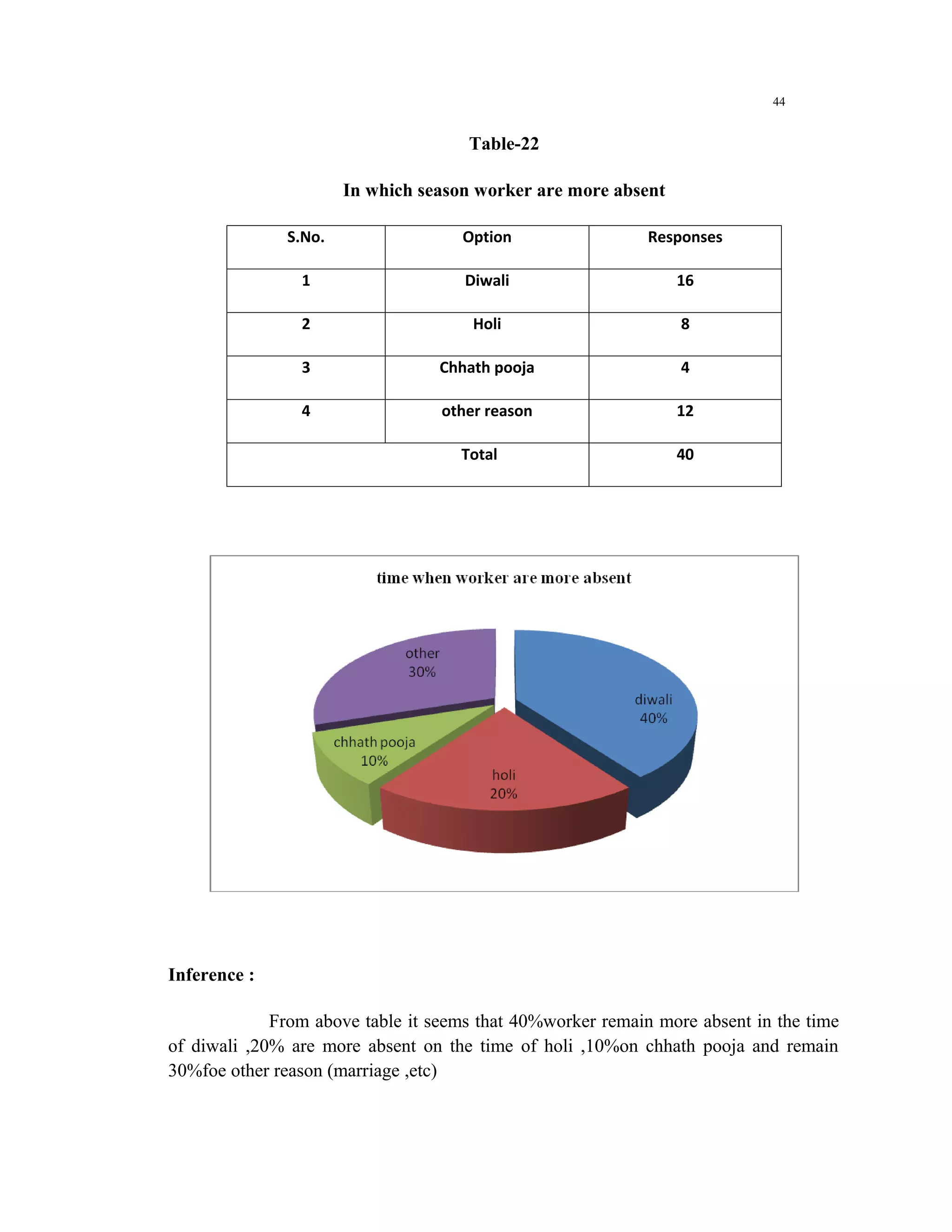
                                     Table-22

                      In which season worker are more absent

              S.No.                 Option                  Responses

                1                    Diwali                    16

                2                     Holi                      8

                3                Chhath pooja                   4

                4                 other reason                 12

                                    Total                      40


Inference :

             From above table it seems that 40%worker remain more absent in the time
of diwali ,20% are more absent on the time of holi ,10%on chhath pooja and remain
30%foe other reason (marriage ,etc)
45


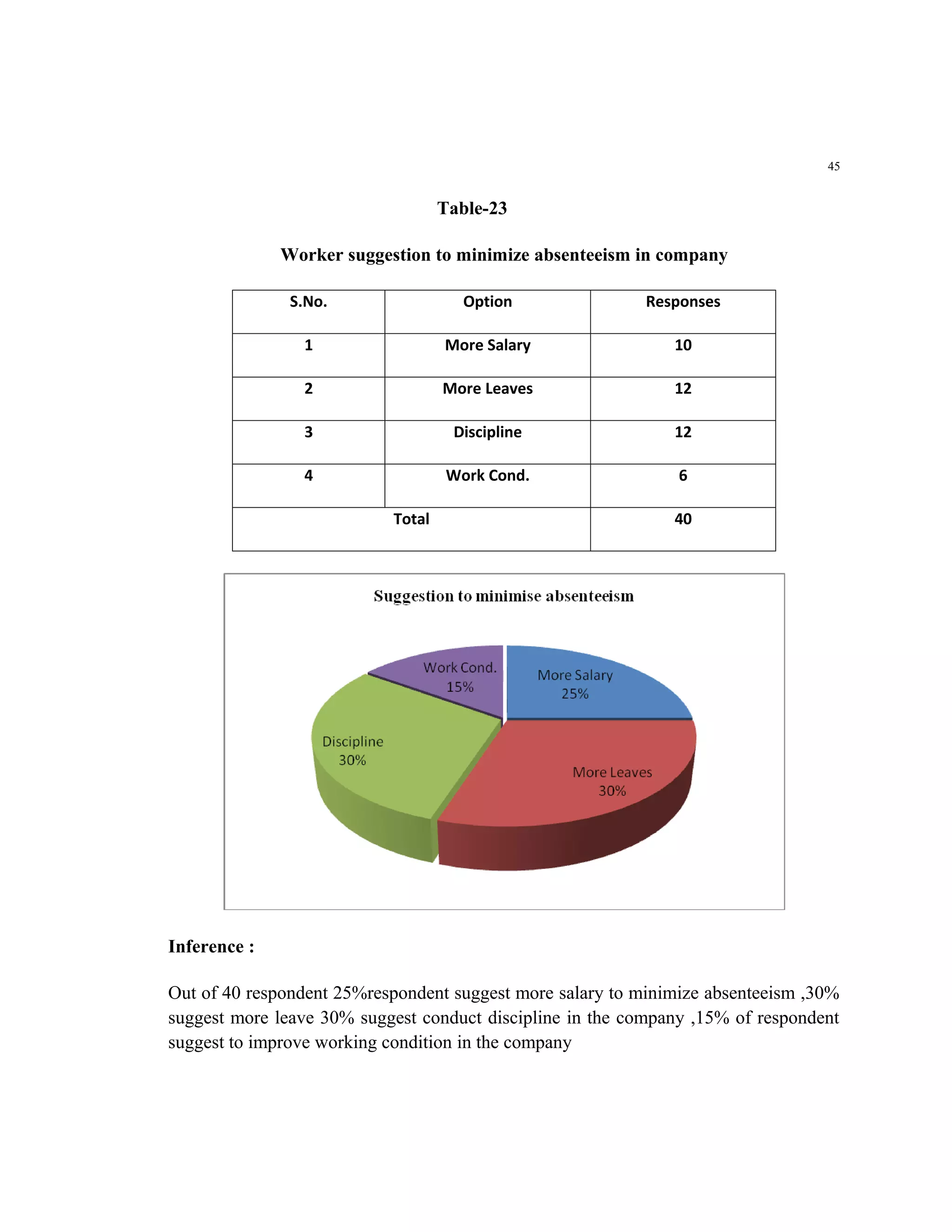
                                   Table-23

              Worker suggestion to minimize absenteeism in company

               S.No.                  Option               Responses

                1                  More Salary                10

                2                  More Leaves                12

                3                   Discipline                12

                4                   Work Cond.                 6

                           Total                              40


Inference :

Out of 40 respondent 25%respondent suggest more salary to minimize absenteeism ,30%
suggest more leave 30% suggest conduct discipline in the company ,15% of respondent
suggest to improve working condition in the company
46


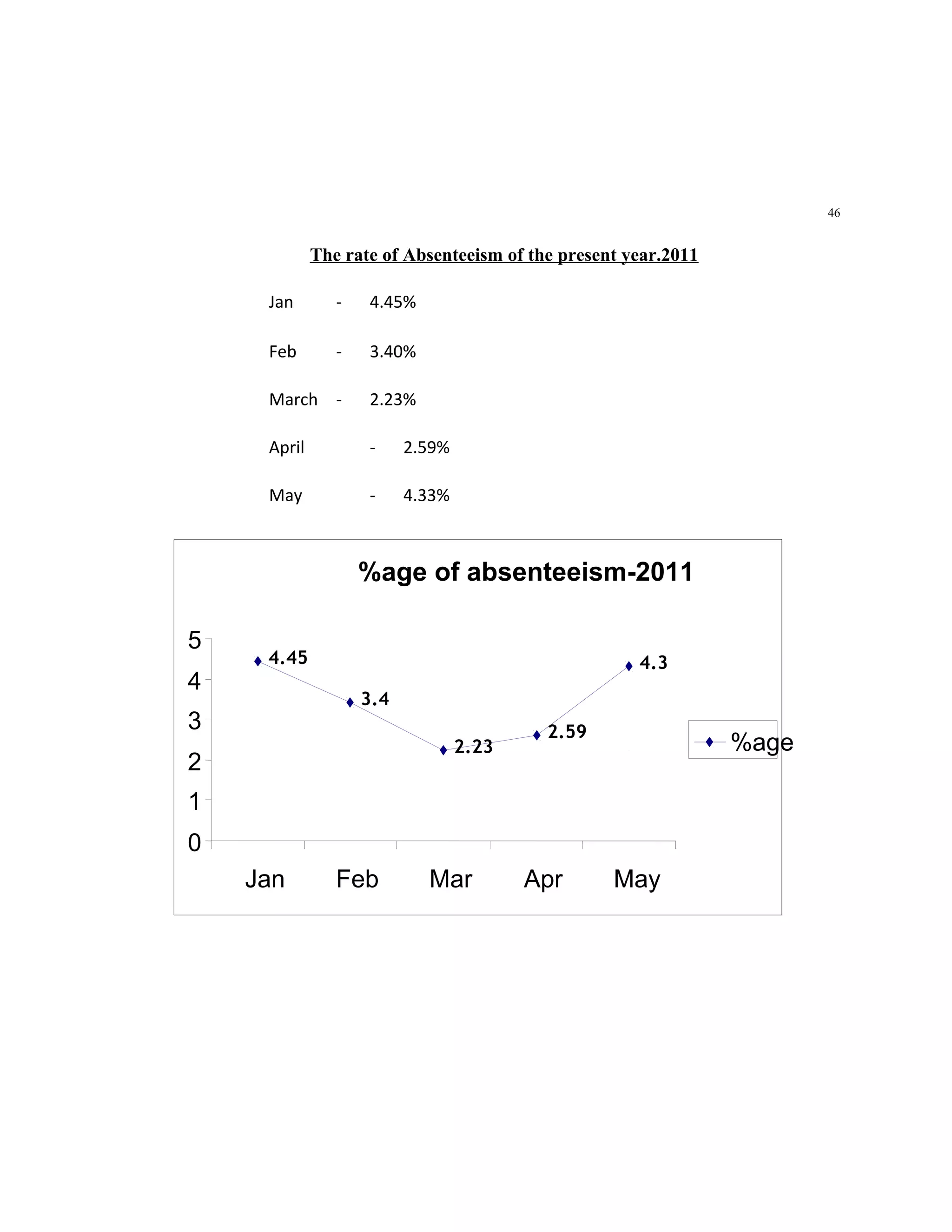
             The rate of Absenteeism of the present year.2011

     Jan        -   4.45%

     Feb        -   3.40%

     March -        2.23%

     April          -     2.59%

     May            -     4.33%


                    %age of absenteeism-2011

5
     4.45                                            4.3
4
                    3.4
3                                         2.59
                                  2.23                          %age
2
1
0
    Jan         Feb         Mar          Apr      May
47


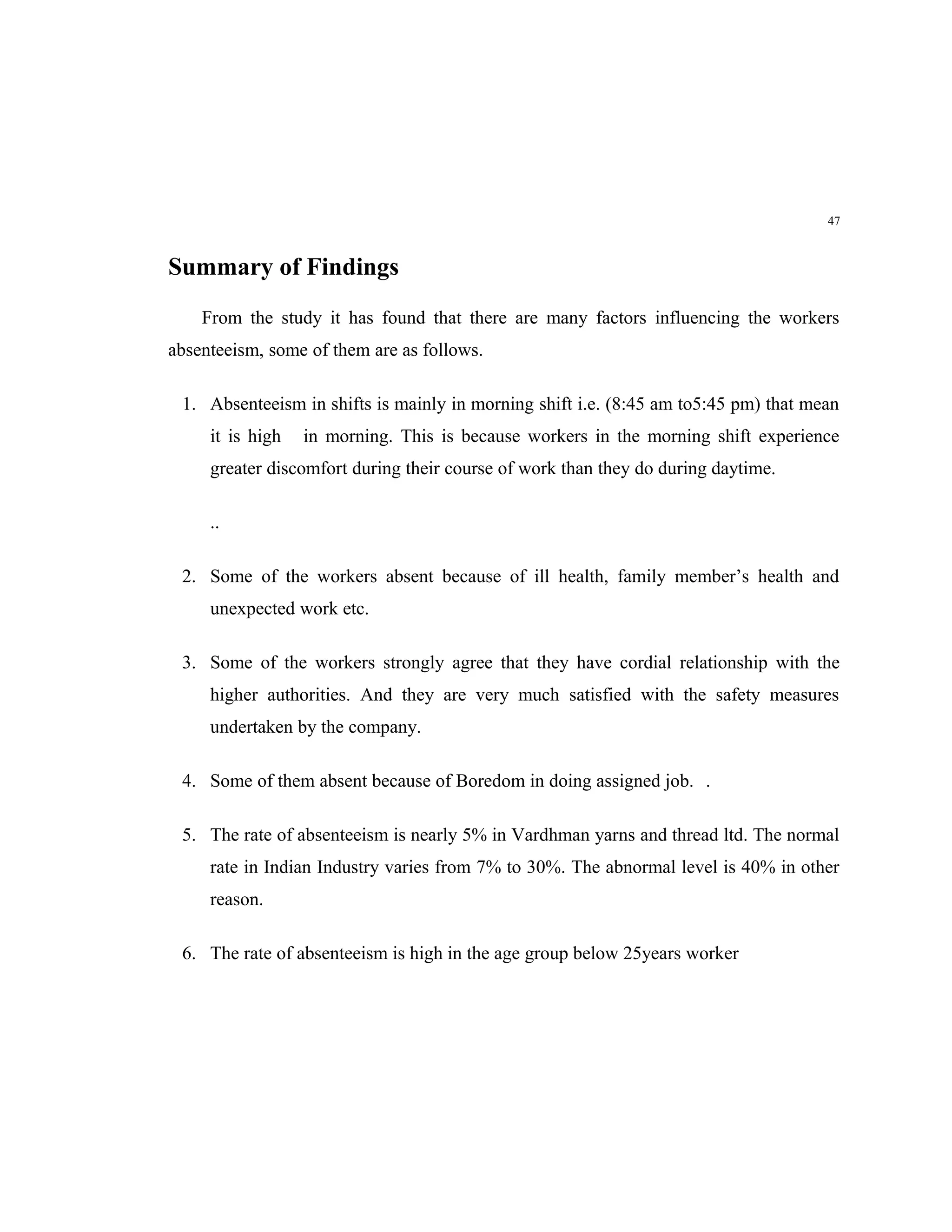
Summary of Findings
    From the study it has found that there are many factors influencing the workers
absenteeism, some of them are as follows.

 1. Absenteeism in shifts is mainly in morning shift i.e. (8:45 am to5:45 pm) that mean
     it is high   in morning. This is because workers in the morning shift experience
     greater discomfort during their course of work than they do during daytime.

     ..

 2. Some of the workers absent because of ill health, family member’s health and
     unexpected work etc.

 3. Some of the workers strongly agree that they have cordial relationship with the
     higher authorities. And they are very much satisfied with the safety measures
     undertaken by the company.

 4. Some of them absent because of Boredom in doing assigned job. .

 5. The rate of absenteeism is nearly 5% in Vardhman yarns and thread ltd. The normal
     rate in Indian Industry varies from 7% to 30%. The abnormal level is 40% in other
     reason.

 6. The rate of absenteeism is high in the age group below 25years worker
48


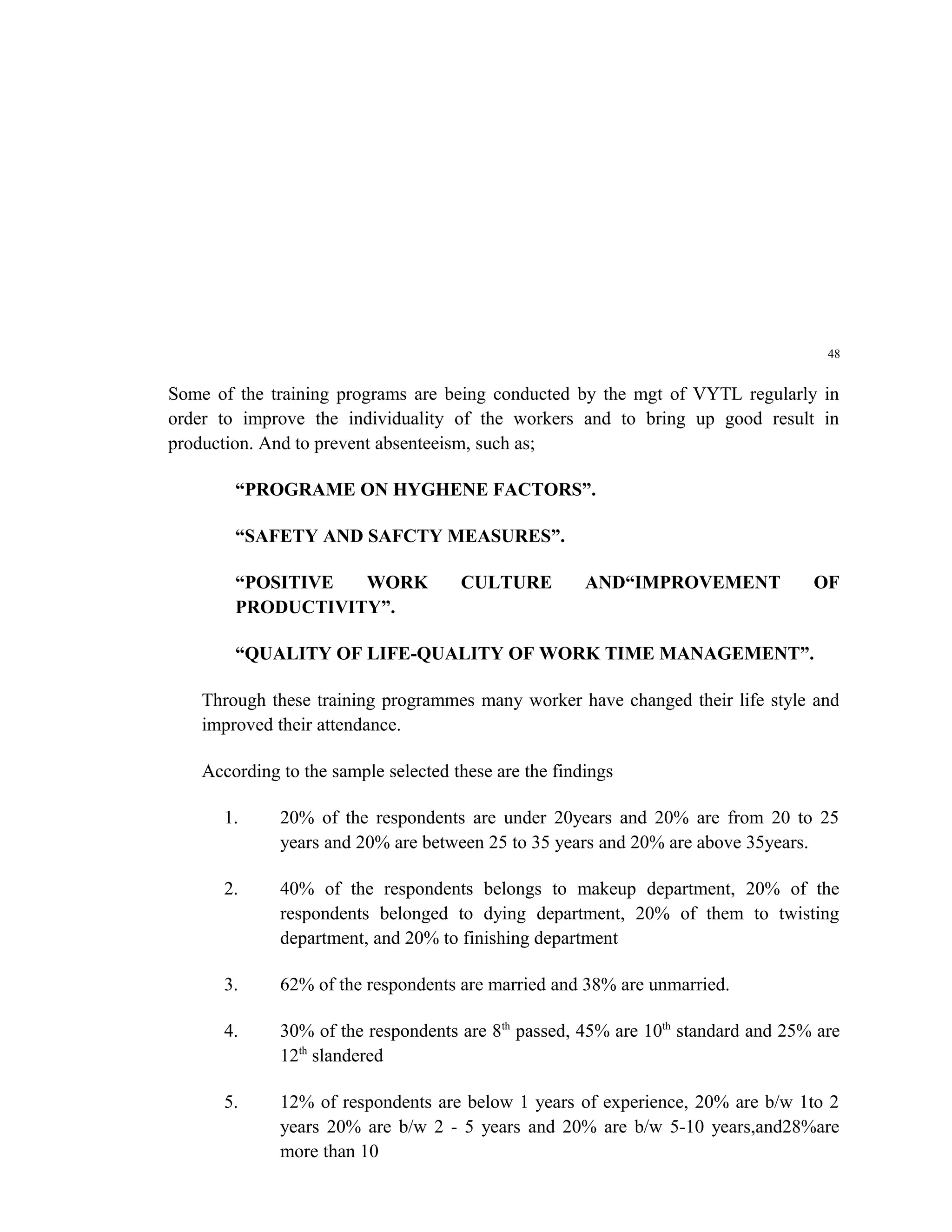
Some of the training programs are being conducted by the mgt of VYTL regularly in
order to improve the individuality of the workers and to bring up good result in
production. And to prevent absenteeism, such as;

        “PROGRAME ON HYGHENE FACTORS”.

        “SAFETY AND SAFCTY MEASURES”.

        “POSITIVE  WORK               CULTURE          AND“IMPROVEMENT            OF
        PRODUCTIVITY”.

        “QUALITY OF LIFE-QUALITY OF WORK TIME MANAGEMENT”.

    Through these training programmes many worker have changed their life style and
    improved their attendance.

    According to the sample selected these are the findings

      1.      20% of the respondents are under 20years and 20% are from 20 to 25
              years and 20% are between 25 to 35 years and 20% are above 35years.

      2.      40% of the respondents belongs to makeup department, 20% of the
              respondents belonged to dying department, 20% of them to twisting
              department, and 20% to finishing department

      3.      62% of the respondents are married and 38% are unmarried.

      4.      30% of the respondents are 8th passed, 45% are 10th standard and 25% are
              12th slandered

      5.      12% of respondents are below 1 years of experience, 20% are b/w 1to 2
              years 20% are b/w 2 - 5 years and 20% are b/w 5-10 years,and28%are
              more than 10
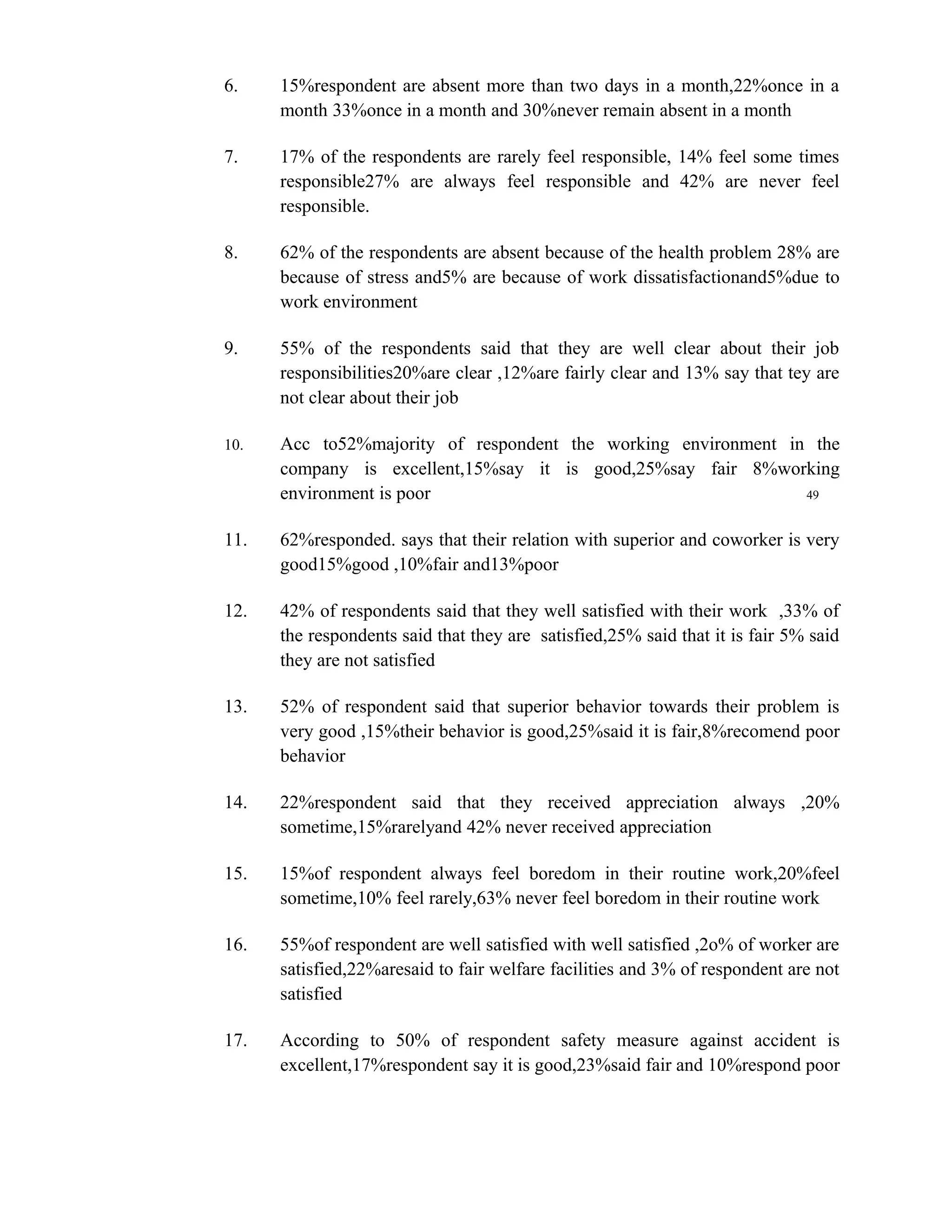
6.    15%respondent are absent more than two days in a month,22%once in a
      month 33%once in a month and 30%never remain absent in a month

7.    17% of the respondents are rarely feel responsible, 14% feel some times
      responsible27% are always feel responsible and 42% are never feel
      responsible.

8.    62% of the respondents are absent because of the health problem 28% are
      because of stress and5% are because of work dissatisfactionand5%due to
      work environment

9.    55% of the respondents said that they are well clear about their job
      responsibilities20%are clear ,12%are fairly clear and 13% say that tey are
      not clear about their job

10.   Acc to52%majority of respondent the working environment in the
      company is excellent,15%say it is good,25%say fair 8%working
      environment is poor                                       49


11.   62%responded. says that their relation with superior and coworker is very
      good15%good ,10%fair and13%poor

12.   42% of respondents said that they well satisfied with their work ,33% of
      the respondents said that they are satisfied,25% said that it is fair 5% said
      they are not satisfied

13.   52% of respondent said that superior behavior towards their problem is
      very good ,15%their behavior is good,25%said it is fair,8%recomend poor
      behavior

14.   22%respondent said that they received appreciation always ,20%
      sometime,15%rarelyand 42% never received appreciation

15.   15%of respondent always feel boredom in their routine work,20%feel
      sometime,10% feel rarely,63% never feel boredom in their routine work

16.   55%of respondent are well satisfied with well satisfied ,2o% of worker are
      satisfied,22%aresaid to fair welfare facilities and 3% of respondent are not
      satisfied

17.   According to 50% of respondent safety measure against accident is
      excellent,17%respondent say it is good,23%said fair and 10%respond poor
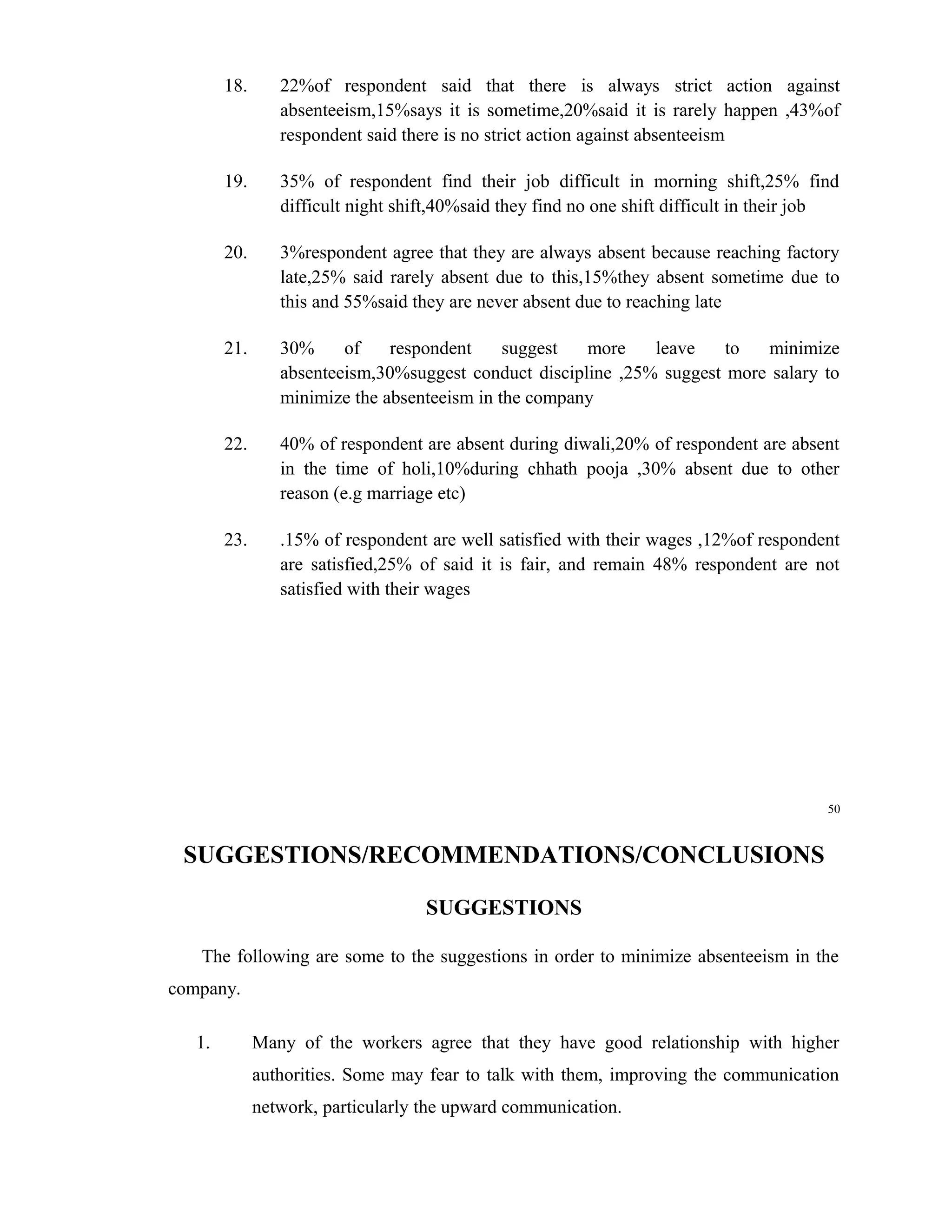
18.      22%of respondent said that there is always strict action against
                 absenteeism,15%says it is sometime,20%said it is rarely happen ,43%of
                 respondent said there is no strict action against absenteeism

        19.      35% of respondent find their job difficult in morning shift,25% find
                 difficult night shift,40%said they find no one shift difficult in their job

        20.      3%respondent agree that they are always absent because reaching factory
                 late,25% said rarely absent due to this,15%they absent sometime due to
                 this and 55%said they are never absent due to reaching late

        21.      30%     of    respondent     suggest  more    leave    to  minimize
                 absenteeism,30%suggest conduct discipline ,25% suggest more salary to
                 minimize the absenteeism in the company

        22.      40% of respondent are absent during diwali,20% of respondent are absent
                 in the time of holi,10%during chhath pooja ,30% absent due to other
                 reason (e.g marriage etc)

        23.      .15% of respondent are well satisfied with their wages ,12%of respondent
                 are satisfied,25% of said it is fair, and remain 48% respondent are not
                 satisfied with their wages


                                                                                          50


 SUGGESTIONS/RECOMMENDATIONS/CONCLUSIONS

                                    SUGGESTIONS

   The following are some to the suggestions in order to minimize absenteeism in the
company.

   1.         Many of the workers agree that they have good relationship with higher
              authorities. Some may fear to talk with them, improving the communication
              network, particularly the upward communication.
2.       Since the literacy rate very lower only few members are the 12th and,
           maximum of them are less literates, so that by counseling the workers about
           their career, income & expenditure, habit and culture. The company so what
           can reduce the absenteeism rate.

  3.       By providing high wages and allowance based on organizational financial
           positions.

  4.       Selecting the workers by testing them thoroughly regarding their aspirations,
           value system, and sense of responsibility.

  5.       The management should conduct regular seminars, group’s discussions, social
           gathering orientations programmers’ on the problems of absenteeism.

  6.       The personnel department (HRD) of the factory must conduct the interviews
           of the absenteeism cases and give proper counseling to the workers.

  7.       The employees who are attending to 3rd shifts have to be provided more
           benefits than the workers. In order to make them enthusiastic to attend the
           workers.


Limitation of the study
   The study was limited only to vardhman yarn and thread unit only.


   As sampling is taken as an element of the study there might always be sampling
       errors.

   The sample under consideration may not reflect the whole population.


   Survey and study has been carried out in a span of only 6 weeks due to time
       constraint.

      Since absenteeism is a vast topic to be discussed, the study may not reflect each
       and every aspect.                                                              51
CONCLUSION
1. Majority of the employees are absenting due to ailment and health problems.

2. Majority of the employees has said they are paid worth of their work.

3. Majority of the employees has said that there is no strict action against
   absenteeism.

4. Most of the workers does not intimate their senior regarding their leaves.

5. Though there are limitations the personal department is taking special care to
   frame certain policies and procedures that would reduce absenteeism and increase
   the labor turn over.

6. Majority of workers is facing problems in 1st shift the company had to take
   necessary steps to reduce the problems.

7. Majority of workers never got appreciation for their punctuality in the
   organization. So, The Management must think upon this aspect.
52


                           Bibliography

BOOKS:


   “HUMAN RESOURCE MANAGEMENT”

    By C.B. GUPTA

    Published by SULTAN CHAND & SONS, New Delhi.


   “RESEARCH METHODOLOGY”

    By C.R. KOTHARI

    Published by NEW AGE INTERNATIONAL PUBLICATION


   “PRESONNEL MANAGEMENT”

    By C.B. MAMORIA & GANKAR

    Published by MALYA PUBLISHING HOUSE


WEBSITE

      1. http://www.vardhman.com/products_yarns_overview.asp

      2. http://www.citehr.com/research.php?q=absentieesm&x=0&y=0
53
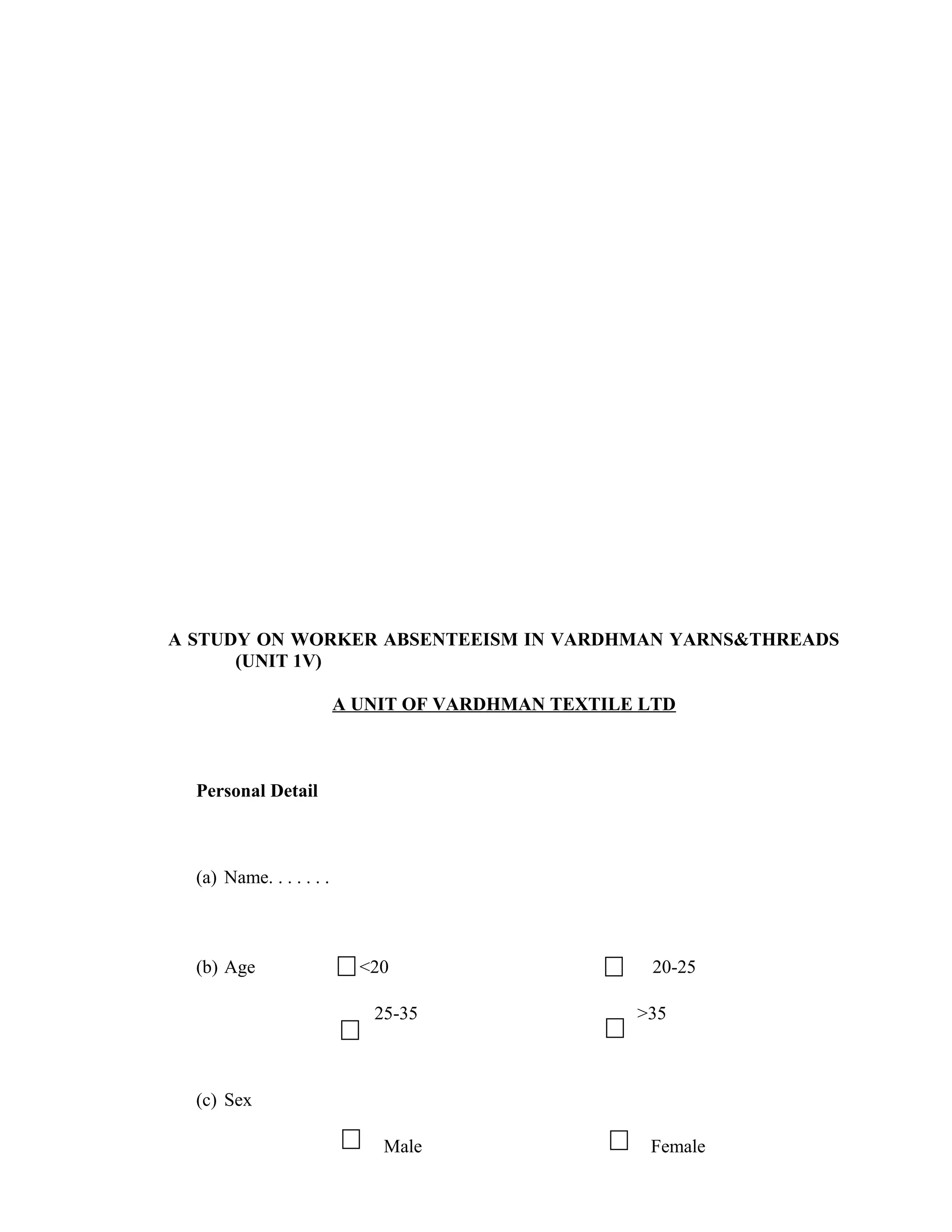
ANNEXURE
A STUDY ON WORKER ABSENTEEISM IN VARDHMAN YARNS&THREADS
      (UNIT 1V)

                          A UNIT OF VARDHMAN TEXTILE LTD


  Personal Detail


  (a) Name. . . . . . .


  (b) Age                   <20                      20-25

                             25-35                  >35


  (c) Sex

                              Male                   Female
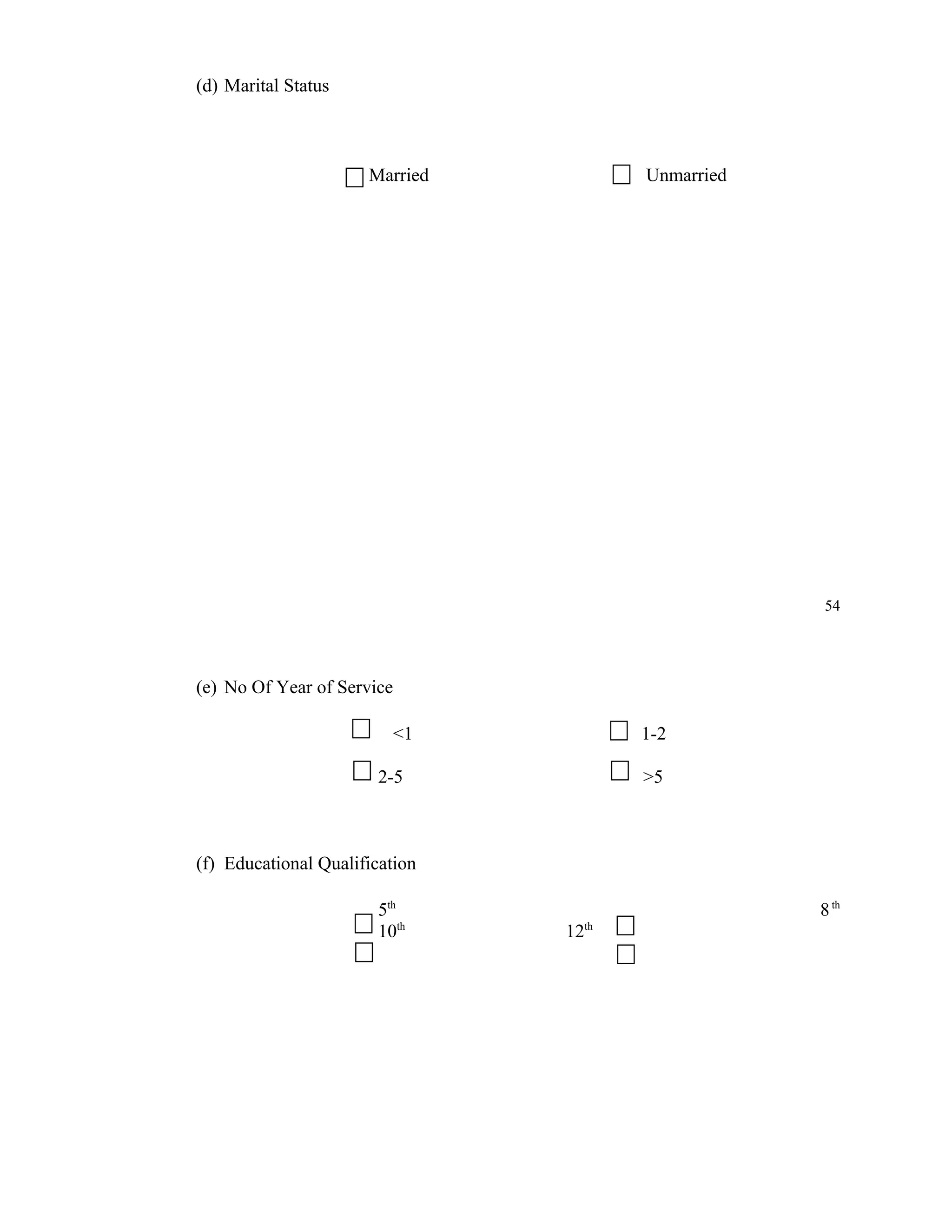
(d) Marital Status


                      Married           Unmarried


                                                    54


(e) No Of Year of Service

                            <1          1-2

                       2-5              >5


(f) Educational Qualification

                       5th                          8 th
                       10th      12th
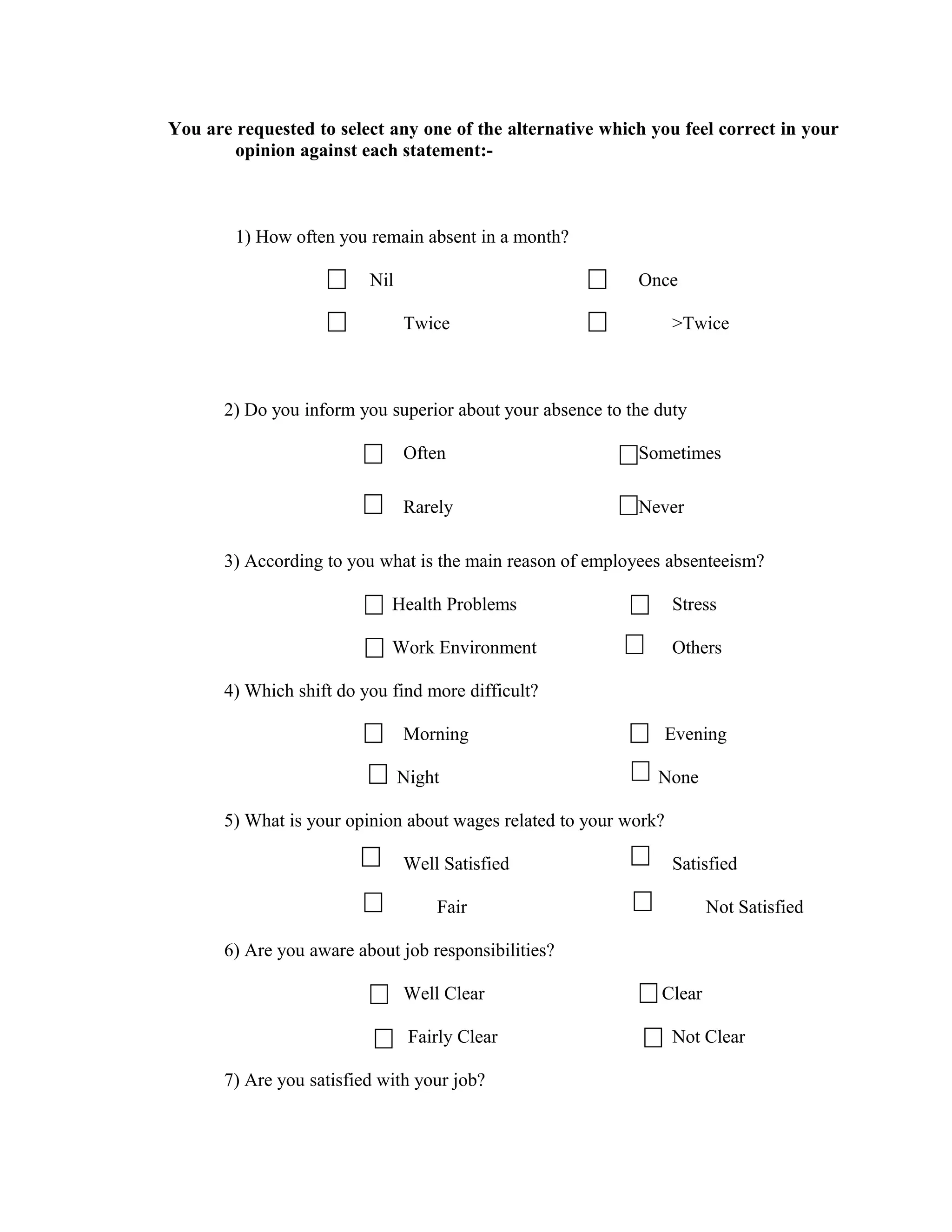
You are requested to select any one of the alternative which you feel correct in your
        opinion against each statement:-


        1) How often you remain absent in a month?

                          Nil                               Once

                                Twice                              >Twice


       2) Do you inform you superior about your absence to the duty

                                Often                       Sometimes

                                Rarely                      Never

       3) According to you what is the main reason of employees absenteeism?

                             Health Problems                       Stress

                             Work Environment                      Others

       4) Which shift do you find more difficult?

                                Morning                            Evening

                                Night                          None

       5) What is your opinion about wages related to your work?

                                Well Satisfied                     Satisfied

                                    Fair                               Not Satisfied

       6) Are you aware about job responsibilities?

                                Well Clear                     Clear

                                 Fairly Clear                      Not Clear

       7) Are you satisfied with your job?
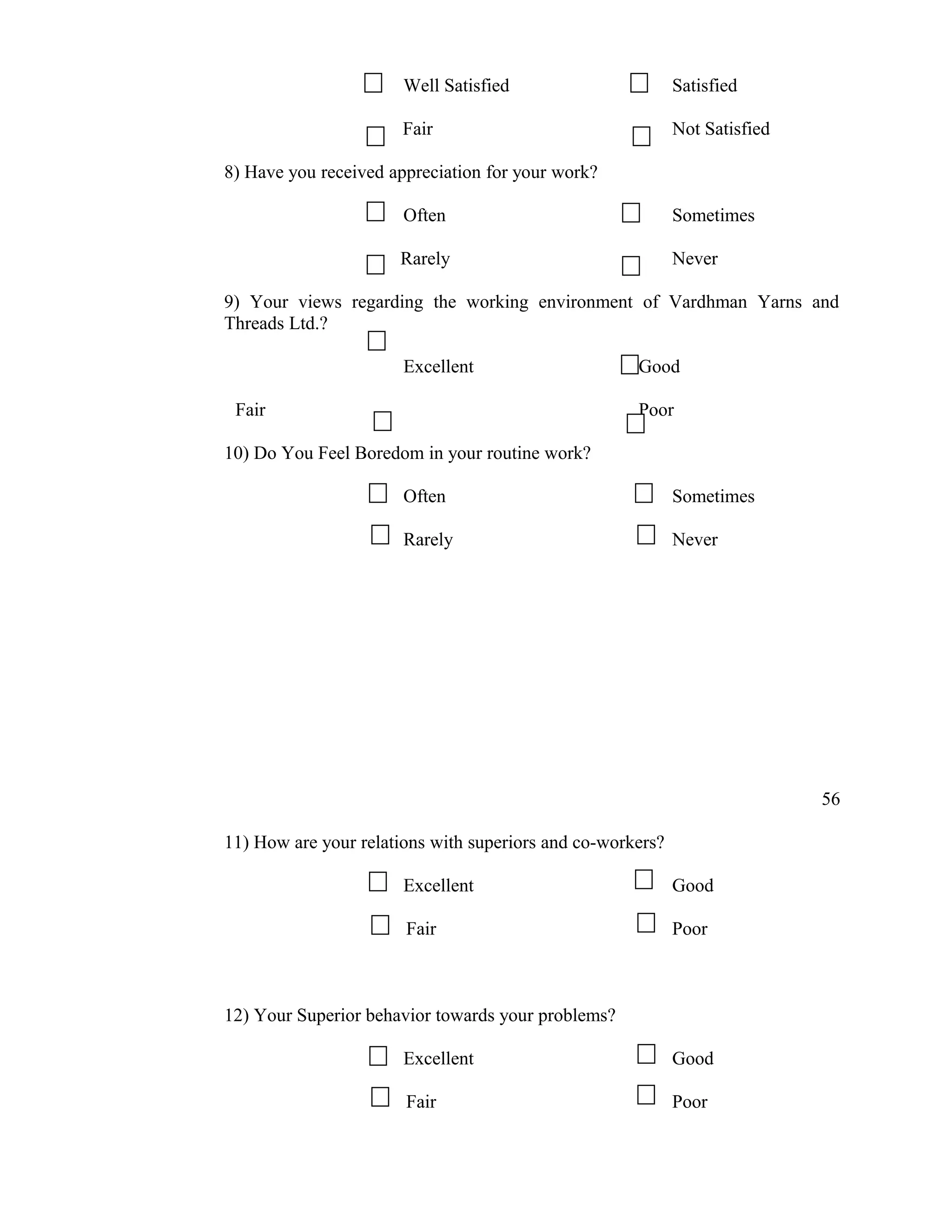
Well Satisfied                       Satisfied

                       Fair                                 Not Satisfied

8) Have you received appreciation for your work?

                       Often                                Sometimes

                      Rarely                                Never

9) Your views regarding the working environment of Vardhman Yarns and
Threads Ltd.?

                       Excellent                     Good

 Fair                                                Poor

10) Do You Feel Boredom in your routine work?

                       Often                                Sometimes

                       Rarely                               Never


                                                                            56

11) How are your relations with superiors and co-workers?

                       Excellent                            Good

                       Fair                                 Poor


12) Your Superior behavior towards your problems?

                       Excellent                            Good

                       Fair                                 Poor
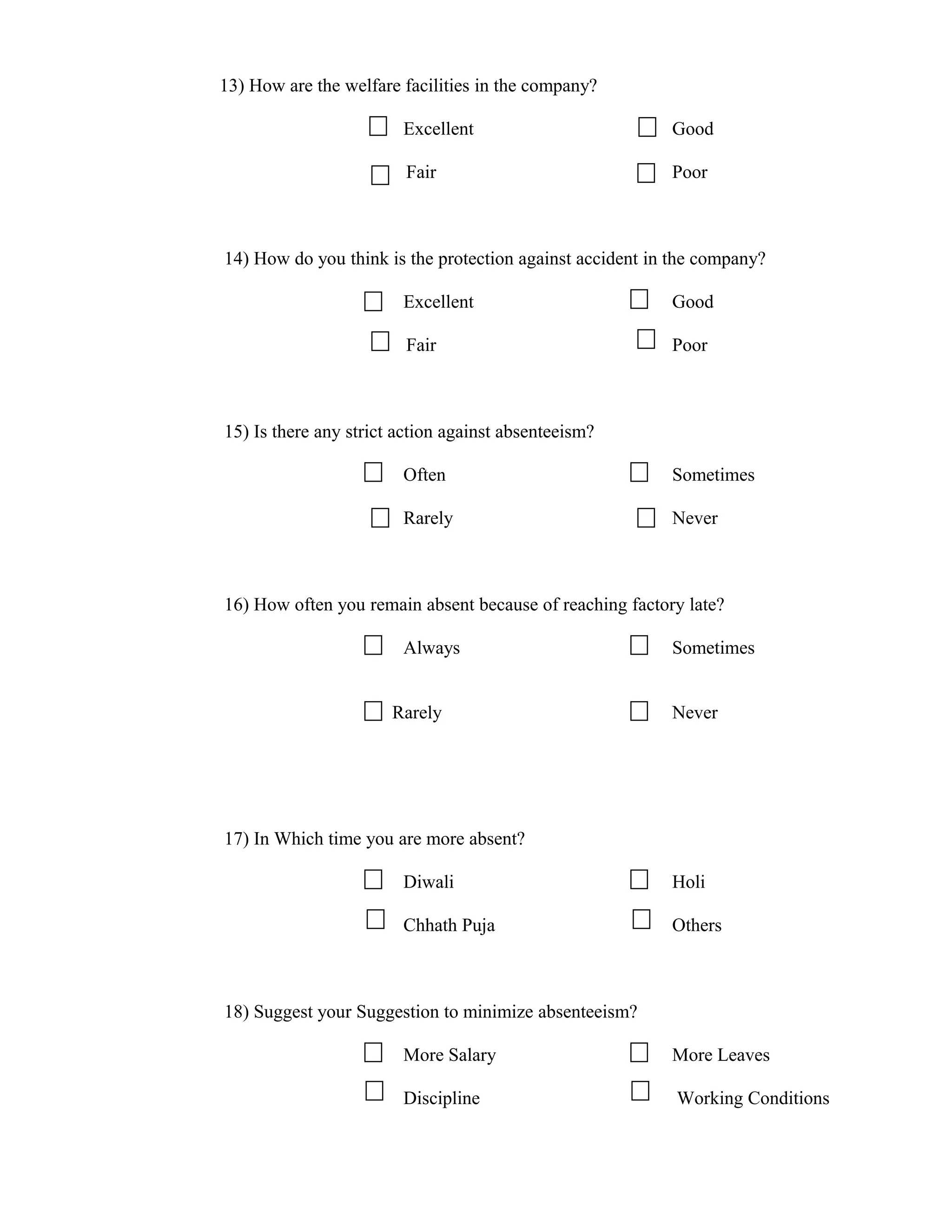
13) How are the welfare facilities in the company?

                        Excellent                         Good

                         Fair                             Poor


14) How do you think is the protection against accident in the company?

                        Excellent                         Good

                         Fair                             Poor


15) Is there any strict action against absenteeism?

                        Often                             Sometimes

                        Rarely                            Never


16) How often you remain absent because of reaching factory late?

                        Always                            Sometimes


                       Rarely                             Never


17) In Which time you are more absent?

                        Diwali                            Holi

                        Chhath Puja                       Others


18) Suggest your Suggestion to minimize absenteeism?

                        More Salary                       More Leaves

                        Discipline                         Working Conditions
Thank you
Thank you

Swati project (1)

  • 1.
    A COMPREHENSIVE STUDYON WORKER’S ABSENTEEISM VARDHMAN YARN & THREAD LTD. BADDI DR IT. INSTITUTE OF MANAGEMENT AND TECNOLOGY (IMT) In partial fulfillment of requirement of degree of ( BACHELOR OF BUSINESS ADMINSTRATION) Submitted To: Submitted By: Mr.Gagan Gulatis Swati Rai Roll No 80907322029 BBA 6th sem
  • 2.
    ACKNOWLEDGEMENT Talent & capabilitiesare of course necessary but opportunities and good guidance are two very important things without which no persons can climb those infant ladders towards progress. First of all I am very much indebted and thankful to my parents and God for giving me strength for completion of my Internship. . I express my sincere thanks to my project guide Mr. Gagan Gulati for providing me her valuable time and fruitful guidance. Lastly but not least , I thank my friends , relatives and near and dear ones for their wholehearted support in this efforts of mine. SWATI RAI PREFACE
  • 3.
    There is afamous saying “The theory without practical is lame and practical without theory is blind.” Absenteeism is a serious workplace problem and an expensive occurrence for both employers and employees seemingly unpredictable in nature. Human resource is an important part of any business and managing them is an important task. Summer training is an integral part of the student of Management have to undergo training session in a business organization for 6 weeks to gain some practical knowledge in their specialization and to gain some working experience. Our institution has come forward with the opportunity to bridge the gap by imparting modern scientific management principle underlying the concept of the future prospective managers. To the emphasis on practical aspect of management education the faculty of Academy of Management Studies, baddi has with a modern system of practical training of repute and following management technique to the student as integral part of MBA. In accordance with the above obligation under going project in “vardhman yarns&thread Pvt. Ltd., baddi. The title of my project is “Absenteeism of Employee” Certainly this analysis explores my abilities and strength to its fullest extent for the achievement of organization as well as my personal goal. CONTENTS
  • 4.
    1 Profile of Vardhman Yarns and Threads Ltd., Baddi 1.1 Mission & Vision 01-01 1.2 History 02-02 1.3 Philosophy 03-03 1.4 Portfolio 04-05 1.5 Holdings 06-07 1.6 Market 08-08 1.7 Achievements 09-10 2 Absenteeism : An Introduction 2.1 Concept of Absenteeism. 12-12 2.2 Types of Absenteeism 13-13 2.3 Calculation of absenteeism 14-15 2.4 Causes of absenteeism 14-15 2.5 Categories of absenteeism 16-16 2.6 Measure to minimize absenteeism 17-17 3 Review of literature 18-19 4 Research Methodology 4.1 Statement of problem 20-20 4.2 Objective of the study 20-20 4.3 Scope of study 20-20 4.4 Methodology Used: Questionnaire 21-22 4.5 Sampling unit and sampling size 21-22 3.6 Method of Data Collection 21-22
  • 5.
    5 Data Analysis: Inference 23-46 Findings and Suggestions 47-51 Limitation of study 51-51 Conclusion 52-52 Bibliography Annexure
  • 6.
  • 7.
    ABOUT THE COMPANY Vardhmanis a major integrated textile producer in India. The Group was setup in 1965 at Ludhiana, Northern India. Since then, the Group has expanded manifold and is today, perhaps, the largest textile conglomerate in India. The Group recorded a turnover of Rs.3860 crores in FY 2008-09. The Group portfolio includes manufacturing and marketing of Yarns, Fabrics, Sewing Threads, Fiber and Alloy Steel. 1.1 Mission Vardhman aims to be world class textile organization producing diverse range of products for the global textile market.Vardhman seeks to achieve customer delight through excellence in manufacturing and customer service based on creative combination of state-of-the-art technology and human resources. Yardman is committed to be responsible corporate citizen. Vision Vardhman- rooted in values ,creating word class textile. 1
  • 8.
    1.2 HISTORY The industrialcity of Ludhiana, located in the fertile Malwa region of Central Punjab is otherwise known as the "Manchester of India". Within the precincts of this city is located the Corporate headquarters of the Vardhman Group, a household name in Northern India. The Vardhman Group, born in 1965, under the entrepreneurship of Late Lala Rattan Chand Oswal has today blossomed into one of the largest Textile Business houses in India. At its inception, Vardhman had an installed capacity of 14,000 spindles, today; its capacity has increased multifold to over 8.0 lacs spindles. In 1982 the Group entered the sewing thread market in the country which was a forward integration of the business. Today Vardhman Threads is the second largest producer of sewing thread in India. In 1990, it undertook yet another diversification - this time into the weaving business. The grey fabric weaving unit at Baddi (HP), commissioned in 1990 with a capacity of 20,000 meters per day, has already made its mark as a quality producer of Grey poplin, sheeting, and shirting in the domestic as well as foreign market. This was followed by entry into fabric processing by setting up Auro Textiles at Baddi, which currently has a processing capacity of 1 lacs meters/day. In the year 1999 the Group has added yet another feather to its cap with the setting up of Vardhman Acrylics Ltd., Bharuch (Gujarat) which is a joint venture in Acrylic Fibre production undertaken with Marubeni and Exlan of Japan. The company also has a strong presence in the markets of Japan, Hong Kong, Korea, UK and EU in addition to the domestic market. Adherence to systems and a true dedication to quality has resulted in obtaining the coveted ISO 9002/ ISO 14002 quality award which is the first in Textile industry in India and yet another laurel to its credit. 2
  • 9.
    1.3 PHILOSOPHY • Total customer focus in all operational areas • Products to be of best available quality for premium market segments through TQM and zero defect implementation. All functional areas. • Global orientation targeting - at least 20% production for exports. • Integrated diversification/product range expansion • World class manufacturing facilities with most modern R&D and process technology. • • Faith in individual potential and respect for human values. • Encouraging innovation for constant improvements to achieve excellence in all functional areas. • Accepting change as a way of life • • Appreciating our role as a responsible corporate citizen.
  • 10.
    3 1.4 PORTFOLIO The groupportfolio includes Yarn, Fabrics, Sewing Thread, Fibre and Alloy Steel Yarns Yarn Manufacturing is the major activity of the group accounting for 65 percent of the group turnover. Vardhman is virtually a supermarket of yarns, producing the widest range of cotton, synthetics and blended, Grey and Dyed yarns and Hand Knitting Yarns, in which Vardhman is the market leader in India. The group has nine production plants with a total capacity of over 5.5 lacs spindles, spread all over the country. In many of the yarn market segments, Vardhman holds the largest market share. Vardhman is also the largest exporters of yarn from India, exporting yarns worth more than USD 90 million. Sewing Thread Vardhman is the second largest producer of sewing thread in the country. The sewing thread manufacturing capacity is being expanded from present 17 tons per day to 22 tons per day in its sewing thread plants located at Hoshiarpur, Baddi and Ludhiana. Sewing threads contributes 12 percent of the group turnover.
  • 11.
    4 Fabrics The group hascreated state-of-the-art fabric weaving and processing facilities in its plant at Baddi, Northern India. The group has installed 208 shuttles less looms and a fabric processing capacity of 30 million meters per annum in collaboration of Tokai Senko of Japan. Fabrics business contributes 8 percent to the group turnover. Fibre The group has recently set up an Acrylic Staple Fibre plant at Bharuch in Gujarat in collaboration with Marubeni and Japan Exlan of Japan. The plant has annual capacity of 18000 tons per annum. Fibre contributes 8 percent to the total turnover of the group. Steel The Group is also present in upper-end of the steel industry. The group has manufacturing capacity of 100000 tons of special and alloy steel. The group supplies its steel products to some of the most stringent quality steel buyers like Maruti and Telco. It contributes 6 percent to the total turnover of the group 5
  • 12.
    1.5 HOLDINGS Spinning Business DomesticTrade Area Units Vardhman Spinning & General Mills Ludhiana, Punjab Auro Spinning Baddi, HP Arihant Spinning Malerkotla, Punjab Arisht Spinning Baddi, HP Gas Mercerised Yarn Business Hoshiarpur, Punjab Auro Dyeing Baddi, HP Export Oriented Units Anant Spinning Mandideep, MP Vardhman Spinning & General Mills Export Oriented Units Baddi, HP VMT Baddi, HP Fabric Business Auro Weaving Baddi, HP MSML Textiles Division Baddi, HP Auro Textiles Baddi, HP Sewing Thread Business ST-I Hoshiarpur, Punjab ST-II Ludhiana, Punjab
  • 13.
    ST-III Perundurai, TN ST-IV Baddi, HP Vardhman Special Steels Ludhiana, Punjab Bharuch, Gujarat Vardhman Acrylics Limited 6 VARDHMAN GROUP
  • 14.
  • 15.
    Largest Spinning capacity in India - over half a million spindles. • Largest producer of Cotton, Synthetics and Blended yarns in the country • Largest Dyeing Capacity of Fibre and Yarn • Largest Exporter of Cotton Yarn • Market Leader in Hand Knitting Yarns in India • Largest range of Textile products • Second largest producer of Sewing Thread in the country • Collaborations with specialist worldwide
  • 16.
    8 1.7ACHIEVEMENTS It’s an overwhelmingfeeling when the efforts and hard work put in are recognized and felicitated. A feeling that galvanizes the Group into believing in more, in itself and reaffirming its commitment to offer products that invoke trust and reliability Back home, the Vardhman Group became India's first textile company to be awarded ICO9002/ ISO 14002 Certification. It is the largest producer and exporter of yarns and Grey woven fabrics from India. Vardhman is also the largest producer of tyercord yarns and the second largest producer of sewing threads in India. The Vardhman Group vision of excellence is matched by a dedication and sincerity to be the best and excel in every industry it has a presence. Chairman, Mr. S.P. Oswal got Shri Padam Bhushan award in January 2010 Textile Export Promotion Council 2007-08 Special achievement award in yarn category Textile Export Promotion Council 2007-08 Silver top exporter award in yarn category Textile Export Promotion Council 2007-08 Bronze trophy in processed yarn category
  • 17.
    Textile Export PromotionCouncil 2005-06 Bronze trophy for highest global export category overall World trophy in highest export in yarn category. Textile Export Promotion Council 2003-04 Gold trophy in EOU/EPZ for export of cotton yarn Textile Export Promotion Council 2003-04 Bronze trophy in mill fabric exporter category Textile Export Promotion Council 2002-03 Gold Trophy in EOU/EPZ for export of cotton yarn Textile Export Promotion Council 1998-99 Silver Trophy Textile Export Promotion Council 1997-98 Bronze Trophy
  • 18.
    10 Vardhman Yarns and Threads Limited, UNIT-IV,BADDI Vardhman Textiles Limited (VTXL) transferred its threads business on a slump sale basis to one of its subsidiary companies, Vardhman Yarns and Threads Limited (VYTL), through a Scheme of Arrangement, Re-organization and Demerger as sanctioned by the Hon’ble Punjab and Haryana High Court, with effect from 1 st April, 2008. The holding of VTXL in VYTL as on the said date was more than 98 percent. The threads business of the subsidiary company, viz. VYTL, comprises of four manufacturing units located at Hoshiarpur and Ludhiana (Punjab), Perundurai (Tamil Nadu) and Baddi (HimachalPradesh).
  • 19.
    The Company enteredinto a joint venture in VYTL with M/s. American & Efird, Inc. (A&E), one of the world’s largest global manufacturers and distributors of industrial sewing threads, embroidery threads and technical textiles, with A&E’s initial holding of 35 percent. Recently, A&E has acquired the additional 14 percent equity shares of the joint venture company, VYTL, from Vardhman Textiles Limited and thus holds 49 percent equity shares. The joint venture Company, however, continues to be a subsidiary of Vardhman Textiles Limited, whose shareholding is now 51 percent 11 Absenteeism An Introduction
  • 20.
    2.1 INTRODUCTION Some Definitionsof Absenteeism: - “Absenteeism” is a practice or a habit of being an “absence” and an “absentee” is one who habitually stays away - WEBSTER’S DICTIONARY - ‘Absenteeism’ is the failure of a worker to report for work when he is scheduled to work. - LABOUR BUREAU SIMLA Meaning: Employees’ presence at the work place during the schedule time is highly essential for the smooth running of the production process in particular and the organization in general. Despite the significance of presence, employees sometime fail to report to the work place during the scheduled time, which is known as “Absenteeism”. According to PICOARS AND MAYERS: Unexpected absence disturbs the efficiency of the group as the jobs are inter connected, if one single man remains absent without prior notice the whole operation process is distributed. This Absenteeism results in production losses because, due to Absenteeism, workers cost increases and thus efficiency of operations is affected. 2.2 Features of Absenteeism: Research Studies undertaken by different authors reveal the following features of Absenteeism  The rate of Absenteeism is the lowest on pay day; it increases considerably on the days following the payment of wages and bonus  Absenteeism is generally high among the workers below 25 years of age and those above 40 years of age.
  • 21.
     The rateof Absenteeism varies from department to department within an organization.  Absenteeism in traditional industries is seasonal in character 12 2.3 Types of Absenteeism Absenteeism is of four types viz…. 1. Authorized Absenteeism. 2. Unauthorized Absenteeism. 3. Willful Absenteeism. 4. Absenteeism caused by circumstances beyond one’s control. 1) Authorized Absenteeism If an employee absents himself from work by taking permission from superior and applying for leave, such Absenteeism is called authorized Absenteeism. 2) Unauthorized Absenteeism If any employee absents himself from work without informing or taking permission and without applying for leave, such absenteeism is called Unauthorized Absenteeism. 3) Willful Absenteeism If any employee absents himself from duty willfully, such Absenteeism is called Willful Absenteeism 4) Absenteeism caused by circumstances beyond one’s control If any employee absent himself from duty owing to the circumstances beyond his control like involvement in accidents (or) sudden sickness, such absenteeism is called Absenteeism caused by circumstances beyond one’s control. 2.5 Calculations of Absenteeism rate:
  • 22.
    Absenteeism can becalculated with the help of the following formula. Absenteeism rate = ( No of Mondays lost / No of Mondays scheduled to work)*100 Absenteeism rate can be calculated for different employees and for different time periods like month & year. 13 Frequency rate The frequency rate reflects the incidence of absence and is usually expressed as the no of separate absence in a given period, irrespective of absence. The frequency rate represents the average no of absence per worker in a given period. Frequency rate = (The no of times in which the leave was availed/ Total no of Monday’s schedules to work)*100 Severity rate: Severity rate is the average length of time lost per absence and is calculated by using the following. Severity rate = (Total no of days absent during a period/ Total no of times absent during that period)*100 A high severity rate indicates that the employee is absent for longer duration each time. High frequency and severity rates indicates that the employee is absent more frequently and for longer duration’s each time resulting in high Absenteeism even in absolute terms. 2.6 Causes of Absenteeism The following are the general causes of the Absenteeism 1. Maladjustment with the working conditions: If the working conditions of the company are poor, the workers cannot adjust themselves with the company’s working conditions. Then they prefer to stay away from the company. 2. Social and religious ceremonies: Social & religious functions divert the workers attention from the work. 3. Unsatisfactory housing
  • 23.
    Conditions at theworking place 4. Industrial housing The industrial fugue compels workers to remain outside the work place. 5. Unhealthy working conditions The poor and intolerable working conditions in the factories irritate the working excess heat, noise, either too much or too low lighting, poor ventilation, dust, smoke cause poor health of the workers. This factory causes the workers to be absent. 6. Poor welfare facilities Though a no of legislation concerning welfare facilities are enacted, many organizations fail to provide welfare facilities. This is either due to the poor financial position of the companies (or) due to the exploitative attitude of the employs. The welfare facilities includes poor sanitation, washing, bathing first aid appliances, ambulance, restrooms drinking water, canteen, shelter, crèches etc.. The dissatisfied worker with these facilities prefers to be away from the workplace. 7. Alcoholism Workers mostly prefer to spend money on the consumption of liquor and enjoyment after getting the wages. Therefore, the rate of absenteeism is more during the first week every month 8. Indebtness The low level wages and unplanned expenditure of the workers force then to borrow heavily. The research studies indicate that workers borrow more than 10 times of their net pay. Consequently workers fail to repay the money. Then they try to escape the place in order to avoid the money lenders. This leads to absenteeism. 9. Maladjustment with job demands The fast enhancing technology demand higher level skills from the workers fail to meet these demands due to their lower level education and/or absenteeism of training. 10. Unsound personnel policies The improper and unrealistic personnel policies result in employee dissatisfaction. The dissatisfied employee in tune prefers to be away from the work 11. Inadequate leave facilities The inadequate leave facilities provided by the employer forces him to depend on ESI leave which allows the workers to be away from the work for 56 days in a year on half pay.
  • 24.
    12. Low level of wages Wages in some organizations are very poor and they are quite inadequate to meet the basic needs of the employees. Therefore, employers go for other employment during their busy seasons and earn more money. Further, some employees take up part time jobs. Thus the employees resort to moonlighting and absent themselves from the work. 15 Categories of Absenteeism K.N.VAID classified chronic absenteeism to fine categories viz…. 1) Entrepreneurs 2) Status seekers 3) Epicureans 4) Family-oriented and 5) The sick and the old. 1) Entrepreneurs These classes of absenteeism consider that their jobs are very small for their total interest and personal goals. They engage themselves in other social and economic activities to fulfill their goals. 2) The status seekers This type pf Absentees enjoy or perceive a higher ascribed social status and are keen on maintaining it. 3) The epicureans The classes of absentees do not like to take up the jobs which demand initiative responsibilities, discipline and discomfort they wish to have money, power, and status but are unwilling to work for their achievement. 4) Family-oriented These types of absentees are often identified with the family activities. 5) The sick and old
  • 25.
    These categories ofabsentees are mostly unhealthy, with a weak constitution or old people. 16 Measures to minimize Absenteeism Absenteeism affects the organization from multiple angles. It severely affects the production process and the business process. The effect of unauthorized absenteeism is more compared other types of absenteeism. However, it would be difficult to completely avoid absenteeism. The management can minimize absenteeism. The following measures are useful in controlling or minimizing absenteeism. 1) Selecting the employees by testing them thoroughly regarding their aspirations value systems, responsibility and sensitiveness. 2) Adopting a humanistic approach in dealing with the personal problems of employees. 3) Following or proactive approach in identifying and redressing employee grievances. 4) Providing hygienic working conditions. 5) Providing welfare measures and fringe benefits, balancing the need for the employee and the ability of the organization. 6) Providing high wages and allowances based on the organizational financial positions. 7) Impressing the communication network particularly the upward communication. 8) Providing leave facility based on the needs of the employees and organizational requirement. 9) Providing safety & health measures. 10) Providing cordial human relations & Industrial relations. 11) Educating the workers. 12) Counseling the workers about their carrier, income & expenditure habits & culture. 13) Free flow of information, exchanging of ideas problems etc between subordinate & superior.
  • 26.
    14) Granting leaveand financial assistance liberally in case of sickness of employee & his family members. 15) Offering attendance bonus & inducements. 16) Providing extensive training, encouragement, special allowance in cash for technological advancements. 17 PART- III REVIEW OF LITERATURE
  • 27.
    Brian S. Klaas/26September 2002/http://www.science direct.com This study examined the merits of one perspective on the relationship between absenteeism and grievance activity by studying whether that relationship varied across six types of grievance activity. The transfer function between each type of grievance activity and absenteeism was estimated with time series techniques. Data were collected on the monthly level of absenteeism and grievance activity over an 8-year period from a unionized organization. The results suggest that the direction of the relationship varies substantially in association with the nature of the grievance. Although statistically significant increases in absenteeism occurred in association with policy grievances, statistically significant decreases in absenteeism occurred in the month following disciplinary grievances and negative outcomes from disciplinary grievances Craig A. Olson/1999-02-01/ http://www.ingentaconnect.com The aim of this paper is to bring the temporal nature of absence decisions into the forefront of the analysis of employee absenteeism. The theoretical contribution of the paper draws on the conventional labor supply model of absence behavior and extends the analysis in order to place absenteeism in the context of multi period analysis. In addition, the implications of a specific absence penalty system are analyzed which essentially makes the availability of overtime working conditional on an employee's absence history. The empirical analysis explores a daily panel of absence histories gathered by the firm which operates this particular penalty system. The analysis of such panel data, therefore, incorporates the temporal aspect to the absence decision-making process. The findings suggest that the absence penalty system is effective and, furthermore, the results indicate ways in which the effectiveness of the system could be enhanced. In general, the results confirm the findings of other researchers, which suggest that characteristics of the employment contract such as wages are important determinants of observed absence behavior Tove H. Hammera/ October 1981/ http://www.science direct.com
  • 28.
    Used R. M.Steers and S. R. Rhodes's model as a framework for examining patterns of absenteeism and their predictors among 112 workers (mean age 44 yrs) in an employee- owned organization. The focus of the study was the effect of job satisfaction on voluntary absenteeism, which is traditionally thought to be either negative or canceled out by pressures to attend work. An alternative hypothesis is offered by A. O. Hirschman's (1970) exit, voice, and loyalty (EVL) model, which suggests that workers who are loyal to their employer and believe that they can improve undesirable conditions will come to work when they are dissatisfied because they can voice their complaints instead of withdrawing silently. Results show that absenteeism was affected primarily by organizational and financial commitment but that job satisfaction was not a predictor. Voluntary absenteeism declined after transfer to employee ownership but was offset by an increase in involuntary withdrawal as employees began publicly to legitimize their 18 absenteeism. Results suggest that a better understanding of the psychological processes leading to temporary withdrawal could come from an examination of the costs to the worker of being present, in addition to the traditional focus on the rewards of working. Joseph J. Martocchio/3 October 2002/ http://www.science direct.com Meta-analyses were performed on 34 samples that included correlations of the age and employee absenteeism relationship. Samples were categorized into 2 groups for voluntary absenteeism and involuntary absenteeism based on the frequency index and the time-lost index, respectively. Results indicated that both voluntary and involuntary absence are inversely related to age. Unexplained variance remained for each of the absence measures after variance due to sampling error and measurement unreliability was statistically estimated. Work demand was negatively associated with age, but not in the expected direction. Work demand did not moderate the age-absence relationship for either voluntary or involuntary absence. Sex moderated the relationship between age and voluntary absenteeism only. For men, the relationships were negative; for women, they did not differ significantly from 0. Implications for research and human resource management practices regarding aging and absenteeism are discussed. James A. Breaugh/9 May 2007/ http://www.ingentaconnect.com Recent reviews of the absenteeism literature indicate that absenteeism as a phenomenon is still neither well understood nor accurately predicted. The present study incorporated many of the suggestions for improving absenteeism research that were made in the reviews. More specifically, a longitudinal design was used to assess the accuracy with
  • 29.
    which the 1977absenteeism (i.e., total days absent, absence frequency, and supervisory absenteeism rating) of 112 research scientists could be predicted from their previous absenteeism (1974-1976). In addition, the relationships between 1977 absenteeism and 3 work attitudes (job satisfaction, job involvement, and supervisory satisfaction) were assessed. Findings show that past absenteeism was a better predictor of 1977 absenteeism than were the 3 work attitudes. Data relevant to the psychometric equivalence and stability of the absenteeism measures are also reported 19 PART- IV RESEARCH METHODOLOGY
  • 30.
    RESEARCH METHODOLOGY: Theoretical backgroundof the Topic: Absenteeism has been variously defined by the Authorities from time to time. Thus the term Absenteeism refers to the workers absence from his regular task, when he is scheduled to work. Any employees stay away from work if he has taken leave to which he is entitled or on the grounds of sickness or some accident without any previous sanction of leave. Nevertheless usually, involuntary lay off, lack of work, authorized leave or vacation period of work stoppage are not counted as absence. Strikes, lock outs and late attendance are treated as absence. STATEMENT OF PROBLEM Study of Absenteeism among Industrial Worker is not only from view point of but it is important from the view point of moral of employees. Even though the effect of the good morale of employees, may not be calculated in terms of costs, but it should be said that, it is important than cost.There is a clear relationship between high absenteeism and employees moral, because it can easily traced that these department having high rate of absenteeism have low moral.
  • 31.
    There is aclear relationship between employee’s attitude & absenteeism. They are related to each other. So employee’s attitude & morale are the important factors. Labors is Human Factor, therefore consideration shall also be taken into account in the discussion of problem connected in the absenteeism has been continuous to be one of the major labors problem in Indian Industries. As “No work No pay” is usually the general rule, the loss to workers absenteeism is quite obvious when the workers fail to attend to the regular work, there income is reduced and the workers become still poorer. Hence, Health and efficiency of the worker is affected by the irregularity of the workers attendance. The loss of employees and industry is due to absenteeism is still greater and both efficiency and discipline suffer the maintenance of additional workers leads to serious implications. Thus the above discussions show how the problem of absenteeism is very important to the organization. So, I have selected this problem of study. 20 OBJECTIVES OF THE STUDY The Study aims at assessing the absenteeism in workers.  To find out causes of Absenteeism & suggest remedies to reduce it.  To find out the rate of Absenteeism in vardhman yarns thread  To know the corrective measures taken by the co. to reduces the rate of Absenteeism SCOPE OF THE STUDY The present study “ Workers Absenteeism” Covered only at vardhman yarn and thread unit, could be of great use for the organization concerned in the following area:  . The study attempts to analyze the effectiveness and employee’s individual opinion about reason for the absenteeism.
  • 32.
     . Thestudy emphasizes to reveal the reasons behind the absenteeism in vardhman unit.  . The study aims to work on the feedback given by the employees and come up with valuable suggestions for the improvement of the Absenteeism. This is the technique followed in social research on any subject. The research has selected the subject: “A Study of Absenteeism of workers in vardhman yarns and threads ltd Baddi unit” RESEARCH DESIGN: The process starts after selection of the topic Research Design denotes the planning of the research study by which the researcher followed the below mentioned methods and techniques DATA COLLECTION: Data Collected from primary and secondary data/sources. Primary Data: Asking questions with employees and workers personally. Secondary Data: Collecting the data from reference books and past records. 21 SAMPLING METHODS: Convenience Sampling. Sampling Units: 40 Methods of Data Collection: Primary Data: Interview Method Questionnaire
  • 33.
    Secondary Data: Company Records ProcessingAnd Analysis Of Data. After the data have been collected it has be analyzed. The data obtained from the questionnaire is arranged in a serial order their master copy with tabulation method is being prepared. Tabulation is part of the technical procedure where in the essential data is put in the form table. 22 3.1 DATA ANALYSIS AND INTERPRETATION Table 1 Age of the Respondents Employee age in years Respondents Percentage Below 20 10 25 20-25 10 25 25-35 10 25 Above 35 10 25 Total 40 100
  • 34.
    Inference: The above table explains that from the total respondents 25% of respondents are below age groups of 20 years. 25% of respondents are of groups of 20- 25 years, 25-35 years age of groups is 25% and above 35 years are 25% of respondents. None of the respondents are below further it clears that majority of total respondents are from all age of groups. 23 Table -2 Table showing in which department the respondents’ works. Department Respondents Percentage Make-up 16 40 Finishing 8 20 Dyeing 8 20 Twisting 8 20
  • 35.
    total 40 100 Inference: From the above table it indicates that of the total respondents, 40% of respondents are working in make-up department. In finishig 20% of respondents, 20% of respondents are working in dyeing ,and the rest 20% of respondents in twisting Further it clears that no of respondents are working in make- up department 24 Table-3 Marital status of respondents Marital status respondents Percentage married 25 62.50 unmarried 15 37.50
  • 36.
    Total 40 100 Inference: According to the survey conducted 62.50% of respondents are got married and rest of respondents is got married and rests of respondents i.e. 37.50 %of respondents are un- married. From the above table it is clear that the majority of respondents i.e. 62.50% of respondents are married. 25 Table -4 The educational qualification of Respondents
  • 37.
    Qualification Respondents Percentage 5th 0 0 8th 12 30 10th 18 45 12th 10 25 Total 40 100 Inference: As shown in the table most of the respondents i.e.30 % of respondents are 8 passede, 45% of respondents are 10th & 25% of respondents and 5th th passed are 0%. 26 Table-5 Years of experience of the respondent’s years of
  • 38.
    s.no experience Response 1 <1 8 2 1 to2 8 3 2 to5 8 4 5to10 8 5 >10 8 total 40 Inference : From the above table that is indicates that of the total respondents, 20% of respondents are below 1 years of experience 20% of respondents are2 to 5 years of experience, 20%
  • 39.
    of respondents andhaving5 to 10 years of experience & rest of respondents i.e. 20% of respondents & having 10 and more years experience. 27 Table-6 How often worker remain absent in a month Opinion Respondents Nil 12 Once 9 Twice 13 >two 6 Total 40 Inference:
  • 40.
    As shown inabove table out of 40 respondent 30% does not remain absent in a month, 22% remain absent once in a month,33% absent for two days in a month and remain 15% absent more than two days 28 Table-7 Responsibility of intimation to supervisor S.No. Option Responses 1 Often 16 2 Sometimes 8 3 Rarely 10 4 Never 6 Total 40
  • 41.
    Inference: As per thetable 17%of respondents feeling this responsibility rarely 14% feel it sometimes where as 27% feel it as must and the other i.e. 42% feel it never. 29 Table-8 What is the main reason of employee absenteeism? Sr.No. Option Responses 1 Health Problem 25 2 Stress 11 3 Work Dissatisfaction 2 4 Work Environment 2 Total 40
  • 42.
    Inference: Out of total 40 respondents, 62% of respondents are absent because of health problem, and 28% of respondents absents because of stress ,5% of respondents will absent because of work dissatisfaction ,and remain 5% because of work environment From the above table it is clearly observed that the workers will absent to duty i.e. 62% are absent for health reason only 30 Table-9 Are you aware of your job responsibilities? S.No. Option Responses 1 Well Clear 22 2 Clear 8 3 Fairly Clear 5 4 Don't Know 5 Total 40
  • 43.
    Inference : Out of 40 respondent 55% respondent are well clear about their job responsibilities ,20%say clear ,12%say they are fairly clear and restof13%dont know about their responsibilities 31 Table -10 Workers satisfaction regarding their job S.No. Option Responses 1 Well Satisfied 17 2 Satisfied 13 3 Fair 8 4 Not Satisfied 2
  • 44.
    Total 40 Inference: According to the survey conducted 36.19% of respondents are well satisfied with their job,33% respondents are satisfied with their job ,20%says it is fair, and the rest of respondents i.e. 5% are not satisfied with their job From the above table it clears that the majority of respondents are satisfied with their job. 32 Table-11 Workers view regarding absent due to the working environment S.No. Option Responses 1 strongly agree 3
  • 45.
    2 Agree 6 3 Disagree 10 4 strongly disagree 21 Total 40 Inference: According to the survey conducted out of total 40 respondents 7% of respondents are strongly agree and 15% of respondents are agree, 25% of respondents and disagree and rest i.e. 53% of respondents are strongly disagree for it. Further it clears that majority of total respondents i.e 40, 53% of respondents do not agree for the given statement. 33 Table -12 Relation with superior and coworker
  • 46.
    S.No. Option Responses 1 Very Good 25 2 Good 6 3 Fair 4 4 Poor 5 Total 40 Inference: As per the table 62% of respondents have very good relationship with higher authorities and coworker 15% have good relationship, 10% have fair and13%have not any good relations 34
  • 47.
    Table-13 Superior behavior towards worker problem S.No. Option Responses 1 Very Good 21 2 Good 6 3 Fair 10 4 Poor 3 Total 40 Inference: Out of 40 respondent 52%says superior behavior is very good,15%say good ,25%it is fair and remain8% poor behavior of superior
  • 48.
    35 Table-14 Worker having received any appreciation at their workplace S.No. Option Responses 1 Often 9 2 Sometimes 8 3 Rarely 6 4 Never 17 Total 40 Inference: According to survey conducted 22% of respondent are having creditors often,20% respondent having sometime,15% having rarely and the rest of respondents i.e. 43% of respondents are not having any creditors.
  • 49.
    Further it isclear that majority of total respondents i.e. 43% of respondents are not having creditors at their workplace. 36 Table-15 Feeling boredom with assigning duty S.No. Option Responses 1 Often 6 2 Sometimes 5 3 Rarely 4 4 Never 25 Total 40 Inference:
  • 50.
    The table showsthat 10% of the respondents felt boredom at work rarely, 12% felt sometimes, 15% felt always and 63% felt never, it seems that the majority employees are interested in the work. 37 Table-16 Worker satisfaction regarding their wages S.No. Option Responses 1 Well Satisfied 6 2 Satisfied 5 3 Fair 10 4 Not Satisfied 19 Total 40
  • 51.
    Inference : Out of40 respondent 15% of respondent well satisfied with their wages,12%of respondent are satisfied,25% say it is fair ,and48% of respondent are not satisfied with their wagesin the company 39 Table-17 Welfare facilities in the company S.No. Option Responses 1 Well Satisfied 22 2 Satisfied 8 3 Fair 9 4 Not Satisfied 1 Total 40
  • 52.
    Inference: The table shows that nearly 55% are well satisfied about welfare measures in the factory 20% feel, they are satisfied,22%feel they are fare and 3%feel they are not adequate 40 Table-18 Safety measure against accident in the company S.No. Option Responses 1 Excellent 20 2 Good 7 3 Fair 9
  • 53.
    4 Poor 4 Total 40 Inference: The table shows that nearly 50% say excellent about safety measures in the factory only 17% feel good,23% say that its fair, 10% say they are not adequate. 41 Table-19 Strict action against absenteeism S.No. Option Responses 1 Often 9
  • 54.
    2 Sometimes 6 3 Rarely 8 4 Never 17 40 Total Inference : From above table it seems that 22%worker says that there is always strict against absenteeism.15%says sometime,20%says rarely and remain43%no action against absenteeism 42 Table-20 Which shift worker find more difficult?
  • 55.
    S.No. Option Responses 1 Morning 14 2 Evening 0 3 Night 10 4 None 16 Total 40 Inference: As it can be clearly seen from the above table that from the total respondents i.e. 40, 35% of respondents are facing problems in morning shift 25% in night shif,0%in evening shift and move and rest of respondents 40% are not facing problems in any shift. Further it clears that majority of total respondents i.e. 40% are not facing problems in any shifts. 43 Table-21
  • 56.
    Absent due toreaching factory late S.No. Option Responses 1 Rarely 10 2 Sometimes 7 3 Always 1 4 Never 22 Total 40 Inference: As per the table due to reaching factory late 25% of respondents are rarely. 17% are sometimes absent 3% are always absent and 55% are never absent only due to this reason.
  • 57.
    44 Table-22 In which season worker are more absent S.No. Option Responses 1 Diwali 16 2 Holi 8 3 Chhath pooja 4 4 other reason 12 Total 40 Inference : From above table it seems that 40%worker remain more absent in the time of diwali ,20% are more absent on the time of holi ,10%on chhath pooja and remain 30%foe other reason (marriage ,etc)
  • 58.
    45 Table-23 Worker suggestion to minimize absenteeism in company S.No. Option Responses 1 More Salary 10 2 More Leaves 12 3 Discipline 12 4 Work Cond. 6 Total 40 Inference : Out of 40 respondent 25%respondent suggest more salary to minimize absenteeism ,30% suggest more leave 30% suggest conduct discipline in the company ,15% of respondent suggest to improve working condition in the company
  • 59.
    46 The rate of Absenteeism of the present year.2011 Jan - 4.45% Feb - 3.40% March - 2.23% April - 2.59% May - 4.33% %age of absenteeism-2011 5 4.45 4.3 4 3.4 3 2.59 2.23 %age 2 1 0 Jan Feb Mar Apr May
  • 60.
    47 Summary of Findings From the study it has found that there are many factors influencing the workers absenteeism, some of them are as follows. 1. Absenteeism in shifts is mainly in morning shift i.e. (8:45 am to5:45 pm) that mean it is high in morning. This is because workers in the morning shift experience greater discomfort during their course of work than they do during daytime. .. 2. Some of the workers absent because of ill health, family member’s health and unexpected work etc. 3. Some of the workers strongly agree that they have cordial relationship with the higher authorities. And they are very much satisfied with the safety measures undertaken by the company. 4. Some of them absent because of Boredom in doing assigned job. . 5. The rate of absenteeism is nearly 5% in Vardhman yarns and thread ltd. The normal rate in Indian Industry varies from 7% to 30%. The abnormal level is 40% in other reason. 6. The rate of absenteeism is high in the age group below 25years worker
  • 61.
    48 Some of thetraining programs are being conducted by the mgt of VYTL regularly in order to improve the individuality of the workers and to bring up good result in production. And to prevent absenteeism, such as; “PROGRAME ON HYGHENE FACTORS”. “SAFETY AND SAFCTY MEASURES”. “POSITIVE WORK CULTURE AND“IMPROVEMENT OF PRODUCTIVITY”. “QUALITY OF LIFE-QUALITY OF WORK TIME MANAGEMENT”. Through these training programmes many worker have changed their life style and improved their attendance. According to the sample selected these are the findings 1. 20% of the respondents are under 20years and 20% are from 20 to 25 years and 20% are between 25 to 35 years and 20% are above 35years. 2. 40% of the respondents belongs to makeup department, 20% of the respondents belonged to dying department, 20% of them to twisting department, and 20% to finishing department 3. 62% of the respondents are married and 38% are unmarried. 4. 30% of the respondents are 8th passed, 45% are 10th standard and 25% are 12th slandered 5. 12% of respondents are below 1 years of experience, 20% are b/w 1to 2 years 20% are b/w 2 - 5 years and 20% are b/w 5-10 years,and28%are more than 10
  • 62.
    6. 15%respondent are absent more than two days in a month,22%once in a month 33%once in a month and 30%never remain absent in a month 7. 17% of the respondents are rarely feel responsible, 14% feel some times responsible27% are always feel responsible and 42% are never feel responsible. 8. 62% of the respondents are absent because of the health problem 28% are because of stress and5% are because of work dissatisfactionand5%due to work environment 9. 55% of the respondents said that they are well clear about their job responsibilities20%are clear ,12%are fairly clear and 13% say that tey are not clear about their job 10. Acc to52%majority of respondent the working environment in the company is excellent,15%say it is good,25%say fair 8%working environment is poor 49 11. 62%responded. says that their relation with superior and coworker is very good15%good ,10%fair and13%poor 12. 42% of respondents said that they well satisfied with their work ,33% of the respondents said that they are satisfied,25% said that it is fair 5% said they are not satisfied 13. 52% of respondent said that superior behavior towards their problem is very good ,15%their behavior is good,25%said it is fair,8%recomend poor behavior 14. 22%respondent said that they received appreciation always ,20% sometime,15%rarelyand 42% never received appreciation 15. 15%of respondent always feel boredom in their routine work,20%feel sometime,10% feel rarely,63% never feel boredom in their routine work 16. 55%of respondent are well satisfied with well satisfied ,2o% of worker are satisfied,22%aresaid to fair welfare facilities and 3% of respondent are not satisfied 17. According to 50% of respondent safety measure against accident is excellent,17%respondent say it is good,23%said fair and 10%respond poor
  • 63.
    18. 22%of respondent said that there is always strict action against absenteeism,15%says it is sometime,20%said it is rarely happen ,43%of respondent said there is no strict action against absenteeism 19. 35% of respondent find their job difficult in morning shift,25% find difficult night shift,40%said they find no one shift difficult in their job 20. 3%respondent agree that they are always absent because reaching factory late,25% said rarely absent due to this,15%they absent sometime due to this and 55%said they are never absent due to reaching late 21. 30% of respondent suggest more leave to minimize absenteeism,30%suggest conduct discipline ,25% suggest more salary to minimize the absenteeism in the company 22. 40% of respondent are absent during diwali,20% of respondent are absent in the time of holi,10%during chhath pooja ,30% absent due to other reason (e.g marriage etc) 23. .15% of respondent are well satisfied with their wages ,12%of respondent are satisfied,25% of said it is fair, and remain 48% respondent are not satisfied with their wages 50 SUGGESTIONS/RECOMMENDATIONS/CONCLUSIONS SUGGESTIONS The following are some to the suggestions in order to minimize absenteeism in the company. 1. Many of the workers agree that they have good relationship with higher authorities. Some may fear to talk with them, improving the communication network, particularly the upward communication.
  • 64.
    2. Since the literacy rate very lower only few members are the 12th and, maximum of them are less literates, so that by counseling the workers about their career, income & expenditure, habit and culture. The company so what can reduce the absenteeism rate. 3. By providing high wages and allowance based on organizational financial positions. 4. Selecting the workers by testing them thoroughly regarding their aspirations, value system, and sense of responsibility. 5. The management should conduct regular seminars, group’s discussions, social gathering orientations programmers’ on the problems of absenteeism. 6. The personnel department (HRD) of the factory must conduct the interviews of the absenteeism cases and give proper counseling to the workers. 7. The employees who are attending to 3rd shifts have to be provided more benefits than the workers. In order to make them enthusiastic to attend the workers. Limitation of the study  The study was limited only to vardhman yarn and thread unit only.  As sampling is taken as an element of the study there might always be sampling errors.  The sample under consideration may not reflect the whole population.  Survey and study has been carried out in a span of only 6 weeks due to time constraint.  Since absenteeism is a vast topic to be discussed, the study may not reflect each and every aspect. 51
  • 65.
    CONCLUSION 1. Majority ofthe employees are absenting due to ailment and health problems. 2. Majority of the employees has said they are paid worth of their work. 3. Majority of the employees has said that there is no strict action against absenteeism. 4. Most of the workers does not intimate their senior regarding their leaves. 5. Though there are limitations the personal department is taking special care to frame certain policies and procedures that would reduce absenteeism and increase the labor turn over. 6. Majority of workers is facing problems in 1st shift the company had to take necessary steps to reduce the problems. 7. Majority of workers never got appreciation for their punctuality in the organization. So, The Management must think upon this aspect.
  • 66.
    52 Bibliography BOOKS:  “HUMAN RESOURCE MANAGEMENT” By C.B. GUPTA Published by SULTAN CHAND & SONS, New Delhi.  “RESEARCH METHODOLOGY” By C.R. KOTHARI Published by NEW AGE INTERNATIONAL PUBLICATION  “PRESONNEL MANAGEMENT” By C.B. MAMORIA & GANKAR Published by MALYA PUBLISHING HOUSE WEBSITE 1. http://www.vardhman.com/products_yarns_overview.asp 2. http://www.citehr.com/research.php?q=absentieesm&x=0&y=0
  • 67.
  • 68.
  • 69.
    A STUDY ONWORKER ABSENTEEISM IN VARDHMAN YARNS&THREADS (UNIT 1V) A UNIT OF VARDHMAN TEXTILE LTD Personal Detail (a) Name. . . . . . . (b) Age <20 20-25 25-35 >35 (c) Sex Male Female
  • 70.
    (d) Marital Status Married Unmarried 54 (e) No Of Year of Service <1 1-2 2-5 >5 (f) Educational Qualification 5th 8 th 10th 12th
  • 71.
    You are requestedto select any one of the alternative which you feel correct in your opinion against each statement:- 1) How often you remain absent in a month? Nil Once Twice >Twice 2) Do you inform you superior about your absence to the duty Often Sometimes Rarely Never 3) According to you what is the main reason of employees absenteeism? Health Problems Stress Work Environment Others 4) Which shift do you find more difficult? Morning Evening Night None 5) What is your opinion about wages related to your work? Well Satisfied Satisfied Fair Not Satisfied 6) Are you aware about job responsibilities? Well Clear Clear Fairly Clear Not Clear 7) Are you satisfied with your job?
  • 72.
    Well Satisfied Satisfied Fair Not Satisfied 8) Have you received appreciation for your work? Often Sometimes Rarely Never 9) Your views regarding the working environment of Vardhman Yarns and Threads Ltd.? Excellent Good Fair Poor 10) Do You Feel Boredom in your routine work? Often Sometimes Rarely Never 56 11) How are your relations with superiors and co-workers? Excellent Good Fair Poor 12) Your Superior behavior towards your problems? Excellent Good Fair Poor
  • 73.
    13) How arethe welfare facilities in the company? Excellent Good Fair Poor 14) How do you think is the protection against accident in the company? Excellent Good Fair Poor 15) Is there any strict action against absenteeism? Often Sometimes Rarely Never 16) How often you remain absent because of reaching factory late? Always Sometimes Rarely Never 17) In Which time you are more absent? Diwali Holi Chhath Puja Others 18) Suggest your Suggestion to minimize absenteeism? More Salary More Leaves Discipline Working Conditions
  • 74.
  • 75.