












A PROJECT REPORT
ON
“CAUSES OF ATTRITION AMONGST THE LOCAL AND
OUTSIDE WORKERS”
FOR
“CHENAB TEXTILES LTD.”
BY
NITIKA CHOUDHRY
UNDER THE GUIDANCE OF
S.M.SOVANI
SUBMITTED TO
UNIVERSITY OF PUNE
IN PARTIAL FULFILLMENT OF THE REQUIREMENT FOR
THE AWARD OF THE DEGREE OF MASTER OF BUSINESS
ADMINISTATION (MBA).
THROUGH
VISHWAKARMA INSTITUTE OF MANAGEMENT, PUNE-48.
Acknowledgement
I would like to begin by thanking CHENAB TEXTILES LTD, for giving me the
opportunity to do my summer training with them.
I take the opportunity to express my thanks and gratitude to director Dr. Sharad Joshi of
my college for their guidance and encouragement in carrying out these project works. I
am also grateful to respected Mrs. Smita Sovani (My Project Guide) for her cooperation
and guidance.
I would like to express my sincere gratitude to Sh. B.S. Chemma DGM & HRD for
providing me with constant guidance requisite information & proper help through
out the project. I am also thankful to other staff of CTM for helping me to carry out
the work of these projects actively & smoothly.
Lastly, my thanks to all those who are directly or indirectly helped me to complete
my work under study.
Nitika Choudhary
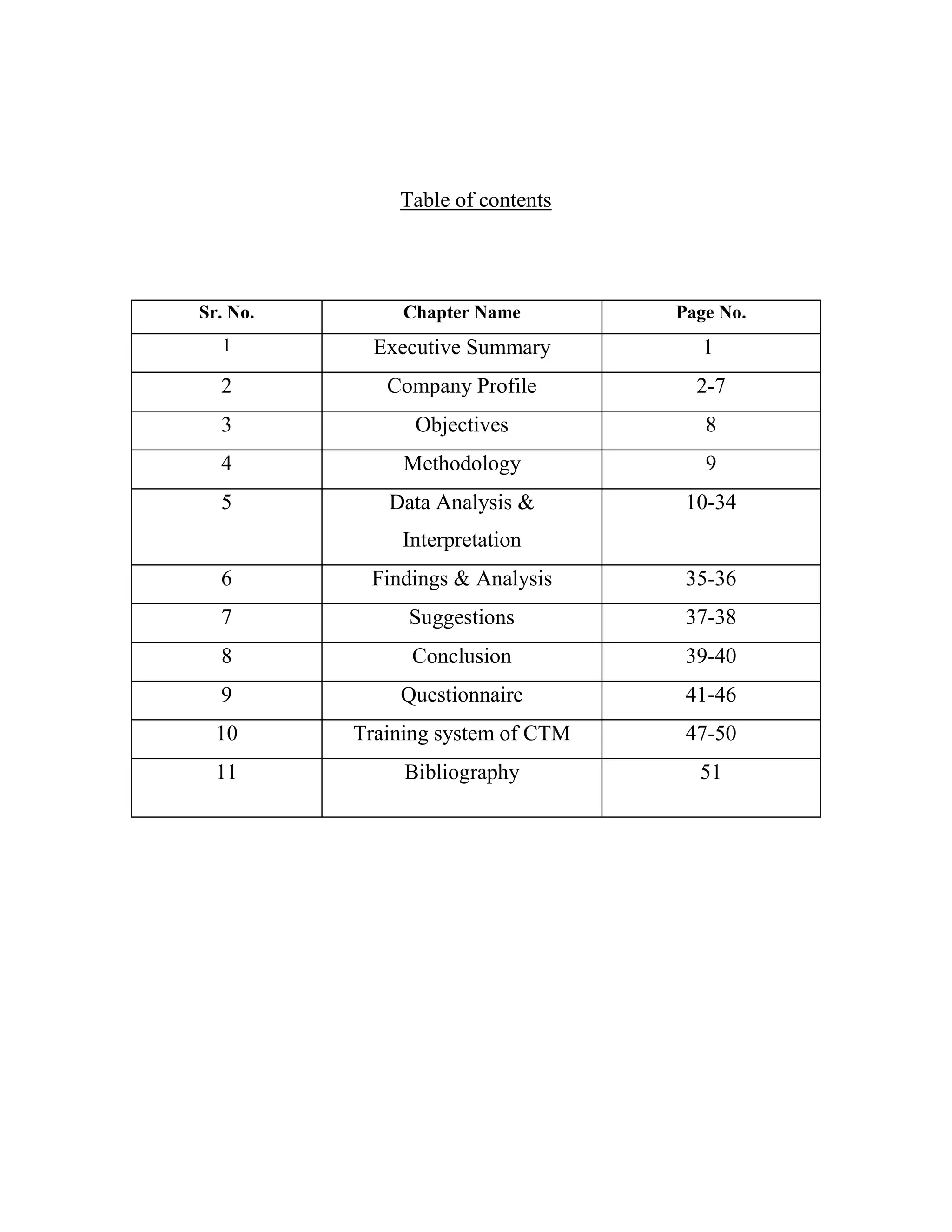
Table of contents
Sr. No. Chapter Name Page No.
1 Executive Summary 1
2 Company Profile 2-7
3 Objectives 8
4 Methodology 9
5 Data Analysis &
Interpretation
10-34
6 Findings & Analysis 35-36
7 Suggestions 37-38
8 Conclusion 39-40
9 Questionnaire 41-46
10 Training system of CTM 47-50
11 Bibliography 51
To Whomsoever It May Concern
This is to certify that Ms. Nitika Choudhry is a bonafide student of our institute. She has
successfully carried out her summer project “Causes of attrition amongst the local and
outside workers” titled, at Chenab Textiles Ltd, Jammu & Kashmir.
This is original study of Ms. Nitika Choudhry and important sources of data used by her
have been acknowledged in her report.
The report is submitted in partial fulfillment of two years full time course of Masters in
Business Administration 2006-2008 as per the rule.
Mrs. S.M. Sovani Dr. Sharad Joshi
Project Guide Director
Vishwakarma Institute of Management
EXECUIVE SUMMARY
Chenab Textile Mill (CTM) is a part of Sutlej Textile and industries Ltd, a blue chip
company of K.K Birla Group. It is the biggest and oldest Company of (J&K). The project
entitled “Causes of Attrition among Local and Outsider Workers of CTM and Suggest
improvement if any” in CTM. In my Project “Causes of Attrition among local and
outside worker” I have to find out factors, which were responsible for high Attrition
among workers and remedies for the same. As this is a manufacturing concern and
workers play a very crucial role in the growth and development of the company by being
more productive and efficient. As the company is located in Jammu & Kashmir (J&K)
and the worker inspite of getting perks like free Housing, Electricity and Water etc which
is unlikely in any other state in India, there is high attrition among workers. So, the
Company gave me this opportunity to analyse the problems and suggest some
constructive remedies for the same.
The second part of the project includes the Study the training system of
the company in brief. It was interesting to study the working of HR Department in a
manufacturing Firm. Training being one of the most important functions of HR
Department was chosen for study. The study was spread over 6 weeks during which
different officials working in the HR Department have provided very important data in
this respect, Formal and Informal interviews were taken as well as research (through
questionnaire) were the basic methods of data collection.
COMPANY’S PROFILE
Chenab Textile Mills (CTM) is a part of Sutlej Textiles and Industries Ltd., a Blue Chip
Company of the K.K. Birla Group- one of the top 20 business houses in India. Under its
chairman Dr. K.K Birla, the group is engaged in diversifying activities including
fertilizers, sugar, shipping, media, tea coffee, food processing, engineering, cement,
textile machinery, agro based industries apart for spinning units. CTM being the largest
and oldest industrial unit of J&K stands a proud member of this group.
Establishment of the company
CTM was set up at Kathua in 1962 with initial capacity of 12600 spindles and its
commercial production commenced in Jan. 1965. Despite the set back because of
disturbance of peace two wars with Pakistan in 1965 & 1971, the mill completed its 2nd
phase of 12400 spindles in 1976 raising the total capacity to 25000 spindles. There have
been many ups and downs because of various reason including locational disadvantage
but the mill and the Birla’s put their maximum possible resources to keep the mill in
operation. During the early nineties the liberalization of economy was initiated and the
Indian industry become open for globalization competition and it become imperative for
Indian industry to modernized by upgrading the technology and create for the capacities
to face challenges of international competition by producing quality product and take
advantage of the scale of economy. In view of this the mill invested over Rs. 125.00
corers on modernization and expansion of capacities during the last decade of 20th
centaury. As on date the installed capacity of the mills is 138392 spindles.
MISSION OF THE COMPANY
To be the largest single point provided for all blends and shades of spun yarn and an
organization that prides itself on integrity, environmental consciousness, scheduled
delivery and adherence to international quality norms to the best of our customer’s
satisfaction.
VALUE OF THE COMPANY:-
Care:- Giving back to the society, serving the community and providing respectful
conduct to the public and our peer.
Competence: - For us, our customer come first. Giving them the best in class products,
maximum output and most convenient scheduled.
Craft:- Treating the science of textile yarns with the dedication and reverence of an art
form, we believe in our work as a merger of technology and craft.
Vision:- To be a leading player in the global textile industry, providing comprehensive
textile solution under one roof, highlighted by quality, variety and impeccability for our
esteemed customers.
THE COMPANY FORMING BIRLA GROUP IN TABULAR FORMAT IS GIVEN
BELOW:
1. CHENAB TEXTILE MILLS (KATHUA)
2. BADHI (H.P.)
3. DHAMN GANGRA PROCESSING UNIT (GUJRAT)
4. SUTLEJ TEXTILE MILL (RAJASTHAN)
REGIONAL OFFICERS:
1. MUMBAI
2. CALCUTTA
3. DELHI
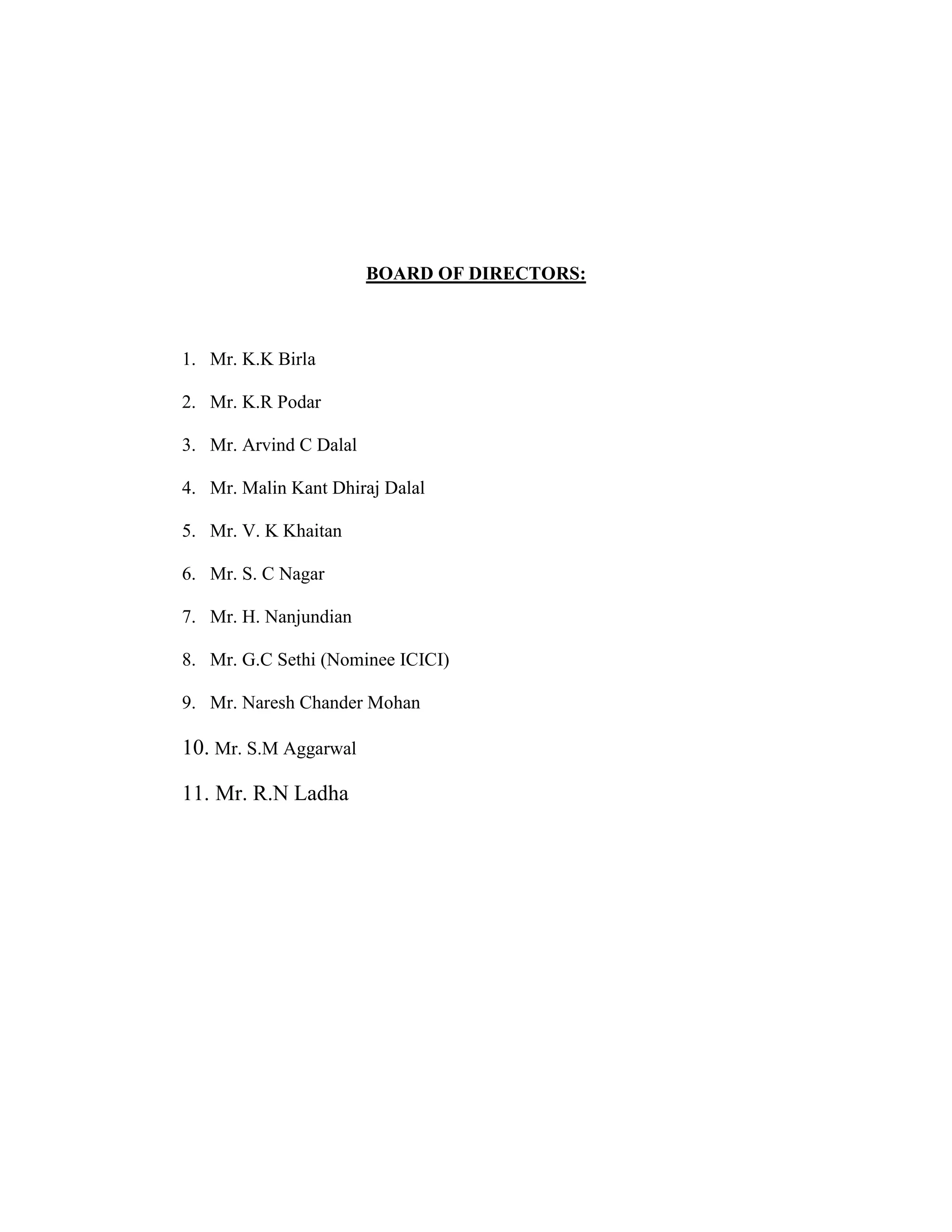
BOARD OF DIRECTORS:
1. Mr. K.K Birla
2. Mr. K.R Podar
3. Mr. Arvind C Dalal
4. Mr. Malin Kant Dhiraj Dalal
5. Mr. V. K Khaitan
6. Mr. S. C Nagar
7. Mr. H. Nanjundian
8. Mr. G.C Sethi (Nominee ICICI)
9. Mr. Naresh Chander Mohan
10. Mr. S.M Aggarwal
11. Mr. R.N Ladha
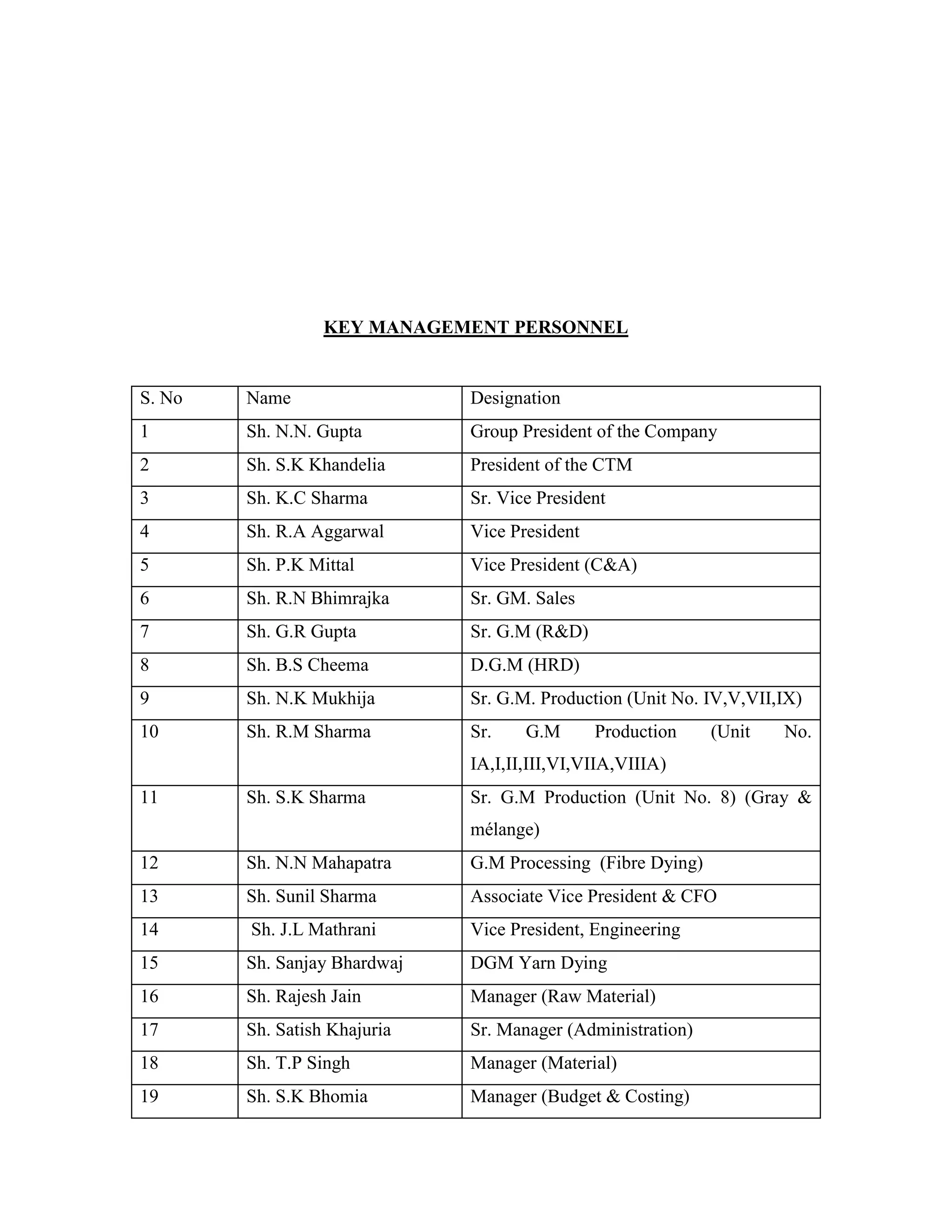
KEY MANAGEMENT PERSONNEL
S. No Name Designation
1 Sh. N.N. Gupta Group President of the Company
2 Sh. S.K Khandelia President of the CTM
3 Sh. K.C Sharma Sr. Vice President
4 Sh. R.A Aggarwal Vice President
5 Sh. P.K Mittal Vice President (C&A)
6 Sh. R.N Bhimrajka Sr. GM. Sales
7 Sh. G.R Gupta Sr. G.M (R&D)
8 Sh. B.S Cheema D.G.M (HRD)
9 Sh. N.K Mukhija Sr. G.M. Production (Unit No. IV,V,VII,IX)
10 Sh. R.M Sharma Sr. G.M Production (Unit No.
IA,I,II,III,VI,VIIA,VIIIA)
11 Sh. S.K Sharma Sr. G.M Production (Unit No. 8) (Gray &
mélange)
12 Sh. N.N Mahapatra G.M Processing (Fibre Dying)
13 Sh. Sunil Sharma Associate Vice President & CFO
14 Sh. J.L Mathrani Vice President, Engineering
15 Sh. Sanjay Bhardwaj DGM Yarn Dying
16 Sh. Rajesh Jain Manager (Raw Material)
17 Sh. Satish Khajuria Sr. Manager (Administration)
18 Sh. T.P Singh Manager (Material)
19 Sh. S.K Bhomia Manager (Budget & Costing)
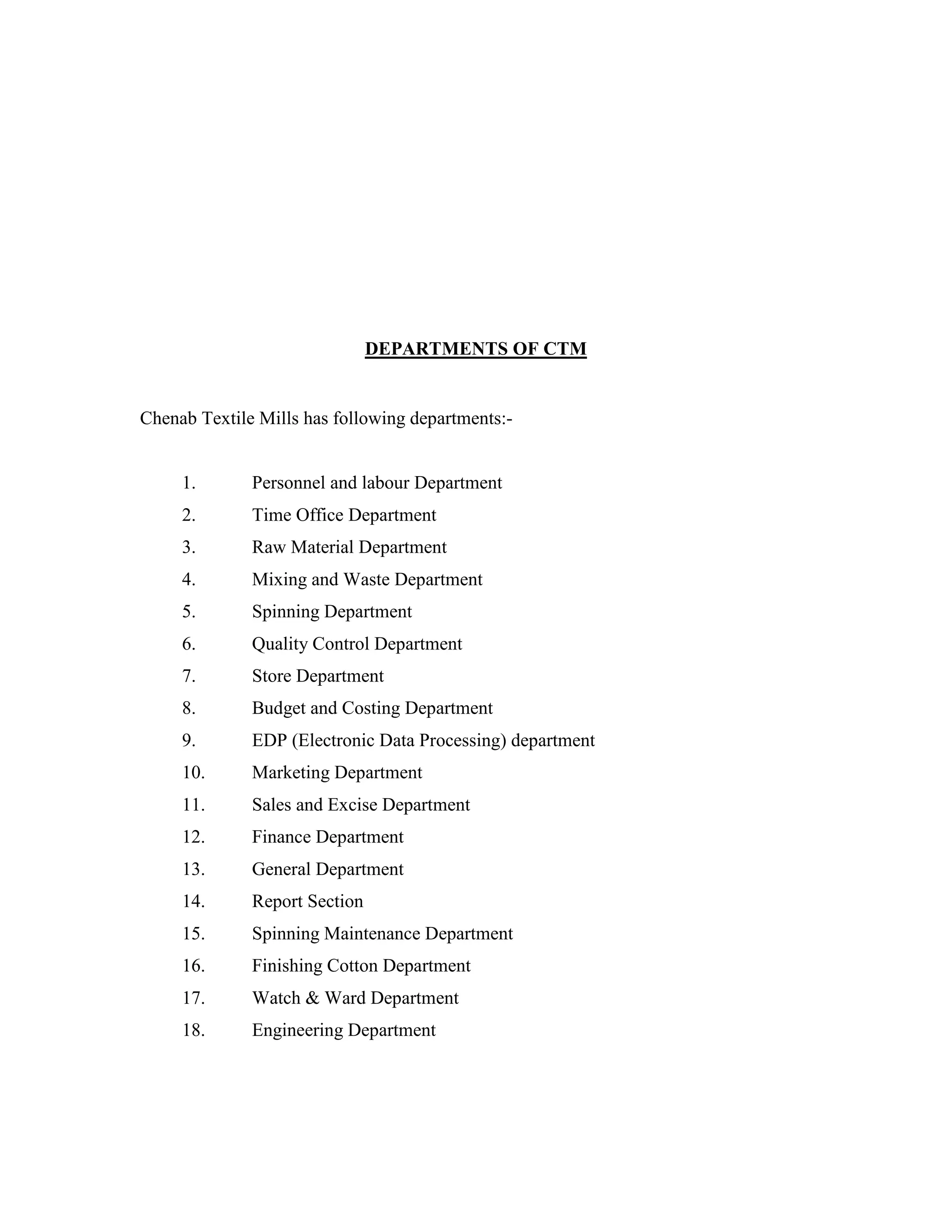
DEPARTMENTS OF CTM
Chenab Textile Mills has following departments:-
1. Personnel and labour Department
2. Time Office Department
3. Raw Material Department
4. Mixing and Waste Department
5. Spinning Department
6. Quality Control Department
7. Store Department
8. Budget and Costing Department
9. EDP (Electronic Data Processing) department
10. Marketing Department
11. Sales and Excise Department
12. Finance Department
13. General Department
14. Report Section
15. Spinning Maintenance Department
16. Finishing Cotton Department
17. Watch & Ward Department
18. Engineering Department
THE AIM OF THE STUDY
Practical training imposes skill in the field of business managements and
administration. It reduces the gap between theoretical and practical knowledge
for a Management Student. This type of practical training helps a lot in gearing
insight in to actual business environment and different organizational activities.
The main objectives of my studies are:-
1 To study the causes of attrition and remedial measures to reduce or stop
attrition.
2 To know about training system and development of workers in various
units congenial.
3 To have a healthy communication with the workers or employees.
4 The main aim of the studding the above mentioned is to ultimately lead
the mill to progress up to highest.
METHODOLOGY
To study “causes of Attrition of New Trainees Local & Outsider” and “study the Training
system of the CTM” primary and secondary sources of information have been employed
for collection of data. The sources of collecting data are as follows:
Personal observation
The main first choice of collecting data and information is personal observation.
Discussion
The 2nd
source of collecting information is the personal discussion with Manager,
Supervisor and workers in CTM.
Specific Questionnaire
While conducting a survey a questionnaire was prepared to help in carrying out the
analysis, which has been given in the Annexure
Files and Records
The 4th
source of collecting information is from the official files and records of the
company.
Internet
The other source of collecting the information from the Internet
GRAPH OF RECRUITED WORKERS & LEFT OUT WORKERS
With the help of labour department the give me the information of the workers that how
many workers are recruited and how many left out the organization.
From their information I Plotted a graph between numbers of workers recruited month
wise and number of worker left out month wise.
GRAPH OF RECRUITED WORKERS
0
100
200
300
400
500
600
700
Jan. Feb. March April May June July
NO. OF MONTHS
NO.OFRECRUITEDWORKERS
From the graph it is clear that number of workers is maximum in the month of January
and then decreases and after few months the number of workers remain constant.
GRAPH OF LEFT OUT WORKERS
0
100
200
300
400
500
600
700
800
Jan. Feb. March April May June July
NO OF MONTHS
NOOFLEFTOUTWORKERS
When I plotted a graph between the numbers of workers left with number of months I
found that magnitude of decrease of workers in the beginning is minimum and then
increases and reaches to maximum after few months.
From the graph it is concluded that attrition is a major problem of the company and
appropriate measures should be adopt to check the causes of attrition for the betterment
and up-liftman of the company.
I have randomly chosen 100 workers from 2000 workers in the ration 1:20 and enquired
about the causes of attrition among new and old employees. Workers cooperate and
helped me in my project.
1 30% Of worker are illiterate
2 20% of worker has education up to 5th
standard.
3 While 25% comprises of 8th
class literate. And 10th
class literate 20% and 12th
and
above comprises only 5% of the total.
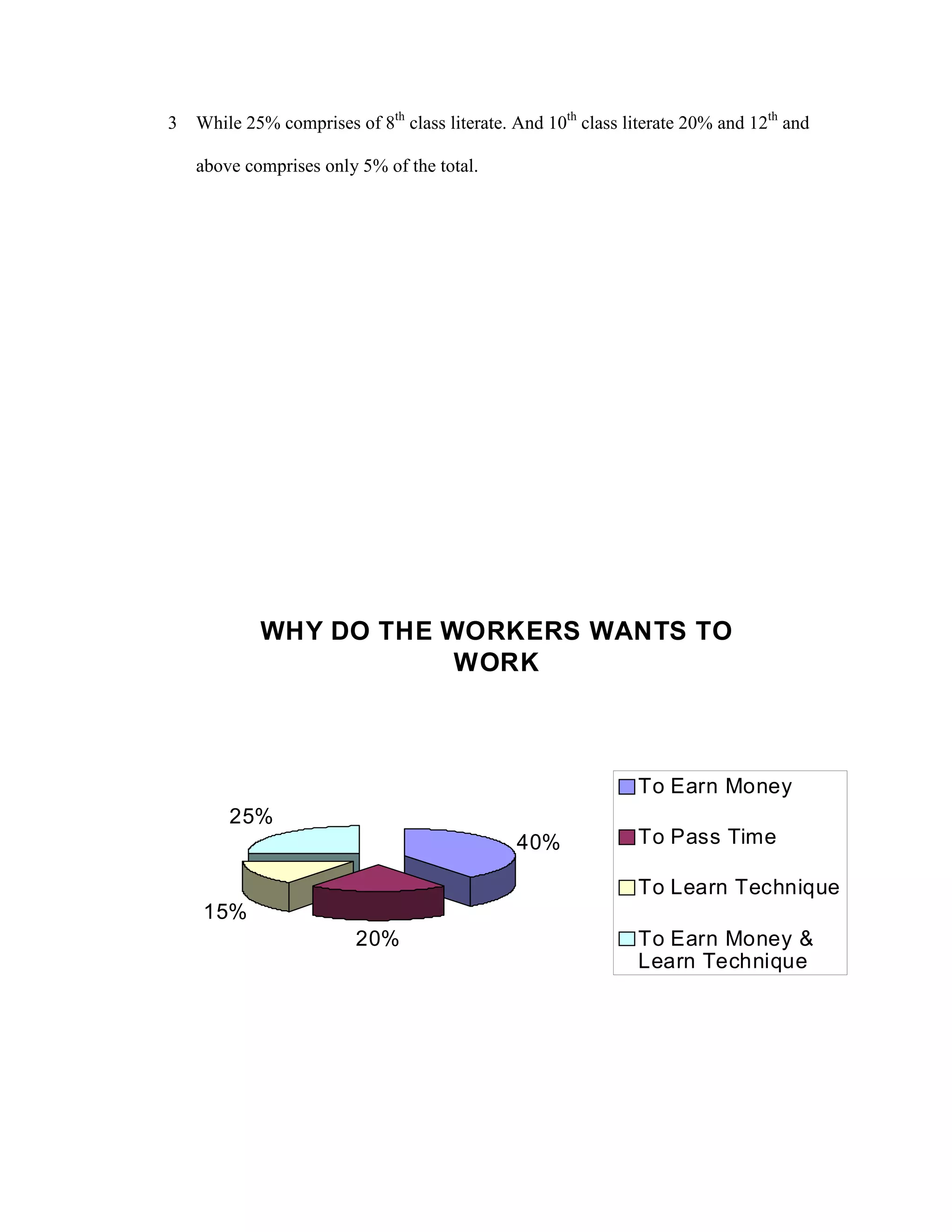
WHY DO THE WORKERS WANTS TO
WORK
40%
20%
15%
25%
To Earn Money
To Pass Time
To Learn Technique
To Earn Money &
Learn Technique
Interpretation
1 The reason why do workers want to work is to earn money.
2 Secondly is to do time pass.
3 Thirdly is to learn techniques & lastly is to earn money as well as learn
techniques.
Interpretation:
1 Reason for leaving the previous job by workers were 40% Family
problems,20% health problem, 15%less wages and 25% for other reason.
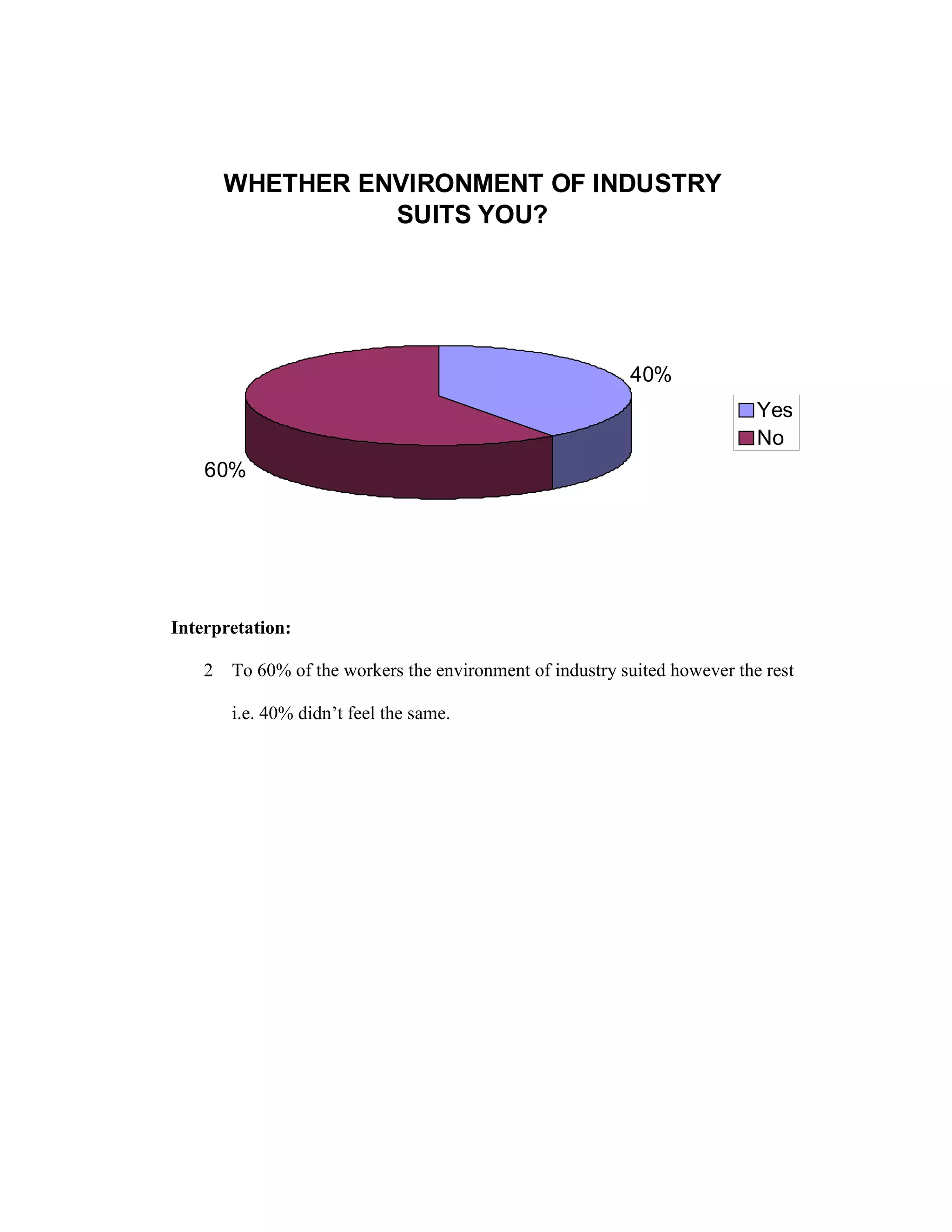
WHETHER ENVIRONMENT OF INDUSTRY
SUITS YOU?
40%
60%
Yes
No
Interpretation:
2 To 60% of the workers the environment of industry suited however the rest
i.e. 40% didn’t feel the same.
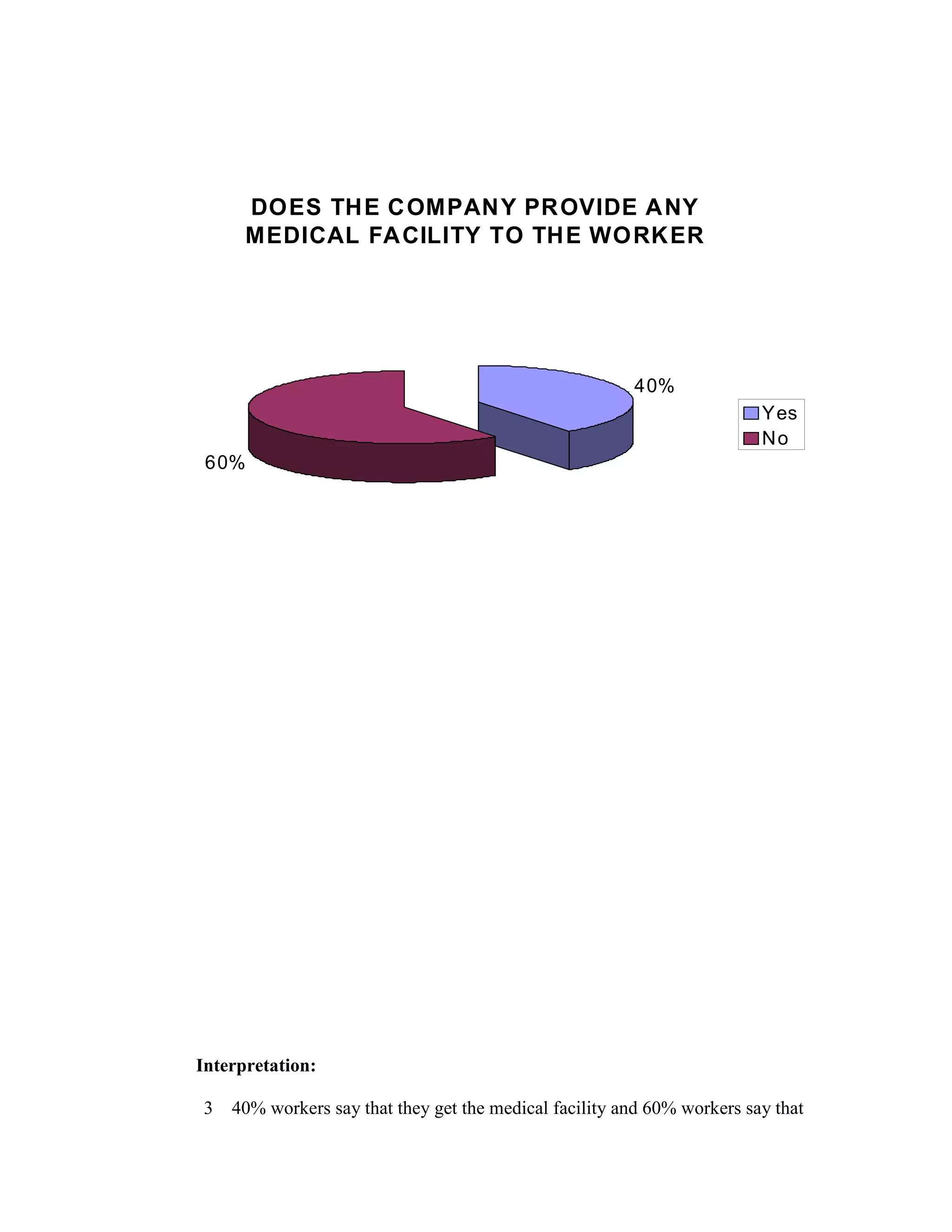
DOES THE COMPANY PROVIDE ANY
MEDICAL FACILITY TO THE WORKER
40%
60%
Yes
No
Interpretation:
3 40% workers say that they get the medical facility and 60% workers say that
they don’t get.
WHEN YOU WERE ILL WHO LOOK AFTER
YOU?
40%
30%
15%
15%
Wife
Mother
No-One
Room Mates
Interpretation:
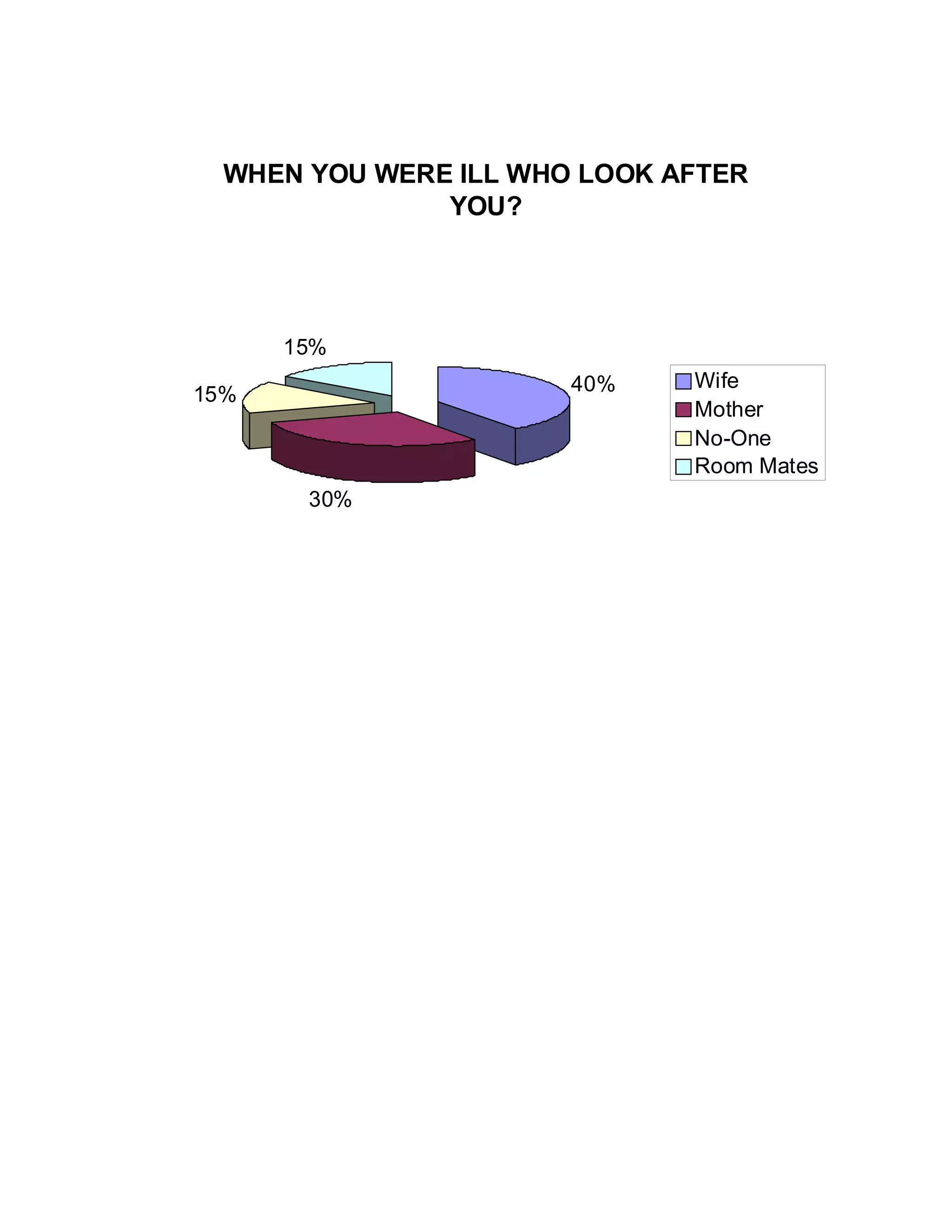
4 40% worker says when they were ill their wife look after them
5 30% worker says Mother look after them.
6 15% worker says that Room mates look after them.
7 15% workers says that when they were ill no one look after them
DO YOU WANT TO LIVE
20%
80%
Alone
with Families
Interpretation:
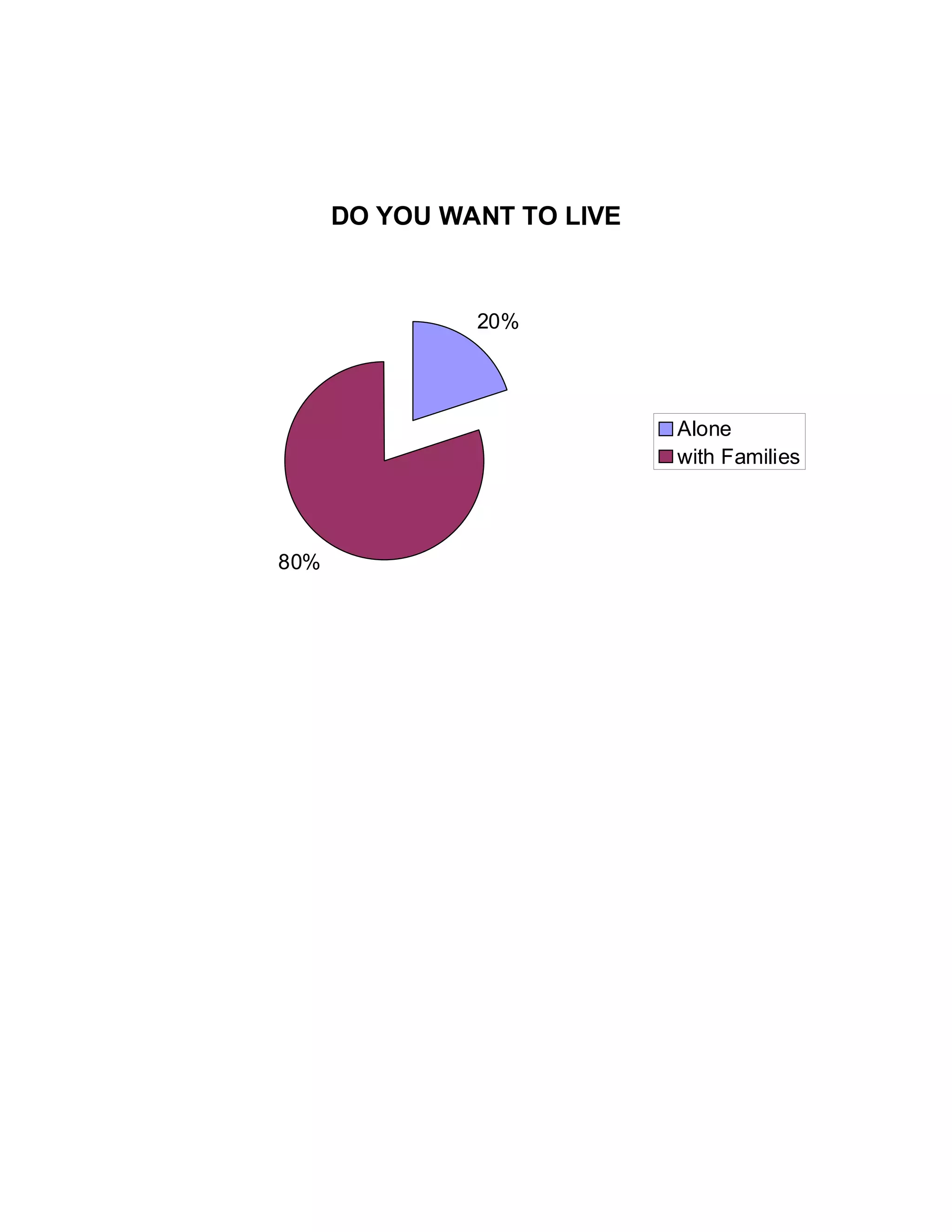
1 80% of worker says that they want to live with their Family.
2 20% of workers says that they want to live alone.
HOW IS YOUR RELATION WITH YOUR
SUPERVISOR
40%
30%
30%
Good
Average
Below
Interpretation:
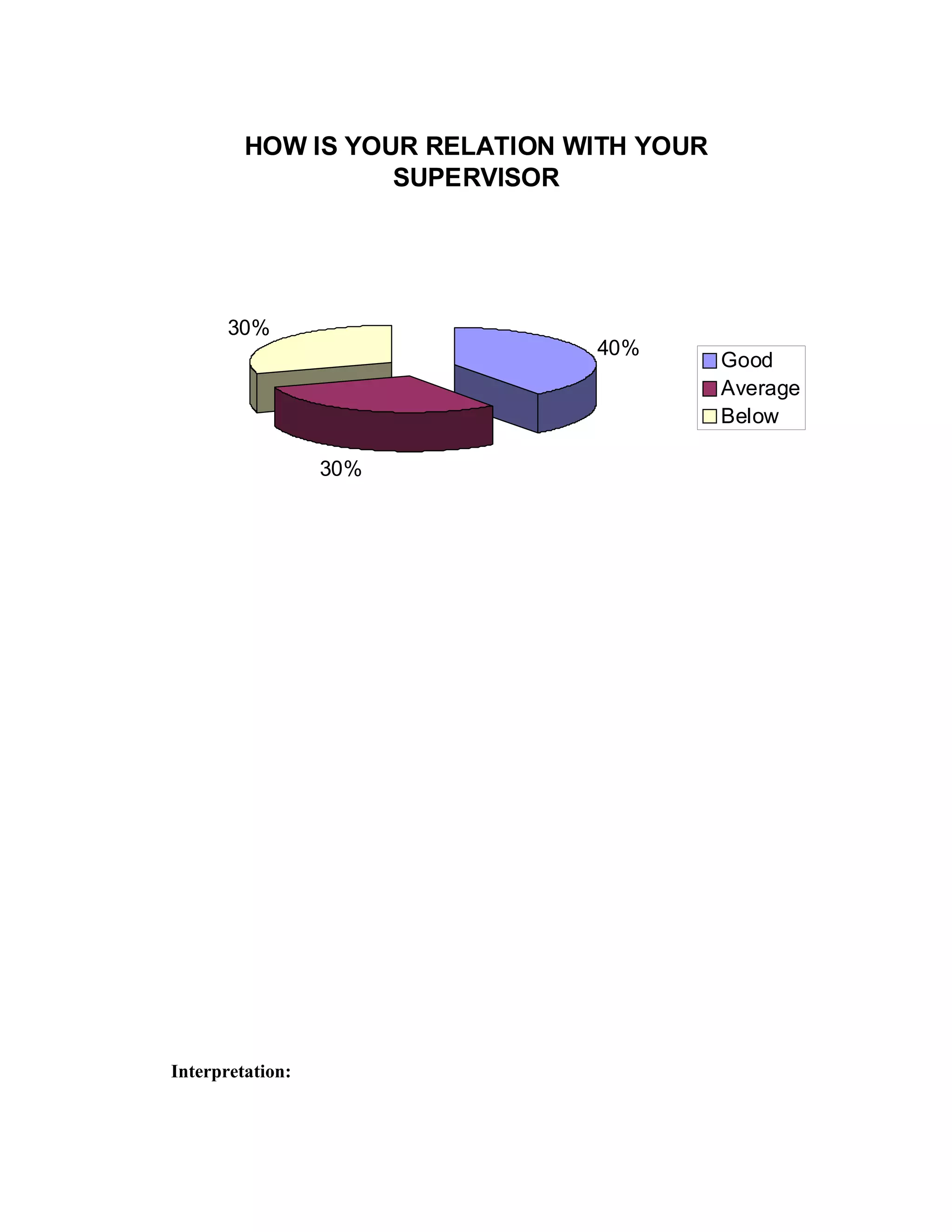
1 40% of workers says that they have good relation with their supervisor.
2 30% of workers says that they have the average relation with their supervisor.
3 30% of workers says that they have poor relation with their supervisor.
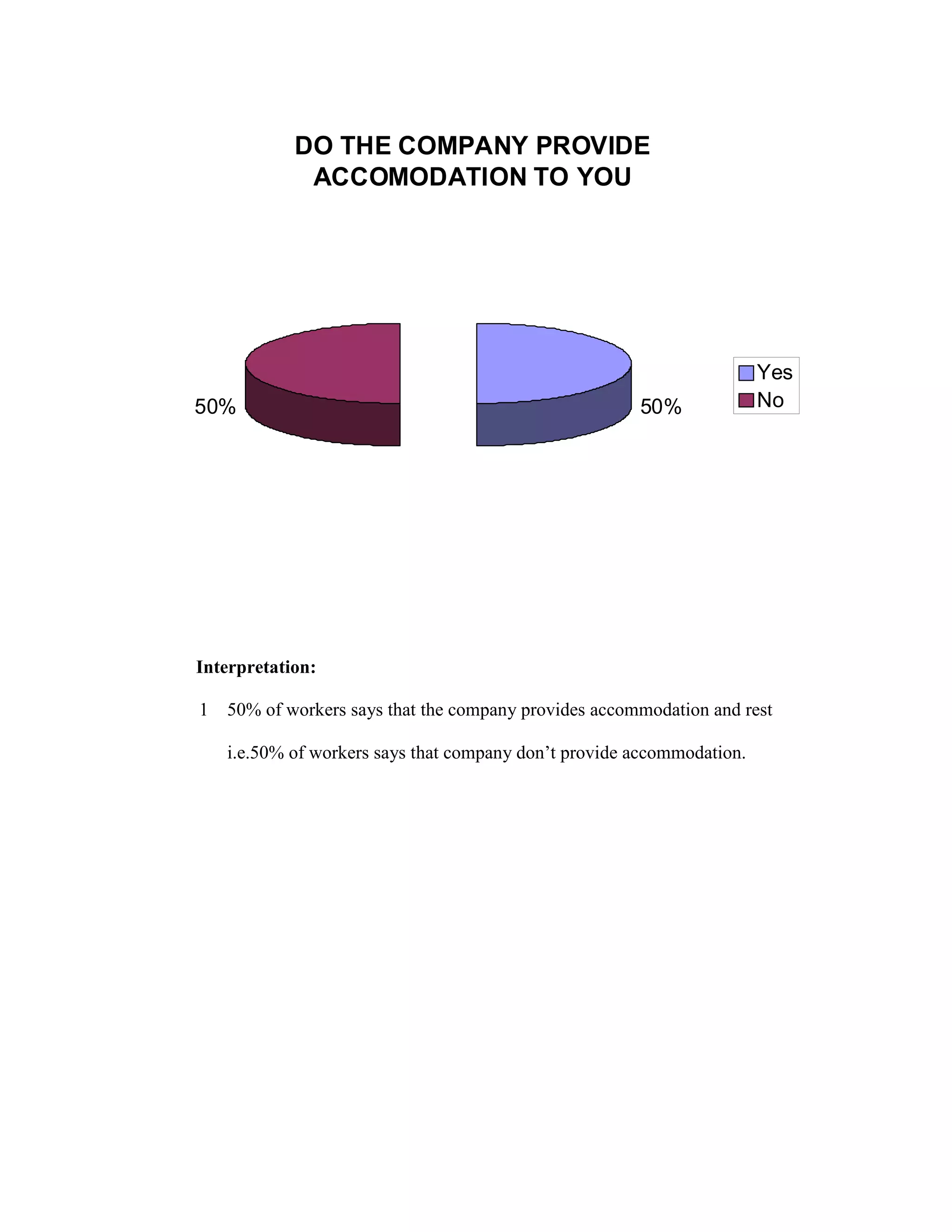
DO THE COMPANY PROVIDE
ACCOMODATION TO YOU
50%50%
Yes
No
Interpretation:
1 50% of workers says that the company provides accommodation and rest
i.e.50% of workers says that company don’t provide accommodation.
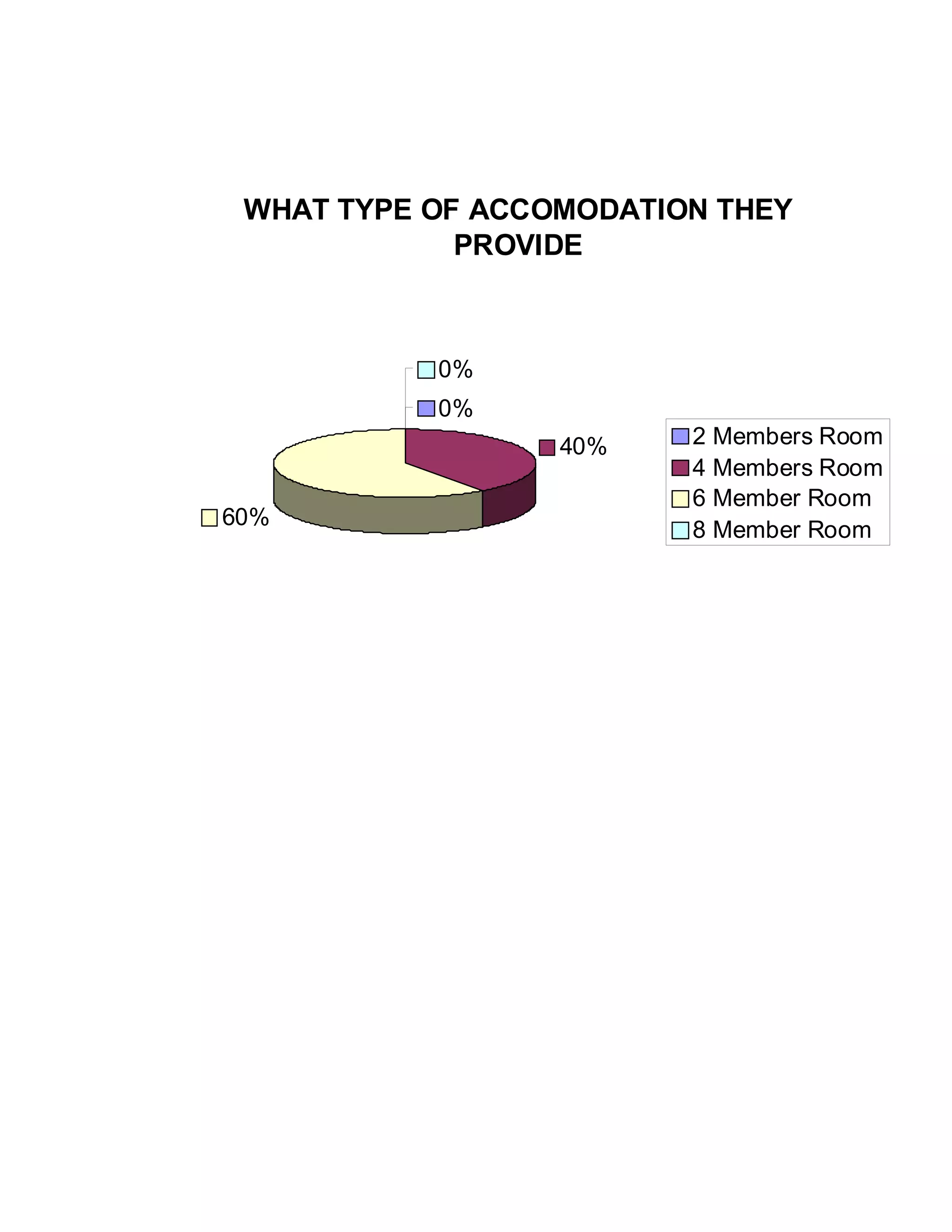
WHAT TYPE OF ACCOMODATION THEY
PROVIDE
0%
40%
60%
0%
2 Members Room
4 Members Room
6 Member Room
8 Member Room
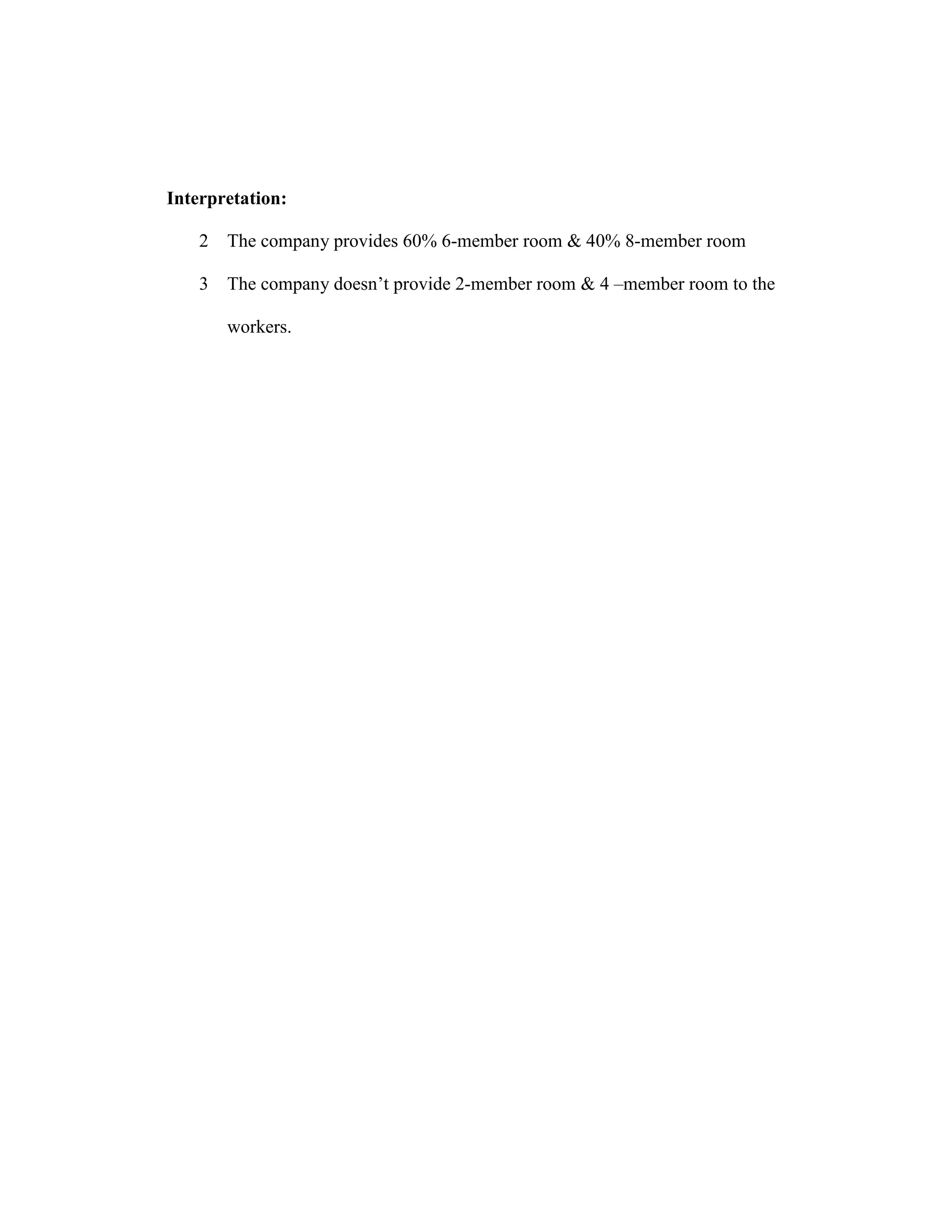
Interpretation:
2 The company provides 60% 6-member room & 40% 8-member room
3 The company doesn’t provide 2-member room & 4 –member room to the
workers.
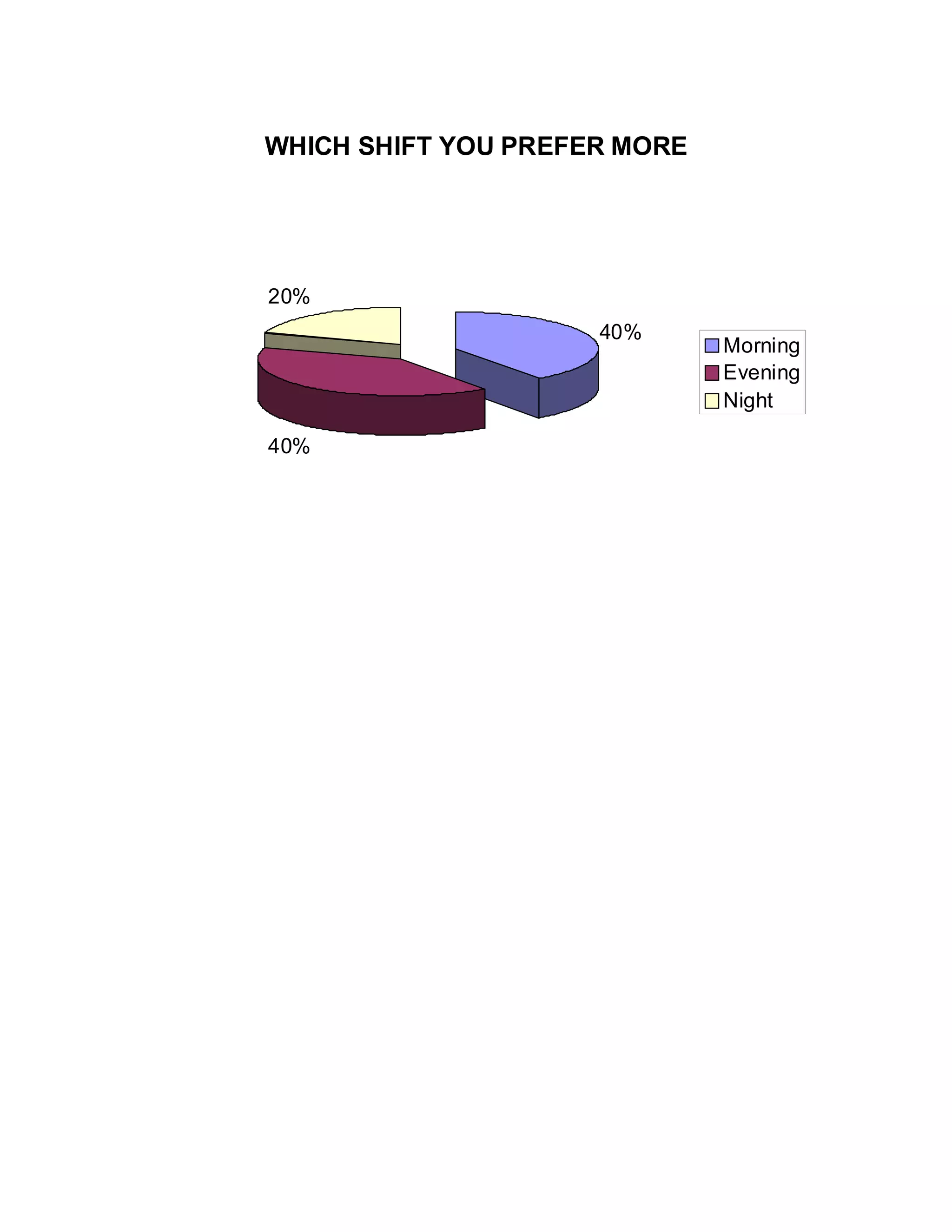
WHICH SHIFT YOU PREFER MORE
40%
40%
20%
Morning
Evening
Night
Interpretation:
1 40% of the workers prefer morning shift.
2 40% of the workers prefer evening shift.
3 20% of the workers prefer night shift.
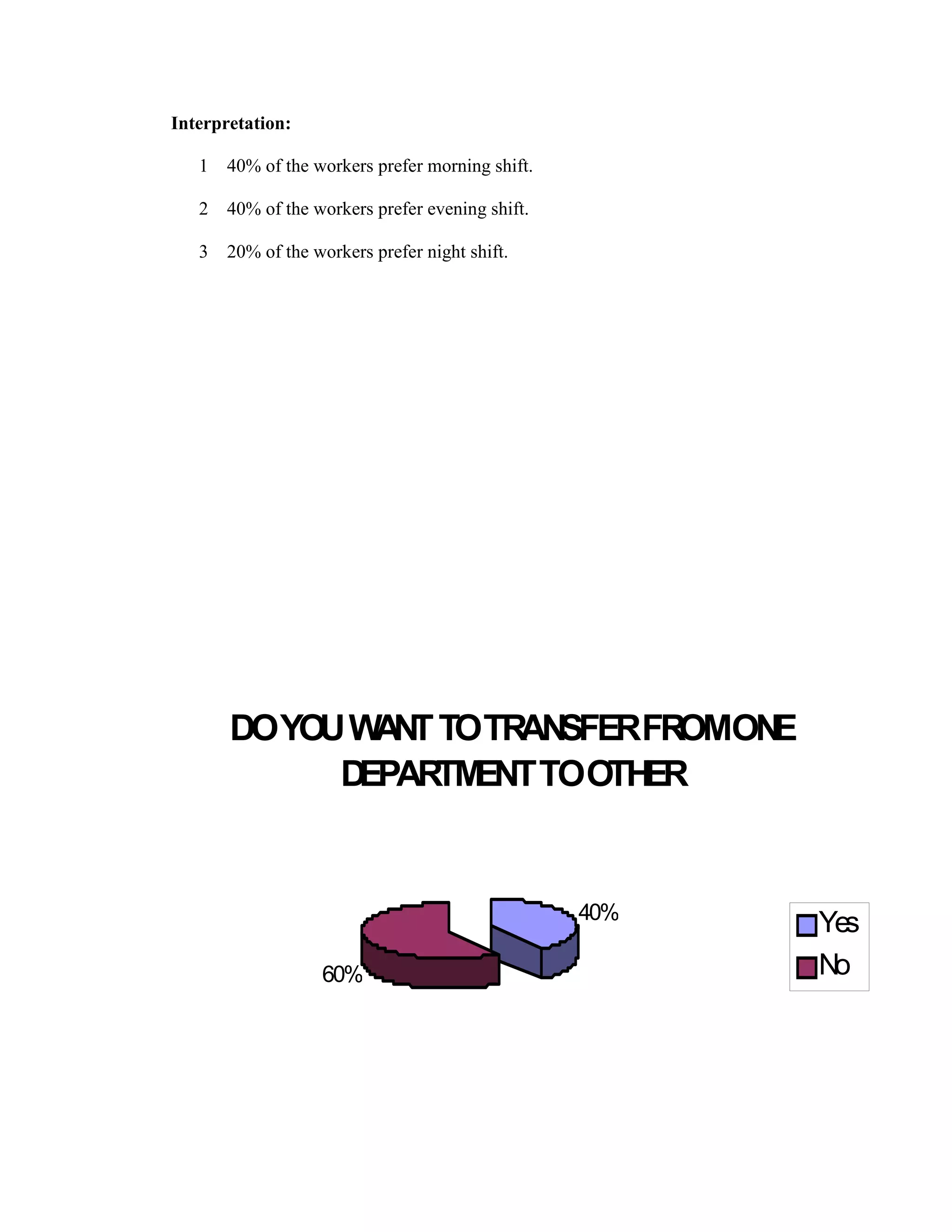
DOYOUWANTTOTRANSFERFROMONE
DEPARTMENTTOOTHER
40%
60%
Yes
No
Interpretation:
1 60% of the workers don’t want to transfer from one department to other.
2 40% of the workers want to transfer from one department to other.
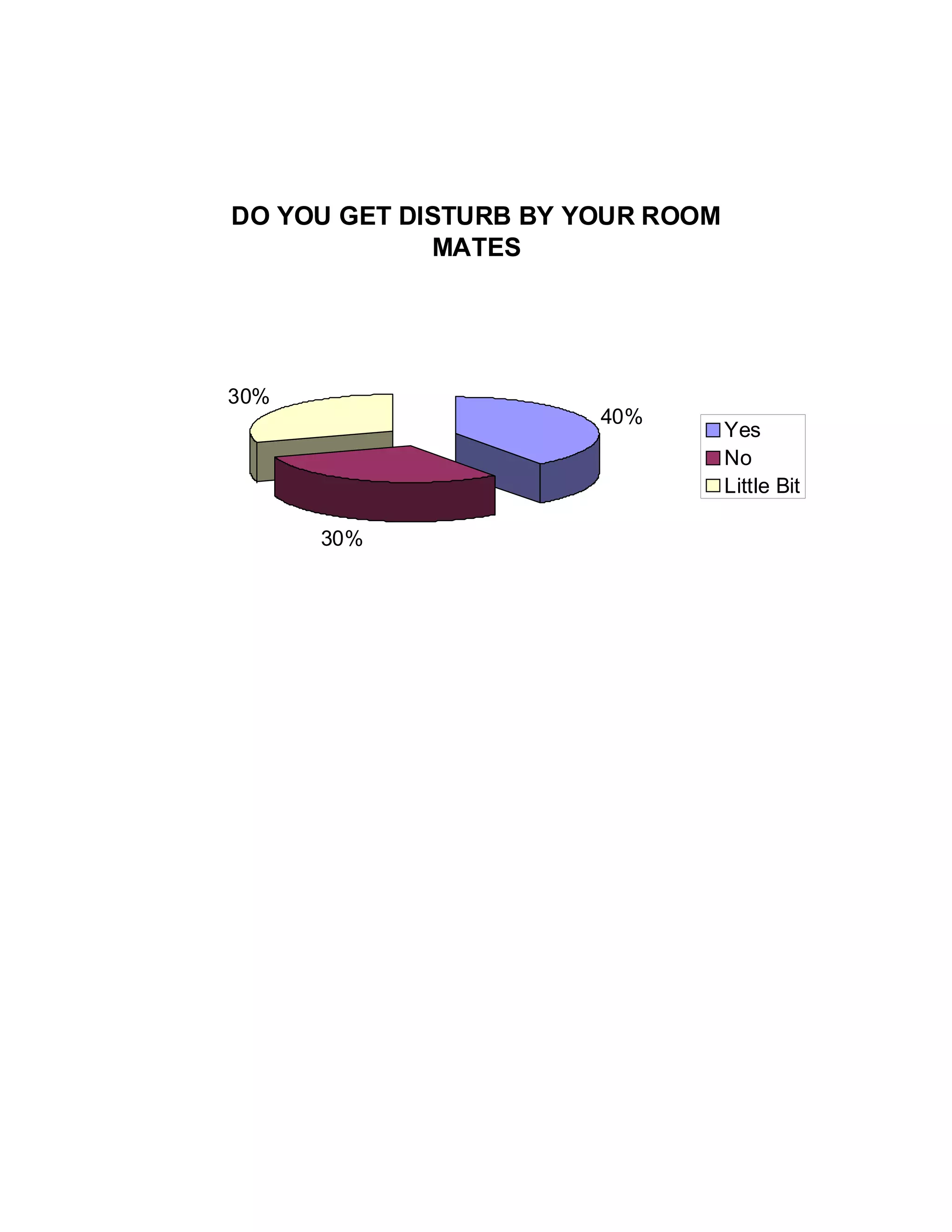
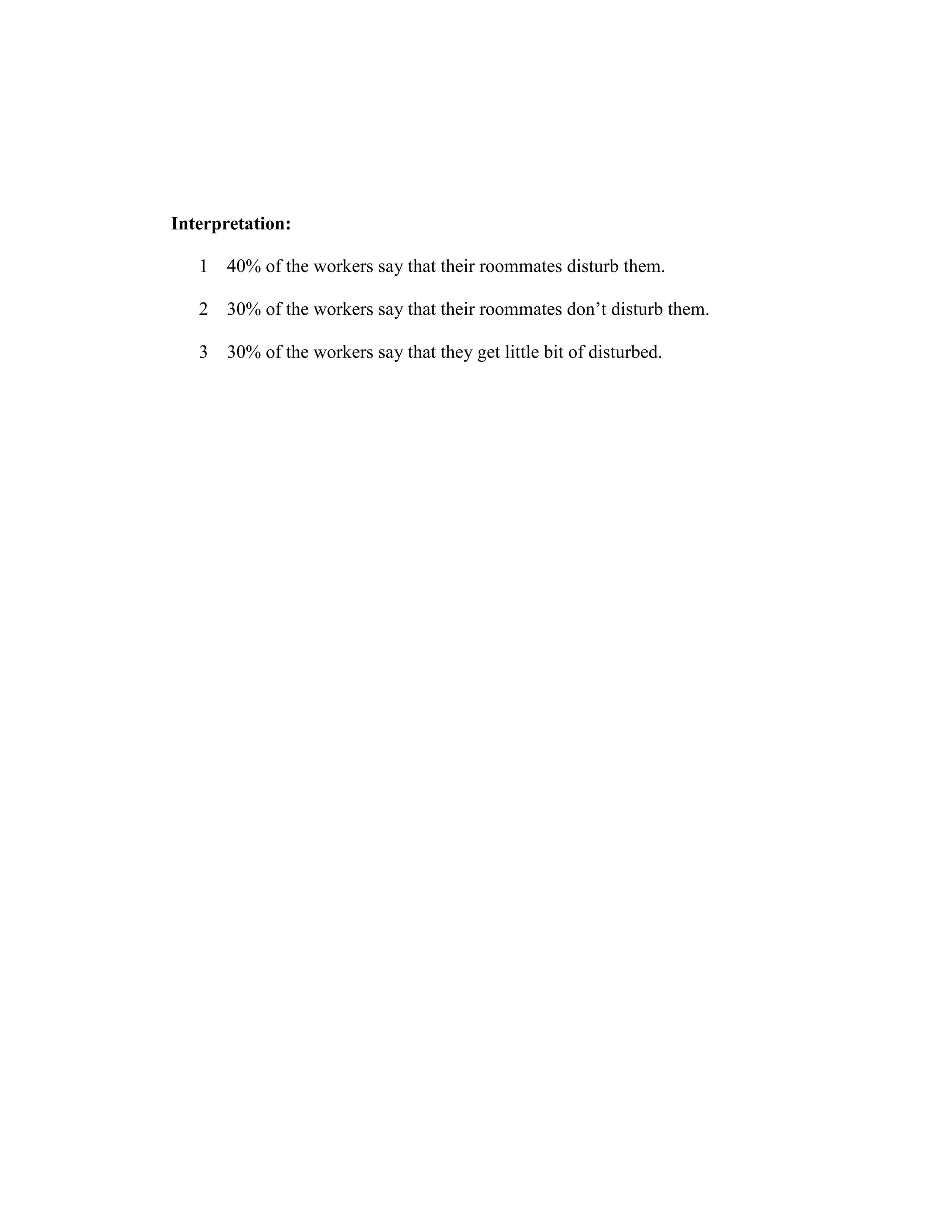
DO YOU GET DISTURB BY YOUR ROOM
MATES
40%
30%
30%
Yes
No
Little Bit
Interpretation:
1 40% of the workers say that their roommates disturb them.
2 30% of the workers say that their roommates don’t disturb them.
3 30% of the workers say that they get little bit of disturbed.
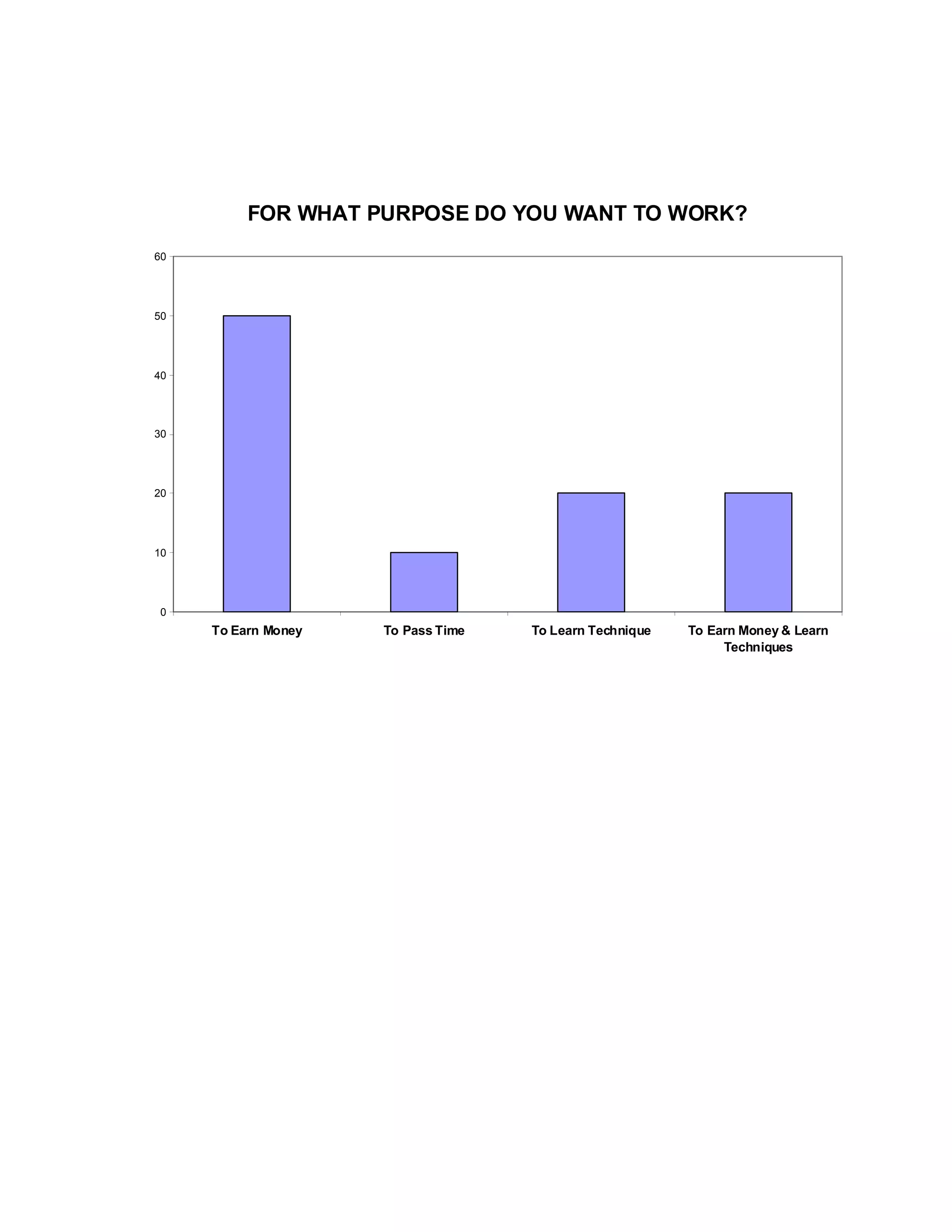
FOR WHAT PURPOSE DO YOU WANT TO WORK?
0
10
20
30
40
50
60
To Earn Money To Pass Time To Learn Technique To Earn Money & Learn
Techniques
Interpretation:
1 50 % of workers purpose is to earn money.
2 10% of the workers purpose is to pass time.
3 20% of the workers purpose is to learn technique
4 20% of the workers purpose is to earn money and to learn techniques
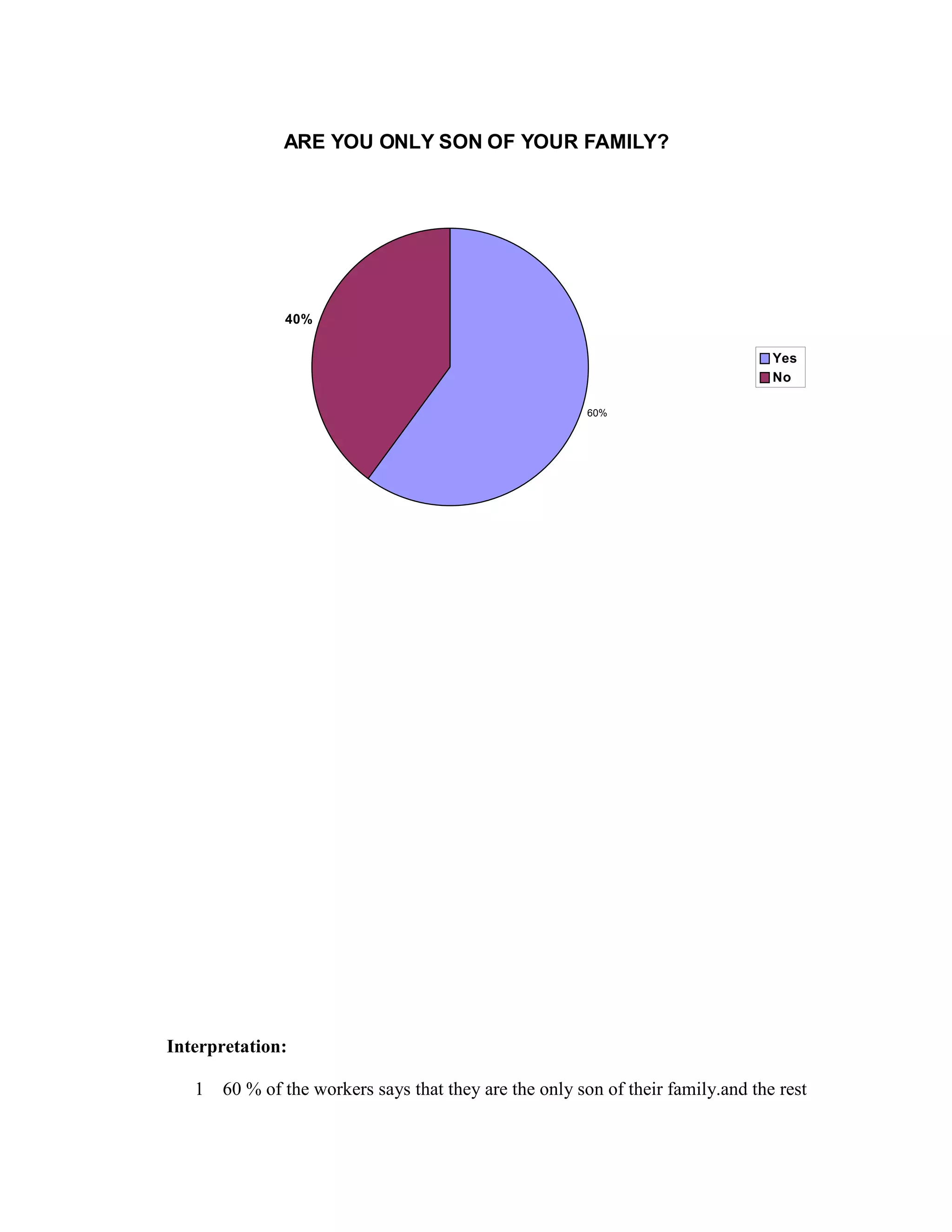
ARE YOU ONLY SON OF YOUR FAMILY?
60%
40%
Yes
No
Interpretation:
1 60 % of the workers says that they are the only son of their family.and the rest
i.e.40% of the workers say that they are not the only son of their family.
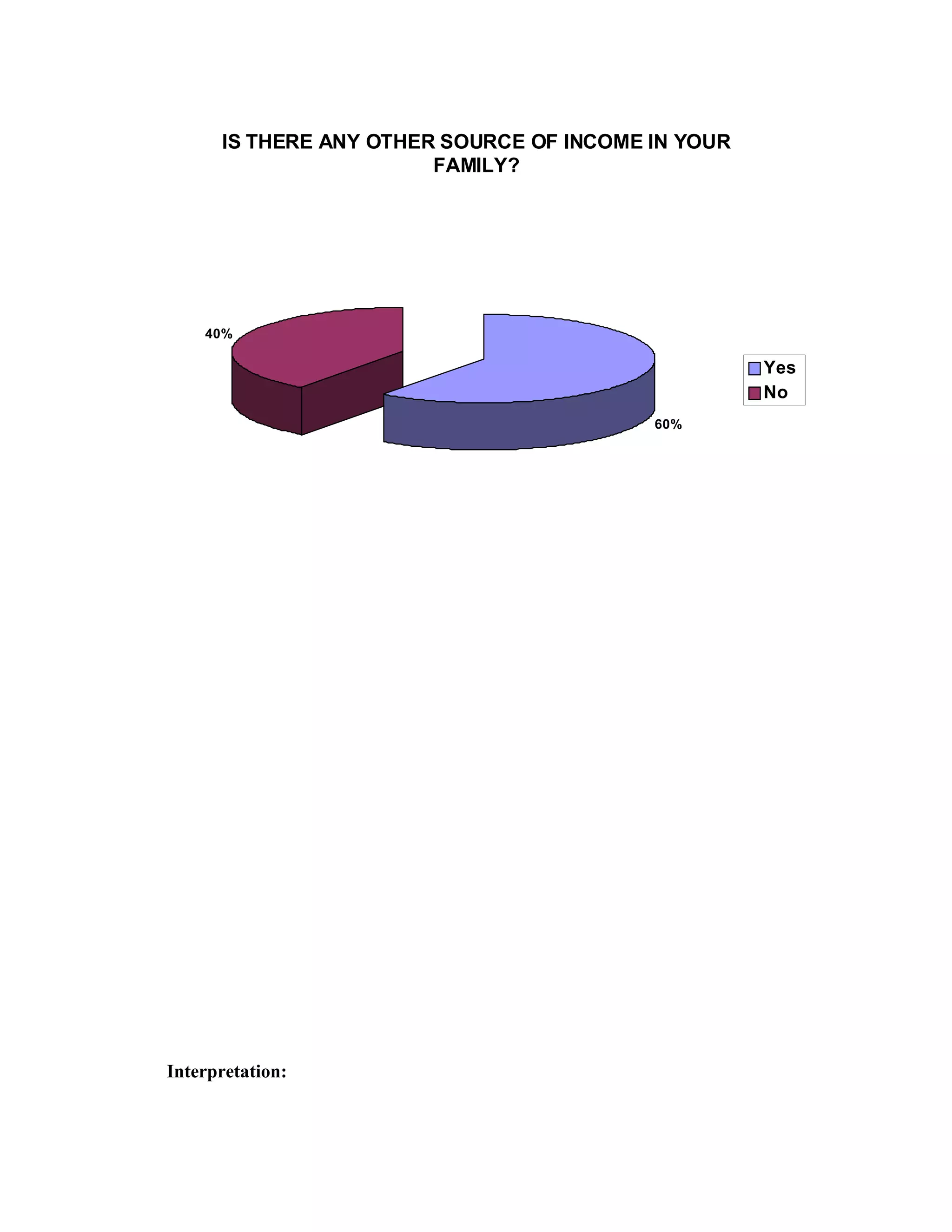
IS THERE ANY OTHER SOURCE OF INCOME IN YOUR
FAMILY?
60%
40%
Yes
No
Interpretation:
2 60% of the workers says that they have other source of income in their family
and the rest don’t have
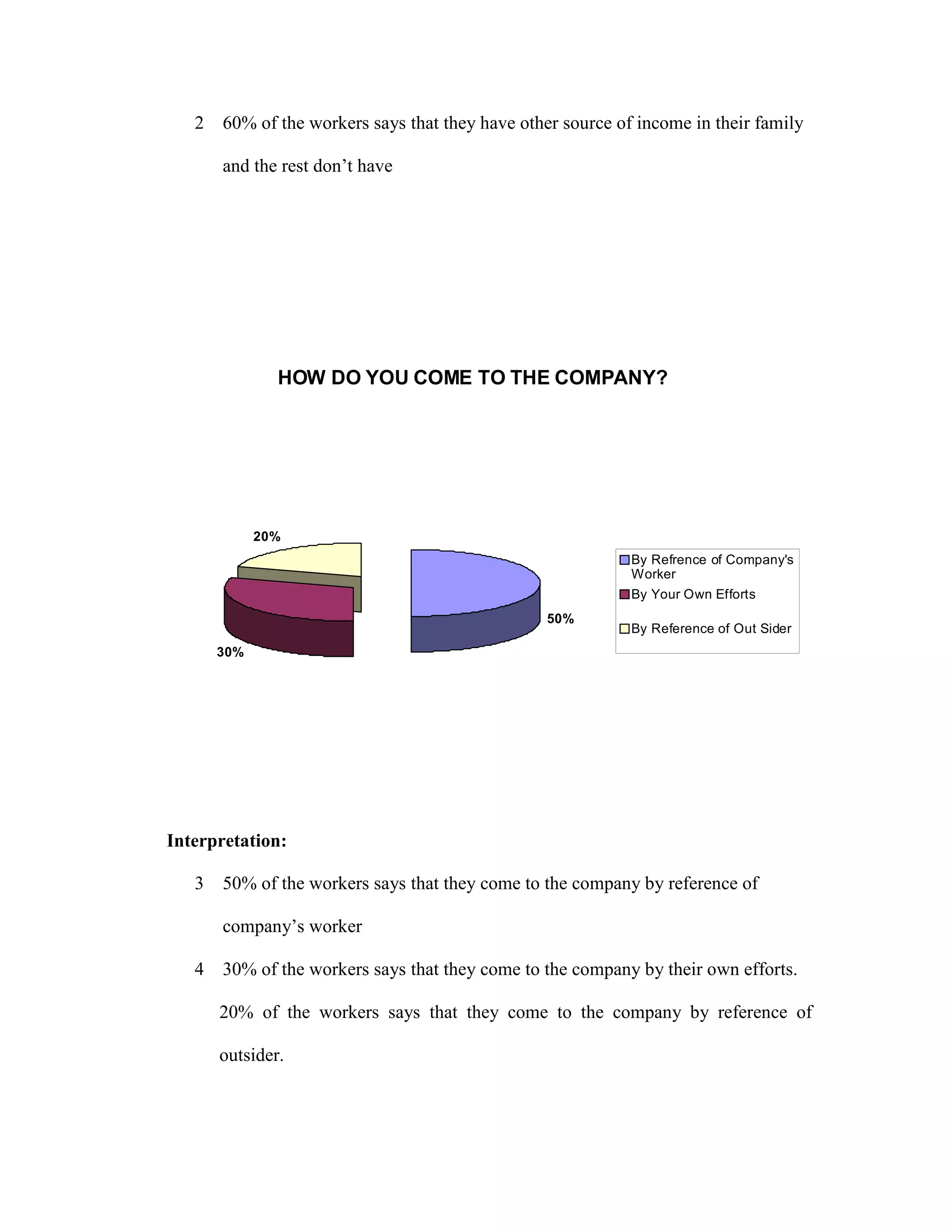
HOW DO YOU COME TO THE COMPANY?
50%
30%
20%
By Refrence of Company's
Worker
By Your Own Efforts
By Reference of Out Sider
Interpretation:
3 50% of the workers says that they come to the company by reference of
company’s worker
4 30% of the workers says that they come to the company by their own efforts.
20% of the workers says that they come to the company by reference of
outsider.
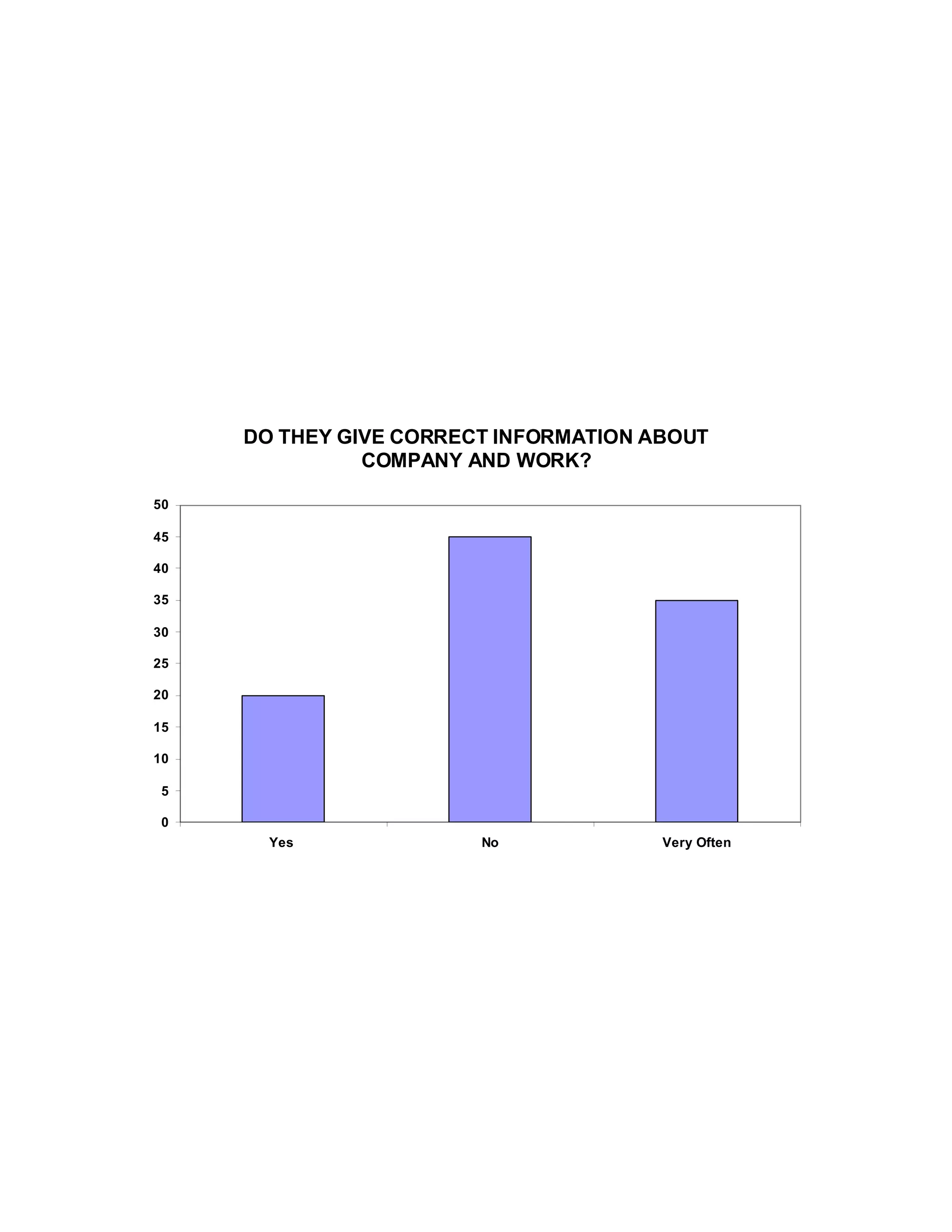
DO THEY GIVE CORRECT INFORMATION ABOUT
COMPANY AND WORK?
0
5
10
15
20
25
30
35
40
45
50
Yes No Very Often
Interpretation:
1 20% of the workers says that the referee give the correct information about
the company and the work.
2 45% of the workers says that they don’t give the correct information about the
company and the work.
3 35% of the workers says that they give the information very often about the
company and the work.
Interpretation:
1 45% of the workers don’t get the job according to their expectation
2 35% of workers get job according to their expectation
3 20 % of the workers get the job according to their expectation.
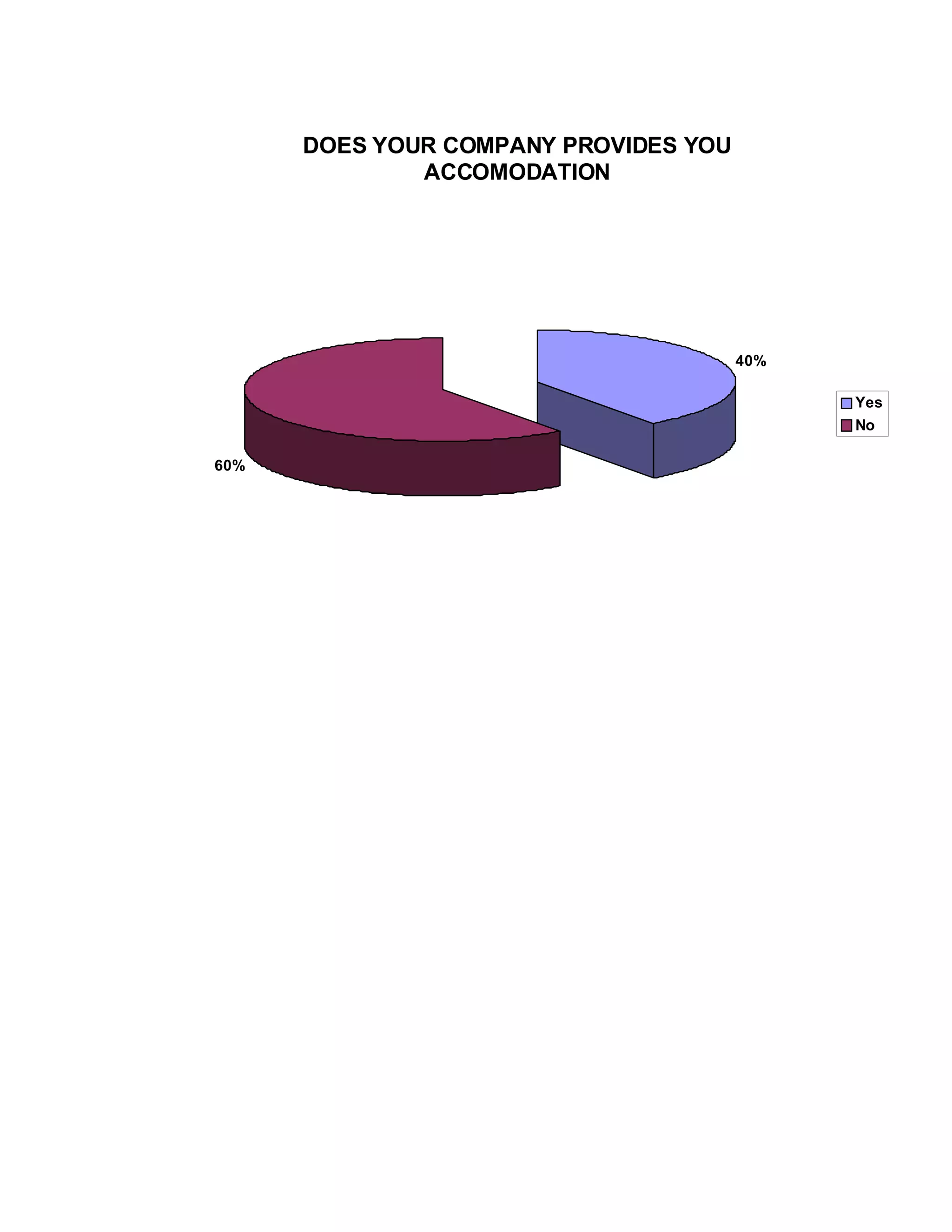
DOES YOUR COMPANY PROVIDES YOU
ACCOMODATION
40%
60%
Yes
No
Interpretation:
60 % of the workers says that the company does not provide accommodation and the rest
i.e.40% of the workers says that the company oprovides accommodation
0
5
10
15
20
25
30
35
40
45
50
3 People 4 People 5 People 6 People
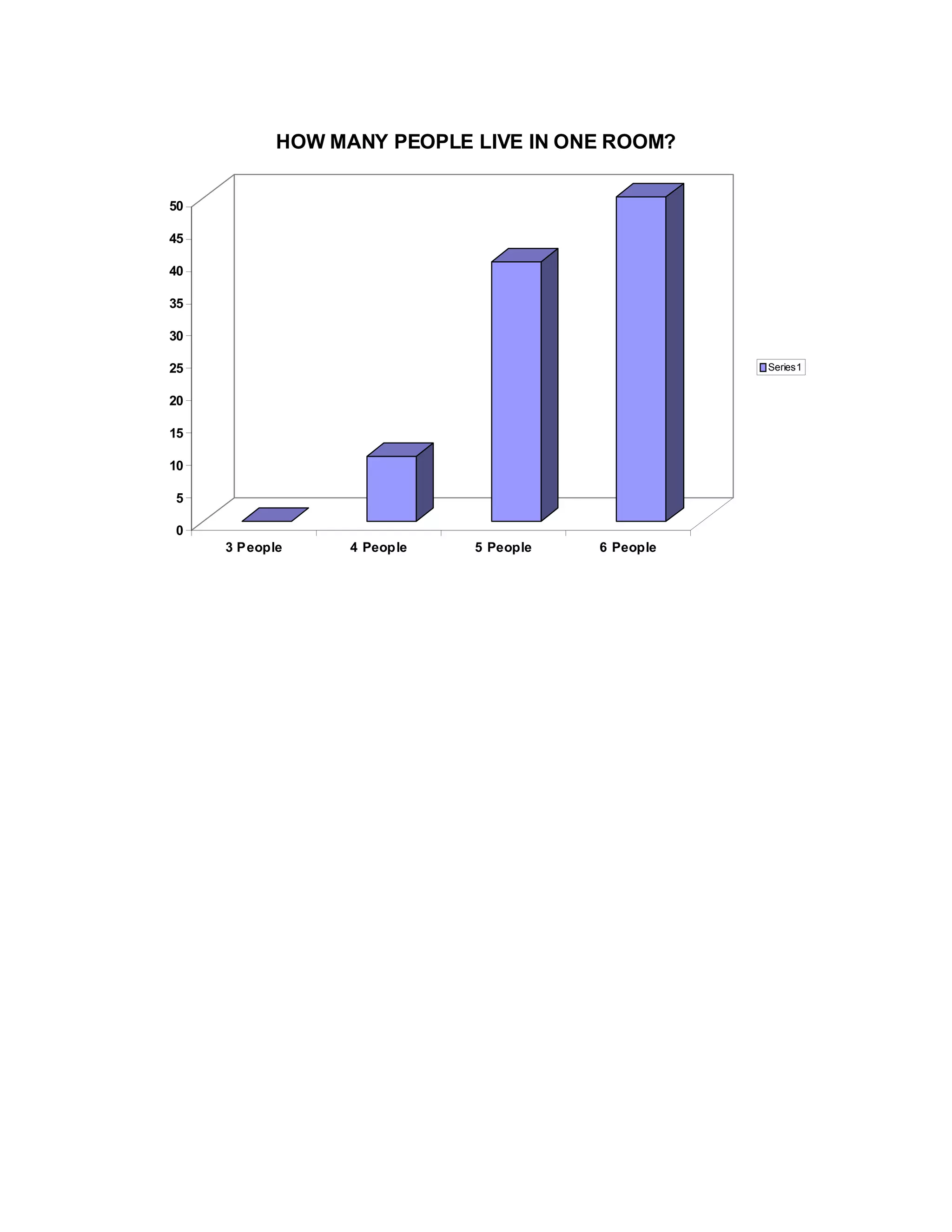
HOW MANY PEOPLE LIVE IN ONE ROOM?
Series1
Interpretation:
1 50% of the workers live in 6 people room.
2 40% of the workers live in 5 people room
3 10% of the workers live in 4 people room
0% of the workers live in 3 people room
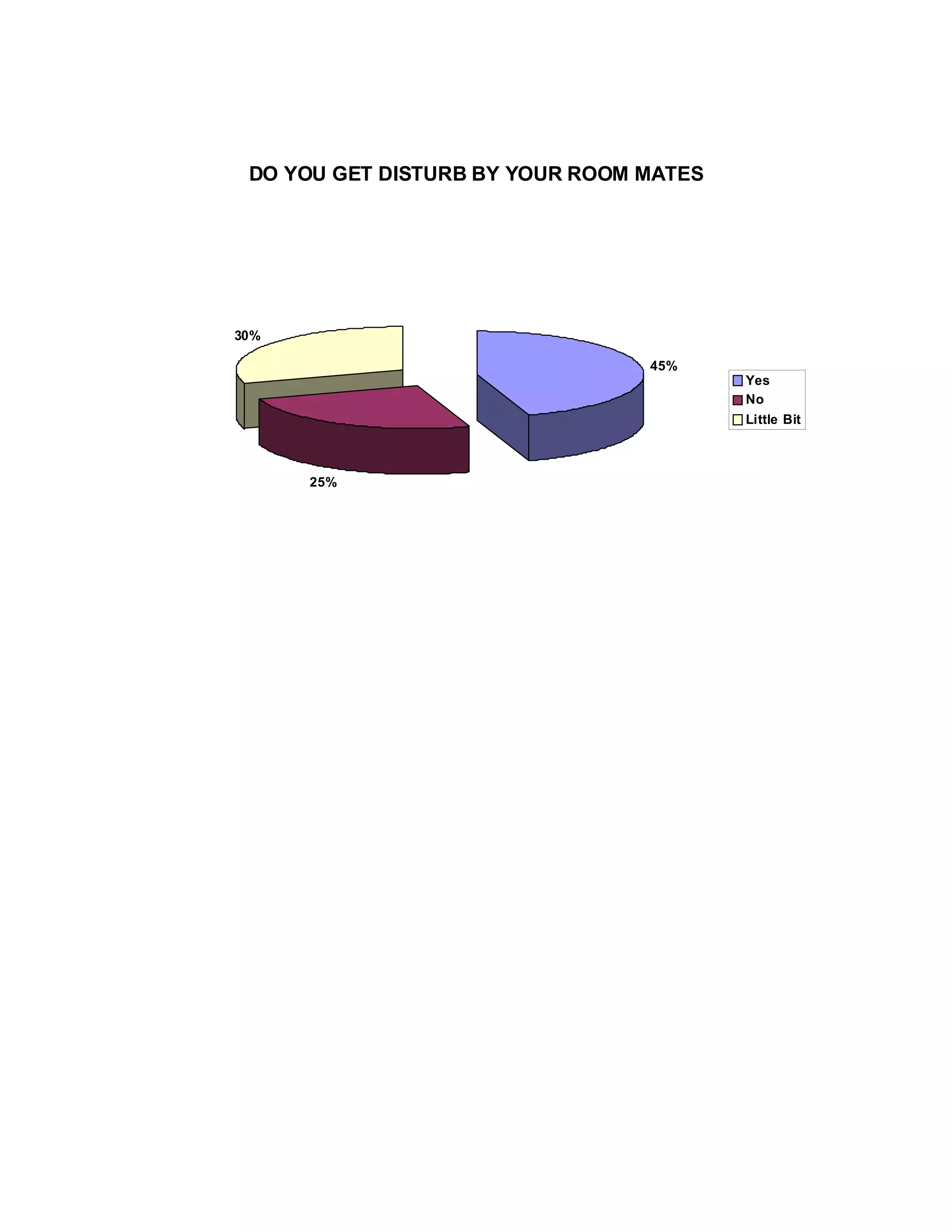
DO YOU GET DISTURB BY YOUR ROOM MATES
45%
25%
30%
Yes
No
Little Bit
Interpretation:
1 45% of the workers get disturbed by their room mates
2 30% of the workers get little bit disturbed by their room mates.
3 25 % of the workers don’t get disturbed by their room mates
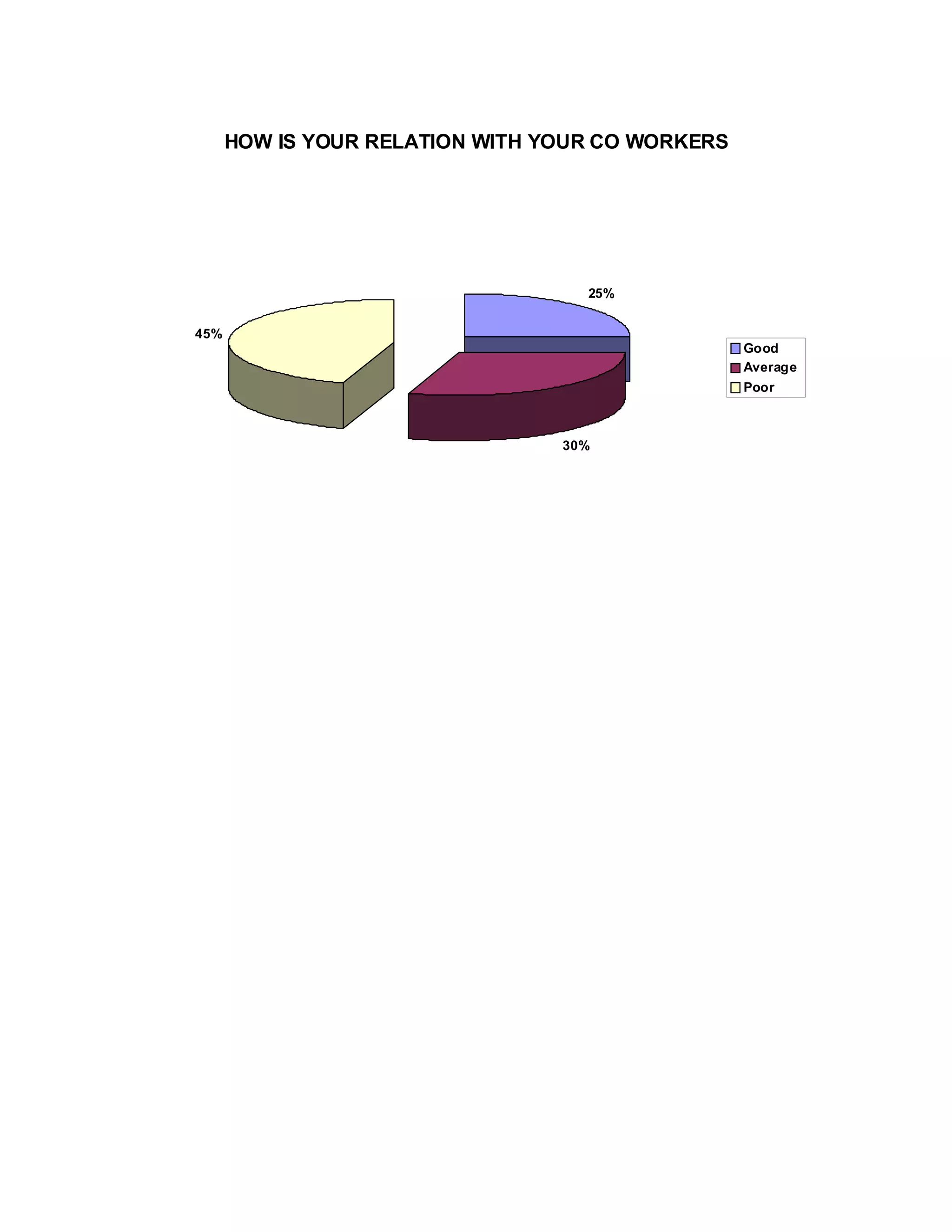
HOW IS YOUR RELATION WITH YOUR CO WORKERS
25%
30%
45%
Good
Average
Poor
Interpretation:
1 25% of the workers have good relation with their co-workers
2 30% of the workers have average relation with their co-workers
3 45% of the workers have poor relation with their co-workers
FINDINGS & ANALYSIS
I found that the main causes of attrition among the new workers local and outsider by
questionnaire
OUTSIDER
1. Home sickness
2. Health problem
3. Family problem
4. To earn more
5. Accommodation problem
6. Problem with their room mates
7. Not satisfied with wages
8. Illiteracy
9. Literacy
10. More age
11. Get new job in other organization
12. New workers don’t get correct information about the work before they join the
organization
13. Have no patience
14. Poor relation with co-workers
15. Poor relation with supervisor
16. Disciplined life
17. Habit of drugs
18. Work cannot meet with their expectation
19. Language problem
20. Night shift
21. Time limit
22. When the worker is sick and there is no one to look after him as he is living
far away from his family.
23. Transfer from one department to another.
24. Feel insult
25. Physically unfit for job
LOCAL
Many of the reasons of local workers who leave their job are similar to that of outsider,
but some exceptions are as follows:
1. Time pass
2. Prestige
3. Superstition
4. When the time of reaping and harvesting of crops
5. Convenience problem
SUGGESTIONS
The progress of organization depends upon the continuous working of workers and
employees. Organization will not function properly up to higher degree of efficiency
without the high efforts of worker. The productivity of organization depends upon trained
workers. If trained workers show attrition then efficiency of productivity will decrease.
An organization will face heavy losses. Therefore attrition of workers should be taken
care of.
Following suggestions are made to stop or reduce the attrition:
1. There should be healthy, cognitive and congenial atmosphere between the workers
and the employees.
2. Workers are advised time to time not to remain absent or leave the mill without any
pre information and causes to leave the mill.
3. The company should provide accommodation to the worker’s family so that the
worker should not feel home sick
4. It is suggested to higher authority that a care should be taken to provide better
accommodation to the workers.
5. Leave of the worker should sanction as and when they need otherwise they leave
the mill due to home sickness.
6. The supervisor should not insult the worker at the time of working hours or in front
of other workers.
7. Proper scheme of bonus, dearness allowances, EPF should be implemented as the
trained workers start working.
8. Any problem related to workers should be solved by immediate officer of the mill.
9. Training system should be strengthened which raises the moral and self confidence
of the employee
CONCLUSION
Chenab Textile Mill is the largest mill of J&K and a sister concern of Birla Group of
Industries, one of the top 20 business houses of India and has around 5000 workers with
professional managers.
CTM is a production unit and thus to increase its production capacity and to achieve the
organizational goals, it is necessary to seek the attrition of the new and the old workers,
which is the biggest asset of the textile company.
On studying the whole process of attrition it is concluded that attrition is because of:
1. Detective training system.
2. Poor relation and no rapport with the supervisor.
3. Substandard accommodation.
4. Lack of various facilities such as lack of proper medical facility etc.
5. Language and educational problem.
6. Transfer of workers from one department to another.
7. Prestige
8. Superstition
9. Night shift
10. time pass
11. Home sickness
12. Disciplined life in the company
13. Habit of drugs
14. When the time of reaping and harvesting period of crop
15. No patience etc.
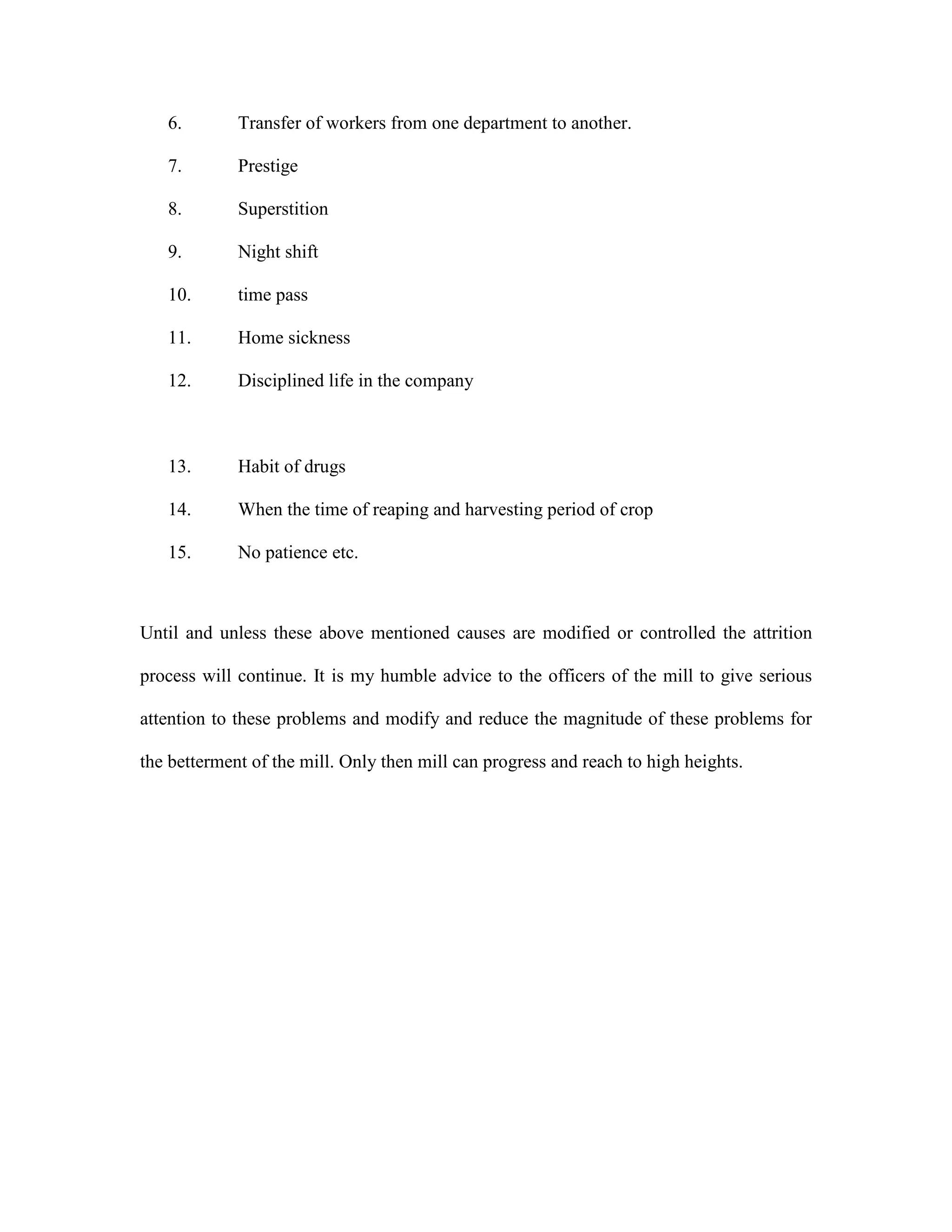
Until and unless these above mentioned causes are modified or controlled the attrition
process will continue. It is my humble advice to the officers of the mill to give serious
attention to these problems and modify and reduce the magnitude of these problems for
the betterment of the mill. Only then mill can progress and reach to high heights.
QUESTIONNAIRE
FOR REJOINED
WORKER:
GERNAL INFORMATION
NAME:
DATE OF BIRTH:
AGE:
EDUCATION QUALIFICATION:
STATE:
MARRIED/UNMARRIED:
Q1For what purpose do you want to work?
1.to earn money 2.to pass time
3.to learn technique 4.to earn money and to learn techniques
Q2. Why you have left the job?
1.family problem 2.health problem
3.less wages 4.other reason
Q3 Whether climate of industry suits you?
1.Yes 2.No
Q4.How is your relation with your supervisor?
1.Good 2.Average 3.Poor
Q5.Dose the company promote you in time?
1.Yes 2.No
Q6.How is the relation with your co-worker?
1.Good 2.Average 3.Poor
Q7.Do the company provide accommodation to you?
1.Yes 2.No
Q8.What type of accommodation they provide?
1.2member room 2.4member room
3.6member room 4.more member room
Q9.Do you get disturbed by your room mates?
1.Yes 2.No
Q10.Which shift you prefer more?
1.Morning 2.Evening 3.Night
Q11.Do you want to transfer from one department to other?
1.Yes 2.No
Q12Does the company provide any medical facility to the worker?
1.Yes 2.No
Q13Does the company provide the scheme of
( EPF)
Employee’s Provident Fund
1.Yes 2.No
Q14 When you were ill who look after you?
1.Wife 2.Mother
3.No-one 4.Room-mates
Q15 Do you want to live
1.Alone 2.With family
QUESTIONNAIRE
FOR NEW WORKER
GERNAL INFORMATION
NAME:
FATHER’S NAME:
AGE:
QUALIFICATION:
OUTSIDER/LOCAL:
MARRIED/UNMARRIED:
Q1.For what purpose ` do you want to work?
1.to earn money 2.to pass time
3.to learn techniques 4.to earn money and learn techniques
Q2Are you only son of your family?
1. Yes 2.No
Q3.Is their any other source of income in your family?
1.Yes 2.No
Q4.How do you come to the company?
1.By reference of company workers 2.By your own efforts
3.By reference of outsiders
Q5.Do they give correct information about company and work?
1.Yes 2.No 3.Very often
Q6.Do you get job according to your expectation?
1.Yes 2.No 3.Little bit
Q7 which shift you prefer more?
1.Morning shift 2.Evening shift 3.Night shift
Q8.Does your company provide you accommodation?
1.Yes 2.No
Q9.How many people live in one room?
1. 3 people 2. 4 people 3. 5 people 4. 6 people
Q10.Do your room disturbs you –mates?
1.Yes 2.No 3.Little bit
Q11.How is your relation with your co-workers?
1.Good 2.Average 3.Poor
Q11.How is your relation with your supervisor?
1.Good 2.Average 3.Poor
STUDY OF TRAINING SYSTEM OF
CHENAB TEXTILE MILL
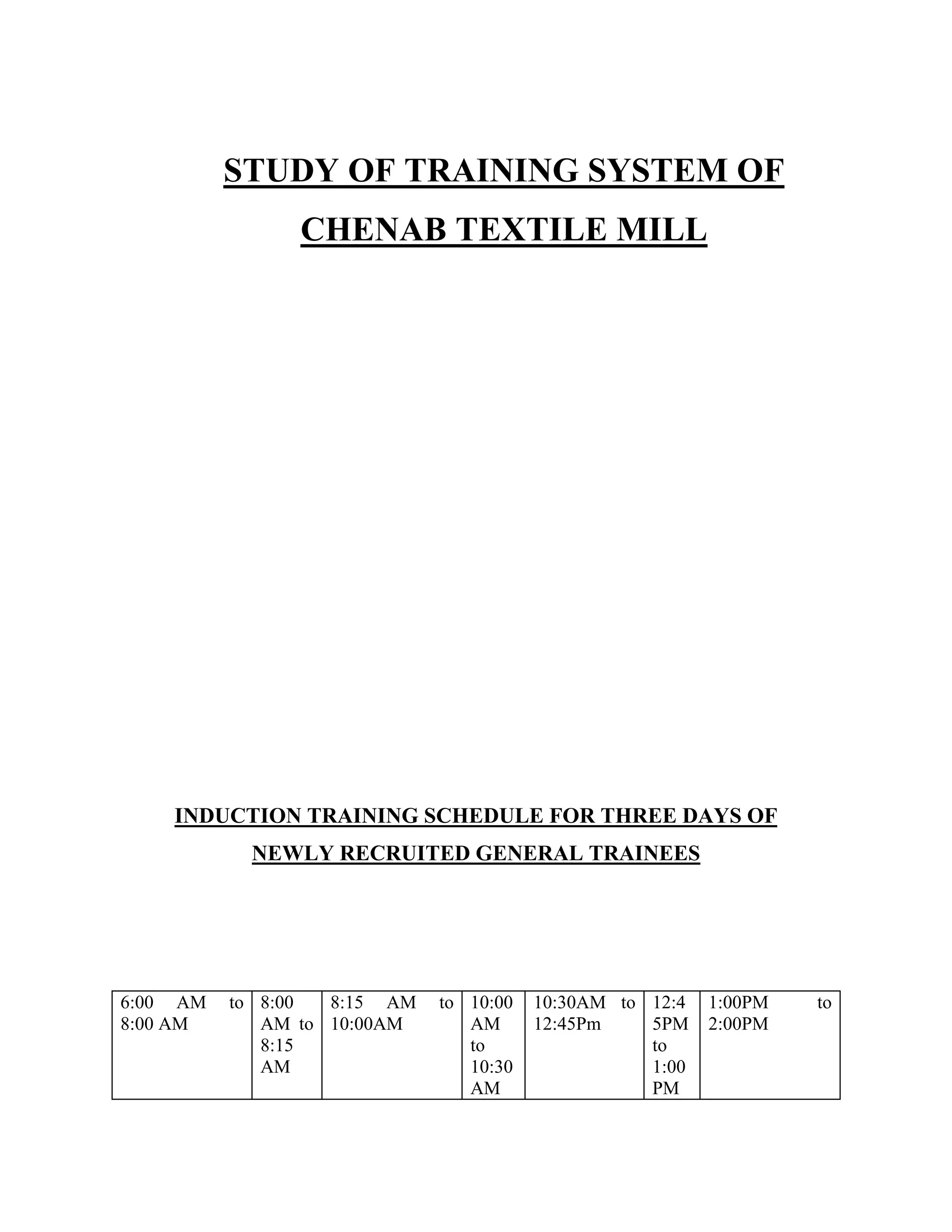
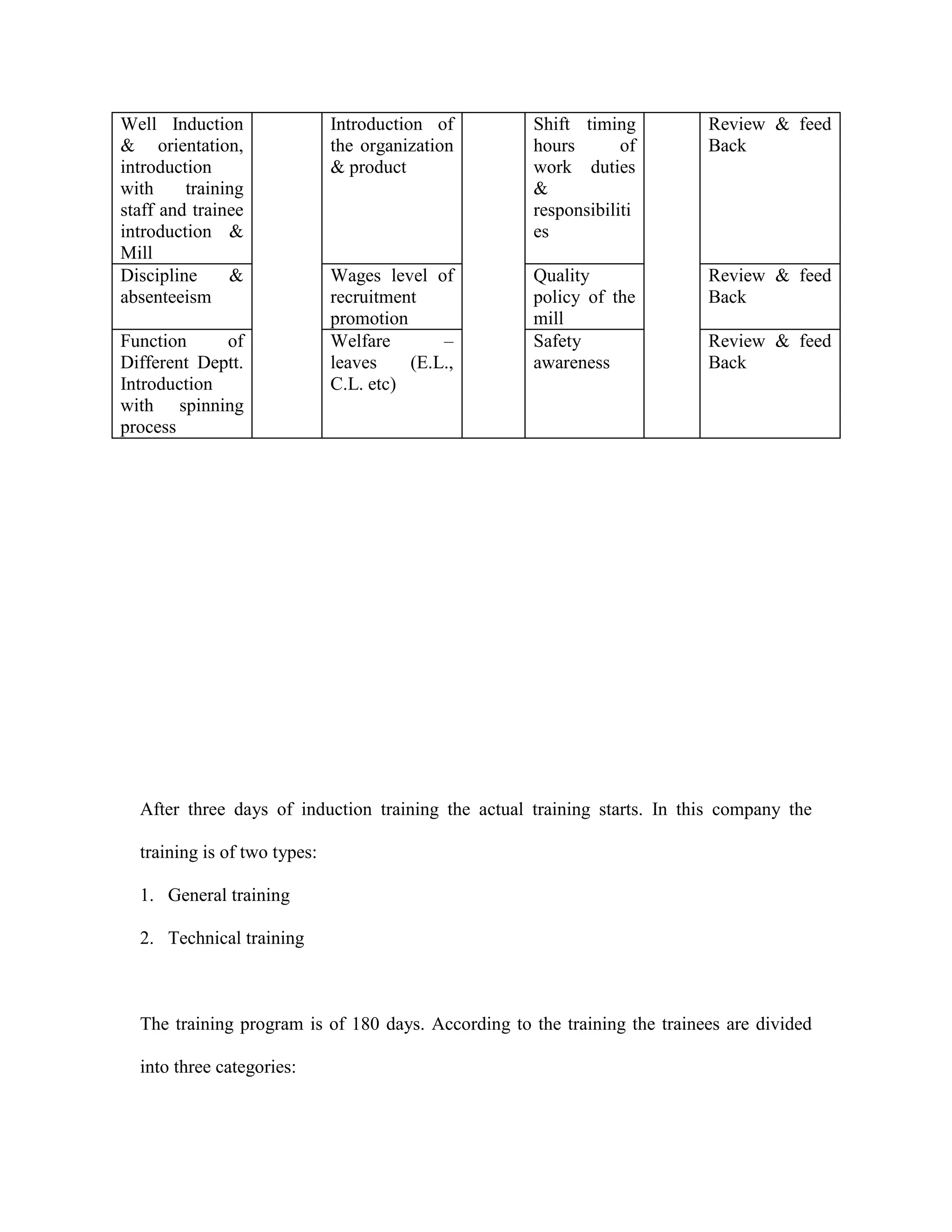
INDUCTION TRAINING SCHEDULE FOR THREE DAYS OF
NEWLY RECRUITED GENERAL TRAINEES
6:00 AM to
8:00 AM
8:00
AM to
8:15
AM
8:15 AM to
10:00AM
10:00
AM
to
10:30
AM
10:30AM to
12:45Pm
12:4
5PM
to
1:00
PM
1:00PM to
2:00PM
Well Induction
& orientation,
introduction
with training
staff and trainee
introduction &
Mill
Introduction of
the organization
& product
Shift timing
hours of
work duties
&
responsibiliti
es
Review & feed
Back
Discipline &
absenteeism
Wages level of
recruitment
promotion
Quality
policy of the
mill
Review & feed
Back
Function of
Different Deptt.
Introduction
with spinning
process
Welfare –
leaves (E.L.,
C.L. etc)
Safety
awareness
Review & feed
Back
After three days of induction training the actual training starts. In this company the
training is of two types:
1. General training
2. Technical training
The training program is of 180 days. According to the training the trainees are divided
into three categories:
APPRENTICE-1
A person recruited shall remain as Apprentice-1 trainee minimum up to 60 days.
APPRENTICE-2
On competition of minimum 60 days attendance and on satisfactory progress
Report duly verified by Departmental In charge and Training Officer, the Apprentice-
2 trainee shall be promoted as Apprentice-2 trainee. Two Apprentice-2 trainees shall
be kept in place of one trained worker.
APPRENTICE-3
After completion of minimum 120 days attendance and subject to verification that the
said Apprentice-2 trainee is able to take workload of the job, the Apprentice-2 trainee
shall be promoted as Apprentice-3. He shall be kept in place of one trained worker-
otherwise he will continue as an Apprentice-2 trainee till he passes the test.
In the training program the trainer teaches the trainee about the following training:
1. General Training
2. Technical Training
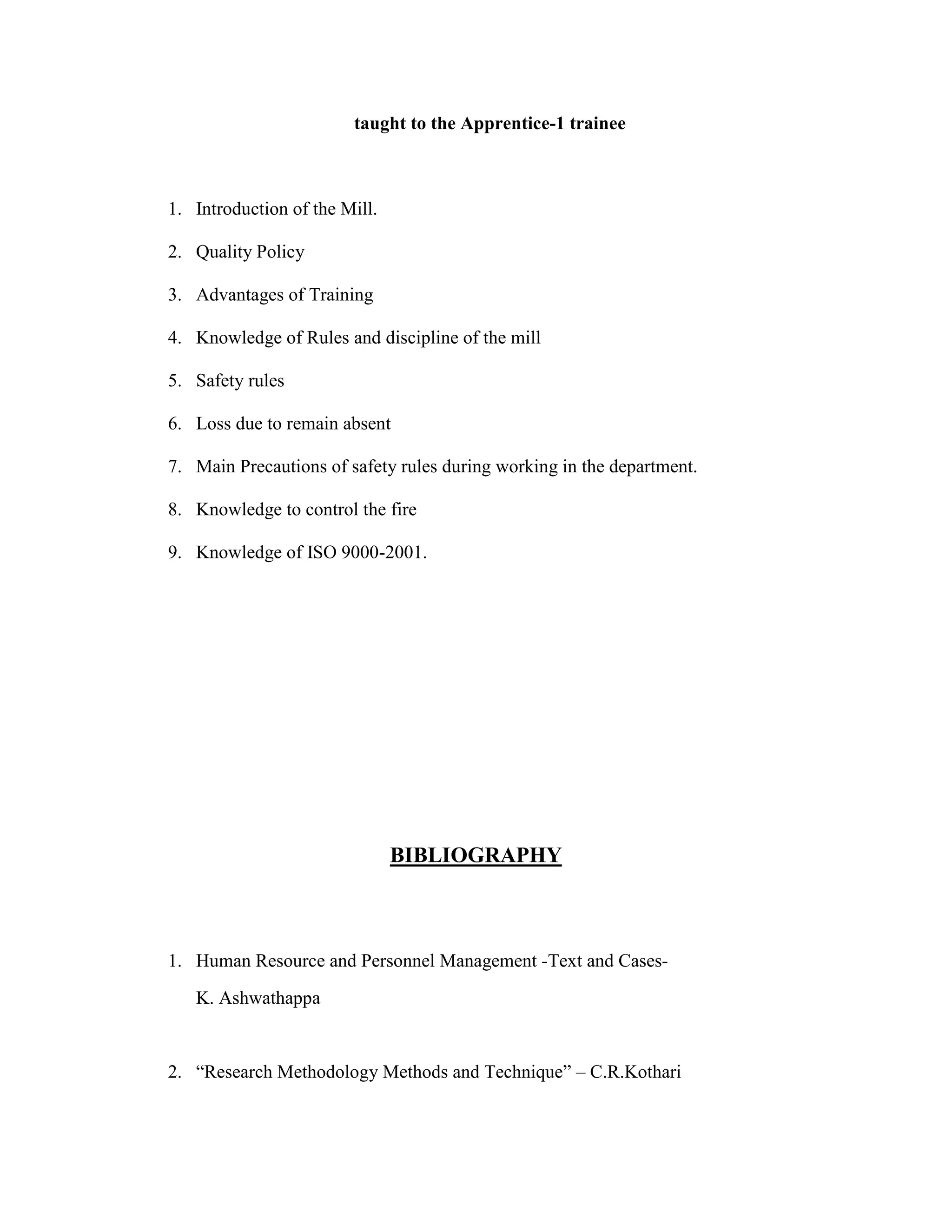
The general training is about 60 days. In this training the following points are
taught to the Apprentice-1 trainee
1. Introduction of the Mill.
2. Quality Policy
3. Advantages of Training
4. Knowledge of Rules and discipline of the mill
5. Safety rules
6. Loss due to remain absent
7. Main Precautions of safety rules during working in the department.
8. Knowledge to control the fire
9. Knowledge of ISO 9000-2001.
BIBLIOGRAPHY
1. Human Resource and Personnel Management -Text and Cases-
K. Ashwathappa
2. “Research Methodology Methods and Technique” – C.R.Kothari
3. “Managing Recruitment, Training and Development” – Mehristapher Elizabeth.
www.hrlinc.com
www.google.com

0601036 causes of attrition amongst the local and outside workers

  • 1.
    A PROJECT REPORT ON “CAUSESOF ATTRITION AMONGST THE LOCAL AND OUTSIDE WORKERS” FOR “CHENAB TEXTILES LTD.” BY NITIKA CHOUDHRY UNDER THE GUIDANCE OF S.M.SOVANI SUBMITTED TO UNIVERSITY OF PUNE IN PARTIAL FULFILLMENT OF THE REQUIREMENT FOR THE AWARD OF THE DEGREE OF MASTER OF BUSINESS ADMINISTATION (MBA). THROUGH VISHWAKARMA INSTITUTE OF MANAGEMENT, PUNE-48.
  • 2.
    Acknowledgement I would liketo begin by thanking CHENAB TEXTILES LTD, for giving me the opportunity to do my summer training with them. I take the opportunity to express my thanks and gratitude to director Dr. Sharad Joshi of my college for their guidance and encouragement in carrying out these project works. I am also grateful to respected Mrs. Smita Sovani (My Project Guide) for her cooperation and guidance. I would like to express my sincere gratitude to Sh. B.S. Chemma DGM & HRD for providing me with constant guidance requisite information & proper help through out the project. I am also thankful to other staff of CTM for helping me to carry out the work of these projects actively & smoothly. Lastly, my thanks to all those who are directly or indirectly helped me to complete my work under study. Nitika Choudhary
  • 3.
    Table of contents Sr.No. Chapter Name Page No. 1 Executive Summary 1 2 Company Profile 2-7 3 Objectives 8 4 Methodology 9 5 Data Analysis & Interpretation 10-34 6 Findings & Analysis 35-36 7 Suggestions 37-38 8 Conclusion 39-40 9 Questionnaire 41-46 10 Training system of CTM 47-50 11 Bibliography 51
  • 4.
    To Whomsoever ItMay Concern This is to certify that Ms. Nitika Choudhry is a bonafide student of our institute. She has successfully carried out her summer project “Causes of attrition amongst the local and outside workers” titled, at Chenab Textiles Ltd, Jammu & Kashmir. This is original study of Ms. Nitika Choudhry and important sources of data used by her have been acknowledged in her report. The report is submitted in partial fulfillment of two years full time course of Masters in Business Administration 2006-2008 as per the rule. Mrs. S.M. Sovani Dr. Sharad Joshi Project Guide Director Vishwakarma Institute of Management
  • 8.
    EXECUIVE SUMMARY Chenab TextileMill (CTM) is a part of Sutlej Textile and industries Ltd, a blue chip company of K.K Birla Group. It is the biggest and oldest Company of (J&K). The project entitled “Causes of Attrition among Local and Outsider Workers of CTM and Suggest improvement if any” in CTM. In my Project “Causes of Attrition among local and outside worker” I have to find out factors, which were responsible for high Attrition among workers and remedies for the same. As this is a manufacturing concern and workers play a very crucial role in the growth and development of the company by being more productive and efficient. As the company is located in Jammu & Kashmir (J&K) and the worker inspite of getting perks like free Housing, Electricity and Water etc which is unlikely in any other state in India, there is high attrition among workers. So, the Company gave me this opportunity to analyse the problems and suggest some
  • 9.
    constructive remedies forthe same. The second part of the project includes the Study the training system of the company in brief. It was interesting to study the working of HR Department in a manufacturing Firm. Training being one of the most important functions of HR Department was chosen for study. The study was spread over 6 weeks during which different officials working in the HR Department have provided very important data in this respect, Formal and Informal interviews were taken as well as research (through questionnaire) were the basic methods of data collection.
  • 10.
    COMPANY’S PROFILE Chenab TextileMills (CTM) is a part of Sutlej Textiles and Industries Ltd., a Blue Chip Company of the K.K. Birla Group- one of the top 20 business houses in India. Under its chairman Dr. K.K Birla, the group is engaged in diversifying activities including fertilizers, sugar, shipping, media, tea coffee, food processing, engineering, cement, textile machinery, agro based industries apart for spinning units. CTM being the largest and oldest industrial unit of J&K stands a proud member of this group. Establishment of the company CTM was set up at Kathua in 1962 with initial capacity of 12600 spindles and its commercial production commenced in Jan. 1965. Despite the set back because of disturbance of peace two wars with Pakistan in 1965 & 1971, the mill completed its 2nd phase of 12400 spindles in 1976 raising the total capacity to 25000 spindles. There have been many ups and downs because of various reason including locational disadvantage but the mill and the Birla’s put their maximum possible resources to keep the mill in operation. During the early nineties the liberalization of economy was initiated and the Indian industry become open for globalization competition and it become imperative for Indian industry to modernized by upgrading the technology and create for the capacities to face challenges of international competition by producing quality product and take advantage of the scale of economy. In view of this the mill invested over Rs. 125.00 corers on modernization and expansion of capacities during the last decade of 20th centaury. As on date the installed capacity of the mills is 138392 spindles.
  • 11.
    MISSION OF THECOMPANY To be the largest single point provided for all blends and shades of spun yarn and an organization that prides itself on integrity, environmental consciousness, scheduled delivery and adherence to international quality norms to the best of our customer’s satisfaction. VALUE OF THE COMPANY:- Care:- Giving back to the society, serving the community and providing respectful conduct to the public and our peer. Competence: - For us, our customer come first. Giving them the best in class products, maximum output and most convenient scheduled. Craft:- Treating the science of textile yarns with the dedication and reverence of an art form, we believe in our work as a merger of technology and craft. Vision:- To be a leading player in the global textile industry, providing comprehensive textile solution under one roof, highlighted by quality, variety and impeccability for our esteemed customers.
  • 12.
    THE COMPANY FORMINGBIRLA GROUP IN TABULAR FORMAT IS GIVEN BELOW: 1. CHENAB TEXTILE MILLS (KATHUA) 2. BADHI (H.P.) 3. DHAMN GANGRA PROCESSING UNIT (GUJRAT) 4. SUTLEJ TEXTILE MILL (RAJASTHAN) REGIONAL OFFICERS: 1. MUMBAI 2. CALCUTTA 3. DELHI
  • 13.
    BOARD OF DIRECTORS: 1.Mr. K.K Birla 2. Mr. K.R Podar 3. Mr. Arvind C Dalal 4. Mr. Malin Kant Dhiraj Dalal 5. Mr. V. K Khaitan 6. Mr. S. C Nagar 7. Mr. H. Nanjundian 8. Mr. G.C Sethi (Nominee ICICI) 9. Mr. Naresh Chander Mohan 10. Mr. S.M Aggarwal 11. Mr. R.N Ladha
  • 14.
    KEY MANAGEMENT PERSONNEL S.No Name Designation 1 Sh. N.N. Gupta Group President of the Company 2 Sh. S.K Khandelia President of the CTM 3 Sh. K.C Sharma Sr. Vice President 4 Sh. R.A Aggarwal Vice President 5 Sh. P.K Mittal Vice President (C&A) 6 Sh. R.N Bhimrajka Sr. GM. Sales 7 Sh. G.R Gupta Sr. G.M (R&D) 8 Sh. B.S Cheema D.G.M (HRD) 9 Sh. N.K Mukhija Sr. G.M. Production (Unit No. IV,V,VII,IX) 10 Sh. R.M Sharma Sr. G.M Production (Unit No. IA,I,II,III,VI,VIIA,VIIIA) 11 Sh. S.K Sharma Sr. G.M Production (Unit No. 8) (Gray & mélange) 12 Sh. N.N Mahapatra G.M Processing (Fibre Dying) 13 Sh. Sunil Sharma Associate Vice President & CFO 14 Sh. J.L Mathrani Vice President, Engineering 15 Sh. Sanjay Bhardwaj DGM Yarn Dying 16 Sh. Rajesh Jain Manager (Raw Material) 17 Sh. Satish Khajuria Sr. Manager (Administration) 18 Sh. T.P Singh Manager (Material) 19 Sh. S.K Bhomia Manager (Budget & Costing)
  • 15.
    DEPARTMENTS OF CTM ChenabTextile Mills has following departments:- 1. Personnel and labour Department 2. Time Office Department 3. Raw Material Department 4. Mixing and Waste Department 5. Spinning Department 6. Quality Control Department 7. Store Department 8. Budget and Costing Department 9. EDP (Electronic Data Processing) department 10. Marketing Department 11. Sales and Excise Department 12. Finance Department 13. General Department 14. Report Section 15. Spinning Maintenance Department 16. Finishing Cotton Department 17. Watch & Ward Department 18. Engineering Department
  • 16.
    THE AIM OFTHE STUDY Practical training imposes skill in the field of business managements and administration. It reduces the gap between theoretical and practical knowledge for a Management Student. This type of practical training helps a lot in gearing insight in to actual business environment and different organizational activities. The main objectives of my studies are:- 1 To study the causes of attrition and remedial measures to reduce or stop attrition. 2 To know about training system and development of workers in various units congenial. 3 To have a healthy communication with the workers or employees. 4 The main aim of the studding the above mentioned is to ultimately lead the mill to progress up to highest.
  • 17.
    METHODOLOGY To study “causesof Attrition of New Trainees Local & Outsider” and “study the Training system of the CTM” primary and secondary sources of information have been employed for collection of data. The sources of collecting data are as follows: Personal observation The main first choice of collecting data and information is personal observation. Discussion The 2nd source of collecting information is the personal discussion with Manager, Supervisor and workers in CTM. Specific Questionnaire While conducting a survey a questionnaire was prepared to help in carrying out the analysis, which has been given in the Annexure Files and Records The 4th source of collecting information is from the official files and records of the company. Internet The other source of collecting the information from the Internet
  • 18.
    GRAPH OF RECRUITEDWORKERS & LEFT OUT WORKERS With the help of labour department the give me the information of the workers that how many workers are recruited and how many left out the organization. From their information I Plotted a graph between numbers of workers recruited month wise and number of worker left out month wise. GRAPH OF RECRUITED WORKERS 0 100 200 300 400 500 600 700 Jan. Feb. March April May June July NO. OF MONTHS NO.OFRECRUITEDWORKERS
  • 19.
    From the graphit is clear that number of workers is maximum in the month of January and then decreases and after few months the number of workers remain constant. GRAPH OF LEFT OUT WORKERS 0 100 200 300 400 500 600 700 800 Jan. Feb. March April May June July NO OF MONTHS NOOFLEFTOUTWORKERS
  • 20.
    When I plotteda graph between the numbers of workers left with number of months I found that magnitude of decrease of workers in the beginning is minimum and then increases and reaches to maximum after few months. From the graph it is concluded that attrition is a major problem of the company and appropriate measures should be adopt to check the causes of attrition for the betterment and up-liftman of the company. I have randomly chosen 100 workers from 2000 workers in the ration 1:20 and enquired about the causes of attrition among new and old employees. Workers cooperate and helped me in my project. 1 30% Of worker are illiterate 2 20% of worker has education up to 5th standard.
  • 21.
    3 While 25%comprises of 8th class literate. And 10th class literate 20% and 12th and above comprises only 5% of the total. WHY DO THE WORKERS WANTS TO WORK 40% 20% 15% 25% To Earn Money To Pass Time To Learn Technique To Earn Money & Learn Technique
  • 22.
    Interpretation 1 The reasonwhy do workers want to work is to earn money. 2 Secondly is to do time pass. 3 Thirdly is to learn techniques & lastly is to earn money as well as learn techniques.
  • 23.
    Interpretation: 1 Reason forleaving the previous job by workers were 40% Family problems,20% health problem, 15%less wages and 25% for other reason.
  • 24.
    WHETHER ENVIRONMENT OFINDUSTRY SUITS YOU? 40% 60% Yes No Interpretation: 2 To 60% of the workers the environment of industry suited however the rest i.e. 40% didn’t feel the same.
  • 25.
    DOES THE COMPANYPROVIDE ANY MEDICAL FACILITY TO THE WORKER 40% 60% Yes No Interpretation: 3 40% workers say that they get the medical facility and 60% workers say that
  • 26.
  • 27.
    WHEN YOU WEREILL WHO LOOK AFTER YOU? 40% 30% 15% 15% Wife Mother No-One Room Mates
  • 28.
    Interpretation: 4 40% workersays when they were ill their wife look after them 5 30% worker says Mother look after them. 6 15% worker says that Room mates look after them. 7 15% workers says that when they were ill no one look after them
  • 29.
    DO YOU WANTTO LIVE 20% 80% Alone with Families
  • 30.
    Interpretation: 1 80% ofworker says that they want to live with their Family. 2 20% of workers says that they want to live alone.
  • 31.
    HOW IS YOURRELATION WITH YOUR SUPERVISOR 40% 30% 30% Good Average Below Interpretation:
  • 32.
    1 40% ofworkers says that they have good relation with their supervisor. 2 30% of workers says that they have the average relation with their supervisor. 3 30% of workers says that they have poor relation with their supervisor.
  • 33.
    DO THE COMPANYPROVIDE ACCOMODATION TO YOU 50%50% Yes No Interpretation: 1 50% of workers says that the company provides accommodation and rest i.e.50% of workers says that company don’t provide accommodation.
  • 34.
    WHAT TYPE OFACCOMODATION THEY PROVIDE 0% 40% 60% 0% 2 Members Room 4 Members Room 6 Member Room 8 Member Room
  • 35.
    Interpretation: 2 The companyprovides 60% 6-member room & 40% 8-member room 3 The company doesn’t provide 2-member room & 4 –member room to the workers.
  • 36.
    WHICH SHIFT YOUPREFER MORE 40% 40% 20% Morning Evening Night
  • 37.
    Interpretation: 1 40% ofthe workers prefer morning shift. 2 40% of the workers prefer evening shift. 3 20% of the workers prefer night shift. DOYOUWANTTOTRANSFERFROMONE DEPARTMENTTOOTHER 40% 60% Yes No
  • 38.
    Interpretation: 1 60% ofthe workers don’t want to transfer from one department to other. 2 40% of the workers want to transfer from one department to other.
  • 39.
    DO YOU GETDISTURB BY YOUR ROOM MATES 40% 30% 30% Yes No Little Bit
  • 40.
    Interpretation: 1 40% ofthe workers say that their roommates disturb them. 2 30% of the workers say that their roommates don’t disturb them. 3 30% of the workers say that they get little bit of disturbed.
  • 41.
    FOR WHAT PURPOSEDO YOU WANT TO WORK? 0 10 20 30 40 50 60 To Earn Money To Pass Time To Learn Technique To Earn Money & Learn Techniques
  • 42.
    Interpretation: 1 50 %of workers purpose is to earn money. 2 10% of the workers purpose is to pass time. 3 20% of the workers purpose is to learn technique 4 20% of the workers purpose is to earn money and to learn techniques
  • 43.
    ARE YOU ONLYSON OF YOUR FAMILY? 60% 40% Yes No Interpretation: 1 60 % of the workers says that they are the only son of their family.and the rest
  • 44.
    i.e.40% of theworkers say that they are not the only son of their family.
  • 45.
    IS THERE ANYOTHER SOURCE OF INCOME IN YOUR FAMILY? 60% 40% Yes No Interpretation:
  • 46.
    2 60% ofthe workers says that they have other source of income in their family and the rest don’t have HOW DO YOU COME TO THE COMPANY? 50% 30% 20% By Refrence of Company's Worker By Your Own Efforts By Reference of Out Sider Interpretation: 3 50% of the workers says that they come to the company by reference of company’s worker 4 30% of the workers says that they come to the company by their own efforts. 20% of the workers says that they come to the company by reference of outsider.
  • 47.
    DO THEY GIVECORRECT INFORMATION ABOUT COMPANY AND WORK? 0 5 10 15 20 25 30 35 40 45 50 Yes No Very Often
  • 48.
    Interpretation: 1 20% ofthe workers says that the referee give the correct information about the company and the work. 2 45% of the workers says that they don’t give the correct information about the company and the work. 3 35% of the workers says that they give the information very often about the company and the work.
  • 49.
    Interpretation: 1 45% ofthe workers don’t get the job according to their expectation 2 35% of workers get job according to their expectation 3 20 % of the workers get the job according to their expectation.
  • 50.
    DOES YOUR COMPANYPROVIDES YOU ACCOMODATION 40% 60% Yes No
  • 51.
    Interpretation: 60 % ofthe workers says that the company does not provide accommodation and the rest i.e.40% of the workers says that the company oprovides accommodation
  • 52.
    0 5 10 15 20 25 30 35 40 45 50 3 People 4People 5 People 6 People HOW MANY PEOPLE LIVE IN ONE ROOM? Series1
  • 53.
    Interpretation: 1 50% ofthe workers live in 6 people room. 2 40% of the workers live in 5 people room 3 10% of the workers live in 4 people room 0% of the workers live in 3 people room
  • 54.
    DO YOU GETDISTURB BY YOUR ROOM MATES 45% 25% 30% Yes No Little Bit
  • 55.
    Interpretation: 1 45% ofthe workers get disturbed by their room mates 2 30% of the workers get little bit disturbed by their room mates. 3 25 % of the workers don’t get disturbed by their room mates
  • 56.
    HOW IS YOURRELATION WITH YOUR CO WORKERS 25% 30% 45% Good Average Poor
  • 57.
    Interpretation: 1 25% ofthe workers have good relation with their co-workers 2 30% of the workers have average relation with their co-workers 3 45% of the workers have poor relation with their co-workers
  • 58.
    FINDINGS & ANALYSIS Ifound that the main causes of attrition among the new workers local and outsider by questionnaire OUTSIDER 1. Home sickness 2. Health problem 3. Family problem 4. To earn more 5. Accommodation problem 6. Problem with their room mates 7. Not satisfied with wages 8. Illiteracy 9. Literacy 10. More age 11. Get new job in other organization 12. New workers don’t get correct information about the work before they join the organization 13. Have no patience 14. Poor relation with co-workers 15. Poor relation with supervisor 16. Disciplined life
  • 59.
    17. Habit ofdrugs 18. Work cannot meet with their expectation 19. Language problem 20. Night shift 21. Time limit 22. When the worker is sick and there is no one to look after him as he is living far away from his family. 23. Transfer from one department to another. 24. Feel insult 25. Physically unfit for job LOCAL Many of the reasons of local workers who leave their job are similar to that of outsider, but some exceptions are as follows: 1. Time pass 2. Prestige 3. Superstition 4. When the time of reaping and harvesting of crops 5. Convenience problem
  • 60.
    SUGGESTIONS The progress oforganization depends upon the continuous working of workers and employees. Organization will not function properly up to higher degree of efficiency without the high efforts of worker. The productivity of organization depends upon trained workers. If trained workers show attrition then efficiency of productivity will decrease. An organization will face heavy losses. Therefore attrition of workers should be taken care of. Following suggestions are made to stop or reduce the attrition: 1. There should be healthy, cognitive and congenial atmosphere between the workers and the employees. 2. Workers are advised time to time not to remain absent or leave the mill without any pre information and causes to leave the mill.
  • 61.
    3. The companyshould provide accommodation to the worker’s family so that the worker should not feel home sick 4. It is suggested to higher authority that a care should be taken to provide better accommodation to the workers. 5. Leave of the worker should sanction as and when they need otherwise they leave the mill due to home sickness. 6. The supervisor should not insult the worker at the time of working hours or in front of other workers. 7. Proper scheme of bonus, dearness allowances, EPF should be implemented as the trained workers start working. 8. Any problem related to workers should be solved by immediate officer of the mill. 9. Training system should be strengthened which raises the moral and self confidence of the employee
  • 62.
    CONCLUSION Chenab Textile Millis the largest mill of J&K and a sister concern of Birla Group of Industries, one of the top 20 business houses of India and has around 5000 workers with professional managers. CTM is a production unit and thus to increase its production capacity and to achieve the organizational goals, it is necessary to seek the attrition of the new and the old workers, which is the biggest asset of the textile company. On studying the whole process of attrition it is concluded that attrition is because of: 1. Detective training system. 2. Poor relation and no rapport with the supervisor. 3. Substandard accommodation. 4. Lack of various facilities such as lack of proper medical facility etc. 5. Language and educational problem.
  • 63.
    6. Transfer ofworkers from one department to another. 7. Prestige 8. Superstition 9. Night shift 10. time pass 11. Home sickness 12. Disciplined life in the company 13. Habit of drugs 14. When the time of reaping and harvesting period of crop 15. No patience etc. Until and unless these above mentioned causes are modified or controlled the attrition process will continue. It is my humble advice to the officers of the mill to give serious attention to these problems and modify and reduce the magnitude of these problems for the betterment of the mill. Only then mill can progress and reach to high heights.
  • 64.
    QUESTIONNAIRE FOR REJOINED WORKER: GERNAL INFORMATION NAME: DATEOF BIRTH: AGE: EDUCATION QUALIFICATION: STATE: MARRIED/UNMARRIED: Q1For what purpose do you want to work? 1.to earn money 2.to pass time 3.to learn technique 4.to earn money and to learn techniques Q2. Why you have left the job?
  • 65.
    1.family problem 2.healthproblem 3.less wages 4.other reason Q3 Whether climate of industry suits you? 1.Yes 2.No Q4.How is your relation with your supervisor? 1.Good 2.Average 3.Poor Q5.Dose the company promote you in time? 1.Yes 2.No Q6.How is the relation with your co-worker? 1.Good 2.Average 3.Poor Q7.Do the company provide accommodation to you? 1.Yes 2.No Q8.What type of accommodation they provide? 1.2member room 2.4member room 3.6member room 4.more member room Q9.Do you get disturbed by your room mates?
  • 66.
    1.Yes 2.No Q10.Which shiftyou prefer more? 1.Morning 2.Evening 3.Night Q11.Do you want to transfer from one department to other? 1.Yes 2.No Q12Does the company provide any medical facility to the worker? 1.Yes 2.No Q13Does the company provide the scheme of ( EPF) Employee’s Provident Fund 1.Yes 2.No Q14 When you were ill who look after you? 1.Wife 2.Mother 3.No-one 4.Room-mates Q15 Do you want to live
  • 67.
    1.Alone 2.With family QUESTIONNAIRE FORNEW WORKER GERNAL INFORMATION NAME: FATHER’S NAME: AGE: QUALIFICATION: OUTSIDER/LOCAL: MARRIED/UNMARRIED: Q1.For what purpose ` do you want to work? 1.to earn money 2.to pass time
  • 68.
    3.to learn techniques4.to earn money and learn techniques Q2Are you only son of your family? 1. Yes 2.No Q3.Is their any other source of income in your family? 1.Yes 2.No Q4.How do you come to the company? 1.By reference of company workers 2.By your own efforts 3.By reference of outsiders Q5.Do they give correct information about company and work? 1.Yes 2.No 3.Very often Q6.Do you get job according to your expectation? 1.Yes 2.No 3.Little bit Q7 which shift you prefer more?
  • 69.
    1.Morning shift 2.Eveningshift 3.Night shift Q8.Does your company provide you accommodation? 1.Yes 2.No Q9.How many people live in one room? 1. 3 people 2. 4 people 3. 5 people 4. 6 people Q10.Do your room disturbs you –mates? 1.Yes 2.No 3.Little bit Q11.How is your relation with your co-workers? 1.Good 2.Average 3.Poor Q11.How is your relation with your supervisor? 1.Good 2.Average 3.Poor
  • 71.
    STUDY OF TRAININGSYSTEM OF CHENAB TEXTILE MILL INDUCTION TRAINING SCHEDULE FOR THREE DAYS OF NEWLY RECRUITED GENERAL TRAINEES 6:00 AM to 8:00 AM 8:00 AM to 8:15 AM 8:15 AM to 10:00AM 10:00 AM to 10:30 AM 10:30AM to 12:45Pm 12:4 5PM to 1:00 PM 1:00PM to 2:00PM
  • 72.
    Well Induction & orientation, introduction withtraining staff and trainee introduction & Mill Introduction of the organization & product Shift timing hours of work duties & responsibiliti es Review & feed Back Discipline & absenteeism Wages level of recruitment promotion Quality policy of the mill Review & feed Back Function of Different Deptt. Introduction with spinning process Welfare – leaves (E.L., C.L. etc) Safety awareness Review & feed Back After three days of induction training the actual training starts. In this company the training is of two types: 1. General training 2. Technical training The training program is of 180 days. According to the training the trainees are divided into three categories:
  • 73.
    APPRENTICE-1 A person recruitedshall remain as Apprentice-1 trainee minimum up to 60 days. APPRENTICE-2 On competition of minimum 60 days attendance and on satisfactory progress Report duly verified by Departmental In charge and Training Officer, the Apprentice- 2 trainee shall be promoted as Apprentice-2 trainee. Two Apprentice-2 trainees shall be kept in place of one trained worker. APPRENTICE-3 After completion of minimum 120 days attendance and subject to verification that the said Apprentice-2 trainee is able to take workload of the job, the Apprentice-2 trainee shall be promoted as Apprentice-3. He shall be kept in place of one trained worker- otherwise he will continue as an Apprentice-2 trainee till he passes the test. In the training program the trainer teaches the trainee about the following training: 1. General Training 2. Technical Training The general training is about 60 days. In this training the following points are
  • 74.
    taught to theApprentice-1 trainee 1. Introduction of the Mill. 2. Quality Policy 3. Advantages of Training 4. Knowledge of Rules and discipline of the mill 5. Safety rules 6. Loss due to remain absent 7. Main Precautions of safety rules during working in the department. 8. Knowledge to control the fire 9. Knowledge of ISO 9000-2001. BIBLIOGRAPHY 1. Human Resource and Personnel Management -Text and Cases- K. Ashwathappa 2. “Research Methodology Methods and Technique” – C.R.Kothari
  • 75.
    3. “Managing Recruitment,Training and Development” – Mehristapher Elizabeth. www.hrlinc.com www.google.com