10/11/2021 Introduction to Data Mining, 2nd Edition 1
Data Mining
Support Vector Machines
Introduction to Data Mining, 2nd Edition
by
Tan, Steinbach, Karpatne, Kumar
10/11/2021 Introduction to Data Mining, 2nd Edition 2
Support Vector Machines
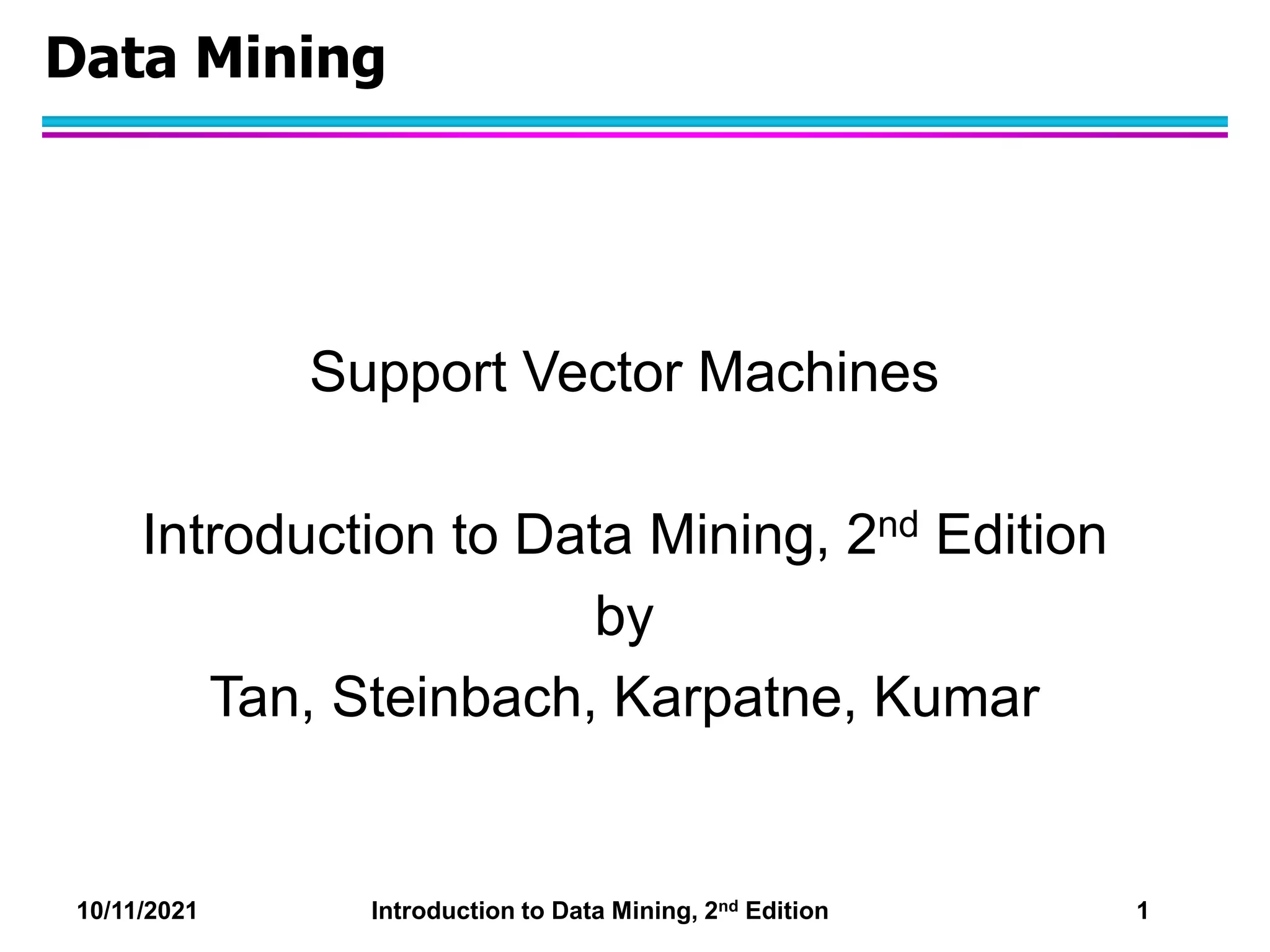
• Find a linear hyperplane (decision boundary) that will separate the data
10/11/2021 Introduction to Data Mining, 2nd Edition 3
Support Vector Machines
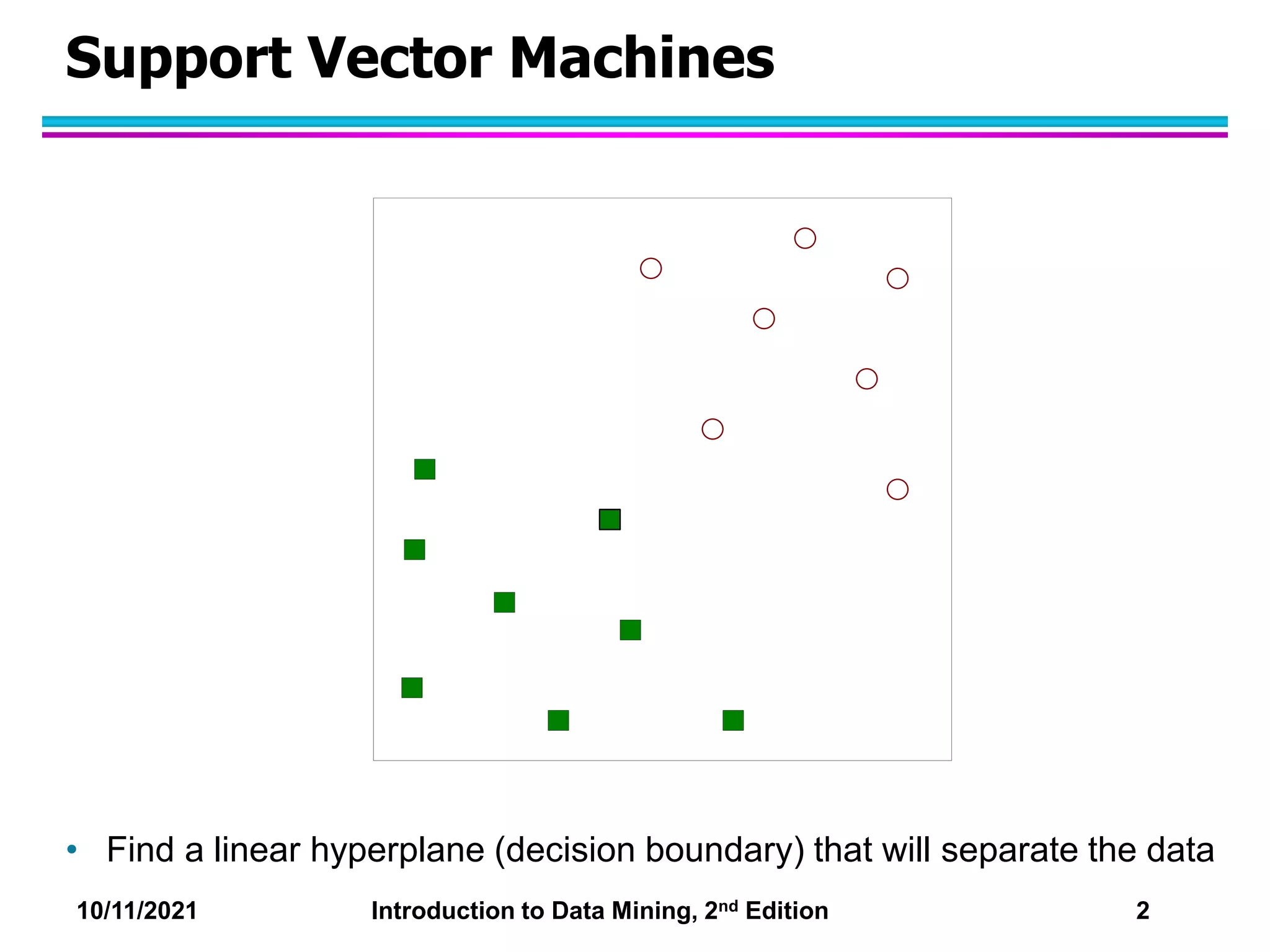
• One Possible Solution
B1
10/11/2021 Introduction to Data Mining, 2nd Edition 4
Support Vector Machines
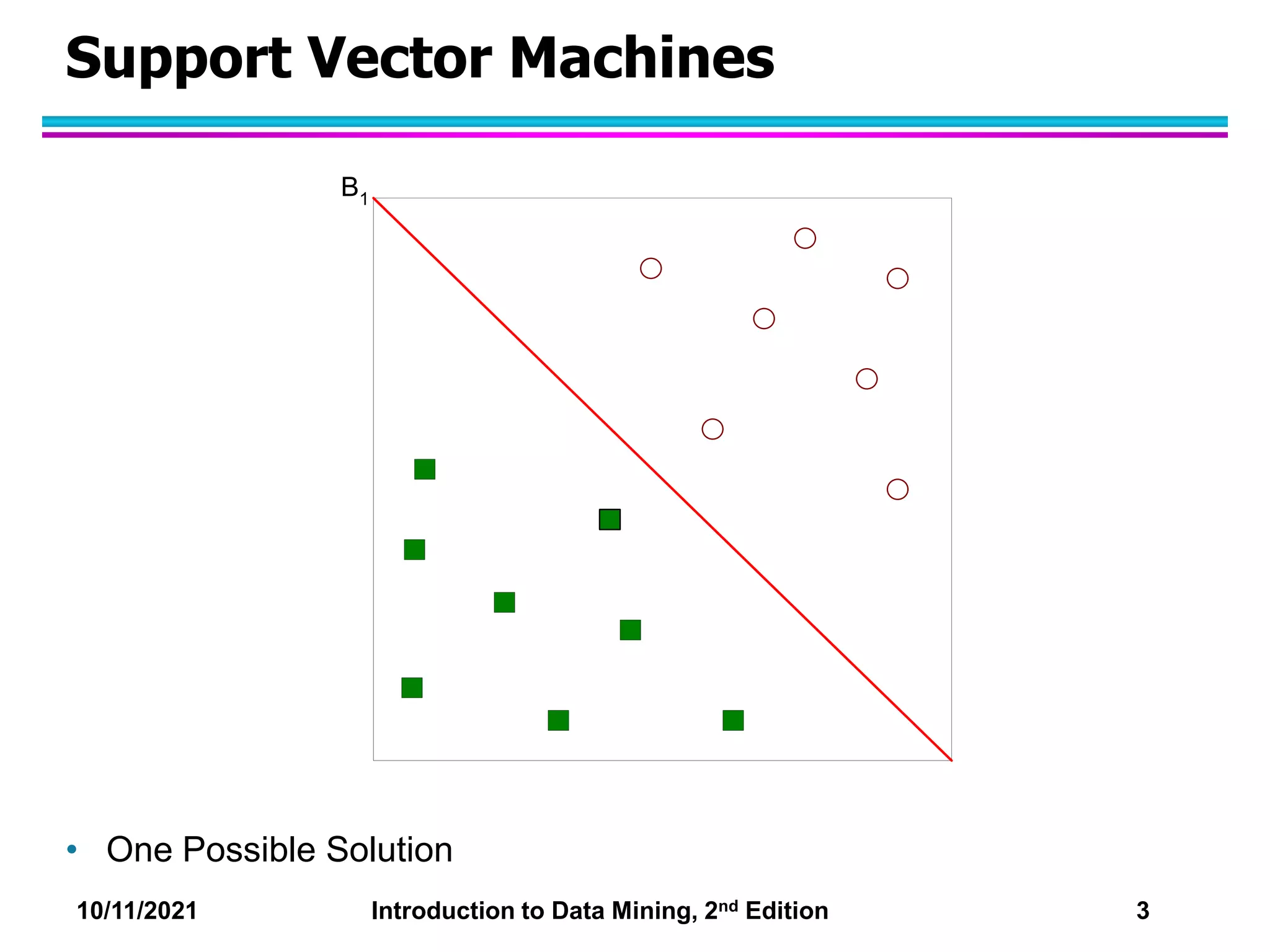
• Another possible solution
B2
10/11/2021 Introduction to Data Mining, 2nd Edition 5
Support Vector Machines
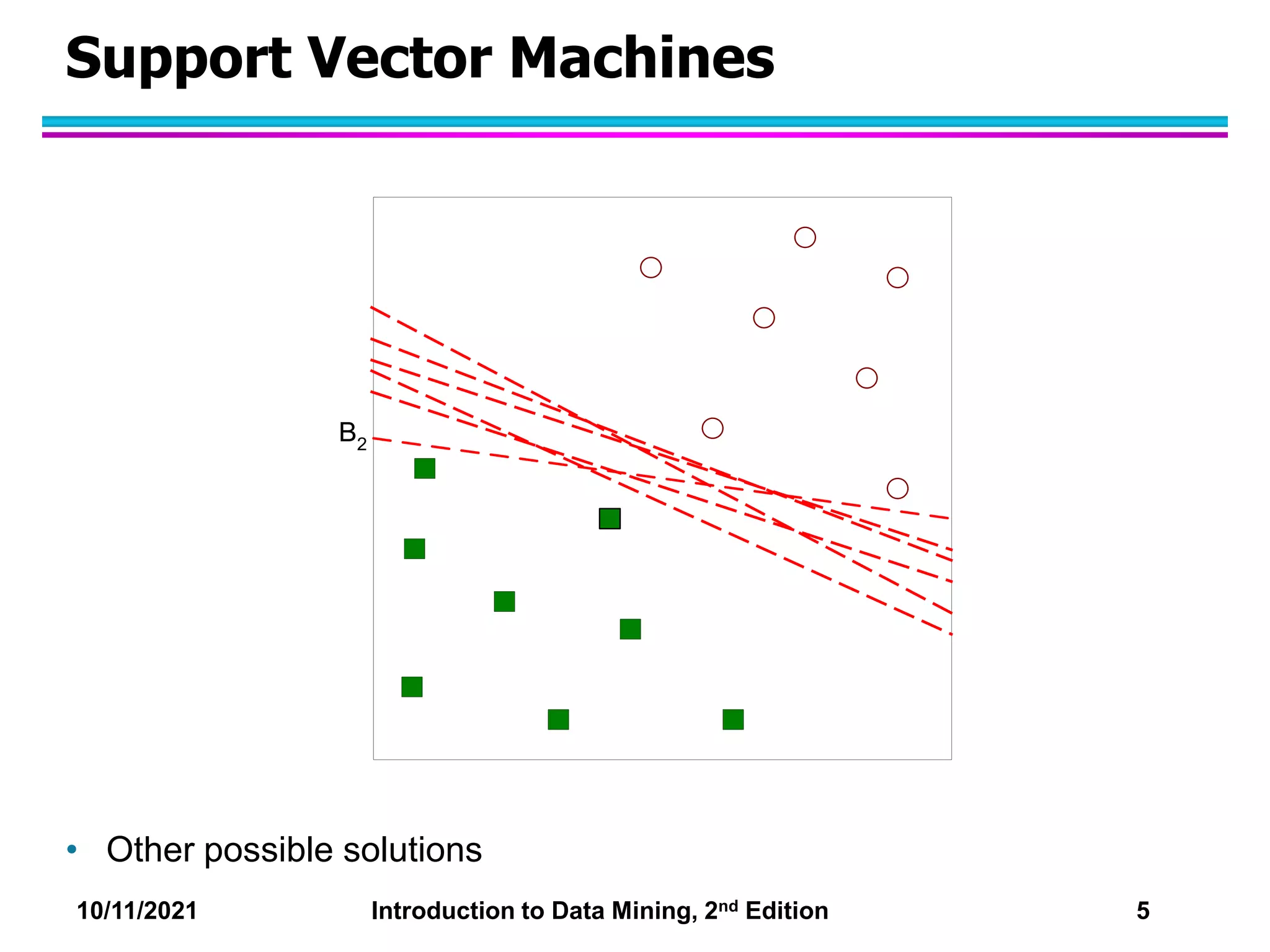
• Other possible solutions
B2
10/11/2021 Introduction to Data Mining, 2nd Edition 6
Support Vector Machines
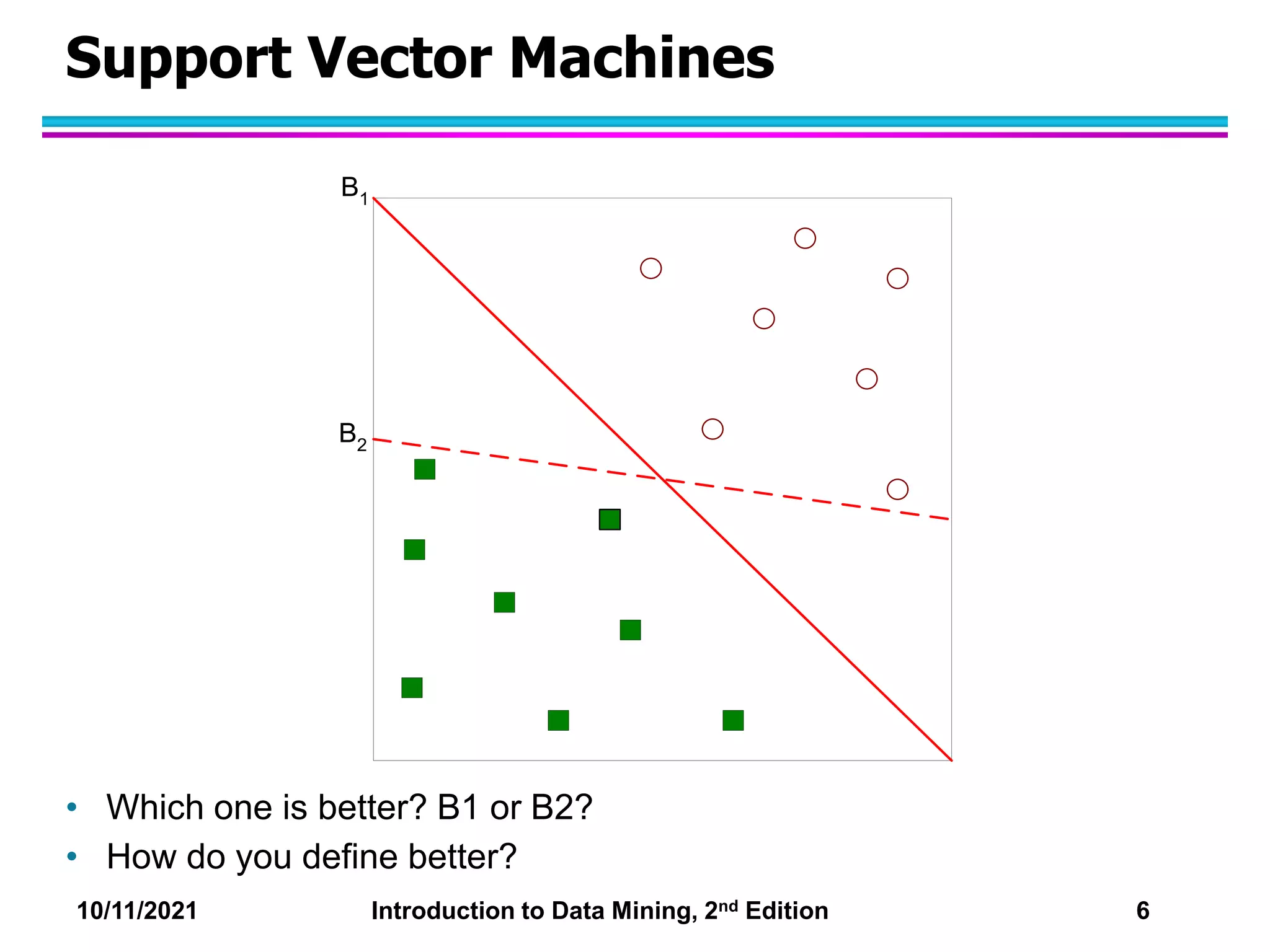
• Which one is better? B1 or B2?
• How do you define better?
B1
B2
10/11/2021 Introduction to Data Mining, 2nd Edition 7
Support Vector Machines
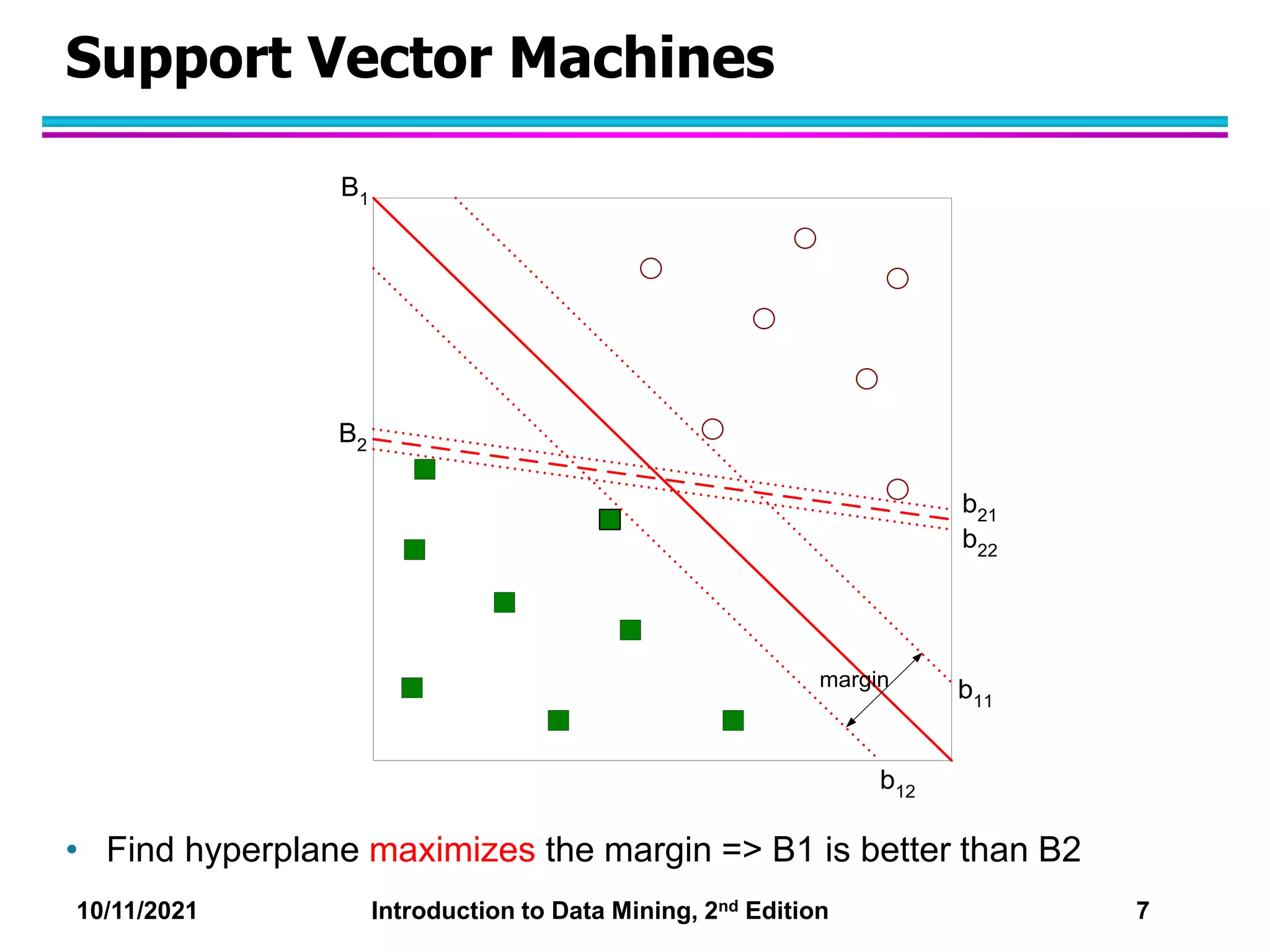
• Find hyperplane maximizes the margin => B1 is better than B2
B1
B2
b11
b12
b21
b22
margin
10/11/2021 Introduction to Data Mining, 2nd Edition 8
Support Vector Machines
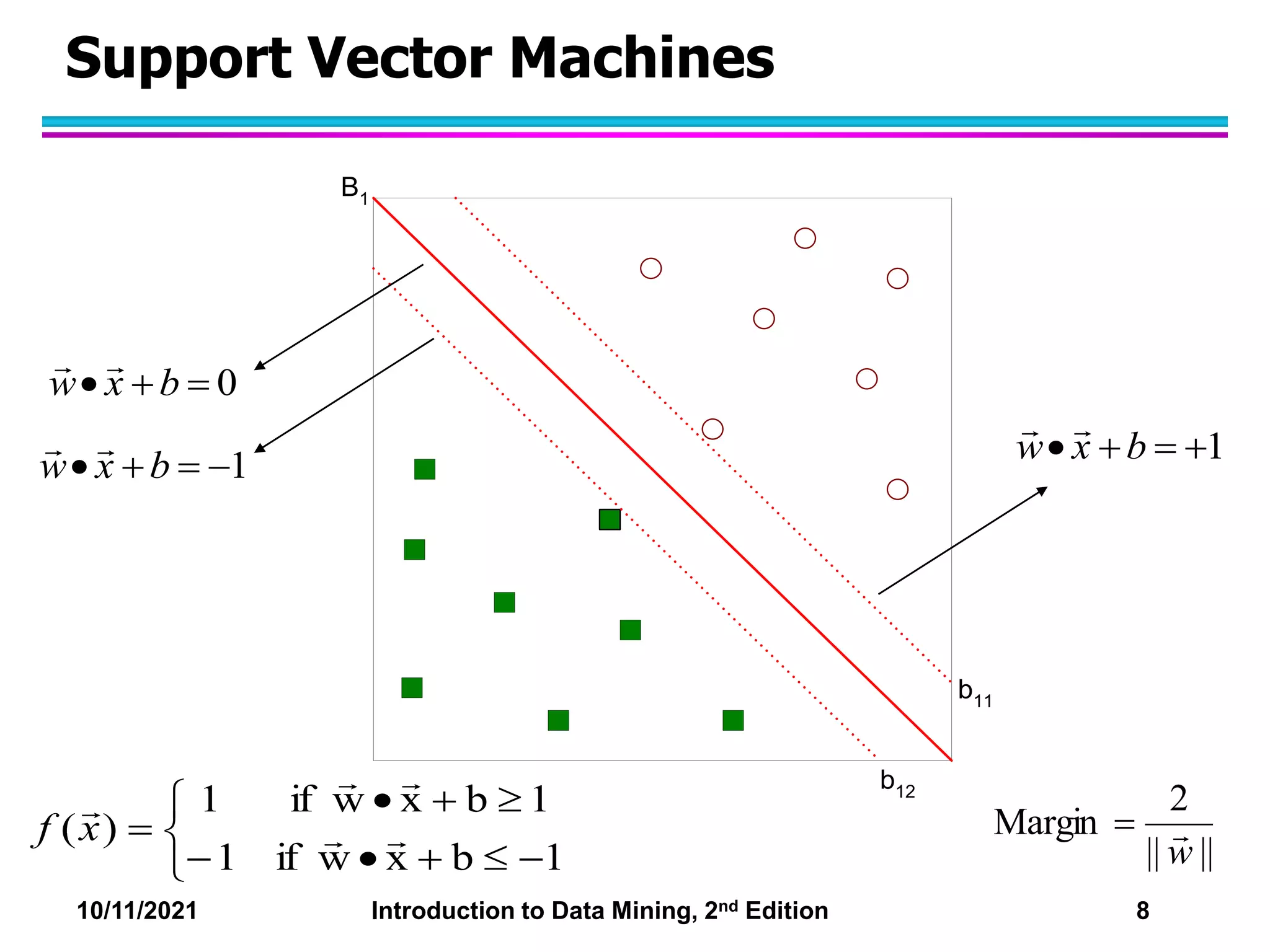
B1
b11
b12
0


 b
x
w


1



 b
x
w

 1



 b
x
w














1
b
x
w
if
1
1
b
x
w
if
1
)
( 




x
f
||
||
2
Margin
w


10/11/2021 Introduction to Data Mining, 2nd Edition 9
Linear SVM
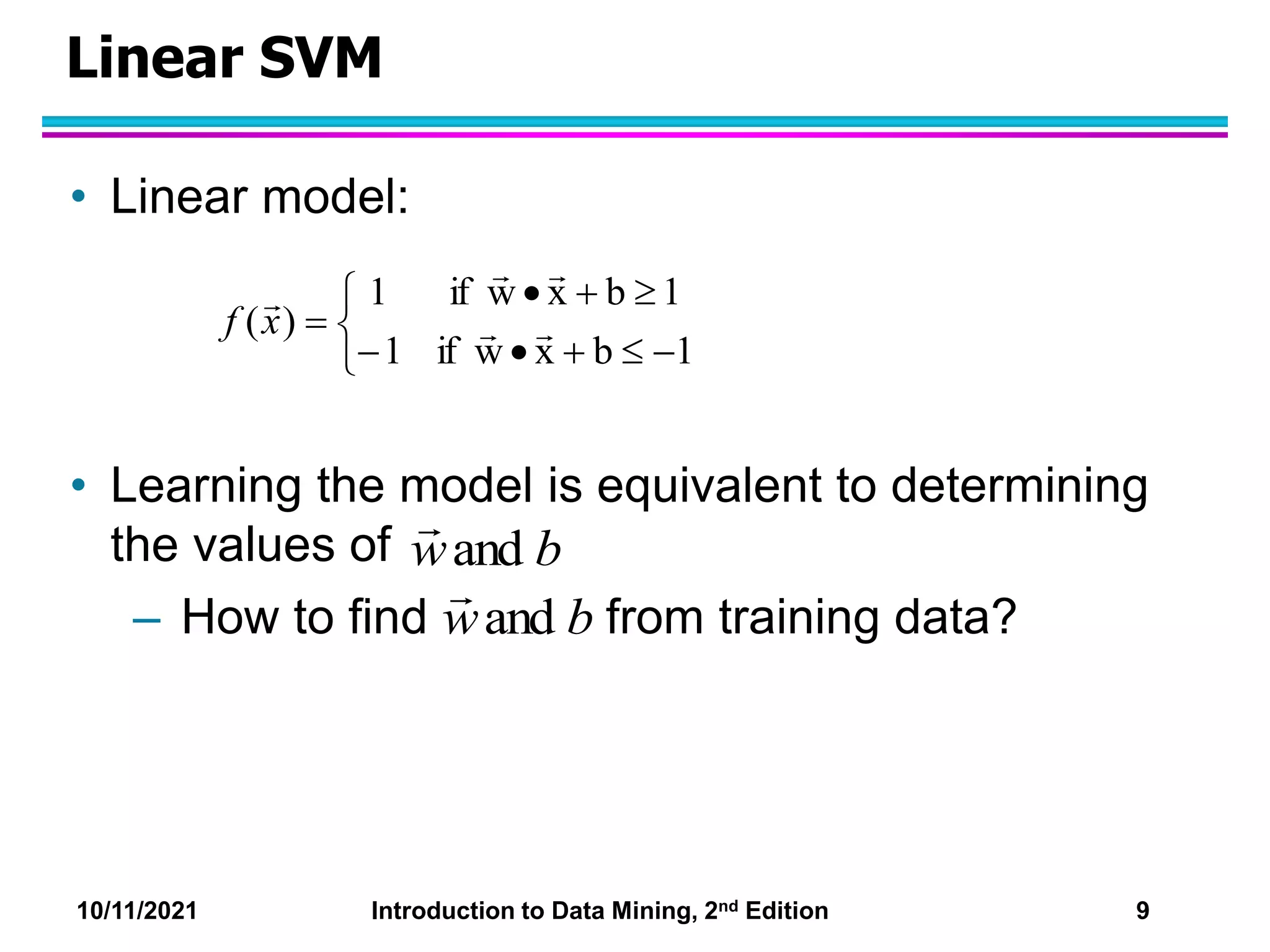
• Linear model:
• Learning the model is equivalent to determining
the values of
– How to find from training data?












1
b
x
w
if
1
1
b
x
w
if
1
)
( 




x
f
and b
w

and b
w

10/11/2021 Introduction to Data Mining, 2nd Edition 10
Learning Linear SVM
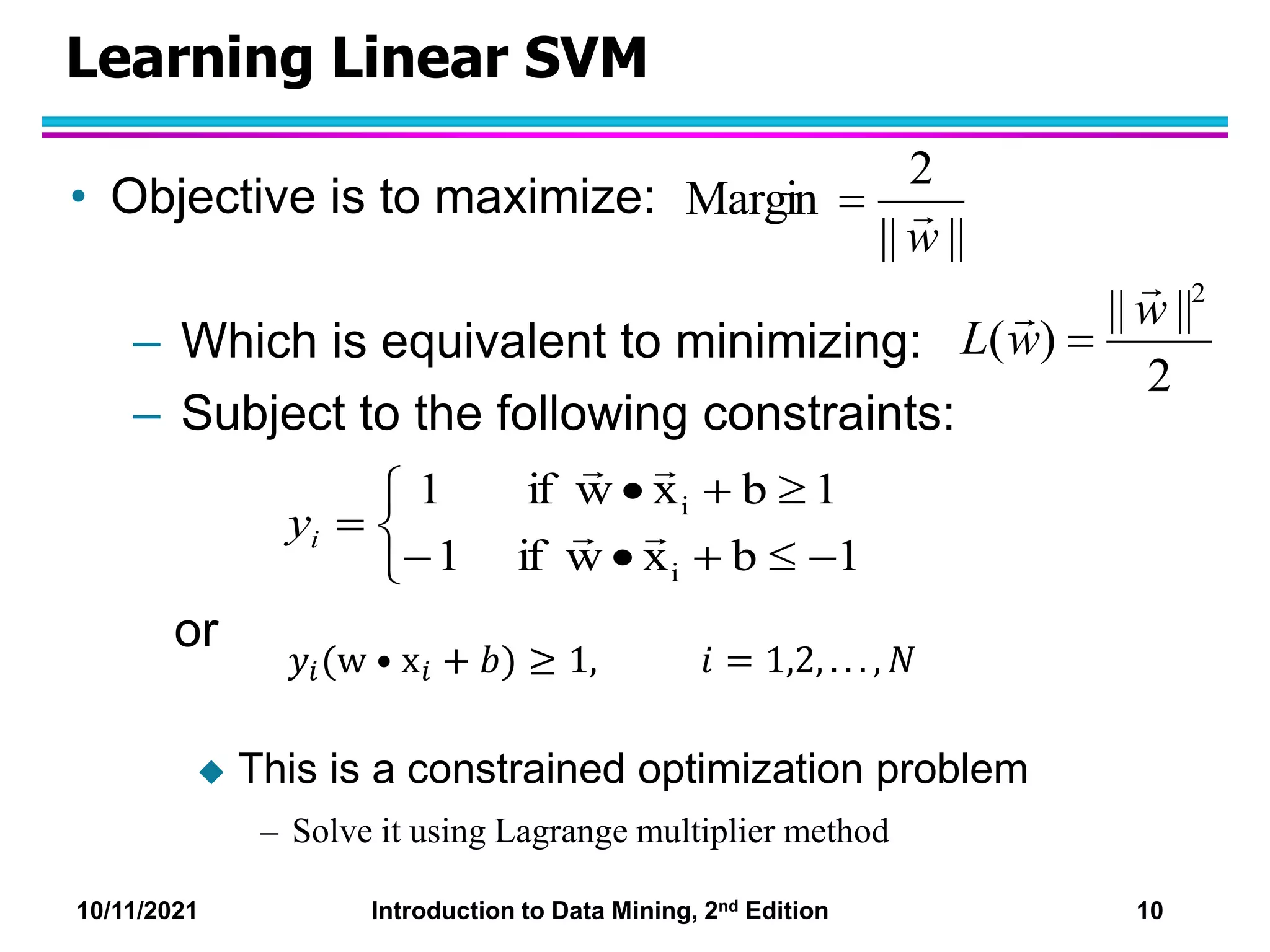
• Objective is to maximize:
– Which is equivalent to minimizing:
– Subject to the following constraints:
or
 This is a constrained optimization problem
– Solve it using Lagrange multiplier method
||
||
2
Margin
w














1
b
x
w
if
1
1
b
x
w
if
1
i
i




i
y
2
||
||
)
(
2
w
w
L



𝑦𝑖(w • x𝑖 + 𝑏) ≥ 1, 𝑖 = 1,2, . . . , 𝑁
10/11/2021 Introduction to Data Mining, 2nd Edition 11
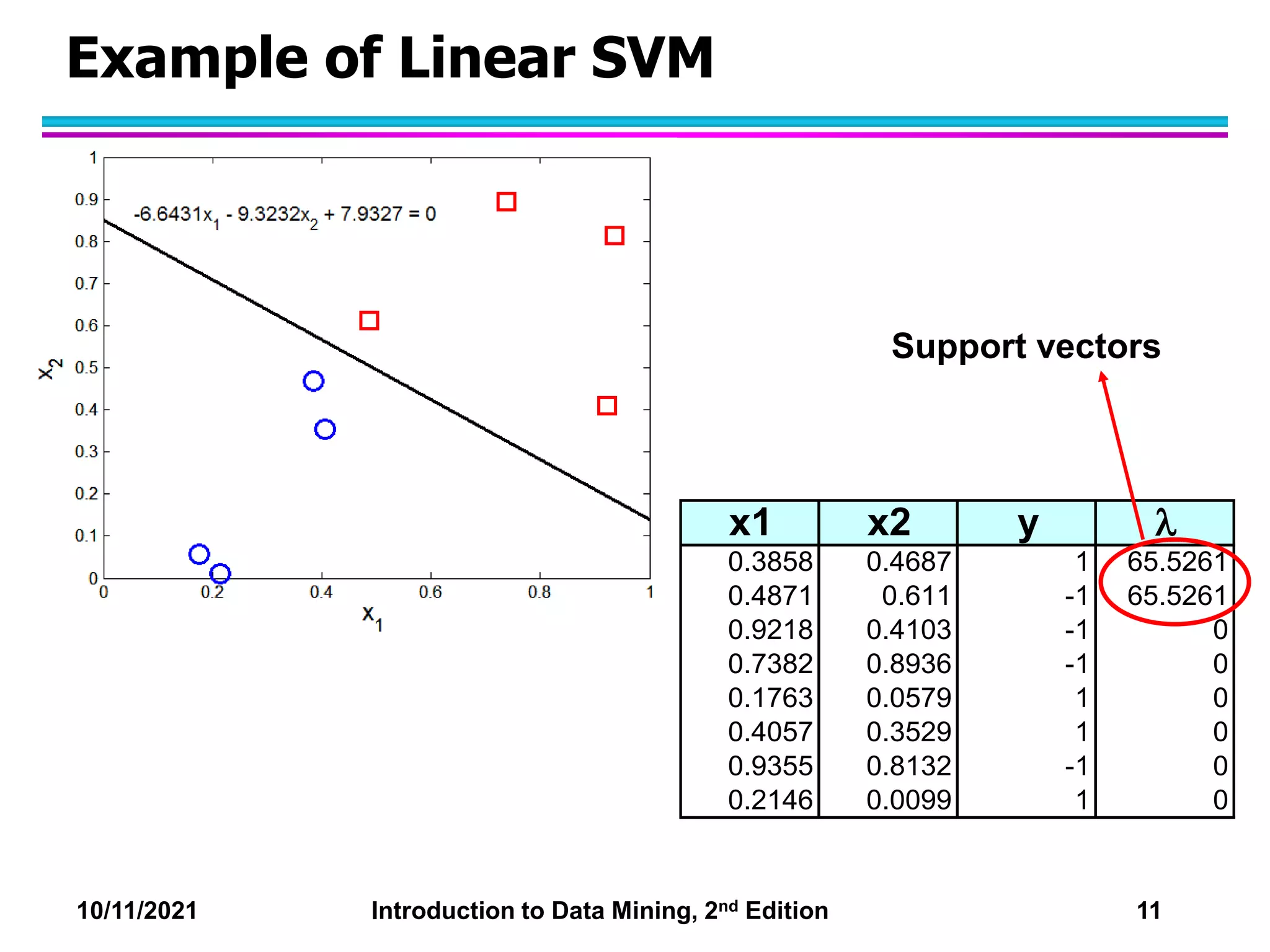
Example of Linear SVM
x1 x2 y l
0.3858 0.4687 1 65.5261
0.4871 0.611 -1 65.5261
0.9218 0.4103 -1 0
0.7382 0.8936 -1 0
0.1763 0.0579 1 0
0.4057 0.3529 1 0
0.9355 0.8132 -1 0
0.2146 0.0099 1 0
Support vectors
10/11/2021 Introduction to Data Mining, 2nd Edition 12
Learning Linear SVM
• Decision boundary depends only on support
vectors
– If you have data set with same support
vectors, decision boundary will not change
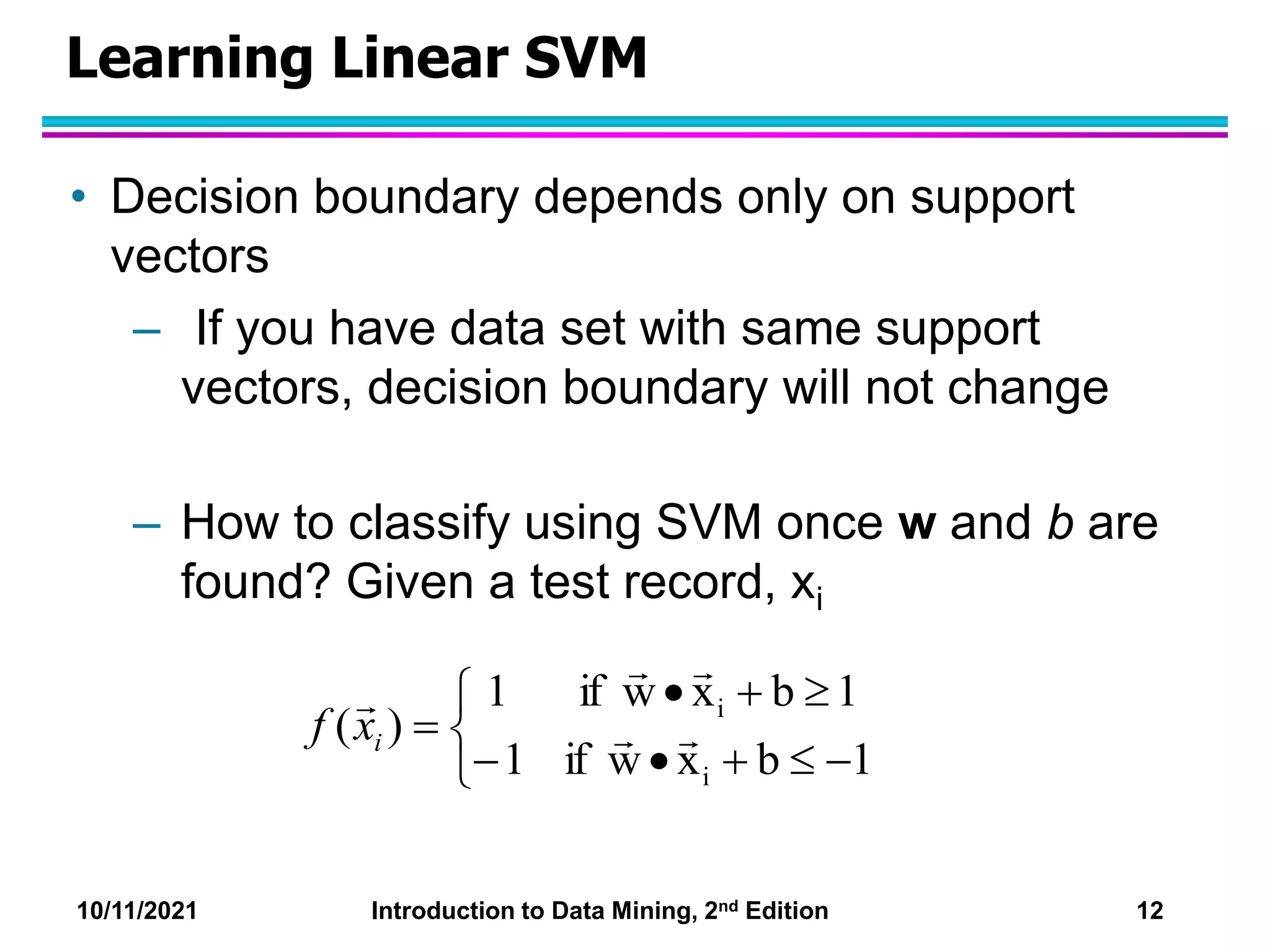
– How to classify using SVM once w and b are
found? Given a test record, xi












1
b
x
w
if
1
1
b
x
w
if
1
)
(
i
i





i
x
f
10/11/2021 Introduction to Data Mining, 2nd Edition 13
Support Vector Machines
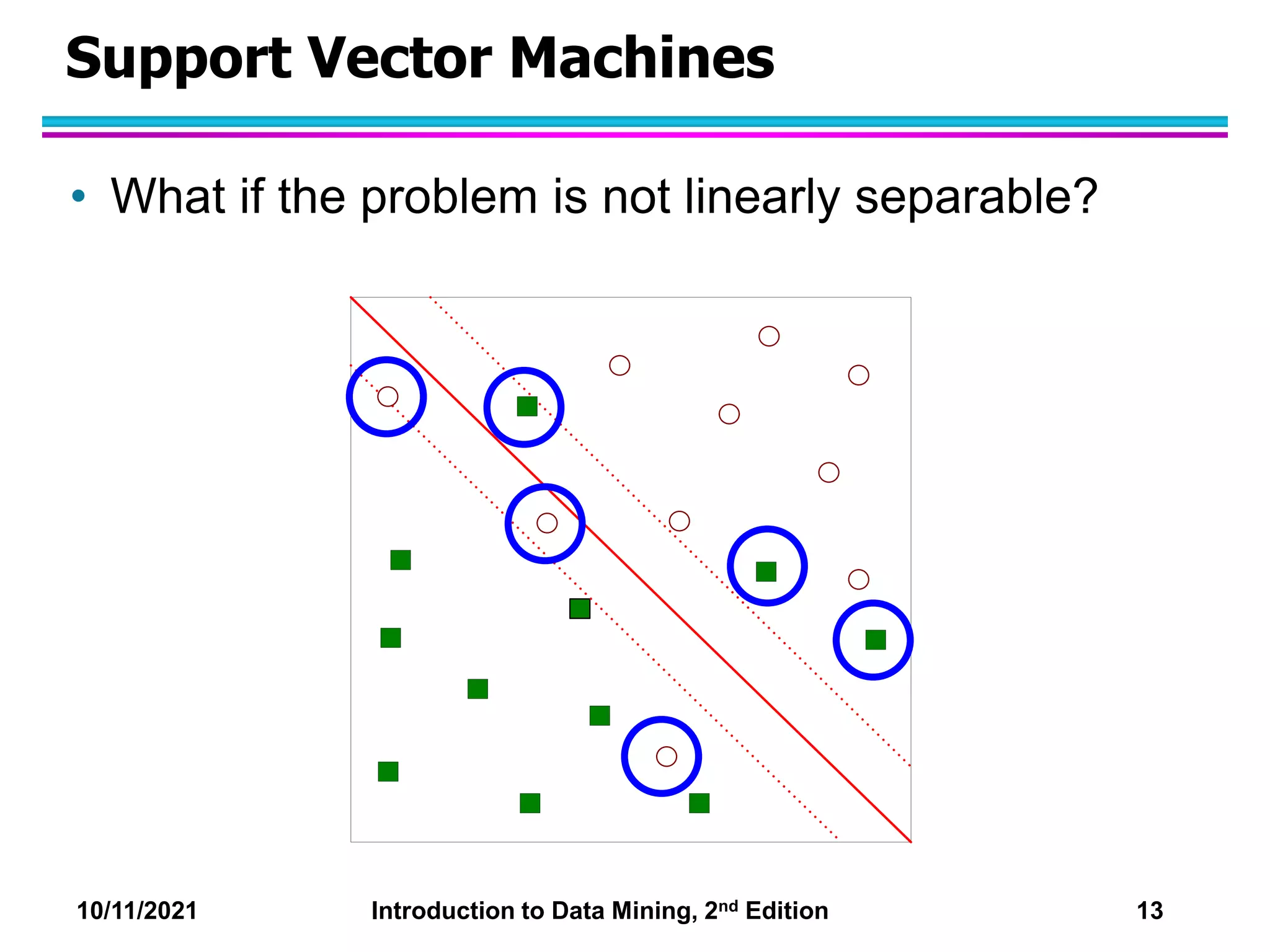
• What if the problem is not linearly separable?
10/11/2021 Introduction to Data Mining, 2nd Edition 14
Support Vector Machines
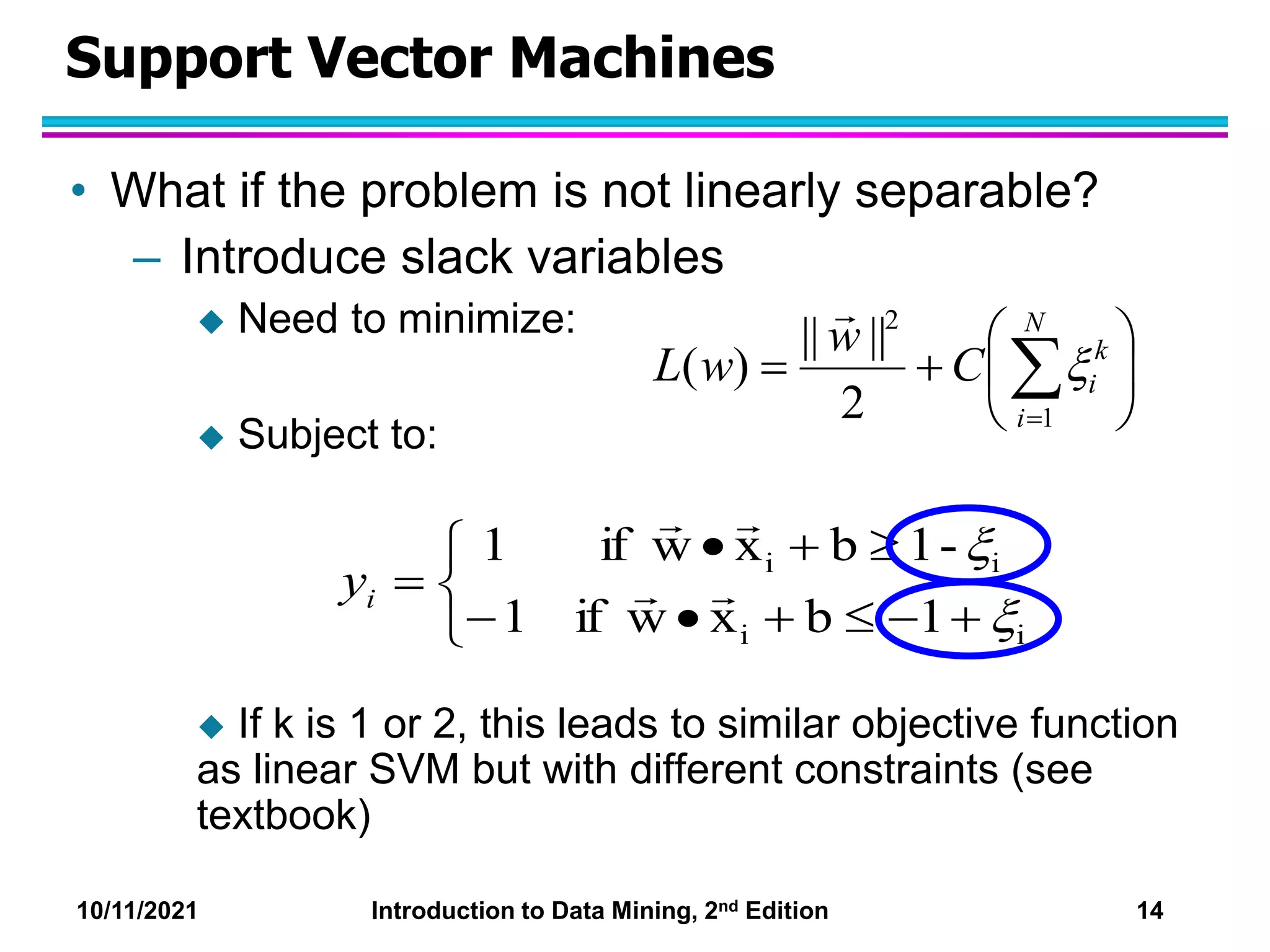
• What if the problem is not linearly separable?
– Introduce slack variables
 Need to minimize:
 Subject to:
 If k is 1 or 2, this leads to similar objective function
as linear SVM but with different constraints (see
textbook)













i
i
i
i
1
b
x
w
if
1
-
1
b
x
w
if
1






i
y







 

N
i
k
i
C
w
w
L
1
2
2
||
||
)
( 

10/11/2021 Introduction to Data Mining, 2nd Edition 15
Support Vector Machines
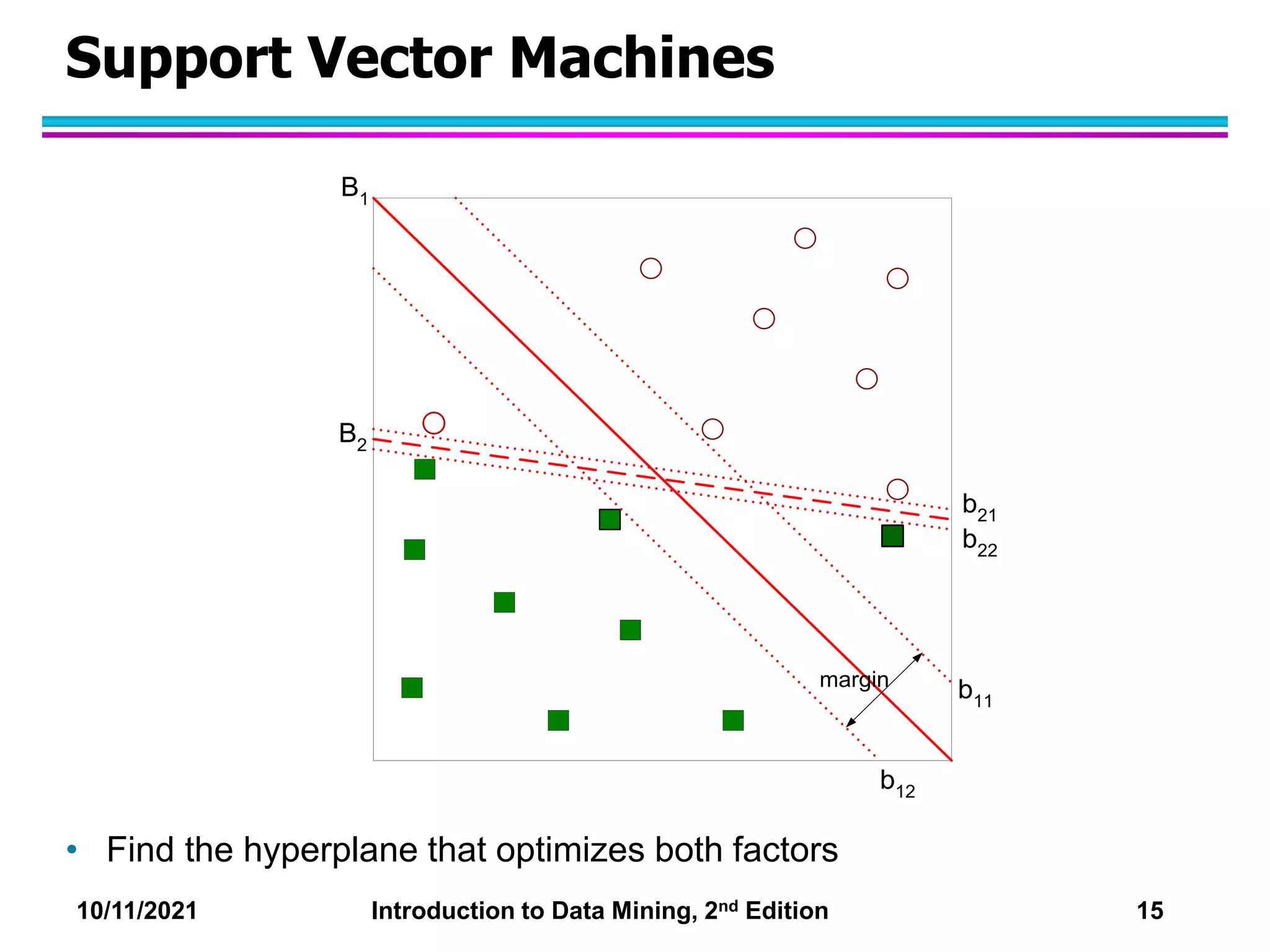
• Find the hyperplane that optimizes both factors
B1
B2
b11
b12
b21
b22
margin
10/11/2021 Introduction to Data Mining, 2nd Edition 16
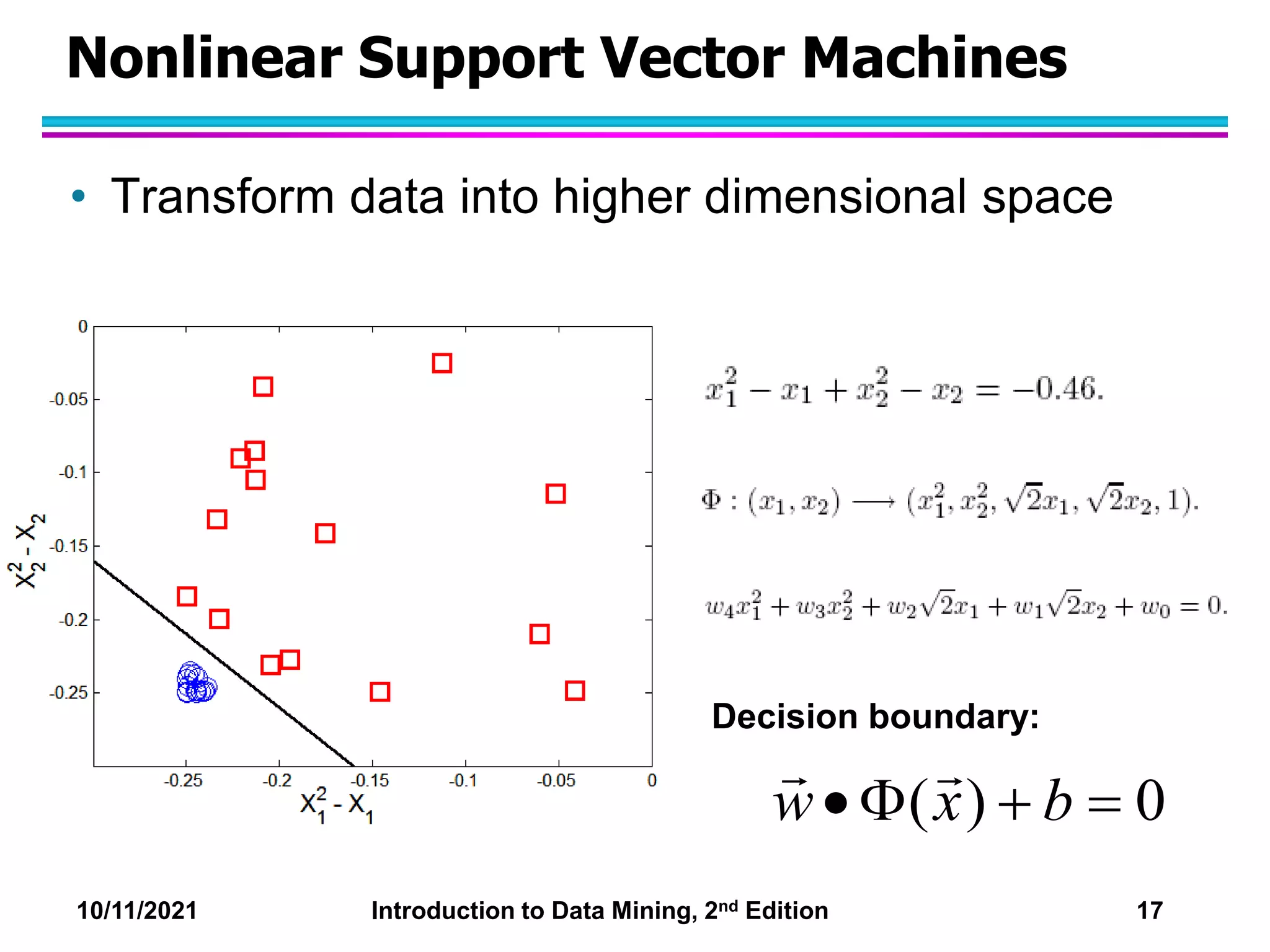
Nonlinear Support Vector Machines
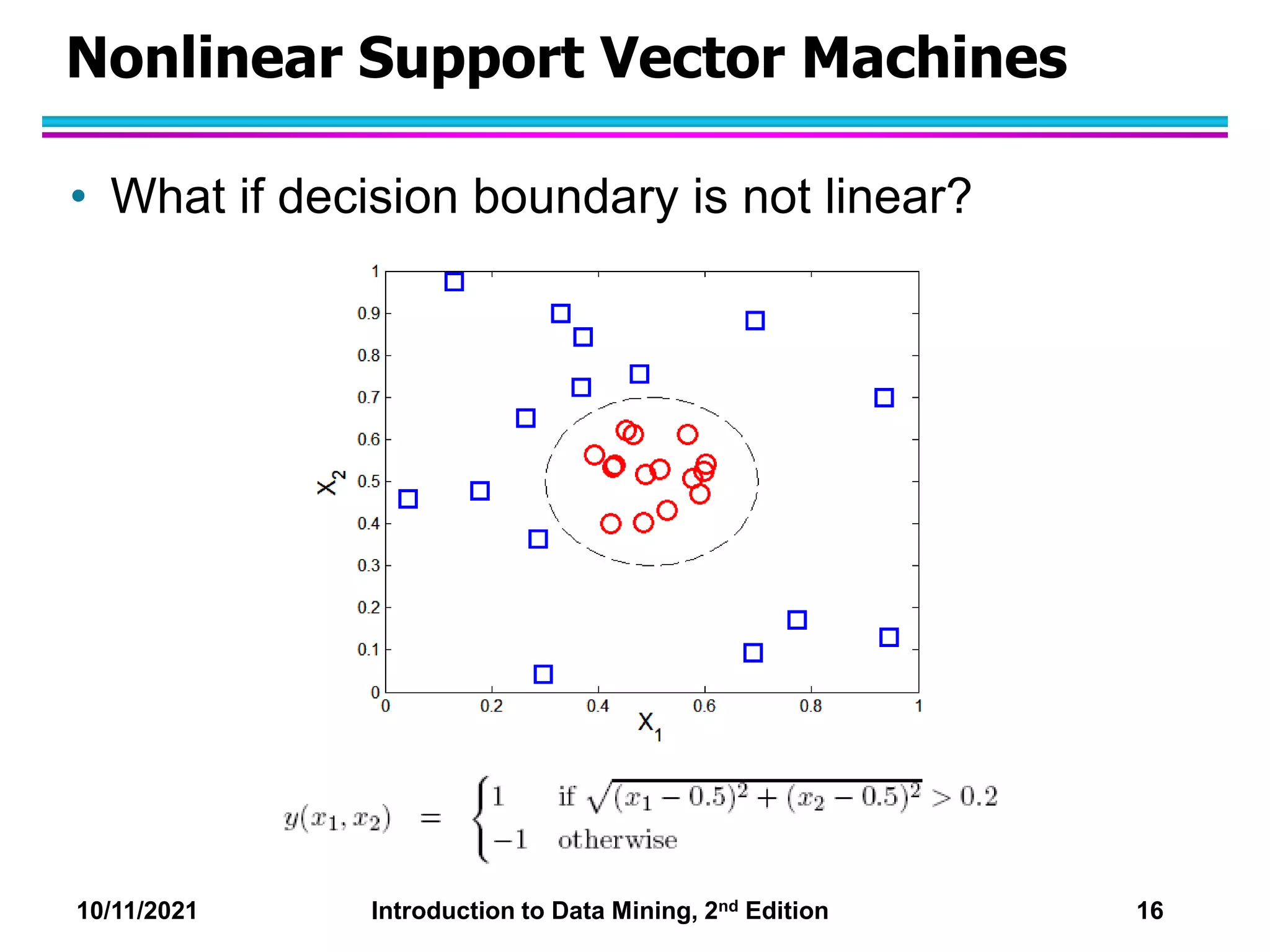
• What if decision boundary is not linear?
10/11/2021 Introduction to Data Mining, 2nd Edition 17
Nonlinear Support Vector Machines
• Transform data into higher dimensional space
0
)
( 


 b
x
w


Decision boundary:
10/11/2021 Introduction to Data Mining, 2nd Edition 18
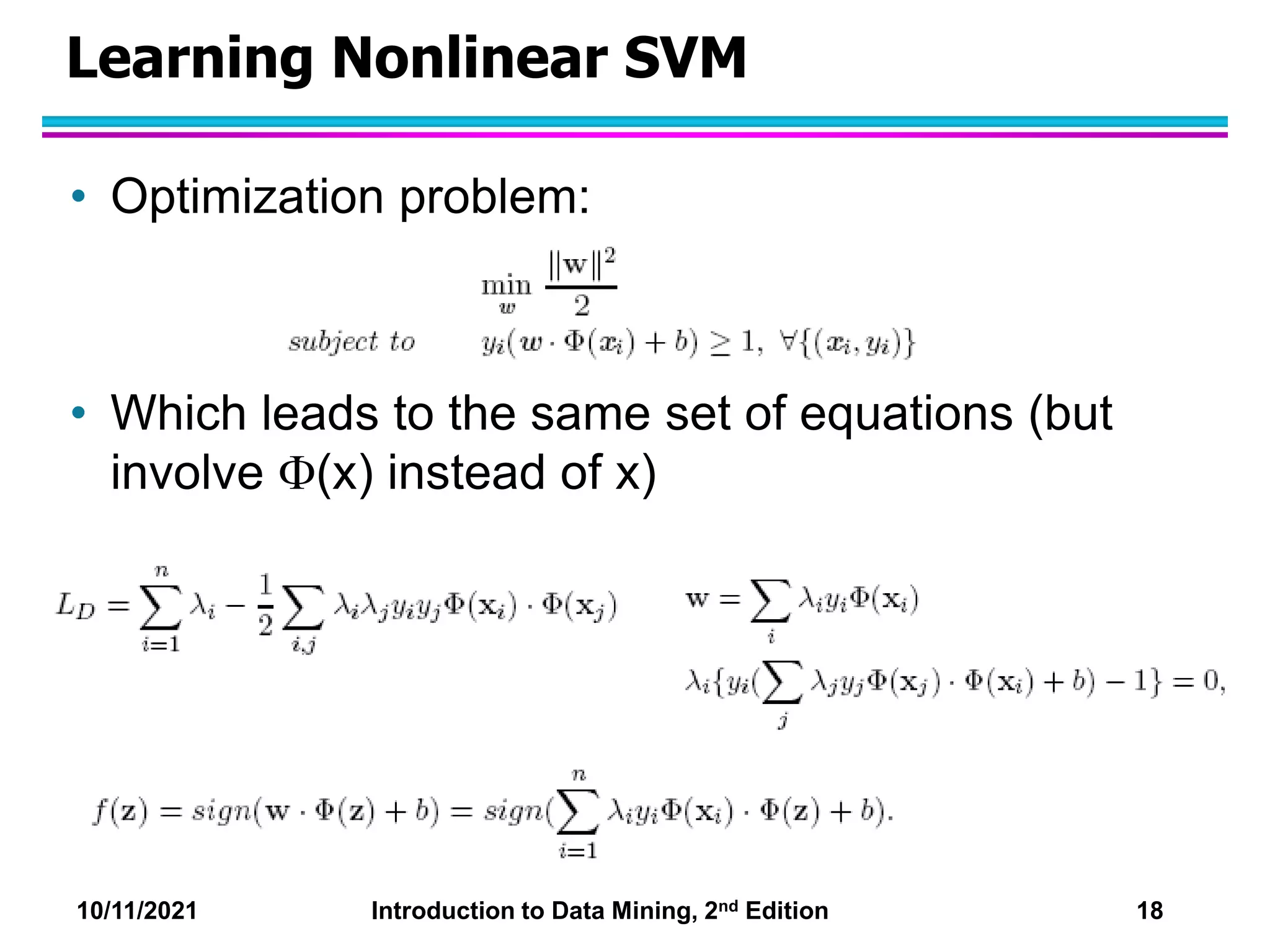
Learning Nonlinear SVM
• Optimization problem:
• Which leads to the same set of equations (but
involve (x) instead of x)
10/11/2021 Introduction to Data Mining, 2nd Edition 19
Learning NonLinear SVM
• Issues:
– What type of mapping function  should be
used?
– How to do the computation in high
dimensional space?
 Most computations involve dot product (xi) (xj)
 Curse of dimensionality?
10/11/2021 Introduction to Data Mining, 2nd Edition 20
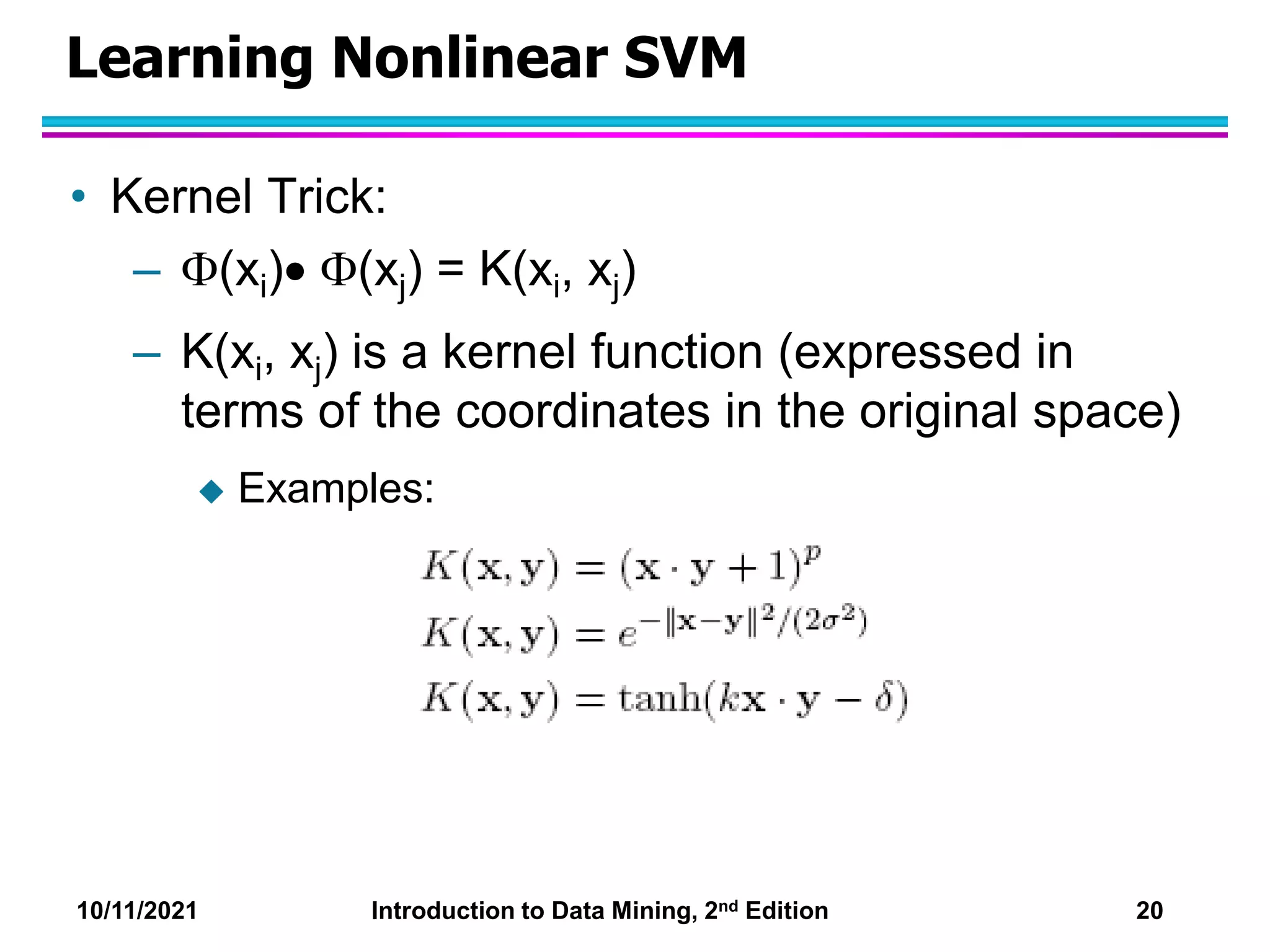
Learning Nonlinear SVM
• Kernel Trick:
– (xi) (xj) = K(xi, xj)
– K(xi, xj) is a kernel function (expressed in
terms of the coordinates in the original space)
 Examples:
10/11/2021 Introduction to Data Mining, 2nd Edition 21
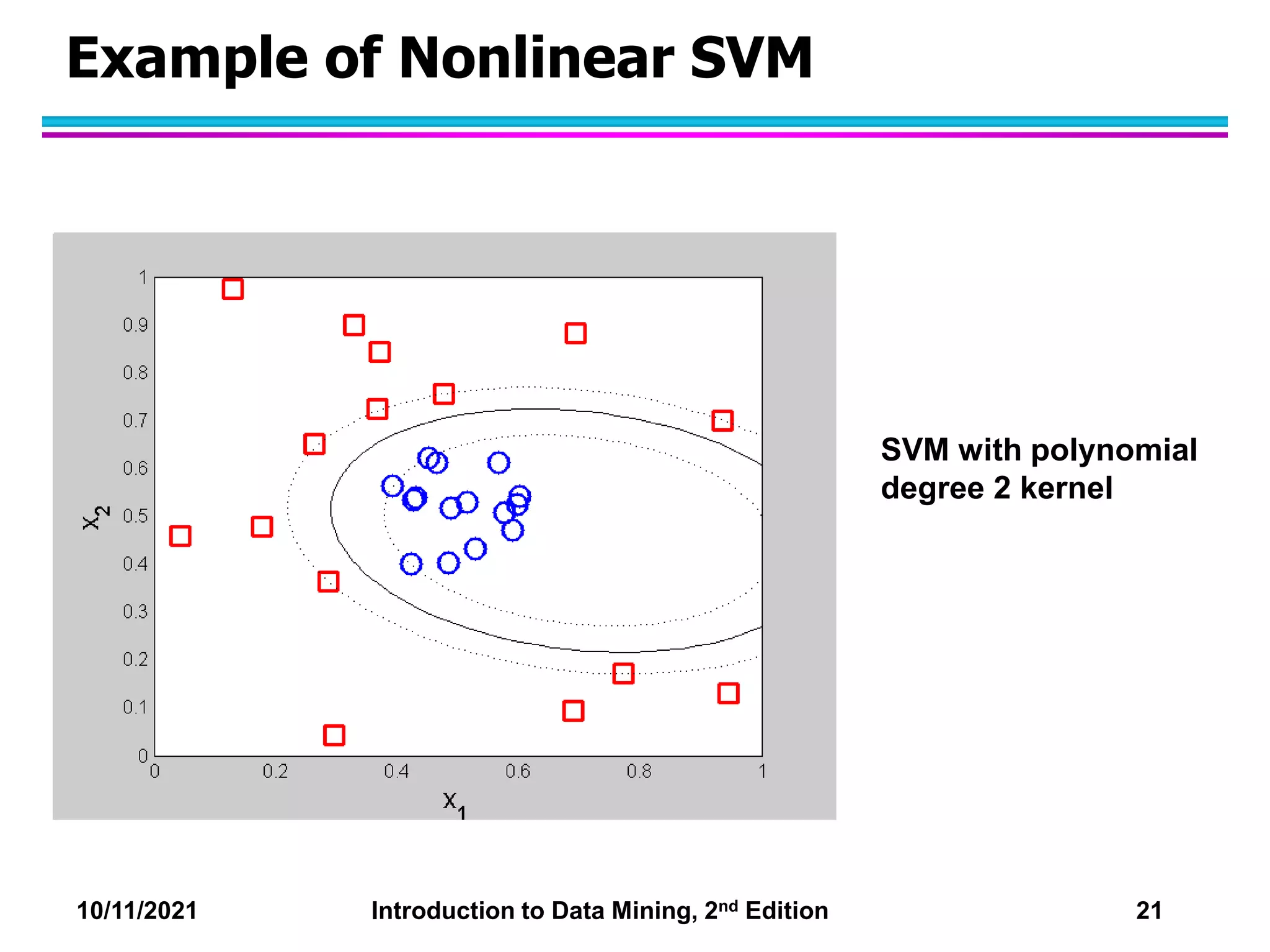
Example of Nonlinear SVM
SVM with polynomial
degree 2 kernel
10/11/2021 Introduction to Data Mining, 2nd Edition 22
Learning Nonlinear SVM
• Advantages of using kernel:
– Don’t have to know the mapping function 
– Computing dot product (xi) (xj) in the
original space avoids curse of dimensionality
• Not all functions can be kernels
– Must make sure there is a corresponding  in
some high-dimensional space
– Mercer’s theorem (see textbook)
10/11/2021 Introduction to Data Mining, 2nd Edition 23
Characteristics of SVM
• The learning problem is formulated as a convex optimization problem
– Efficient algorithms are available to find the global minima
– Many of the other methods use greedy approaches and find locally
optimal solutions
– High computational complexity for building the model
• Robust to noise
• Overfitting is handled by maximizing the margin of the decision boundary,
• SVM can handle irrelevant and redundant attributes better than many
other techniques
• The user needs to provide the type of kernel function and cost function
• Difficult to handle missing values
• What about categorical variables?

svm.pptx

  • 1.
    10/11/2021 Introduction toData Mining, 2nd Edition 1 Data Mining Support Vector Machines Introduction to Data Mining, 2nd Edition by Tan, Steinbach, Karpatne, Kumar
  • 2.
    10/11/2021 Introduction toData Mining, 2nd Edition 2 Support Vector Machines • Find a linear hyperplane (decision boundary) that will separate the data
  • 3.
    10/11/2021 Introduction toData Mining, 2nd Edition 3 Support Vector Machines • One Possible Solution B1
  • 4.
    10/11/2021 Introduction toData Mining, 2nd Edition 4 Support Vector Machines • Another possible solution B2
  • 5.
    10/11/2021 Introduction toData Mining, 2nd Edition 5 Support Vector Machines • Other possible solutions B2
  • 6.
    10/11/2021 Introduction toData Mining, 2nd Edition 6 Support Vector Machines • Which one is better? B1 or B2? • How do you define better? B1 B2
  • 7.
    10/11/2021 Introduction toData Mining, 2nd Edition 7 Support Vector Machines • Find hyperplane maximizes the margin => B1 is better than B2 B1 B2 b11 b12 b21 b22 margin
  • 8.
    10/11/2021 Introduction toData Mining, 2nd Edition 8 Support Vector Machines B1 b11 b12 0    b x w   1     b x w   1     b x w               1 b x w if 1 1 b x w if 1 ) (      x f || || 2 Margin w  
  • 9.
    10/11/2021 Introduction toData Mining, 2nd Edition 9 Linear SVM • Linear model: • Learning the model is equivalent to determining the values of – How to find from training data?             1 b x w if 1 1 b x w if 1 ) (      x f and b w  and b w 
  • 10.
    10/11/2021 Introduction toData Mining, 2nd Edition 10 Learning Linear SVM • Objective is to maximize: – Which is equivalent to minimizing: – Subject to the following constraints: or  This is a constrained optimization problem – Solve it using Lagrange multiplier method || || 2 Margin w               1 b x w if 1 1 b x w if 1 i i     i y 2 || || ) ( 2 w w L    𝑦𝑖(w • x𝑖 + 𝑏) ≥ 1, 𝑖 = 1,2, . . . , 𝑁
  • 11.
    10/11/2021 Introduction toData Mining, 2nd Edition 11 Example of Linear SVM x1 x2 y l 0.3858 0.4687 1 65.5261 0.4871 0.611 -1 65.5261 0.9218 0.4103 -1 0 0.7382 0.8936 -1 0 0.1763 0.0579 1 0 0.4057 0.3529 1 0 0.9355 0.8132 -1 0 0.2146 0.0099 1 0 Support vectors
  • 12.
    10/11/2021 Introduction toData Mining, 2nd Edition 12 Learning Linear SVM • Decision boundary depends only on support vectors – If you have data set with same support vectors, decision boundary will not change – How to classify using SVM once w and b are found? Given a test record, xi             1 b x w if 1 1 b x w if 1 ) ( i i      i x f
  • 13.
    10/11/2021 Introduction toData Mining, 2nd Edition 13 Support Vector Machines • What if the problem is not linearly separable?
  • 14.
    10/11/2021 Introduction toData Mining, 2nd Edition 14 Support Vector Machines • What if the problem is not linearly separable? – Introduce slack variables  Need to minimize:  Subject to:  If k is 1 or 2, this leads to similar objective function as linear SVM but with different constraints (see textbook)              i i i i 1 b x w if 1 - 1 b x w if 1       i y           N i k i C w w L 1 2 2 || || ) (  
  • 15.
    10/11/2021 Introduction toData Mining, 2nd Edition 15 Support Vector Machines • Find the hyperplane that optimizes both factors B1 B2 b11 b12 b21 b22 margin
  • 16.
    10/11/2021 Introduction toData Mining, 2nd Edition 16 Nonlinear Support Vector Machines • What if decision boundary is not linear?
  • 17.
    10/11/2021 Introduction toData Mining, 2nd Edition 17 Nonlinear Support Vector Machines • Transform data into higher dimensional space 0 ) (     b x w   Decision boundary:
  • 18.
    10/11/2021 Introduction toData Mining, 2nd Edition 18 Learning Nonlinear SVM • Optimization problem: • Which leads to the same set of equations (but involve (x) instead of x)
  • 19.
    10/11/2021 Introduction toData Mining, 2nd Edition 19 Learning NonLinear SVM • Issues: – What type of mapping function  should be used? – How to do the computation in high dimensional space?  Most computations involve dot product (xi) (xj)  Curse of dimensionality?
  • 20.
    10/11/2021 Introduction toData Mining, 2nd Edition 20 Learning Nonlinear SVM • Kernel Trick: – (xi) (xj) = K(xi, xj) – K(xi, xj) is a kernel function (expressed in terms of the coordinates in the original space)  Examples:
  • 21.
    10/11/2021 Introduction toData Mining, 2nd Edition 21 Example of Nonlinear SVM SVM with polynomial degree 2 kernel
  • 22.
    10/11/2021 Introduction toData Mining, 2nd Edition 22 Learning Nonlinear SVM • Advantages of using kernel: – Don’t have to know the mapping function  – Computing dot product (xi) (xj) in the original space avoids curse of dimensionality • Not all functions can be kernels – Must make sure there is a corresponding  in some high-dimensional space – Mercer’s theorem (see textbook)
  • 23.
    10/11/2021 Introduction toData Mining, 2nd Edition 23 Characteristics of SVM • The learning problem is formulated as a convex optimization problem – Efficient algorithms are available to find the global minima – Many of the other methods use greedy approaches and find locally optimal solutions – High computational complexity for building the model • Robust to noise • Overfitting is handled by maximizing the margin of the decision boundary, • SVM can handle irrelevant and redundant attributes better than many other techniques • The user needs to provide the type of kernel function and cost function • Difficult to handle missing values • What about categorical variables?