Eurostat
Data Science
and its role in
Big Data analytics
THE CONTRACTOR IS ACTING UNDER A FRAMEWORK CONTRACT CONCLUDED WITH THE COMMISSION
Outline
Eurostat
1. Data Science, basic concepts
2. A short history
3. A new concept of Science?
4. Big Data as the new frontier of Data Science
5. Data, information, knowledge
Data
Science
NEW KINDS
OF DATA
INTERDISCIPLINARY
DATA AS
PRODUCT
NEW METHODS FOR
MAKING-SENSE TO DATA
LOUKADIS (O’REILLY MEDIA)
…merely using data isn’t really what we
mean by “data science.” A data application
acquires its value from the data itself, and
creates more data as a result. It’s not just an
application with data; it’s a data product.
Data science enables the creation of data
products
...[DS includes]
mathematics, statistics,
data engineering,
pattern recognition and
learning, advanced
computing,visualization,
uncertainty modeling,
data warehousing, and
high performance
computing with the goal
of extracting meaning
from data and creating
data products
MOUT
Data science is the study of
where information comes
from, what it represents
and how it can be turned
into a valuable resource in
the creation of business and
IT strategies
ROUSE
volumes of data that are structured or
unstructured, which is a continuation of
the field data mining and predictive
analytics, also known as knowledge
discovery and data mining (KDD).
"Unstructured data" can include emails,
videos, photos, social media, and other
user-generated content.
The field of data science is
emerging at the intersection of
the fields of social science and
statistics, information and
computer science, and design
BERKELEY SCHOOL OF
INFORMATION
WIKIPEDIA
Extraction of knowledge from large
First, the raw material, the
“data” part of Data Science,
is increasingly
heterogeneous and
unstructured. Second,
computers interpret data
automatically, makingthem
active agents in the process
of sense making.
At its core, data science
involves using automated
methods to analyze
massive amounts of data
and to extract knowledge
from them.
NEW YORK
UNIVERSITY
DHAR
Eurostat
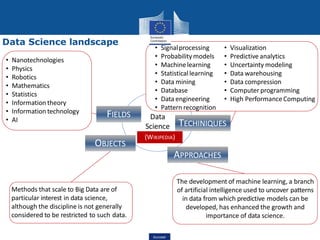
Data Science landscape
Data
Science
• Nanotechnologies
• Physics
• Robotics
• Mathematics
• Statistics
• Information theory
• Information technology
• AI
FIELDS
APPROACHES
OBJECTS
TECHINIQUES
The development of machine learning, a branch
of artificial intelligence used to uncover patterns
in data from which predictive models can be
developed, has enhanced the growth and
importance of data science.
Methods that scale to Big Data are of
particular interest in data science,
although the discipline is not generally
considered to be restricted to such data.
• Signalprocessing
• Probabilitymodels
• Machinelearning
• Statisticallearning
• Data mining
• Database
• Data engineering
• Pattern recognition
• Visualization
• Predictive analytics
• Uncertainty modeling
• Data warehousing
• Data compression
• Computer programming
• High PerformanceComputing
(WIKIPEDIA)
Eurostat
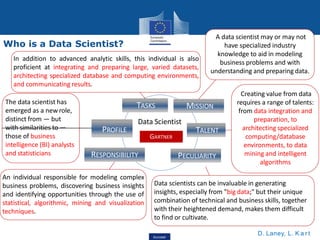
Who is a Data Scientist?
Data Scientist
PROFILE
MISSION
RESPONSIBILITY
TASKS
TALENT
PECULIARITY
In addition to advanced analytic skills, this individual is also
proficient at integrating and preparing large, varied datasets,
architecting specialized database and computing environments,
and communicating results.
GARTNER
A data scientist may or may not
have specialized industry
knowledge to aid in modeling
business problems and with
understanding and preparing data.
An individual responsible for modeling complex
business problems, discovering business insights
and identifying opportunities through the use of
statistical, algorithmic, mining and visualization
techniques.
The data scientist has
emerged as a new role,
distinct from — but
with similarities to —
those of business
intelligence (BI) analysts
and statisticians
Creating value from data
requires a range of talents:
from data integration and
preparation, to
architecting specialized
computing/database
environments, to data
mining and intelligent
algorithms
Data scientists can be invaluable in generating
insights, especially from "big data;" but their unique
combination of technical and business skills, together
with their heightened demand, makes them difficult
to find or cultivate.
Eurostat
D. Laney, L. K a r t
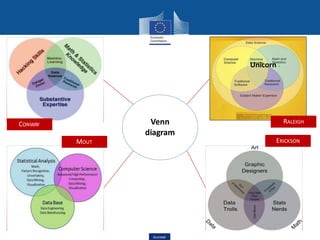
Unicorn
Venn
diagram
CONWAY RALEIGH
MOUT ERICKSON
Eurostat
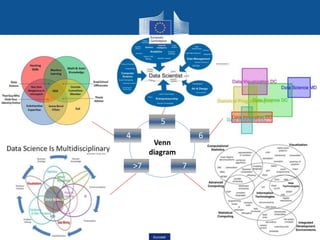
Venn
diagram
4
5
6
7
>7
Eurostat
Eurostat
Eurostat
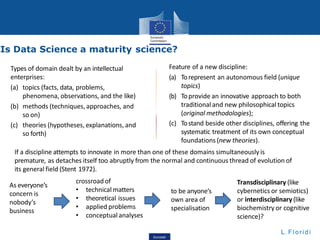
Is Data Science a maturity science?
Feature of a new discipline:
(a) Torepresent an autonomous field (unique
topics)
(b) Toprovide an innovative approach to both
traditional and new philosophical topics
(original methodologies);
(c) Tostand beside other disciplines, offering the
systematic treatment of its own conceptual
foundations (new theories).
Types of domain dealt by an intellectual
enterprises:
(a) topics (facts, data, problems,
phenomena, observations, and the like)
(b) methods (techniques, approaches, and
so on)
(c) theories (hypotheses, explanations, and
so forth)
crossroad of
• technical matters
• theoretical issues
• applied problems
• conceptualanalyses
As everyone’s
concern is
nobody’s
business
to be anyone’s
own area of
specialisation
Transdisciplinary (like
cybernetics or semiotics)
or interdisciplinary (like
biochemistry or cognitive
science)?
If a discipline attempts to innovate in more than one of these domains simultaneously is
premature, as detaches itself too abruptly from the normal and continuous thread of evolution of
its general field (Stent 1972).
L. Fl ori di
Eurostat
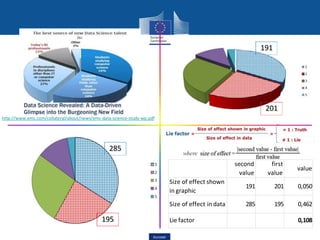
where
second
value
first
value
value
Size of effect shown
in graphic
191 201 0,050
Size of effect in data 285 195 0,462
Lie factor 0,108
191
201
285
195
http://www.emc.com/collateral/about/news/emc-data-science-study-wp.pdf
Eurostat
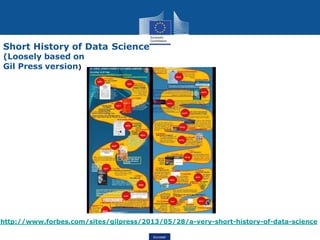
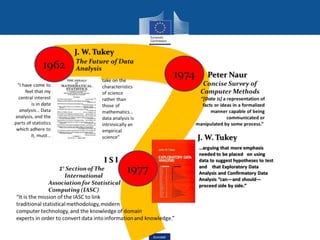
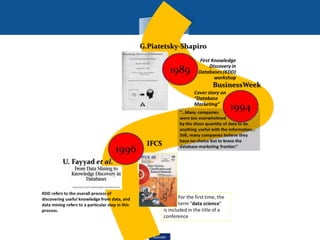
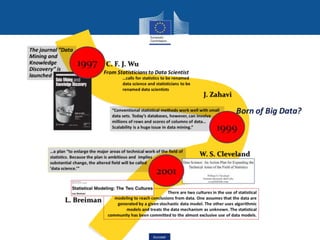
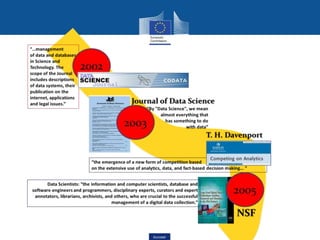
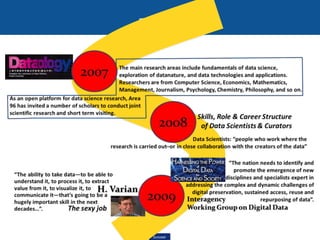
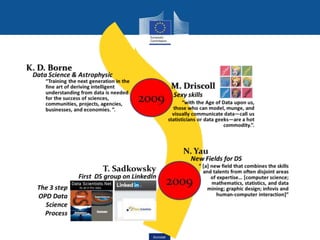
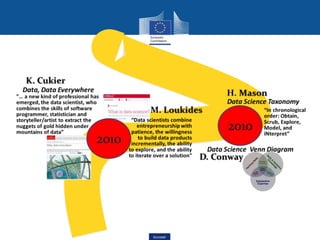
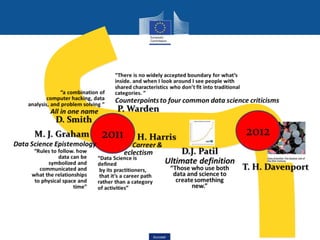
Short History of Data Science
(Loosely based on
Gil Press version)
http://www.forbes.com/sites/gilpress/2013/05/28/a-very-short-history-of-data-science
Eurostat
Eurostat
Eurostat
Eurostat
Eurostat
Eurostat
Eurostat
Eurostat
Eurostat
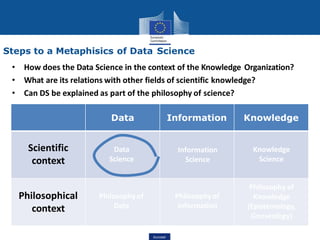
Data Information Knowledge
Scientific
context
Data
Science
Information
Science
Knowledge
Science
Philosophical
context
Philosophyof
Data
Philosophyof
Information
Philosophy of
Knowledge
(Epistemology,
Gnoseology)
Steps to a Metaphisics of Data Science
• How does the Data Science in the context of the Knowledge Organization?
• What are its relations with other fields of scientific knowledge?
• Can DS be explained as part of the philosophy of science?
Eurostat
Data
Ambito
scientifico
Ambito
filosofico
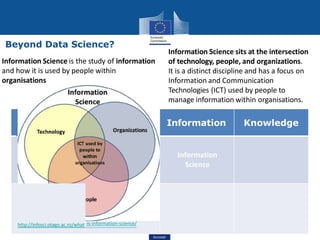
Information Science sits at the intersection
of technology, people, and organizations.
It is a distinct discipline and has a focus on
Information and Communication
Technologies (ICT) used by people to
manage information within organisations.
Beyond Data Science?
Eurostat
Information Knowledge
Information
Science
http://infosci.otago.ac.nz/what -is-information-science/
Information Science is the study of information
and how it is used by people within
organisations
nowledge
Data
Informatio
n K
Ambito
scientifico
Ambito
filosofico
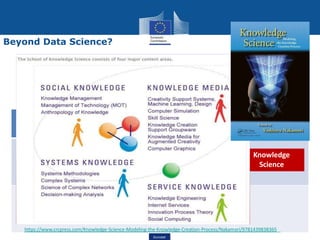
https://www.crcpress.com/Knowledge-Science-Modeling-the-Knowledge-Creation-Process/Nakamori/9781439838365
Knowledge
Science
Beyond Data Science?
Eurostat

ppt_ids-data science.pdf

  • 1.
    Eurostat Data Science and itsrole in Big Data analytics THE CONTRACTOR IS ACTING UNDER A FRAMEWORK CONTRACT CONCLUDED WITH THE COMMISSION
  • 2.
    Outline Eurostat 1. Data Science,basic concepts 2. A short history 3. A new concept of Science? 4. Big Data as the new frontier of Data Science 5. Data, information, knowledge
  • 3.
    Data Science NEW KINDS OF DATA INTERDISCIPLINARY DATAAS PRODUCT NEW METHODS FOR MAKING-SENSE TO DATA LOUKADIS (O’REILLY MEDIA) …merely using data isn’t really what we mean by “data science.” A data application acquires its value from the data itself, and creates more data as a result. It’s not just an application with data; it’s a data product. Data science enables the creation of data products ...[DS includes] mathematics, statistics, data engineering, pattern recognition and learning, advanced computing,visualization, uncertainty modeling, data warehousing, and high performance computing with the goal of extracting meaning from data and creating data products MOUT Data science is the study of where information comes from, what it represents and how it can be turned into a valuable resource in the creation of business and IT strategies ROUSE volumes of data that are structured or unstructured, which is a continuation of the field data mining and predictive analytics, also known as knowledge discovery and data mining (KDD). "Unstructured data" can include emails, videos, photos, social media, and other user-generated content. The field of data science is emerging at the intersection of the fields of social science and statistics, information and computer science, and design BERKELEY SCHOOL OF INFORMATION WIKIPEDIA Extraction of knowledge from large First, the raw material, the “data” part of Data Science, is increasingly heterogeneous and unstructured. Second, computers interpret data automatically, makingthem active agents in the process of sense making. At its core, data science involves using automated methods to analyze massive amounts of data and to extract knowledge from them. NEW YORK UNIVERSITY DHAR Eurostat
  • 4.
    Data Science landscape Data Science •Nanotechnologies • Physics • Robotics • Mathematics • Statistics • Information theory • Information technology • AI FIELDS APPROACHES OBJECTS TECHINIQUES The development of machine learning, a branch of artificial intelligence used to uncover patterns in data from which predictive models can be developed, has enhanced the growth and importance of data science. Methods that scale to Big Data are of particular interest in data science, although the discipline is not generally considered to be restricted to such data. • Signalprocessing • Probabilitymodels • Machinelearning • Statisticallearning • Data mining • Database • Data engineering • Pattern recognition • Visualization • Predictive analytics • Uncertainty modeling • Data warehousing • Data compression • Computer programming • High PerformanceComputing (WIKIPEDIA) Eurostat
  • 5.
    Who is aData Scientist? Data Scientist PROFILE MISSION RESPONSIBILITY TASKS TALENT PECULIARITY In addition to advanced analytic skills, this individual is also proficient at integrating and preparing large, varied datasets, architecting specialized database and computing environments, and communicating results. GARTNER A data scientist may or may not have specialized industry knowledge to aid in modeling business problems and with understanding and preparing data. An individual responsible for modeling complex business problems, discovering business insights and identifying opportunities through the use of statistical, algorithmic, mining and visualization techniques. The data scientist has emerged as a new role, distinct from — but with similarities to — those of business intelligence (BI) analysts and statisticians Creating value from data requires a range of talents: from data integration and preparation, to architecting specialized computing/database environments, to data mining and intelligent algorithms Data scientists can be invaluable in generating insights, especially from "big data;" but their unique combination of technical and business skills, together with their heightened demand, makes them difficult to find or cultivate. Eurostat D. Laney, L. K a r t
  • 6.
  • 7.
  • 8.
  • 9.
  • 10.
    Is Data Sciencea maturity science? Feature of a new discipline: (a) Torepresent an autonomous field (unique topics) (b) Toprovide an innovative approach to both traditional and new philosophical topics (original methodologies); (c) Tostand beside other disciplines, offering the systematic treatment of its own conceptual foundations (new theories). Types of domain dealt by an intellectual enterprises: (a) topics (facts, data, problems, phenomena, observations, and the like) (b) methods (techniques, approaches, and so on) (c) theories (hypotheses, explanations, and so forth) crossroad of • technical matters • theoretical issues • applied problems • conceptualanalyses As everyone’s concern is nobody’s business to be anyone’s own area of specialisation Transdisciplinary (like cybernetics or semiotics) or interdisciplinary (like biochemistry or cognitive science)? If a discipline attempts to innovate in more than one of these domains simultaneously is premature, as detaches itself too abruptly from the normal and continuous thread of evolution of its general field (Stent 1972). L. Fl ori di Eurostat
  • 11.
    where second value first value value Size of effectshown in graphic 191 201 0,050 Size of effect in data 285 195 0,462 Lie factor 0,108 191 201 285 195 http://www.emc.com/collateral/about/news/emc-data-science-study-wp.pdf Eurostat
  • 12.
    Short History ofData Science (Loosely based on Gil Press version) http://www.forbes.com/sites/gilpress/2013/05/28/a-very-short-history-of-data-science Eurostat
  • 13.
  • 14.
  • 15.
  • 16.
  • 17.
  • 18.
  • 19.
  • 20.
  • 21.
    Data Information Knowledge Scientific context Data Science Information Science Knowledge Science Philosophical context Philosophyof Data Philosophyof Information Philosophyof Knowledge (Epistemology, Gnoseology) Steps to a Metaphisics of Data Science • How does the Data Science in the context of the Knowledge Organization? • What are its relations with other fields of scientific knowledge? • Can DS be explained as part of the philosophy of science? Eurostat
  • 22.
    Data Ambito scientifico Ambito filosofico Information Science sitsat the intersection of technology, people, and organizations. It is a distinct discipline and has a focus on Information and Communication Technologies (ICT) used by people to manage information within organisations. Beyond Data Science? Eurostat Information Knowledge Information Science http://infosci.otago.ac.nz/what -is-information-science/ Information Science is the study of information and how it is used by people within organisations
  • 23.