CANADIAN COAST GUARD AUXILIARY - PACIFIC
HUMAN FACTORS
CANADIAN COAST GUARD AUXILIARY - PACIFIC
Why Human Factors?
• Since search and rescue units often have to
perform their duties in adverse conditions,
mishaps or errors are bound to happen.
• These errors can sometimes have disastrous
consequences.
• Technical errors have been shown to be
involved in less than 25% of accidents.
CANADIAN COAST GUARD AUXILIARY - PACIFIC
Human Error
• In search and rescue terms this is when the
wrong action or bad decision is not
discovered and is uncorrected.
• Inaction and indecision can also become
human errors.
CANADIAN COAST GUARD AUXILIARY - PACIFIC
Profile of a Good SAR Team
CANADIAN COAST GUARD AUXILIARY - PACIFIC
Profile of a Good SAR Team
Individuals that are good at teamwork:
1. Communicate clearly and precisely
2. Accept challenges and know how to respond
to them
3. Use appropriate short term strategies
4. Have the right balance between authority and
assertiveness
5. Know how to control their workload
CANADIAN COAST GUARD AUXILIARY - PACIFIC
Profile of a Good SAR Team
6. Manage to find a balance between
performance and people orientated styles
7. Can maintain an adequate level of alertness
8. Have sound judgement and, usually, good
decision-making skills
CANADIAN COAST GUARD AUXILIARY - PACIFIC
Communication
CANADIAN COAST GUARD AUXILIARY - PACIFIC
Communication
• This is a key factor, since misunderstandings
are so common.
• What may be a clear message transmitted by
the one end, is not what is heard by the
receivers.
• Sometimes what is heard, is not what was
said.
CANADIAN COAST GUARD AUXILIARY - PACIFIC
Communication
• Communication has to be “open” in that
everyone’s opinions are welcome.
• They also need to be “interactive” which
means everyone is participating in the
communication process.
CANADIAN COAST GUARD AUXILIARY - PACIFIC
Communication
• The next step is “closed loop communication”.
1. The sender sends the message.
2. The recipient acknowledges by repeating all
the important information.
3. Finally the sender confirms the accuracy of
what the recipient said.
CANADIAN COAST GUARD AUXILIARY - PACIFIC
Briefing
CANADIAN COAST GUARD AUXILIARY - PACIFIC
Briefing
• Briefings can minimize the risk of confusion and
should be used when planning anything
requiring active participation by another member
of the team
• The rules for briefing are:
1. Make the time
2. Be open and friendly
3. Anyone can conduct the briefing
4. The briefing must be interactive
CANADIAN COAST GUARD AUXILIARY - PACIFIC
Briefing
5. Define responsibilities
6. Use closed loop communications
7. Keep focused
8. Ensure that no question remains unanswered
CANADIAN COAST GUARD AUXILIARY - PACIFIC
De-briefing
CANADIAN COAST GUARD AUXILIARY - PACIFIC
Debriefings
• A debriefing should conducted as soon after
a mission as possible
1. The coxswain should conduct the debriefing
and should indicate his mistakes first
2. Everybody should remain objective
3. Evaluate positive and negative aspects of
your performance
4. Try to learn from your mistakes
CANADIAN COAST GUARD AUXILIARY - PACIFIC
Debriefings
5. Avoid finger-pointing. Talk about team
performance
6. Keep the briefing interesting
7. Prepare plans for the next time you
encounter a situation like this one
8. Keep a cordial, informal atmosphere
CANADIAN COAST GUARD AUXILIARY - PACIFIC
Challenge and Response
CANADIAN COAST GUARD AUXILIARY - PACIFIC
Challenge and Response
• People who challenge can be seen as a
problem in a team.
• However some challenges can be useful, and
it has been shown that a lack of challenges is
involved in more than 30% of marine
accidents.
CANADIAN COAST GUARD AUXILIARY - PACIFIC
Steps in a Challenge
• Challenging a concept usually involves the
following steps:
1. A concept is stated and limits are set
2. The situation progresses and moves outside
the limits that were set
3. A challenge is issued
4. A proper response is formulated
CANADIAN COAST GUARD AUXILIARY - PACIFIC
Example of a Challenge
Coxswain: “We will turn to port at the fourth red
buoy.”
Crew “Port at the fourth red buoy.”
Coxswain “ That’s right!”
Coxswain “OK - let’s turn to port now.”
Crew “But … don’t we have to another buoy to
pass before we turn?!”
Coxswain “Oops, you’re right. One more buoy.”
CANADIAN COAST GUARD AUXILIARY - PACIFIC
Example of a Challenge
Another example of where a challenge would
be if your depth sounder showed 2 metres
and the plotter showed 20 metres.
CANADIAN COAST GUARD AUXILIARY - PACIFIC
Taking Advantage of Challenges
• Challenges should be allowed and welcomed
in a team.
• Always challenge when you feel you are
moving outside the original concept.
• Be diplomatic when you formulate a
challenge.
CANADIAN COAST GUARD AUXILIARY - PACIFIC
Answering Challenges
• Always check the validity of the challenge.
Use a third source of information if necessary.
• Be cautious, especially in emergency
situations. The challenge may be valid.
• Be diplomatic when you formulate a response
to a challenge. Never laugh at or belittle or
get angry with someone who has issued an
invalid challenge - if you do so, the person
may no longer challenge when you need it.
CANADIAN COAST GUARD AUXILIARY - PACIFIC
Obstacles to Challenges
The challenger:
• is a quiet person or lacks confidence
• is not assertive.
• puts the coxswain on a pedestal
• does not understand something.
• does not like responsibilities.
• is involved with interpersonal conflicts.
• has had bad experiences with inappropriate
responses to previous challenges.
CANADIAN COAST GUARD AUXILIARY - PACIFIC
Obstacles to Challenges
The receiver:
• feels that their authority is threatened by
challenges.
• lacks confidence.
• responds emotionally
• has poor communication skills.
• has poor management skills.
CANADIAN COAST GUARD AUXILIARY - PACIFIC
Short Term Strategies
CANADIAN COAST GUARD AUXILIARY - PACIFIC
Short Term Strategies
• Short term strategies are defined as plans
that are developed to solve a particular
problem,
• They should be used where time permits to
solve any problem that is not covered by
standard operating procedures.
CANADIAN COAST GUARD AUXILIARY - PACIFIC
Short Term Strategies
• They require:
1. Identify the problem.
2. Develop plans to deal with the problem.
3. Check the plans with the team in a briefing.
4. Explain the plan and get commitment.
5. Monitor the correct use of the plan.
6. Modify the plan if the conditions change or
further information becomes available.
CANADIAN COAST GUARD AUXILIARY - PACIFIC
Authority and Assertiveness
CANADIAN COAST GUARD AUXILIARY - PACIFIC
Authority and Assertiveness
• The right level of authority needs to be found for
each team.
• To much authority can be a too little.
• There two kinds of authority
1. Formal authority - coxswain or captain’ s
authority
2. Personal authority - is that which makes people
to listen to one’s suggestions - wisdom,
professionalism, integrity, honesty and
diplomacy
CANADIAN COAST GUARD AUXILIARY - PACIFIC
Authority and Assertiveness
• Using formal authority to command attention
should be avoided
• Assertiveness - someone who is assertive is
able to voice their concerns. Too much or too
little assertiveness can be bad.
CANADIAN COAST GUARD AUXILIARY - PACIFIC
Authority and Assertiveness 1
Situation: Coxswain with strong authority and
crew with weak assertiveness.
• The strong authority of the coxswain will
intimidate the crew.
• This is a one person team.
CANADIAN COAST GUARD AUXILIARY - PACIFIC
Authority and Assertiveness 1
Coxswain: “Let’s go this way and take a
shortcut”
Crew “”But…” to express concern regarding
shallow depth in this area.
Coxswain: “I said we are going this way. What’s
your problem?”
Crew: “Nothing … sorry.”
CANADIAN COAST GUARD AUXILIARY - PACIFIC
Authority and Assertiveness 2
Situation: Coxswain with weak authority and
crew with strong assertiveness.
• This is probably the least dangerous of the
four situations where the strong
assertiveness of the crew compensates for
the coxswain’s lack of authority.
CANADIAN COAST GUARD AUXILIARY - PACIFIC
Authority and Assertiveness 2
Coxswain: “You are leaving the channel if you
go this way.”
Crew “It doesn’t matter…. The water is deep
enough.”
Coxswain: “But … I would prefer if we could
remain in the channel…”
Crew: “I said it’s deep enough. It’s not the first
time I’ve been this way.”
Coxswain: “OK, OK, if you are so sure…”
CANADIAN COAST GUARD AUXILIARY - PACIFIC
Authority and Assertiveness 3
Situation: Coxswain with strong authority and
crew with strong assertiveness.
• This can cause serious conflicts amongst the
team.
• The coxswain and crew will argue constantly.
• The coxswain may have to use his formal
authority to end the altercation.
• This situation is dangerous and stressful.
CANADIAN COAST GUARD AUXILIARY - PACIFIC
Authority and Assertiveness 3
Coxswain: “You are leaving the channel if you go
this way.”
Crew “It doesn’t matter.The water is deep enough.”
Coxswain: “I don’t want you to leave the channel -
is that clear?”
Crew: “Read my lips: IT IS DEEP ENOUGH FOR
US TO GO IN THERE.”
Coxswain: “I am in command here, so do as I say.”
CANADIAN COAST GUARD AUXILIARY - PACIFIC
Authority and Assertiveness 4
Situation: Coxswain with weak authority and
crew with weak assertiveness.
• This is the probably the most dangerous
situation, as no one is willing to take the
necessary decisions or actions.
CANADIAN COAST GUARD AUXILIARY - PACIFIC
Authority and Assertiveness
Coxswain: “I’m not sure, but I think we just left
the channel.”
Crew “Should I slow down?”
Coxswain: “I don’t know… Wait… I can’t find
our position…”
Crew: “You got it?”
Coxswain: “Not yet .. Let’s wait a bit .. We
should see something that will help us.”
Crew: “OK,…”
CANADIAN COAST GUARD AUXILIARY - PACIFIC
CRUNCH!
The boat runs up on a
submerged rock and is damaged
CANADIAN COAST GUARD AUXILIARY - PACIFIC
Authority and Assertiveness
• None of the 4 situations are ideal, so be
vigilant for the situation forming.
• If you want someone to become assertive,
the appropriate working environment needs to
be created - it may be necessary to lower the
level of authority.
• If you want someone to be less assertive, you
may want to increase authority (increasing
personal authority is better than formal
authority).
CANADIAN COAST GUARD AUXILIARY - PACIFIC
Management Styles
CANADIAN COAST GUARD AUXILIARY - PACIFIC
Management Styles
• The management style of the coxswain can
have a profound effect on the behaviour ,
performance and well being of a team.
• The following approach to analyzing this is
based on performance and people
CANADIAN COAST GUARD AUXILIARY - PACIFIC
Management Style 1
Tiger Style
• High on Performance / Low on People
Characteristic Effect on the Team
Believes in performance Silent team low level of communication
Often has too much authority Low assertiveness of team members
Has a high opinion of themselves No challenges
Does not care about what others may think Performance may decline
Does not care about teamwork Team morale may get low
Great leader in crisis Team members will not take many
Takes full responsibility for their decisions initiatives
Is loyal to the team
Does not like challenges
May have a tendency to do or control everything
Does not delegate easily
CANADIAN COAST GUARD AUXILIARY - PACIFIC
Management Style 2
Penguin Style
• Low on Performance / High on People
Characteristic Effect on the Team
Is a good listener Friendly and calm working atmosphere
Forgives easily, probably to avoid conflicts General lowering of professional standards
Is always positive, even when results are False feeling of adequacy on the team
unsatisfactory, and learning opportunities
are lost because of this lack of objectivity
Believe that people are more important than Team members that are high on
performance. If people are well treated, performance might get annoyed
they will necessarily do a good job. Little training is done with the team
Like to talk with everybody; has a tendency Leader does not command respect
to accept lower professional standards so because of inability to provide objective
that everybody can do well and constructive feedback
CANADIAN COAST GUARD AUXILIARY - PACIFIC
Management Style 3
Snail Style
• Low on Performance / Low on People
Characteristic Effect on the Team
Serious lack of motivation All effects are negative
Is not really interested in their job Worst management style
Has a tendency to to do the minimum Low team morale
Avoids conflicts Professional standards can get dangerously
Has a low opinion of their own capabilities low
and those of the team Very little training is done
Has low professional standards, both personally
and for the team
Poor communicator and weak authority
Does not use short term strategies
Can often hide personal ineptitude by avoiding risks
CANADIAN COAST GUARD AUXILIARY - PACIFIC
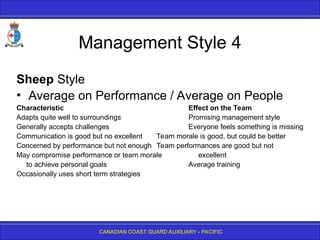
Management Style 4
Sheep Style
• Average on Performance / Average on People
Characteristic Effect on the Team
Adapts quite well to surroundings Promising management style
Generally accepts challenges Everyone feels something is missing
Communication is good but no excellent Team morale is good, but could be better
Concerned by performance but not enough Team performances are good but not
May compromise performance or team morale excellent
to achieve personal goals Average training
Occasionally uses short term strategies
CANADIAN COAST GUARD AUXILIARY - PACIFIC
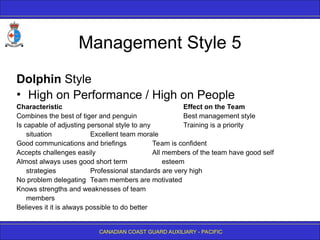
Management Style 5
Dolphin Style
• High on Performance / High on People
Characteristic Effect on the Team
Combines the best of tiger and penguin Best management style
Is capable of adjusting personal style to any Training is a priority
situation Excellent team morale
Good communications and briefings Team is confident
Accepts challenges easily All members of the team have good self
Almost always uses good short term esteem
strategies Professional standards are very high
No problem delegating Team members are motivated
Knows strengths and weaknesses of team
members
Believes it it is always possible to do better
CANADIAN COAST GUARD AUXILIARY - PACIFIC
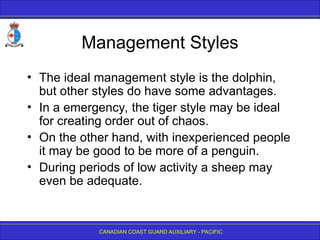
Management Styles
• The ideal management style is the dolphin,
but other styles do have some advantages.
• In a emergency, the tiger style may be ideal
for creating order out of chaos.
• On the other hand, with inexperienced people
it may be good to be more of a penguin.
• During periods of low activity a sheep may
even be adequate.
CANADIAN COAST GUARD AUXILIARY - PACIFIC
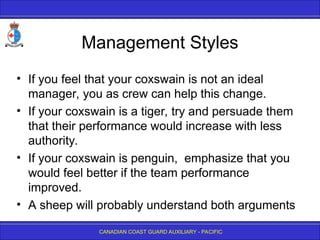
Management Styles
• If you feel that your coxswain is not an ideal
manager, you as crew can help this change.
• If your coxswain is a tiger, try and persuade them
that their performance would increase with less
authority.
• If your coxswain is penguin, emphasize that you
would feel better if the team performance
improved.
• A sheep will probably understand both arguments
CANADIAN COAST GUARD AUXILIARY - PACIFIC
Workload
CANADIAN COAST GUARD AUXILIARY - PACIFIC
Workload
• To be efficient, you need to control your
workload.
• If you get overloaded on a mission, you will
be under stress and then your work
performance will be adversely affected.
CANADIAN COAST GUARD AUXILIARY - PACIFIC
Workload
• Consequences of an overload situation:
1. duplication of effort, without being aware of it.
2. increase of errors.
3. increase in level of authority with increasing
workload.
4. tunnel vision, with individuals focusing on
important tasks and may miss important details.
5. Generalised bad mood and impatience.
CANADIAN COAST GUARD AUXILIARY - PACIFIC
Workload
6. lowered attention to tasks.
7. lowered attention to tasks.
8. delegation decreases as workload increases.
9. Short term strategies are neglected.
10.decrease in communications (no one has
time to talk).
CANADIAN COAST GUARD AUXILIARY - PACIFIC
Workload
Ways to lighten the workload:
1. Decrease the number of tasks to be
accomplished.
2. Decrease the weight of individual tasks.
3. Increase the time available for accomplishing
the tasks.
CANADIAN COAST GUARD AUXILIARY - PACIFIC
Decreasing Tasks
• The best way to reduce the number of tasks
is to delegate.
• When you delegate a task to crew, you can
both train, and you show that person that you
trust their abilities.
• However you should be careful as to how
much you delegate, so you don’t overload
someone less experienced.
CANADIAN COAST GUARD AUXILIARY - PACIFIC
Delegation
• Effective delegation includes:
1. Decide what tasks you can delegate.
2. Decide who is suited to performing those
tasks.
3. Plan your delegating strategy.
• To delegate you must know the skills of your
crew.
• Ideally those delegated tasks should become
opportunities for learning.
CANADIAN COAST GUARD AUXILIARY - PACIFIC
Delegation
• Choose the person for the task you wish to
delegate.
• Inform other team members that this task has
been delegated.
• Be prepared to give all necessary support to
the person who has taken on the delegated
task, but not too much so that they become
discouraged.
• Show appreciation
CANADIAN COAST GUARD AUXILIARY - PACIFIC
Delegation
• Show appreciation when someone does a
great job, by a reward or by giving more
responsibilities.
CANADIAN COAST GUARD AUXILIARY - PACIFIC
Combating Reasons Not to
Delegate
• “If you want something to be done properly,
do it yourself.”
• True - it takes time to learn a new job… but
you had to learn - remember?
CANADIAN COAST GUARD AUXILIARY - PACIFIC
Combating Reasons Not to
Delegate
• “By the time I showed him, I could have done
it twice....”
• Again speed with quality won’t come right
away.
CANADIAN COAST GUARD AUXILIARY - PACIFIC
Combating Reasons Not to
Delegate
• “I like doing this job, and I’m good at it, so
why should I delegate?”
• With practice, you will also get to like the job
of delegating.
• How did you learn to do this job?
CANADIAN COAST GUARD AUXILIARY - PACIFIC
Combating Reasons Not to
Delegate
• “What if he makes mistakes?”
• Sometime you need to let people make
mistakes. Mistakes are not usually critical.
CANADIAN COAST GUARD AUXILIARY - PACIFIC
Combating Reasons Not to
Delegate
• “I will lose control.”
• You will actually increase your control
because you will be able to get more done
within the same amount of time.
CANADIAN COAST GUARD AUXILIARY - PACIFIC
Decrease the Weight of Individual
Tasks
• The best way to achieve this is training, as
difficult tasks may become easier to perform.
• Checklists may be useful for tasks involving
many steps.
CANADIAN COAST GUARD AUXILIARY - PACIFIC
Increase Time Available for
Accomplishing the Tasks
• When you are on the vessel, the best way to
increase time is slow down.
• By reducing the number of tasks you directly
increase the time available for the other
tasks.
CANADIAN COAST GUARD AUXILIARY - PACIFIC
State of a Team
CANADIAN COAST GUARD AUXILIARY - PACIFIC
State of a Team
• If your team gets bored or inattentive,
performance will suffer markedly.
• Stress and Panic will affect your team the
same way.
CANADIAN COAST GUARD AUXILIARY - PACIFIC
State of a Team
• There are six states in which a team can find
itself:
1. Optimum state +1
2. Concerned state +2
3. Alarmed state +3
4. Bored state -1
5. Inattentive state -2
6. Inattentive at a critical phase-3
CANADIAN COAST GUARD AUXILIARY - PACIFIC
State of a Team
• In emergency situations, the state of your team
might have a tendency to rise.
• You need to try to keep your team in a +1
state, by using techniques previously
described
• Use short term strategies, make time, ensure
good communications and use briefings.
• These measures may help you to relieve
pressure.
CANADIAN COAST GUARD AUXILIARY - PACIFIC
State of a Team
1. Optimum state
In this state your workload and stress are
appropriate. You do not have to fight to stay
awake. You are motivated and efficient.
2. Concerned state
Both your workload and stress levels are going
up. You are starting to wonder whether you
can do everything in a timely manner. Your
worries begin to affect your productivity.
CANADIAN COAST GUARD AUXILIARY - PACIFIC
State of a Team
3. Alarmed state
You are overloaded. There is no doubt that you
cannot complete everything on time, and you
are looking for ways to rectify this.
It is hard to think about all this while you still
have to work.
You need to concentrate to control your
extreme stress level and panic
CANADIAN COAST GUARD AUXILIARY - PACIFIC
State of a Team
4. Bored state
Workload is low and you have nothing to do.
Things have been this way for a while, and your
level of attention and motivation is getting
quite low.
Fatigue begins to take its toll.
CANADIAN COAST GUARD AUXILIARY - PACIFIC
State of a Team
5. Inattentive state
This is where boredom and carelessness combine
to produce a dangerous mix.
You are making mistakes and really feel the
necessity to correct them.
If you don’t do something quickly, the next
mistake could lead you into a critical situation
What is worse you may not even notice that you
are in trouble.
CANADIAN COAST GUARD AUXILIARY - PACIFIC
State of a Team
6. Inattentive at a Critical Phase
You are now in trouble and you don’t know it.
Eventually you will wake up and understand
what is going on, and if you are lucky there
will be time to do something.
If you are not, you will have to face the
consequences of your lack of attention.
Usually there will be a period of confusion.
CANADIAN COAST GUARD AUXILIARY - PACIFIC
Judgement and Decision Making
CANADIAN COAST GUARD AUXILIARY - PACIFIC
Judgement and Decision Making
To develop judgement, you need a good decision
making process.
1. Vigilance
This be aware that things may not go as planned.
Vigilance therefore can minimize the risk of
being caught unaware.
2. Problem discovery
This needs to be dome quickly otherwise there
may be no chance to use judgement.
CANADIAN COAST GUARD AUXILIARY - PACIFIC
Judgement and Decision Making
3. Problem diagnosis
On discovery, understanding how and why the
problem happened.
4. Alternative generation
Find a solution, and solution is good. Find as many
solutions as possible.
5. Risk analysis
Analyze the risk associated with each solution and
pick the best.
CANADIAN COAST GUARD AUXILIARY - PACIFIC
Judgement and Decision Making
6. External influences
When choosing a solution, you are likely to be
influenced by external factors. These
influences may push you toward a less than
ideal solution.
CANADIAN COAST GUARD AUXILIARY - PACIFIC
Judgement and Decision Making
These external factors may include:
1. Economic factors (e.g. it’s too expensive)
2. Responsibilities (e.g. I promised.. I have
to..)
3. Peer pressures (e.g. everybody is doing
it… I have to be like the others…)
4. Physical status (e.g. fatigue, illness… )
CANADIAN COAST GUARD AUXILIARY - PACIFIC
Judgement and Decision Making
5. General attitude
These can seriously affect a person’s
judgement, and some are considered
dangerous:
a. anti-authority (e.g. Don’t tell me what to do …
I don’t have to follow the rules… )
b. impulsiveness (e.g. Do something …QUICK!)
c. invulnerability (e.g. It won’t happen to me)
CANADIAN COAST GUARD AUXILIARY - PACIFIC
Judgement and Decision Making
5. General attitude
d. excess confidence (e.g. I can easily do it!)
e. resignation (e.g. What’s the point… it won’t
change anything..)
f. narrow mindedness (e.g. I’ve been doing
things this way for the past 3 years and I’m not
about to change.)
g. lack of initiative (e.g. It’s not my job to so
this.”
CANADIAN COAST GUARD AUXILIARY - PACIFIC
Judgement and Decision Making
5. General attitude
h. laziness (e.g. That should be enough…
Nobody will notice… )
CANADIAN COAST GUARD AUXILIARY - PACIFIC
Judgement and Decision Making
6. Hidden pressures
These are simply pressures that you are not
aware of, from past experiences, fears and
beliefs.
You need to identify hidden pressures, and a
good way of doing this, is to ask
yourself,”Why am I doing this?”
CANADIAN COAST GUARD AUXILIARY - PACIFIC
Judgement and Decision Making
7. Decision
You have decided what is the best solution and
you are ready to act. Conduct a briefing.
8. Action
Translate plans into actions.
9. Monitoring
Monitor the effectiveness of the solution, and
apply any corrective measures if necessary.
CANADIAN COAST GUARD AUXILIARY - PACIFIC
Image and Attitude
CANADIAN COAST GUARD AUXILIARY - PACIFIC
Image and Attitude
The image you project and attitude you have
when doing search and rescue can have a
profound impact on the efficacy and safety of
your unit.
How you present yourself with appearance and
actions to others around you is important.
CANADIAN COAST GUARD AUXILIARY - PACIFIC
Heroism: A Dangerous Attitude
A heroic attitude is not needed in a rescue
situation, and is no help to anyone.
Anyone willing to risk their life on a SAR
mission should stay home, as the last thing a
SAR team needs is the risk of another victim
on its hands.
CANADIAN COAST GUARD AUXILIARY - PACIFIC
Professionalism
The strangers who you go out and assist, need
to feel that they can put their trust in you.
Therefore you need to act and look like a
professional. Part of that is your image.
Professional: If something that someone does is
professional, it is done well, and is of a very
high standard.
CANADIAN COAST GUARD AUXILIARY - PACIFIC
Professionalism
To be professional you need to have the skills
that are necessary to translate the knowledge
into action.
CANADIAN COAST GUARD AUXILIARY - PACIFIC
Professionalism
People involved in SAR must work with:
• Other people (crew, RCC coordinators, etc)
• Boats and outfit (engines, GPS, radios, etc)
• Equipment (SAR equipment)
• Aids to navigation, charts etc.
• People requiring assistance or in distress
CANADIAN COAST GUARD AUXILIARY - PACIFIC
Professionalism
As a result SAR personnel need to:
• work in teams
• use the available equipment
• navigate
• provide first aid
• perform related tasks
CANADIAN COAST GUARD AUXILIARY - PACIFIC
Professionalism
To identify skills, a list of the situations that may be
encountered by SAR personnel is the most
appropriate tool. These will include:
• cold water, rain, fog, winds
• currents, shallow water, deep water, heavy seas,
waves
• fire and explosions
• lack of sleep / fatigue, stress
• hypothermia
CANADIAN COAST GUARD AUXILIARY - PACIFIC
Professionalism
SAR personnel must be skilled enough to
handle combination of the above items, such
as:
Vessel in fog, strong currents, and provide
skilled first aid when under stress.
CANADIAN COAST GUARD AUXILIARY - PACIFIC
Professionalism
There are many ways of acquiring knowledge.
• Experienced personnel can pass on their
knowledge.
• Taking courses, station training.
Skills are usually acquired through practice.
People who practice a lot will usually be more
more skilled.
Reading will provide the knowledge, but practice
will forge the skill.
CANADIAN COAST GUARD AUXILIARY - PACIFIC
Acting in a Professional Manner
• Skill and knowledge cannot be readily
assessed by an observer.
• Evaluating level of knowledge and skill
usually requires observing someone for a
while.
• This cannot assessed on first impression.
CANADIAN COAST GUARD AUXILIARY - PACIFIC
Acting in a Professional Manner
• No matter how knowledgable, skilled and
experienced a crew may be, if image and
attitude are no professional, the first
impression will be bad
CANADIAN COAST GUARD AUXILIARY - PACIFIC
Image
• The image of the SAR crew and vessel will
have a profound impact on first impression.
CANADIAN COAST GUARD AUXILIARY - PACIFIC
Image
Person and Clothing
• Any stains
• Appropriate? (no swimsuits)
• Properly worn (avoid unbuttoned shirts etc)
• Personal grooming
CANADIAN COAST GUARD AUXILIARY - PACIFIC
Image
Vessel
• Is it clean?
• Is it in good repair?
• Is it properly maintained?
Equipment
• Is it properly stowed?
• Is it in good condition and reliable?
CANADIAN COAST GUARD AUXILIARY - PACIFIC
Crew Attitude
The attitude of a SAR crew in how they act or
respond is as important as their image
• Be polite and treat people with respect
• Be positive - smile
• Stay calm and look confident
• Be careful with gestures, stand straight, look
people in the eye, and avoid using sunglasses
when talking to them.
• Treat others as equals
CANADIAN COAST GUARD AUXILIARY - PACIFIC
Knowledge and Skills
Your knowledge level will be revealed by the
way you answer questions.
Your skill level will be revealed by the way you
carry out the various evolutions when you
and your crew go into action.
People will judge your competency based on
their own level of knowledge and skills.
CANADIAN COAST GUARD AUXILIARY - PACIFIC
Vessel Operation
The way the vessel is operated out on the water
whether on a mission or during training will
reflect on the public’s view of the auxiliary.
If you navigate in a reckless manner, all your
efforts trying to be professional are wasted.
CANADIAN COAST GUARD AUXILIARY - PACIFIC
Vessel Operation
Navigating in a professional manner means:
• Observing the collision and other regulations
• Avoiding passing to close to other vessels
• Manoeuvring in a way that will clearly show
your intentions
• Avoiding riding the wake of other vessels and
intentionally jumping waves
• Manoeuvring at a safe and reasonable speed
• Showing courtesy
CANADIAN COAST GUARD AUXILIARY - PACIFIC
Vessel Operation
Courtesy should be shown to other people on the
water by:
• Slowing down when passing close to other
vessels
• Manoeuvring at slow speed in marina or near
docks
• Avoiding excessive noise in marinas at night
• Do not overtake less manoeuvrable vessels in
narrow areas
CANADIAN COAST GUARD AUXILIARY - PACIFIC
Critical-Incident Stress
Management
CANADIAN COAST GUARD AUXILIARY - PACIFIC
Critical-Incident Stress
Management
Critical Incident Stress can result from SAR
personnel’s exposure to extremely difficult
situations.
Pacific region has a counseling service to our
SAR crews who are exposed to critical
incidents.
This will normally be activated by Joint Rescue
Coordination Centre.
CANADIAN COAST GUARD AUXILIARY - PACIFIC
Critical-Incident Stress
This is the reaction of a human being to a critical
incident. These can include:
• death or severe injury
• suicide or sudden death of a co-worker
• multiple casualty incidents
• incidents where victims seriously injured
• prolonged rescue or recovery operation,
especially involving children or where the victim
is known to the rescuer
CANADIAN COAST GUARD AUXILIARY - PACIFIC
Critical-Incident Stress
• situations with intense media coverage and
scrutiny
• situations of violence in the workplace
CANADIAN COAST GUARD AUXILIARY - PACIFIC
Critical-Incident Stress
The following situations are specific to maritime
SAR operations:
• recovery of bodies
• witness of a suicide
• operating in full view of public and/ or media
• failing to succeed in a rescue attempt
• failing at CPR in a case where the victim still
had vital signs when recovered.
CANADIAN COAST GUARD AUXILIARY - PACIFIC
Critical-Incident Stress
Other situations can be stressful:
• exposure for long periods to the mtion of a
rescue vessel in violent weather
• failing to assist in cases of damage or
property loss
• being unfairly criticized for response to an
incident.
CANADIAN COAST GUARD AUXILIARY - PACIFIC
Reacting According to
Experience
Individuals will react according their own
experiences, age.
Younger crew members can forget that loss of
life may occur in SAR operations.
A short debriefing is a good way of reducing or
avoiding stress.
CANADIAN COAST GUARD AUXILIARY - PACIFIC
Reacting According to
Experience
An affirmative answer to any of the following
questions after a critical incident may indicate
that the job related stress has reached a danger
point and a debriefing is needed:
1. Do I have trouble putting the incident out of my
mind?
2. Do I experience persistent, jittery feelings?
3. Am I forgetful, short tempered or fearful?
CANADIAN COAST GUARD AUXILIARY - PACIFIC
Reacting According to
Experience
4. Do I have nightmares, sleep disturbances, or a
preoccupation with death?
5. Am I withdrawn from friends or family and less
interested in sex or other activities that I used
to find enjoyable?
6. Do I find myself drinking too much or
depending on drugs to calm my nerves, or get
me through the day?
7. Am I simply feeling out of sorts?
CANADIAN COAST GUARD AUXILIARY - PACIFIC
Countering the Effects of Stress
Many things can be done to counter the effects
of stress:
1. Rest
2. Rotate jobs on board
3. Keep everyone informed and updated
frequently
4. Avoid excessive coffee and sugar, since both
tend to increase stress reactions in the body
CANADIAN COAST GUARD AUXILIARY - PACIFIC
Countering the Effects of Stress
5. Cover bodies
Refusing to recognise a stressful situation may
have a serious impact on you and your
colleagues.
The coxswain must create a climate of open
discussion where feelings and reactions can be
expressed.
It is a weakness to deny the problem exists.
CANADIAN COAST GUARD AUXILIARY - PACIFIC
This is an extract from the CCG SAR
Seamanship Reference Manual

Workplaces Ethics_CCGA_Human_Factors.ppt

  • 1.
    CANADIAN COAST GUARDAUXILIARY - PACIFIC HUMAN FACTORS CANADIAN COAST GUARD AUXILIARY - PACIFIC
  • 2.
    CANADIAN COAST GUARDAUXILIARY - PACIFIC Why Human Factors? • Since search and rescue units often have to perform their duties in adverse conditions, mishaps or errors are bound to happen. • These errors can sometimes have disastrous consequences. • Technical errors have been shown to be involved in less than 25% of accidents.
  • 3.
    CANADIAN COAST GUARDAUXILIARY - PACIFIC Human Error • In search and rescue terms this is when the wrong action or bad decision is not discovered and is uncorrected. • Inaction and indecision can also become human errors.
  • 4.
    CANADIAN COAST GUARDAUXILIARY - PACIFIC Profile of a Good SAR Team
  • 5.
    CANADIAN COAST GUARDAUXILIARY - PACIFIC Profile of a Good SAR Team Individuals that are good at teamwork: 1. Communicate clearly and precisely 2. Accept challenges and know how to respond to them 3. Use appropriate short term strategies 4. Have the right balance between authority and assertiveness 5. Know how to control their workload
  • 6.
    CANADIAN COAST GUARDAUXILIARY - PACIFIC Profile of a Good SAR Team 6. Manage to find a balance between performance and people orientated styles 7. Can maintain an adequate level of alertness 8. Have sound judgement and, usually, good decision-making skills
  • 7.
    CANADIAN COAST GUARDAUXILIARY - PACIFIC Communication
  • 8.
    CANADIAN COAST GUARDAUXILIARY - PACIFIC Communication • This is a key factor, since misunderstandings are so common. • What may be a clear message transmitted by the one end, is not what is heard by the receivers. • Sometimes what is heard, is not what was said.
  • 9.
    CANADIAN COAST GUARDAUXILIARY - PACIFIC Communication • Communication has to be “open” in that everyone’s opinions are welcome. • They also need to be “interactive” which means everyone is participating in the communication process.
  • 10.
    CANADIAN COAST GUARDAUXILIARY - PACIFIC Communication • The next step is “closed loop communication”. 1. The sender sends the message. 2. The recipient acknowledges by repeating all the important information. 3. Finally the sender confirms the accuracy of what the recipient said.
  • 11.
    CANADIAN COAST GUARDAUXILIARY - PACIFIC Briefing
  • 12.
    CANADIAN COAST GUARDAUXILIARY - PACIFIC Briefing • Briefings can minimize the risk of confusion and should be used when planning anything requiring active participation by another member of the team • The rules for briefing are: 1. Make the time 2. Be open and friendly 3. Anyone can conduct the briefing 4. The briefing must be interactive
  • 13.
    CANADIAN COAST GUARDAUXILIARY - PACIFIC Briefing 5. Define responsibilities 6. Use closed loop communications 7. Keep focused 8. Ensure that no question remains unanswered
  • 14.
    CANADIAN COAST GUARDAUXILIARY - PACIFIC De-briefing
  • 15.
    CANADIAN COAST GUARDAUXILIARY - PACIFIC Debriefings • A debriefing should conducted as soon after a mission as possible 1. The coxswain should conduct the debriefing and should indicate his mistakes first 2. Everybody should remain objective 3. Evaluate positive and negative aspects of your performance 4. Try to learn from your mistakes
  • 16.
    CANADIAN COAST GUARDAUXILIARY - PACIFIC Debriefings 5. Avoid finger-pointing. Talk about team performance 6. Keep the briefing interesting 7. Prepare plans for the next time you encounter a situation like this one 8. Keep a cordial, informal atmosphere
  • 17.
    CANADIAN COAST GUARDAUXILIARY - PACIFIC Challenge and Response
  • 18.
    CANADIAN COAST GUARDAUXILIARY - PACIFIC Challenge and Response • People who challenge can be seen as a problem in a team. • However some challenges can be useful, and it has been shown that a lack of challenges is involved in more than 30% of marine accidents.
  • 19.
    CANADIAN COAST GUARDAUXILIARY - PACIFIC Steps in a Challenge • Challenging a concept usually involves the following steps: 1. A concept is stated and limits are set 2. The situation progresses and moves outside the limits that were set 3. A challenge is issued 4. A proper response is formulated
  • 20.
    CANADIAN COAST GUARDAUXILIARY - PACIFIC Example of a Challenge Coxswain: “We will turn to port at the fourth red buoy.” Crew “Port at the fourth red buoy.” Coxswain “ That’s right!” Coxswain “OK - let’s turn to port now.” Crew “But … don’t we have to another buoy to pass before we turn?!” Coxswain “Oops, you’re right. One more buoy.”
  • 21.
    CANADIAN COAST GUARDAUXILIARY - PACIFIC Example of a Challenge Another example of where a challenge would be if your depth sounder showed 2 metres and the plotter showed 20 metres.
  • 22.
    CANADIAN COAST GUARDAUXILIARY - PACIFIC Taking Advantage of Challenges • Challenges should be allowed and welcomed in a team. • Always challenge when you feel you are moving outside the original concept. • Be diplomatic when you formulate a challenge.
  • 23.
    CANADIAN COAST GUARDAUXILIARY - PACIFIC Answering Challenges • Always check the validity of the challenge. Use a third source of information if necessary. • Be cautious, especially in emergency situations. The challenge may be valid. • Be diplomatic when you formulate a response to a challenge. Never laugh at or belittle or get angry with someone who has issued an invalid challenge - if you do so, the person may no longer challenge when you need it.
  • 24.
    CANADIAN COAST GUARDAUXILIARY - PACIFIC Obstacles to Challenges The challenger: • is a quiet person or lacks confidence • is not assertive. • puts the coxswain on a pedestal • does not understand something. • does not like responsibilities. • is involved with interpersonal conflicts. • has had bad experiences with inappropriate responses to previous challenges.
  • 25.
    CANADIAN COAST GUARDAUXILIARY - PACIFIC Obstacles to Challenges The receiver: • feels that their authority is threatened by challenges. • lacks confidence. • responds emotionally • has poor communication skills. • has poor management skills.
  • 26.
    CANADIAN COAST GUARDAUXILIARY - PACIFIC Short Term Strategies
  • 27.
    CANADIAN COAST GUARDAUXILIARY - PACIFIC Short Term Strategies • Short term strategies are defined as plans that are developed to solve a particular problem, • They should be used where time permits to solve any problem that is not covered by standard operating procedures.
  • 28.
    CANADIAN COAST GUARDAUXILIARY - PACIFIC Short Term Strategies • They require: 1. Identify the problem. 2. Develop plans to deal with the problem. 3. Check the plans with the team in a briefing. 4. Explain the plan and get commitment. 5. Monitor the correct use of the plan. 6. Modify the plan if the conditions change or further information becomes available.
  • 29.
    CANADIAN COAST GUARDAUXILIARY - PACIFIC Authority and Assertiveness
  • 30.
    CANADIAN COAST GUARDAUXILIARY - PACIFIC Authority and Assertiveness • The right level of authority needs to be found for each team. • To much authority can be a too little. • There two kinds of authority 1. Formal authority - coxswain or captain’ s authority 2. Personal authority - is that which makes people to listen to one’s suggestions - wisdom, professionalism, integrity, honesty and diplomacy
  • 31.
    CANADIAN COAST GUARDAUXILIARY - PACIFIC Authority and Assertiveness • Using formal authority to command attention should be avoided • Assertiveness - someone who is assertive is able to voice their concerns. Too much or too little assertiveness can be bad.
  • 32.
    CANADIAN COAST GUARDAUXILIARY - PACIFIC Authority and Assertiveness 1 Situation: Coxswain with strong authority and crew with weak assertiveness. • The strong authority of the coxswain will intimidate the crew. • This is a one person team.
  • 33.
    CANADIAN COAST GUARDAUXILIARY - PACIFIC Authority and Assertiveness 1 Coxswain: “Let’s go this way and take a shortcut” Crew “”But…” to express concern regarding shallow depth in this area. Coxswain: “I said we are going this way. What’s your problem?” Crew: “Nothing … sorry.”
  • 34.
    CANADIAN COAST GUARDAUXILIARY - PACIFIC Authority and Assertiveness 2 Situation: Coxswain with weak authority and crew with strong assertiveness. • This is probably the least dangerous of the four situations where the strong assertiveness of the crew compensates for the coxswain’s lack of authority.
  • 35.
    CANADIAN COAST GUARDAUXILIARY - PACIFIC Authority and Assertiveness 2 Coxswain: “You are leaving the channel if you go this way.” Crew “It doesn’t matter…. The water is deep enough.” Coxswain: “But … I would prefer if we could remain in the channel…” Crew: “I said it’s deep enough. It’s not the first time I’ve been this way.” Coxswain: “OK, OK, if you are so sure…”
  • 36.
    CANADIAN COAST GUARDAUXILIARY - PACIFIC Authority and Assertiveness 3 Situation: Coxswain with strong authority and crew with strong assertiveness. • This can cause serious conflicts amongst the team. • The coxswain and crew will argue constantly. • The coxswain may have to use his formal authority to end the altercation. • This situation is dangerous and stressful.
  • 37.
    CANADIAN COAST GUARDAUXILIARY - PACIFIC Authority and Assertiveness 3 Coxswain: “You are leaving the channel if you go this way.” Crew “It doesn’t matter.The water is deep enough.” Coxswain: “I don’t want you to leave the channel - is that clear?” Crew: “Read my lips: IT IS DEEP ENOUGH FOR US TO GO IN THERE.” Coxswain: “I am in command here, so do as I say.”
  • 38.
    CANADIAN COAST GUARDAUXILIARY - PACIFIC Authority and Assertiveness 4 Situation: Coxswain with weak authority and crew with weak assertiveness. • This is the probably the most dangerous situation, as no one is willing to take the necessary decisions or actions.
  • 39.
    CANADIAN COAST GUARDAUXILIARY - PACIFIC Authority and Assertiveness Coxswain: “I’m not sure, but I think we just left the channel.” Crew “Should I slow down?” Coxswain: “I don’t know… Wait… I can’t find our position…” Crew: “You got it?” Coxswain: “Not yet .. Let’s wait a bit .. We should see something that will help us.” Crew: “OK,…”
  • 40.
    CANADIAN COAST GUARDAUXILIARY - PACIFIC CRUNCH! The boat runs up on a submerged rock and is damaged
  • 41.
    CANADIAN COAST GUARDAUXILIARY - PACIFIC Authority and Assertiveness • None of the 4 situations are ideal, so be vigilant for the situation forming. • If you want someone to become assertive, the appropriate working environment needs to be created - it may be necessary to lower the level of authority. • If you want someone to be less assertive, you may want to increase authority (increasing personal authority is better than formal authority).
  • 42.
    CANADIAN COAST GUARDAUXILIARY - PACIFIC Management Styles
  • 43.
    CANADIAN COAST GUARDAUXILIARY - PACIFIC Management Styles • The management style of the coxswain can have a profound effect on the behaviour , performance and well being of a team. • The following approach to analyzing this is based on performance and people
  • 44.
    CANADIAN COAST GUARDAUXILIARY - PACIFIC Management Style 1 Tiger Style • High on Performance / Low on People Characteristic Effect on the Team Believes in performance Silent team low level of communication Often has too much authority Low assertiveness of team members Has a high opinion of themselves No challenges Does not care about what others may think Performance may decline Does not care about teamwork Team morale may get low Great leader in crisis Team members will not take many Takes full responsibility for their decisions initiatives Is loyal to the team Does not like challenges May have a tendency to do or control everything Does not delegate easily
  • 45.
    CANADIAN COAST GUARDAUXILIARY - PACIFIC Management Style 2 Penguin Style • Low on Performance / High on People Characteristic Effect on the Team Is a good listener Friendly and calm working atmosphere Forgives easily, probably to avoid conflicts General lowering of professional standards Is always positive, even when results are False feeling of adequacy on the team unsatisfactory, and learning opportunities are lost because of this lack of objectivity Believe that people are more important than Team members that are high on performance. If people are well treated, performance might get annoyed they will necessarily do a good job. Little training is done with the team Like to talk with everybody; has a tendency Leader does not command respect to accept lower professional standards so because of inability to provide objective that everybody can do well and constructive feedback
  • 46.
    CANADIAN COAST GUARDAUXILIARY - PACIFIC Management Style 3 Snail Style • Low on Performance / Low on People Characteristic Effect on the Team Serious lack of motivation All effects are negative Is not really interested in their job Worst management style Has a tendency to to do the minimum Low team morale Avoids conflicts Professional standards can get dangerously Has a low opinion of their own capabilities low and those of the team Very little training is done Has low professional standards, both personally and for the team Poor communicator and weak authority Does not use short term strategies Can often hide personal ineptitude by avoiding risks
  • 47.
    CANADIAN COAST GUARDAUXILIARY - PACIFIC Management Style 4 Sheep Style • Average on Performance / Average on People Characteristic Effect on the Team Adapts quite well to surroundings Promising management style Generally accepts challenges Everyone feels something is missing Communication is good but no excellent Team morale is good, but could be better Concerned by performance but not enough Team performances are good but not May compromise performance or team morale excellent to achieve personal goals Average training Occasionally uses short term strategies
  • 48.
    CANADIAN COAST GUARDAUXILIARY - PACIFIC Management Style 5 Dolphin Style • High on Performance / High on People Characteristic Effect on the Team Combines the best of tiger and penguin Best management style Is capable of adjusting personal style to any Training is a priority situation Excellent team morale Good communications and briefings Team is confident Accepts challenges easily All members of the team have good self Almost always uses good short term esteem strategies Professional standards are very high No problem delegating Team members are motivated Knows strengths and weaknesses of team members Believes it it is always possible to do better
  • 49.
    CANADIAN COAST GUARDAUXILIARY - PACIFIC Management Styles • The ideal management style is the dolphin, but other styles do have some advantages. • In a emergency, the tiger style may be ideal for creating order out of chaos. • On the other hand, with inexperienced people it may be good to be more of a penguin. • During periods of low activity a sheep may even be adequate.
  • 50.
    CANADIAN COAST GUARDAUXILIARY - PACIFIC Management Styles • If you feel that your coxswain is not an ideal manager, you as crew can help this change. • If your coxswain is a tiger, try and persuade them that their performance would increase with less authority. • If your coxswain is penguin, emphasize that you would feel better if the team performance improved. • A sheep will probably understand both arguments
  • 51.
    CANADIAN COAST GUARDAUXILIARY - PACIFIC Workload
  • 52.
    CANADIAN COAST GUARDAUXILIARY - PACIFIC Workload • To be efficient, you need to control your workload. • If you get overloaded on a mission, you will be under stress and then your work performance will be adversely affected.
  • 53.
    CANADIAN COAST GUARDAUXILIARY - PACIFIC Workload • Consequences of an overload situation: 1. duplication of effort, without being aware of it. 2. increase of errors. 3. increase in level of authority with increasing workload. 4. tunnel vision, with individuals focusing on important tasks and may miss important details. 5. Generalised bad mood and impatience.
  • 54.
    CANADIAN COAST GUARDAUXILIARY - PACIFIC Workload 6. lowered attention to tasks. 7. lowered attention to tasks. 8. delegation decreases as workload increases. 9. Short term strategies are neglected. 10.decrease in communications (no one has time to talk).
  • 55.
    CANADIAN COAST GUARDAUXILIARY - PACIFIC Workload Ways to lighten the workload: 1. Decrease the number of tasks to be accomplished. 2. Decrease the weight of individual tasks. 3. Increase the time available for accomplishing the tasks.
  • 56.
    CANADIAN COAST GUARDAUXILIARY - PACIFIC Decreasing Tasks • The best way to reduce the number of tasks is to delegate. • When you delegate a task to crew, you can both train, and you show that person that you trust their abilities. • However you should be careful as to how much you delegate, so you don’t overload someone less experienced.
  • 57.
    CANADIAN COAST GUARDAUXILIARY - PACIFIC Delegation • Effective delegation includes: 1. Decide what tasks you can delegate. 2. Decide who is suited to performing those tasks. 3. Plan your delegating strategy. • To delegate you must know the skills of your crew. • Ideally those delegated tasks should become opportunities for learning.
  • 58.
    CANADIAN COAST GUARDAUXILIARY - PACIFIC Delegation • Choose the person for the task you wish to delegate. • Inform other team members that this task has been delegated. • Be prepared to give all necessary support to the person who has taken on the delegated task, but not too much so that they become discouraged. • Show appreciation
  • 59.
    CANADIAN COAST GUARDAUXILIARY - PACIFIC Delegation • Show appreciation when someone does a great job, by a reward or by giving more responsibilities.
  • 60.
    CANADIAN COAST GUARDAUXILIARY - PACIFIC Combating Reasons Not to Delegate • “If you want something to be done properly, do it yourself.” • True - it takes time to learn a new job… but you had to learn - remember?
  • 61.
    CANADIAN COAST GUARDAUXILIARY - PACIFIC Combating Reasons Not to Delegate • “By the time I showed him, I could have done it twice....” • Again speed with quality won’t come right away.
  • 62.
    CANADIAN COAST GUARDAUXILIARY - PACIFIC Combating Reasons Not to Delegate • “I like doing this job, and I’m good at it, so why should I delegate?” • With practice, you will also get to like the job of delegating. • How did you learn to do this job?
  • 63.
    CANADIAN COAST GUARDAUXILIARY - PACIFIC Combating Reasons Not to Delegate • “What if he makes mistakes?” • Sometime you need to let people make mistakes. Mistakes are not usually critical.
  • 64.
    CANADIAN COAST GUARDAUXILIARY - PACIFIC Combating Reasons Not to Delegate • “I will lose control.” • You will actually increase your control because you will be able to get more done within the same amount of time.
  • 65.
    CANADIAN COAST GUARDAUXILIARY - PACIFIC Decrease the Weight of Individual Tasks • The best way to achieve this is training, as difficult tasks may become easier to perform. • Checklists may be useful for tasks involving many steps.
  • 66.
    CANADIAN COAST GUARDAUXILIARY - PACIFIC Increase Time Available for Accomplishing the Tasks • When you are on the vessel, the best way to increase time is slow down. • By reducing the number of tasks you directly increase the time available for the other tasks.
  • 67.
    CANADIAN COAST GUARDAUXILIARY - PACIFIC State of a Team
  • 68.
    CANADIAN COAST GUARDAUXILIARY - PACIFIC State of a Team • If your team gets bored or inattentive, performance will suffer markedly. • Stress and Panic will affect your team the same way.
  • 69.
    CANADIAN COAST GUARDAUXILIARY - PACIFIC State of a Team • There are six states in which a team can find itself: 1. Optimum state +1 2. Concerned state +2 3. Alarmed state +3 4. Bored state -1 5. Inattentive state -2 6. Inattentive at a critical phase-3
  • 70.
    CANADIAN COAST GUARDAUXILIARY - PACIFIC State of a Team • In emergency situations, the state of your team might have a tendency to rise. • You need to try to keep your team in a +1 state, by using techniques previously described • Use short term strategies, make time, ensure good communications and use briefings. • These measures may help you to relieve pressure.
  • 71.
    CANADIAN COAST GUARDAUXILIARY - PACIFIC State of a Team 1. Optimum state In this state your workload and stress are appropriate. You do not have to fight to stay awake. You are motivated and efficient. 2. Concerned state Both your workload and stress levels are going up. You are starting to wonder whether you can do everything in a timely manner. Your worries begin to affect your productivity.
  • 72.
    CANADIAN COAST GUARDAUXILIARY - PACIFIC State of a Team 3. Alarmed state You are overloaded. There is no doubt that you cannot complete everything on time, and you are looking for ways to rectify this. It is hard to think about all this while you still have to work. You need to concentrate to control your extreme stress level and panic
  • 73.
    CANADIAN COAST GUARDAUXILIARY - PACIFIC State of a Team 4. Bored state Workload is low and you have nothing to do. Things have been this way for a while, and your level of attention and motivation is getting quite low. Fatigue begins to take its toll.
  • 74.
    CANADIAN COAST GUARDAUXILIARY - PACIFIC State of a Team 5. Inattentive state This is where boredom and carelessness combine to produce a dangerous mix. You are making mistakes and really feel the necessity to correct them. If you don’t do something quickly, the next mistake could lead you into a critical situation What is worse you may not even notice that you are in trouble.
  • 75.
    CANADIAN COAST GUARDAUXILIARY - PACIFIC State of a Team 6. Inattentive at a Critical Phase You are now in trouble and you don’t know it. Eventually you will wake up and understand what is going on, and if you are lucky there will be time to do something. If you are not, you will have to face the consequences of your lack of attention. Usually there will be a period of confusion.
  • 76.
    CANADIAN COAST GUARDAUXILIARY - PACIFIC Judgement and Decision Making
  • 77.
    CANADIAN COAST GUARDAUXILIARY - PACIFIC Judgement and Decision Making To develop judgement, you need a good decision making process. 1. Vigilance This be aware that things may not go as planned. Vigilance therefore can minimize the risk of being caught unaware. 2. Problem discovery This needs to be dome quickly otherwise there may be no chance to use judgement.
  • 78.
    CANADIAN COAST GUARDAUXILIARY - PACIFIC Judgement and Decision Making 3. Problem diagnosis On discovery, understanding how and why the problem happened. 4. Alternative generation Find a solution, and solution is good. Find as many solutions as possible. 5. Risk analysis Analyze the risk associated with each solution and pick the best.
  • 79.
    CANADIAN COAST GUARDAUXILIARY - PACIFIC Judgement and Decision Making 6. External influences When choosing a solution, you are likely to be influenced by external factors. These influences may push you toward a less than ideal solution.
  • 80.
    CANADIAN COAST GUARDAUXILIARY - PACIFIC Judgement and Decision Making These external factors may include: 1. Economic factors (e.g. it’s too expensive) 2. Responsibilities (e.g. I promised.. I have to..) 3. Peer pressures (e.g. everybody is doing it… I have to be like the others…) 4. Physical status (e.g. fatigue, illness… )
  • 81.
    CANADIAN COAST GUARDAUXILIARY - PACIFIC Judgement and Decision Making 5. General attitude These can seriously affect a person’s judgement, and some are considered dangerous: a. anti-authority (e.g. Don’t tell me what to do … I don’t have to follow the rules… ) b. impulsiveness (e.g. Do something …QUICK!) c. invulnerability (e.g. It won’t happen to me)
  • 82.
    CANADIAN COAST GUARDAUXILIARY - PACIFIC Judgement and Decision Making 5. General attitude d. excess confidence (e.g. I can easily do it!) e. resignation (e.g. What’s the point… it won’t change anything..) f. narrow mindedness (e.g. I’ve been doing things this way for the past 3 years and I’m not about to change.) g. lack of initiative (e.g. It’s not my job to so this.”
  • 83.
    CANADIAN COAST GUARDAUXILIARY - PACIFIC Judgement and Decision Making 5. General attitude h. laziness (e.g. That should be enough… Nobody will notice… )
  • 84.
    CANADIAN COAST GUARDAUXILIARY - PACIFIC Judgement and Decision Making 6. Hidden pressures These are simply pressures that you are not aware of, from past experiences, fears and beliefs. You need to identify hidden pressures, and a good way of doing this, is to ask yourself,”Why am I doing this?”
  • 85.
    CANADIAN COAST GUARDAUXILIARY - PACIFIC Judgement and Decision Making 7. Decision You have decided what is the best solution and you are ready to act. Conduct a briefing. 8. Action Translate plans into actions. 9. Monitoring Monitor the effectiveness of the solution, and apply any corrective measures if necessary.
  • 86.
    CANADIAN COAST GUARDAUXILIARY - PACIFIC Image and Attitude
  • 87.
    CANADIAN COAST GUARDAUXILIARY - PACIFIC Image and Attitude The image you project and attitude you have when doing search and rescue can have a profound impact on the efficacy and safety of your unit. How you present yourself with appearance and actions to others around you is important.
  • 88.
    CANADIAN COAST GUARDAUXILIARY - PACIFIC Heroism: A Dangerous Attitude A heroic attitude is not needed in a rescue situation, and is no help to anyone. Anyone willing to risk their life on a SAR mission should stay home, as the last thing a SAR team needs is the risk of another victim on its hands.
  • 89.
    CANADIAN COAST GUARDAUXILIARY - PACIFIC Professionalism The strangers who you go out and assist, need to feel that they can put their trust in you. Therefore you need to act and look like a professional. Part of that is your image. Professional: If something that someone does is professional, it is done well, and is of a very high standard.
  • 90.
    CANADIAN COAST GUARDAUXILIARY - PACIFIC Professionalism To be professional you need to have the skills that are necessary to translate the knowledge into action.
  • 91.
    CANADIAN COAST GUARDAUXILIARY - PACIFIC Professionalism People involved in SAR must work with: • Other people (crew, RCC coordinators, etc) • Boats and outfit (engines, GPS, radios, etc) • Equipment (SAR equipment) • Aids to navigation, charts etc. • People requiring assistance or in distress
  • 92.
    CANADIAN COAST GUARDAUXILIARY - PACIFIC Professionalism As a result SAR personnel need to: • work in teams • use the available equipment • navigate • provide first aid • perform related tasks
  • 93.
    CANADIAN COAST GUARDAUXILIARY - PACIFIC Professionalism To identify skills, a list of the situations that may be encountered by SAR personnel is the most appropriate tool. These will include: • cold water, rain, fog, winds • currents, shallow water, deep water, heavy seas, waves • fire and explosions • lack of sleep / fatigue, stress • hypothermia
  • 94.
    CANADIAN COAST GUARDAUXILIARY - PACIFIC Professionalism SAR personnel must be skilled enough to handle combination of the above items, such as: Vessel in fog, strong currents, and provide skilled first aid when under stress.
  • 95.
    CANADIAN COAST GUARDAUXILIARY - PACIFIC Professionalism There are many ways of acquiring knowledge. • Experienced personnel can pass on their knowledge. • Taking courses, station training. Skills are usually acquired through practice. People who practice a lot will usually be more more skilled. Reading will provide the knowledge, but practice will forge the skill.
  • 96.
    CANADIAN COAST GUARDAUXILIARY - PACIFIC Acting in a Professional Manner • Skill and knowledge cannot be readily assessed by an observer. • Evaluating level of knowledge and skill usually requires observing someone for a while. • This cannot assessed on first impression.
  • 97.
    CANADIAN COAST GUARDAUXILIARY - PACIFIC Acting in a Professional Manner • No matter how knowledgable, skilled and experienced a crew may be, if image and attitude are no professional, the first impression will be bad
  • 98.
    CANADIAN COAST GUARDAUXILIARY - PACIFIC Image • The image of the SAR crew and vessel will have a profound impact on first impression.
  • 99.
    CANADIAN COAST GUARDAUXILIARY - PACIFIC Image Person and Clothing • Any stains • Appropriate? (no swimsuits) • Properly worn (avoid unbuttoned shirts etc) • Personal grooming
  • 100.
    CANADIAN COAST GUARDAUXILIARY - PACIFIC Image Vessel • Is it clean? • Is it in good repair? • Is it properly maintained? Equipment • Is it properly stowed? • Is it in good condition and reliable?
  • 101.
    CANADIAN COAST GUARDAUXILIARY - PACIFIC Crew Attitude The attitude of a SAR crew in how they act or respond is as important as their image • Be polite and treat people with respect • Be positive - smile • Stay calm and look confident • Be careful with gestures, stand straight, look people in the eye, and avoid using sunglasses when talking to them. • Treat others as equals
  • 102.
    CANADIAN COAST GUARDAUXILIARY - PACIFIC Knowledge and Skills Your knowledge level will be revealed by the way you answer questions. Your skill level will be revealed by the way you carry out the various evolutions when you and your crew go into action. People will judge your competency based on their own level of knowledge and skills.
  • 103.
    CANADIAN COAST GUARDAUXILIARY - PACIFIC Vessel Operation The way the vessel is operated out on the water whether on a mission or during training will reflect on the public’s view of the auxiliary. If you navigate in a reckless manner, all your efforts trying to be professional are wasted.
  • 104.
    CANADIAN COAST GUARDAUXILIARY - PACIFIC Vessel Operation Navigating in a professional manner means: • Observing the collision and other regulations • Avoiding passing to close to other vessels • Manoeuvring in a way that will clearly show your intentions • Avoiding riding the wake of other vessels and intentionally jumping waves • Manoeuvring at a safe and reasonable speed • Showing courtesy
  • 105.
    CANADIAN COAST GUARDAUXILIARY - PACIFIC Vessel Operation Courtesy should be shown to other people on the water by: • Slowing down when passing close to other vessels • Manoeuvring at slow speed in marina or near docks • Avoiding excessive noise in marinas at night • Do not overtake less manoeuvrable vessels in narrow areas
  • 106.
    CANADIAN COAST GUARDAUXILIARY - PACIFIC Critical-Incident Stress Management
  • 107.
    CANADIAN COAST GUARDAUXILIARY - PACIFIC Critical-Incident Stress Management Critical Incident Stress can result from SAR personnel’s exposure to extremely difficult situations. Pacific region has a counseling service to our SAR crews who are exposed to critical incidents. This will normally be activated by Joint Rescue Coordination Centre.
  • 108.
    CANADIAN COAST GUARDAUXILIARY - PACIFIC Critical-Incident Stress This is the reaction of a human being to a critical incident. These can include: • death or severe injury • suicide or sudden death of a co-worker • multiple casualty incidents • incidents where victims seriously injured • prolonged rescue or recovery operation, especially involving children or where the victim is known to the rescuer
  • 109.
    CANADIAN COAST GUARDAUXILIARY - PACIFIC Critical-Incident Stress • situations with intense media coverage and scrutiny • situations of violence in the workplace
  • 110.
    CANADIAN COAST GUARDAUXILIARY - PACIFIC Critical-Incident Stress The following situations are specific to maritime SAR operations: • recovery of bodies • witness of a suicide • operating in full view of public and/ or media • failing to succeed in a rescue attempt • failing at CPR in a case where the victim still had vital signs when recovered.
  • 111.
    CANADIAN COAST GUARDAUXILIARY - PACIFIC Critical-Incident Stress Other situations can be stressful: • exposure for long periods to the mtion of a rescue vessel in violent weather • failing to assist in cases of damage or property loss • being unfairly criticized for response to an incident.
  • 112.
    CANADIAN COAST GUARDAUXILIARY - PACIFIC Reacting According to Experience Individuals will react according their own experiences, age. Younger crew members can forget that loss of life may occur in SAR operations. A short debriefing is a good way of reducing or avoiding stress.
  • 113.
    CANADIAN COAST GUARDAUXILIARY - PACIFIC Reacting According to Experience An affirmative answer to any of the following questions after a critical incident may indicate that the job related stress has reached a danger point and a debriefing is needed: 1. Do I have trouble putting the incident out of my mind? 2. Do I experience persistent, jittery feelings? 3. Am I forgetful, short tempered or fearful?
  • 114.
    CANADIAN COAST GUARDAUXILIARY - PACIFIC Reacting According to Experience 4. Do I have nightmares, sleep disturbances, or a preoccupation with death? 5. Am I withdrawn from friends or family and less interested in sex or other activities that I used to find enjoyable? 6. Do I find myself drinking too much or depending on drugs to calm my nerves, or get me through the day? 7. Am I simply feeling out of sorts?
  • 115.
    CANADIAN COAST GUARDAUXILIARY - PACIFIC Countering the Effects of Stress Many things can be done to counter the effects of stress: 1. Rest 2. Rotate jobs on board 3. Keep everyone informed and updated frequently 4. Avoid excessive coffee and sugar, since both tend to increase stress reactions in the body
  • 116.
    CANADIAN COAST GUARDAUXILIARY - PACIFIC Countering the Effects of Stress 5. Cover bodies Refusing to recognise a stressful situation may have a serious impact on you and your colleagues. The coxswain must create a climate of open discussion where feelings and reactions can be expressed. It is a weakness to deny the problem exists.
  • 117.
    CANADIAN COAST GUARDAUXILIARY - PACIFIC This is an extract from the CCG SAR Seamanship Reference Manual