Survey Development Dana Alsup, Katie DeRusso, Michele Farina,  Sarah Loudenslager, Sara Tekavec
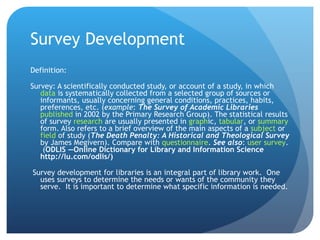
Survey Development Definition: Survey: A scientifically conducted study, or account of a study, in which  data  is systematically collected from a selected group of sources or informants, usually concerning general conditions, practices, habits, preferences, etc. ( example :  The Survey of Academic Libraries   published  in 2002 by the Primary Research Group). The statistical results of survey  research  are usually presented in  graph ic,  tabular , or  summary  form. Also refers to a brief overview of the main aspects of a  subject  or  field  of study ( The Death Penalty: A Historical and Theological Survey  by James Megivern). Compare with  questionnaire .  See also :  user survey .  ( ODLIS —Online Dictionary for Library and Information Science http://lu.com/odlis/)   Survey development for libraries is an integral part of library work.  One uses surveys to determine the needs or wants of the community they serve.  It is important to determine what specific information is needed.
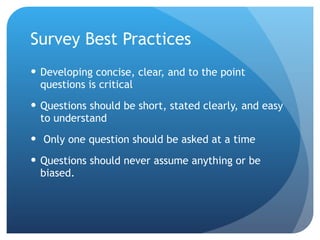
Survey Best Practices Developing concise, clear, and to the point questions is critical   Questions should be short, stated clearly, and easy to understand Only one question should be asked at a time   Questions should never assume anything or be biased.  
Other Considerations The next step is to choose between oral (phone or in-person), print, or online survey. See future slides for breakdown of the pros and cons of each method (see chart on next slide).  Remember people are busy and don ’ t want to spend too much time chatting.  It is beneficial to offer incentives or rewards for taking time to fill out the survey. Other options (besides surveys) are focus groups and observation.
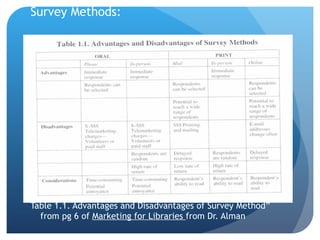
Survey Methods: Table 1.1. Advantages and Disadvantages of Survey Method ”  from pg 6 of  Marketing for Libraries  from Dr. Alman
Academic Libraries Survey Considerations for Academic Libraries:  Several versions may need to be developed for different user groups: undergraduates, graduate students and faculty Care must be taken to ensure that academic libraries are prepared and willing to act on survey results Results should be shared with faculty Survey takers need to be able to see changes based on their survey, even with the short turn around time for students
Public Libraries Survey Considerations for Public Libraries: Surveys need to be developed for many different patron groups Surveys need to be written at a 6 th  grade reading level Surveys for adults will sometimes be about their babies or young children who cannot give opinions yet Incentives will encourage patrons to take the survey, but public library budgets can be tight and not allow for extra spending on incentives
School Libraries Survey Considerations for School Libraries: When making survey questions you should keep school’s Mission and Vision statements in mind.  School’s also have long-range planning goals in place. The following are all stakeholders in a school library: superintendent, principal, school trustees, library media specialists, teachers, IT coordinator, parents, students, library volunteers, public librarians, curriculum surpervisors, department heads, community members.  Any and all of these are logical survey recipients. The importance placed upon state-mandated or other standardized tests must be considered when planning for school library materials and services, as well as state or district curriculum, district technology plan, and accreditation requirements.
Special Libraries Survey Considerations for Special Libraries: Surveys for special libraries and information centers can reveal  standard methods for marketing and promoting the library. Also, whether technology plays a significant role in how this is done.  Surveys for zoo and wildlife libraries, as well as other special libraries, can show the importance of maintaining special collections which are not normally found elsewhere.  Surveys for law libraries, as well as other libraries, can show the importance of maintaining and preserving their collections, as some of their earliest documents deem to be most important.
Special Libraries Continued… Surveys for medical libraries can aid in patient safety initiatives, awareness, and importance of the impact of medical libraries, such as shortened length of stay and lower hospital charges for patients Surveys for corporate libraries should be kept to a minimal length for corporate personnel, as they are extremely busy.
Archives Survey Considerations for Archives: In 2007 The National  Archives implemented a self-assessment program to measure service quality.  This is one example of how surveys can me used in archives.  In 2009 the OCLC initiated a survey of 300+ archives and special collections. The questions were designed to assess the extent and accessibility of the collections. The report used this data to make recommendations for future plans and address the new technologies in this decade
Reaching Non-Users Go outside the traditional library setting (restaurants, shops, stores, social hangouts)  Connect with community partners and schools Utilize multiple survey types Utilize multiple survey formats Offer incentives for survey takers

Survey development

  • 1.
    Survey Development DanaAlsup, Katie DeRusso, Michele Farina, Sarah Loudenslager, Sara Tekavec
  • 2.
    Survey Development Definition:Survey: A scientifically conducted study, or account of a study, in which data is systematically collected from a selected group of sources or informants, usually concerning general conditions, practices, habits, preferences, etc. ( example : The Survey of Academic Libraries published in 2002 by the Primary Research Group). The statistical results of survey research are usually presented in graph ic, tabular , or summary form. Also refers to a brief overview of the main aspects of a subject or field of study ( The Death Penalty: A Historical and Theological Survey by James Megivern). Compare with questionnaire . See also : user survey . ( ODLIS —Online Dictionary for Library and Information Science http://lu.com/odlis/)   Survey development for libraries is an integral part of library work.  One uses surveys to determine the needs or wants of the community they serve.  It is important to determine what specific information is needed.
  • 3.
    Survey Best PracticesDeveloping concise, clear, and to the point questions is critical   Questions should be short, stated clearly, and easy to understand Only one question should be asked at a time   Questions should never assume anything or be biased.  
  • 4.
    Other Considerations Thenext step is to choose between oral (phone or in-person), print, or online survey. See future slides for breakdown of the pros and cons of each method (see chart on next slide). Remember people are busy and don ’ t want to spend too much time chatting.  It is beneficial to offer incentives or rewards for taking time to fill out the survey. Other options (besides surveys) are focus groups and observation.
  • 5.
    Survey Methods: Table1.1. Advantages and Disadvantages of Survey Method ” from pg 6 of Marketing for Libraries from Dr. Alman
  • 6.
    Academic Libraries SurveyConsiderations for Academic Libraries: Several versions may need to be developed for different user groups: undergraduates, graduate students and faculty Care must be taken to ensure that academic libraries are prepared and willing to act on survey results Results should be shared with faculty Survey takers need to be able to see changes based on their survey, even with the short turn around time for students
  • 7.
    Public Libraries SurveyConsiderations for Public Libraries: Surveys need to be developed for many different patron groups Surveys need to be written at a 6 th grade reading level Surveys for adults will sometimes be about their babies or young children who cannot give opinions yet Incentives will encourage patrons to take the survey, but public library budgets can be tight and not allow for extra spending on incentives
  • 8.
    School Libraries SurveyConsiderations for School Libraries: When making survey questions you should keep school’s Mission and Vision statements in mind.  School’s also have long-range planning goals in place. The following are all stakeholders in a school library: superintendent, principal, school trustees, library media specialists, teachers, IT coordinator, parents, students, library volunteers, public librarians, curriculum surpervisors, department heads, community members.  Any and all of these are logical survey recipients. The importance placed upon state-mandated or other standardized tests must be considered when planning for school library materials and services, as well as state or district curriculum, district technology plan, and accreditation requirements.
  • 9.
    Special Libraries SurveyConsiderations for Special Libraries: Surveys for special libraries and information centers can reveal  standard methods for marketing and promoting the library. Also, whether technology plays a significant role in how this is done. Surveys for zoo and wildlife libraries, as well as other special libraries, can show the importance of maintaining special collections which are not normally found elsewhere. Surveys for law libraries, as well as other libraries, can show the importance of maintaining and preserving their collections, as some of their earliest documents deem to be most important.
  • 10.
    Special Libraries Continued…Surveys for medical libraries can aid in patient safety initiatives, awareness, and importance of the impact of medical libraries, such as shortened length of stay and lower hospital charges for patients Surveys for corporate libraries should be kept to a minimal length for corporate personnel, as they are extremely busy.
  • 11.
    Archives Survey Considerationsfor Archives: In 2007 The National  Archives implemented a self-assessment program to measure service quality.  This is one example of how surveys can me used in archives. In 2009 the OCLC initiated a survey of 300+ archives and special collections. The questions were designed to assess the extent and accessibility of the collections. The report used this data to make recommendations for future plans and address the new technologies in this decade
  • 12.
    Reaching Non-Users Gooutside the traditional library setting (restaurants, shops, stores, social hangouts) Connect with community partners and schools Utilize multiple survey types Utilize multiple survey formats Offer incentives for survey takers