Dr. Mohammed Roshen A R
JR (Academic)
Moderator: Dr. Prabhat Agarwal
 ROBERT JUDET EMILE LETOURNEL MARVIN
TILE
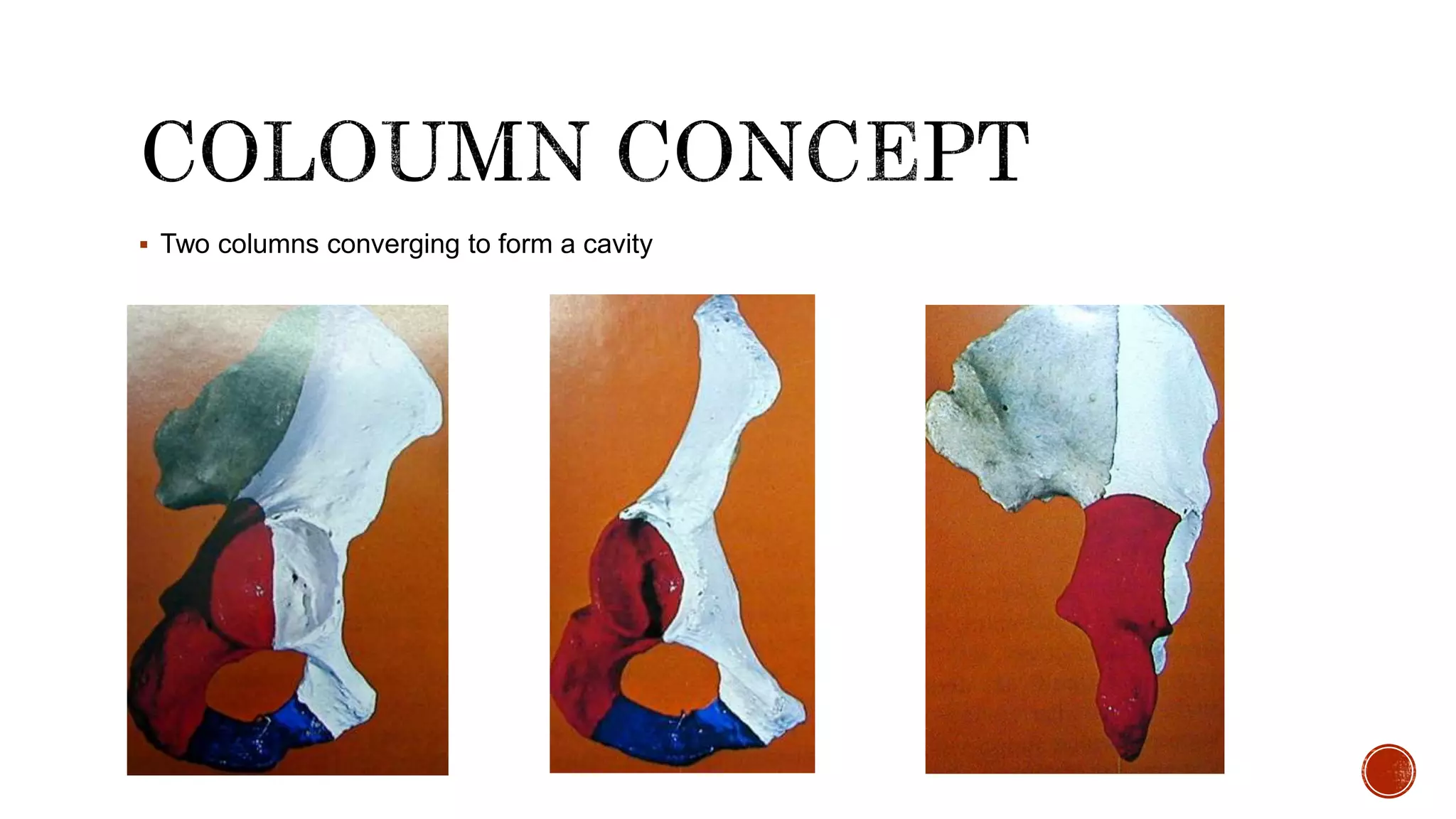
 Two columns converging to form a cavity
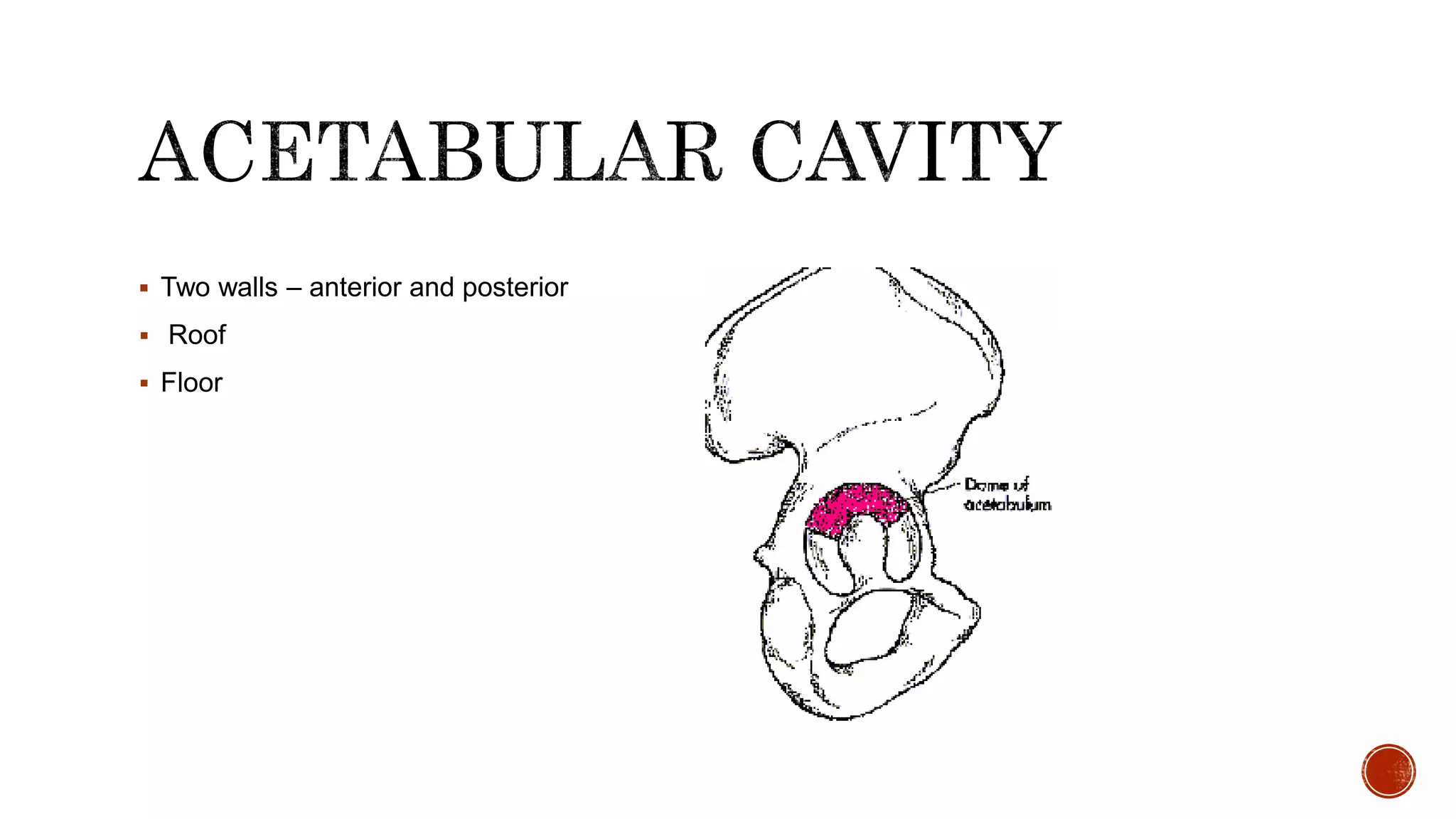
 Two walls – anterior and posterior
 Roof
 Floor
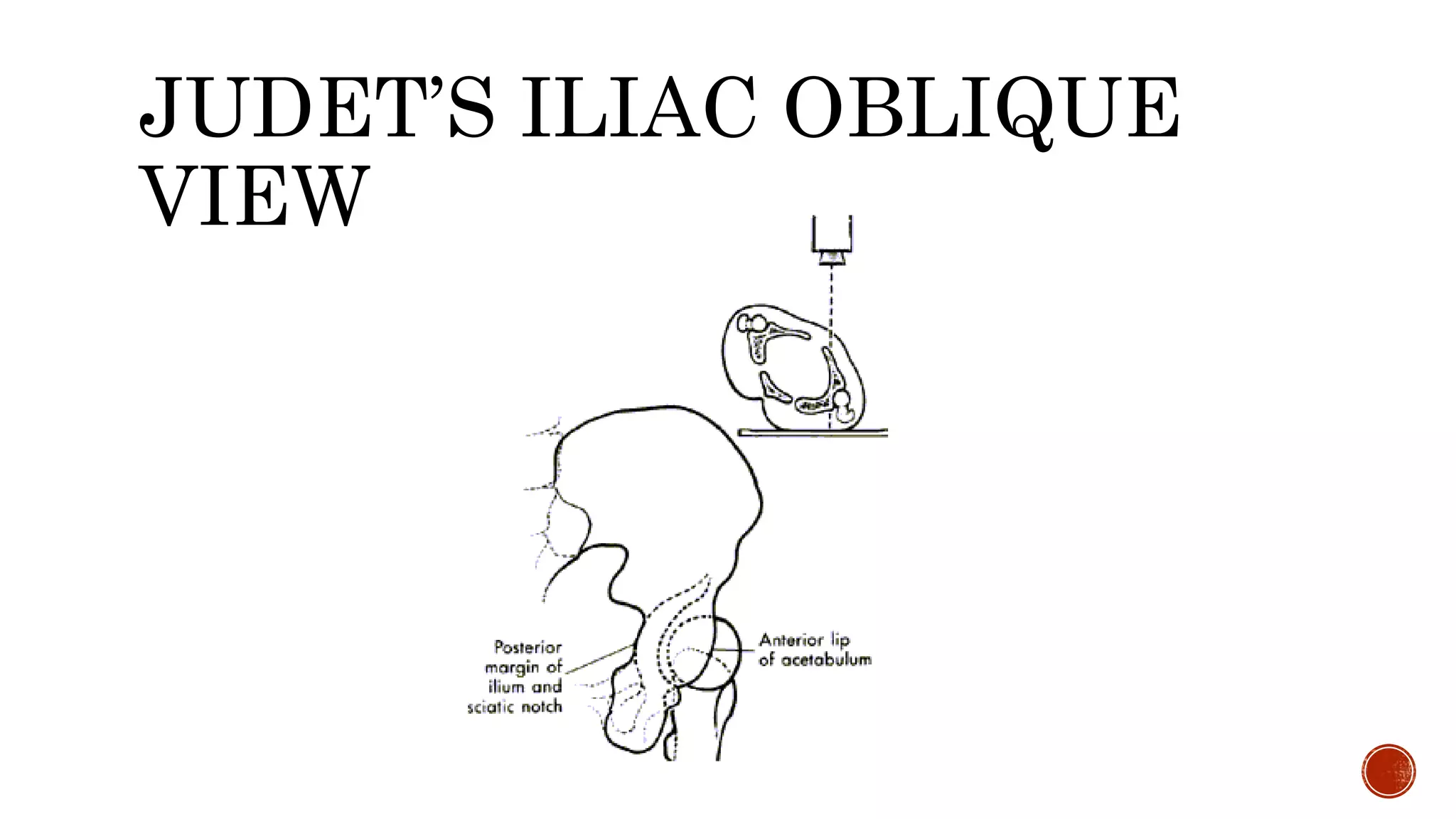
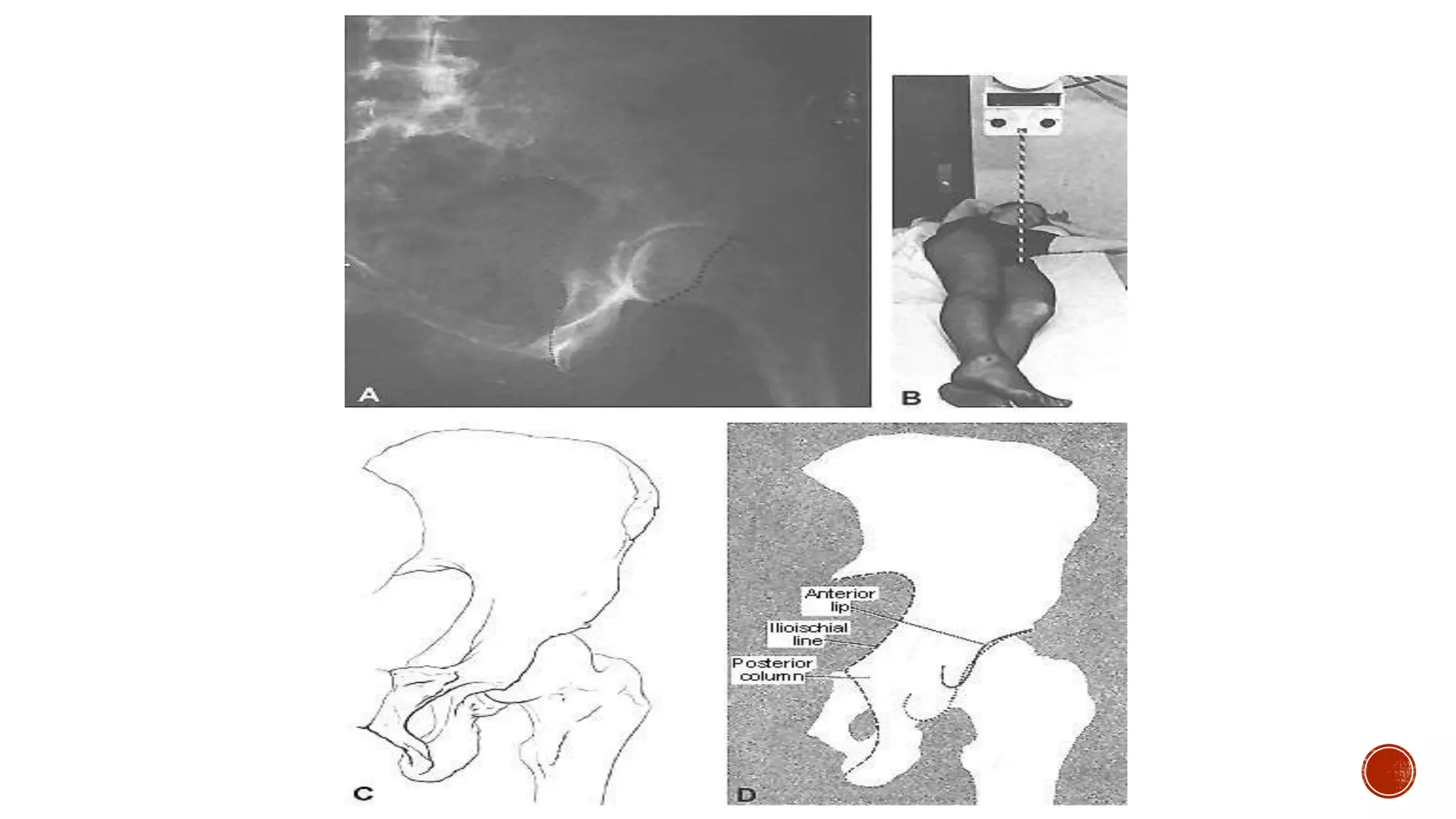
JUDET’S ILIAC OBLIQUE
VIEW
 Size of fragment
 Degree of displacement
 Amount of articular surface
 Site of origin of fragment
 Marginal impaction
 Position of femoral head dislocation,
subluxation, perfect reduction
 Incarcerated fragment
 Most acetabular fractures fit into one of ten types
 Five simple fracture patterns
 Five associated fracture patterns
 Posterior wall fracture
 Posterior column fracture
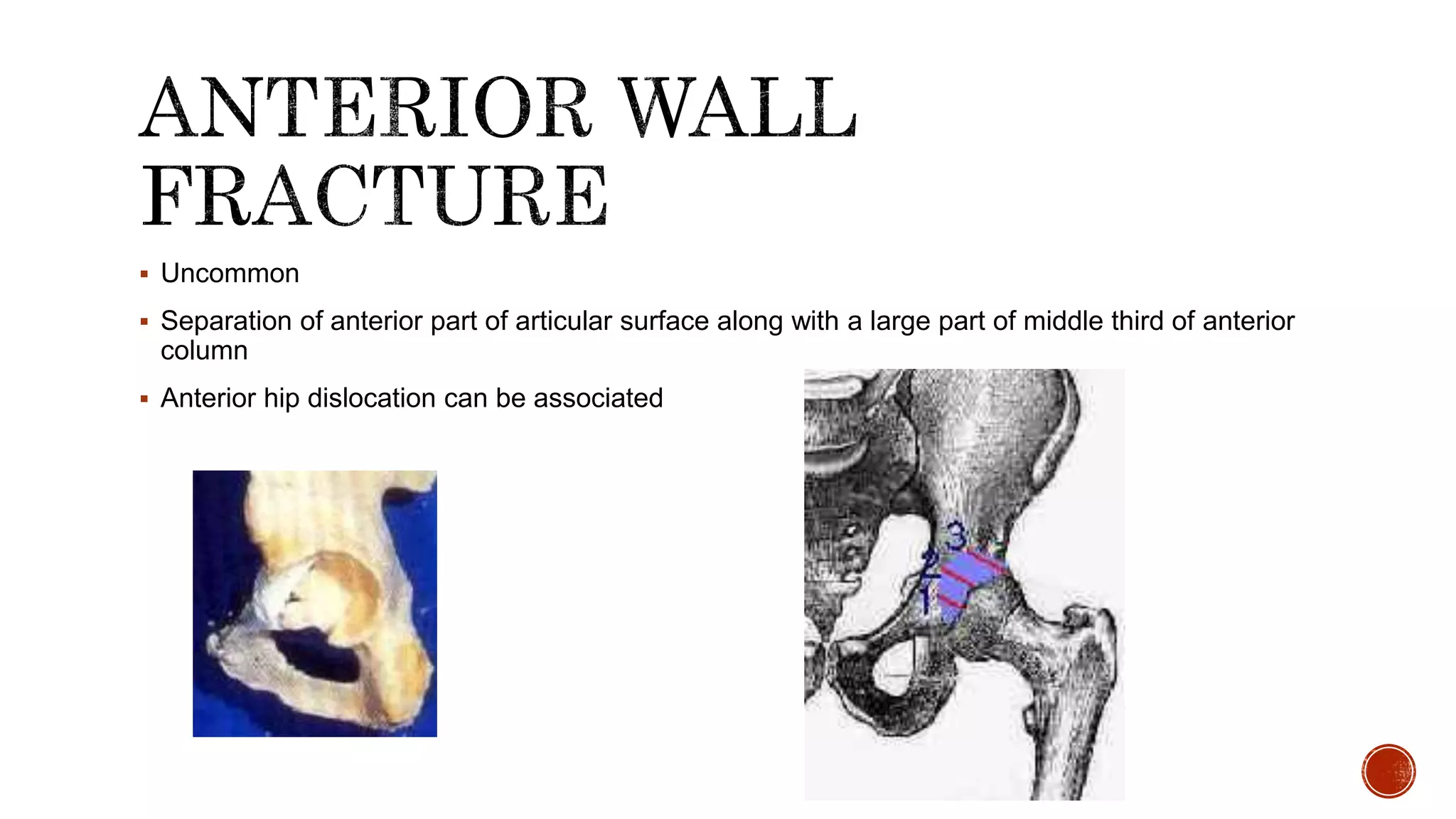
 Anterior wall fracture
 Anterior column fracture
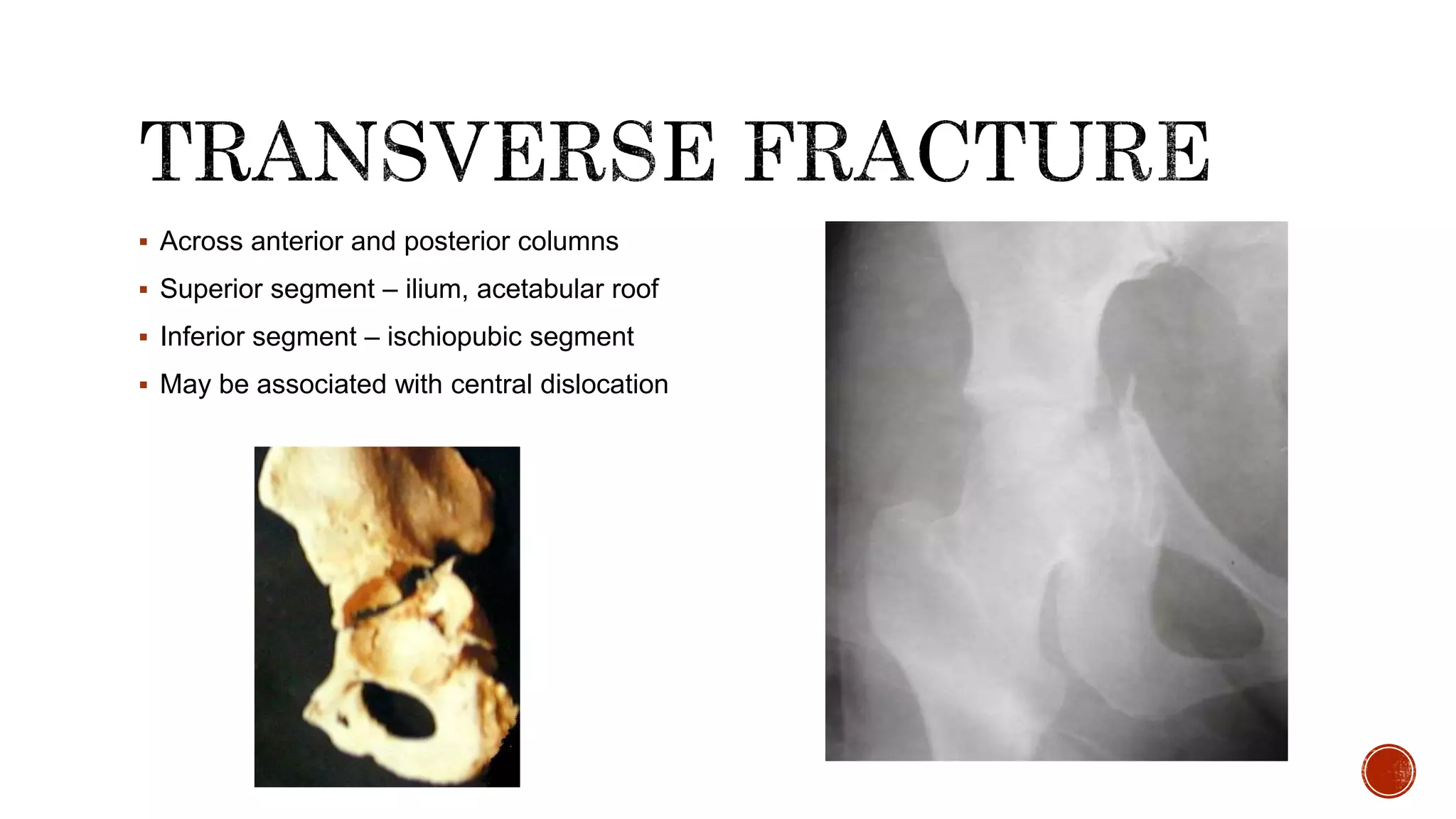
 Transverse fracture
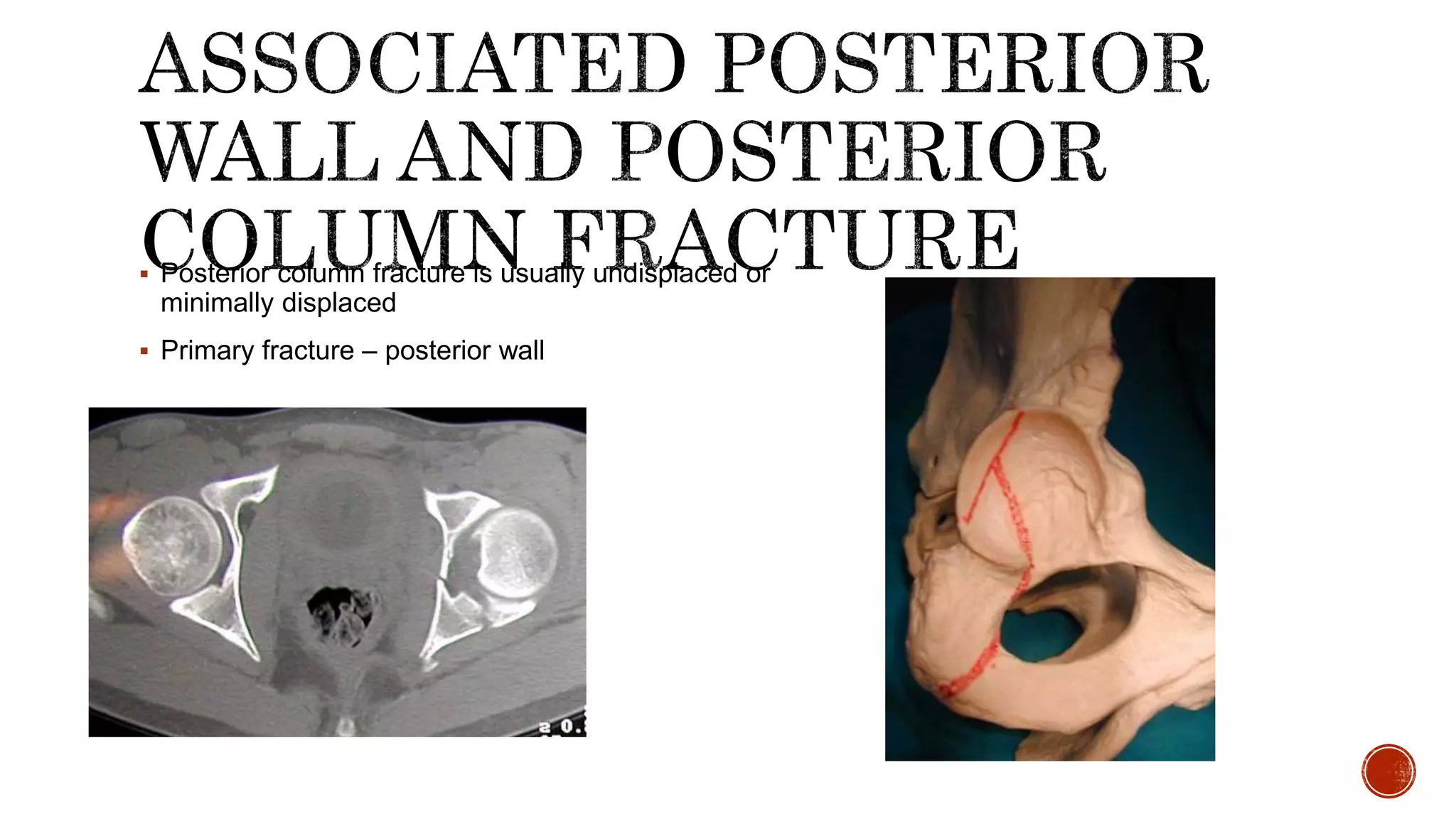
 Posterior column and posterior wall fracture
 Transverse and posterior wall fracture
 T-shaped fracture
 Anterior column or wall and posterior hemi transverse fracture
 Complete both-column fracture
 Includes posterior articular surface and retro acetabular surface
 Extends from PSIS to ischio pubic ramus
 Involves posterior articular surface and ilio ischial line
 Uncommon
 Separation of anterior part of articular surface along with a large part of middle third of anterior
column
 Anterior hip dislocation can be associated
 Extends from symphysis pubis to iliac crest
 Most commonly fracture line exits below AIIS
 Often comminution into the quadrilateral plate
 Across anterior and posterior columns
 Superior segment – ilium, acetabular roof
 Inferior segment – ischiopubic segment
 May be associated with central dislocation
 Posterior column fracture is usually undisplaced or
minimally displaced
 Primary fracture – posterior wall
 Anterior Column intact
 Posterior dislocation
 Displaced posterior wall
 Ilio ischial line disrupted
 Commonly posterior dislocation
 Sometimes central dislocation
 Highest incidence of pre op sciatic palsy and AVN of femoral head
 Transverse and vertical components
 Acetabular cavity is split into at least 3 fragments
 All segments of fractured acetabulum are detached from the ilium
 Fracture Displaced >2mm
 Irreducible fracture dislocation
 Intra articular fragment interfering with joint movement
 Instability of the joint
 To prepare the joint for hip replacement
 Severe osteoporosis
 Very old patients
 Severe associated injuries
 Poor local skin condition
 Limited experience of the surgeon
 0-7 DAYS 74%
 8-14 DAYS 71%
 15-21 DAYS 57%
 POOR RESULTS AFTER 3 WEEKS
 Open acetabular fracture
 New onset sciatic nerve palsy after closed reduction of hip dislocation
 Irreducible posterior hip dislocation
 Medial dislocation of femoral head against cancellous bone surface of intact ilium
 Type of fracture pattern
 Posterior dislocation
 Initial displacement
 Presence if intraarticular fragments
 Presence of acetabular impaction
 Injury to cartilage or bone of femoral head
 Anatomical reduction
 posterior– Kocher Langenbeck
 anterior– Ilioinguinal, Stoppa
 extensile– Extended Iliofemoral
 Approach to posterior column and posterior articular surface
 Posterior Wall Fractures
 Posterior Column Fractures
 Posterior Column / Posterior Wall Fractures
 Juxta-tectal / Infra-tectal Transverse or
 Transverse with Posterior Wall Fractures
 Some T-shaped Fractures
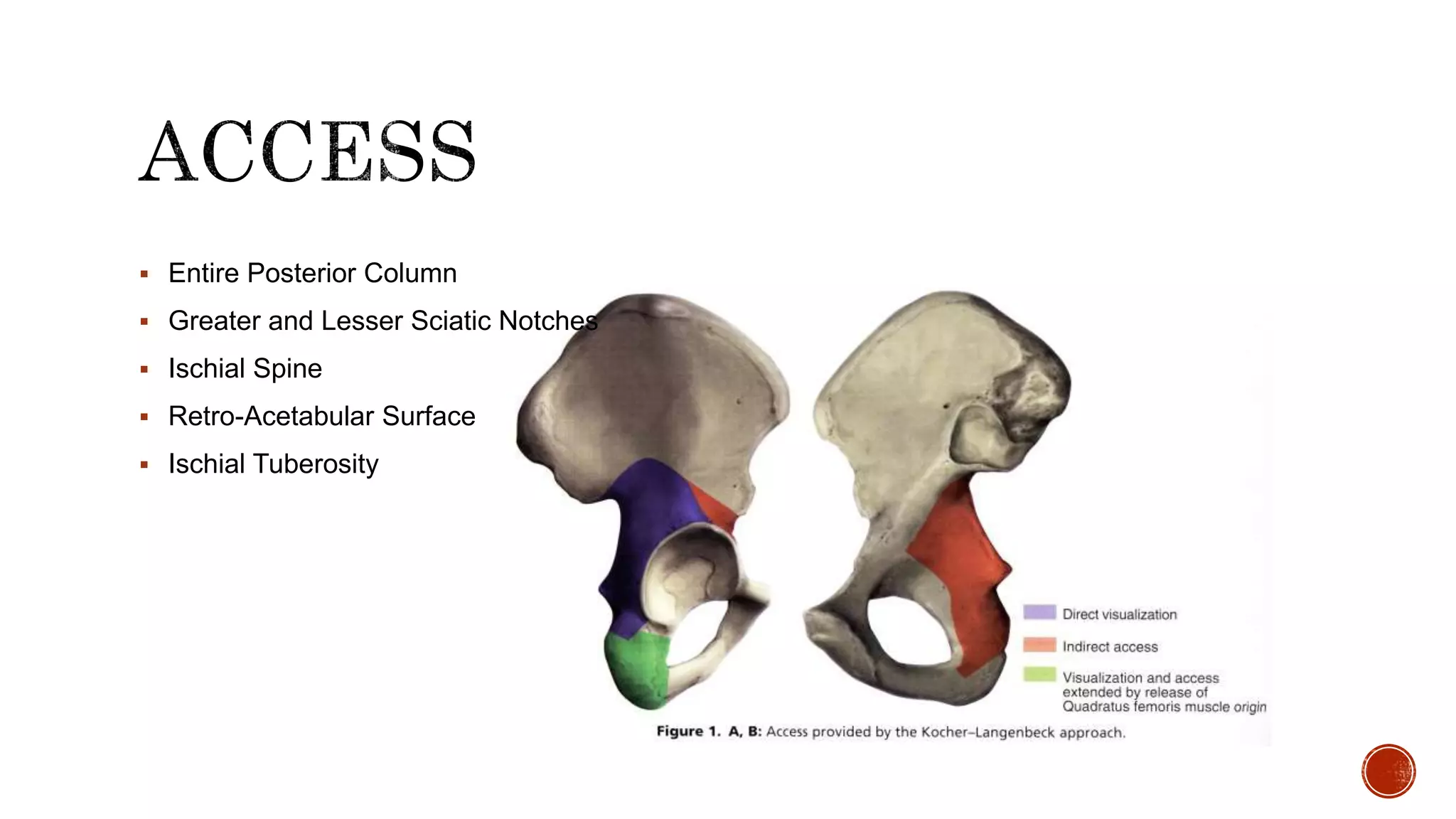
 Entire Posterior Column
 Greater and Lesser Sciatic Notches
 Ischial Spine
 Retro-Acetabular Surface
 Ischial Tuberosity
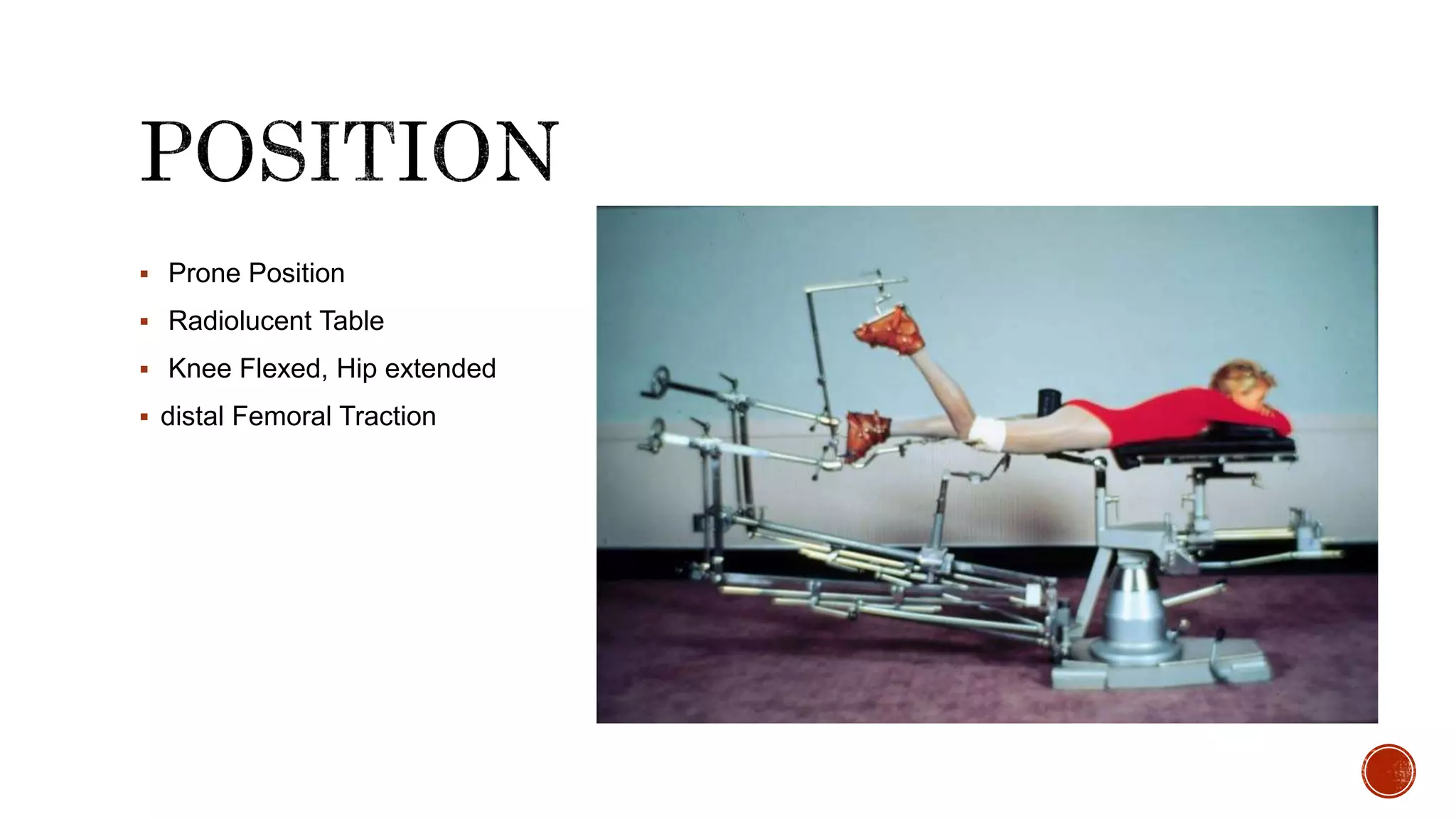
 Prone Position
 Radiolucent Table
 Knee Flexed, Hip extended
 distal Femoral Traction
Prone Position
 Aids in Reduction of Transverse Fractures
 Improves Quadrilateral Surface Access
 Allows Clamp Placement through Greater
 Sciatic Notch
 Controls Position of Hip, Minimizes Sciatic
 Nerve Stretch
 6 to 8 cm from PSIS
 Tip of Greater Trochanter
 Parallel Shaft of Femur 15-20 cm
 Divide Iliotibial Band
 Separate Fibers of Gluteus Maximus
– Superior Gluteal Artery
– Inferior Gluteal Artery
 Split to Inferior Gluteal Nerve Branch
 Release Gluteus Maximus Insertion 1 cm from its insertion
 Identify Sciatic Nerve on Border of Quadratus Femoris Muscle
 Release Piriformis Tendon >1cm from trochanter
 Release Conjoint Tendon
 Open Obturator Internus Bursa for Sciatic Nerve Retractor
FEMORAL HEAD BLOOD SUPPLY
 Deep Branch of Medial Femoral Circumflex
 May be injured by:
– Detaching quadratus
– Reflecting obturator internus or piriformis too close to trochanter
 84%: Anterior to Piriformis
 12%: Peroneal Division through Piriformis
 3%: Peroneal Division Posterior to
Piriformis / Tibial Division anterior to
Piriformis
 1%: Entire Nerve through Piriformis
 Subperiosteal Elevation of:
– Greater Sciatic Notch
– Quadrilateral Surface
– Gluteus Minimus
 Debridement of Fracture Edges
 Avoid Devascularization of Fx Fragments
 Infection 2-5%
 Sciatic Nerve palsy 3-5%
 Heterotopic Ossification 8-25%
 Developed by Letournel (1960) after extensive
cadaveric anatomical study
 Approach to the
anterior column and anterior articular surface
 Hip abductors are not disturbed (rapid post op
rehabilitation)
 INDICATIONS:
 Anterior Wall
 Anterior Column
 Transverse with Anterior > Posterior Displacement
 Anterior Column / Posterior Hemitransverse
 Associated Both Column
 SI Joint
 Internal Iliac Fossa
 Pelvic Brim
 Quadrilateral Surface
 Superior Pubic Ramus
 Limited Access to External Iliac Wing
 The surgical exposure requires development of three wound intervals
Lateral
Middle
medial
 Mobilization of the femoral vessels and nerve, as well as the spermatic cord (male) or round
ligament (female), is key to the development of these intervals.
 Supine
 Distal Femoral Traction
 Traction avoided in contralateral pubic ramus fracture
 Access to Greater Trochanter (Lateral Traction)
 Hip flexed 20°
 3-4 cm cranial to Symphysis pubis
 Curve to ASIS
 Parallel Iliac Crest -Past Most Convex Portion of Ilium
anterior 2/3
 Subperiosteal Dissect Internal Iliac Fossa
release the external oblique insertion
mobilize the iliacus muscle
subperiosteally
 • Expose Sacroiliac Joint
 Dissect over Pelvic Brim
 Incise External Oblique Aponeurosis
– From ASIS to midline
– 1 cm proximal to External Inguinal Ring
 Expose Floor of Inguinal Canal
 Retract Spermatic Cord/Round Ligament
 Protect Ilioinguinal Nerve
 Lies proximal to the inguinal ligament after
penetrating the abdominal wall
 Incise Inguinal Ligament
 Leave 1-2 mm with Internal Oblique and Transversus
Abdominis origin
 Protect External Iliac Vessels
 Protect Lateral Femoral Cutaneous
usually encountered just deep to the conjoint tendon
(of the internal oblique and the transversus abdominis)
approximately 1-2 cm medial to the anterior superior iliac
spine.
 Divide conjoint tendon& rectus abdominis at their insertion on
pubis to open retropubic space
 Structures beneath inguinal ligament lie in 2 compartment
Lacuna muscularom
Lateral
Contains iliopsoas muscle,femoral nerve & lateral
cutaneous nerve
Lacuna vasorum
Medial
Contans external iliac vessels & lymphatics
 Incise Iliopectineal Fascia to Superior Ramus and from Pelvic
Brim
 Iliopsoas freed from the pelvic brim
 Ecompasses the entire internal iliac fossa from the
sacroiliac joint posteriorly to the iliopectineal eminence
anteriorly.
 This window is optimized with hip flexion to relax the
iliopsoas
 Medial retraction usually requires placement of retractors
on the quadrilateral surface
 Internal Iliac Fossa
 Sacroiliac Joint
 Pelvic Brim - Upper 1/3
 Pelvic Brim - SI joint to pectineal eminence
 Quadrilateral Surface
 Anterior Rim
 Medial retraction of the femoral vessels should be gentle
and must be carefully monitored.
 The most limited leaves the ipsilateral rectus insertion
attached and visualization is provided between the
rectus and the spermatic cord (or round ligament)
 Superior Pubic Ramus
 Symphysis Pubis
 Medial window may also be created utilizing Stoppa approach
– Midline rectus split
– Subperiosteal dissection of quadrilateral surface
– Retractor in lesser sciatic notch
– Protect obturator nerve/artery
 Vascular Anastamosis
– External Iliac
– Obturator
 Frequently Venous
 Occasionally Arterial
 Infection 2-5%
 Femoral Nerve palsy 2%
 Lateral Femoral Cutaneous
– Dysesthesia common
– Sensation returns 80-90% by 1 year
 Heterotopic Ossification 2-10%
 Vascular Injury <1%
 Intrapelvic approach
 Hirvensalo et al 1993 – first described
 Substitute-ilioinguinal approach
 INDICATIONS
 Anterior wall
 Anterior column
 Transverse
 T type
 Post hemitransverse
 Both column
 ADVANTAGE
Improved quadrilateral surface exposure & post column
Minimise dissection( avoid middle window)
Iliac vessels dissection not required
 DISADVANTAGE
Lack of acess to middle window
 Position : supine
 Skin incision
Pfannensteil or
Midline incision starting 1cm inf to pubic symphysis ending 2-3 cm inf to umbilicus
 Subcutaneous tissue dissected in line with skin incision
 Fascia over both rectus muscle exposed
 Fascia incise along linea alba
 Rectus muscle both bellies retracted laterally
 In proximal aspect do not enter peritoneum
 Entire approach periperitoneal space
 Loosely packed wet sponge in retropubic space to protect bladder
 The thick periosteum from the superior pubic bone is dissected sharply, allowing for deeper blunt
dissection.
 At the beginning, dissection should be enlarged also on the anterior part of the symphysis.
 The upper border of the superior pubic ramus is identified (pecten pubis) and the dissection is carried
laterally along the pelvic brim. The iliopectineal fascia is detached from the pelvic brim
 Dissecting carefully along the medial surface of the superior ramus, the corona mortis vessels
are identified and ligated (or clipped) as necessary
 Dissection of the periosteum is continued further laterally following the upper border of the
superior pubic bone to the direction of the pelvic brim exposing the beginning of the iliopectineal
eminence
 At this point the beginning of the iliopectineal arch should be dissected from the bone. This enables the
elevation of the femoral vessels and nerve.
 The dissection is continued subperiosteally more laterally following the upper border of the pelvic brim.
 At this point the entire internal surface of the superior pubic ramus has been exposed adequately for plate
fixation
 At this level, the obturator neurovascular bundle is crossing the quadrilateral surface. In some cases it
should be mobilized. A spatula or malleable retractor is used to protect the obturator neurovascular
bundle and pelvic floor.
 With a Cobb elevator, the periosteum and obturator internus is elevated and the quadrilateral surface can
be sufficiently exposed.
 One Hohmann retractor should be put in the middle part of the superior pubic ramus and another curved
Hohmann retractor is placed on the posterior top of the acetabulum on the iliac part of the pelvic brim.
 Great care should be taken not to injure the external iliac vein which may be in close proximity to the
elevators
 In some rare cases, the internal iliac artery bifurcates very distally and makes the dissection of
the posterior part of the quadrilateral surface risky and limits the further dissection
 Developed by Letournel (1975)
 Based on Smith- Peterson Approach
 Maximal Simultaneous access to both
columns of the acetabulum
 INDICATIONS:
 Transtectal Transverse +PW or T-shaped fractures
 Transverse fractures with extended posterior wall
 T-shaped fractures with wide separations of the vertical stem of the "T" or those with associated
pubic symphysis dislocations.
 Certain Associated Both Column Fractures.
 Associated fracture patterns or transverse fractures which are operated greater than 21 days
following injury.
 INDICATIONS IN BOTH COLOUMN FRACTURES
 Inability to reduce Posterior Column through Ilioinguinal
 Wide displacement at the rim
 Complex posterior column involvement
 Associated SI joint disruption
 Small posterior wall component
 External Aspect of Ilium
 Anterior Column as far medial as
Iliopectineal eminence
 Posterior Column to the Upper Ischial
Tuberosity
 POSITION:
 Lateral Position
 • Distal Femoral Traction
 • Knee flexed 45°
 INCISION:
 Inverted J incision
 Parallel Iliac Crest from PSIS to ASIS
 Incise along anteriorlateral thigh
 Release Origins of Gluteals and Tensor
Fascia Lata from Iliac Crest
 Dissect Subperiosteal Iliac Wing
 Elevate Periosteum from Greater Sciatic
Notch
 Incise Fascia Lata to end of muscle belly
 Retract Tensor Fascia Lata Muscle
Posteriorly
 Incise Sheath of Rectus Femoris
 Ligate Lateral Femoral Circumflex Artery
and Vein
 Release Gluteus Medius and Minimus
Tendons from Greater Trochanter
 Alternatively, Greater Trochanteric
Osteotomy
 Reflect Gluteals and Tensor Fascia Lata
Posteriorly pedicled on Superior Gluteal
 Incise and Retract:
 – Piriformis Tendon
 – Obturator Internus Tendon with Gemelli muscles
 Place Sciatic Nerve Retractor in Lesser Sciatic Notch
 Capsulotomy if Required
 If Internal Iliac Fossa Exposure Required:
– Elevate Abdominal Muscles from Iliac Crest
– Elevate Iliacus Subperiosteally
– Release Sartorius and Inguinal Ligament from ASIS
– Preserve Anterior Capsule and Direct Head of Rectus for Blood Supply to Anterior Column
 COMPLICATIONS
 Infection 2-5%
 Sciatic Nerve palsy 3-5%
 Heterotopic Ossification 20-50%
 Kocher-Langenbeck + Ilioinguinal
 • May be simultaneous or sequential
 – Simultaneous may compromise both approaches but can aid in assessment of transverse
fracture reduction
 – Care with sequential not to block anterior reduction during posterior fixation
 Rarely necessary
 – T-shaped fractures if unable to reduce anterior column from KL
 – AW+PHT if hemitransverse is segmental or widely displaced
 The bony pelvis lies in close proximity to various vascular , neural and soft tissue structures making these
structures vulnerable in the event of pelvic ring disruption
 Anterior ring fixation may provide structural protection of posterior fixation
 If combined open and percutaneus techniques are used, the open portion is often done first to aid in
reduction of the percutaneusly treated injury
 LETOURNEL’s Golden rule: Posterior stabilization to be done before anterior as posterior is the main
weight bearing part.
 Indications for ORIF
Symphyseal dislocation >2.5cm(static or dynamic)
To augment posterior fixation in vertically dislaced fractures.
Locked symphysis.
 PFANNENSTEILAPPROACH
 Supine Position
 8 cm incision
 The cut edges of the rectus abdominal
muscles superiorly to reveal the symphysis
and pubic crest.
 If access to the back of the symphysis is
required, use the fingers to push the bladder
gently off the back of the bone
 Anterior External Fixation for controlling rotation but Internal fixation >>> for resisting vertical
displacements
 Ex fix particularly useful in open injuries or pts requiring GI/GU procedures.
 Apply circumferential wrap at the level of the GT.
 Internally rotate the legs and tape them.
 Anterior approach to pubic symphysis.
 Place reduction forceps anteriorly so that plate can be put on the superior surface.
 Inlet view: judge the alignment of the plate;
 Outlet view judge the length of screws; screws should have a bicortical purchase.
 Fractures medial to insertion of inguinal ligament should be treated like symphyseal dislocations.
 • Comminuted fractures: ORIF
 • Minimal comminution: Ramus screw
 Indications for ORIF:-
1. Displaced iliac wing fractures that enter and exit both the crest and GSN/SIJ.
2. Multiplanar instability(disruption of ligaments)
3. Non impacted comminuted displaced sacral fractures.
4. Vertical or cephalad displacement.
5. U shaped fractures with spino-pelvic dissociation
 Pt is placed prone with longitudinal traction.
 In severely displaced fractures we can rigidly fix the contralateral pelvis
 Make a curved incision over the iliac
crest, beginning 7 cm posterior to the
anterior superior iliac spine. Curve the
incision anteriorly and medially along
the line of the inguinal ligament for 5
cm.
 Subperiosteally dissect the iliacus muscle and retract medially to reach the anterior part of the SIJ.
 Care should be taken not to injure L5 nerve root.
 Inlet projection - screw towards anterior aspect of
promontory
 Outlet - screw is above the S1 foramen
 Screw to be directed anteriorly; superiorly and
medially.
 Iliac wing fractures exiting through the SIJ are crescent #.
 Crescent fragment is the variable sized that contains the PSIS and PIIS and remains attached to the
sacrum.
 Smaller the “CRESCENT” fragment > damage to posterior structures
 ALWAYS POSTERIOR APPROACH
 Can be regarded as a pelvic injury, spinal injury or both.
 Indications for fixation:-
Ant and post ring disruption with vertical sheer sacrum fracture.
Comminuted # with rotation
Spinal-pelvic dissociation
Rarely in impacted # with Internal rotation deformity
 ILIOSACRAL SCREW
 PLATE FIXATION
 1. Spinal point of fixation- L5(usually)
 2. Iliac screw just inf to PSIS
 3. Iliac screw is connected to pedicle screw with appropriate rods and screw-rod clamps
 This bypasses the lines of force transmission from
spine to illium through the construct instead of the
sacrum
Surgical approach to acetabulum and pelvis

Surgical approach to acetabulum and pelvis

  • 1.
    Dr. Mohammed RoshenA R JR (Academic) Moderator: Dr. Prabhat Agarwal
  • 2.
     ROBERT JUDETEMILE LETOURNEL MARVIN TILE
  • 3.
     Two columnsconverging to form a cavity
  • 4.
     Two walls– anterior and posterior  Roof  Floor
  • 6.
  • 10.
     Size offragment  Degree of displacement  Amount of articular surface  Site of origin of fragment  Marginal impaction
  • 11.
     Position offemoral head dislocation, subluxation, perfect reduction  Incarcerated fragment
  • 12.
     Most acetabularfractures fit into one of ten types  Five simple fracture patterns  Five associated fracture patterns
  • 13.
     Posterior wallfracture  Posterior column fracture  Anterior wall fracture  Anterior column fracture  Transverse fracture
  • 14.
     Posterior columnand posterior wall fracture  Transverse and posterior wall fracture  T-shaped fracture  Anterior column or wall and posterior hemi transverse fracture  Complete both-column fracture
  • 15.
     Includes posteriorarticular surface and retro acetabular surface
  • 16.
     Extends fromPSIS to ischio pubic ramus  Involves posterior articular surface and ilio ischial line
  • 17.
     Uncommon  Separationof anterior part of articular surface along with a large part of middle third of anterior column  Anterior hip dislocation can be associated
  • 18.
     Extends fromsymphysis pubis to iliac crest  Most commonly fracture line exits below AIIS  Often comminution into the quadrilateral plate
  • 19.
     Across anteriorand posterior columns  Superior segment – ilium, acetabular roof  Inferior segment – ischiopubic segment  May be associated with central dislocation
  • 20.
     Posterior columnfracture is usually undisplaced or minimally displaced  Primary fracture – posterior wall
  • 21.
     Anterior Columnintact  Posterior dislocation  Displaced posterior wall  Ilio ischial line disrupted
  • 22.
     Commonly posteriordislocation  Sometimes central dislocation  Highest incidence of pre op sciatic palsy and AVN of femoral head
  • 23.
     Transverse andvertical components  Acetabular cavity is split into at least 3 fragments
  • 24.
     All segmentsof fractured acetabulum are detached from the ilium
  • 25.
     Fracture Displaced>2mm  Irreducible fracture dislocation  Intra articular fragment interfering with joint movement  Instability of the joint  To prepare the joint for hip replacement
  • 26.
     Severe osteoporosis Very old patients  Severe associated injuries  Poor local skin condition  Limited experience of the surgeon
  • 27.
     0-7 DAYS74%  8-14 DAYS 71%  15-21 DAYS 57%  POOR RESULTS AFTER 3 WEEKS
  • 28.
     Open acetabularfracture  New onset sciatic nerve palsy after closed reduction of hip dislocation
  • 29.
     Irreducible posteriorhip dislocation  Medial dislocation of femoral head against cancellous bone surface of intact ilium
  • 30.
     Type offracture pattern  Posterior dislocation  Initial displacement  Presence if intraarticular fragments  Presence of acetabular impaction
  • 31.
     Injury tocartilage or bone of femoral head  Anatomical reduction
  • 32.
     posterior– KocherLangenbeck  anterior– Ilioinguinal, Stoppa  extensile– Extended Iliofemoral
  • 33.
     Approach toposterior column and posterior articular surface
  • 34.
     Posterior WallFractures  Posterior Column Fractures  Posterior Column / Posterior Wall Fractures  Juxta-tectal / Infra-tectal Transverse or  Transverse with Posterior Wall Fractures  Some T-shaped Fractures
  • 35.
     Entire PosteriorColumn  Greater and Lesser Sciatic Notches  Ischial Spine  Retro-Acetabular Surface  Ischial Tuberosity
  • 36.
     Prone Position Radiolucent Table  Knee Flexed, Hip extended  distal Femoral Traction
  • 37.
    Prone Position  Aidsin Reduction of Transverse Fractures  Improves Quadrilateral Surface Access  Allows Clamp Placement through Greater  Sciatic Notch  Controls Position of Hip, Minimizes Sciatic  Nerve Stretch
  • 38.
     6 to8 cm from PSIS  Tip of Greater Trochanter  Parallel Shaft of Femur 15-20 cm
  • 40.
     Divide IliotibialBand  Separate Fibers of Gluteus Maximus – Superior Gluteal Artery – Inferior Gluteal Artery  Split to Inferior Gluteal Nerve Branch
  • 41.
     Release GluteusMaximus Insertion 1 cm from its insertion  Identify Sciatic Nerve on Border of Quadratus Femoris Muscle
  • 43.
     Release PiriformisTendon >1cm from trochanter  Release Conjoint Tendon  Open Obturator Internus Bursa for Sciatic Nerve Retractor
  • 44.
    FEMORAL HEAD BLOODSUPPLY  Deep Branch of Medial Femoral Circumflex  May be injured by: – Detaching quadratus – Reflecting obturator internus or piriformis too close to trochanter
  • 45.
     84%: Anteriorto Piriformis  12%: Peroneal Division through Piriformis  3%: Peroneal Division Posterior to Piriformis / Tibial Division anterior to Piriformis  1%: Entire Nerve through Piriformis
  • 47.
     Subperiosteal Elevationof: – Greater Sciatic Notch – Quadrilateral Surface – Gluteus Minimus  Debridement of Fracture Edges  Avoid Devascularization of Fx Fragments
  • 48.
     Infection 2-5% Sciatic Nerve palsy 3-5%  Heterotopic Ossification 8-25%
  • 49.
     Developed byLetournel (1960) after extensive cadaveric anatomical study  Approach to the anterior column and anterior articular surface  Hip abductors are not disturbed (rapid post op rehabilitation)
  • 50.
     INDICATIONS:  AnteriorWall  Anterior Column  Transverse with Anterior > Posterior Displacement  Anterior Column / Posterior Hemitransverse  Associated Both Column
  • 51.
     SI Joint Internal Iliac Fossa  Pelvic Brim  Quadrilateral Surface  Superior Pubic Ramus  Limited Access to External Iliac Wing
  • 52.
     The surgicalexposure requires development of three wound intervals Lateral Middle medial  Mobilization of the femoral vessels and nerve, as well as the spermatic cord (male) or round ligament (female), is key to the development of these intervals.
  • 53.
     Supine  DistalFemoral Traction  Traction avoided in contralateral pubic ramus fracture  Access to Greater Trochanter (Lateral Traction)  Hip flexed 20°
  • 54.
     3-4 cmcranial to Symphysis pubis  Curve to ASIS  Parallel Iliac Crest -Past Most Convex Portion of Ilium anterior 2/3
  • 56.
     Subperiosteal DissectInternal Iliac Fossa release the external oblique insertion mobilize the iliacus muscle subperiosteally  • Expose Sacroiliac Joint  Dissect over Pelvic Brim
  • 57.
     Incise ExternalOblique Aponeurosis – From ASIS to midline – 1 cm proximal to External Inguinal Ring  Expose Floor of Inguinal Canal  Retract Spermatic Cord/Round Ligament  Protect Ilioinguinal Nerve  Lies proximal to the inguinal ligament after penetrating the abdominal wall
  • 59.
     Incise InguinalLigament  Leave 1-2 mm with Internal Oblique and Transversus Abdominis origin  Protect External Iliac Vessels  Protect Lateral Femoral Cutaneous usually encountered just deep to the conjoint tendon (of the internal oblique and the transversus abdominis) approximately 1-2 cm medial to the anterior superior iliac spine.
  • 60.
     Divide conjointtendon& rectus abdominis at their insertion on pubis to open retropubic space  Structures beneath inguinal ligament lie in 2 compartment Lacuna muscularom Lateral Contains iliopsoas muscle,femoral nerve & lateral cutaneous nerve Lacuna vasorum Medial Contans external iliac vessels & lymphatics  Incise Iliopectineal Fascia to Superior Ramus and from Pelvic Brim
  • 61.
     Iliopsoas freedfrom the pelvic brim
  • 62.
     Ecompasses theentire internal iliac fossa from the sacroiliac joint posteriorly to the iliopectineal eminence anteriorly.  This window is optimized with hip flexion to relax the iliopsoas  Medial retraction usually requires placement of retractors on the quadrilateral surface  Internal Iliac Fossa  Sacroiliac Joint  Pelvic Brim - Upper 1/3
  • 63.
     Pelvic Brim- SI joint to pectineal eminence  Quadrilateral Surface  Anterior Rim  Medial retraction of the femoral vessels should be gentle and must be carefully monitored.
  • 64.
     The mostlimited leaves the ipsilateral rectus insertion attached and visualization is provided between the rectus and the spermatic cord (or round ligament)  Superior Pubic Ramus  Symphysis Pubis
  • 65.
     Medial windowmay also be created utilizing Stoppa approach – Midline rectus split – Subperiosteal dissection of quadrilateral surface – Retractor in lesser sciatic notch – Protect obturator nerve/artery
  • 66.
     Vascular Anastamosis –External Iliac – Obturator  Frequently Venous  Occasionally Arterial
  • 67.
     Infection 2-5% Femoral Nerve palsy 2%  Lateral Femoral Cutaneous – Dysesthesia common – Sensation returns 80-90% by 1 year  Heterotopic Ossification 2-10%  Vascular Injury <1%
  • 68.
     Intrapelvic approach Hirvensalo et al 1993 – first described  Substitute-ilioinguinal approach
  • 69.
     INDICATIONS  Anteriorwall  Anterior column  Transverse  T type  Post hemitransverse  Both column
  • 70.
     ADVANTAGE Improved quadrilateralsurface exposure & post column Minimise dissection( avoid middle window) Iliac vessels dissection not required  DISADVANTAGE Lack of acess to middle window
  • 71.
     Position :supine  Skin incision Pfannensteil or Midline incision starting 1cm inf to pubic symphysis ending 2-3 cm inf to umbilicus
  • 72.
     Subcutaneous tissuedissected in line with skin incision  Fascia over both rectus muscle exposed  Fascia incise along linea alba
  • 73.
     Rectus muscleboth bellies retracted laterally  In proximal aspect do not enter peritoneum  Entire approach periperitoneal space
  • 74.
     Loosely packedwet sponge in retropubic space to protect bladder
  • 75.
     The thickperiosteum from the superior pubic bone is dissected sharply, allowing for deeper blunt dissection.  At the beginning, dissection should be enlarged also on the anterior part of the symphysis.  The upper border of the superior pubic ramus is identified (pecten pubis) and the dissection is carried laterally along the pelvic brim. The iliopectineal fascia is detached from the pelvic brim
  • 76.
     Dissecting carefullyalong the medial surface of the superior ramus, the corona mortis vessels are identified and ligated (or clipped) as necessary
  • 77.
     Dissection ofthe periosteum is continued further laterally following the upper border of the superior pubic bone to the direction of the pelvic brim exposing the beginning of the iliopectineal eminence
  • 78.
     At thispoint the beginning of the iliopectineal arch should be dissected from the bone. This enables the elevation of the femoral vessels and nerve.  The dissection is continued subperiosteally more laterally following the upper border of the pelvic brim.  At this point the entire internal surface of the superior pubic ramus has been exposed adequately for plate fixation
  • 79.
     At thislevel, the obturator neurovascular bundle is crossing the quadrilateral surface. In some cases it should be mobilized. A spatula or malleable retractor is used to protect the obturator neurovascular bundle and pelvic floor.  With a Cobb elevator, the periosteum and obturator internus is elevated and the quadrilateral surface can be sufficiently exposed.  One Hohmann retractor should be put in the middle part of the superior pubic ramus and another curved Hohmann retractor is placed on the posterior top of the acetabulum on the iliac part of the pelvic brim.  Great care should be taken not to injure the external iliac vein which may be in close proximity to the elevators
  • 80.
     In somerare cases, the internal iliac artery bifurcates very distally and makes the dissection of the posterior part of the quadrilateral surface risky and limits the further dissection
  • 81.
     Developed byLetournel (1975)  Based on Smith- Peterson Approach  Maximal Simultaneous access to both columns of the acetabulum
  • 82.
     INDICATIONS:  TranstectalTransverse +PW or T-shaped fractures  Transverse fractures with extended posterior wall  T-shaped fractures with wide separations of the vertical stem of the "T" or those with associated pubic symphysis dislocations.  Certain Associated Both Column Fractures.  Associated fracture patterns or transverse fractures which are operated greater than 21 days following injury.
  • 83.
     INDICATIONS INBOTH COLOUMN FRACTURES  Inability to reduce Posterior Column through Ilioinguinal  Wide displacement at the rim  Complex posterior column involvement  Associated SI joint disruption  Small posterior wall component
  • 84.
     External Aspectof Ilium  Anterior Column as far medial as Iliopectineal eminence  Posterior Column to the Upper Ischial Tuberosity
  • 85.
     POSITION:  LateralPosition  • Distal Femoral Traction  • Knee flexed 45°
  • 87.
     INCISION:  InvertedJ incision  Parallel Iliac Crest from PSIS to ASIS  Incise along anteriorlateral thigh
  • 88.
     Release Originsof Gluteals and Tensor Fascia Lata from Iliac Crest  Dissect Subperiosteal Iliac Wing  Elevate Periosteum from Greater Sciatic Notch  Incise Fascia Lata to end of muscle belly
  • 89.
     Retract TensorFascia Lata Muscle Posteriorly  Incise Sheath of Rectus Femoris  Ligate Lateral Femoral Circumflex Artery and Vein
  • 91.
     Release GluteusMedius and Minimus Tendons from Greater Trochanter  Alternatively, Greater Trochanteric Osteotomy  Reflect Gluteals and Tensor Fascia Lata Posteriorly pedicled on Superior Gluteal
  • 93.
     Incise andRetract:  – Piriformis Tendon  – Obturator Internus Tendon with Gemelli muscles  Place Sciatic Nerve Retractor in Lesser Sciatic Notch  Capsulotomy if Required
  • 95.
     If InternalIliac Fossa Exposure Required: – Elevate Abdominal Muscles from Iliac Crest – Elevate Iliacus Subperiosteally – Release Sartorius and Inguinal Ligament from ASIS – Preserve Anterior Capsule and Direct Head of Rectus for Blood Supply to Anterior Column
  • 96.
     COMPLICATIONS  Infection2-5%  Sciatic Nerve palsy 3-5%  Heterotopic Ossification 20-50%
  • 97.
     Kocher-Langenbeck +Ilioinguinal  • May be simultaneous or sequential  – Simultaneous may compromise both approaches but can aid in assessment of transverse fracture reduction  – Care with sequential not to block anterior reduction during posterior fixation
  • 98.
     Rarely necessary – T-shaped fractures if unable to reduce anterior column from KL  – AW+PHT if hemitransverse is segmental or widely displaced
  • 100.
     The bonypelvis lies in close proximity to various vascular , neural and soft tissue structures making these structures vulnerable in the event of pelvic ring disruption
  • 105.
     Anterior ringfixation may provide structural protection of posterior fixation  If combined open and percutaneus techniques are used, the open portion is often done first to aid in reduction of the percutaneusly treated injury  LETOURNEL’s Golden rule: Posterior stabilization to be done before anterior as posterior is the main weight bearing part.
  • 106.
     Indications forORIF Symphyseal dislocation >2.5cm(static or dynamic) To augment posterior fixation in vertically dislaced fractures. Locked symphysis.
  • 107.
     PFANNENSTEILAPPROACH  SupinePosition  8 cm incision
  • 109.
     The cutedges of the rectus abdominal muscles superiorly to reveal the symphysis and pubic crest.  If access to the back of the symphysis is required, use the fingers to push the bladder gently off the back of the bone
  • 110.
     Anterior ExternalFixation for controlling rotation but Internal fixation >>> for resisting vertical displacements  Ex fix particularly useful in open injuries or pts requiring GI/GU procedures.
  • 111.
     Apply circumferentialwrap at the level of the GT.  Internally rotate the legs and tape them.  Anterior approach to pubic symphysis.  Place reduction forceps anteriorly so that plate can be put on the superior surface.
  • 113.
     Inlet view:judge the alignment of the plate;  Outlet view judge the length of screws; screws should have a bicortical purchase.
  • 114.
     Fractures medialto insertion of inguinal ligament should be treated like symphyseal dislocations.  • Comminuted fractures: ORIF  • Minimal comminution: Ramus screw
  • 115.
     Indications forORIF:- 1. Displaced iliac wing fractures that enter and exit both the crest and GSN/SIJ. 2. Multiplanar instability(disruption of ligaments) 3. Non impacted comminuted displaced sacral fractures. 4. Vertical or cephalad displacement. 5. U shaped fractures with spino-pelvic dissociation
  • 116.
     Pt isplaced prone with longitudinal traction.  In severely displaced fractures we can rigidly fix the contralateral pelvis
  • 119.
     Make acurved incision over the iliac crest, beginning 7 cm posterior to the anterior superior iliac spine. Curve the incision anteriorly and medially along the line of the inguinal ligament for 5 cm.
  • 120.
     Subperiosteally dissectthe iliacus muscle and retract medially to reach the anterior part of the SIJ.  Care should be taken not to injure L5 nerve root.
  • 123.
     Inlet projection- screw towards anterior aspect of promontory  Outlet - screw is above the S1 foramen  Screw to be directed anteriorly; superiorly and medially.
  • 124.
     Iliac wingfractures exiting through the SIJ are crescent #.  Crescent fragment is the variable sized that contains the PSIS and PIIS and remains attached to the sacrum.  Smaller the “CRESCENT” fragment > damage to posterior structures  ALWAYS POSTERIOR APPROACH
  • 125.
     Can beregarded as a pelvic injury, spinal injury or both.  Indications for fixation:- Ant and post ring disruption with vertical sheer sacrum fracture. Comminuted # with rotation Spinal-pelvic dissociation Rarely in impacted # with Internal rotation deformity
  • 126.
  • 127.
     1. Spinalpoint of fixation- L5(usually)  2. Iliac screw just inf to PSIS  3. Iliac screw is connected to pedicle screw with appropriate rods and screw-rod clamps
  • 128.
     This bypassesthe lines of force transmission from spine to illium through the construct instead of the sacrum