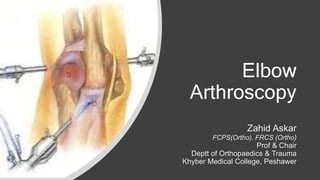
Elbow
Arthroscopy
Zahid Askar
FCPS(Ortho), FRCS (Ortho)
Prof & Chair
Deptt of Orthopaedics & Trauma
Khyber Medical College, Peshawer
Introduction
• 1931 Burman
• Initial Description in 1980s
• Confined space, complex
articulation, proximity of major
neurovascular structures
• Initially used primarily as a
diagnostic tool, now routinely
used to treat
• Advantages
• Improved articular visualization
• Decreased postoperative pain
• Faster postoperative recovery
• Disadvantages
• Technically demanding
• High risk of damage to
neurovascular structures due to
proximity to the joint
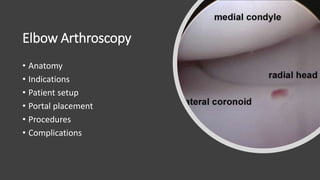
Elbow Arthroscopy
• Anatomy
• Indications
• Patient setup
• Portal placement
• Procedures
• Complications
Anatomy
Indications
•Loose body removal
•Osteophyte debridement
•Synovectomy
•Capsular releases for stiffness
•OCD capitellum
•Lateral epicondylitis
•Debridement for septic arthritis
Preparation
• GA
• EUA
• Tourniquet
Instruments
4 mm, 30° angled arthroscope in the anterior
compartment, and use a 2.7 mm, 30° scope in the
posterolateral and posterior compartments.
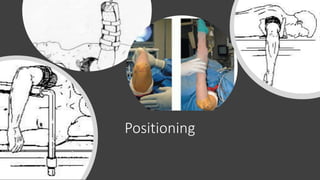
Positioning
Prone Elbow Arthroscopy
Advantages
• Best access to posterior portal
• No arm support necessary
Disadvantages
• More difficult anesthesia
• Difficult to convert to open
• Image reversal
Lateral decubitus elbow arthroscopy
• Same advantages with the prone position
• It does not compromise the airway
Supine Elbow Arthroscopy
Advantages
• Best anterior access
• Easier anesthesia
• Easy conversion to open
Disadvantages
• Difficult posterior access
and orientation
Portal Placement
Technique
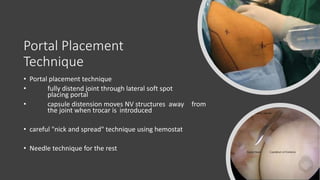
• Portal placement technique
• fully distend joint through lateral soft spot
placing portal
• capsule distension moves NV structures away from
the joint when trocar is introduced
• careful "nick and spread" technique using hemostat
• Needle technique for the rest
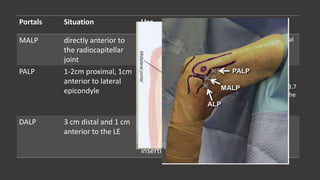
Portals
• Lateral
DALP
MALP
PALP
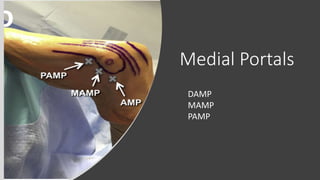
• Medial
• Posterior
DP
PL
DL
DAMP
MAMP
PAMP
Lateral Portals
Standard or DALP
MALP
PALP
.
,
Portals Situation Use Neurovascular
Straucuture
MALP directly anterior to
the radiocapitellar
joint
workhorse of the lateral
portals.
9.8 mm from the radial
nerve
PALP 1-2cm proximal, 1cm
anterior to lateral
epicondyle
See radial head, medial
side of elbow, coronoid,
trochlea, brachialis
insertion, coronoid fossa
Radial nerve with an
average distance
ranging from 9.9 to 13.7
mm and 6 mm from the
LABCN
DALP 3 cm distal and 1 cm
anterior to the LE
See radial head, medial
side of elbow, coronoid,
trochlea, brachialis
insertion, coronoid fossa
radial nerve 4.0 to
7.2 mm.LABCN is
approximately 7.6 to
12.6 mm away
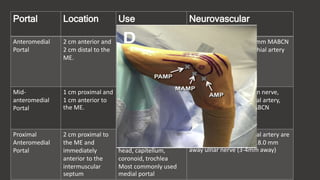
Medial Portals
DAMP
MAMP
PAMP
Portal Location Use Neurovascular
Structures
Anteromedial
Portal
2 cm anterior and
2 cm distal to the
ME.
Used most often to
augment the proximal
anteromedial portal to
access medial recess.
Place under direct
visualization.
Median nerve 5.0 to 7.0 mm MABCN
1.0 to 8.9 mm away, Brachial artery
15.2 to 16.6 mm
Mid-
anteromedial
Portal
1 cm proximal and
1 cm anterior to
the ME.
Given its close proximity
to the anteromedial
portal and proximal
anteromedial portal
(PAMP), it is rarely used
13.8 mm from the median nerve,
17.6 mm from the brachial artery,
and 7.0 mm from the MABCN
Proximal
Anteromedial
Portal
2 cm proximal to
the ME and
immediately
anterior to the
intermuscular
septum
viewing entire anterior
compartment, radial
head, capitellum,
coronoid, trochlea
Most commonly used
medial portal
median nerve and brachial artery are
approximately 12.4 and 18.0 mm
away ulnar nerve (3-4mm away)
Posterior
Portals
DPP
PLP
DLP
DUP
Portal Location Use Neurovascular
Structures
Straight
posterior
(transtriceps)
3cm proximal to
olecranon, triceps
midline (musculotend.
junction
Elbow partially extended, good
for removing impinging
olecranon osteophytes and
loose bodies from posteromedial
compartment
NONE
Posterolateral 2-3 cm proximal to
olecranon and just
lateral to triceps
Elbow 20-30deg flexion (to relax
triceps)
NIL
Direct lateral
(or midlateral)
"soft spot" portal (in
triangle formed by
olecranon, radial
head, epicondyle)
Initial site for joint distension
before scope is inserted,
viewing posterior compartment
relatively safe,
lateral
antebrachial
cutaneous nerve
Portals commonly used
PALP provides good visualization of the anterior
ulnohumeral and radiocapitellar joint
Soft Spot Portal Best Visualization
• Posterior Surface of Radial Head • Posterior Capitellum •
Radial Surface of Olecranon
Proximal Medial Portal Best Visualization for: •
Radiocapitellar joint • Coronoid • Trochlea •
Radio-ulnar joint • Anterior capsule
Posterolateral Portal Best Visualization for:
• Olecranon Process • Olecranon Fossa • Posterior
Ulnar Gutter
Olecronon
ME
Ulnar Nerve
Radial Head
Most experienced only
• Capsulectomy •Osteocapsular
arthroplasty • Fracture fixation
Low
Diagnostic arthroscopy, Loose body
removal , Plicae excision Debridement of OCD
Advanced
• Synovectomy • Capsulotomy •
Radial head excision • Lateral
epicondylitis release
Level of experience
Pearls
• PROPER POSITIONING OF THE
PATIENT
• Identification and labelling of all
landmarks
• Consideration of the intra-
articular pathology
• Fewest number of portals
required
• Beware of the location of Radial ,
Ulnar and Median Nerve
Pitfalls
• Beware of the prior surgical interventions
• Excessive swelling and fluid extravasation
• Each additional portal increase the risk of complications
• Inadvertent distal placement of anterior portals
decrease the safe working distance from critical
neurovascular distances
• Because of the location of the Ulnar nerve , here is no
true safe zone on the medial side
• Elbow arthroscopy is a difficult procedure with a
steep learning curve
• As experience is gained indications are expanding
• Start with easier procedures and stay in the safe
side
Thanks for your attention !!!

Elbow arthroscopy

  • 1.
    Elbow Arthroscopy Zahid Askar FCPS(Ortho), FRCS(Ortho) Prof & Chair Deptt of Orthopaedics & Trauma Khyber Medical College, Peshawer
  • 2.
    Introduction • 1931 Burman •Initial Description in 1980s • Confined space, complex articulation, proximity of major neurovascular structures • Initially used primarily as a diagnostic tool, now routinely used to treat
  • 3.
    • Advantages • Improvedarticular visualization • Decreased postoperative pain • Faster postoperative recovery • Disadvantages • Technically demanding • High risk of damage to neurovascular structures due to proximity to the joint
  • 4.
    Elbow Arthroscopy • Anatomy •Indications • Patient setup • Portal placement • Procedures • Complications
  • 5.
  • 6.
    Indications •Loose body removal •Osteophytedebridement •Synovectomy •Capsular releases for stiffness •OCD capitellum •Lateral epicondylitis •Debridement for septic arthritis
  • 7.
  • 8.
    Instruments 4 mm, 30°angled arthroscope in the anterior compartment, and use a 2.7 mm, 30° scope in the posterolateral and posterior compartments.
  • 9.
  • 10.
    Prone Elbow Arthroscopy Advantages •Best access to posterior portal • No arm support necessary Disadvantages • More difficult anesthesia • Difficult to convert to open • Image reversal Lateral decubitus elbow arthroscopy • Same advantages with the prone position • It does not compromise the airway Supine Elbow Arthroscopy Advantages • Best anterior access • Easier anesthesia • Easy conversion to open Disadvantages • Difficult posterior access and orientation
  • 11.
    Portal Placement Technique • Portalplacement technique • fully distend joint through lateral soft spot placing portal • capsule distension moves NV structures away from the joint when trocar is introduced • careful "nick and spread" technique using hemostat • Needle technique for the rest
  • 12.
    Portals • Lateral DALP MALP PALP • Medial •Posterior DP PL DL DAMP MAMP PAMP
  • 13.
  • 14.
    . , Portals Situation UseNeurovascular Straucuture MALP directly anterior to the radiocapitellar joint workhorse of the lateral portals. 9.8 mm from the radial nerve PALP 1-2cm proximal, 1cm anterior to lateral epicondyle See radial head, medial side of elbow, coronoid, trochlea, brachialis insertion, coronoid fossa Radial nerve with an average distance ranging from 9.9 to 13.7 mm and 6 mm from the LABCN DALP 3 cm distal and 1 cm anterior to the LE See radial head, medial side of elbow, coronoid, trochlea, brachialis insertion, coronoid fossa radial nerve 4.0 to 7.2 mm.LABCN is approximately 7.6 to 12.6 mm away
  • 15.
  • 16.
    Portal Location UseNeurovascular Structures Anteromedial Portal 2 cm anterior and 2 cm distal to the ME. Used most often to augment the proximal anteromedial portal to access medial recess. Place under direct visualization. Median nerve 5.0 to 7.0 mm MABCN 1.0 to 8.9 mm away, Brachial artery 15.2 to 16.6 mm Mid- anteromedial Portal 1 cm proximal and 1 cm anterior to the ME. Given its close proximity to the anteromedial portal and proximal anteromedial portal (PAMP), it is rarely used 13.8 mm from the median nerve, 17.6 mm from the brachial artery, and 7.0 mm from the MABCN Proximal Anteromedial Portal 2 cm proximal to the ME and immediately anterior to the intermuscular septum viewing entire anterior compartment, radial head, capitellum, coronoid, trochlea Most commonly used medial portal median nerve and brachial artery are approximately 12.4 and 18.0 mm away ulnar nerve (3-4mm away)
  • 17.
  • 18.
    Portal Location UseNeurovascular Structures Straight posterior (transtriceps) 3cm proximal to olecranon, triceps midline (musculotend. junction Elbow partially extended, good for removing impinging olecranon osteophytes and loose bodies from posteromedial compartment NONE Posterolateral 2-3 cm proximal to olecranon and just lateral to triceps Elbow 20-30deg flexion (to relax triceps) NIL Direct lateral (or midlateral) "soft spot" portal (in triangle formed by olecranon, radial head, epicondyle) Initial site for joint distension before scope is inserted, viewing posterior compartment relatively safe, lateral antebrachial cutaneous nerve
  • 19.
  • 20.
    PALP provides goodvisualization of the anterior ulnohumeral and radiocapitellar joint Soft Spot Portal Best Visualization • Posterior Surface of Radial Head • Posterior Capitellum • Radial Surface of Olecranon
  • 21.
    Proximal Medial PortalBest Visualization for: • Radiocapitellar joint • Coronoid • Trochlea • Radio-ulnar joint • Anterior capsule Posterolateral Portal Best Visualization for: • Olecranon Process • Olecranon Fossa • Posterior Ulnar Gutter
  • 22.
  • 25.
    Most experienced only •Capsulectomy •Osteocapsular arthroplasty • Fracture fixation Low Diagnostic arthroscopy, Loose body removal , Plicae excision Debridement of OCD Advanced • Synovectomy • Capsulotomy • Radial head excision • Lateral epicondylitis release Level of experience
  • 26.
    Pearls • PROPER POSITIONINGOF THE PATIENT • Identification and labelling of all landmarks • Consideration of the intra- articular pathology • Fewest number of portals required • Beware of the location of Radial , Ulnar and Median Nerve
  • 27.
    Pitfalls • Beware ofthe prior surgical interventions • Excessive swelling and fluid extravasation • Each additional portal increase the risk of complications • Inadvertent distal placement of anterior portals decrease the safe working distance from critical neurovascular distances • Because of the location of the Ulnar nerve , here is no true safe zone on the medial side
  • 28.
    • Elbow arthroscopyis a difficult procedure with a steep learning curve • As experience is gained indications are expanding • Start with easier procedures and stay in the safe side
  • 29.
    Thanks for yourattention !!!