
1Challenge the future
Marching Cubes
A High Resolution 3D Surface Construction
Algorithm
2Challenge the future
Introduction
• Algorithm developed by William E. Lorensen and Harvey E.
Cline and published in the 1987 SIGGRAPH proceedings.
• Aims to create 3D models from Medical data:
• X-ray computed tomography (CT)
• Magnetic resonance (MR)
• Single-photon emission computed
tomography (SPECT)
3Challenge the future
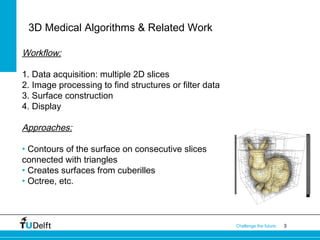
3D Medical Algorithms & Related Work
Workflow:
1. Data acquisition: multiple 2D slices
2. Image processing to find structures or filter data
3. Surface construction
4. Display
Approaches:
• Contours of the surface on consecutive slices
connected with triangles
• Creates surfaces from cuberilles
• Octree, etc.
4Challenge the future
Marching Cubes Algorithm
• Locate surface to a user-specified value
• Create triangles
• Calculate normals to ensure the quality of the image
Idea
5Challenge the future
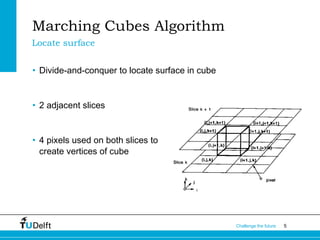
Marching Cubes Algorithm
• Divide-and-conquer to locate surface in cube
• 2 adjacent slices
• 4 pixels used on both slices to
create vertices of cube
Locate surface
6Challenge the future
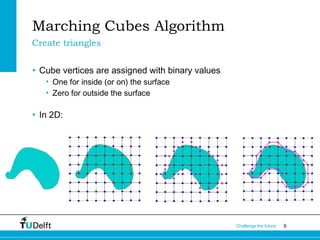
Marching Cubes Algorithm
• Cube vertices are assigned with binary values
• One for inside (or on) the surface
• Zero for outside the surface
• In 2D:
Create triangles
7Challenge the future
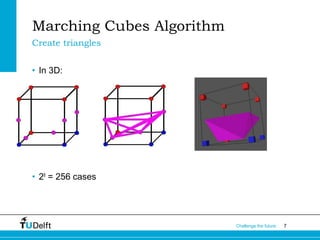
Marching Cubes Algorithm
• In 3D:
• 28
= 256 cases
Create triangles
8Challenge the future
Marching Cubes Algorithm
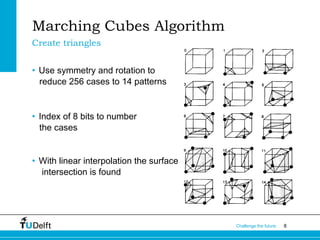
• Use symmetry and rotation to
reduce 256 cases to 14 patterns
• Index of 8 bits to number
the cases
• With linear interpolation the surface
intersection is found
Create triangles
9Challenge the future
Marching Cubes Algorithm
• Final step to increase the quality of the image
• With central differences an unit normal can be calculated for
every cube vertex using 4 slices
• Interpolation of these normals
Calculate normals
10Challenge the future
Improvements
• Efficiency increased by using pixel-to-pixel and line-to-line
coherence.
• 3 new edges are needed to interpolate
• Other 9 edges are obtained from previous slices, lines or pixels
• Reducing slice resolution by averaging four pixels into one
• Solid modeling using the three notions “inside”, “outside”,
and “on”
11Challenge the future
Implementation and Results
Implementation
• Number of triangles is proportional to the area of the surface = A lot!
• Filtering is applied to reduce the resolution and number of triangles
Results
• CT
• MR
• SPECT
12Challenge the future
Conclusions
• Realism is achieved by the calculation of the normalized gradient
• Large number of triangles reduced by surface cutting and
connectivity
• The algorithm has some flaws:
• high amount of memory needed to store resulting surface
• Sign change in the 14 original patterns can lead to mistakes

Marching Cubes

  • 1.
    1Challenge the future MarchingCubes A High Resolution 3D Surface Construction Algorithm
  • 2.
    2Challenge the future Introduction •Algorithm developed by William E. Lorensen and Harvey E. Cline and published in the 1987 SIGGRAPH proceedings. • Aims to create 3D models from Medical data: • X-ray computed tomography (CT) • Magnetic resonance (MR) • Single-photon emission computed tomography (SPECT)
  • 3.
    3Challenge the future 3DMedical Algorithms & Related Work Workflow: 1. Data acquisition: multiple 2D slices 2. Image processing to find structures or filter data 3. Surface construction 4. Display Approaches: • Contours of the surface on consecutive slices connected with triangles • Creates surfaces from cuberilles • Octree, etc.
  • 4.
    4Challenge the future MarchingCubes Algorithm • Locate surface to a user-specified value • Create triangles • Calculate normals to ensure the quality of the image Idea
  • 5.
    5Challenge the future MarchingCubes Algorithm • Divide-and-conquer to locate surface in cube • 2 adjacent slices • 4 pixels used on both slices to create vertices of cube Locate surface
  • 6.
    6Challenge the future MarchingCubes Algorithm • Cube vertices are assigned with binary values • One for inside (or on) the surface • Zero for outside the surface • In 2D: Create triangles
  • 7.
    7Challenge the future MarchingCubes Algorithm • In 3D: • 28 = 256 cases Create triangles
  • 8.
    8Challenge the future MarchingCubes Algorithm • Use symmetry and rotation to reduce 256 cases to 14 patterns • Index of 8 bits to number the cases • With linear interpolation the surface intersection is found Create triangles
  • 9.
    9Challenge the future MarchingCubes Algorithm • Final step to increase the quality of the image • With central differences an unit normal can be calculated for every cube vertex using 4 slices • Interpolation of these normals Calculate normals
  • 10.
    10Challenge the future Improvements •Efficiency increased by using pixel-to-pixel and line-to-line coherence. • 3 new edges are needed to interpolate • Other 9 edges are obtained from previous slices, lines or pixels • Reducing slice resolution by averaging four pixels into one • Solid modeling using the three notions “inside”, “outside”, and “on”
  • 11.
    11Challenge the future Implementationand Results Implementation • Number of triangles is proportional to the area of the surface = A lot! • Filtering is applied to reduce the resolution and number of triangles Results • CT • MR • SPECT
  • 12.
    12Challenge the future Conclusions •Realism is achieved by the calculation of the normalized gradient • Large number of triangles reduced by surface cutting and connectivity • The algorithm has some flaws: • high amount of memory needed to store resulting surface • Sign change in the 14 original patterns can lead to mistakes

Editor's Notes

  • #3 - Objective paper - Introduction to 3D medical algorithms - Related work
  • #4 http://www.byclb.com/TR/Tutorials/volume_rendering/ch1_1.htm Octree: http://http.developer.nvidia.com/GPUGems2/gpugems2_chapter37.html BUT each of these techniques throw away useful information in the original data. The marching cubes approach uses information from the original 3D data to derive inter-slice connectivity, surface location and surface gradient.
  • #5 Explain algorithm Divide and conquer Slices and cubes Intersection cubes and surface 14 patterns Normalized vector and density
  • #12 Implementation Overview Errors
  • #13 http://web.cs.wpi.edu/~matt/courses/cs563/talks/march_cub.html