RESERVOIR ENGINEERING
BY
TAREK
AHMEDLECTURER
SYED NAWAZ
FOUNDER OF PETROLEUM UNIVERSE
INTRODUCTION
• Ph.D in Petroleum Engineering from university
of Oklahoma
• Writer of Hydrocarbon Phase Behavior (1989)
Fundamentals of Rock Properties
Porosity
• Definition and
its types
• Numerical
problem
Saturation
• Definition and
its types
• Numerical
problem
Surface and
Interfacial Tension
• Introduction
• Important terms
• Formula
• Derivation
• Question?
Introduction
• This comes into picture only
when the reservoir is of
multiphase system. Fluids
should be immiscible.
• The reason behind the OWC
and GOC and GWC
• The forces at the interface
of 2 immiscible fluid is
called interfacial or surface
tension. They both are
classified based on state of
matters.
• If force act between gas and
liquid then it is surface
tension. Between 2 fluid is
interfacial tension.
Important terms
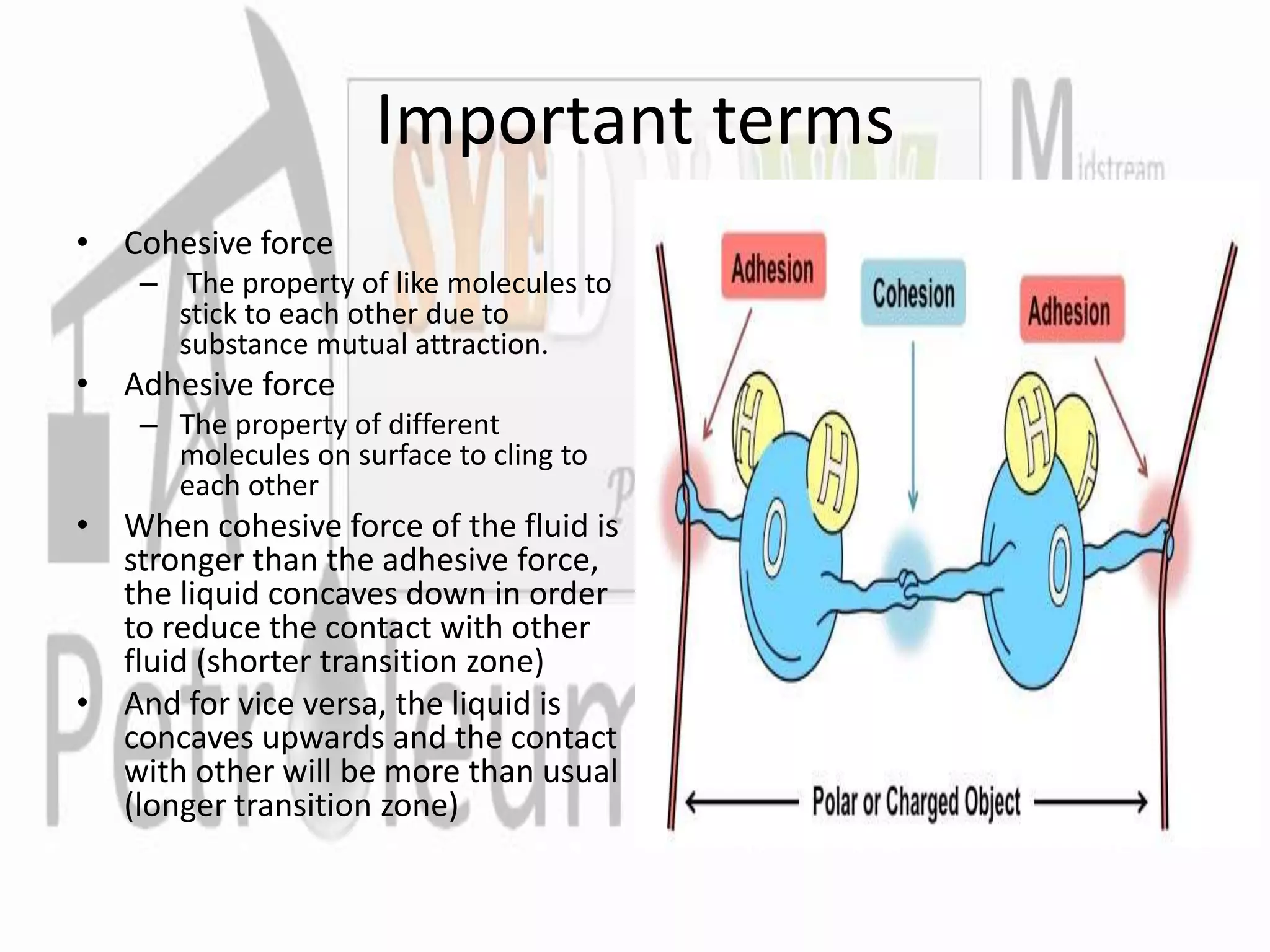
• Cohesive force
– The property of like molecules to
stick to each other due to
substance mutual attraction.
• Adhesive force
– The property of different
molecules on surface to cling to
each other
• When cohesive force of the fluid is
stronger than the adhesive force,
the liquid concaves down in order
to reduce the contact with other
fluid (shorter transition zone)
• And for vice versa, the liquid is
concaves upwards and the contact
with other will be more than usual
(longer transition zone)
Interfacial tension
• When more than one
immiscible fluid present
in the porous medium a
thin film develops at the
boundary between the 2
fluids surface.
• At the interface of the
fluid, the force exerted
by 2 immiscible fluid
phases is dissimilar
which leads to the
phenomenon of
interfacial tension.
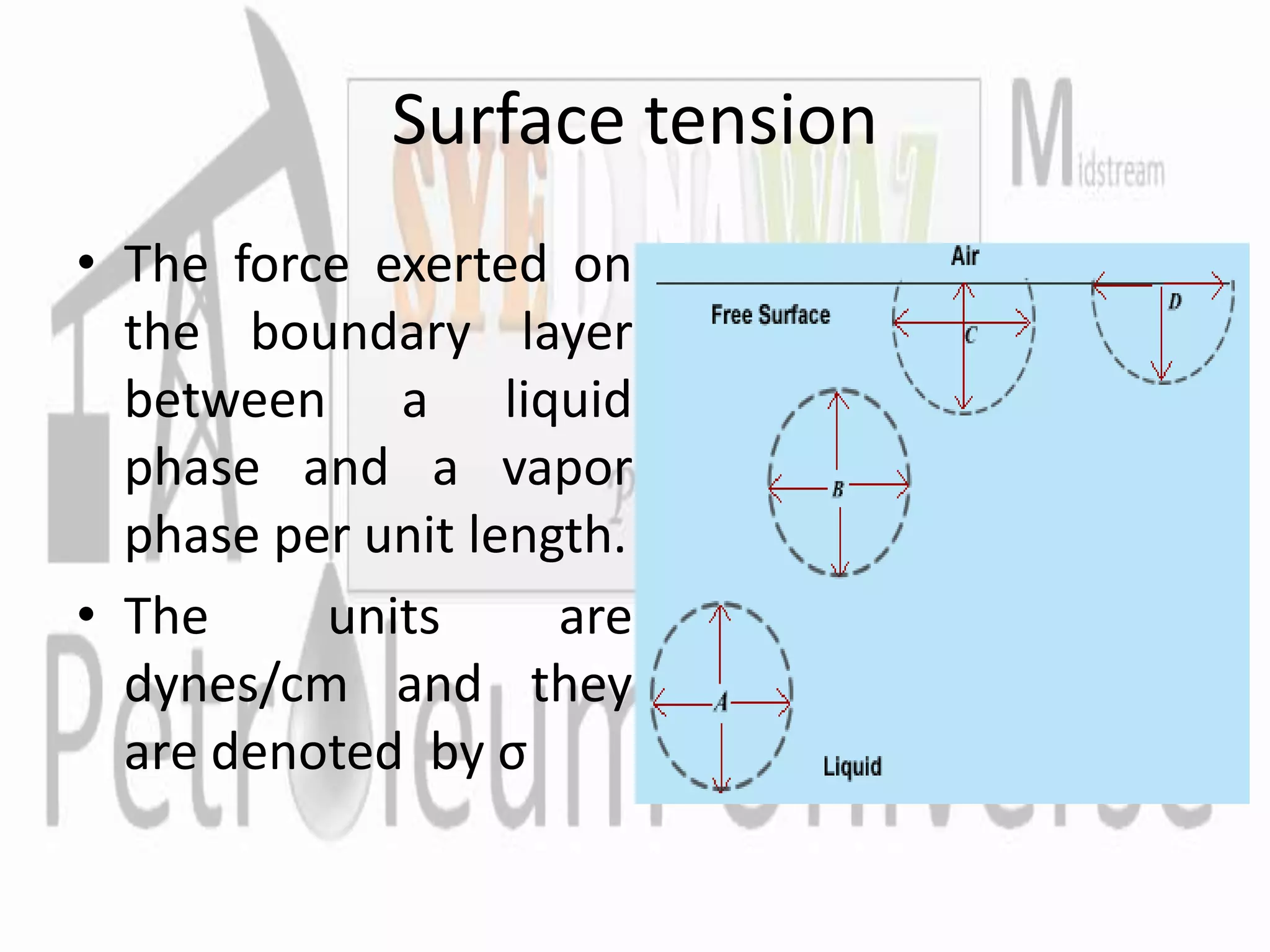
Surface tension
• The force exerted on
the boundary layer
between a liquid
phase and a vapor
phase per unit length.
• The units are
dynes/cm and they
are denoted by σ
Formula
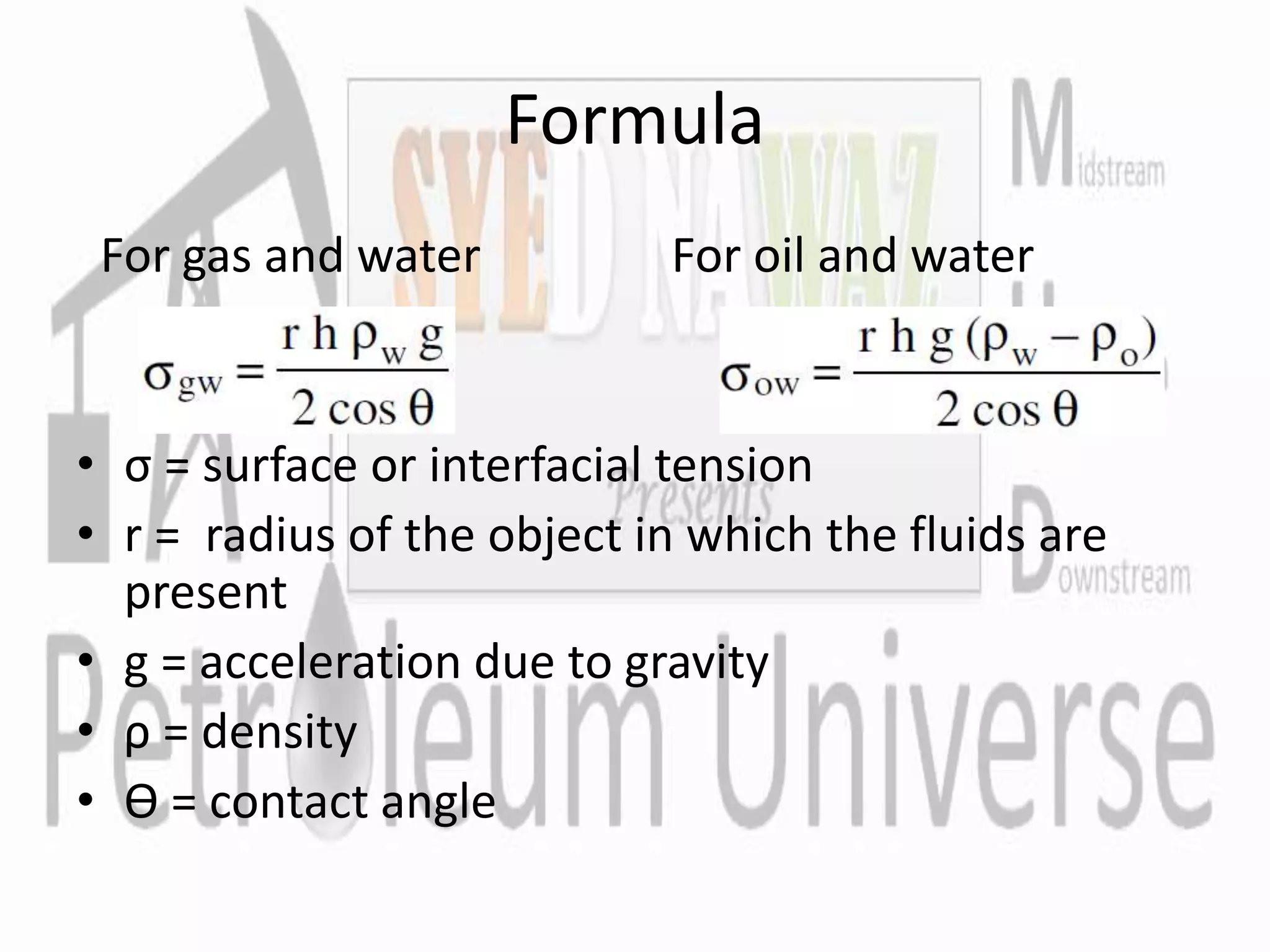
For gas and water For oil and water
• σ = surface or interfacial tension
• r = radius of the object in which the fluids are
present
• g = acceleration due to gravity
• ρ = density
• Ѳ = contact angle
derivation
By taking r as a radius of a
capillary tube, the total
upward forces is given as
The upward force is
counteracted by the weight
of the water, which is
equivalent to downward
force of mass times
acceleration
Derivation contd.
• Density of air is negligible in comparison of
water
• Equating both the equations
• Finally for gas and water the equation is
• For oil and water the equation is
Numerical Approach
• An oil-water system has a radius of 0.001 mm,
whose angle of contact is 45 and density of oil
and water is given as 43.7 and 62.4 lb/cubic ft.
Calculated interfacial tension between fluids is
30 dynes/cm find the height to which the
liquid is held in cm?
References and Queries?
• Calhoun, J. R., Fundamentals of Reservoir Engineering. University of
Oklahoma
• Press, 1976.
• Cole, Frank, Reservoir Engineering Manual. Houston: Gulf Publishing
• Company, 1969.
• Dykstra, H., and Parsons, R. L., “The Prediction of Oil Recovery by
Water
• Flood,” In Secondary Recovery of Oil in the United States, 2nd ed., pp.
• 160–174. API, 1950.
• Geertsma, J., “The Effect of Fluid Pressure Decline on Volumetric
Changes
• of Porous Rocks,” Trans. AIME, 1957, pp. 210, 331–340.
• Hall, H. N., “Compressibility of Reservoir Rocks,” Trans. AIME, 1953, p.
309.
• Petrogate academy- Dehradun
Email ID: nawaz.delta.au@gmail.com
Thank you
https://bit.ly/3ibtqZt
https://www.facebook.com/Petroleum-Universe-
575251903155462/?modal=admin_todo_tour
https://www.linkedin.com/company/67110978/admin/
https://www.slideshare.net/SYEDNAWAZ4/edit_my_uploads

Surface and interfacial tension

  • 1.
  • 2.
    INTRODUCTION • Ph.D inPetroleum Engineering from university of Oklahoma • Writer of Hydrocarbon Phase Behavior (1989)
  • 3.
    Fundamentals of RockProperties Porosity • Definition and its types • Numerical problem Saturation • Definition and its types • Numerical problem Surface and Interfacial Tension • Introduction • Important terms • Formula • Derivation • Question?
  • 4.
    Introduction • This comesinto picture only when the reservoir is of multiphase system. Fluids should be immiscible. • The reason behind the OWC and GOC and GWC • The forces at the interface of 2 immiscible fluid is called interfacial or surface tension. They both are classified based on state of matters. • If force act between gas and liquid then it is surface tension. Between 2 fluid is interfacial tension.
  • 5.
    Important terms • Cohesiveforce – The property of like molecules to stick to each other due to substance mutual attraction. • Adhesive force – The property of different molecules on surface to cling to each other • When cohesive force of the fluid is stronger than the adhesive force, the liquid concaves down in order to reduce the contact with other fluid (shorter transition zone) • And for vice versa, the liquid is concaves upwards and the contact with other will be more than usual (longer transition zone)
  • 6.
    Interfacial tension • Whenmore than one immiscible fluid present in the porous medium a thin film develops at the boundary between the 2 fluids surface. • At the interface of the fluid, the force exerted by 2 immiscible fluid phases is dissimilar which leads to the phenomenon of interfacial tension.
  • 7.
    Surface tension • Theforce exerted on the boundary layer between a liquid phase and a vapor phase per unit length. • The units are dynes/cm and they are denoted by σ
  • 8.
    Formula For gas andwater For oil and water • σ = surface or interfacial tension • r = radius of the object in which the fluids are present • g = acceleration due to gravity • ρ = density • Ѳ = contact angle
  • 9.
    derivation By taking ras a radius of a capillary tube, the total upward forces is given as The upward force is counteracted by the weight of the water, which is equivalent to downward force of mass times acceleration
  • 10.
    Derivation contd. • Densityof air is negligible in comparison of water • Equating both the equations • Finally for gas and water the equation is • For oil and water the equation is
  • 11.
    Numerical Approach • Anoil-water system has a radius of 0.001 mm, whose angle of contact is 45 and density of oil and water is given as 43.7 and 62.4 lb/cubic ft. Calculated interfacial tension between fluids is 30 dynes/cm find the height to which the liquid is held in cm?
  • 12.
    References and Queries? •Calhoun, J. R., Fundamentals of Reservoir Engineering. University of Oklahoma • Press, 1976. • Cole, Frank, Reservoir Engineering Manual. Houston: Gulf Publishing • Company, 1969. • Dykstra, H., and Parsons, R. L., “The Prediction of Oil Recovery by Water • Flood,” In Secondary Recovery of Oil in the United States, 2nd ed., pp. • 160–174. API, 1950. • Geertsma, J., “The Effect of Fluid Pressure Decline on Volumetric Changes • of Porous Rocks,” Trans. AIME, 1957, pp. 210, 331–340. • Hall, H. N., “Compressibility of Reservoir Rocks,” Trans. AIME, 1953, p. 309. • Petrogate academy- Dehradun Email ID: nawaz.delta.au@gmail.com
  • 13.