I  am doing my extended
  project qualification asking 'to what extent
  does TV programmes (food media) represent
  both the problem and the solution for the
  eating disorder debate? With reference to 3
  or 4 case study texts for example
  magazine, TV, Website, advertising.
 In order to do this, I am going to look at a
  number of texts and see how
  they demonstrate this representation. I will
  also be looking at why the media is producing
  so many of these shows and why the
  audience is so obsessed with them.
 When  people hear the words „eating
 disorder‟ they automatically think of severly
 underweight people who are either struggling
 with anorexia nervosa or bulimia nervosa.
 This is untrue. The definition of an eating
 disorder can also refer to an overweight
 person who has an unhealthy obsession with
 food.
   Anorexia is an eating disorder characterized by
    an extremely reduced appetite or total aversion
    to food. Anorexia is a serious psychological
    disorder and is a condition that goes well beyond
    out-of-control dieting. With anorexia, the drive
    to become thinner is actually secondary to
    concerns about control and/or fears relating to
    one's body. There are psychological and
    behavioral symptoms as well as physical
    symptoms of anorexia including: depression,
    social withdrawal, fatigue, food obsession, heart
    and gastrointestinal complications, kidney
    function, flaky skin, brittle nails, and tooth loss
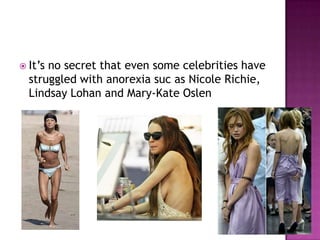
 It‟sno secret that even some celebrities have
  struggled with anorexia suc as Nicole Richie,
  Lindsay Lohan and Mary-Kate Oslen
   Anorexia Nervosa is more common in women than men, but
    people of all ages and backgrounds can suffer from the disease.
   In the UK, 1 in 100 women aged between 15 and 30, suffers from
    anorexia. Reports show girls as young as five years of age have
    weight concerns, and think about going on a diet.
   Approximately 11 people in 100,000 develop anorexia nervosa
    each year.
   Anorexia nervosa is most likely to strike during the mid-teenage
    years.
   Anorexia affects approximately 1 in 150 fifteen-year-old
    females, and 1 in 1000 fifteen-year-old males.
   Approximately 1 percent of 16 to 18 year olds have anorexia.
   About 40 percent of people with anorexia recover completely.
    Around 5 percent of cases of anorexia will be fatal.
   Currently, in developing countries and black
    communities, anorexia nervosa appears to be somewhat rare.
   The following table shows the number of diagnosed and admitted cases of anorexia
    in NHS hospitals, England, from 1996-97 onwards. Please note these figures
    represent individual cases and not the actual number of patients (some patients will
    have had more than one admission).


      2005-06                                              620
      2004-05                                              517
      2003-04                                              532
      2002-03                                              552
      2001-02                                              497
      2000-01                                              469
      1999-2000                                            482
      1998-99                                              465
      1997-98                                              484
      1996-97                                              419
   Bulimia nervosa is an eating disorder characterized
    by episodes of secretive excessive eating (binge-
    eating) followed by inappropriate methods of weight
    control, such as self-induced vomiting
    (purging), abuse of laxatives, or excessive exercise.
    Like anorexia, bulimia is generally thought to be a
    psychological eating disorder. It is another condition
    that goes beyond out-of-control dieting. The cycle of
    overeating and purging can quickly become an
    obsession similar to an addiction to drugs or other
    substances. Although bulimia has been widely
    considered to be pshychological and sociocultural in
    origin, not everyone is susceptible to developing
    bulimia.
   Young people in the age group of fourteen to twenty
    five are the most at risk of developing anorexia or
    bulimia.
   Approximately 1-2 percent of women in the UK suffer from
    bulimia.
   Every year there are as many as 18 new cases of bulimia
    nervosa per 100,000 population per year.
   Bulimia nervosa commonly begins in the mid-teenage
    years.
   Approximately 4 percent of women suffer
    with bulimia during their lifetime, but it is less common in
    men.
    The average age of onset of bulimia is 18-19 years.
   Bulimia affects mainly women between the ages of 16 and
    40, and is most likely to begin at about 19 years of age.
   According to some studies, as many as 8 percent of women
    suffer from bulimia at some stage in their life, and it
    affects about 5 percent of female college students.
   Approximately 5 percent of bulimia sufferers go on to
    develop anorexia nervosa.
   The following table shows the number of diagnosed and admitted cases of bulimia in
    NHS hospitals, England, from 1996-97 onwards. Please note these figures represent
    individual cases and not the actual number of patients (some patients will have had
    more than one admission).

        2005-06                                               23
        2004-05                                               23
        2003-04                                               22
        2002-03                                               32
        2001-02                                               26
        2000-01                                               19
        1999-2000                                             28
        1998-99                                               24
        1997-98                                               46
        1996-97                                               49
 Rather than controlling their appetites and
  calories, overweight and obese people consume
  more food than is necessary causing them to gain
  excess amounts of weight and become severly
  overweight or morbidly obese.
 Overweight is generally defined as having
  more body fat than is optimally healthy. Being
  overweight is a common condition, especially
  where food supplies are plentiful and lifestyles
  are sedentary. Excess weight has reached
  epidemic proportions globally, with more than 1
  billion adults being either overweight
  or obese.Increases have been observed across all
  age groups.
   Obesity is a medical condition in which excess body
    fat has accumulated to the extent that it may have
    an adverse effect on health, leading to reduced life
    expectancy and/or increased health problems.
    People are considered obese when their body mass
    index(BMI), a measurement obtained by dividing a
    person's weight in kilograms by the square of the
    person's height in metres, exceeds 30 kg/m2”
   Currently, in England, most people are overweight or
    obese. This includes 61.3% of adults and 30% of
    children aged between 2 and 15.
   Overweight and obese people are also at a higher risk
    of getting type two diabaetes and certain cancers.
 There  has been a marked increase in obesity
  rates over the past eight years – in 1993 13%
  of men and 16% of women were obese – in
  2011 this rose to 24% for men and 26% for
  women.
 For children attending reception class (aged
  4-5 years) during 2011-12, 9.5% were obese.
 During 2011-12 there were 11,736 hospital
  admissions due to obesity – this over 11 times
  higher than during 2001-02.
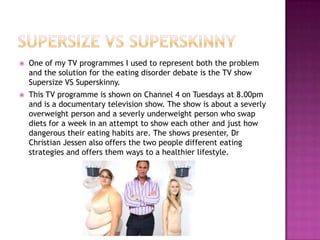
   One of my TV programmes I used to represent both the problem
    and the solution for the eating disorder debate is the TV show
    Supersize VS Superskinny.
   This TV programme is shown on Channel 4 on Tuesdays at 8.00pm
    and is a documentary television show. The show is about a severly
    overweight person and a severly underweight person who swap
    diets for a week in an attempt to show each other and just how
    dangerous their eating habits are. The shows presenter, Dr
    Christian Jessen also offers the two people different eating
    strategies and offers them ways to a healthier lifestyle.
 Because of its „helping‟ nature the show has
 been branded and represented as a solution
 to the eating disorder debate as it offers
 solutions to both ends of the eating disorder
 scale. The end of each show often shows the
 two people vowing never to go back to their
 old bad diets ever again and hows them
 having a new diet plan involving healthier
 foods. By seeing this, the audience belives
 that the show has helped the people and has
 helped the audience who may be looking for
 new healthier diets.
   However, Supersize vs Supserskinny can be argued to
    be a problem for the eating disorder debate.
    Although the show is all about offering a solution to
    people with poor diets, the advertisements during
    the show have an entirely differnet motive. Whilst
    watching an episode, during the adverts there was an
    advertisement for KFC‟s BBQ Rancher Box Meal which
    was targeted at women, especially those with a busy
    schedule and using the song “She‟s a lady” to attract
    the audiences attention.
   http://www.youtube.com/watch?v=kaX-AF0-Fpw
   When researching the nutrtional information on this
    meal I discovered that the meal comes to 1095
    calories. Considering a female should only consume
    2000 calories a day, this meal is very unhealthy and is
    over half of her recomemended guideline daily
    amounts (GDA).
 There was also an advertisement for Wyke‟s
 rich and creamy mature cheddar cheese
 during this television show which contains
 410 calories per 100g.
   The show has been accused of being 'triggering' for eating disorder
    sufferers, with Chief Executive of B-eat, Susan Ringwood, saying 'They're
    deadly, not entertainment.„
   It‟s been argued that replacing one unhealthy diet for another is taking
    an unnecessary risk with the contestants' health, to which Channel 4
    replied that this all takes place under the supervision of medical experts,
    including celebrity GP Dr Christian Jessen.
   During the last season of Supersize, which aired in 2011, young
    ambassadors for the charity B-eat (the UK‟s largest eating disorder
    support group) took to Twitter in droves to express concern.
   Over-indulging: Dr Christian Jessen shows Louise how much she eats with
    a rather vulgar visual aid
   Many described it as 'triggering', meaning that the programme caused
    them emotional distress relating to their own struggles with food and
    body image.
   One particularly enraged user, @Faloog, who is in recovery from anorexia
    nervosa, said: '#SupersizevSuperskinny. Sensationalist. Unhealthy
    messages & methods. Triggering. Unhelpful. Exploitive. Patronising. HATE
    IT.'
   In March 2011, Natasha Devon, Director of positive body image campaign
    Body Gossip, blogged her concerns about the way eating disorders are
    portrayed within Supersize, branding it 'reductive'.
   Dr Christian Jessen himself took to Twitter in response to Natasha‟s blog,
    claiming that they use 'the country‟s leading experts'.
   Yet he failed to mention the whole load of medical experts who had
    already refused to take part and had expressed their concerns.
   For a healthy member of the public, Supersize may seem like a bit of
    harmless fun, yet Dr Phillippa Diedrichs, a researcher at the University of
    West England‟s Centre for Appearance Research, warns against taking this
    view.
   She said: 'Reality shows that focus on weight loss tend to heavily promote
    the idea that the body is malleable, and that any size, weight, or shape
    can be obtained. 'These programmes often reinforce the unrealistic, thin
    beauty ideal by using body weight and weight loss as an indicator of
    participants' success (e.g. through weekly weigh-ins) and they often show
    an oversimplified relationship between weight status and health.'
   I also looked at a documentary Fearne Cotton did called
    „The truth about online anorexia‟. „Online anorexia‟ or
    „Pro-ana websites‟ as they are sometimes reffered to as is
    the promotion of the eating disorder anorexia nervosa. It is
    often referred to simply as "ana" and is sometimes
    personified by anorexics as a girl named 'Ana'. The lesser-
    used term pro-mia refers likewise to bulimia nervosa and
    is sometimes used interchangeably with pro-ana.
   Pro-ana organizations differ widely in their stances. Most
    claim that they exist mainly as a non-judgmental
    environment for anorexics; a place to turn to, to discuss
    their illness, and to support those who choose to enter
    recovery. Others deny anorexia nervosa is a mental illness
    and claim instead that it is a "lifestyle choice" that should
    be respected by doctors and family.
   Such sites have flourished on the Internet, mainly through tight-
    knit support groups centred around web forums and, more
    recently, social network services such Tumblr and Facebook .
    These groups are typically small, vulnerable, partly hidden and
    characterized by frequent migrations. They also have an
    overwhelming female readership and are frequently the only
    means of support available to socially isolated anorexics.
   Members of such support groups may:
   Endorse anorexia and/or bulimia as desirable (84% and 64%
    respectively in a 2010 survey).
   Share crash dieting techniques and recipes (67% of sites in a 2006
    survey, rising to 83% in a 2010 survey).
   Coach each other on using socially acceptable pretexts for
    refusing food, such as veganism (which is notably more prevalent
    in the eating-disordered in general
   Compete with each other at losing weight, or fast together in
    displays of solidarity.
   Commiserate with one another after breaking fast or binging.
   Advise on how to best induce vomiting, and on using laxatives.
   Give tips on hiding weight loss from parents and doctors.
   Post their weight, body measurements, details of their dietary
    regimen or pictures of themselves to solicit acceptance and
    affirmation.
   Suggest ways to ignore or suppress hunger pangs.
 Possibly the worst part of these „Pro-ana‟
  websites is that the people on them truly believe
  that they are helping one another by sharing
  information such as “If you're going to drink diet
  soda, drink quickly in large gulps. This will help
  fill you up faster and prevent hunger pains” and
  “Most people just want the taste of food, so
  chew the food you want and spit it out. Don't
  swallow the food!” I found many more „useful‟
  tips and hints to keep from being hungry on this
  website:
 http://anabootcamp.weebly.com/techniques.ht
  ml
 Fearne Cotton even calls the websites “so sad”
  and struggles when she is on the „Rainbow diet‟.
  The rainbow diet can be seen in the next slide.
 Fearne says: “There‟s so much pressure on
  women to conform and look a certain way. Even
  if you‟re not actually sucked into dieting
  yourself, it‟s still around you and you have to
  choose not to take it on.”
 “Women waste so much time worrying about it.
  Especially young girls – I think it‟s such a shame
  they don‟t put their energy into having
  adventures and achieving their goals. It‟s all
  about looking a certain way, rather than doing
  something cool. A lot of girls probably hold
  themselves back from achieving a lot because
  they‟re too busy obsessing about their weight.”
   Monday (white):
    Breakfast: ½ apple (40.5 cals)
    Lunch: ½ apple (40.5 cals)
    Dinner: 1 cucumber (24 cals)
    Total: 105 cals
    Tuesday (yellow):
    Breakfast: 1 banana (108.5 cals)
    Lunch: 1 banana (108.5 cals)
    Dinner: ½ cup corn (66 cals)
    Total: 283 cals
    Wednesday (fast):
    Thursday (orange):
    Breakfast: ½ orange (31 cals)
    Lunch: ½ orange (31 cals)
    Dinner: 1 carrot (26 cals)
    Total: 88 cals
    Friday (red):
    Breakfast: ½ cup strawberries (21.5 cals)
    Lunch: ½ cup strawberries (21.5 cals)
    Dinner: ½ red pepper (16 cals)
    Total: 59 cals
    Saturday (purple/blue):
    Breakfast: 10 blueberries (8 cals)
    Lunch: 10 blueberries (8 cals)
    Dinner: 10 raspberries (24 cals)
    Total: 40 cals
    Sunday (green):
    Breakfast: ½ cup grapes (57 cals)
    Lunch: ½ grapes (57 cals)
    Dinner: 1 cup lettuce (7 cals)
    Total: 121 cals
 As you can clearly see, this is a dangerous diet
  that is being promoted by these websites that
  has consequences such as fainting, tiredness and
  dehydration.
 Fearne adresses the problem that these websites
  have caused when she says she “feels guilty
  about going out for dinner” when she broke the
  rules of the diet and had a tuna steak salad she
  said that she felt “It became more about the
  rules and the boundaries I‟d set for myself. I
  kept thinking I shouldn‟t eat all of this salad”
  this is obviously showing that many other people
  using these pro-ana websites are most likely to
  feel guilty if they break them as well, making
  them incredibly powerful against vunverable
  people.
 Pro-ana sites are clearly a problem in the eating
  disorder debate but are being labelled by people
  with eating disorders as being the solution as
  they offer what they see as helpful advice
 Ithas been argued that food advertisements
  can be a big part of the problem when
  adressing obesity and overweightness by
  having celebrities advertising fast food or
  unhelathy snacks.
   This has been especially
    criticised when these
    advertisements can be seen by
    children and stars such as
    Cheryl Cole and Girls Aloud
    act as role model for young
    girls to aspire to be like so the
    argument is that if a girl sees
    Girl‟s Aloud advertising a Kit
    Kat Senses bar then she is
    likely to buy one to be like her
    role models. It has been
    argued that this is
    problematic because although
    a Kit Kat Senses bar only
    contains 165 calories, its
    argued that Girl‟s Aloud would
    never eat one to stay so thin
    so that is leading young girls
    to chase unrealistic ideals.
 The same can be said for
 Beyoncé advertising Pepsi
 as sugary and fizzy drinks
 are every parents worst
 nightmare, having one of
 the most influencial and
 empowering people on
 the planet endorsing it
 will make the audience
 think that it is okay to
 consume this largely
 unhealthy product
 because Beyoncé does it.
   http://www.youtube.com/watch?v=VyFVG4VfPmg
   The Little Mermaid Disney film, Urusla the wicked sea witch says
    how she can 'help' people in need.
    She calls the people in the couldren, one of whom is overweight
    then trhe lyrics are 'I use it on behalf of the miserable, the
    lonely, and depressed (pathetic). Poor unfortunate souls In
    pain, in need this one longing to be thinner that one wants to get
    the girl and do I help them? Yes, indeed‟
   From an early age, children are seeing that overweight people
    are depressed and unhappy with their lives because of their
    weight. Even Ursula, the villain is overweight, and the hero and
    damsel in distress is slim and of an average weight.

EPQ Presentation

  • 2.
    I amdoing my extended project qualification asking 'to what extent does TV programmes (food media) represent both the problem and the solution for the eating disorder debate? With reference to 3 or 4 case study texts for example magazine, TV, Website, advertising.  In order to do this, I am going to look at a number of texts and see how they demonstrate this representation. I will also be looking at why the media is producing so many of these shows and why the audience is so obsessed with them.
  • 3.
     When people hear the words „eating disorder‟ they automatically think of severly underweight people who are either struggling with anorexia nervosa or bulimia nervosa. This is untrue. The definition of an eating disorder can also refer to an overweight person who has an unhealthy obsession with food.
  • 4.
    Anorexia is an eating disorder characterized by an extremely reduced appetite or total aversion to food. Anorexia is a serious psychological disorder and is a condition that goes well beyond out-of-control dieting. With anorexia, the drive to become thinner is actually secondary to concerns about control and/or fears relating to one's body. There are psychological and behavioral symptoms as well as physical symptoms of anorexia including: depression, social withdrawal, fatigue, food obsession, heart and gastrointestinal complications, kidney function, flaky skin, brittle nails, and tooth loss
  • 5.
     It‟sno secretthat even some celebrities have struggled with anorexia suc as Nicole Richie, Lindsay Lohan and Mary-Kate Oslen
  • 6.
    Anorexia Nervosa is more common in women than men, but people of all ages and backgrounds can suffer from the disease.  In the UK, 1 in 100 women aged between 15 and 30, suffers from anorexia. Reports show girls as young as five years of age have weight concerns, and think about going on a diet.  Approximately 11 people in 100,000 develop anorexia nervosa each year.  Anorexia nervosa is most likely to strike during the mid-teenage years.  Anorexia affects approximately 1 in 150 fifteen-year-old females, and 1 in 1000 fifteen-year-old males.  Approximately 1 percent of 16 to 18 year olds have anorexia.  About 40 percent of people with anorexia recover completely. Around 5 percent of cases of anorexia will be fatal.  Currently, in developing countries and black communities, anorexia nervosa appears to be somewhat rare.
  • 7.
    The following table shows the number of diagnosed and admitted cases of anorexia in NHS hospitals, England, from 1996-97 onwards. Please note these figures represent individual cases and not the actual number of patients (some patients will have had more than one admission). 2005-06 620 2004-05 517 2003-04 532 2002-03 552 2001-02 497 2000-01 469 1999-2000 482 1998-99 465 1997-98 484 1996-97 419
  • 8.
    Bulimia nervosa is an eating disorder characterized by episodes of secretive excessive eating (binge- eating) followed by inappropriate methods of weight control, such as self-induced vomiting (purging), abuse of laxatives, or excessive exercise. Like anorexia, bulimia is generally thought to be a psychological eating disorder. It is another condition that goes beyond out-of-control dieting. The cycle of overeating and purging can quickly become an obsession similar to an addiction to drugs or other substances. Although bulimia has been widely considered to be pshychological and sociocultural in origin, not everyone is susceptible to developing bulimia.  Young people in the age group of fourteen to twenty five are the most at risk of developing anorexia or bulimia.
  • 9.
    Approximately 1-2 percent of women in the UK suffer from bulimia.  Every year there are as many as 18 new cases of bulimia nervosa per 100,000 population per year.  Bulimia nervosa commonly begins in the mid-teenage years.  Approximately 4 percent of women suffer with bulimia during their lifetime, but it is less common in men. The average age of onset of bulimia is 18-19 years.  Bulimia affects mainly women between the ages of 16 and 40, and is most likely to begin at about 19 years of age.  According to some studies, as many as 8 percent of women suffer from bulimia at some stage in their life, and it affects about 5 percent of female college students.  Approximately 5 percent of bulimia sufferers go on to develop anorexia nervosa.
  • 10.
    The following table shows the number of diagnosed and admitted cases of bulimia in NHS hospitals, England, from 1996-97 onwards. Please note these figures represent individual cases and not the actual number of patients (some patients will have had more than one admission). 2005-06 23 2004-05 23 2003-04 22 2002-03 32 2001-02 26 2000-01 19 1999-2000 28 1998-99 24 1997-98 46 1996-97 49
  • 11.
     Rather thancontrolling their appetites and calories, overweight and obese people consume more food than is necessary causing them to gain excess amounts of weight and become severly overweight or morbidly obese.  Overweight is generally defined as having more body fat than is optimally healthy. Being overweight is a common condition, especially where food supplies are plentiful and lifestyles are sedentary. Excess weight has reached epidemic proportions globally, with more than 1 billion adults being either overweight or obese.Increases have been observed across all age groups.
  • 12.
    Obesity is a medical condition in which excess body fat has accumulated to the extent that it may have an adverse effect on health, leading to reduced life expectancy and/or increased health problems. People are considered obese when their body mass index(BMI), a measurement obtained by dividing a person's weight in kilograms by the square of the person's height in metres, exceeds 30 kg/m2”  Currently, in England, most people are overweight or obese. This includes 61.3% of adults and 30% of children aged between 2 and 15.  Overweight and obese people are also at a higher risk of getting type two diabaetes and certain cancers.
  • 13.
     There has been a marked increase in obesity rates over the past eight years – in 1993 13% of men and 16% of women were obese – in 2011 this rose to 24% for men and 26% for women.  For children attending reception class (aged 4-5 years) during 2011-12, 9.5% were obese.  During 2011-12 there were 11,736 hospital admissions due to obesity – this over 11 times higher than during 2001-02.
  • 14.
    One of my TV programmes I used to represent both the problem and the solution for the eating disorder debate is the TV show Supersize VS Superskinny.  This TV programme is shown on Channel 4 on Tuesdays at 8.00pm and is a documentary television show. The show is about a severly overweight person and a severly underweight person who swap diets for a week in an attempt to show each other and just how dangerous their eating habits are. The shows presenter, Dr Christian Jessen also offers the two people different eating strategies and offers them ways to a healthier lifestyle.
  • 15.
     Because ofits „helping‟ nature the show has been branded and represented as a solution to the eating disorder debate as it offers solutions to both ends of the eating disorder scale. The end of each show often shows the two people vowing never to go back to their old bad diets ever again and hows them having a new diet plan involving healthier foods. By seeing this, the audience belives that the show has helped the people and has helped the audience who may be looking for new healthier diets.
  • 16.
    However, Supersize vs Supserskinny can be argued to be a problem for the eating disorder debate. Although the show is all about offering a solution to people with poor diets, the advertisements during the show have an entirely differnet motive. Whilst watching an episode, during the adverts there was an advertisement for KFC‟s BBQ Rancher Box Meal which was targeted at women, especially those with a busy schedule and using the song “She‟s a lady” to attract the audiences attention.  http://www.youtube.com/watch?v=kaX-AF0-Fpw  When researching the nutrtional information on this meal I discovered that the meal comes to 1095 calories. Considering a female should only consume 2000 calories a day, this meal is very unhealthy and is over half of her recomemended guideline daily amounts (GDA).
  • 17.
     There wasalso an advertisement for Wyke‟s rich and creamy mature cheddar cheese during this television show which contains 410 calories per 100g.
  • 18.
    The show has been accused of being 'triggering' for eating disorder sufferers, with Chief Executive of B-eat, Susan Ringwood, saying 'They're deadly, not entertainment.„  It‟s been argued that replacing one unhealthy diet for another is taking an unnecessary risk with the contestants' health, to which Channel 4 replied that this all takes place under the supervision of medical experts, including celebrity GP Dr Christian Jessen.  During the last season of Supersize, which aired in 2011, young ambassadors for the charity B-eat (the UK‟s largest eating disorder support group) took to Twitter in droves to express concern.  Over-indulging: Dr Christian Jessen shows Louise how much she eats with a rather vulgar visual aid  Many described it as 'triggering', meaning that the programme caused them emotional distress relating to their own struggles with food and body image.  One particularly enraged user, @Faloog, who is in recovery from anorexia nervosa, said: '#SupersizevSuperskinny. Sensationalist. Unhealthy messages & methods. Triggering. Unhelpful. Exploitive. Patronising. HATE IT.'
  • 19.
    In March 2011, Natasha Devon, Director of positive body image campaign Body Gossip, blogged her concerns about the way eating disorders are portrayed within Supersize, branding it 'reductive'.  Dr Christian Jessen himself took to Twitter in response to Natasha‟s blog, claiming that they use 'the country‟s leading experts'.  Yet he failed to mention the whole load of medical experts who had already refused to take part and had expressed their concerns.  For a healthy member of the public, Supersize may seem like a bit of harmless fun, yet Dr Phillippa Diedrichs, a researcher at the University of West England‟s Centre for Appearance Research, warns against taking this view.  She said: 'Reality shows that focus on weight loss tend to heavily promote the idea that the body is malleable, and that any size, weight, or shape can be obtained. 'These programmes often reinforce the unrealistic, thin beauty ideal by using body weight and weight loss as an indicator of participants' success (e.g. through weekly weigh-ins) and they often show an oversimplified relationship between weight status and health.'
  • 20.
    I also looked at a documentary Fearne Cotton did called „The truth about online anorexia‟. „Online anorexia‟ or „Pro-ana websites‟ as they are sometimes reffered to as is the promotion of the eating disorder anorexia nervosa. It is often referred to simply as "ana" and is sometimes personified by anorexics as a girl named 'Ana'. The lesser- used term pro-mia refers likewise to bulimia nervosa and is sometimes used interchangeably with pro-ana.  Pro-ana organizations differ widely in their stances. Most claim that they exist mainly as a non-judgmental environment for anorexics; a place to turn to, to discuss their illness, and to support those who choose to enter recovery. Others deny anorexia nervosa is a mental illness and claim instead that it is a "lifestyle choice" that should be respected by doctors and family.
  • 21.
    Such sites have flourished on the Internet, mainly through tight- knit support groups centred around web forums and, more recently, social network services such Tumblr and Facebook . These groups are typically small, vulnerable, partly hidden and characterized by frequent migrations. They also have an overwhelming female readership and are frequently the only means of support available to socially isolated anorexics.  Members of such support groups may:  Endorse anorexia and/or bulimia as desirable (84% and 64% respectively in a 2010 survey).  Share crash dieting techniques and recipes (67% of sites in a 2006 survey, rising to 83% in a 2010 survey).  Coach each other on using socially acceptable pretexts for refusing food, such as veganism (which is notably more prevalent in the eating-disordered in general  Compete with each other at losing weight, or fast together in displays of solidarity.  Commiserate with one another after breaking fast or binging.  Advise on how to best induce vomiting, and on using laxatives.  Give tips on hiding weight loss from parents and doctors.  Post their weight, body measurements, details of their dietary regimen or pictures of themselves to solicit acceptance and affirmation.  Suggest ways to ignore or suppress hunger pangs.
  • 22.
     Possibly theworst part of these „Pro-ana‟ websites is that the people on them truly believe that they are helping one another by sharing information such as “If you're going to drink diet soda, drink quickly in large gulps. This will help fill you up faster and prevent hunger pains” and “Most people just want the taste of food, so chew the food you want and spit it out. Don't swallow the food!” I found many more „useful‟ tips and hints to keep from being hungry on this website:  http://anabootcamp.weebly.com/techniques.ht ml
  • 23.
     Fearne Cottoneven calls the websites “so sad” and struggles when she is on the „Rainbow diet‟. The rainbow diet can be seen in the next slide.  Fearne says: “There‟s so much pressure on women to conform and look a certain way. Even if you‟re not actually sucked into dieting yourself, it‟s still around you and you have to choose not to take it on.”  “Women waste so much time worrying about it. Especially young girls – I think it‟s such a shame they don‟t put their energy into having adventures and achieving their goals. It‟s all about looking a certain way, rather than doing something cool. A lot of girls probably hold themselves back from achieving a lot because they‟re too busy obsessing about their weight.”
  • 24.
    Monday (white): Breakfast: ½ apple (40.5 cals) Lunch: ½ apple (40.5 cals) Dinner: 1 cucumber (24 cals) Total: 105 cals Tuesday (yellow): Breakfast: 1 banana (108.5 cals) Lunch: 1 banana (108.5 cals) Dinner: ½ cup corn (66 cals) Total: 283 cals Wednesday (fast): Thursday (orange): Breakfast: ½ orange (31 cals) Lunch: ½ orange (31 cals) Dinner: 1 carrot (26 cals) Total: 88 cals Friday (red): Breakfast: ½ cup strawberries (21.5 cals) Lunch: ½ cup strawberries (21.5 cals) Dinner: ½ red pepper (16 cals) Total: 59 cals Saturday (purple/blue): Breakfast: 10 blueberries (8 cals) Lunch: 10 blueberries (8 cals) Dinner: 10 raspberries (24 cals) Total: 40 cals Sunday (green): Breakfast: ½ cup grapes (57 cals) Lunch: ½ grapes (57 cals) Dinner: 1 cup lettuce (7 cals) Total: 121 cals
  • 25.
     As youcan clearly see, this is a dangerous diet that is being promoted by these websites that has consequences such as fainting, tiredness and dehydration.  Fearne adresses the problem that these websites have caused when she says she “feels guilty about going out for dinner” when she broke the rules of the diet and had a tuna steak salad she said that she felt “It became more about the rules and the boundaries I‟d set for myself. I kept thinking I shouldn‟t eat all of this salad” this is obviously showing that many other people using these pro-ana websites are most likely to feel guilty if they break them as well, making them incredibly powerful against vunverable people.  Pro-ana sites are clearly a problem in the eating disorder debate but are being labelled by people with eating disorders as being the solution as they offer what they see as helpful advice
  • 26.
     Ithas beenargued that food advertisements can be a big part of the problem when adressing obesity and overweightness by having celebrities advertising fast food or unhelathy snacks.
  • 27.
    This has been especially criticised when these advertisements can be seen by children and stars such as Cheryl Cole and Girls Aloud act as role model for young girls to aspire to be like so the argument is that if a girl sees Girl‟s Aloud advertising a Kit Kat Senses bar then she is likely to buy one to be like her role models. It has been argued that this is problematic because although a Kit Kat Senses bar only contains 165 calories, its argued that Girl‟s Aloud would never eat one to stay so thin so that is leading young girls to chase unrealistic ideals.
  • 28.
     The samecan be said for Beyoncé advertising Pepsi as sugary and fizzy drinks are every parents worst nightmare, having one of the most influencial and empowering people on the planet endorsing it will make the audience think that it is okay to consume this largely unhealthy product because Beyoncé does it.
  • 29.
    http://www.youtube.com/watch?v=VyFVG4VfPmg  The Little Mermaid Disney film, Urusla the wicked sea witch says how she can 'help' people in need. She calls the people in the couldren, one of whom is overweight then trhe lyrics are 'I use it on behalf of the miserable, the lonely, and depressed (pathetic). Poor unfortunate souls In pain, in need this one longing to be thinner that one wants to get the girl and do I help them? Yes, indeed‟  From an early age, children are seeing that overweight people are depressed and unhappy with their lives because of their weight. Even Ursula, the villain is overweight, and the hero and damsel in distress is slim and of an average weight.