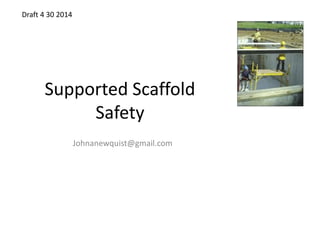
Supported Scaffold
Safety
Johnanewquist@gmail.com
Draft 4 30 2014
Nov 2013
• The victim was working
outside the sixth floor of New
York University’s Languages
and Literature Building on the
corner of University Place and
W. 8th St. when he plunged
from the sixth floor level
about 11:20 a.m., police said.
• The victim, in his 40s, landed
on the roof of the neighboring
two-story NYU Cantor Film
Center.
Aug 2013
• Work resumed today at
McDowell High School
where eight workers
were injured Monday
due to a scaffold
collapse.
June 2013
• Virginia Tech
• Several construction
workers were taken to the
hospital after an incident at
the Davidson Hall
construction site on
campus.
• A hydraulic construction
scaffold collapsed late
Friday morning and one end
of the platform fell
approximately 20-25 feet
before striking the ground.
NY 2012
• Three workers were injured
Thursday after a scaffolding
structure they were working
on collapsed in Manhattan.
• Officials say it happened
just after 9 a.m. at 366
Broadway between Franklin
and White Streets.
• They say workers were
putting up scaffolding on
the sidewalk when the
framing collapsed.
Common Scaffold Hazards
• No guardrails on
scaffolds.
What else is wrong?
Common Scaffold Hazards
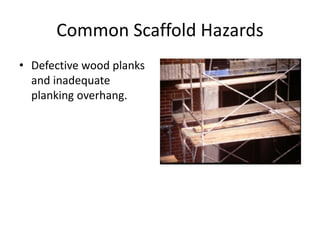
• Defective wood planks
and inadequate
planking overhang.
Common Scaffold Hazards
• Unsafe access to
scaffold.
Common Scaffold Hazards
• Cross bracing not
adequate.
Common Scaffold Hazards
• Inadequate footings.
General Requirements
• Erect/dismantle all
Scaffolds According to
the Manufacturer's
Instructions and
Competent Persons (CP)
Direction
11
General Requirements
• All scaffolds are to be
capable of supporting,
without failure, at least
• 4 times the maximum
• intended load.
12
General requirements
Design load
• The design load of all
scaffolds shall be
• calculated on the basis
of:
• Light--Supporting 25 lbs
per square foot
• Medium--Supporting 50
lbs. Per square foot
• Heavy-- Supporting 75
lbs. Per square foot
Where is the overload?
13
General Requirements
• Stable Footings
• Base Plate, Screw Jacks
& Mudsills
Planks with Visible Defects MUST NOT
be Used
15
Base Plate & Mudsill Required
16
Proper Scaffold Base
17
Masonry Blocks & Bricks NOT
Acceptable as Scaffold Base
18
General Requirements
• Platforms at Least 18”
Wide
• Ladder Jack, Pump Jack,
Top Plate, and Roof
Brackets Can Be 12”
Wide
19
General Requirements
• Each platform on all
working levels must
be fully planked and
secured to prevent
movement.
20
General Requirements
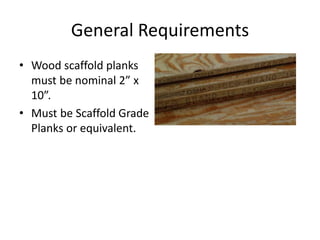
• Wood scaffold planks
must be nominal 2” x
10”.
• Must be Scaffold Grade
Planks or equivalent.
General Requirements
• Planks Extend 6” Past
Supports or Secured
22
General Requirements
• Or Cleated to prevent
plank movement
23
General Requirements
• Front edge of all
platforms within 14” of
face of work
• Exceptions:
• 3” for outrigger scaffold
• 18” for plastering
and lathing
operations
2010 Death
• Event Date: 01/26/2010
• Employee #1 was accessing
the bracket scaffolding by
exiting a second floor window.
• There was a 15 inch space
between the bottom of the
eave and the top of the
scaffold plank.
• While in the process of
accessing the roof employee
#1 apparently slipped and fell
between the house and the
scaffold plank, landing 27 feet
below on the frozen ground.
Fully Braced Scaffold
• Scaffolds must be
braced per
manufacturer’s
instruction
26
Competent Person
• Inspect scaffolding
and components
prior to each work
shift
Competent Person
• Evaluate connections to
support load and prevent
swaying
• Determine structural
soundness when intermixing
components manufacturer
• Train erectors and dismantlers
to recognize work hazards
• Determine feasibility of
providing fall protection and
access
General Requirements
Access
• Do not stand on ties,
guardrails, or
extensions
• 16 ½ Inches between
rungs
Violation 29
Portable Access Ladder
• Must be secured to
prevent
displacement.
• Extend at least 3’
above landing to
provide a handhold.
30
Attachable Access Ladder
31
Scaffold Stairway
32
1926.451(f) Use
Proper clearance near overhead lines
Keep 10 foot minimum unless de-energized,
Scaffold Fall Protection
• Scaffolding 10’ or higher
must have some means of
fall protection:
 guardrails or
 personal fall arrest system
(PFAS)
34
Scaffold Fall Protection
• Toprails installed between
38” and 45” High.
• Midrails installed halfway
between toprail and
platform.
Scaffold Fall Protection
• Cross bracing OK as
guardrails if the center
point is between
• 20” to 30” for Midrail
and
• 38” to 45” for Toprail.
Scaffold Fall Protection
• Toprails to 200 lbs. of
force
• Midrails to 150 lbs. of
force in any direction
Falling Object Protection
• Anyone working on or
around a scaffold must
wear a hard hat.
• Workers on or below
scaffolds must be
protected from falling
objects by:
• Toeboards
• Mesh
• Screens; or
• Equivalent measures
Wind
• Enclosing scaffold will
create wind load
• Engineering calculations
needed.
Scaffold Safety Training
• All employees must be
trained prior to working
on scaffolds.
• Qualified person must
conduct the training and
include the following:
– Electrical Hazards
– Fall Protection
– Falling Object Protection
– Proper Use
– Material Handling
– Load-carrying Capacities
40
Questions
Presenter Biography
• John Newquist began working in the field of safety and health
in 1983 starting with OSHA.
• Taught at the OSHA Training Institute where he created and
developed the Fall Arrest and Process Safety Management for
OSHA.
• Held management positions for OSHA in Aurora, Peoria,
Chicago Regional Office and the OSHA National Office in DC.
• Worked with several OSHA recognition companies including
Ford, Marathon, Exxon, Nucor, and Conoco.
• Conducted hundreds of training sessions across the country in
the areas for fall protection, construction safety, industry
safety, combustible dust and process safety management.
• Works with clients in the Illinois, Indiana, and Wisconsin
areas.

Supported Scaffold Safety

  • 1.
  • 2.
    Nov 2013 • Thevictim was working outside the sixth floor of New York University’s Languages and Literature Building on the corner of University Place and W. 8th St. when he plunged from the sixth floor level about 11:20 a.m., police said. • The victim, in his 40s, landed on the roof of the neighboring two-story NYU Cantor Film Center.
  • 3.
    Aug 2013 • Workresumed today at McDowell High School where eight workers were injured Monday due to a scaffold collapse.
  • 4.
    June 2013 • VirginiaTech • Several construction workers were taken to the hospital after an incident at the Davidson Hall construction site on campus. • A hydraulic construction scaffold collapsed late Friday morning and one end of the platform fell approximately 20-25 feet before striking the ground.
  • 5.
    NY 2012 • Threeworkers were injured Thursday after a scaffolding structure they were working on collapsed in Manhattan. • Officials say it happened just after 9 a.m. at 366 Broadway between Franklin and White Streets. • They say workers were putting up scaffolding on the sidewalk when the framing collapsed.
  • 6.
    Common Scaffold Hazards •No guardrails on scaffolds. What else is wrong?
  • 7.
    Common Scaffold Hazards •Defective wood planks and inadequate planking overhang.
  • 8.
    Common Scaffold Hazards •Unsafe access to scaffold.
  • 9.
    Common Scaffold Hazards •Cross bracing not adequate.
  • 10.
    Common Scaffold Hazards •Inadequate footings.
  • 11.
    General Requirements • Erect/dismantleall Scaffolds According to the Manufacturer's Instructions and Competent Persons (CP) Direction 11
  • 12.
    General Requirements • Allscaffolds are to be capable of supporting, without failure, at least • 4 times the maximum • intended load. 12
  • 13.
    General requirements Design load •The design load of all scaffolds shall be • calculated on the basis of: • Light--Supporting 25 lbs per square foot • Medium--Supporting 50 lbs. Per square foot • Heavy-- Supporting 75 lbs. Per square foot Where is the overload? 13
  • 14.
    General Requirements • StableFootings • Base Plate, Screw Jacks & Mudsills
  • 15.
    Planks with VisibleDefects MUST NOT be Used 15
  • 16.
    Base Plate &Mudsill Required 16
  • 17.
  • 18.
    Masonry Blocks &Bricks NOT Acceptable as Scaffold Base 18
  • 19.
    General Requirements • Platformsat Least 18” Wide • Ladder Jack, Pump Jack, Top Plate, and Roof Brackets Can Be 12” Wide 19
  • 20.
    General Requirements • Eachplatform on all working levels must be fully planked and secured to prevent movement. 20
  • 21.
    General Requirements • Woodscaffold planks must be nominal 2” x 10”. • Must be Scaffold Grade Planks or equivalent.
  • 22.
    General Requirements • PlanksExtend 6” Past Supports or Secured 22
  • 23.
    General Requirements • OrCleated to prevent plank movement 23
  • 24.
    General Requirements • Frontedge of all platforms within 14” of face of work • Exceptions: • 3” for outrigger scaffold • 18” for plastering and lathing operations
  • 25.
    2010 Death • EventDate: 01/26/2010 • Employee #1 was accessing the bracket scaffolding by exiting a second floor window. • There was a 15 inch space between the bottom of the eave and the top of the scaffold plank. • While in the process of accessing the roof employee #1 apparently slipped and fell between the house and the scaffold plank, landing 27 feet below on the frozen ground.
  • 26.
    Fully Braced Scaffold •Scaffolds must be braced per manufacturer’s instruction 26
  • 27.
    Competent Person • Inspectscaffolding and components prior to each work shift
  • 28.
    Competent Person • Evaluateconnections to support load and prevent swaying • Determine structural soundness when intermixing components manufacturer • Train erectors and dismantlers to recognize work hazards • Determine feasibility of providing fall protection and access
  • 29.
    General Requirements Access • Donot stand on ties, guardrails, or extensions • 16 ½ Inches between rungs Violation 29
  • 30.
    Portable Access Ladder •Must be secured to prevent displacement. • Extend at least 3’ above landing to provide a handhold. 30
  • 31.
  • 32.
  • 33.
    1926.451(f) Use Proper clearancenear overhead lines Keep 10 foot minimum unless de-energized,
  • 34.
    Scaffold Fall Protection •Scaffolding 10’ or higher must have some means of fall protection:  guardrails or  personal fall arrest system (PFAS) 34
  • 35.
    Scaffold Fall Protection •Toprails installed between 38” and 45” High. • Midrails installed halfway between toprail and platform.
  • 36.
    Scaffold Fall Protection •Cross bracing OK as guardrails if the center point is between • 20” to 30” for Midrail and • 38” to 45” for Toprail.
  • 37.
    Scaffold Fall Protection •Toprails to 200 lbs. of force • Midrails to 150 lbs. of force in any direction
  • 38.
    Falling Object Protection •Anyone working on or around a scaffold must wear a hard hat. • Workers on or below scaffolds must be protected from falling objects by: • Toeboards • Mesh • Screens; or • Equivalent measures
  • 39.
    Wind • Enclosing scaffoldwill create wind load • Engineering calculations needed.
  • 40.
    Scaffold Safety Training •All employees must be trained prior to working on scaffolds. • Qualified person must conduct the training and include the following: – Electrical Hazards – Fall Protection – Falling Object Protection – Proper Use – Material Handling – Load-carrying Capacities 40
  • 41.
  • 42.
    Presenter Biography • JohnNewquist began working in the field of safety and health in 1983 starting with OSHA. • Taught at the OSHA Training Institute where he created and developed the Fall Arrest and Process Safety Management for OSHA. • Held management positions for OSHA in Aurora, Peoria, Chicago Regional Office and the OSHA National Office in DC. • Worked with several OSHA recognition companies including Ford, Marathon, Exxon, Nucor, and Conoco. • Conducted hundreds of training sessions across the country in the areas for fall protection, construction safety, industry safety, combustible dust and process safety management. • Works with clients in the Illinois, Indiana, and Wisconsin areas.