OSHA Office of Training & Education 1
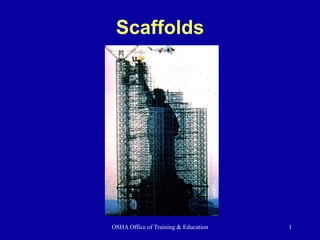
Scaffolds
OSHA Office of Training & Education 2
What Is A Scaffold?
An elevated, temporary work platform
Three basic types:
 Supported scaffolds -- platforms
supported by rigid, load bearing
members, such as poles, legs,
frames, & outriggers
 Suspended scaffolds -- platforms
suspended by ropes or other non-
rigid, overhead support
 Aerial Lifts -- such as “cherry
pickers” or “boom trucks”
OSHA Office of Training & Education 3
Hazards
• Falls from elevation – caused
by slipping, unsafe access, and
the lack of fall protection
• Struck by falling tools / debris
• Electrocution – from overhead
power lines
• Scaffold collapse - caused by
instability or overloading
• Bad planking giving way
Employees working on scaffolds are
exposed to these hazards:
OSHA Office of Training & Education 4
Fall Hazards
• While climbing on or off
the scaffold
• Working on unguarded
scaffold platforms
• When scaffold
platforms or planks fail
Falls may occur:
OSHA Office of Training & Education 5
Protecting Workers from Falls
• Guardrails, and/or
• Personal Fall Arrest
Systems (PFAS)
If a worker on a scaffold
can fall more than 10
feet, protect them by:
OSHA Office of Training & Education 6
Install along open sides & ends
Front edge of platforms not
more than 14 inches from the
work, unless using guardrails
and/or PFAS
Top rails - 38 to 45 inches tall
Midrails halfway between
toprail and platform
Toeboards at least 3-1/2 inches
high
Guardrails
OSHA Office of Training & Education 7
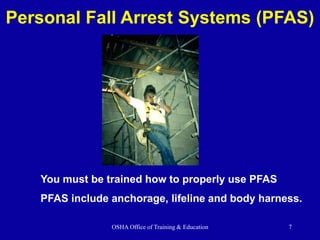
Personal Fall Arrest Systems (PFAS)
You must be trained how to properly use PFAS
PFAS include anchorage, lifeline and body harness.
OSHA Office of Training & Education 8
 Can use PFAS instead of
guardrails on some
scaffolds
 Use PFAS & guardrails on
suspension scaffolds
 Use PFAS on erectors and
dismantlers where feasible
Fall Protection Requirements
The ends of this scaffold
are not properly guarded
OSHA Office of Training & Education 9
Falling Object Protection
 Wear hardhats
 Barricade area below scaffold
to forbid entry into that area
 Use panels or screens if
material is stacked higher than
the toeboard
 Build a canopy or erect a net
below the scaffold that will
contain or deflect falling objects
OSHA Office of Training & Education 10
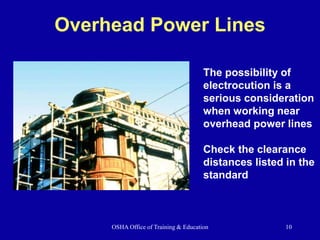
Overhead Power Lines
The possibility of
electrocution is a
serious consideration
when working near
overhead power lines
Check the clearance
distances listed in the
standard
OSHA Office of Training & Education 11
Scaffold Support Examples
Good support Inadequate support –
in danger of collapse?
Base plate
Mud sills
OSHA Office of Training & Education 12
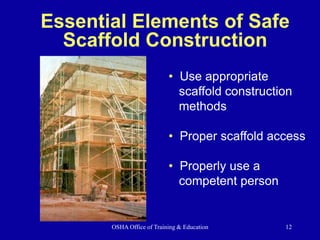
Essential Elements of Safe
Scaffold Construction
• Use appropriate
scaffold construction
methods
• Proper scaffold access
• Properly use a
competent person
OSHA Office of Training & Education 13
Scaffold Platform Construction
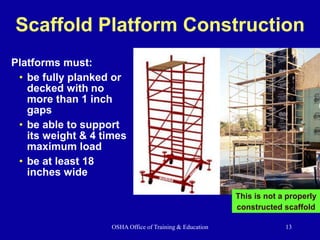
Platforms must:
• be fully planked or
decked with no
more than 1 inch
gaps
• be able to support
its weight & 4 times
maximum load
• be at least 18
inches wide
This is not a properly
constructed scaffold
OSHA Office of Training & Education 14
• No large gaps in front
edge of platforms
• Each abutted end of
plank must rest on a
separate support
surface
• Overlap platforms at
least 12 inches over
supports, unless
restrained to prevent
movement
Scaffold Platform Construction
Planks not properly
overlapped
OSHA Office of Training & Education 15
Scaffold Platform Construction
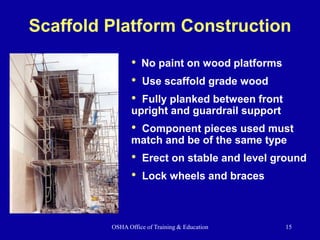
• No paint on wood platforms
• Use scaffold grade wood
• Fully planked between front
upright and guardrail support
• Component pieces used must
match and be of the same type
• Erect on stable and level ground
• Lock wheels and braces
OSHA Office of Training & Education 16
Scaffold Height
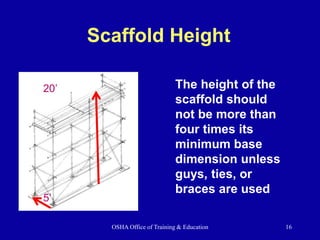
The height of the
scaffold should
not be more than
four times its
minimum base
dimension unless
guys, ties, or
braces are used
20’
5’
OSHA Office of Training & Education 17
Platform Ends
Each end of a
platform, unless
cleated or otherwise
restrained by hooks,
must extend over its
support by at least 6
inches
No Cleats
OSHA Office of Training & Education 18
Supported Scaffolds
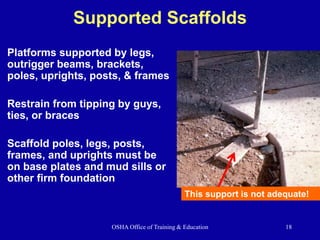
Platforms supported by legs,
outrigger beams, brackets,
poles, uprights, posts, & frames
Restrain from tipping by guys,
ties, or braces
Scaffold poles, legs, posts,
frames, and uprights must be
on base plates and mud sills or
other firm foundation
This support is not adequate!
OSHA Office of Training & Education 19
Proper Scaffold Access
Provide access when scaffold
platforms are more than 2 feet
above or below a point of access
Permitted types of access:
• Ladders, such as portable, hook-
on, attachable, stairway type, and
built-ins
• Stair towers
• Ramps and walkways
May use building stairs and come
out window
OSHA Office of Training & Education 20
Scaffold Access
• No access by
crossbraces
• When using
ladders, bottom
rung no more than
24 inches high
• Can use some end
frames
• Can access from
another scaffold,
structure or hoist
End Frame
Do not access
by crossbraces
OSHA Office of Training & Education 21
Suspension Scaffolds
Train employees to recognize hazards
Secure/tie to prevent swaying
Support devices must rest on surfaces
that can support four times the load
Competent person:
 evaluate connections to ensure the
supporting surfaces can support load
 inspect ropes for defects before shift
PFAS must have anchors independent
of the scaffold support system
Platforms suspended by ropes or wires. Rope must be capable
of supporting 6 times the load
OSHA Office of Training & Education 22
Moving Scaffolds
Employees can’t be on a moving
scaffold unless:
• Surface is level
• Height to base ratio is 2 to 1
• Outriggers are installed on
both sides of scaffolds
Employees can’t be on scaffold
part beyond the wheels
Competent person must be on
site to supervise
OSHA Office of Training & Education 23
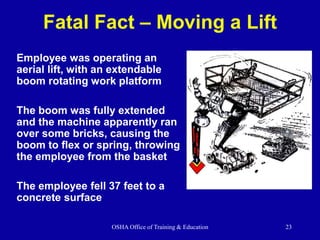
Fatal Fact – Moving a Lift
Employee was operating an
aerial lift, with an extendable
boom rotating work platform
The boom was fully extended
and the machine apparently ran
over some bricks, causing the
boom to flex or spring, throwing
the employee from the basket
The employee fell 37 feet to a
concrete surface
OSHA Office of Training & Education 24
Don’t use Shore or Lean-to Scaffolds
Shore scaffold
supported scaffold
which is placed
against a building
or structure and
held in place with
props
Lean-to scaffold
supported scaffold
which is kept erect
by tilting it toward
and resting it
against a building
or structure
OSHA Office of Training & Education 25
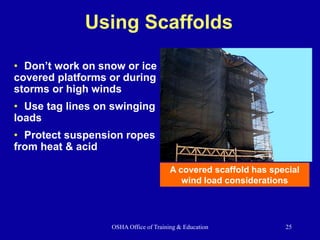
Using Scaffolds
• Don’t work on snow or ice
covered platforms or during
storms or high winds
• Use tag lines on swinging
loads
• Protect suspension ropes
from heat & acid
A covered scaffold has special
wind load considerations
OSHA Office of Training & Education 26
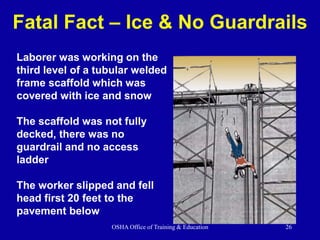
Fatal Fact – Ice & No Guardrails
Laborer was working on the
third level of a tubular welded
frame scaffold which was
covered with ice and snow
The scaffold was not fully
decked, there was no
guardrail and no access
ladder
The worker slipped and fell
head first 20 feet to the
pavement below
OSHA Office of Training & Education 27
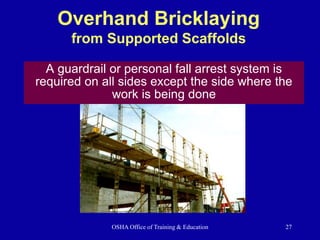
Overhand Bricklaying
from Supported Scaffolds
A guardrail or personal fall arrest system is
required on all sides except the side where the
work is being done
OSHA Office of Training & Education 28
Competent Person
Person capable of identifying and
promptly correcting hazards
Determines if it’s safe to work on
a scaffold during storms or high
winds
Trains workers to recognize
hazards
Selects qualified workers to
conduct work
OSHA Office of Training & Education 29
Scaffold Inspection
Competent person
inspects scaffolds for
visible defects before
each shift and after
any alterations
Defective parts must
be immediately
repaired
Deformed bearer
OSHA Office of Training & Education 30
Scaffold Erection
Scaffolds can only be
erected, moved,
dismantled or altered
under the
supervision of a
competent person
Competent person
selects & directs
these workers and
determines the
feasibility of fall
protection
OSHA Office of Training & Education 31
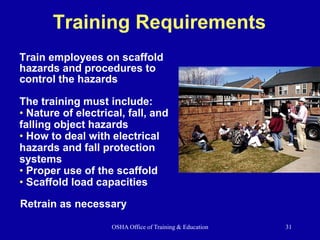
Training Requirements
Train employees on scaffold
hazards and procedures to
control the hazards
The training must include:
• Nature of electrical, fall, and
falling object hazards
• How to deal with electrical
hazards and fall protection
systems
• Proper use of the scaffold
• Scaffold load capacities
Retrain as necessary
OSHA Office of Training & Education 32
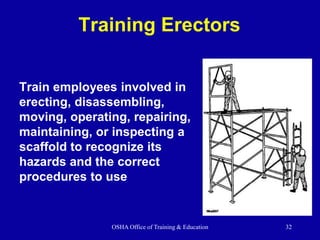
Training Erectors
Train employees involved in
erecting, disassembling,
moving, operating, repairing,
maintaining, or inspecting a
scaffold to recognize its
hazards and the correct
procedures to use
OSHA Office of Training & Education 33
Avoid the Main Hazards of
Scaffolds
• Falls from elevation
• Bad planking
• Scaffold collapse
• Getting struck by falling
tools or debris
• Electrocution
OSHA Office of Training & Education 34
Summary
• Use appropriate scaffold construction methods
 Erect, move, or alter scaffold properly
 Protect from falling objects or tools
• Ensure stable access
• Use a competent person
 Train on scaffold construction and the hazards
involved with scaffolds
 Inspect scaffold before each shift and after
alterations
 Determine fall protection requirements
Remember to:

5. scaffolds ppt construction

  • 1.
    OSHA Office ofTraining & Education 1 Scaffolds
  • 2.
    OSHA Office ofTraining & Education 2 What Is A Scaffold? An elevated, temporary work platform Three basic types:  Supported scaffolds -- platforms supported by rigid, load bearing members, such as poles, legs, frames, & outriggers  Suspended scaffolds -- platforms suspended by ropes or other non- rigid, overhead support  Aerial Lifts -- such as “cherry pickers” or “boom trucks”
  • 3.
    OSHA Office ofTraining & Education 3 Hazards • Falls from elevation – caused by slipping, unsafe access, and the lack of fall protection • Struck by falling tools / debris • Electrocution – from overhead power lines • Scaffold collapse - caused by instability or overloading • Bad planking giving way Employees working on scaffolds are exposed to these hazards:
  • 4.
    OSHA Office ofTraining & Education 4 Fall Hazards • While climbing on or off the scaffold • Working on unguarded scaffold platforms • When scaffold platforms or planks fail Falls may occur:
  • 5.
    OSHA Office ofTraining & Education 5 Protecting Workers from Falls • Guardrails, and/or • Personal Fall Arrest Systems (PFAS) If a worker on a scaffold can fall more than 10 feet, protect them by:
  • 6.
    OSHA Office ofTraining & Education 6 Install along open sides & ends Front edge of platforms not more than 14 inches from the work, unless using guardrails and/or PFAS Top rails - 38 to 45 inches tall Midrails halfway between toprail and platform Toeboards at least 3-1/2 inches high Guardrails
  • 7.
    OSHA Office ofTraining & Education 7 Personal Fall Arrest Systems (PFAS) You must be trained how to properly use PFAS PFAS include anchorage, lifeline and body harness.
  • 8.
    OSHA Office ofTraining & Education 8  Can use PFAS instead of guardrails on some scaffolds  Use PFAS & guardrails on suspension scaffolds  Use PFAS on erectors and dismantlers where feasible Fall Protection Requirements The ends of this scaffold are not properly guarded
  • 9.
    OSHA Office ofTraining & Education 9 Falling Object Protection  Wear hardhats  Barricade area below scaffold to forbid entry into that area  Use panels or screens if material is stacked higher than the toeboard  Build a canopy or erect a net below the scaffold that will contain or deflect falling objects
  • 10.
    OSHA Office ofTraining & Education 10 Overhead Power Lines The possibility of electrocution is a serious consideration when working near overhead power lines Check the clearance distances listed in the standard
  • 11.
    OSHA Office ofTraining & Education 11 Scaffold Support Examples Good support Inadequate support – in danger of collapse? Base plate Mud sills
  • 12.
    OSHA Office ofTraining & Education 12 Essential Elements of Safe Scaffold Construction • Use appropriate scaffold construction methods • Proper scaffold access • Properly use a competent person
  • 13.
    OSHA Office ofTraining & Education 13 Scaffold Platform Construction Platforms must: • be fully planked or decked with no more than 1 inch gaps • be able to support its weight & 4 times maximum load • be at least 18 inches wide This is not a properly constructed scaffold
  • 14.
    OSHA Office ofTraining & Education 14 • No large gaps in front edge of platforms • Each abutted end of plank must rest on a separate support surface • Overlap platforms at least 12 inches over supports, unless restrained to prevent movement Scaffold Platform Construction Planks not properly overlapped
  • 15.
    OSHA Office ofTraining & Education 15 Scaffold Platform Construction • No paint on wood platforms • Use scaffold grade wood • Fully planked between front upright and guardrail support • Component pieces used must match and be of the same type • Erect on stable and level ground • Lock wheels and braces
  • 16.
    OSHA Office ofTraining & Education 16 Scaffold Height The height of the scaffold should not be more than four times its minimum base dimension unless guys, ties, or braces are used 20’ 5’
  • 17.
    OSHA Office ofTraining & Education 17 Platform Ends Each end of a platform, unless cleated or otherwise restrained by hooks, must extend over its support by at least 6 inches No Cleats
  • 18.
    OSHA Office ofTraining & Education 18 Supported Scaffolds Platforms supported by legs, outrigger beams, brackets, poles, uprights, posts, & frames Restrain from tipping by guys, ties, or braces Scaffold poles, legs, posts, frames, and uprights must be on base plates and mud sills or other firm foundation This support is not adequate!
  • 19.
    OSHA Office ofTraining & Education 19 Proper Scaffold Access Provide access when scaffold platforms are more than 2 feet above or below a point of access Permitted types of access: • Ladders, such as portable, hook- on, attachable, stairway type, and built-ins • Stair towers • Ramps and walkways May use building stairs and come out window
  • 20.
    OSHA Office ofTraining & Education 20 Scaffold Access • No access by crossbraces • When using ladders, bottom rung no more than 24 inches high • Can use some end frames • Can access from another scaffold, structure or hoist End Frame Do not access by crossbraces
  • 21.
    OSHA Office ofTraining & Education 21 Suspension Scaffolds Train employees to recognize hazards Secure/tie to prevent swaying Support devices must rest on surfaces that can support four times the load Competent person:  evaluate connections to ensure the supporting surfaces can support load  inspect ropes for defects before shift PFAS must have anchors independent of the scaffold support system Platforms suspended by ropes or wires. Rope must be capable of supporting 6 times the load
  • 22.
    OSHA Office ofTraining & Education 22 Moving Scaffolds Employees can’t be on a moving scaffold unless: • Surface is level • Height to base ratio is 2 to 1 • Outriggers are installed on both sides of scaffolds Employees can’t be on scaffold part beyond the wheels Competent person must be on site to supervise
  • 23.
    OSHA Office ofTraining & Education 23 Fatal Fact – Moving a Lift Employee was operating an aerial lift, with an extendable boom rotating work platform The boom was fully extended and the machine apparently ran over some bricks, causing the boom to flex or spring, throwing the employee from the basket The employee fell 37 feet to a concrete surface
  • 24.
    OSHA Office ofTraining & Education 24 Don’t use Shore or Lean-to Scaffolds Shore scaffold supported scaffold which is placed against a building or structure and held in place with props Lean-to scaffold supported scaffold which is kept erect by tilting it toward and resting it against a building or structure
  • 25.
    OSHA Office ofTraining & Education 25 Using Scaffolds • Don’t work on snow or ice covered platforms or during storms or high winds • Use tag lines on swinging loads • Protect suspension ropes from heat & acid A covered scaffold has special wind load considerations
  • 26.
    OSHA Office ofTraining & Education 26 Fatal Fact – Ice & No Guardrails Laborer was working on the third level of a tubular welded frame scaffold which was covered with ice and snow The scaffold was not fully decked, there was no guardrail and no access ladder The worker slipped and fell head first 20 feet to the pavement below
  • 27.
    OSHA Office ofTraining & Education 27 Overhand Bricklaying from Supported Scaffolds A guardrail or personal fall arrest system is required on all sides except the side where the work is being done
  • 28.
    OSHA Office ofTraining & Education 28 Competent Person Person capable of identifying and promptly correcting hazards Determines if it’s safe to work on a scaffold during storms or high winds Trains workers to recognize hazards Selects qualified workers to conduct work
  • 29.
    OSHA Office ofTraining & Education 29 Scaffold Inspection Competent person inspects scaffolds for visible defects before each shift and after any alterations Defective parts must be immediately repaired Deformed bearer
  • 30.
    OSHA Office ofTraining & Education 30 Scaffold Erection Scaffolds can only be erected, moved, dismantled or altered under the supervision of a competent person Competent person selects & directs these workers and determines the feasibility of fall protection
  • 31.
    OSHA Office ofTraining & Education 31 Training Requirements Train employees on scaffold hazards and procedures to control the hazards The training must include: • Nature of electrical, fall, and falling object hazards • How to deal with electrical hazards and fall protection systems • Proper use of the scaffold • Scaffold load capacities Retrain as necessary
  • 32.
    OSHA Office ofTraining & Education 32 Training Erectors Train employees involved in erecting, disassembling, moving, operating, repairing, maintaining, or inspecting a scaffold to recognize its hazards and the correct procedures to use
  • 33.
    OSHA Office ofTraining & Education 33 Avoid the Main Hazards of Scaffolds • Falls from elevation • Bad planking • Scaffold collapse • Getting struck by falling tools or debris • Electrocution
  • 34.
    OSHA Office ofTraining & Education 34 Summary • Use appropriate scaffold construction methods  Erect, move, or alter scaffold properly  Protect from falling objects or tools • Ensure stable access • Use a competent person  Train on scaffold construction and the hazards involved with scaffolds  Inspect scaffold before each shift and after alterations  Determine fall protection requirements Remember to: