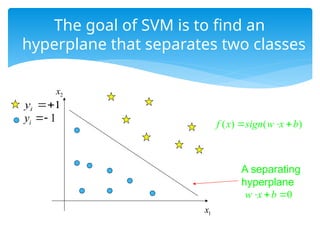
The goal ofSVM is to find an
hyperplane that separates two classes
A separating
hyperplane
1
i
y
1
i
y
( ) ( )
f x sign w x b
0
w x b
1
x
2
x
3.
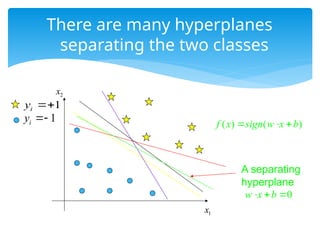
There are manyhyperplanes
separating the two classes
A separating
hyperplane
1
i
y
1
i
y
( ) ( )
f x sign w x b
0
w x b
1
x
2
x
4.
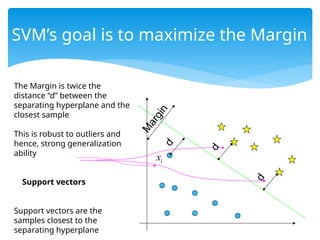
SVM’s goal isto maximize the Margin
The Margin is twice the
distance “d” between the
separating hyperplane and the
closest sample
This is robust to outliers and
hence, strong generalization
ability
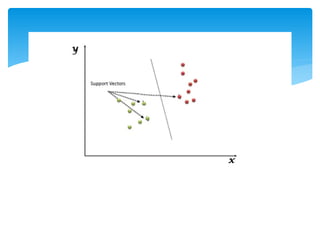
Support vectors
Support vectors are the
samples closest to the
separating hyperplane
i
x
M
a
r
g
i
n
d
d
d
5.
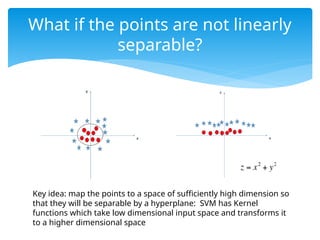
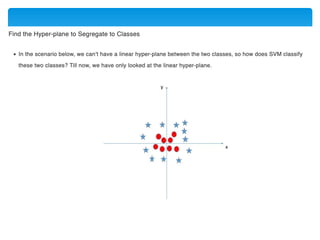
What if thepoints are not linearly
separable?
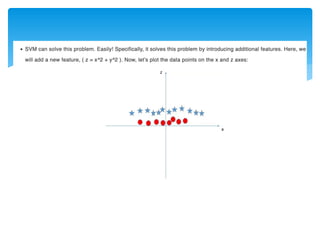
Key idea: map the points to a space of sufficiently high dimension so
that they will be separable by a hyperplane: SVM has Kernel
functions which take low dimensional input space and transforms it
to a higher dimensional space
6.
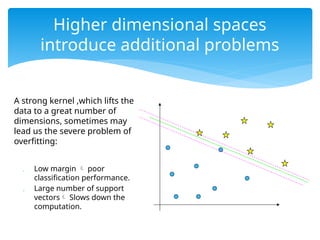
A strong kernel,which lifts the
data to a great number of
dimensions, sometimes may
lead us the severe problem of
overfitting:
Low margin poor
classification performance.
Large number of support
vectors Slows down the
computation.
Higher dimensional spaces
introduce additional problems
7.
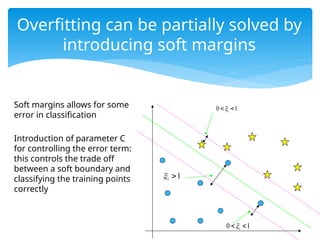
Soft margins allowsfor some
error in classification
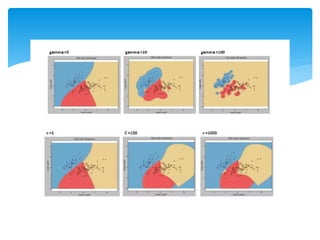
Introduction of parameter C
for controlling the error term:
this controls the trade off
between a soft boundary and
classifying the training points
correctly
Overfitting can be partially solved by
introducing soft margins
0 1
i
0 1
i
1
i
8.
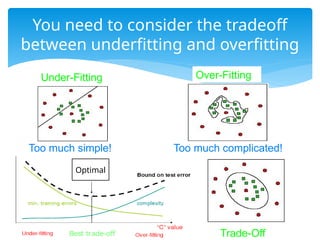
You need toconsider the tradeoff
between underfitting and overfitting
Too much simple! Too much complicated!
Under-Fitting Over-Fitting
Trade-Off
Optimal
9.
Pros:
Itworks really well with clear margin of separation
It is effective in high dimensional spaces.
It is effective in cases where number of dimensions is greater than
the number of samples.
It uses a subset of training points in the decision function (called
support vectors), so it is also memory efficient.
Cons:
It doesn’t perform well, when we have large data set because the
required training time is higher
It also doesn’t perform very well, when the data set has more noise
i.e. target classes are overlapping
Pros and Cons with SVM




![SVM[Support vector Machine] Machine learning](https://cdn.slidesharecdn.com/ss_thumbnails/svm-250403184638-1cd9afdb-thumbnail.jpg?width=640&height=640&fit=bounds)


