SUPPLY CHAIN MANAGEMENT
MS.B.JAYALAKSHMI
Definition of Supply Chain Management
 Supply Chain Management (SCM) is the management of the flow of goods, information,
and resources across all stages of a product’s lifecycle, from raw materials to the final
delivery to the customer. SCM involves coordinating and integrating these activities across
various partners to achieve high efficiency, reduce costs, and improve customer
satisfaction
Key Element of SCM
 Planning and Forecasting
 Demand Forecasting: Involves predicting customer demand to ensure that products are
available without overproducing. Effective forecasting is essential for minimizing stockouts and
excess inventory.
 Capacity Planning: Determines the production capacity needed to meet demand without
delays or resource wastage. This includes assessing labour, equipment, and facility capacities.
 Production Planning: Involves deciding on the quantities and timelines for producing goods,
balancing customer demand with resource availability.
 Risk Management: Identifying potential risks (supply disruptions, natural disasters, etc.) and
developing strategies to mitigate them, such as alternate suppliers or stockpiling critical
materials.
 Budgeting and Cost Analysis: Allocating resources efficiently and ensuring costs remain within
budget.
 Sourcing and Procurement
 Supplier Selection: Choosing reliable suppliers who provide quality raw materials or components at
competitive prices.
 Supplier Relationship Management: Establishing strong, collaborative relationships with suppliers for long-
term partnerships, often involving regular reviews and performance evaluations.
 Production and Operations
 Manufacturing Operations: Converting raw materials into finished goods, using techniques such as Lean
Manufacturing and Six Sigma to maximize efficiency and minimize waste.
 Quality Control and Assurance: Monitoring processes and inspecting products to ensure they meet quality
standards, reducing defects and maintaining customer satisfaction.
 Product Lifecycle Management: Managing the complete lifecycle of products, from initial concept and design
to production, delivery, and eventual end-of-life disposal.
 Inventory Management: Balancing stock levels to ensure there are enough products to meet demand
without excessive holding costs. This includes managing raw materials, work-in-process (WIP), and finished
goods.
 Inventory Management
 Stock Control: Maintaining optimal stock levels to meet demand without incurring high storage
costs or risking obsolescence.
 Warehouse Management: Organizing warehouse space to ensure efficient storage, retrieval, and
dispatch of goods. This may involve automation and inventory tracking systems.
 Inventory Forecasting and Replenishment: Using forecasting methods to predict future demand
and determine reorder points to prevent stockouts.
 Safety Stock and Buffer Stock: Keeping additional stock as a cushion to handle unexpected spikes
in demand or supply chain disruptions.
 Inventory Valuation: Accurately valuing inventory for financial reporting and assessing inventory
turnover to measure efficiency.
 . Logistics and Distribution
 Transportation Management: Selecting optimal transportation modes (air, sea, rail, or road)
based on cost, speed, and reliability for inbound and outbound logistics.
 Warehousing and Storage: Ensuring goods are stored in suitable facilities until they are
needed for production or shipment to customers.
 Order Fulfillment: Coordinating the process of picking, packing, and shipping products to
customers efficiently to meet delivery timelines.
 Last-Mile Delivery: Managing the final stage of the delivery process to ensure products reach
the customer on time, a critical component for customer satisfaction in e-commerce.
 Reverse Logistics: Handling product returns, exchanges, repairs, and recycling to maximize
asset recovery and minimize waste.
 Customer Service and Relationship Management
 Order Management: Managing customer orders from order placement to delivery, ensuring
accurate and timely fulfilment.
 Customer Service and Support: Providing assistance to customers, handling inquiries,
resolving issues, and processing returns or replacements.
 Customer Relationship Management (CRM): Building strong relationships with customers by
understanding their needs, preferences, and purchasing behaviours to increase satisfaction
and loyalty.
 After-Sales Service: Ensuring continued support for customers post-purchase, which can
include warranty services, product repairs, and technical support.
 Feedback Collection and Improvement: Collecting feedback from customers to identify areas
for improvement in products, services, or delivery processes.
 . Information Flow and Technology Integration
 Data Collection and Analysis: Collecting data from various sources (sales data, market trends,
etc.) and analyzing it to make informed decisions.
 Enterprise Resource Planning (ERP) Systems: Integrating various business processes across
departments (procurement, production, finance) to ensure smooth information flow.
 Supply Chain Visibility and Transparency: Real-time tracking of inventory, shipments, and
production status to respond quickly to changes.
 Automated Data Sharing: Using technology like Electronic Data Interchange (EDI) to share
order, inventory, and shipping data seamlessly with suppliers, distributors, and partners.
 Advanced Analytics and Artificial Intelligence (AI): Leveraging AI for predictive analytics,
demand forecasting, and optimizing logistics routes, improving decision-making and efficiency.
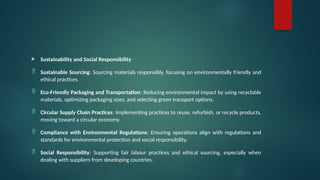
 Sustainability and Social Responsibility
 Sustainable Sourcing: Sourcing materials responsibly, focusing on environmentally friendly and
ethical practices.
 Eco-Friendly Packaging and Transportation: Reducing environmental impact by using recyclable
materials, optimizing packaging sizes, and selecting green transport options.
 Circular Supply Chain Practices: Implementing practices to reuse, refurbish, or recycle products,
moving toward a circular economy.
 Compliance with Environmental Regulations: Ensuring operations align with regulations and
standards for environmental protection and social responsibility.
 Social Responsibility: Supporting fair labour practices and ethical sourcing, especially when
dealing with suppliers from developing countries.
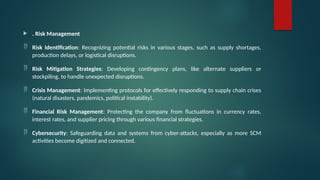
 . Risk Management
 Risk Identification: Recognizing potential risks in various stages, such as supply shortages,
production delays, or logistical disruptions.
 Risk Mitigation Strategies: Developing contingency plans, like alternate suppliers or
stockpiling, to handle unexpected disruptions.
 Crisis Management: Implementing protocols for effectively responding to supply chain crises
(natural disasters, pandemics, political instability).
 Financial Risk Management: Protecting the company from fluctuations in currency rates,
interest rates, and supplier pricing through various financial strategies.
 Cybersecurity: Safeguarding data and systems from cyber-attacks, especially as more SCM
activities become digitized and connected.
Thank you
B JAYALAKSHMI

supply chain management meaning definition importance needs

  • 1.
  • 2.
    Definition of SupplyChain Management  Supply Chain Management (SCM) is the management of the flow of goods, information, and resources across all stages of a product’s lifecycle, from raw materials to the final delivery to the customer. SCM involves coordinating and integrating these activities across various partners to achieve high efficiency, reduce costs, and improve customer satisfaction
  • 3.
    Key Element ofSCM  Planning and Forecasting  Demand Forecasting: Involves predicting customer demand to ensure that products are available without overproducing. Effective forecasting is essential for minimizing stockouts and excess inventory.  Capacity Planning: Determines the production capacity needed to meet demand without delays or resource wastage. This includes assessing labour, equipment, and facility capacities.  Production Planning: Involves deciding on the quantities and timelines for producing goods, balancing customer demand with resource availability.  Risk Management: Identifying potential risks (supply disruptions, natural disasters, etc.) and developing strategies to mitigate them, such as alternate suppliers or stockpiling critical materials.  Budgeting and Cost Analysis: Allocating resources efficiently and ensuring costs remain within budget.
  • 4.
     Sourcing andProcurement  Supplier Selection: Choosing reliable suppliers who provide quality raw materials or components at competitive prices.  Supplier Relationship Management: Establishing strong, collaborative relationships with suppliers for long- term partnerships, often involving regular reviews and performance evaluations.  Production and Operations  Manufacturing Operations: Converting raw materials into finished goods, using techniques such as Lean Manufacturing and Six Sigma to maximize efficiency and minimize waste.  Quality Control and Assurance: Monitoring processes and inspecting products to ensure they meet quality standards, reducing defects and maintaining customer satisfaction.  Product Lifecycle Management: Managing the complete lifecycle of products, from initial concept and design to production, delivery, and eventual end-of-life disposal.  Inventory Management: Balancing stock levels to ensure there are enough products to meet demand without excessive holding costs. This includes managing raw materials, work-in-process (WIP), and finished goods.
  • 5.
     Inventory Management Stock Control: Maintaining optimal stock levels to meet demand without incurring high storage costs or risking obsolescence.  Warehouse Management: Organizing warehouse space to ensure efficient storage, retrieval, and dispatch of goods. This may involve automation and inventory tracking systems.  Inventory Forecasting and Replenishment: Using forecasting methods to predict future demand and determine reorder points to prevent stockouts.  Safety Stock and Buffer Stock: Keeping additional stock as a cushion to handle unexpected spikes in demand or supply chain disruptions.  Inventory Valuation: Accurately valuing inventory for financial reporting and assessing inventory turnover to measure efficiency.
  • 6.
     . Logisticsand Distribution  Transportation Management: Selecting optimal transportation modes (air, sea, rail, or road) based on cost, speed, and reliability for inbound and outbound logistics.  Warehousing and Storage: Ensuring goods are stored in suitable facilities until they are needed for production or shipment to customers.  Order Fulfillment: Coordinating the process of picking, packing, and shipping products to customers efficiently to meet delivery timelines.  Last-Mile Delivery: Managing the final stage of the delivery process to ensure products reach the customer on time, a critical component for customer satisfaction in e-commerce.  Reverse Logistics: Handling product returns, exchanges, repairs, and recycling to maximize asset recovery and minimize waste.
  • 7.
     Customer Serviceand Relationship Management  Order Management: Managing customer orders from order placement to delivery, ensuring accurate and timely fulfilment.  Customer Service and Support: Providing assistance to customers, handling inquiries, resolving issues, and processing returns or replacements.  Customer Relationship Management (CRM): Building strong relationships with customers by understanding their needs, preferences, and purchasing behaviours to increase satisfaction and loyalty.  After-Sales Service: Ensuring continued support for customers post-purchase, which can include warranty services, product repairs, and technical support.  Feedback Collection and Improvement: Collecting feedback from customers to identify areas for improvement in products, services, or delivery processes.
  • 8.
     . InformationFlow and Technology Integration  Data Collection and Analysis: Collecting data from various sources (sales data, market trends, etc.) and analyzing it to make informed decisions.  Enterprise Resource Planning (ERP) Systems: Integrating various business processes across departments (procurement, production, finance) to ensure smooth information flow.  Supply Chain Visibility and Transparency: Real-time tracking of inventory, shipments, and production status to respond quickly to changes.  Automated Data Sharing: Using technology like Electronic Data Interchange (EDI) to share order, inventory, and shipping data seamlessly with suppliers, distributors, and partners.  Advanced Analytics and Artificial Intelligence (AI): Leveraging AI for predictive analytics, demand forecasting, and optimizing logistics routes, improving decision-making and efficiency.
  • 9.
     Sustainability andSocial Responsibility  Sustainable Sourcing: Sourcing materials responsibly, focusing on environmentally friendly and ethical practices.  Eco-Friendly Packaging and Transportation: Reducing environmental impact by using recyclable materials, optimizing packaging sizes, and selecting green transport options.  Circular Supply Chain Practices: Implementing practices to reuse, refurbish, or recycle products, moving toward a circular economy.  Compliance with Environmental Regulations: Ensuring operations align with regulations and standards for environmental protection and social responsibility.  Social Responsibility: Supporting fair labour practices and ethical sourcing, especially when dealing with suppliers from developing countries.
  • 10.
     . RiskManagement  Risk Identification: Recognizing potential risks in various stages, such as supply shortages, production delays, or logistical disruptions.  Risk Mitigation Strategies: Developing contingency plans, like alternate suppliers or stockpiling, to handle unexpected disruptions.  Crisis Management: Implementing protocols for effectively responding to supply chain crises (natural disasters, pandemics, political instability).  Financial Risk Management: Protecting the company from fluctuations in currency rates, interest rates, and supplier pricing through various financial strategies.  Cybersecurity: Safeguarding data and systems from cyber-attacks, especially as more SCM activities become digitized and connected.
  • 11.