Supply
Chain
Analysis
of
Textile
Industry
GROUP 2
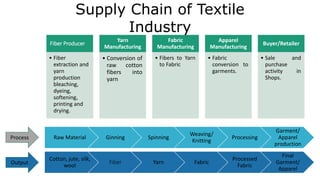
Cotton, jute, silk,
wool
Fiber Yarn Fabric
Processed
Fabric
Final
Garment/
Apparel
Fiber Producer
• Fiber
extraction and
yarn
production
bleaching,
dyeing,
softening,
printing and
drying.
Yarn
Manufacturing
• Conversion of
raw cotton
fibers into
yarn
Fabric
Manufacturing
• Fibers to Yarn
to Fabric
Apparel
Manufacturing
• Fabric
conversion to
garments.
Buyer/Retailer
• Sale and
purchase
activity in
Shops.
Raw Material Ginning Spinning
Weaving/
Knitting
Processing
Garment/
Apparel
production
Process
Output
Supply Chain of Textile
Industry
Industry Players
• Aditya Birla Group
• Raymond Group-Park Avenue
• Arvind Textiles
• Siyaram Silk Mills
• Ralph Lauren
• Willson
• Fabindia Overseas
• Trident Group
• Bombay Dyeing
• Laxmi Mills
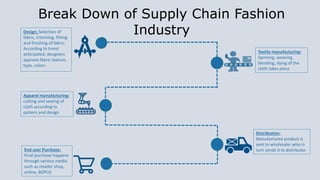
Textile manufacturing:
Spinning, weaving,
blending, dying of the
cloth takes place
Apparel manufacturing:
cutting and sewing of
cloth according to
pattern and design
Distribution:
Manufactured product is
sent to wholesaler who in
turn sends it to distributor
End user Purchase:
Final purchase happens
through various media
such as retailer shop,
online, BOPUS
Design: Selection of
fabric, trimming, fitting
and finishing of fabric.
According to trend
anticipated, designers
approve fabric texture,
type, colors
Break Down of Supply Chain Fashion
Industry
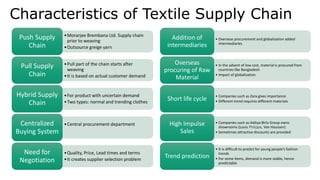
•Morarjee Brembana Ltd. Supply chain
prior to weaving
•Outsource greige yarn
Push Supply
Chain
•Pull part of the chain starts after
weaving
•It is based on actual customer demand
Pull Supply
Chain
•For product with uncertain demand
•Two types: normal and trending clothes
Hybrid Supply
Chain
•Central procurement department
Centralized
Buying System
•Quality, Price, Lead times and terms
•It creates supplier selection problem
Need for
Negotiation
• Overseas procurement and globalization added
intermediaries
Addition of
intermediaries
• In the advent of low cost, material is procured from
countries like Bangladesh
• Impact of globalization
Overseas
procuring of Raw
Material
• Companies such as Zara gives importance
• Different trend requires different materials
Short life cycle
• Companies such as Aditya Birla Group owns
showrooms (Louis Philippe, Van Haussen)
• Sometimes attractive discounts are provided
High Impulse
Sales
• It is difficult to predict for young people’s fashion
trends
• For some items, demand is more stable, hence
predictable
Trend prediction
Characteristics of Textile Supply Chain
Challenges in Textile Industry
• Inventory management-. Garment products are highly volatile in nature and have the shorter life cycles. Their
demand changes very fast as customer preference and market trends are highly variable in nature.
• Lead Time-Higher lead time reduces the responsiveness and increases the chances of high inventory holding and
therefore, problem of overstocking.
• Collaboration-The major identified variables are top management commitment, information sharing, trust
among the supply chain partners, long term relationships and risk and reward sharing
• Logistical Challenges-High fragmentation and underdevelopment of Indian logistics Industry results in the lack of
economies of scale.
• Technology- They are lacking in technological advancement in the implementation of the practices like VMI and
CPFR.
• Covid-19 impact-Supply chain disruption due to demand reduction and reduced production, Transport
connectivity
Challenges for sustainable supply chain of
textiles
Challenges
for
Sustainable
Supply Chain
Water,
Energy
and Land
Sustainable
Raw
Material
Waste
impact
Respons-
ibility
towards
employees
Chemicals
Health
risks
Animal
welfare
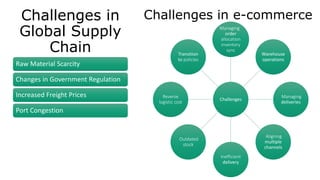
Challenges in e-commerce
Raw Material Scarcity
Changes in Government Regulation
Increased Freight Prices
Port Congestion
Challenges
Managing
order
allocation
inventory
sync
Warehouse
operations
Managing
deliveries
Aligning
multiple
channels
Inefficient
delivery
Outdated
stock
Reverse
logistic cost
Transition
to policies
Challenges in
Global Supply
Chain
Technology Trends Transforming the
Fashion Supply Chain Process
1. Wearable Technology
• Incorporation of smart glasses and watches into warehouses and distribution centers to enhance in-
house communications amongst staff
• Make rapid real-time data-sharing possible via voice command systems and instant photo capture
• Increasing employee efficiency and communication. E.g., Activity-tracking Bracelets, Finger-trigger
Gloves, Voice headsets, etc.
2. Artificial Intelligence
• Align demand with product distribution, reduce profit-eroding markdowns
• Also analyzes sales to determine which products are popular or sluggish, by
utilizing technology that increases ratio of hits to misses by better allocating resources
• Utilizes deep learning on collected data to provide critical insights that increases the production
resources dedicated to successful products
Technology Trends Transforming the
Fashion Supply Chain Process
3. Agile Supply Chain Methodology
• Prioritizes adaptability
• Immediate solutions available to avoid potentially catastrophic delays
• Apparel companies are now better leveraging inventory by adding new distribution centers and growing physical
resources to achieve greater agility in meeting demand
4. Sustainable Supply Chain
• Companies' efforts to consider the environmental and human impact of their products' journey through the supply chain
• Ecological footprint of textile industry is not sustainable as the sector is emitting 1.7 billion Tonnes of CO2 and 2.1
billion tonnes of waste per year
• Example: process innovation can be seen in Nike's ColorDry - a technology to dye fabric using
CO2, Patagonia Archroma Advance Denim Technology that results in shorter production lines needing 30 percent less
energy and 84 percent less water
5. Use of Blockchain technology to increase the efficiency of supply chain
• Through its pioneering platform GreenTrackT based on blockchain technology, Birla Cellulose along
with their value chain partners tracks material flow real time in the supply chain of fiber, from certified
forests to the end consumers
• Through simple scan of QR code end-to-end sustainability journey is visible to consumers and helps
them make an informed purchase decision
• Birla Cellulose is prioritizing the increased use of alternate feedstock like textile waste and is committed
to accelerate innovations that are aligned with UN SDGs 2030
Technology Trends Transforming the
Fashion Supply Chain Process
THANK YOU
Presented By:
Shraddha Singh
Srikanth S
Aishwarya Bhat
Ankit Sharma
Eshaan Kulshreshtha
Rajiv Kumar
Chetan Sonawane
Ananya Tanaya
Swati Patil

Textile supply chain.pptx

  • 1.
  • 2.
    Cotton, jute, silk, wool FiberYarn Fabric Processed Fabric Final Garment/ Apparel Fiber Producer • Fiber extraction and yarn production bleaching, dyeing, softening, printing and drying. Yarn Manufacturing • Conversion of raw cotton fibers into yarn Fabric Manufacturing • Fibers to Yarn to Fabric Apparel Manufacturing • Fabric conversion to garments. Buyer/Retailer • Sale and purchase activity in Shops. Raw Material Ginning Spinning Weaving/ Knitting Processing Garment/ Apparel production Process Output Supply Chain of Textile Industry
  • 3.
    Industry Players • AdityaBirla Group • Raymond Group-Park Avenue • Arvind Textiles • Siyaram Silk Mills • Ralph Lauren • Willson • Fabindia Overseas • Trident Group • Bombay Dyeing • Laxmi Mills
  • 4.
    Textile manufacturing: Spinning, weaving, blending,dying of the cloth takes place Apparel manufacturing: cutting and sewing of cloth according to pattern and design Distribution: Manufactured product is sent to wholesaler who in turn sends it to distributor End user Purchase: Final purchase happens through various media such as retailer shop, online, BOPUS Design: Selection of fabric, trimming, fitting and finishing of fabric. According to trend anticipated, designers approve fabric texture, type, colors Break Down of Supply Chain Fashion Industry
  • 5.
    •Morarjee Brembana Ltd.Supply chain prior to weaving •Outsource greige yarn Push Supply Chain •Pull part of the chain starts after weaving •It is based on actual customer demand Pull Supply Chain •For product with uncertain demand •Two types: normal and trending clothes Hybrid Supply Chain •Central procurement department Centralized Buying System •Quality, Price, Lead times and terms •It creates supplier selection problem Need for Negotiation • Overseas procurement and globalization added intermediaries Addition of intermediaries • In the advent of low cost, material is procured from countries like Bangladesh • Impact of globalization Overseas procuring of Raw Material • Companies such as Zara gives importance • Different trend requires different materials Short life cycle • Companies such as Aditya Birla Group owns showrooms (Louis Philippe, Van Haussen) • Sometimes attractive discounts are provided High Impulse Sales • It is difficult to predict for young people’s fashion trends • For some items, demand is more stable, hence predictable Trend prediction Characteristics of Textile Supply Chain
  • 6.
    Challenges in TextileIndustry • Inventory management-. Garment products are highly volatile in nature and have the shorter life cycles. Their demand changes very fast as customer preference and market trends are highly variable in nature. • Lead Time-Higher lead time reduces the responsiveness and increases the chances of high inventory holding and therefore, problem of overstocking. • Collaboration-The major identified variables are top management commitment, information sharing, trust among the supply chain partners, long term relationships and risk and reward sharing • Logistical Challenges-High fragmentation and underdevelopment of Indian logistics Industry results in the lack of economies of scale. • Technology- They are lacking in technological advancement in the implementation of the practices like VMI and CPFR. • Covid-19 impact-Supply chain disruption due to demand reduction and reduced production, Transport connectivity
  • 7.
    Challenges for sustainablesupply chain of textiles Challenges for Sustainable Supply Chain Water, Energy and Land Sustainable Raw Material Waste impact Respons- ibility towards employees Chemicals Health risks Animal welfare
  • 8.
    Challenges in e-commerce RawMaterial Scarcity Changes in Government Regulation Increased Freight Prices Port Congestion Challenges Managing order allocation inventory sync Warehouse operations Managing deliveries Aligning multiple channels Inefficient delivery Outdated stock Reverse logistic cost Transition to policies Challenges in Global Supply Chain
  • 9.
    Technology Trends Transformingthe Fashion Supply Chain Process 1. Wearable Technology • Incorporation of smart glasses and watches into warehouses and distribution centers to enhance in- house communications amongst staff • Make rapid real-time data-sharing possible via voice command systems and instant photo capture • Increasing employee efficiency and communication. E.g., Activity-tracking Bracelets, Finger-trigger Gloves, Voice headsets, etc. 2. Artificial Intelligence • Align demand with product distribution, reduce profit-eroding markdowns • Also analyzes sales to determine which products are popular or sluggish, by utilizing technology that increases ratio of hits to misses by better allocating resources • Utilizes deep learning on collected data to provide critical insights that increases the production resources dedicated to successful products
  • 10.
    Technology Trends Transformingthe Fashion Supply Chain Process 3. Agile Supply Chain Methodology • Prioritizes adaptability • Immediate solutions available to avoid potentially catastrophic delays • Apparel companies are now better leveraging inventory by adding new distribution centers and growing physical resources to achieve greater agility in meeting demand 4. Sustainable Supply Chain • Companies' efforts to consider the environmental and human impact of their products' journey through the supply chain • Ecological footprint of textile industry is not sustainable as the sector is emitting 1.7 billion Tonnes of CO2 and 2.1 billion tonnes of waste per year • Example: process innovation can be seen in Nike's ColorDry - a technology to dye fabric using CO2, Patagonia Archroma Advance Denim Technology that results in shorter production lines needing 30 percent less energy and 84 percent less water
  • 11.
    5. Use ofBlockchain technology to increase the efficiency of supply chain • Through its pioneering platform GreenTrackT based on blockchain technology, Birla Cellulose along with their value chain partners tracks material flow real time in the supply chain of fiber, from certified forests to the end consumers • Through simple scan of QR code end-to-end sustainability journey is visible to consumers and helps them make an informed purchase decision • Birla Cellulose is prioritizing the increased use of alternate feedstock like textile waste and is committed to accelerate innovations that are aligned with UN SDGs 2030 Technology Trends Transforming the Fashion Supply Chain Process
  • 12.
    THANK YOU Presented By: ShraddhaSingh Srikanth S Aishwarya Bhat Ankit Sharma Eshaan Kulshreshtha Rajiv Kumar Chetan Sonawane Ananya Tanaya Swati Patil