Designing forthe Web Overview
CHAPTER
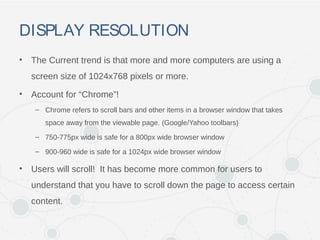
DISPLAY RESOLUTION
• The Current trend is that more and more computers are using a
screen size of 1024x768 pixels or more.
• Account for “Chrome”!
– Chrome refers to scroll bars and other items in a browser window that takes
space away from the viewable page. (Google/Yahoo toolbars)
– 750-775px wide is safe for a 800px wide browser window
– 900-960 wide is safe for a 1024px wide browser window
• Users will scroll! It has become more common for users to
understand that you have to scroll down the page to access certain
content.
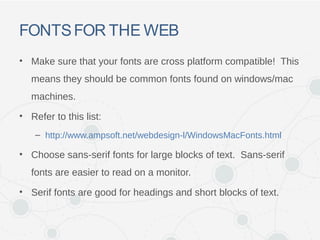
FONTSFOR THE WEB
• Make sure that your fonts are cross platform compatible! This
means they should be common fonts found on windows/mac
machines.
• Refer to this list:
– http://www.ampsoft.net/webdesign-l/WindowsMacFonts.html
• Choose sans-serif fonts for large blocks of text. Sans-serif
fonts are easier to read on a monitor.
• Serif fonts are good for headings and short blocks of text.
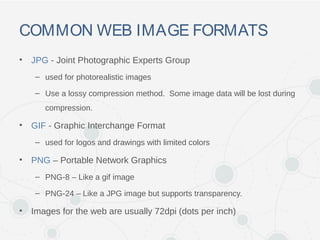
COMMON WEB IMAGE FORMATS
• JPG - Joint Photographic Experts Group
– used for photorealistic images
– Use a lossy compression method. Some image data will be lost during
compression.
• GIF - Graphic Interchange Format
– used for logos and drawings with limited colors
• PNG – Portable Network Graphics
– PNG-8 – Like a gif image
– PNG-24 – Like a JPG image but supports transparency.
• Images for the web are usually 72dpi (dots per inch)
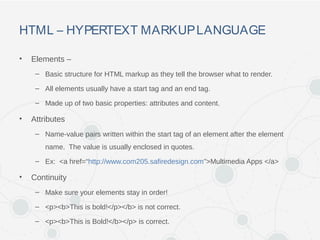
HTML – HYPERTEXT MARKUPLANGUAGE
• Elements –
– Basic structure for HTML markup as they tell the browser what to render.
– All elements usually have a start tag and an end tag.
– Made up of two basic properties: attributes and content.
• Attributes
– Name-value pairs written within the start tag of an element after the element
name. The value is usually enclosed in quotes.
– Ex: <a href=“http://www.com205.safiredesign.com”>Multimedia Apps </a>
• Continuity
– Make sure your elements stay in order!
– <p><b>This is bold!</p></b> is not correct.
– <p><b>This is Bold!</b></p> is correct.
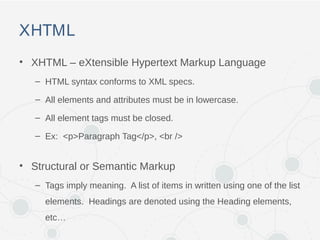
XHTML
• XHTML – eXtensible Hypertext Markup Language
– HTML syntax conforms to XML specs.
– All elements and attributes must be in lowercase.
– All element tags must be closed.
– Ex: <p>Paragraph Tag</p>, <br />
• Structural or Semantic Markup
– Tags imply meaning. A list of items in written using one of the list
elements. Headings are denoted using the Heading elements,
etc…
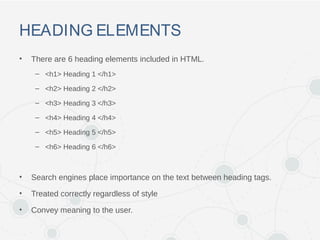
HEADING ELEMENTS
• There are 6 heading elements included in HTML.
– <h1> Heading 1 </h1>
– <h2> Heading 2 </h2>
– <h3> Heading 3 </h3>
– <h4> Heading 4 </h4>
– <h5> Heading 5 </h5>
– <h6> Heading 6 </h6>
• Search engines place importance on the text between heading tags.
• Treated correctly regardless of style
• Convey meaning to the user.
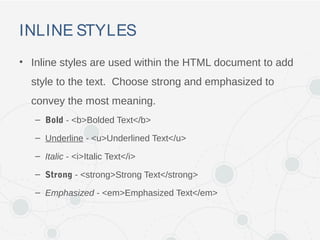
INLINE STYLES
• Inline styles are used within the HTML document to add
style to the text. Choose strong and emphasized to
convey the most meaning.
– Bold - <b>Bolded Text</b>
– Underline - <u>Underlined Text</u>
– Italic - <i>Italic Text</i>
– Strong - <strong>Strong Text</strong>
– Emphasized - <em>Emphasized Text</em>
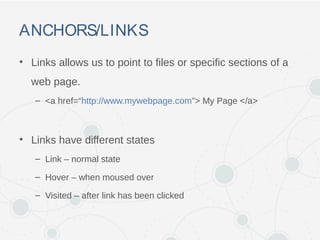
ANCHORS/LINKS
• Links allows us to point to files or specific sections of a
web page.
– <a href=“http://www.mywebpage.com”> My Page </a>
• Links have different states
– Link – normal state
– Hover – when moused over
– Visited – after link has been clicked
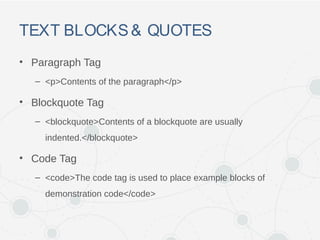
TEXT BLOCKS& QUOTES
• Paragraph Tag
– <p>Contents of the paragraph</p>
• Blockquote Tag
– <blockquote>Contents of a blockquote are usually
indented.</blockquote>
• Code Tag
– <code>The code tag is used to place example blocks of
demonstration code</code>
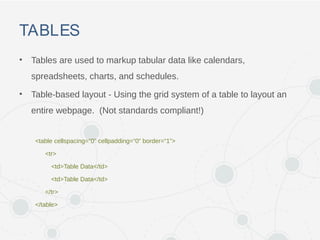
TABLES
• Tables are used to markup tabular data like calendars,
spreadsheets, charts, and schedules.
• Table-based layout - Using the grid system of a table to layout an
entire webpage. (Not standards compliant!)
<table cellspacing=“0” cellpadding=“0” border=“1”>
<tr>
<td>Table Data</td>
<td>Table Data</td>
</tr>
</table>
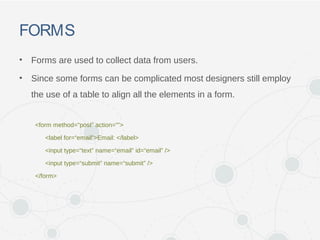
FORMS
• Forms are used to collect data from users.
• Since some forms can be complicated most designers still employ
the use of a table to align all the elements in a form.
<form method=“post” action=“”>
<label for=“email”>Email: </label>
<input type=“text” name=“email” id=“email” />
<input type=“submit” name=“submit” />
</form>
LISTS- ORDERED LISTS
• Ordered Lists are used for step by step instructions.
• List items can have either letters, numbers or roman numerals.
<ol>
<li>List Item 1</li>
<li>List Item 2</li>
</ol>
LISTS– UNORDERED LISTS
• Unordered lists are used for generic lists of items.
• They can also be styled using CSS and used for navigation.
• Default style is a bulleted list.
• List shapes and style can be changed using CSS.
<ul>
<li>List Item 1</li>
<li>List Item 2</li>
</ul>
LISTS- DEFINITION LISTS
• Definition lists are used to provide a relationship between
term/definition pairs.
• These can be easily styled using CSS.
<dl>
<dt>Term</dt>
<dd>Definition</dd>
<dt>Term</dt>
<dd>Defininition</dd>
</dl>
CSS– CASCADING STYLE SHEETS
• Cascading Style Sheets is the W3C Standard for controlling the
visual presentation of web pages.
• A style sheet consists of one or more rules that describe how page
elements should be displayed.
• A web page can have more than one style sheet attached to it.
• The cascade order provides a set of rules for resolving conflicts
between different style sheets. Styles with more weight take
precedence over styles with lower weight.
• CSS Styles can be applied to a document in 3 ways
CSSRULE STRUCTURE
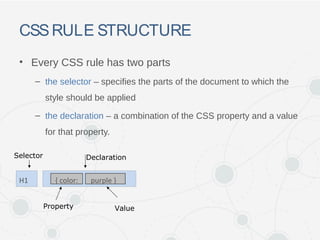
• Every CSS rule has two parts
– the selector – specifies the parts of the document to which the
style should be applied
– the declaration – a combination of the CSS property and a value
for that property.
Declaration
Property Value
Selector
H1 { color: purple }
CSS– INLINE STYLES
• Inline Styles – style information is specified for an individual element
using the style attribute within that elements HTML tag.
<h1 style=“color: purple; font-size: 20px;”> Purple Heading</h1>
CSS– EMBEDDED STYLES
• Embedded Style Sheets – placed at the top of an HTML document
inside the Style element which must be placed within the head
portion of the document.
<style type=“text/css”>
h1 {
color: purple;
font-size: 20px;
}
</style>
CSS– EXTERNAL STYLE SHEETS
• External Style Sheets – style rules that are stored in a
separate document and referenced from an HTML
document in one of two ways.
– <link rel=“stylesheet” type=“text/css” href=“mystyles.css” />
– <style type=“text/css”
@import url(mystyles.css);
</style>

Supplement web design

  • 1.
    Designing forthe WebOverview CHAPTER
  • 2.
    DISPLAY RESOLUTION • TheCurrent trend is that more and more computers are using a screen size of 1024x768 pixels or more. • Account for “Chrome”! – Chrome refers to scroll bars and other items in a browser window that takes space away from the viewable page. (Google/Yahoo toolbars) – 750-775px wide is safe for a 800px wide browser window – 900-960 wide is safe for a 1024px wide browser window • Users will scroll! It has become more common for users to understand that you have to scroll down the page to access certain content.
  • 3.
    FONTSFOR THE WEB •Make sure that your fonts are cross platform compatible! This means they should be common fonts found on windows/mac machines. • Refer to this list: – http://www.ampsoft.net/webdesign-l/WindowsMacFonts.html • Choose sans-serif fonts for large blocks of text. Sans-serif fonts are easier to read on a monitor. • Serif fonts are good for headings and short blocks of text.
  • 4.
    COMMON WEB IMAGEFORMATS • JPG - Joint Photographic Experts Group – used for photorealistic images – Use a lossy compression method. Some image data will be lost during compression. • GIF - Graphic Interchange Format – used for logos and drawings with limited colors • PNG – Portable Network Graphics – PNG-8 – Like a gif image – PNG-24 – Like a JPG image but supports transparency. • Images for the web are usually 72dpi (dots per inch)
  • 5.
    HTML – HYPERTEXTMARKUPLANGUAGE • Elements – – Basic structure for HTML markup as they tell the browser what to render. – All elements usually have a start tag and an end tag. – Made up of two basic properties: attributes and content. • Attributes – Name-value pairs written within the start tag of an element after the element name. The value is usually enclosed in quotes. – Ex: <a href=“http://www.com205.safiredesign.com”>Multimedia Apps </a> • Continuity – Make sure your elements stay in order! – <p><b>This is bold!</p></b> is not correct. – <p><b>This is Bold!</b></p> is correct.
  • 6.
    XHTML • XHTML –eXtensible Hypertext Markup Language – HTML syntax conforms to XML specs. – All elements and attributes must be in lowercase. – All element tags must be closed. – Ex: <p>Paragraph Tag</p>, <br /> • Structural or Semantic Markup – Tags imply meaning. A list of items in written using one of the list elements. Headings are denoted using the Heading elements, etc…
  • 7.
    HEADING ELEMENTS • Thereare 6 heading elements included in HTML. – <h1> Heading 1 </h1> – <h2> Heading 2 </h2> – <h3> Heading 3 </h3> – <h4> Heading 4 </h4> – <h5> Heading 5 </h5> – <h6> Heading 6 </h6> • Search engines place importance on the text between heading tags. • Treated correctly regardless of style • Convey meaning to the user.
  • 8.
    INLINE STYLES • Inlinestyles are used within the HTML document to add style to the text. Choose strong and emphasized to convey the most meaning. – Bold - <b>Bolded Text</b> – Underline - <u>Underlined Text</u> – Italic - <i>Italic Text</i> – Strong - <strong>Strong Text</strong> – Emphasized - <em>Emphasized Text</em>
  • 9.
    ANCHORS/LINKS • Links allowsus to point to files or specific sections of a web page. – <a href=“http://www.mywebpage.com”> My Page </a> • Links have different states – Link – normal state – Hover – when moused over – Visited – after link has been clicked
  • 10.
    TEXT BLOCKS& QUOTES •Paragraph Tag – <p>Contents of the paragraph</p> • Blockquote Tag – <blockquote>Contents of a blockquote are usually indented.</blockquote> • Code Tag – <code>The code tag is used to place example blocks of demonstration code</code>
  • 11.
    TABLES • Tables areused to markup tabular data like calendars, spreadsheets, charts, and schedules. • Table-based layout - Using the grid system of a table to layout an entire webpage. (Not standards compliant!) <table cellspacing=“0” cellpadding=“0” border=“1”> <tr> <td>Table Data</td> <td>Table Data</td> </tr> </table>
  • 12.
    FORMS • Forms areused to collect data from users. • Since some forms can be complicated most designers still employ the use of a table to align all the elements in a form. <form method=“post” action=“”> <label for=“email”>Email: </label> <input type=“text” name=“email” id=“email” /> <input type=“submit” name=“submit” /> </form>
  • 13.
    LISTS- ORDERED LISTS •Ordered Lists are used for step by step instructions. • List items can have either letters, numbers or roman numerals. <ol> <li>List Item 1</li> <li>List Item 2</li> </ol>
  • 14.
    LISTS– UNORDERED LISTS •Unordered lists are used for generic lists of items. • They can also be styled using CSS and used for navigation. • Default style is a bulleted list. • List shapes and style can be changed using CSS. <ul> <li>List Item 1</li> <li>List Item 2</li> </ul>
  • 15.
    LISTS- DEFINITION LISTS •Definition lists are used to provide a relationship between term/definition pairs. • These can be easily styled using CSS. <dl> <dt>Term</dt> <dd>Definition</dd> <dt>Term</dt> <dd>Defininition</dd> </dl>
  • 16.
    CSS– CASCADING STYLESHEETS • Cascading Style Sheets is the W3C Standard for controlling the visual presentation of web pages. • A style sheet consists of one or more rules that describe how page elements should be displayed. • A web page can have more than one style sheet attached to it. • The cascade order provides a set of rules for resolving conflicts between different style sheets. Styles with more weight take precedence over styles with lower weight. • CSS Styles can be applied to a document in 3 ways
  • 17.
    CSSRULE STRUCTURE • EveryCSS rule has two parts – the selector – specifies the parts of the document to which the style should be applied – the declaration – a combination of the CSS property and a value for that property. Declaration Property Value Selector H1 { color: purple }
  • 18.
    CSS– INLINE STYLES •Inline Styles – style information is specified for an individual element using the style attribute within that elements HTML tag. <h1 style=“color: purple; font-size: 20px;”> Purple Heading</h1>
  • 19.
    CSS– EMBEDDED STYLES •Embedded Style Sheets – placed at the top of an HTML document inside the Style element which must be placed within the head portion of the document. <style type=“text/css”> h1 { color: purple; font-size: 20px; } </style>
  • 20.
    CSS– EXTERNAL STYLESHEETS • External Style Sheets – style rules that are stored in a separate document and referenced from an HTML document in one of two ways. – <link rel=“stylesheet” type=“text/css” href=“mystyles.css” /> – <style type=“text/css” @import url(mystyles.css); </style>