PROMOTING SUCCESS
For First Time Supervisors
OBJECTIVE
 To provide basic information on functions
of supervisors;
 Promoting success and support for first
time supervisors
 Re-orientation on policies and procedures
and SOP in the plant
Course Outline
I. ROLE OF A SUPERVISOR
II. TRANSITION FROM TEAM MEMBERS TO FIRST-LINE-SUPERVISOR
• Differences between staff employees and first line supervisor
III. QUALITIES OF A SUPERVISOR
IV. DEVELOPING LEADERSHIP SKILLS
V. POSITIVE ATTITUDE
What is a Supervisor
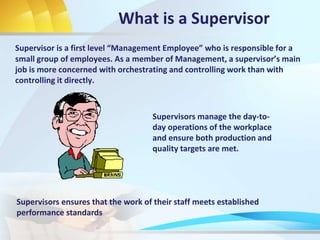
Supervisor is a first level “Management Employee” who is responsible for a
small group of employees. As a member of Management, a supervisor’s main
job is more concerned with orchestrating and controlling work than with
controlling it directly.
Supervisors manage the day-to-
day operations of the workplace
and ensure both production and
quality targets are met.
Supervisors ensures that the work of their staff meets established
performance standards
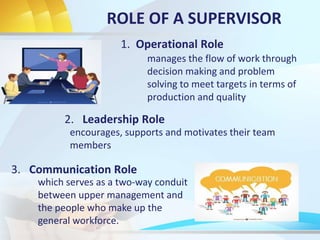
ROLE OF A SUPERVISOR
2. Leadership Role
3. Communication Role
1. Operational Role
manages the flow of work through
decision making and problem
solving to meet targets in terms of
production and quality
encourages, supports and motivates their team
members
which serves as a two-way conduit
between upper management and
the people who make up the
general workforce.
TRANSITION TO SUPERVISOR
If you cannot make that transition, you will have an
impossible task when you need to say “no”,
reprimand, discipline, or even fire people who are
friends.
Promotion from within
Assume a different role and many patterns of
behavior may require change
You have made a choice to become a boss
You will have to “think before you speak”
You become a part of management
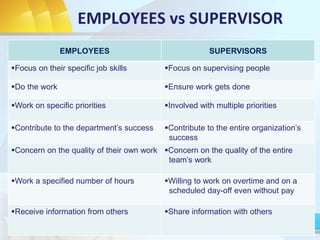
EMPLOYEES vs SUPERVISOR
EMPLOYEES SUPERVISORS
Focus on their specific job skills Focus on supervising people
Do the work Ensure work gets done
Work on specific priorities Involved with multiple priorities
Contribute to the department’s success Contribute to the entire organization’s
success
Concern on the quality of their own work Concern on the quality of the entire
team’s work
Work a specified number of hours Willing to work on overtime and on a
scheduled day-off even without pay
Receive information from others Share information with others
1. GOOD COMMUNICATION SKILLS
QUALITIES OF A SUPERVISOR
“Good Listening Skills”
 communicate upward to higher management
about issues and concerns
 present complex ideas in simple terms
QUALITIES OF A SUPERVISOR
2. RESOURCEFULNESS
 being creative and seeing solutions
 make things happen
3. FLEXIBILITY
QUALITIES OF A SUPERVISOR
“Adapt Readily to Change”
 needs of work team members will change
 needs of the business will change throughout the year,
throughout the week, maybe even throughout the day
4. COMMITMENT AND RESPONSIBILITY
QUALITIES OF A SUPERVISOR
“INTEGRITY
AND
RELIABILITY”
 Analyzes situations accurately and adapts well to change;
demonstrates willingness to incorporate new ideas or methods
 Embraces change in work and work
environment even when there is
some ambiguity. Making an effort
to apply a positive mind set when
faced with new situations at work,
adapting to new ways of seeing and
doing things
5. EMPATHY
QUALITIES OF A SUPERVISOR
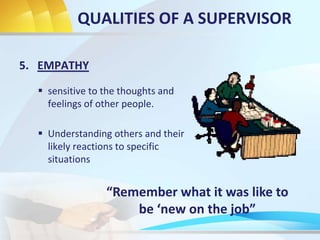
“Remember what it was like to
be ‘new on the job”
 Understanding others and their
likely reactions to specific
situations
 sensitive to the thoughts and
feelings of other people.
6. RESPECT
QUALITIES OF A SUPERVISOR
“Being respectful is
more than just being
courteous and polite.”
 Acknowledging individual needs and aspirations
 treat people as individuals
7. ENTHUSIASM
QUALITIES OF A SUPERVISOR
“People who are enthusiastic can generally
motivate and energise others to behave the
same way and reach their full potential ”
 Champion your team by being positive, empowering,
motivational and committed
 Reaching out to employees directly, showing concern and
giving encouragement that, in turn, prompts greater
employee engagement
8. TIME MANAGEMENT SKILL
QUALITIES OF A SUPERVISOR
“Know how to prioritize.”
 know how to say ’no’ when it’s needed
 know how to manage interruptions and
distractions from the task at hand
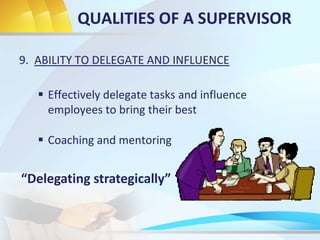
9. ABILITY TO DELEGATE AND INFLUENCE
QUALITIES OF A SUPERVISOR
“Delegating strategically”
 Coaching and mentoring
 Effectively delegate tasks and influence
employees to bring their best
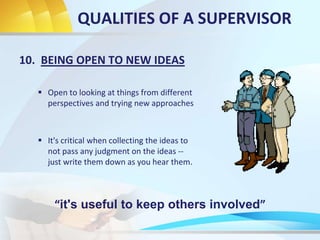
10. BEING OPEN TO NEW IDEAS
QUALITIES OF A SUPERVISOR
“it's useful to keep others involved”
 It's critical when collecting the ideas to
not pass any judgment on the ideas --
just write them down as you hear them.
 Open to looking at things from different
perspectives and trying new approaches
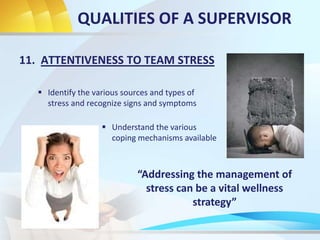
11. ATTENTIVENESS TO TEAM STRESS
QUALITIES OF A SUPERVISOR
“Addressing the management of
stress can be a vital wellness
strategy”
 Understand the various
coping mechanisms available
 Identify the various sources and types of
stress and recognize signs and symptoms
Which qualities do you have right now?
What action plans do you intend to take to
QUALITIES OF A SUPERVISOR
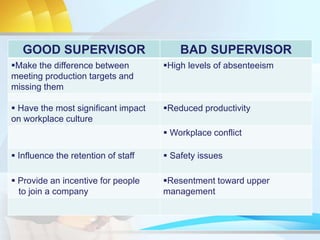
GOOD SUPERVISOR BAD SUPERVISOR
Make the difference between
meeting production targets and
missing them
High levels of absenteeism
 Have the most significant impact
on workplace culture
Reduced productivity
 Workplace conflict
 Influence the retention of staff  Safety issues
 Provide an incentive for people
to join a company
Resentment toward upper
management
DEVELOPING LEADERSHIP SKILLS
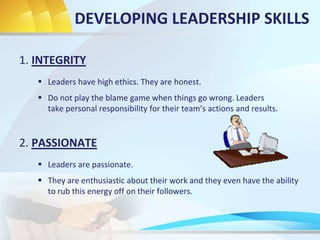
1. INTEGRITY
 Leaders have high ethics. They are honest.
2. PASSIONATE
 Leaders are passionate.
 Do not play the blame game when things go wrong. Leaders
take personal responsibility for their team’s actions and results.
 They are enthusiastic about their work and they even have the ability
to rub this energy off on their followers.
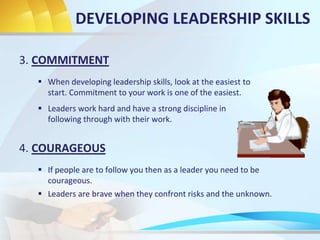
3. COMMITMENT
 When developing leadership skills, look at the easiest to
start. Commitment to your work is one of the easiest.
4. COURAGEOUS
 If people are to follow you then as a leader you need to be
courageous.
DEVELOPING LEADERSHIP SKILLS
 Leaders work hard and have a strong discipline in
following through with their work.
 Leaders are brave when they confront risks and the unknown.
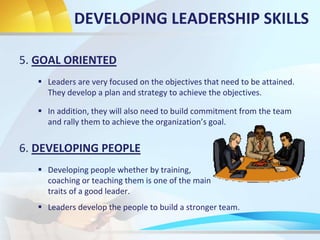
5. GOAL ORIENTED
 Leaders are very focused on the objectives that need to be attained.
They develop a plan and strategy to achieve the objectives.
6. DEVELOPING PEOPLE
 Developing people whether by training,
coaching or teaching them is one of the main
traits of a good leader.
DEVELOPING LEADERSHIP SKILLS
 In addition, they will also need to build commitment from the team
and rally them to achieve the organization’s goal.
 Leaders develop the people to build a stronger team.
7. PRIORITIZE
 Leaders do the most urgent and important things first regardless of
their interest in them. For them, whatever that needs to be done
should be completed with the best possible effort.
8. NO PUBLIC GLORY
 Leaders know whatever achievements
are the result of joint effort of their
units. They share glory and credit with
the rest for the work.
DEVELOPING LEADERSHIP SKILLS
POSITIVE ATTITUDE
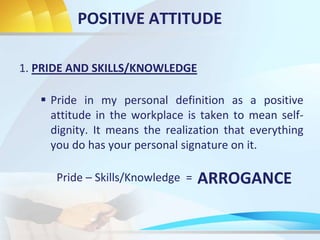
1. PRIDE AND SKILLS/KNOWLEDGE
 Pride in my personal definition as a positive
attitude in the workplace is taken to mean self-
dignity. It means the realization that everything
you do has your personal signature on it.
Pride – Skills/Knowledge = ARROGANCE
POSITIVE ATTITUDE
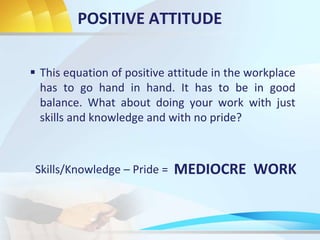
 This equation of positive attitude in the workplace
has to go hand in hand. It has to be in good
balance. What about doing your work with just
skills and knowledge and with no pride?
Skills/Knowledge – Pride = MEDIOCRE WORK
POSITIVE ATTITUDE
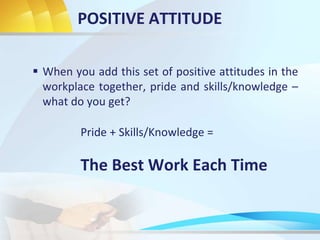
 When you add this set of positive attitudes in the
workplace together, pride and skills/knowledge –
what do you get?
Pride + Skills/Knowledge =
The Best Work Each Time
POSITIVE ATTITUDE
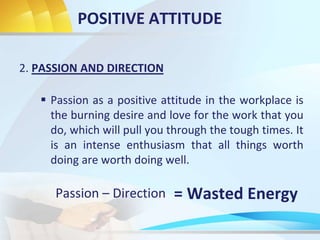
2. PASSION AND DIRECTION
 Passion as a positive attitude in the workplace is
the burning desire and love for the work that you
do, which will pull you through the tough times. It
is an intense enthusiasm that all things worth
doing are worth doing well.
Passion – Direction = Wasted Energy
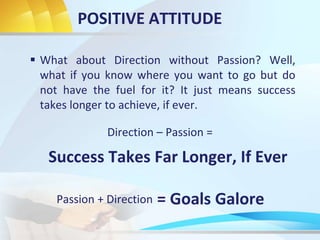
POSITIVE ATTITUDE
 What about Direction without Passion? Well,
what if you know where you want to go but do
not have the fuel for it? It just means success
takes longer to achieve, if ever.
Success Takes Far Longer, If Ever
Direction – Passion =
Passion + Direction = Goals Galore
POSITIVE ATTITUDE
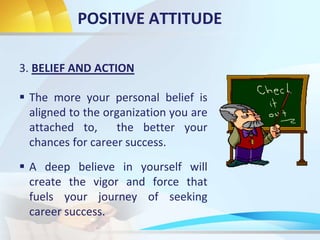
3. BELIEF AND ACTION
 The more your personal belief is
aligned to the organization you are
attached to, the better your
chances for career success.
 A deep believe in yourself will
create the vigor and force that
fuels your journey of seeking
career success.
POSITIVE ATTITUDE
 This belief must be balanced
with action. Action means
making your plans work. It
means doing. Working.
Belief – Action = Fantasies
POSITIVE ATTITUDE
 Anyone without believe in themselves and their
dreams but continue to work their plans is a fool
at work.
 When you are able to synergize believe and
action into one, your dreams come true!
Action – Belief =
Belief + Action =
Fool at Work
Dreams Come True
POSITIVE ATTITUDE
 When you are able to harness the equation these
3 sets of positive attitude in the workplace into
one – reaching for the goal becomes a reality. In
fact, as a newbie seeking career success – when
you internalize this positive attitude in the
workplace into your work attitude…
YOU ARE ON A RIGHT TRACK!
Basic_Supervisory_Skills.pptx

Basic_Supervisory_Skills.pptx

  • 1.
  • 2.
    OBJECTIVE  To providebasic information on functions of supervisors;  Promoting success and support for first time supervisors  Re-orientation on policies and procedures and SOP in the plant
  • 3.
    Course Outline I. ROLEOF A SUPERVISOR II. TRANSITION FROM TEAM MEMBERS TO FIRST-LINE-SUPERVISOR • Differences between staff employees and first line supervisor III. QUALITIES OF A SUPERVISOR IV. DEVELOPING LEADERSHIP SKILLS V. POSITIVE ATTITUDE
  • 4.
    What is aSupervisor Supervisor is a first level “Management Employee” who is responsible for a small group of employees. As a member of Management, a supervisor’s main job is more concerned with orchestrating and controlling work than with controlling it directly. Supervisors manage the day-to- day operations of the workplace and ensure both production and quality targets are met. Supervisors ensures that the work of their staff meets established performance standards
  • 5.
    ROLE OF ASUPERVISOR 2. Leadership Role 3. Communication Role 1. Operational Role manages the flow of work through decision making and problem solving to meet targets in terms of production and quality encourages, supports and motivates their team members which serves as a two-way conduit between upper management and the people who make up the general workforce.
  • 6.
    TRANSITION TO SUPERVISOR Ifyou cannot make that transition, you will have an impossible task when you need to say “no”, reprimand, discipline, or even fire people who are friends. Promotion from within Assume a different role and many patterns of behavior may require change You have made a choice to become a boss You will have to “think before you speak” You become a part of management
  • 7.
    EMPLOYEES vs SUPERVISOR EMPLOYEESSUPERVISORS Focus on their specific job skills Focus on supervising people Do the work Ensure work gets done Work on specific priorities Involved with multiple priorities Contribute to the department’s success Contribute to the entire organization’s success Concern on the quality of their own work Concern on the quality of the entire team’s work Work a specified number of hours Willing to work on overtime and on a scheduled day-off even without pay Receive information from others Share information with others
  • 8.
    1. GOOD COMMUNICATIONSKILLS QUALITIES OF A SUPERVISOR “Good Listening Skills”  communicate upward to higher management about issues and concerns  present complex ideas in simple terms
  • 9.
    QUALITIES OF ASUPERVISOR 2. RESOURCEFULNESS  being creative and seeing solutions  make things happen
  • 10.
    3. FLEXIBILITY QUALITIES OFA SUPERVISOR “Adapt Readily to Change”  needs of work team members will change  needs of the business will change throughout the year, throughout the week, maybe even throughout the day
  • 11.
    4. COMMITMENT ANDRESPONSIBILITY QUALITIES OF A SUPERVISOR “INTEGRITY AND RELIABILITY”  Analyzes situations accurately and adapts well to change; demonstrates willingness to incorporate new ideas or methods  Embraces change in work and work environment even when there is some ambiguity. Making an effort to apply a positive mind set when faced with new situations at work, adapting to new ways of seeing and doing things
  • 12.
    5. EMPATHY QUALITIES OFA SUPERVISOR “Remember what it was like to be ‘new on the job”  Understanding others and their likely reactions to specific situations  sensitive to the thoughts and feelings of other people.
  • 13.
    6. RESPECT QUALITIES OFA SUPERVISOR “Being respectful is more than just being courteous and polite.”  Acknowledging individual needs and aspirations  treat people as individuals
  • 14.
    7. ENTHUSIASM QUALITIES OFA SUPERVISOR “People who are enthusiastic can generally motivate and energise others to behave the same way and reach their full potential ”  Champion your team by being positive, empowering, motivational and committed  Reaching out to employees directly, showing concern and giving encouragement that, in turn, prompts greater employee engagement
  • 15.
    8. TIME MANAGEMENTSKILL QUALITIES OF A SUPERVISOR “Know how to prioritize.”  know how to say ’no’ when it’s needed  know how to manage interruptions and distractions from the task at hand
  • 16.
    9. ABILITY TODELEGATE AND INFLUENCE QUALITIES OF A SUPERVISOR “Delegating strategically”  Coaching and mentoring  Effectively delegate tasks and influence employees to bring their best
  • 17.
    10. BEING OPENTO NEW IDEAS QUALITIES OF A SUPERVISOR “it's useful to keep others involved”  It's critical when collecting the ideas to not pass any judgment on the ideas -- just write them down as you hear them.  Open to looking at things from different perspectives and trying new approaches
  • 18.
    11. ATTENTIVENESS TOTEAM STRESS QUALITIES OF A SUPERVISOR “Addressing the management of stress can be a vital wellness strategy”  Understand the various coping mechanisms available  Identify the various sources and types of stress and recognize signs and symptoms
  • 19.
    Which qualities doyou have right now? What action plans do you intend to take to QUALITIES OF A SUPERVISOR
  • 20.
    GOOD SUPERVISOR BADSUPERVISOR Make the difference between meeting production targets and missing them High levels of absenteeism  Have the most significant impact on workplace culture Reduced productivity  Workplace conflict  Influence the retention of staff  Safety issues  Provide an incentive for people to join a company Resentment toward upper management
  • 21.
    DEVELOPING LEADERSHIP SKILLS 1.INTEGRITY  Leaders have high ethics. They are honest. 2. PASSIONATE  Leaders are passionate.  Do not play the blame game when things go wrong. Leaders take personal responsibility for their team’s actions and results.  They are enthusiastic about their work and they even have the ability to rub this energy off on their followers.
  • 22.
    3. COMMITMENT  Whendeveloping leadership skills, look at the easiest to start. Commitment to your work is one of the easiest. 4. COURAGEOUS  If people are to follow you then as a leader you need to be courageous. DEVELOPING LEADERSHIP SKILLS  Leaders work hard and have a strong discipline in following through with their work.  Leaders are brave when they confront risks and the unknown.
  • 23.
    5. GOAL ORIENTED Leaders are very focused on the objectives that need to be attained. They develop a plan and strategy to achieve the objectives. 6. DEVELOPING PEOPLE  Developing people whether by training, coaching or teaching them is one of the main traits of a good leader. DEVELOPING LEADERSHIP SKILLS  In addition, they will also need to build commitment from the team and rally them to achieve the organization’s goal.  Leaders develop the people to build a stronger team.
  • 24.
    7. PRIORITIZE  Leadersdo the most urgent and important things first regardless of their interest in them. For them, whatever that needs to be done should be completed with the best possible effort. 8. NO PUBLIC GLORY  Leaders know whatever achievements are the result of joint effort of their units. They share glory and credit with the rest for the work. DEVELOPING LEADERSHIP SKILLS
  • 25.
    POSITIVE ATTITUDE 1. PRIDEAND SKILLS/KNOWLEDGE  Pride in my personal definition as a positive attitude in the workplace is taken to mean self- dignity. It means the realization that everything you do has your personal signature on it. Pride – Skills/Knowledge = ARROGANCE
  • 26.
    POSITIVE ATTITUDE  Thisequation of positive attitude in the workplace has to go hand in hand. It has to be in good balance. What about doing your work with just skills and knowledge and with no pride? Skills/Knowledge – Pride = MEDIOCRE WORK
  • 27.
    POSITIVE ATTITUDE  Whenyou add this set of positive attitudes in the workplace together, pride and skills/knowledge – what do you get? Pride + Skills/Knowledge = The Best Work Each Time
  • 28.
    POSITIVE ATTITUDE 2. PASSIONAND DIRECTION  Passion as a positive attitude in the workplace is the burning desire and love for the work that you do, which will pull you through the tough times. It is an intense enthusiasm that all things worth doing are worth doing well. Passion – Direction = Wasted Energy
  • 29.
    POSITIVE ATTITUDE  Whatabout Direction without Passion? Well, what if you know where you want to go but do not have the fuel for it? It just means success takes longer to achieve, if ever. Success Takes Far Longer, If Ever Direction – Passion = Passion + Direction = Goals Galore
  • 30.
    POSITIVE ATTITUDE 3. BELIEFAND ACTION  The more your personal belief is aligned to the organization you are attached to, the better your chances for career success.  A deep believe in yourself will create the vigor and force that fuels your journey of seeking career success.
  • 31.
    POSITIVE ATTITUDE  Thisbelief must be balanced with action. Action means making your plans work. It means doing. Working. Belief – Action = Fantasies
  • 32.
    POSITIVE ATTITUDE  Anyonewithout believe in themselves and their dreams but continue to work their plans is a fool at work.  When you are able to synergize believe and action into one, your dreams come true! Action – Belief = Belief + Action = Fool at Work Dreams Come True
  • 33.
    POSITIVE ATTITUDE  Whenyou are able to harness the equation these 3 sets of positive attitude in the workplace into one – reaching for the goal becomes a reality. In fact, as a newbie seeking career success – when you internalize this positive attitude in the workplace into your work attitude… YOU ARE ON A RIGHT TRACK!

Editor's Notes

  • #22 If you are to gain people's trust then it is important to learn this trait early. Some of the actual situations you can practice this behavior is taking responsibility for your own actions.