Supernova R. Sri Madhavi
What is Supernova? Supernova is a celestial body Supernova is actually a stellar explosion The term, “Supernova” was coined in 1926 by a Swedish astrophysicist, Fritz Zwicky
What is the meaning of Supernova? A very bright new star shining in the  celestial sphere
How often does a Supernova occur? About once in 50 years It happens in the galaxy Its size is about the size of the milky way
What is the importance of Supernova? Supernova plays a significant role in enriching the interstellar medium with higher mass elements the expanding shock waves from supernova explosions can trigger the formation of new stars
Types of Supernova There are two common types of Supernova: Ia II
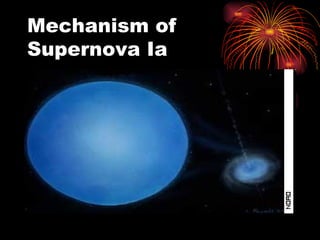
Type Ia Supernova This supernova is the result of the activity of a couple of stars; one of which is a type of star known as “White Dwarf” White dwarf is a star rich in carbon and oxygen.
Type Ia Supernova The  “White Dwarf” absorbs matter from the companion and therefore its mass increases, When the density of the core of the White Dwarf reaches a critical density of 2 x 10 9  g/cm 3   carbon and oxygen undergo fusion uncontrollably, and therefore the star explodes
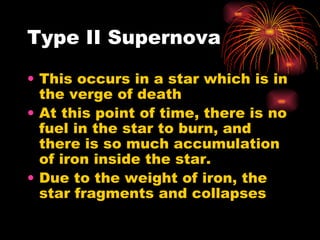
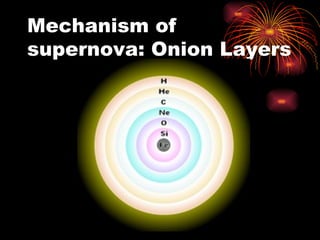
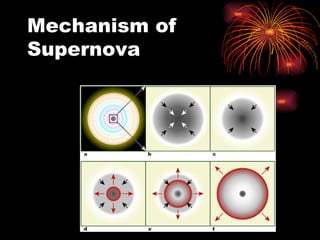
Type II Supernova This occurs in a star which is in the verge of death At this point of time, there is no  fuel in the star to burn, and there is so much accumulation of iron inside the star. Due to the weight of iron, the star fragments and collapses
Mechanism of Supernova Ia
Mechanism of supernova: Onion Layers
Mechanism of Supernova
Other Types Other types of Supernova are: Ib Ic IIP IIL
What happens when Supernova occurs? - 1 A supernova can  radiate  as much  energy  as the  Sun  could emit over its life span.
What happens when Supernova occurs? -2 The explosion expels star's material at a velocity of up to 30,000 km/s (a tenth the  speed of light )
What happens when Supernova occurs? -3 The material coming out of a Supernova produces a  shock wave  into the surrounding  interstellar medium . This shock wave sweeps up an expanding shell of gas and dust called a  supernova remnant .

Supernova- Part 3

  • 1.
  • 2.
    What is Supernova?Supernova is a celestial body Supernova is actually a stellar explosion The term, “Supernova” was coined in 1926 by a Swedish astrophysicist, Fritz Zwicky
  • 3.
    What is themeaning of Supernova? A very bright new star shining in the celestial sphere
  • 4.
    How often doesa Supernova occur? About once in 50 years It happens in the galaxy Its size is about the size of the milky way
  • 5.
    What is theimportance of Supernova? Supernova plays a significant role in enriching the interstellar medium with higher mass elements the expanding shock waves from supernova explosions can trigger the formation of new stars
  • 6.
    Types of SupernovaThere are two common types of Supernova: Ia II
  • 7.
    Type Ia SupernovaThis supernova is the result of the activity of a couple of stars; one of which is a type of star known as “White Dwarf” White dwarf is a star rich in carbon and oxygen.
  • 8.
    Type Ia SupernovaThe “White Dwarf” absorbs matter from the companion and therefore its mass increases, When the density of the core of the White Dwarf reaches a critical density of 2 x 10 9 g/cm 3 carbon and oxygen undergo fusion uncontrollably, and therefore the star explodes
  • 9.
    Type II SupernovaThis occurs in a star which is in the verge of death At this point of time, there is no fuel in the star to burn, and there is so much accumulation of iron inside the star. Due to the weight of iron, the star fragments and collapses
  • 10.
  • 11.
  • 12.
  • 13.
    Other Types Othertypes of Supernova are: Ib Ic IIP IIL
  • 14.
    What happens whenSupernova occurs? - 1 A supernova can radiate as much energy as the Sun could emit over its life span.
  • 15.
    What happens whenSupernova occurs? -2 The explosion expels star's material at a velocity of up to 30,000 km/s (a tenth the speed of light )
  • 16.
    What happens whenSupernova occurs? -3 The material coming out of a Supernova produces a shock wave into the surrounding interstellar medium . This shock wave sweeps up an expanding shell of gas and dust called a supernova remnant .