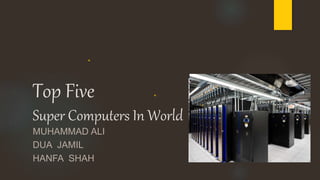
Top Five
Super Computers In World
MUHAMMAD ALI
DUA JAMIL
HANFA SHAH
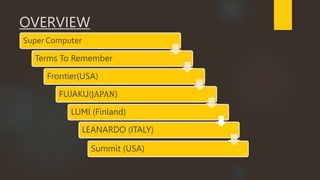
OVERVIEW
Super Computer
Terms To Remember
Frontier(USA)
FUJAKU(JAPAN)
LUMI (Finland)
LEANARDO (ITALY)
Summit (USA)
SUPER COMPUTER
 A supercomputer is a type of computer that is designed to perform
complex calculations at high speeds. These computers are typically used
for scientific and engineering work that requires a lot of processing
power.
 FIELDS IN WHICH USED:
 Quantum Mechanics
 Weather Forecasting
 Molecular Modeling
TERMS TO REMEMBER
 AMD EPYC:
 Company name
 GHz:
 Base Clock Speed
 BASE CLOCK SPEED:
 Minimum Speed of Operations of Core of Processor
 Linpack Performance:
 Measure of System FLOPS introduced by JACK DONGARRA
 FLOPS/s:
 Additions and Multiplications a computer can perform per second
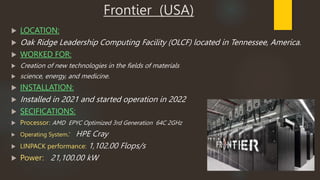
Frontier (USA)
 LOCATION:
 Oak Ridge Leadership Computing Facility (OLCF) located in Tennessee, America.
 WORKED FOR:
 Creation of new technologies in the fields of materials
 science, energy, and medicine.
 INSTALLATION:
 Installed in 2021 and started operation in 2022
 SECIFICATIONS:
 Processor: AMD EPYC Optimized 3rd Generation 64C 2GHz
 Operating System: HPE Cray
 LINPACK performance: 1,102.00 Flops/s
 Power: 21,100.00 kW
FUJAKU (Japan)
LOCATION:
The RIKEN Center for
Computational Science in Wako, Japan.
DEVELOPMENT:
It was developed in June 2020.
WORKED FOR:
COVID-19 viral droplet infection prediction, space exploration, urban
transportation, etc.
SPECIFICATIONS:
Processor: A64FX 48C 2.2GHz
OS: Red Hat Enterprise Linux
LINPACK performance: 442.01 Flop/s
Power: 29,899.23 kW
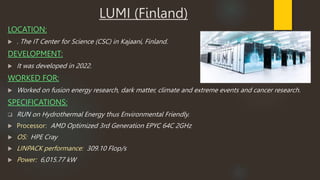
LUMI (Finland)
LOCATION:
 . The IT Center for Science (CSC) in Kajaani, Finland.
DEVELOPMENT:
 It was developed in 2022.
WORKED FOR:
 Worked on fusion energy research, dark matter, climate and extreme events and cancer research.
SPECIFICATIONS:
 RUN on Hydrothermal Energy thus Environmental Friendly.
 Processor: AMD Optimized 3rd Generation EPYC 64C 2GHz
 OS: HPE Cray
 LINPACK performance: 309.10 Flop/s
 Power: 6,015.77 kW
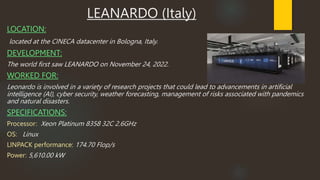
LEANARDO (Italy)
LOCATION:
located at the CINECA datacenter in Bologna, Italy.
DEVELOPMENT:
The world first saw LEANARDO on November 24, 2022.
WORKED FOR:
Leonardo is involved in a variety of research projects that could lead to advancements in artificial
intelligence (AI), cyber security, weather forecasting, management of risks associated with pandemics
and natural disasters.
SPECIFICATIONS:
Processor: Xeon Platinum 8358 32C 2.6GHz
OS: Linux
LINPACK performance: 174.70 Flop/s
Power: 5,610.00 kW
SUMMIT (USA)
LOCATION:
It is located in Oak Ridge National Laboratory Tennessee.
Development:
It was developed in 2018.
WORKED FOR:
To Solve challenging problems in the fields of energy, AI, human health, and
making predictions in physics, such as the lifetime of neutrinos.
SPECIFICATIONS:
Processor: IBM POWER9 22C 3.07GHz
OS: RHEL 7.4
LINPACK performance: 148.60 Flop/s
Power: 10,096.00 kW
Quantum computing is a field of computation that utilizes the principles of quantum
mechanics to perform certain types of calculations much faster and efficiently than
classical computers.
Here are a few important properties and applications of quantum computing:
QUANTUM COMPUTING
Properties of Quantum Computing:
• SUPERPOSITION:
Quantum bits (qubits) can exist in multiple states simultaneously, allowing quantum computers to
explore many possibilities in parallel.
• ENTANGLEMENT:
Qubits can be entangled, meaning the state of one qubit is dependent on the state of another,
even when they are physically separated. This property enables complex, interconnected
calculations.
• INTERFERENCE:
Quantum computers use interference effects to enhance correct solutions and reduce incorrect
ones, improving computational efficiency.
• QUANTUM TUNNELING:
Quantum computers can exploit quantum tunneling to solve certain optimization
problems efficiently.
 Challenges and Limitations:
• ERROR CORRECTIONS:
Quantum computers are highly susceptible to errors due to factors like decoherence.
Developing effective error correction is a major challenge.
• SCALABILITY:
Building large-scale, fault-tolerant quantum computers remains a significant technical
challenge.
THANKS

Top Five Super Computers (1).pptx

  • 1.
    Top Five Super ComputersIn World MUHAMMAD ALI DUA JAMIL HANFA SHAH
  • 2.
    OVERVIEW Super Computer Terms ToRemember Frontier(USA) FUJAKU(JAPAN) LUMI (Finland) LEANARDO (ITALY) Summit (USA)
  • 3.
    SUPER COMPUTER  Asupercomputer is a type of computer that is designed to perform complex calculations at high speeds. These computers are typically used for scientific and engineering work that requires a lot of processing power.  FIELDS IN WHICH USED:  Quantum Mechanics  Weather Forecasting  Molecular Modeling
  • 4.
    TERMS TO REMEMBER AMD EPYC:  Company name  GHz:  Base Clock Speed  BASE CLOCK SPEED:  Minimum Speed of Operations of Core of Processor  Linpack Performance:  Measure of System FLOPS introduced by JACK DONGARRA  FLOPS/s:  Additions and Multiplications a computer can perform per second
  • 5.
    Frontier (USA)  LOCATION: Oak Ridge Leadership Computing Facility (OLCF) located in Tennessee, America.  WORKED FOR:  Creation of new technologies in the fields of materials  science, energy, and medicine.  INSTALLATION:  Installed in 2021 and started operation in 2022  SECIFICATIONS:  Processor: AMD EPYC Optimized 3rd Generation 64C 2GHz  Operating System: HPE Cray  LINPACK performance: 1,102.00 Flops/s  Power: 21,100.00 kW
  • 6.
    FUJAKU (Japan) LOCATION: The RIKENCenter for Computational Science in Wako, Japan. DEVELOPMENT: It was developed in June 2020. WORKED FOR: COVID-19 viral droplet infection prediction, space exploration, urban transportation, etc. SPECIFICATIONS: Processor: A64FX 48C 2.2GHz OS: Red Hat Enterprise Linux LINPACK performance: 442.01 Flop/s Power: 29,899.23 kW
  • 7.
    LUMI (Finland) LOCATION:  .The IT Center for Science (CSC) in Kajaani, Finland. DEVELOPMENT:  It was developed in 2022. WORKED FOR:  Worked on fusion energy research, dark matter, climate and extreme events and cancer research. SPECIFICATIONS:  RUN on Hydrothermal Energy thus Environmental Friendly.  Processor: AMD Optimized 3rd Generation EPYC 64C 2GHz  OS: HPE Cray  LINPACK performance: 309.10 Flop/s  Power: 6,015.77 kW
  • 8.
    LEANARDO (Italy) LOCATION: located atthe CINECA datacenter in Bologna, Italy. DEVELOPMENT: The world first saw LEANARDO on November 24, 2022. WORKED FOR: Leonardo is involved in a variety of research projects that could lead to advancements in artificial intelligence (AI), cyber security, weather forecasting, management of risks associated with pandemics and natural disasters. SPECIFICATIONS: Processor: Xeon Platinum 8358 32C 2.6GHz OS: Linux LINPACK performance: 174.70 Flop/s Power: 5,610.00 kW
  • 9.
    SUMMIT (USA) LOCATION: It islocated in Oak Ridge National Laboratory Tennessee. Development: It was developed in 2018. WORKED FOR: To Solve challenging problems in the fields of energy, AI, human health, and making predictions in physics, such as the lifetime of neutrinos. SPECIFICATIONS: Processor: IBM POWER9 22C 3.07GHz OS: RHEL 7.4 LINPACK performance: 148.60 Flop/s Power: 10,096.00 kW
  • 10.
    Quantum computing isa field of computation that utilizes the principles of quantum mechanics to perform certain types of calculations much faster and efficiently than classical computers. Here are a few important properties and applications of quantum computing: QUANTUM COMPUTING Properties of Quantum Computing: • SUPERPOSITION: Quantum bits (qubits) can exist in multiple states simultaneously, allowing quantum computers to explore many possibilities in parallel. • ENTANGLEMENT: Qubits can be entangled, meaning the state of one qubit is dependent on the state of another, even when they are physically separated. This property enables complex, interconnected calculations. • INTERFERENCE: Quantum computers use interference effects to enhance correct solutions and reduce incorrect ones, improving computational efficiency.
  • 11.
    • QUANTUM TUNNELING: Quantumcomputers can exploit quantum tunneling to solve certain optimization problems efficiently.  Challenges and Limitations: • ERROR CORRECTIONS: Quantum computers are highly susceptible to errors due to factors like decoherence. Developing effective error correction is a major challenge. • SCALABILITY: Building large-scale, fault-tolerant quantum computers remains a significant technical challenge.
  • 12.