BATTERYBATTERYBATTERYBATTERY
 Electrode materialsElectrode materials
react electrochemicallyreact electrochemically
with the ions required inwith the ions required in
the reaction to bethe reaction to be
transferred throughtransferred through
electrolyte in which theelectrolyte in which the
electrodes are immersedelectrodes are immersed
 Energy storage capacityEnergy storage capacity
is given by Ah or Whis given by Ah or Wh
SHORTCOMINGSSHORTCOMINGS
OF BATTERIESOF BATTERIES
SHORTCOMINGSSHORTCOMINGS
OF BATTERIESOF BATTERIES
 CostCost
 MaintenanceMaintenance
 Shelf and working lifeShelf and working life
 Weight and sizeWeight and size
 Large number ofLarge number of
battery conditioningbattery conditioning
parametersparameters
PEAK POWERPEAK POWER
REQUIREMENT WHEREREQUIREMENT WHERE
BATTERY AND CAPACITORBATTERY AND CAPACITOR
HAS PROBLEMSHAS PROBLEMS
PEAK POWERPEAK POWER
REQUIREMENT WHEREREQUIREMENT WHERE
BATTERY AND CAPACITORBATTERY AND CAPACITOR
HAS PROBLEMSHAS PROBLEMS
 Starting of any DC MotorStarting of any DC Motor
 Generator-Motor setsGenerator-Motor sets
 CamerasCameras
 Audio Video devicesAudio Video devices
SUPERCAPACITOR CAN BE USED TOSUPERCAPACITOR CAN BE USED TO
FULFILLFULFILL
PEAK POWER REQUIREMENTSPEAK POWER REQUIREMENTS
 Starting of any DC MotorStarting of any DC Motor
 Generator-Motor setsGenerator-Motor sets
 CamerasCameras
 Audio Video devicesAudio Video devices
SUPERCAPACITOR CAN BE USED TOSUPERCAPACITOR CAN BE USED TO
FULFILLFULFILL
PEAK POWER REQUIREMENTSPEAK POWER REQUIREMENTS
EDLC Stores Energy in the Form of Electrostatic Charges byEDLC Stores Energy in the Form of Electrostatic Charges by
Polarizing an Electrolyte Solution. There Is No ChemicalPolarizing an Electrolyte Solution. There Is No Chemical
Reaction Involved in Its Mechanism Which Is ReversibleReaction Involved in Its Mechanism Which Is Reversible
STORES GREATER AMOUNT OF ENERGYSTORES GREATER AMOUNT OF ENERGYSTORES GREATER AMOUNT OF ENERGYSTORES GREATER AMOUNT OF ENERGY
EXTREMELY EFFICIENTEXTREMELY EFFICIENT
MAINMAIN
CHARACTERISTICS OFCHARACTERISTICS OF
EDLCEDLC
MAINMAIN
CHARACTERISTICS OFCHARACTERISTICS OF
EDLCEDLC
COMPARATIVE STUDYCOMPARATIVE STUDY
EDLCEDLC
 Operates within its anyOperates within its any
voltage rangevoltage range
 Can be stored in charged/Can be stored in charged/
discharged statedischarged state
 It can completelyIt can completely
dischargedischarge
 Stores less energyStores less energy
 It can deliver frequentIt can deliver frequent
power pulsespower pulses
 It can charge very fastIt can charge very fast
 It can recycle thousandIt can recycle thousand
timestimes
EDLCEDLC
 Operates within its anyOperates within its any
voltage rangevoltage range
 Can be stored in charged/Can be stored in charged/
discharged statedischarged state
 It can completelyIt can completely
dischargedischarge
 Stores less energyStores less energy
 It can deliver frequentIt can deliver frequent
power pulsespower pulses
 It can charge very fastIt can charge very fast
 It can recycle thousandIt can recycle thousand
timestimes
BatteryBattery
 Operates with narrow range ofOperates with narrow range of
voltagevoltage
 Storage is problem in anyStorage is problem in any
statestate
 Over discharging can damageOver discharging can damage
itit
 Stores more energyStores more energy
 Life gets affected due to highLife gets affected due to high
power pulsespower pulses
 Fast charging can damage itFast charging can damage it
 It can recycle few hundredIt can recycle few hundred
timestimes
BatteryBattery
 Operates with narrow range ofOperates with narrow range of
voltagevoltage
 Storage is problem in anyStorage is problem in any
statestate
 Over discharging can damageOver discharging can damage
itit
 Stores more energyStores more energy
 Life gets affected due to highLife gets affected due to high
power pulsespower pulses
 Fast charging can damage itFast charging can damage it
 It can recycle few hundredIt can recycle few hundred
timestimes
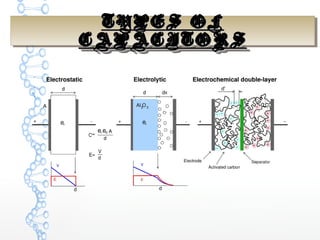
TYPES OFTYPES OF
CAPACITORSCAPACITORS
TYPES OFTYPES OF
CAPACITORSCAPACITORS

Two Electrodes of porous carbon material in the electrolyte withTwo Electrodes of porous carbon material in the electrolyte with
separator.separator.

Porous carbon gives very high surface area of the order of 1500Sq. m perPorous carbon gives very high surface area of the order of 1500Sq. m per
gram.gram.

High surface area gives very high capacitance.High surface area gives very high capacitance.

Two Electrodes of porous carbon material in the electrolyte withTwo Electrodes of porous carbon material in the electrolyte with
separator.separator.

Porous carbon gives very high surface area of the order of 1500Sq. m perPorous carbon gives very high surface area of the order of 1500Sq. m per
gram.gram.

High surface area gives very high capacitance.High surface area gives very high capacitance.
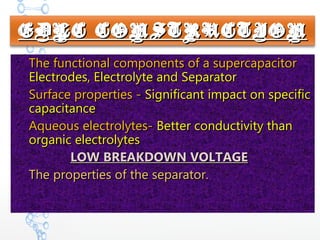
EDLC CONSTRUCTIONEDLC CONSTRUCTION

The functional components of a supercapacitorThe functional components of a supercapacitor
Electrodes, Electrolyte and SeparatorElectrodes, Electrolyte and Separator

Surface properties -Surface properties - Significant impact on specificSignificant impact on specific
capacitancecapacitance

Aqueous electrolytes-Aqueous electrolytes- Better conductivity thanBetter conductivity than
organic electrolytesorganic electrolytes
LOW BREAKDOWN VOLTAGELOW BREAKDOWN VOLTAGE

The properties of the separator.The properties of the separator.
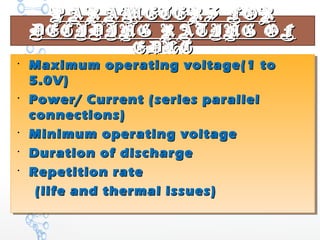
PARAMETERS FORPARAMETERS FOR
DECIDING RATING OFDECIDING RATING OF
EDLCEDLC

Maximum operating voltage(1 toMaximum operating voltage(1 to
5.0V)5.0V)

Power/ Current (series parallelPower/ Current (series parallel
connections)connections)

Minimum operating voltageMinimum operating voltage

Duration of dischargeDuration of discharge

Repetition rateRepetition rate
(life and thermal issues)(life and thermal issues)

Maximum operating voltage(1 toMaximum operating voltage(1 to
5.0V)5.0V)

Power/ Current (series parallelPower/ Current (series parallel
connections)connections)

Minimum operating voltageMinimum operating voltage

Duration of dischargeDuration of discharge

Repetition rateRepetition rate
(life and thermal issues)(life and thermal issues)
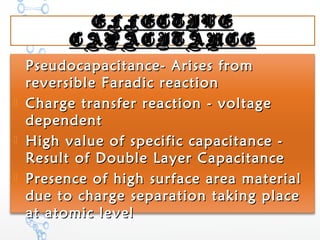
EFFECTIVEEFFECTIVE
CAPACITANCECAPACITANCE
 Pseudocapacitance- Arises fromPseudocapacitance- Arises from
reversible Faradic reactionreversible Faradic reaction
 Charge transfer reaction - voltageCharge transfer reaction - voltage
dependentdependent
 High value of specific capacitance -High value of specific capacitance -
Result of Double Layer CapacitanceResult of Double Layer Capacitance
 Presence of high surface area materialPresence of high surface area material
due to charge separation taking placedue to charge separation taking place
at atomic levelat atomic level
A battery subjected to a pulsed
current without Supercapacitor
A battery subjected to a pulsed
current with a supercapacitor
PROBLEMS INPROBLEMS IN
MANUFACTURINGMANUFACTURING

Packaging

Inter-electrode connection

Ventilation

Leakage of electrolyte

Formation of multi-electrode multi cell unit

Keeping minimum contact resistance to meet
power density

Packaging

Inter-electrode connection

Ventilation

Leakage of electrolyte

Formation of multi-electrode multi cell unit

Keeping minimum contact resistance to meet
power density
AREAS OFAREAS OF
APPLICATIONS OFAPPLICATIONS OF
EDLCEDLC
 Quick charge application- charging in sec andQuick charge application- charging in sec and
discharging in minutes( power tools and toys )discharging in minutes( power tools and toys )
 Electrical Vehicles (starting).Electrical Vehicles (starting).
 Short term support for uninterrupted powerShort term support for uninterrupted power
system with generator backupsystem with generator backup
 Solar array (Energy rich , power poor source )Solar array (Energy rich , power poor source )
 Supporting power buses while switchingSupporting power buses while switching
 Computer memory backups- low current longComputer memory backups- low current long
duration requirementsduration requirements
THANK YOU!!!THANK YOU!!!

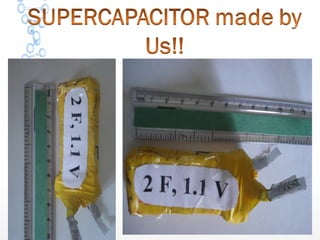
Supercapacitor-

  • 2.
    BATTERYBATTERYBATTERYBATTERY  Electrode materialsElectrodematerials react electrochemicallyreact electrochemically with the ions required inwith the ions required in the reaction to bethe reaction to be transferred throughtransferred through electrolyte in which theelectrolyte in which the electrodes are immersedelectrodes are immersed  Energy storage capacityEnergy storage capacity is given by Ah or Whis given by Ah or Wh
  • 3.
    SHORTCOMINGSSHORTCOMINGS OF BATTERIESOF BATTERIES SHORTCOMINGSSHORTCOMINGS OFBATTERIESOF BATTERIES  CostCost  MaintenanceMaintenance  Shelf and working lifeShelf and working life  Weight and sizeWeight and size  Large number ofLarge number of battery conditioningbattery conditioning parametersparameters
  • 4.
    PEAK POWERPEAK POWER REQUIREMENTWHEREREQUIREMENT WHERE BATTERY AND CAPACITORBATTERY AND CAPACITOR HAS PROBLEMSHAS PROBLEMS PEAK POWERPEAK POWER REQUIREMENT WHEREREQUIREMENT WHERE BATTERY AND CAPACITORBATTERY AND CAPACITOR HAS PROBLEMSHAS PROBLEMS  Starting of any DC MotorStarting of any DC Motor  Generator-Motor setsGenerator-Motor sets  CamerasCameras  Audio Video devicesAudio Video devices SUPERCAPACITOR CAN BE USED TOSUPERCAPACITOR CAN BE USED TO FULFILLFULFILL PEAK POWER REQUIREMENTSPEAK POWER REQUIREMENTS  Starting of any DC MotorStarting of any DC Motor  Generator-Motor setsGenerator-Motor sets  CamerasCameras  Audio Video devicesAudio Video devices SUPERCAPACITOR CAN BE USED TOSUPERCAPACITOR CAN BE USED TO FULFILLFULFILL PEAK POWER REQUIREMENTSPEAK POWER REQUIREMENTS
  • 5.
    EDLC Stores Energyin the Form of Electrostatic Charges byEDLC Stores Energy in the Form of Electrostatic Charges by Polarizing an Electrolyte Solution. There Is No ChemicalPolarizing an Electrolyte Solution. There Is No Chemical Reaction Involved in Its Mechanism Which Is ReversibleReaction Involved in Its Mechanism Which Is Reversible STORES GREATER AMOUNT OF ENERGYSTORES GREATER AMOUNT OF ENERGYSTORES GREATER AMOUNT OF ENERGYSTORES GREATER AMOUNT OF ENERGY EXTREMELY EFFICIENTEXTREMELY EFFICIENT
  • 7.
  • 8.
    COMPARATIVE STUDYCOMPARATIVE STUDY EDLCEDLC Operates within its anyOperates within its any voltage rangevoltage range  Can be stored in charged/Can be stored in charged/ discharged statedischarged state  It can completelyIt can completely dischargedischarge  Stores less energyStores less energy  It can deliver frequentIt can deliver frequent power pulsespower pulses  It can charge very fastIt can charge very fast  It can recycle thousandIt can recycle thousand timestimes EDLCEDLC  Operates within its anyOperates within its any voltage rangevoltage range  Can be stored in charged/Can be stored in charged/ discharged statedischarged state  It can completelyIt can completely dischargedischarge  Stores less energyStores less energy  It can deliver frequentIt can deliver frequent power pulsespower pulses  It can charge very fastIt can charge very fast  It can recycle thousandIt can recycle thousand timestimes BatteryBattery  Operates with narrow range ofOperates with narrow range of voltagevoltage  Storage is problem in anyStorage is problem in any statestate  Over discharging can damageOver discharging can damage itit  Stores more energyStores more energy  Life gets affected due to highLife gets affected due to high power pulsespower pulses  Fast charging can damage itFast charging can damage it  It can recycle few hundredIt can recycle few hundred timestimes BatteryBattery  Operates with narrow range ofOperates with narrow range of voltagevoltage  Storage is problem in anyStorage is problem in any statestate  Over discharging can damageOver discharging can damage itit  Stores more energyStores more energy  Life gets affected due to highLife gets affected due to high power pulsespower pulses  Fast charging can damage itFast charging can damage it  It can recycle few hundredIt can recycle few hundred timestimes
  • 9.
    TYPES OFTYPES OF CAPACITORSCAPACITORS TYPESOFTYPES OF CAPACITORSCAPACITORS
  • 10.
     Two Electrodes ofporous carbon material in the electrolyte withTwo Electrodes of porous carbon material in the electrolyte with separator.separator.  Porous carbon gives very high surface area of the order of 1500Sq. m perPorous carbon gives very high surface area of the order of 1500Sq. m per gram.gram.  High surface area gives very high capacitance.High surface area gives very high capacitance.  Two Electrodes of porous carbon material in the electrolyte withTwo Electrodes of porous carbon material in the electrolyte with separator.separator.  Porous carbon gives very high surface area of the order of 1500Sq. m perPorous carbon gives very high surface area of the order of 1500Sq. m per gram.gram.  High surface area gives very high capacitance.High surface area gives very high capacitance.
  • 11.
    EDLC CONSTRUCTIONEDLC CONSTRUCTION  Thefunctional components of a supercapacitorThe functional components of a supercapacitor Electrodes, Electrolyte and SeparatorElectrodes, Electrolyte and Separator  Surface properties -Surface properties - Significant impact on specificSignificant impact on specific capacitancecapacitance  Aqueous electrolytes-Aqueous electrolytes- Better conductivity thanBetter conductivity than organic electrolytesorganic electrolytes LOW BREAKDOWN VOLTAGELOW BREAKDOWN VOLTAGE  The properties of the separator.The properties of the separator.
  • 12.
    PARAMETERS FORPARAMETERS FOR DECIDINGRATING OFDECIDING RATING OF EDLCEDLC  Maximum operating voltage(1 toMaximum operating voltage(1 to 5.0V)5.0V)  Power/ Current (series parallelPower/ Current (series parallel connections)connections)  Minimum operating voltageMinimum operating voltage  Duration of dischargeDuration of discharge  Repetition rateRepetition rate (life and thermal issues)(life and thermal issues)  Maximum operating voltage(1 toMaximum operating voltage(1 to 5.0V)5.0V)  Power/ Current (series parallelPower/ Current (series parallel connections)connections)  Minimum operating voltageMinimum operating voltage  Duration of dischargeDuration of discharge  Repetition rateRepetition rate (life and thermal issues)(life and thermal issues)
  • 13.
    EFFECTIVEEFFECTIVE CAPACITANCECAPACITANCE  Pseudocapacitance- ArisesfromPseudocapacitance- Arises from reversible Faradic reactionreversible Faradic reaction  Charge transfer reaction - voltageCharge transfer reaction - voltage dependentdependent  High value of specific capacitance -High value of specific capacitance - Result of Double Layer CapacitanceResult of Double Layer Capacitance  Presence of high surface area materialPresence of high surface area material due to charge separation taking placedue to charge separation taking place at atomic levelat atomic level
  • 14.
    A battery subjectedto a pulsed current without Supercapacitor A battery subjected to a pulsed current with a supercapacitor
  • 15.
    PROBLEMS INPROBLEMS IN MANUFACTURINGMANUFACTURING  Packaging  Inter-electrodeconnection  Ventilation  Leakage of electrolyte  Formation of multi-electrode multi cell unit  Keeping minimum contact resistance to meet power density  Packaging  Inter-electrode connection  Ventilation  Leakage of electrolyte  Formation of multi-electrode multi cell unit  Keeping minimum contact resistance to meet power density
  • 16.
    AREAS OFAREAS OF APPLICATIONSOFAPPLICATIONS OF EDLCEDLC  Quick charge application- charging in sec andQuick charge application- charging in sec and discharging in minutes( power tools and toys )discharging in minutes( power tools and toys )  Electrical Vehicles (starting).Electrical Vehicles (starting).  Short term support for uninterrupted powerShort term support for uninterrupted power system with generator backupsystem with generator backup  Solar array (Energy rich , power poor source )Solar array (Energy rich , power poor source )  Supporting power buses while switchingSupporting power buses while switching  Computer memory backups- low current longComputer memory backups- low current long duration requirementsduration requirements
  • 18.