TRIGONOMETRY UNITS 1 &2
By Leslie Zamudio
HOW TO MEASURE IN BOTH DEGREES &
RADIANS
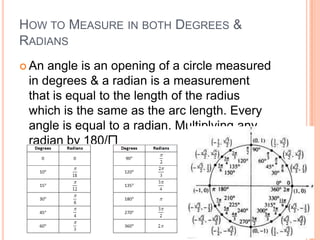
 An angle is an opening of a circle measured
in degrees & a radian is a measurement
that is equal to the length of the radius
which is the same as the arc length. Every
angle is equal to a radian. Multiplying any
radian by 180/∏
SINE AND COSINE
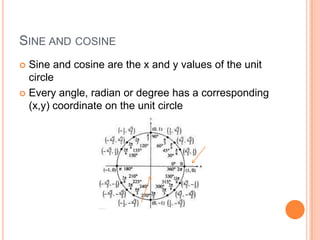
 Sine and cosine are the x and y values of the unit
circle
 Every angle, radian or degree has a corresponding
(x,y) coordinate on the unit circle
SINE AND COSINE
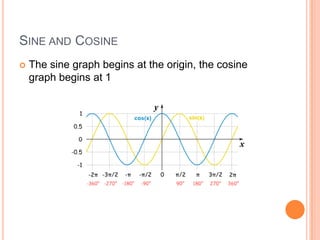
 The sine graph begins at the origin, the cosine
graph begins at 1
SOLVING FOR SINE AND COSINE
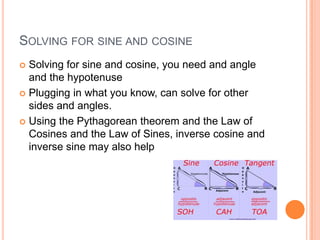
 Solving for sine and cosine, you need and angle
and the hypotenuse
 Plugging in what you know, can solve for other
sides and angles.
 Using the Pythagorean theorem and the Law of
Cosines and the Law of Sines, inverse cosine and
inverse sine may also help
UNIT 2
 F(x)= a sin (bx+c)+d
 F(x)= a cos (bx+c)+d
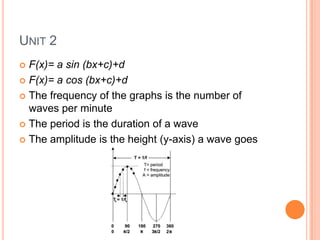
 The frequency of the graphs is the number of
waves per minute
 The period is the duration of a wave
 The amplitude is the height (y-axis) a wave goes
UNIT 2
 A phase shift refers to a horizontal or vertical
translation according to the equation. The phase
shift is defined by c (F(x)= a sin (bx+c)+d ) . If c is
negative the graph shifts over to the right, if it is
positve it shifts to the left.
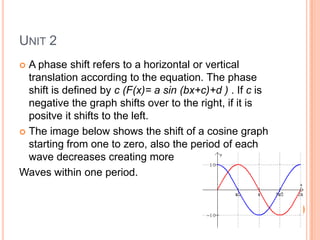
 The image below shows the shift of a cosine graph
starting from one to zero, also the period of each
wave decreases creating more
Waves within one period.
UNIT 2
 Inverse sin-1 / arcsine
 Inverse cos-1 / arccosine
 Inverse tan-1 / arctangent
 The inverse and the arc finds the measurement of
the angle
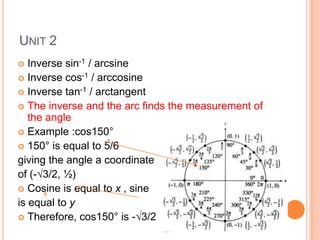
 Example :cos150°
 150° is equal to 5/6
giving the angle a coordinate
of (-√3/2, ½)
 Cosine is equal to x , sine
is equal to y
 Therefore, cos150° is -√3/2

Trigonometry

  • 1.
    TRIGONOMETRY UNITS 1&2 By Leslie Zamudio
  • 2.
    HOW TO MEASUREIN BOTH DEGREES & RADIANS  An angle is an opening of a circle measured in degrees & a radian is a measurement that is equal to the length of the radius which is the same as the arc length. Every angle is equal to a radian. Multiplying any radian by 180/∏
  • 3.
    SINE AND COSINE Sine and cosine are the x and y values of the unit circle  Every angle, radian or degree has a corresponding (x,y) coordinate on the unit circle
  • 4.
    SINE AND COSINE The sine graph begins at the origin, the cosine graph begins at 1
  • 5.
    SOLVING FOR SINEAND COSINE  Solving for sine and cosine, you need and angle and the hypotenuse  Plugging in what you know, can solve for other sides and angles.  Using the Pythagorean theorem and the Law of Cosines and the Law of Sines, inverse cosine and inverse sine may also help
  • 6.
    UNIT 2  F(x)=a sin (bx+c)+d  F(x)= a cos (bx+c)+d  The frequency of the graphs is the number of waves per minute  The period is the duration of a wave  The amplitude is the height (y-axis) a wave goes
  • 7.
    UNIT 2  Aphase shift refers to a horizontal or vertical translation according to the equation. The phase shift is defined by c (F(x)= a sin (bx+c)+d ) . If c is negative the graph shifts over to the right, if it is positve it shifts to the left.  The image below shows the shift of a cosine graph starting from one to zero, also the period of each wave decreases creating more Waves within one period.
  • 8.
    UNIT 2  Inversesin-1 / arcsine  Inverse cos-1 / arccosine  Inverse tan-1 / arctangent  The inverse and the arc finds the measurement of the angle  Example :cos150°  150° is equal to 5/6 giving the angle a coordinate of (-√3/2, ½)  Cosine is equal to x , sine is equal to y  Therefore, cos150° is -√3/2