How many drops are there in a cubic centimeter of fog if the visibility is 100m and the
fog disappears within an hour?
P. L. Kapitza
Solution:
Note: The present solution follows, in general lines, the solution of Acad. Kapitza.
1. Visibility distance:
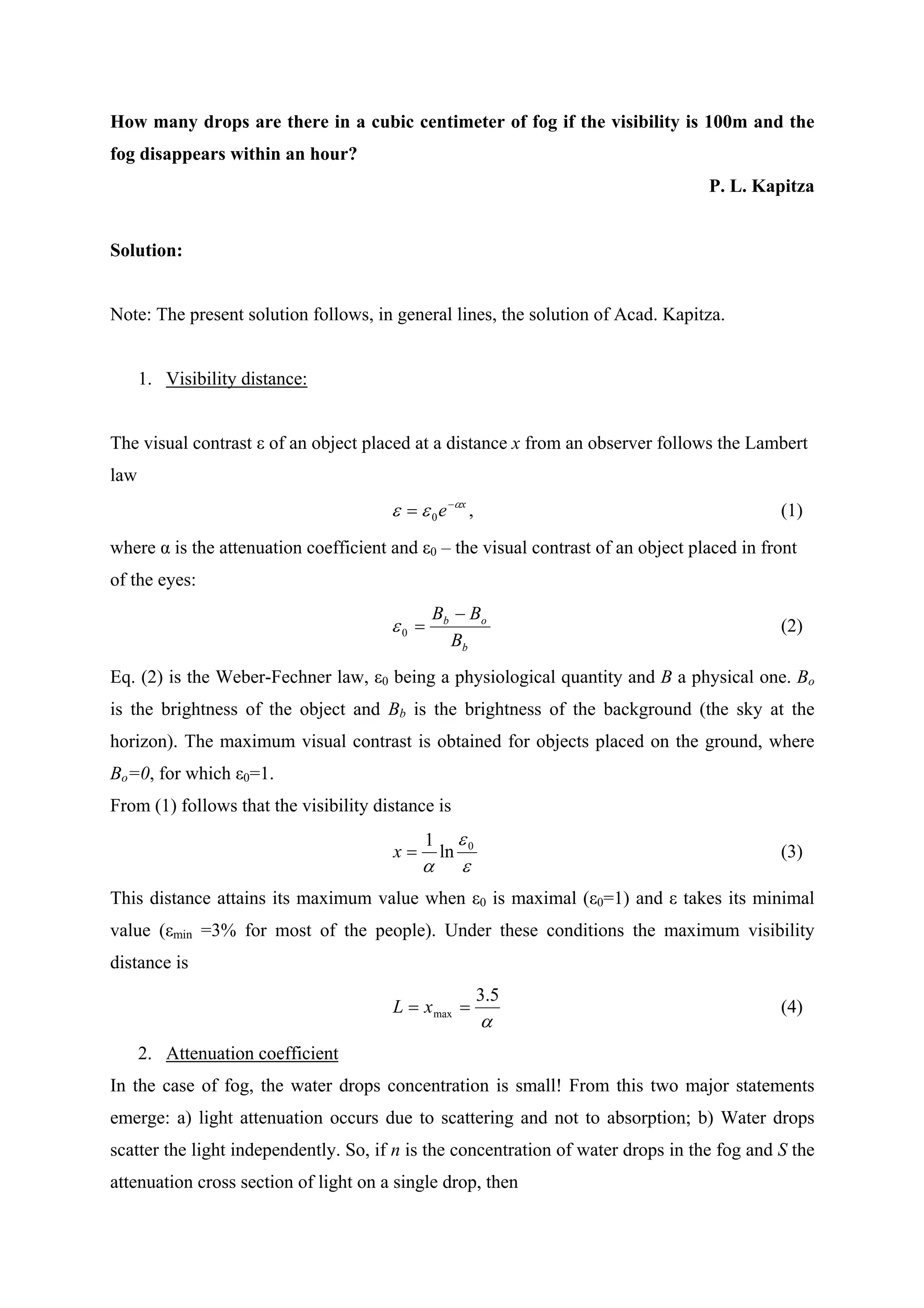
The visual contrast ε of an object placed at a distance x from an observer follows the Lambert
law
x
e α
εε −
= 0 , (1)
where α is the attenuation coefficient and ε0 – the visual contrast of an object placed in front
of the eyes:
b
ob
B
BB −
=0ε (2)
Eq. (2) is the Weber-Fechner law, ε0 being a physiological quantity and B a physical one. Bo
is the brightness of the object and Bb is the brightness of the background (the sky at the
horizon). The maximum visual contrast is obtained for objects placed on the ground, where
Bo=0, for which ε0=1.
From (1) follows that the visibility distance is
ε
ε
α
0
ln
1
=x (3)
This distance attains its maximum value when ε0 is maximal (ε0=1) and ε takes its minimal
value (εmin =3% for most of the people). Under these conditions the maximum visibility
distance is
α
5.3
max == xL (4)
2. Attenuation coefficient
In the case of fog, the water drops concentration is small! From this two major statements
emerge: a) light attenuation occurs due to scattering and not to absorption; b) Water drops
scatter the light independently. So, if n is the concentration of water drops in the fog and S the
attenuation cross section of light on a single drop, then
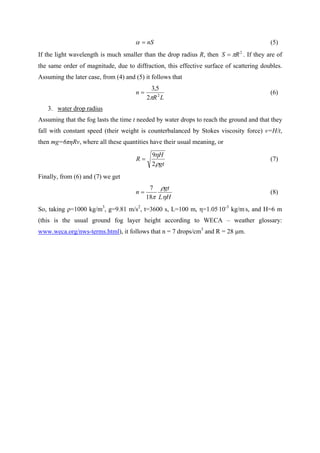
nS=α (5)
If the light wavelength is much smaller than the drop radius R, then 2
RS π= . If they are of
the same order of magnitude, due to diffraction, this effective surface of scattering doubles.
Assuming the later case, from (4) and (5) it follows that
LR
n 2
2
5,3
π
= (6)
3. water drop radius
Assuming that the fog lasts the time t needed by water drops to reach the ground and that they
fall with constant speed (their weight is counterbalanced by Stokes viscosity force) v=H/t,
then mg=6πηRv, where all these quantities have their usual meaning, or
gt
H
R
ρ
η
2
9
= (7)
Finally, from (6) and (7) we get
HL
gt
n
η
ρ
π18
7
= (8)
So, taking ρ=1000 kg/m3
, g=9.81 m/s2
, t=3600 s, L=100 m, η=1.05.
10-3
kg/m.
s, and H=6 m
(this is the usual ground fog layer height according to WECA – weather glossary:
www.weca.org/nws-terms.html), it follows that n = 7 drops/cm3
and R = 28 µm.

Fog visibility

  • 1.
    How many dropsare there in a cubic centimeter of fog if the visibility is 100m and the fog disappears within an hour? P. L. Kapitza Solution: Note: The present solution follows, in general lines, the solution of Acad. Kapitza. 1. Visibility distance: The visual contrast ε of an object placed at a distance x from an observer follows the Lambert law x e α εε − = 0 , (1) where α is the attenuation coefficient and ε0 – the visual contrast of an object placed in front of the eyes: b ob B BB − =0ε (2) Eq. (2) is the Weber-Fechner law, ε0 being a physiological quantity and B a physical one. Bo is the brightness of the object and Bb is the brightness of the background (the sky at the horizon). The maximum visual contrast is obtained for objects placed on the ground, where Bo=0, for which ε0=1. From (1) follows that the visibility distance is ε ε α 0 ln 1 =x (3) This distance attains its maximum value when ε0 is maximal (ε0=1) and ε takes its minimal value (εmin =3% for most of the people). Under these conditions the maximum visibility distance is α 5.3 max == xL (4) 2. Attenuation coefficient In the case of fog, the water drops concentration is small! From this two major statements emerge: a) light attenuation occurs due to scattering and not to absorption; b) Water drops scatter the light independently. So, if n is the concentration of water drops in the fog and S the attenuation cross section of light on a single drop, then
  • 2.
    nS=α (5) If thelight wavelength is much smaller than the drop radius R, then 2 RS π= . If they are of the same order of magnitude, due to diffraction, this effective surface of scattering doubles. Assuming the later case, from (4) and (5) it follows that LR n 2 2 5,3 π = (6) 3. water drop radius Assuming that the fog lasts the time t needed by water drops to reach the ground and that they fall with constant speed (their weight is counterbalanced by Stokes viscosity force) v=H/t, then mg=6πηRv, where all these quantities have their usual meaning, or gt H R ρ η 2 9 = (7) Finally, from (6) and (7) we get HL gt n η ρ π18 7 = (8) So, taking ρ=1000 kg/m3 , g=9.81 m/s2 , t=3600 s, L=100 m, η=1.05. 10-3 kg/m. s, and H=6 m (this is the usual ground fog layer height according to WECA – weather glossary: www.weca.org/nws-terms.html), it follows that n = 7 drops/cm3 and R = 28 µm.