Sunshine
Recorder
Presented by
Tanu Verma 1801793
Jens
Martensson
Sunshine Recorder
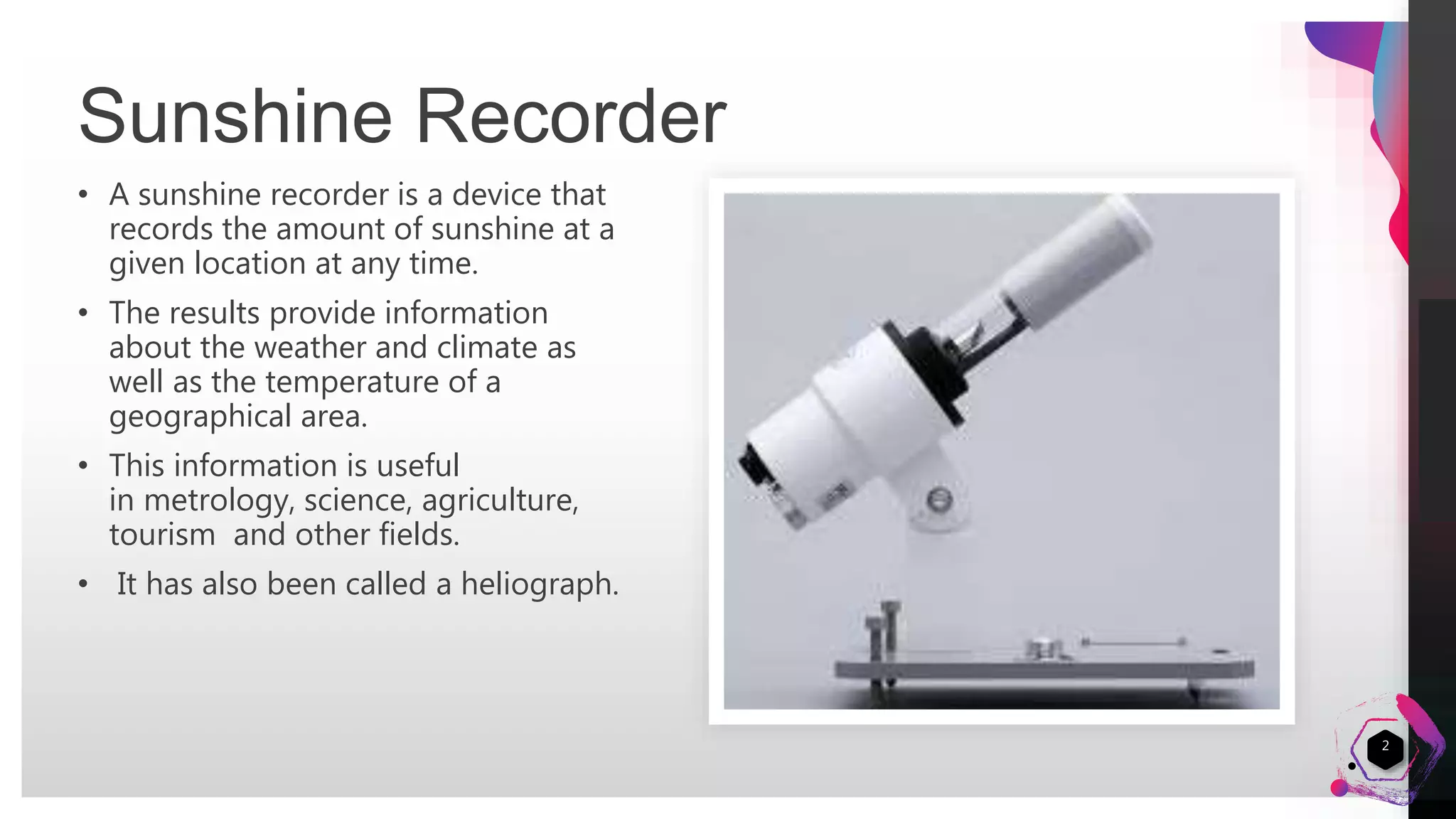
• A sunshine recorder is a device that
records the amount of sunshine at a
given location at any time.
• The results provide information
about the weather and climate as
well as the temperature of a
geographical area.
• This information is useful
in metrology, science, agriculture,
tourism and other fields.
• It has also been called a heliograph.
2
Jens
Martensson
• The popular types of Sunshine Recorder are:
1. Campbell- stokes Recorder
2. Rotating Mirror Sunshine Recorder
3. Blake- Larsen Recorder
Types of Sunshine Recorder
3
Jens
Martensson
4
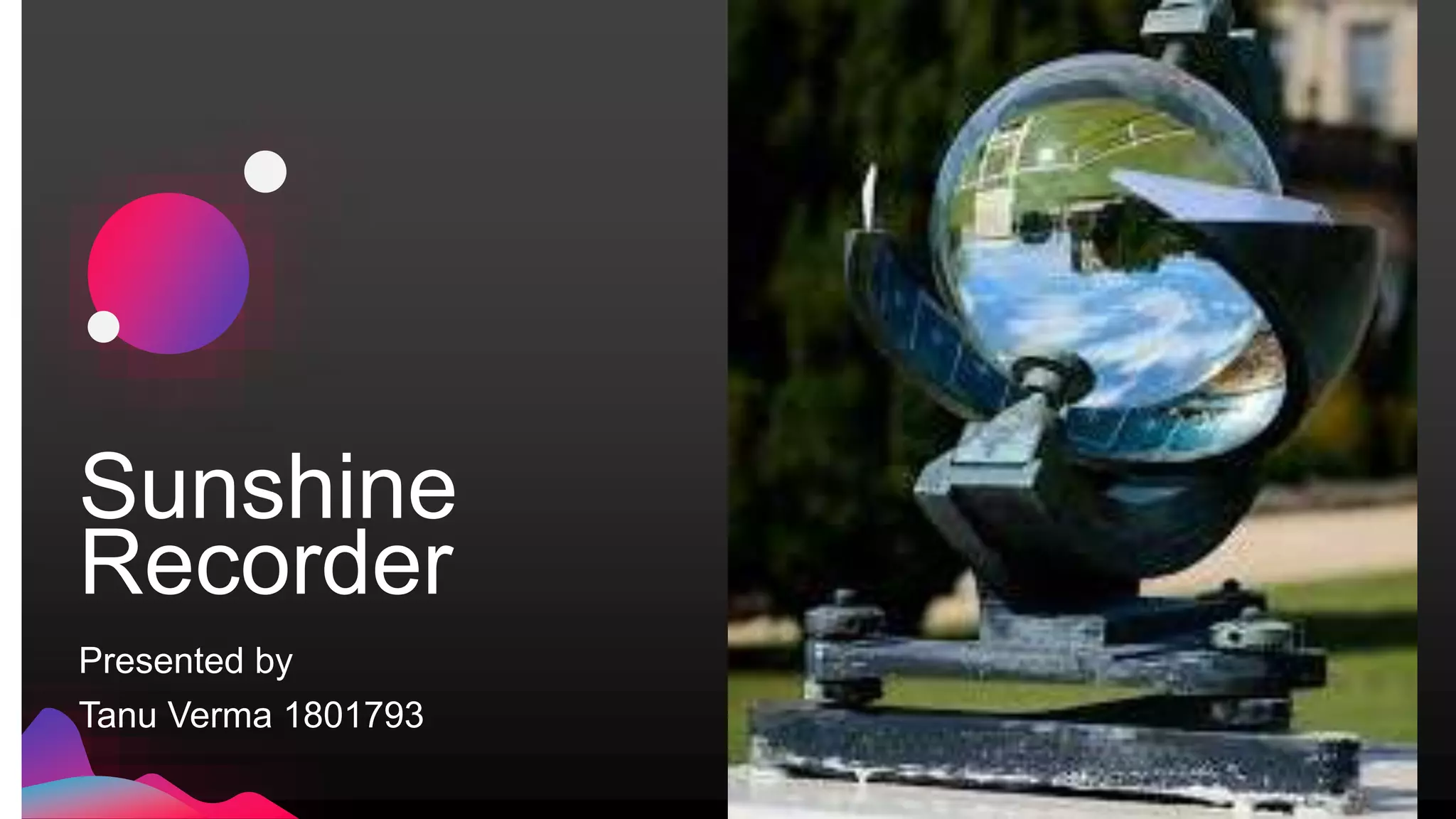
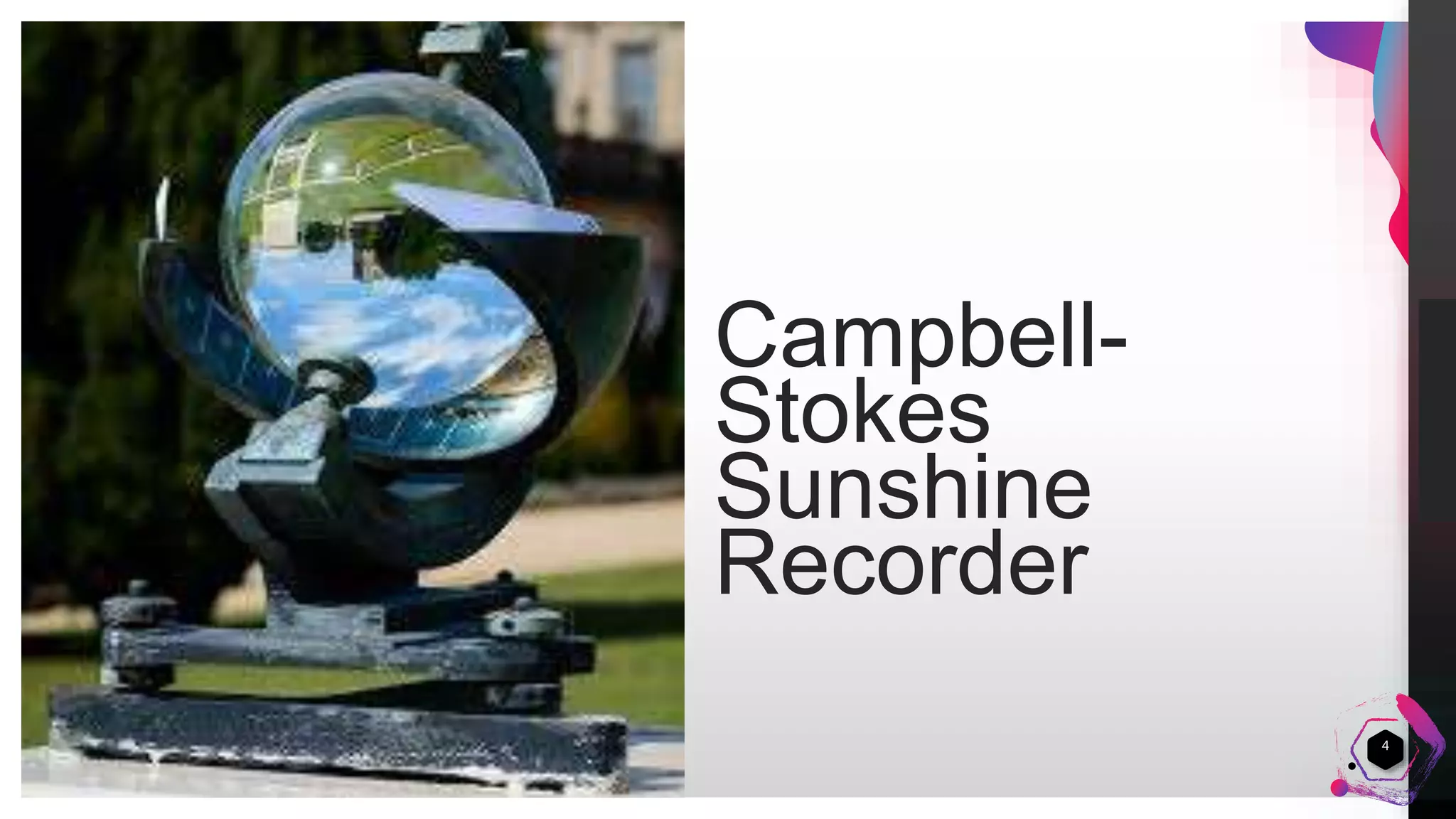
Campbell-
Stokes
Sunshine
Recorder
Jens
Martensson
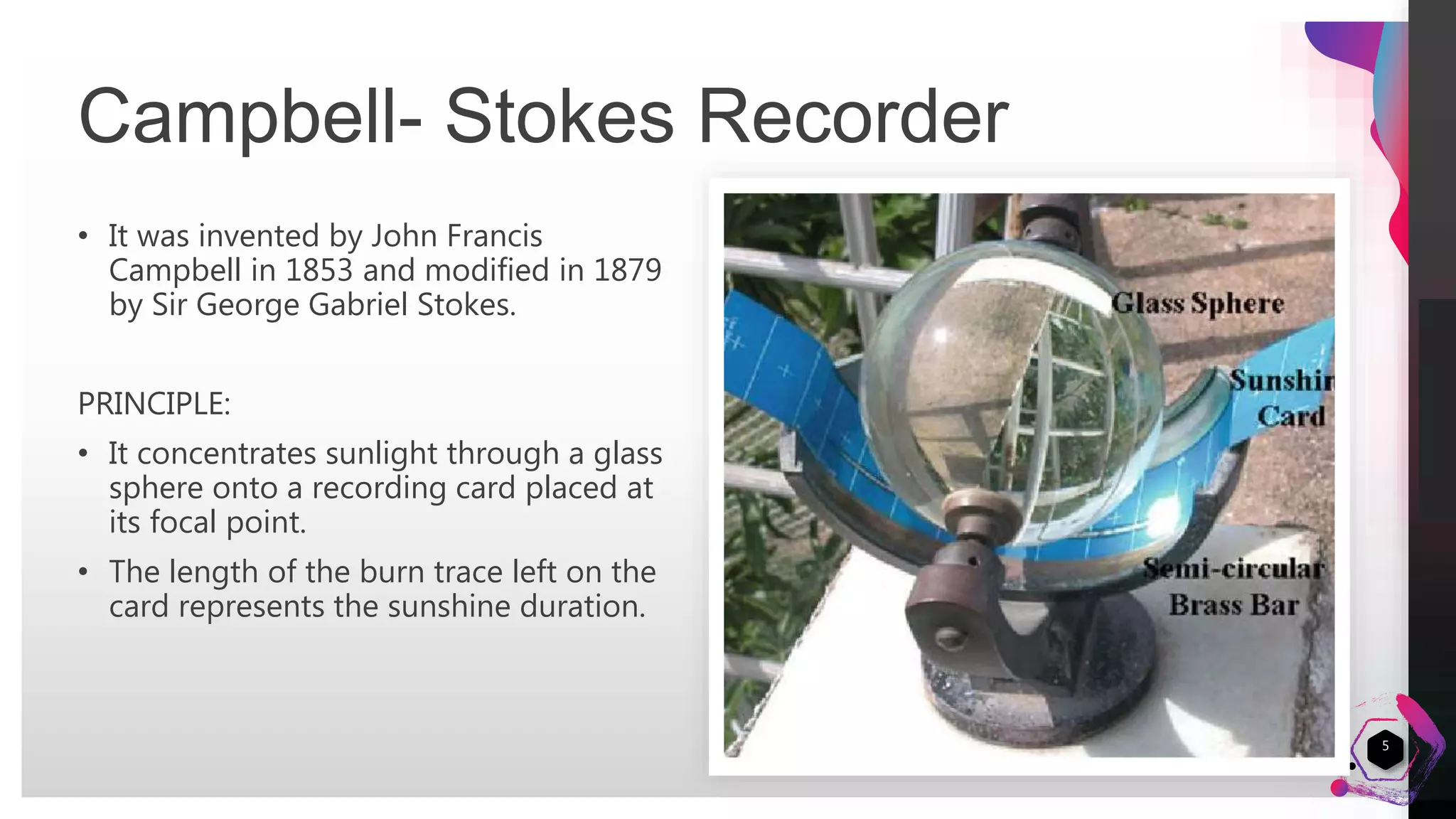
• It was invented by John Francis
Campbell in 1853 and modified in 1879
by Sir George Gabriel Stokes.
PRINCIPLE:
• It concentrates sunlight through a glass
sphere onto a recording card placed at
its focal point.
• The length of the burn trace left on the
card represents the sunshine duration.
Campbell- Stokes Recorder
5
Jens
Martensson
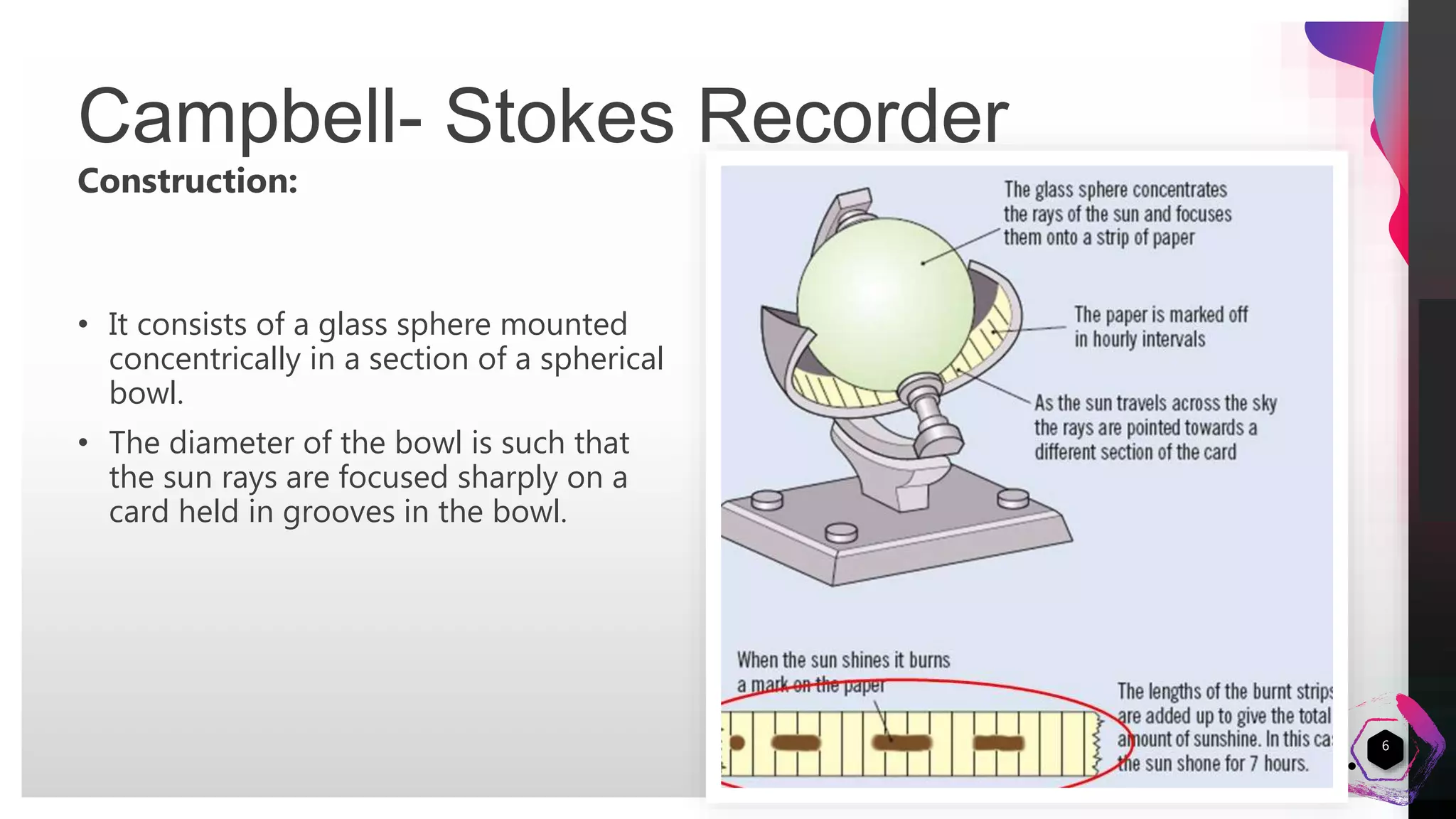
Construction:
• It consists of a glass sphere mounted
concentrically in a section of a spherical
bowl.
• The diameter of the bowl is such that
the sun rays are focused sharply on a
card held in grooves in the bowl.
Campbell- Stokes Recorder
6
Jens
Martensson
Working:
• When sunshine is present the glass
ball would focus the rays and burn a
hole through a strip of photosensitive
card. As the sun moves across the sky
a corresponding hole would be made
in the card.
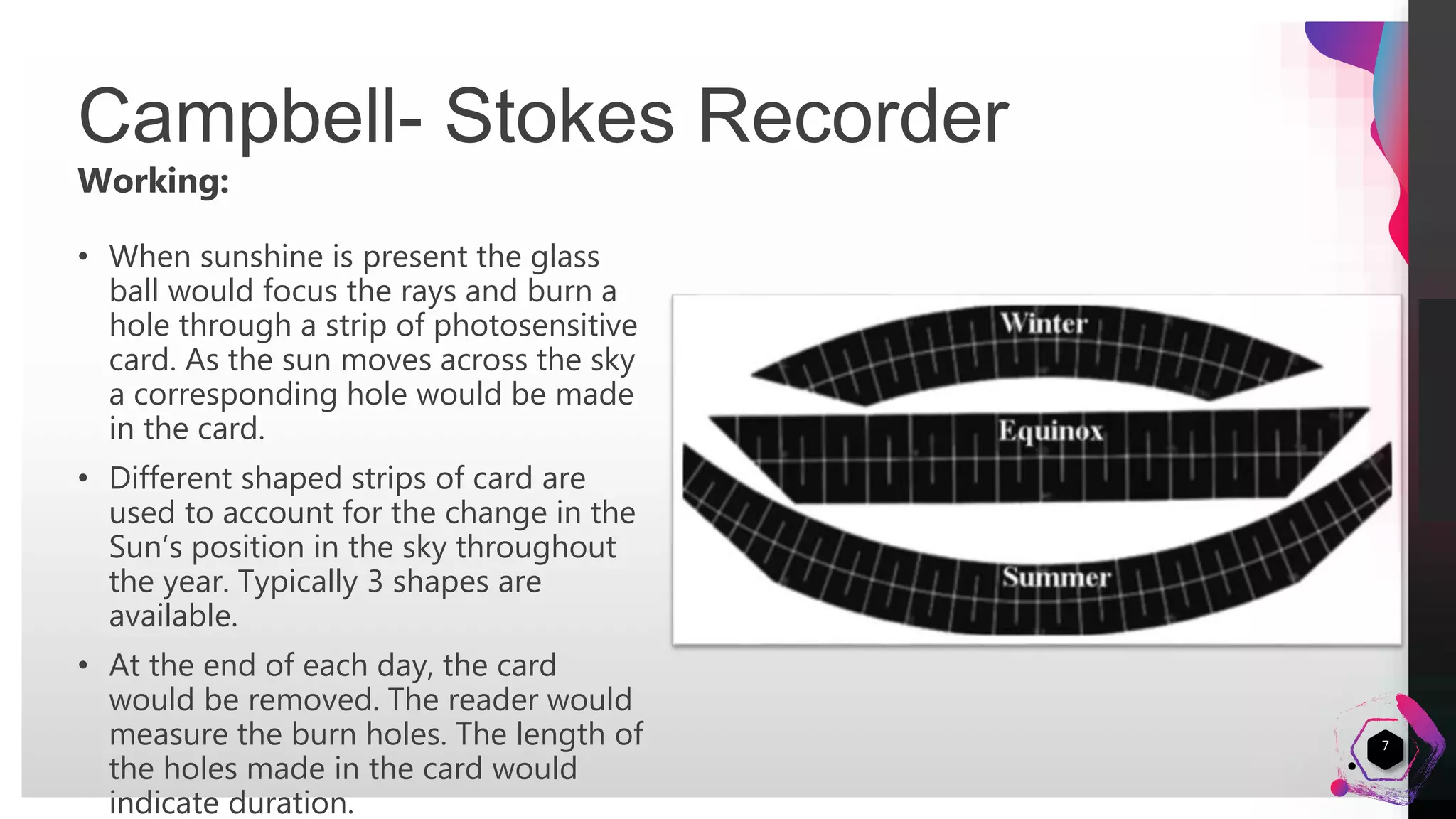
• Different shaped strips of card are
used to account for the change in the
Sun’s position in the sky throughout
the year. Typically 3 shapes are
available.
• At the end of each day, the card
would be removed. The reader would
measure the burn holes. The length of
the holes made in the card would
indicate duration.
Campbell- Stokes Recorder
7
Jens
Martensson
8
Campbell- Stokes Recorder
• The major advantage of this type of
recorder is its simplicity and ease of use.
• There are no moving parts and it thus
requires very little maintenance.
Disadvantages
• Rain may cause the card to be torn
when removing it and thus making it
difficult to read.
• It is also susceptible to external, non-
weather factors such as dust, dirt or
dried bird droppings accumulating on
the glass sphere which requires frequent
inspection and cleaning.
Advantages
Jens
Martensson
9
Rotating Mirror
Sunshine
Recorder
Jens
Martensson
• A rotating mirror is used to reflect
sunlight onto the photo sensor, and the
occurrence of sunshine is detected by
measuring the intensity of the light
received.
• The rotating mirror rotates once every
30 seconds.
• Once the instrument is set to an angle
corresponding to the latitude at the site
by adjusting the scale on the body at
installation, the double-surfaced mirror
reflects sunlight as required throughout
the year regardless of changes in the
sun’s elevation.
Rotating Mirror Sunshine Recorder
10
Jens
Martensson
11
Blake -Larsen
Recorder
Jens
Martensson
• Blake-Larsen Sun Recorder was
developed by Alan Blake (UK) and Ole
Jul Larsen (Denmark).
PRINCIPLE
• It detects sunshine duration as the
human eye would do by its design and
measuring principle.
• Light, reflected by the dome, passes
through a special filter unto the LUX-
sensor. (can separately measure infrared,
full-spectrum or human-visible light.)
• A scientifically deduced algorithm then
determines whether the sun is shining
or not.
Blake- Larsen Recorder
12
Jens
Martensson
Advantages
• The system can produce results which
are far more accurate than, for example,
the Campbell Stokes recorder which
requires manual intervention and skilled
interpretation.
• It will also be much more affordable
than the methods used by professional
forecasters yet will give comparable
results.
Blake- Larsen Recorder
13
Thank
You
Tanu Verma
1801793

Sunshine Recorder

  • 1.
  • 2.
    Jens Martensson Sunshine Recorder • Asunshine recorder is a device that records the amount of sunshine at a given location at any time. • The results provide information about the weather and climate as well as the temperature of a geographical area. • This information is useful in metrology, science, agriculture, tourism and other fields. • It has also been called a heliograph. 2
  • 3.
    Jens Martensson • The populartypes of Sunshine Recorder are: 1. Campbell- stokes Recorder 2. Rotating Mirror Sunshine Recorder 3. Blake- Larsen Recorder Types of Sunshine Recorder 3
  • 4.
  • 5.
    Jens Martensson • It wasinvented by John Francis Campbell in 1853 and modified in 1879 by Sir George Gabriel Stokes. PRINCIPLE: • It concentrates sunlight through a glass sphere onto a recording card placed at its focal point. • The length of the burn trace left on the card represents the sunshine duration. Campbell- Stokes Recorder 5
  • 6.
    Jens Martensson Construction: • It consistsof a glass sphere mounted concentrically in a section of a spherical bowl. • The diameter of the bowl is such that the sun rays are focused sharply on a card held in grooves in the bowl. Campbell- Stokes Recorder 6
  • 7.
    Jens Martensson Working: • When sunshineis present the glass ball would focus the rays and burn a hole through a strip of photosensitive card. As the sun moves across the sky a corresponding hole would be made in the card. • Different shaped strips of card are used to account for the change in the Sun’s position in the sky throughout the year. Typically 3 shapes are available. • At the end of each day, the card would be removed. The reader would measure the burn holes. The length of the holes made in the card would indicate duration. Campbell- Stokes Recorder 7
  • 8.
    Jens Martensson 8 Campbell- Stokes Recorder •The major advantage of this type of recorder is its simplicity and ease of use. • There are no moving parts and it thus requires very little maintenance. Disadvantages • Rain may cause the card to be torn when removing it and thus making it difficult to read. • It is also susceptible to external, non- weather factors such as dust, dirt or dried bird droppings accumulating on the glass sphere which requires frequent inspection and cleaning. Advantages
  • 9.
  • 10.
    Jens Martensson • A rotatingmirror is used to reflect sunlight onto the photo sensor, and the occurrence of sunshine is detected by measuring the intensity of the light received. • The rotating mirror rotates once every 30 seconds. • Once the instrument is set to an angle corresponding to the latitude at the site by adjusting the scale on the body at installation, the double-surfaced mirror reflects sunlight as required throughout the year regardless of changes in the sun’s elevation. Rotating Mirror Sunshine Recorder 10
  • 11.
  • 12.
    Jens Martensson • Blake-Larsen SunRecorder was developed by Alan Blake (UK) and Ole Jul Larsen (Denmark). PRINCIPLE • It detects sunshine duration as the human eye would do by its design and measuring principle. • Light, reflected by the dome, passes through a special filter unto the LUX- sensor. (can separately measure infrared, full-spectrum or human-visible light.) • A scientifically deduced algorithm then determines whether the sun is shining or not. Blake- Larsen Recorder 12
  • 13.
    Jens Martensson Advantages • The systemcan produce results which are far more accurate than, for example, the Campbell Stokes recorder which requires manual intervention and skilled interpretation. • It will also be much more affordable than the methods used by professional forecasters yet will give comparable results. Blake- Larsen Recorder 13
  • 14.