SUMMING UP HORROR What is the purpose of horror movies? Do we derive basic thrills from the adrenaline rush that fear triggers? Do horror movies serve a wider moral purpose?
Summing Up Horror Horror movies are usually concerned with external threats to normality. Horror movies usually reflect the anxieties of their time. Over time, there has been a shift from easily identifiable threats to those “closer to home”, or threats which are not immediately identifiable as “evil”. E.g - Early horror dealt with monsters, werewolves & mummies whereas later movies dealt with threats from within communities.
Not a Straightforward Continuum Recent horror films have re-told old stories in different ways The vampire sub-genre has lasting popularity and changing appeal. Films continue to be made on Dracula legend. The focus, style, techniques and values evident in the text are often radically different.
Fundamental Themes Repression & the revenge of the repressed. Desires, tensions, fears and anxieties. Horror plots are fantastical, but not escapist. They are an attempt to deal with repressed materials. Horror is a “safe” way of confronting these things - a  kind of “catharsis”.
Robin Wood “ Dreams - the embodiment of repressed desires, tensions, fears that our conscious mind rejects - become possible when the censor that guards our subconscious relaxes in sleep, though even then the desires can only emerge in disguise, as fantasies that are innocent or apparently meaningless.” Robin Wood, 1979.
What the *@~#?!! The fantasy is a symptom of something else. It’s an expression of the tension between social norms and unconscious desires. The unconscious desires that erupt in dreams and horror films are the product of social repression. Horror implies a critique of the social world that represses these desires.
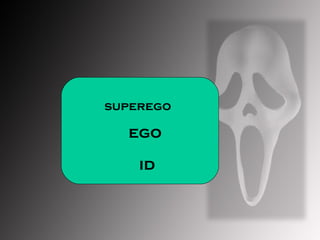
id superego ego
Horror Audiences A taste for westerns may seem strange, but a taste for horror films is often seen as somehow “sick”. People tend to watch horror films obsessively or not at all. How might this be significant for the producers of horror films?
Audiences & Institutions Horror genre can be seen as a “contract” between the industry & audience. Genres such as horror can be seen as standardised formulas. Standardisation in production and familiarity in consumption.
Audiences & Institutions - Part Deux!! Standardisation in production enables the streamlining of the techniques of mass production. Familiarity in consumption makes products easier to consume because the audience knows what is coming next.
And Finally... “ The horror genre is an object that is composed of a collection of films that are related to one another through their common possession of an essentially invariant narrative pattern in which we all know ‘how it will end’…..” Horror - The Film Reader   Mark Jancovich

Summing Up Horror

  • 1.
    SUMMING UP HORRORWhat is the purpose of horror movies? Do we derive basic thrills from the adrenaline rush that fear triggers? Do horror movies serve a wider moral purpose?
  • 2.
    Summing Up HorrorHorror movies are usually concerned with external threats to normality. Horror movies usually reflect the anxieties of their time. Over time, there has been a shift from easily identifiable threats to those “closer to home”, or threats which are not immediately identifiable as “evil”. E.g - Early horror dealt with monsters, werewolves & mummies whereas later movies dealt with threats from within communities.
  • 3.
    Not a StraightforwardContinuum Recent horror films have re-told old stories in different ways The vampire sub-genre has lasting popularity and changing appeal. Films continue to be made on Dracula legend. The focus, style, techniques and values evident in the text are often radically different.
  • 4.
    Fundamental Themes Repression& the revenge of the repressed. Desires, tensions, fears and anxieties. Horror plots are fantastical, but not escapist. They are an attempt to deal with repressed materials. Horror is a “safe” way of confronting these things - a kind of “catharsis”.
  • 5.
    Robin Wood “Dreams - the embodiment of repressed desires, tensions, fears that our conscious mind rejects - become possible when the censor that guards our subconscious relaxes in sleep, though even then the desires can only emerge in disguise, as fantasies that are innocent or apparently meaningless.” Robin Wood, 1979.
  • 6.
    What the *@~#?!!The fantasy is a symptom of something else. It’s an expression of the tension between social norms and unconscious desires. The unconscious desires that erupt in dreams and horror films are the product of social repression. Horror implies a critique of the social world that represses these desires.
  • 7.
  • 8.
    Horror Audiences Ataste for westerns may seem strange, but a taste for horror films is often seen as somehow “sick”. People tend to watch horror films obsessively or not at all. How might this be significant for the producers of horror films?
  • 9.
    Audiences & InstitutionsHorror genre can be seen as a “contract” between the industry & audience. Genres such as horror can be seen as standardised formulas. Standardisation in production and familiarity in consumption.
  • 10.
    Audiences & Institutions- Part Deux!! Standardisation in production enables the streamlining of the techniques of mass production. Familiarity in consumption makes products easier to consume because the audience knows what is coming next.
  • 11.
    And Finally... “The horror genre is an object that is composed of a collection of films that are related to one another through their common possession of an essentially invariant narrative pattern in which we all know ‘how it will end’…..” Horror - The Film Reader Mark Jancovich