The Horror Genre


         Humberto Roberto Bravo Zambrano
The Horror Genre
Horror Films are unsettling films designed to
frighten and panic, cause dread and alarm,
and to invoke our hidden worst fears, often in a
terrifying, shocking finale, while captivating and
entertaining us at the same time.
The Horror Genre
Horror films effectively center on the
dark side of life, the forbidden, and
strange and alarming events. They deal
with our most primal nature and its
fears: our nightmares, our vulnerability,
our terror of the unknown, our fear of
death and dismemberment, loss of
identity.
The Horror Genre
• The Horror film genre is most recognizable
  by its intended emotional effect on the
  audience.


• It tries to frighten, shock, disgust and repel
  the viewer and this is what shapes the
  genre’s other conventions.
Why watch it?
Watching a Horror film gives the
audience an opening into that scary
world, into an outlet for the essence of
fear itself, without actually being in
danger. Weird as it sounds, there's a
very real thrill and fun factor in being
scared or watching disturbing, horrific
images.
Why watch it?
Horror films, when done well and
with less reliance on horrifying
special effects, can be extremely
potent film forms, tapping into our
dream states and the horror of the
irrational and unknown, and the
horror within man himself.
The Horror Genre
The Horror genre horrifying emotional
effect is usually created by a character
convention: a threatening, unnatural
monster.

In a Horror film, a monster is a horrible
breach of nature, a violation of our
normal sense of what is possible.
Conventional Horror Plots
 • The conventional Horror plot will often
   start with the monster’s attack on
   normal life.
 • In response, the other characters must
   discover the monster and try to destroy
   it.
 • People may not believe the monster
   exists or there may be many obstacles
   to overcome before they can destroy it.
Conventional Themes in Horror

 • Man vs. Science: There are things
   that humans are not meant to know
   or do.

 • Man vs. Nature: The environment
   and disasters create the monster.
Iconography in the Horror Genre
    Settings where monsters might be
    expected to appear:
•   An old, dark house;
•   Cemeteries;
•   Laboratories;
•   Suburbs of big cities.
Iconography in the Horror Genre

• Heavy make-up is usually in the
  iconography of Horror films.

• Vampires, Zombies, Werewolves.
Horror History
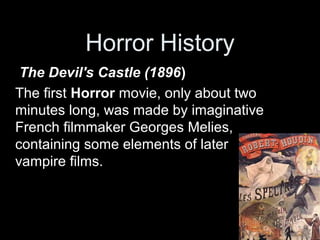
 The Devil's Castle (1896)
The first Horror movie, only about two
minutes long, was made by imaginative
French filmmaker Georges Melies,
containing some elements of later
vampire films.
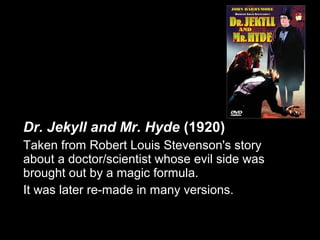
Dr. Jekyll and Mr. Hyde (1920)
Taken from Robert Louis Stevenson's story
about a doctor/scientist whose evil side was
brought out by a magic formula.
It was later re-made in many versions.
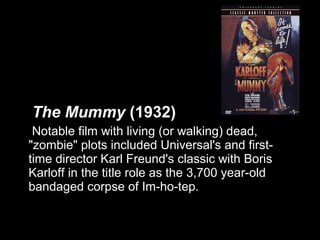
The Mummy (1932)
 Notable film with living (or walking) dead,
"zombie" plots included Universal's and first-
time director Karl Freund's classic with Boris
Karloff in the title role as the 3,700 year-old
bandaged corpse of Im-ho-tep.
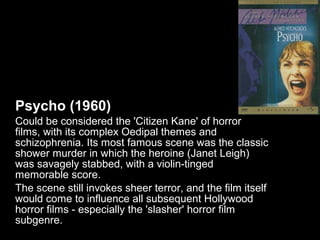
Psycho (1960)
Could be considered the 'Citizen Kane' of horror
films, with its complex Oedipal themes and
schizophrenia. Its most famous scene was the classic
shower murder in which the heroine (Janet Leigh)
was savagely stabbed, with a violin-tinged
memorable score.
The scene still invokes sheer terror, and the film itself
would come to influence all subsequent Hollywood
horror films - especially the 'slasher' horror film
subgenre.
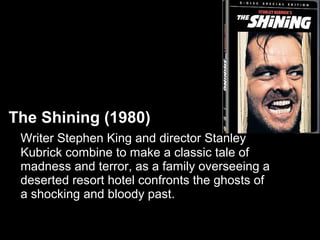
The Shining (1980)
 Writer Stephen King and director Stanley
 Kubrick combine to make a classic tale of
 madness and terror, as a family overseeing a
 deserted resort hotel confronts the ghosts of
 a shocking and bloody past.
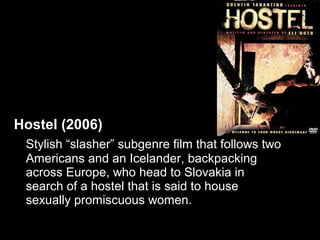
Hostel (2006)
 Stylish “slasher” subgenre film that follows two
 Americans and an Icelander, backpacking
 across Europe, who head to Slovakia in
 search of a hostel that is said to house
 sexually promiscuous women.

Humberto bravo

  • 1.
    The Horror Genre Humberto Roberto Bravo Zambrano
  • 2.
    The Horror Genre HorrorFilms are unsettling films designed to frighten and panic, cause dread and alarm, and to invoke our hidden worst fears, often in a terrifying, shocking finale, while captivating and entertaining us at the same time.
  • 3.
    The Horror Genre Horrorfilms effectively center on the dark side of life, the forbidden, and strange and alarming events. They deal with our most primal nature and its fears: our nightmares, our vulnerability, our terror of the unknown, our fear of death and dismemberment, loss of identity.
  • 4.
    The Horror Genre •The Horror film genre is most recognizable by its intended emotional effect on the audience. • It tries to frighten, shock, disgust and repel the viewer and this is what shapes the genre’s other conventions.
  • 5.
    Why watch it? Watchinga Horror film gives the audience an opening into that scary world, into an outlet for the essence of fear itself, without actually being in danger. Weird as it sounds, there's a very real thrill and fun factor in being scared or watching disturbing, horrific images.
  • 6.
    Why watch it? Horrorfilms, when done well and with less reliance on horrifying special effects, can be extremely potent film forms, tapping into our dream states and the horror of the irrational and unknown, and the horror within man himself.
  • 7.
    The Horror Genre TheHorror genre horrifying emotional effect is usually created by a character convention: a threatening, unnatural monster. In a Horror film, a monster is a horrible breach of nature, a violation of our normal sense of what is possible.
  • 8.
    Conventional Horror Plots • The conventional Horror plot will often start with the monster’s attack on normal life. • In response, the other characters must discover the monster and try to destroy it. • People may not believe the monster exists or there may be many obstacles to overcome before they can destroy it.
  • 9.
    Conventional Themes inHorror • Man vs. Science: There are things that humans are not meant to know or do. • Man vs. Nature: The environment and disasters create the monster.
  • 10.
    Iconography in theHorror Genre Settings where monsters might be expected to appear: • An old, dark house; • Cemeteries; • Laboratories; • Suburbs of big cities.
  • 11.
    Iconography in theHorror Genre • Heavy make-up is usually in the iconography of Horror films. • Vampires, Zombies, Werewolves.
  • 12.
    Horror History TheDevil's Castle (1896) The first Horror movie, only about two minutes long, was made by imaginative French filmmaker Georges Melies, containing some elements of later vampire films.
  • 13.
    Dr. Jekyll andMr. Hyde (1920) Taken from Robert Louis Stevenson's story about a doctor/scientist whose evil side was brought out by a magic formula. It was later re-made in many versions.
  • 14.
    The Mummy (1932) Notable film with living (or walking) dead, "zombie" plots included Universal's and first- time director Karl Freund's classic with Boris Karloff in the title role as the 3,700 year-old bandaged corpse of Im-ho-tep.
  • 15.
    Psycho (1960) Could beconsidered the 'Citizen Kane' of horror films, with its complex Oedipal themes and schizophrenia. Its most famous scene was the classic shower murder in which the heroine (Janet Leigh) was savagely stabbed, with a violin-tinged memorable score. The scene still invokes sheer terror, and the film itself would come to influence all subsequent Hollywood horror films - especially the 'slasher' horror film subgenre.
  • 16.
    The Shining (1980) Writer Stephen King and director Stanley Kubrick combine to make a classic tale of madness and terror, as a family overseeing a deserted resort hotel confronts the ghosts of a shocking and bloody past.
  • 17.
    Hostel (2006) Stylish“slasher” subgenre film that follows two Americans and an Icelander, backpacking across Europe, who head to Slovakia in search of a hostel that is said to house sexually promiscuous women.