What is horror ? 
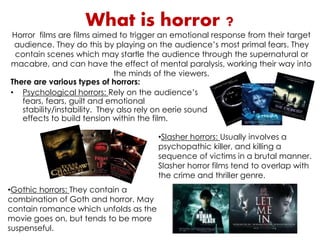
Horror films are films aimed to trigger an emotional response from their target 
audience. They do this by playing on the audience’s most primal fears. They 
contain scenes which may startle the audience through the supernatural or 
macabre, and can have the effect of mental paralysis, working their way into 
the minds of the viewers. 
There are various types of horrors: 
• Psychological horrors: Rely on the audience’s 
fears, fears, guilt and emotional 
stability/instability. They also rely on eerie sound 
effects to build tension within the film. 
•Slasher horrors: Usually involves a 
psychopathic killer, and killing a 
sequence of victims in a brutal manner. 
Slasher horror films tend to overlap with 
the crime and thriller genre. 
•Gothic horrors: They contain a 
combination of Goth and horror. May 
contain romance which unfolds as the 
movie goes on, but tends to be more 
suspenseful.
•Don’t 
•Ignore 
•Setting 
•Technical codes 
•Iconography 
•Narrative 
•Characterisation 
•Themes
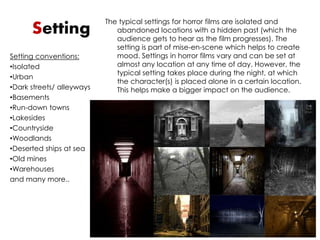
Setting The typical settings for horror films are isolated and 
abandoned locations with a hidden past (which the 
audience gets to hear as the film progresses). The 
setting is part of mise-en-scene which helps to create 
mood. Settings in horror films vary and can be set at 
almost any location at any time of day. However, the 
typical setting takes place during the night, at which 
the character(s) is placed alone in a certain location. 
This helps make a bigger impact on the audience. 
Setting conventions: 
•Isolated 
•Urban 
•Dark streets/ alleyways 
•Basements 
•Run-down towns 
•Lakesides 
•Countryside 
•Woodlands 
•Deserted ships at sea 
•Old mines 
•Warehouses 
and many more..
Technical codes 
Camerawork is important as it helps the 
audience to understand what is happening, 
each shot tells a story. 
• High and low angle shots can be used to 
connote fear, as well as dominance and 
innocence. 
• Point of view shots allow the audience to 
see through a characters’ eyes and place 
the viewer in the film, thus creating more 
tension and suspense. 
• Handheld shots can be used to put the 
audience in the heat of an action and 
create a more terrifying experience. They 
often make it difficult for the audience to 
make out what is happening , and so the 
audience is kept interested as they’re eager 
to find out what happens next (fear of the 
unknown). 
• Extreme close-ups – usually of the victims. 
They show the audience a characters’ facial 
expressions so that the audience can 
emphasize with how the character is feeling. 
•Sounds are extremely important in 
horror films as they help to create a 
scary atmosphere, and build a 
mood. They can put emphasis on a 
specific action or character. 
Ambient diegetic sounds like 
footsteps and non-diegetic sounds 
like a heartbeat can place the 
audience in the film and draw them 
in so much that they think what’s 
happening in the film is actually 
happening around them. 
•Editing can also create mood, and 
can help indicate what is about to 
happen next. If the editing hasn’t 
been paced up for quite a while 
then that usually indicates something 
bad is about to happen. Editing can 
help create unsettling tension and 
suspense amongst an audience.
Iconography 
• Lighting - this is an important part of 
iconography in a horror film as it helps create 
fear amongst an audience. Mainly low lighting is 
used as a representation of the unknown. 
Lighting can be used to create shadows and 
unfamiliar shapes in the darkness. It is used to 
spark the audiences’ imagination which in 
return can bring out fearful emotions. 
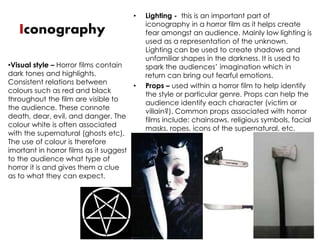
• Props – used within a horror film to help identify 
the style or particular genre. Props can help the 
audience identify each character (victim or 
villain?). Common props associated with horror 
films include: chainsaws, religious symbols, facial 
masks, ropes, icons of the supernatural, etc. 
•Visual style – Horror films contain 
dark tones and highlights. 
Consistent relations between 
colours such as red and black 
throughout the film are visible to 
the audience. These connote 
death, dear, evil, and danger. The 
colour white is often associated 
with the supernatural (ghosts etc). 
The use of colour is therefore 
imortant in horror films as it suggest 
to the audience what type of 
horror it is and gives them a clue 
as to what they can expect.
• The protagonist – Usually a female role. Out of a 
Characterisation 
group of characters she is the smartest and 
most morally standing; survives almost each 
time in order to pave way for a sequel. Not 
always the hero in the film, instead she’s used 
more to create a bond with the audience 
instead of saving herself or the other 
characters. 
• The sex appeal - A promiscuous woman. One 
of the first few characters to die at the 
beginning or middle of the film. 
• The antagonist – the bad guy, who is revealed 
at the very end of the film. They are usually 
killed of by one of the ‘victim’ characters , but 
in some cases is left to live in order make room 
for a possible sequel. 
• The unlikely hero – a character whose actions 
or appearance created the illusion that they 
are the antagonist. 
and the list goes on ... 
There are always certain characters 
we expect to see in a horror film: 
•The one who survives throughout the 
whole movie and faces the 
demon/killer in the end. 
•The clever character who figures 
everything out and tries to warn the 
other character of the dangers. 
•The rescuer 
•The dumb character who falls 
straight into the trap, and gets either 
killer, tortured or captured at the very 
beginning of the movie. This is done 
to provide entertainment for the 
audience. 
•A main character or group of 
characters who are haunted down. 
•The victim hero 
•Creepy children 
•Psychiatric patients 
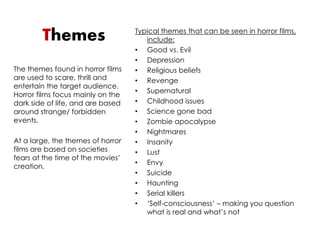
‘The human centipede’ = antagonist 
‘The 
house of 
wax’ = the 
sex 
appeal
Themes Typical themes that can be seen in horror films, 
include: 
• Good vs. Evil 
• Depression 
• Religious beliefs 
• Revenge 
• Supernatural 
• Childhood issues 
• Science gone bad 
• Zombie apocalypse 
• Nightmares 
• Insanity 
• Lust 
• Envy 
• Suicide 
• Haunting 
• Serial killers 
• ‘Self-consciousness’ – making you question 
what is real and what’s not 
The themes found in horror films 
are used to scare, thrill and 
entertain the target audience. 
Horror films focus mainly on the 
dark side of life, and are based 
around strange/ forbidden 
events. 
At a large, the themes of horror 
films are based on societies 
fears at the time of the movies’ 
creation.
So what are the limitations? 
There are various limitations of creating 
a student video from the horror 
genre. 
1) It will prove very difficult to create 
and choose the right sounds to go 
with each little scene. Sound is 
extremely important in horror films 
as it’s vital in creating meaning, 
and bringing out wanted emotions 
amongst the audience. In order to 
be successful in this we would have 
to create the different sounds/ 
music ourselves. This can take us a 
very long time to get right, and 
may end up taking a large portion 
of our post-production time. 
2) Choosing the right location can 
also turn out more difficult than it 
seems. Due to living in London (a 
busy city) it will be very hard to 
find an isolated or abandoned area 
(which is where horror films are 
usually set). This means there are 
limited possibilities as for where I 
can record my film opening. 
3) Mainly dark lighting is required in 
horror films. This can be difficult to 
achieve as some people in my 
group may not be allowed out 
late. This means we may have to 
rely on editing, and edit the lighting 
in our post-production process. On 
the other hand, due to now it 
being the winter season we are 
able to encounter this limitation, as 
we’re able to get the necessary 
lighting at around 5 pm.

Genre research

  • 2.
    What is horror? Horror films are films aimed to trigger an emotional response from their target audience. They do this by playing on the audience’s most primal fears. They contain scenes which may startle the audience through the supernatural or macabre, and can have the effect of mental paralysis, working their way into the minds of the viewers. There are various types of horrors: • Psychological horrors: Rely on the audience’s fears, fears, guilt and emotional stability/instability. They also rely on eerie sound effects to build tension within the film. •Slasher horrors: Usually involves a psychopathic killer, and killing a sequence of victims in a brutal manner. Slasher horror films tend to overlap with the crime and thriller genre. •Gothic horrors: They contain a combination of Goth and horror. May contain romance which unfolds as the movie goes on, but tends to be more suspenseful.
  • 4.
    •Don’t •Ignore •Setting •Technical codes •Iconography •Narrative •Characterisation •Themes
  • 5.
    Setting The typicalsettings for horror films are isolated and abandoned locations with a hidden past (which the audience gets to hear as the film progresses). The setting is part of mise-en-scene which helps to create mood. Settings in horror films vary and can be set at almost any location at any time of day. However, the typical setting takes place during the night, at which the character(s) is placed alone in a certain location. This helps make a bigger impact on the audience. Setting conventions: •Isolated •Urban •Dark streets/ alleyways •Basements •Run-down towns •Lakesides •Countryside •Woodlands •Deserted ships at sea •Old mines •Warehouses and many more..
  • 6.
    Technical codes Cameraworkis important as it helps the audience to understand what is happening, each shot tells a story. • High and low angle shots can be used to connote fear, as well as dominance and innocence. • Point of view shots allow the audience to see through a characters’ eyes and place the viewer in the film, thus creating more tension and suspense. • Handheld shots can be used to put the audience in the heat of an action and create a more terrifying experience. They often make it difficult for the audience to make out what is happening , and so the audience is kept interested as they’re eager to find out what happens next (fear of the unknown). • Extreme close-ups – usually of the victims. They show the audience a characters’ facial expressions so that the audience can emphasize with how the character is feeling. •Sounds are extremely important in horror films as they help to create a scary atmosphere, and build a mood. They can put emphasis on a specific action or character. Ambient diegetic sounds like footsteps and non-diegetic sounds like a heartbeat can place the audience in the film and draw them in so much that they think what’s happening in the film is actually happening around them. •Editing can also create mood, and can help indicate what is about to happen next. If the editing hasn’t been paced up for quite a while then that usually indicates something bad is about to happen. Editing can help create unsettling tension and suspense amongst an audience.
  • 7.
    Iconography • Lighting- this is an important part of iconography in a horror film as it helps create fear amongst an audience. Mainly low lighting is used as a representation of the unknown. Lighting can be used to create shadows and unfamiliar shapes in the darkness. It is used to spark the audiences’ imagination which in return can bring out fearful emotions. • Props – used within a horror film to help identify the style or particular genre. Props can help the audience identify each character (victim or villain?). Common props associated with horror films include: chainsaws, religious symbols, facial masks, ropes, icons of the supernatural, etc. •Visual style – Horror films contain dark tones and highlights. Consistent relations between colours such as red and black throughout the film are visible to the audience. These connote death, dear, evil, and danger. The colour white is often associated with the supernatural (ghosts etc). The use of colour is therefore imortant in horror films as it suggest to the audience what type of horror it is and gives them a clue as to what they can expect.
  • 8.
    • The protagonist– Usually a female role. Out of a Characterisation group of characters she is the smartest and most morally standing; survives almost each time in order to pave way for a sequel. Not always the hero in the film, instead she’s used more to create a bond with the audience instead of saving herself or the other characters. • The sex appeal - A promiscuous woman. One of the first few characters to die at the beginning or middle of the film. • The antagonist – the bad guy, who is revealed at the very end of the film. They are usually killed of by one of the ‘victim’ characters , but in some cases is left to live in order make room for a possible sequel. • The unlikely hero – a character whose actions or appearance created the illusion that they are the antagonist. and the list goes on ... There are always certain characters we expect to see in a horror film: •The one who survives throughout the whole movie and faces the demon/killer in the end. •The clever character who figures everything out and tries to warn the other character of the dangers. •The rescuer •The dumb character who falls straight into the trap, and gets either killer, tortured or captured at the very beginning of the movie. This is done to provide entertainment for the audience. •A main character or group of characters who are haunted down. •The victim hero •Creepy children •Psychiatric patients ‘The human centipede’ = antagonist ‘The house of wax’ = the sex appeal
  • 9.
    Themes Typical themesthat can be seen in horror films, include: • Good vs. Evil • Depression • Religious beliefs • Revenge • Supernatural • Childhood issues • Science gone bad • Zombie apocalypse • Nightmares • Insanity • Lust • Envy • Suicide • Haunting • Serial killers • ‘Self-consciousness’ – making you question what is real and what’s not The themes found in horror films are used to scare, thrill and entertain the target audience. Horror films focus mainly on the dark side of life, and are based around strange/ forbidden events. At a large, the themes of horror films are based on societies fears at the time of the movies’ creation.
  • 10.
    So what arethe limitations? There are various limitations of creating a student video from the horror genre. 1) It will prove very difficult to create and choose the right sounds to go with each little scene. Sound is extremely important in horror films as it’s vital in creating meaning, and bringing out wanted emotions amongst the audience. In order to be successful in this we would have to create the different sounds/ music ourselves. This can take us a very long time to get right, and may end up taking a large portion of our post-production time. 2) Choosing the right location can also turn out more difficult than it seems. Due to living in London (a busy city) it will be very hard to find an isolated or abandoned area (which is where horror films are usually set). This means there are limited possibilities as for where I can record my film opening. 3) Mainly dark lighting is required in horror films. This can be difficult to achieve as some people in my group may not be allowed out late. This means we may have to rely on editing, and edit the lighting in our post-production process. On the other hand, due to now it being the winter season we are able to encounter this limitation, as we’re able to get the necessary lighting at around 5 pm.